
Introduction
Open educational resources (OERs) are defined as “learning, teaching and research materials in any format and a medium that resides in the public domain or are under copyright that have been released under an open license, that permit no-cost access, re-use, re-purpose, adaptation and redistribution by others” (UNESCO, 2019). Some studies focus on the use of OERs to alleviate student financial pressure to achieve social inclusion and educational equity (Abramovich & McBride, 2018; Baker & Sibona, 2022). Other researchers investigate OER creation in specific disciplines, students’ perceptions and learning outcomes, and instructors’ motivations (Chtena, 2021; Kalaf-Hughes, 2021). However, limited research is available to describe and discuss OER-based course design and development in general education courses (Valentino & Hopkins, 2020). General education (GED) courses or gateway courses are introductory-level courses taken by all undergraduate students to meet graduation requirements (Lash & Record, 2019). They often play a fundamental role in affecting students’ learning paths. Given the benefits of OERs in removing financial barriers, fostering knowledge distribution, and enhancing culturally relevant learning experiences (Nusbaum et al., 2020), it is reasonable to investigate the role of OERs-supported course design in increasing student engagement and retention in gateway courses. Accordingly, guided by OER-enabled pedagogy, this research aims to introduce an OER initiative to systematically design and develop learning experiences in GED courses by reusing, retaining, revising, remixing, and redistributing content in an open format to accommodate the needs of students (Wiley, 2014).
Literature Review
Many higher education institutions are working towards creating OERs for gateway courses as a solution to the increased student dropout rate and decrease the rate of high attrition (Valentino & Hopkins, 2020). Research findings show that multiple factors affect the students’ decision to either continue or not continue with their upper-level studies: low social interaction, low academic engagement, mental health concerns, etc. (Bauman et al., 2019; Goldman et al., 2020; Lai-Yeung, 2016; Nusbaum, 2020; Pratt et al., 2019; Soria & Stebleton, 2012). However, the cost of education is primary. The main reason for this movement is to increase the graduation rate in post-secondary education. This has become a common challenge experienced in pursuing higher education. Consequently, many institutions have implemented strategies such as incorporating OERs into gateway courses to help students reduce attendance costs (Hodgkinson-Williams & Arinto, 2017; Valentino & Hopkins, 2020).
Data also suggests that “approximately 34% are still deemed insufficiently prepared to begin college-level coursework (43% in community colleges), relegating many students to developmental, noncredit-bearing courses (Bissell, 2012, p. 49). This data imparts the importance of the education attained at the pre-college levels and during the first two years of college, committing to at least matriculate to an associate’s degree.
Furthermore, the use of OERs for early college requirements and gateway courses address the importance of closing the huge education gap between the poor/rich and the rural/city communities. K-12 education is paid by the school system and taxpayers. However, upon graduation and pursuit of higher education, these students take on the financial responsibility, often resulting in the acquisition of loans and leading to students dropping out. The successful completion of GED core courses taken during the first two years of college in interdisciplinary areas determines whether these students will continue in the program and advance to upper-level courses (Kalaf-Hughes, 2021; O’Donnell et al., 2021). The above education deficit supports the reason for developing OER courses for GED or gateway courses more than core courses, usually taken during the third and fourth year of college. As students complete the first two years of education, learning to navigate the educational system and complete a Bachelor’s degree in their respective fields is more achievable and likely. Therefore, ways to make the GED courses, in particular, more appealing to students will help institutions attract and retain students.
Data from universities, such as Central Washington University, also supports the current project idea to use OERs for GED curriculum to save the cost of education and alleviate the social and financial pressures on the students (Valentino & Hopkins, 2020). Some studies have discussed replacing textbooks in random courses with OERs. Others have mentioned introducing zero textbook cost (ZTC) in their curriculum to reduce costs. Al though ZTC may bring the cost to zero, the instructional materials may not be open and thus cannot be personalized, retained, revised, reused, remixed or redistributed. These are fundamental characteristics of OERs, allowing faculty to tailor books to specific audiences and their needs. Moreover, faculty training concerning the differences between OER and ZTC materials is also important. Using OERs specifically will help faculty keep resources relevant, current and personalized to align with curriculum and student needs. It is pertinent to understand that GED courses are taken at all levels in various modalities and should be available in multiple forms for access and use. This can be accomplished by providing strategic design and development of personalized courses using OERs.
OER-Enabled Pedagogy as a Conceptual Framework
OER-enabled pedagogy is defined as “the set of teaching and learning practices only possible or practical when you have permission to engage in the 5R activities” (Wiley, 2017, para. 17). It has been used to facilitate teaching and learning by encouraging faculty and students to engage in 5R (retain, revise, remix, reuse, and redistribute) activities (Tillinghast et al., 2020). Many researchers have studied the benefits of replacing traditional instructional materials with OERs in their courses to empower students and enhance their learning experiences (Coughlan et al., 2019; Mathew & Kashyap, 2019; Stemock & Kerns, 2019; Wang & Wang, 2017; Whitaker & Greenleaf, 2019). For instance, studies in South America have proven a correlation between using OERs as a self-paced learning tool in conjunction with classroom teaching and the increased likelihood of student success (Hodgkinson-Williams & Arinto, 2017). Thus, guided by the conceptual framework, this study aimed to introduce a systematic process of designing and developing OER-based GED courses to enhance learning experiences, as indicated in collaborating on course design (e.g., learning objectives, assessments, learning activities and lesson presentation), identifying appropriate content, localizing content development, selecting effective pedagogies and tools to deliver the courses, and conducting course evaluation. These elements are encapsulated in the three P’s of pedagogy: personalization or the needs of the students, participation or engagement in the course by designing the courses strategically, and productivity or student outcomes (McLoughlin & Lee, 2008).
The OER Initiative
Research Settings
This study’s data was collected at a four-year public university located in the Southern United States. According to the 2020–2021 institutional report, among a total of 1289 incoming freshmen, around 60% are racial minorities, including African Americans (46%), Asians (3%), Hispanics (1%), and others. Compared to the overall enrollment, a recent rise in enrollment of underrepresented minorities at the institution is evident. Additionally, about 40% of first-year students receive different financial aid, such as the Federal Pell Grant and Stafford Loan. These students’ low disposable income creates barriers to effective education and reduces incentives to continue. Every student takes 13–14 GED core courses (42 credit hours) in the first two years at the institution. Students spend approximately $1680 on textbooks for required core courses. Per the 2020-2021 student enrollment data, these students could save over one million dollars during the first four semesters by adopting open educational resources.
Pre-Project Phase
This institution is the first university in the state to publish open textbooks on the newly formed state OER Commons repository. The first two OER courses were part of the pilot project funded by a state higher education entity. They resulted from a collaboration between the English Department, Office of Distance Education (ODE), and the Library, which culminated in creating two open English textbooks that saved approximately $100,000 annually for students at the institution. As of this writing, Google Analytics reports that 2,091 people in 25 countries have accessed these textbooks. Following the success of English courses, we began an OER initiative by identifying GED courses with high enrollments from all academic programs. The researchers deployed surveys to students and conducted interviews with faculty to take the pulse of the university community in hopes of gauging faculty interest in the project. For instance, faculty participating in the focus group were asked: “Have you ever used OERs in your courses?” Around 45% of the participants had indicated previous use of OERs in their courses. The types of OERs most utilized by instructors included textbooks and videos. In addition, some of the instructors used custom course packs and other instructional content. However, upon further investigation, it became clear that some of the faculty were confused about the difference between free and open resources. Some instructors, for example, have adopted YouTube videos, journal articles, and software for classroom instruction. Although these resources are free to use by students and faculty and may cost zero dollars, by definition of OERs, these materials are not considered open access. Therefore, it was critical to provide necessary training and workshops to better equip them with the correct knowledge and skills to identify, adapt, and share truly open resources.
Moreover, instructors were polled about the difficulties experienced while using or creating OERs. Most participants mentioned that the time involved in OER creation was the main barrier. For instance, one participant responded, “it takes much time to create a course using OERs. However, it is worth knowing that the material is up-to-date and engaging to students.” On the other hand, some participants said they “could not find the right materials or the materials are often outdated.” Other participants have pointed out that the formats of OERs are challenging to adapt to their courses and are inaccessible to their students. Therefore, it is recommended that institutions provide faculty incentives and other rewards for the time and effort they put into creating OERs. ODE acquired a grant to encourage faculty involvement and participation. Thus, they developed a plan to recruit graduate students from the field of study who assisted faculty in identifying and developing content. The grant allowed the researchers to provide OER training to faculty volunteers, graduate students, and instructional designers and incentivize faculty and student aides for their time and effort. It also allowed the exploration of student learning experiences and the implementation of quality standards in course design.
Needs Analysis and Strategy
The institution’s strategic plan aims to increase the use of OERs and scale it as a system-wide initiative to increase student engagement and retention. Its initial solution involved reducing the costs of instructional materials used in GED courses. This began with a thorough evaluation of textbooks used by faculty in these courses to determine if any alternatives could be made. The institution also collaborated with online publishers and third-party companies to develop low-cost electronic materials to replace traditional textbooks. For example, the university participated in an inclusive access program through which third-party companies that work with institutional bookstores provide some respite from the associated education costs, allowing students to access learning resources within the learning management system on the first day of classes. This process varies from institution to institution; some institutions cover the cost of the books, while others pass the fees to the students. In the end, the program remained expensive and does not offer students the needed discount.
To better understand this institution’s current situation, ODE conducted a needs analysis in 2021 (Figure 1 provides details of the initiative process). A survey was distributed to all undergraduate students, allowing their needs to be directly accessed and recorded (Varma & Ren, 2021). A total of 1024 students completed the survey, and the results showed that the high cost of instructional materials (70%) was one of the main barriers preventing undergraduate students from purchasing required textbooks, software, or other resources. For instance, around 30% of the surveyed students felt it was not worth buying textbooks because only a few chapters were used in their courses. Although the university participated in the Inclusive Access Program to decrease the cost of textbooks, students were still expected to spend roughly $120 for textbooks in each course. About 84% of the students were interested in adopting alternative resources to decrease these costs. Therefore, the institution needed to develop and implement an initiative to design and develop OER-based GED courses to reduce costs and increase retention in higher education (Varma & Ren, 2021).
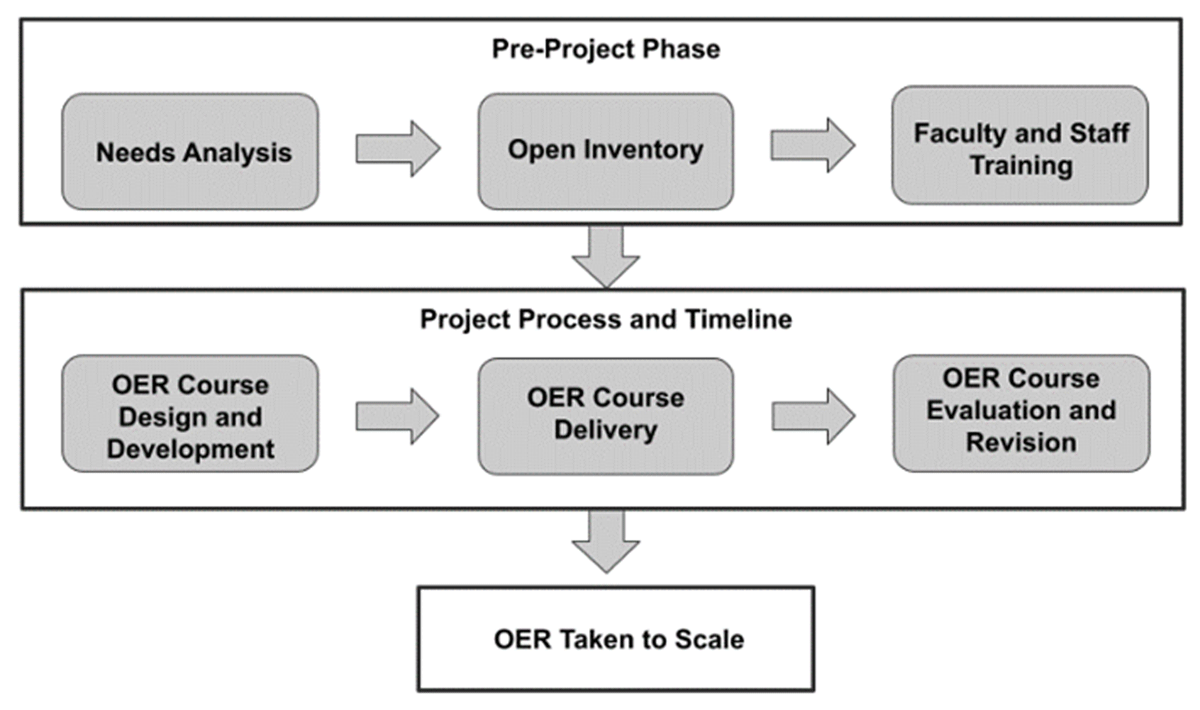
Figure 1
OER Initiative Phases.
Open Inventory Created by Other Organizations
Based on data from the institution’s Office of Institutional Effectiveness, three GED courses have been identified as having the highest enrollment for development during the first cycle: General Introduction to Psychology, Public Speaking, and Media and Culture. Through further investigation, it was discovered that several organizations have already developed OERs for these courses. For instance, Open Oregon Educational Resources and Arizona GED Curriculum have advocated Z-Degree programs or pathways to remove textbook costs for GED courses. Other repositories, such as OER Commons, OpenStax, and Creative Commons (CC), also contain multiple resources for these courses in different formats, such as course modules, textbooks, multimedia resources, and other supplemental instructional materials. The promising discovery of the wide availability and variety of open resources in these disciplines allowed the lead faculty to reuse, revise, and remix these materials based on their specific subject needs. Discussion with these faculty revealed that many were already aware of the availability of these OERs in their subjects. However, there was apprehension about how much time and effort it would take to adapt these resources into content that aligns with their course objectives. Therefore, in addition to faculty training, the decision to provide student aides and instructional designers to assist faculty with researching and identifying instructional materials and consultations in OER-based course design seemed appropriate.
Professional Development and Training
Based on the findings of faculty interviews, ODE organized and held a one-week OER mini-conference on campus, where speakers were invited to discuss topics including the basics of OERs, the availability of OERs at the state and national level, and experiences and lessons learned from other institutions. Participants surveyed at the conference felt satisfied with the conference sessions and expressed that they possessed a better understanding of OERs and an interest in continuously integrating OERs into their courses. Before starting the first cycle of the initiative, ODE provided solid training materials and resources to equip faculty with the needed knowledge and skills to design and develop OER-based courses. For instance, one of the faculty expressed their confusion about copyright, permission, and open licensing. Accordingly, in addition to the general introduction to researching, remixing, and sharing OERs, ODE added resources on copyright, permissions, and licensing guides for educators to the training program.
Project Process and Timeline
The OER initiative led ODE to continue with the project and develop three OERs-based GED courses in the first cycle. The first cycle’s purpose is to gather significant preliminary data that can lay a foundation for the pursuit and acquisition of additional external funding to demonstrate this project’s promise and expand its value to integrate OERs to develop other GED courses with high enrollments. Accordingly, ODE developed the following timeline, including four main phases to accomplish and the required personnel and resources:
Course Design and Development (three courses) -- faculty works with instructional designers to create course development plans, works with OER student aides to research, identify and develop OER content, and builds the courses in the learning management system.
Course Delivery – faculty offers the courses.
Course Evaluation and Revision – ODE conducts course evaluations by collecting and analyzing learning and teaching experience data.
Dissemination – ODE collates all resources created and prepares a repository to be shared with the state and national OER Commons.
Research Methods and Results
After delivering the courses, the researchers distributed an online student learning experience survey and conducted faculty focus group interviews to investigate the effectiveness of initiative on student engagement and retention. The student learning experience survey aimed to address the research question: What have students experienced in the OERs-based GED courses? The online survey contained 17 Likert scale questions adapted from an existing survey (Rowell, 2015), and each 5-point Likert scale included strongly agree to strongly disagree. It was undertaken by students who have completed these courses. The faculty focus group interviews include three questions aimed at investigating the faculty’s perceptions of teaching with OERs.
Students’ Learning Experiences
Fifteen students completed the online survey with a response rate of 48%. Overall, students had positive learning experiences in OERs-based GED courses. For instance, in terms of their perceptions of learning with OERs (see Figure 2), 93% students agreed that they preferred using OERs as learning materials; 93% of students believed that the use of OERs increased their engagement with learning; and all students liked the OERs-incorporated learning environment. In terms of the quality of OERs (see Figure 3), 73% of students believed that the quality of OERs was as good as traditional textbooks, and the use of OERs could help them better understand course content than textbooks. More than 50% of students agreed that OERs were aligned with course learning objectives. For students’ learning satisfaction (see Figure 4), 93% of students wanted to take more OERs-based courses and would like to recommend these courses to other students.
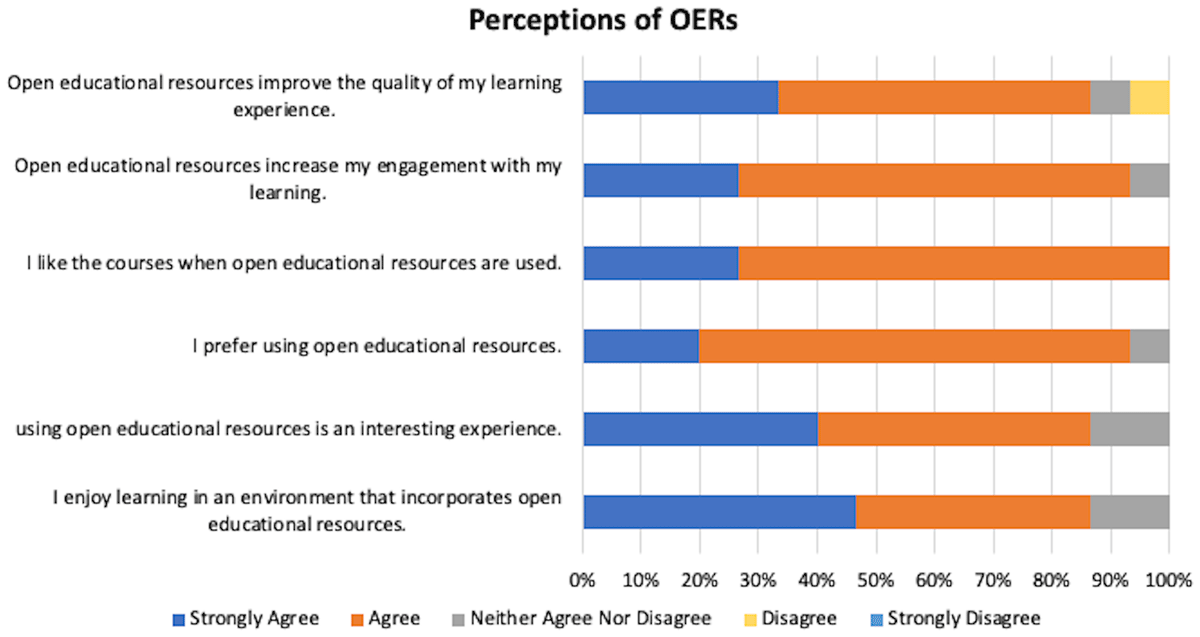
Figure 2
Students’ Perceptions of Learning with OERs.
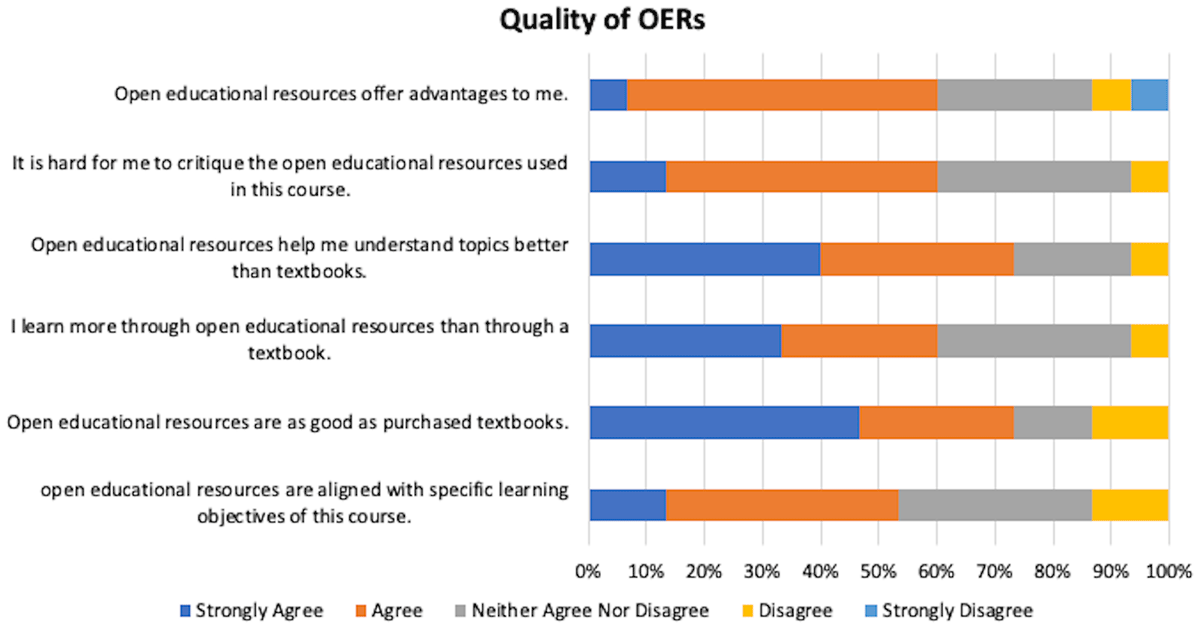
Figure 3
Students’ Perceptions of the Quality of OERs.
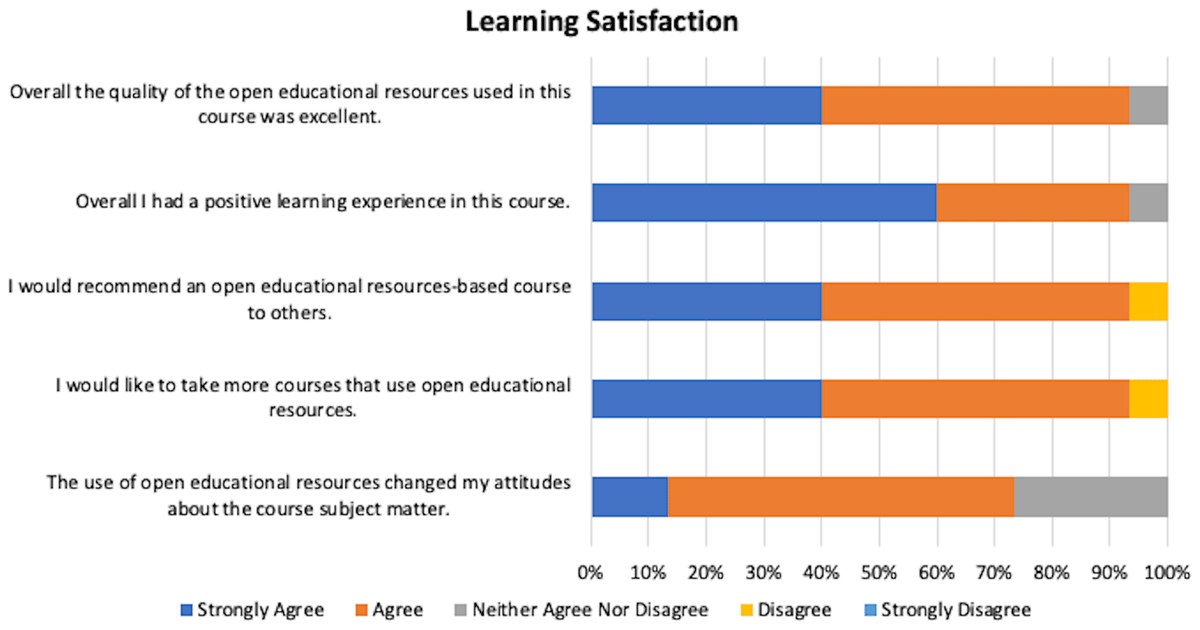
Figure 4
Students’ Learning Satisfaction with OERs.
Teaching Experiences with OERs
The researchers also conducted focus group interviews with faculty who designed and delivered the OERs-based courses. Three questions included:
What was your teaching experience with OERs?
Did you see any differences in student learning?
Do you plan to use the OERs in future classes?
Overall, these instructors had positive experience designing and delivering the OER courses. The opportunity to work with the instructional designers and graduate assistants enabled them to discover various existing open materials and personalize the content to meet their course objectives. They also believed their students benefited from the initiative. For instance, one instructor said, “the students were very excited they did not have to purchase a book. Several students expressed they had very high book costs and many were struggling to get all their books. They were thankful to have a copy readily available to them.” This instructor noted that because of the time spent creating and customizing the learning materials, “the class was more engaging in the time we spent communicating” (faculty 1). Another instructor mentioned that “by including OERs in the course, the students did not have to wait for the book orders to come through, and they could access all the materials on the first day of the class” (faculty 2). He also noted the inclusive access books inconvenience and double charge to students. This especially affected students who either dropped, failed, or were retaking the class, as they had to buy the book again. Instructors agreed that the initiative was a valuable project and would like to continue using OERs for the Public Speaking and Introduction to Psychology classes and wanted to use the OERs for both of their face-to-face and online classes. Additionally, they mentioned that using OERs had reduced the drop/fail/withdrawal rates and increased student retention. They credited this improvement to the ability to revise and remix the materials and adopt effective teaching practices with the help of instructional designers.
Discussions
A major challenge is exploring how to increase faculty buy-in on the project. The courses developed in this initiative are not included as part of the faculty’s teaching load. Therefore, to manage their course workload, faculty would need to increase their effort, resulting in a considerable workload imbalance for most of the faculty involved in the project. For this reason, faculty volunteers, who are open to using OERs and already, to some extent, have experience using them in their courses, have been chosen for the first cycle. Additionally, incentives were built into the project to help increase faculty interest and were emphasized mainly in the process of volunteer recruitment. Incentives, such as providing stipends to faculty and student aides, helped lend greater appreciation of their time and effort put into this project. The funding helped provide faculty, staff, and student aides training. The researchers also recognized the difficulties faced in securing sufficient funding to compensate faculty and student aides. Therefore, alternative strategies were implemented to acquire internal funding for the project.
The project planned to develop and deliver the new courses in all modes, which raised the third area of concern, to provide appropriate and customized training to target the needs of the faculty developing these courses. It was necessary to remember that all institutional GED courses are offered not only to freshmen but also to dual enrollment students from high schools and military students trying to complete their degrees. Therefore, it was also necessary for the institution to organize customized training by external experts for all faculty who will be contributing to developing these GED courses on copyright and creating instructional materials.
Furthermore, difficulties had been anticipated in finding quality open instructional materials that align with the course objectives and assessment needs. Although open inventories, such as CC and OER Commons, contained many valuable resources, some faculty presented concern about the difficulty of finding relevant and quality assessment questions for their courses. Eventually, it became necessary to develop assessments from scratch to meet the weekly learning outcomes predefined in the course development plans. Additionally, as a Quality Matters institution, there is a requirement to follow quality standards while developing courses. There remained a constant challenge to keep the faculty and staff engaged to ensure the development processes speedy completion. The institution began developing the first cycle of courses in the fall semester of 2021 and offering them in the spring semester of 2022 to ensure that faculty and staff were provided with sufficient time to make these courses available as scheduled. To maximize student engagement in the courses being developed with OERs, it was imperative that all content was fully prepared and ready to be offered to students on the first day of the class. To minimize technology barriers in the new courses and ensure maintained project deadlines, these courses utilized technology with which students and faculty were already familiar.
Conclusion
Advantages and Possible Impact
Given how the potential benefits associated with the development of OER courses far outweigh this study’s limitations, the institution intends to move forward to the implementation phase and include OERs in all GED courses. This benefits the participants involved in this project and each of the students who take these OER courses irrespective of the modalities in the future semesters. This project will also help faculty and staff build a student-centered learning experience and create a path of success for them to earn their degrees seamlessly and affordably. In addition, this effort allows the university to significantly contribute to the increased awareness and growth of OERs nationwide through institutional partnerships. The long-term impact of this initiative on the institution includes 1) reduce student tuition costs by recycling OER courses with minimum revision; 2) increase enrollment; 3) decrease dropouts in the first two years of college; 4) academic and research opportunities for faculty; and 5) foster student-centered campus culture.
Limitations
Despite the positive responses obtained from faculty and data from student surveys, the sample sizes proved too limited to ultimately establish, without a doubt, the impact of OERs on student learning experience and retention at this institution. However, given the sufficient amount of literature available to support the argument, it seems promising that the development of OER courses will yield the necessary quantitative and qualitative data to support this stance.
Additionally, this study only focused on the student and faculty experiences using OERs but not the student performance. Further investigation into student performance in all modalities will raise more awareness of the OER’s impact on institutional student success.
Funding Information
This innovative practice is supported by the Research Grant-in-Aid Program of Auburn University at Montgomery.
Competing Interests
The authors have no competing interests to declare.