
Introduction
In Europe, in the last decade, Openness arrived in Higher Education Institutions (HEIs) through the so-called second mission which is Research. Open Science fosters new practices to increase transparency and to widen access and participation (EuropeanCommission, 2020). Openness is now reaching the first mission, i.e. teaching, usually through Open Educational Resources, MOOCs and, to some extent, open credentialing (EuropeanCommission, 2019; Inamorato dos Santos et al., 2016). What about the third mission – contribution to society (Compagnucci & Spigarelli, 2020)?
In a globalised setting, society is no longer narrowed down to the place where the HEI is physically located but potentially extends to the entire world, specifically through scientific cooperation. Scientific cooperation is part of the third mission of HEIs and it is framed by law and political strategies (Hofmänner & Macamo, 2021; Swiss_Confederation, 2020). It is important to make this transparent from the outset. This paper focuses on a new format of international continuing education offered by the University of Geneva to train refugees, in Niger, who are themselves conduits of education. Our first objective is to describe the training which takes the form of a Certificate of Open Studies (COS) to reach out to scientific cooperation as a second objective.
Higher Education in Emergencies
Literature on the education of refugees and displaced persons pertains to the domain of education in emergencies (EiE) which is a subfield of comparative and international education (CIE). The International Bureau of Education in Geneva, in 1912, contributed to shape international education, a field of education that had its own journal as of 1931. Tracing the history of the field is beyond the scope of this article but underlining that it is after World War 2 that CIE has been institutionalised in universities is important. Scholars researched colonialism and world-systems using normative theories and focusing on the nexus education-traditional societies in the 1950s and 1960s. While normative theories dominated the field in those days, i.e. dependency theory, post-modernism, structural-functionalism, sociological theories, those stemming from concrete situations, i.e. actor network theory, social network analysis, critical race theory contribute to reshape the field in more recent times (Jules, 2021).
The field of EiE emerged in the 1990s as a subfield of CIE research (Burde et al., 2017). Nevertheless, organisations like UNESCO are involved since 1950 (UNESCO, 2022b) and contribute to this subfield ever since (e.g. OECD, 2004; UNHCR, 2020). Today, reflection is at a turning point: it questions the unique and imposed Global North/Western-centred perspective that prevails in EiE and HEiE and suggests participatory approaches (e.g. Swindell et al., 2022).
Benefits and challenges of integrating refugees in Higher Education (HE) have been discussed in the literature from several perspectives in the Global North and in the Global South (e.g. Akkari & Sagayar, 2021; Arar, 2021; Brunton et al., 2019; Magee & Pherali, 2019; Sagayar, 2022; Sturgeon, 2021; Suárez-Orozco & Suárez-Orozco, 2022; Unangst & Crea, 2020; Yeo & Yoo, 2022; Zlatkin-Troitschanskaia et al., 2021). International organisations contribute, among others, to credential recognitions and access facilitation (UNESCO, 2020) or to scholarships provision within the 15 by 30 agenda (UNHCR, NoDate). Nevertheless, despite their best efforts, refugees are usually considered as “objects of interventions”.
The paper builds on the deconstruction of past approaches used to promote HEiE: i) the humanitarian approach focusing on refugees’ education in emergencies; ii) the human rights approach focusing on the right to education for HEiE learners and; iii) the development approach focusing on refugees’ education for development (Yeo & Yoo, 2022). It looks beyond the conceptions of the international network for education in emergencies (INEE, 2020) which, with its best efforts, nevertheless addresses education as a “domestication” (Díaz, No date) and not as a means to liberation (Freire, 1994). The paper relies on one hand on epistemologies of the South to let the diversity of languages and knowledges emerge and on the other hand on creative approaches to digital training.
Scientific cooperation
Concepts of scientific cooperation and development cooperation are framed in the scholarly literature and in the law and are contextual. The dual classification draws back to UN and OECD meetings in the 1960s, “which symbolically and practically inscribed the division between international scientific cooperation and development cooperation” (Hofmänner & Macamo, 2021, p. 345). “The expression ‘international scientific cooperation’ is employed to denote all forms of research collaboration that cross the boundaries of the nation state. The term ‘development cooperation’ is used to label cross-boundary research collaboration that emphasises development priorities and objectives” (Hofmänner & Macamo, 2021, p. 337).
In terms of Swiss law, international cooperation through education is framed by 3 acts: the first does not mention education at all but it can be deduced from the goals, section 2 (Confédération_Suisse, 1976, updated 2022). The second addresses international cooperation and mobility in Education (Confédération_Suisse, 2020, updated 2022). It is very relevant for this context even if it never mentions emergency contexts. Finally, the COS being both an implementation-oriented training project within the field of education and a research, the third one addresses relevant issues with regard to research and innovation (Swiss_Confederation, 2012, updated 2022). In addition to federal acts, since 2010, the federal council approves an Education, Research and Innovation strategy (StateSecretariatEducationResearch, 2010) and an International cooperation strategy (Swiss_Confederation, 2020).
Context: urban refugees in Niger
Niger hosted in May 2022, 291 629 refugees and asylum seekers from Nigeria (69%), Mali (21%), Burkina Faso (5%), and other countries (5%) (UNHCR, 2022). In addition, more than 300 000 people were internally displaced and/or Nigerien returnees. The districts hosting the larger number of refugees and displaced population are the border areas of Tillaberi, Maradi, and Diffa, plus Niamey. Niamey hosted as of 31st of May 2022 a total of 4 522 refugees and 774 asylum-seekers. 89% of refugees in Niamey are from Mali, and they are urban refugees, i.e. not living in camps but in the city. Overall, the population of refugees and asylum seekers is predominantly young (58 % youths), with women accounting for 53 %. About 40 000 of them were enrolled in the Nigerien education system, but only about 1000 in secondary education and only a few dozen (about 67 persons) in higher education.
With regard to education, Niger’s laws offer the same access to education to refugees as to national citizens according to the law nº97–016, Art. 10 (Fall, 2022, p. 29). In addition, Niger is part of the Economic Community of West African States (ECOWAS), a geopolitical space offering free population movement for its 15 members which include three of Niger neighbour countries (Nigeria, Mali and Burkina Faso) where most refugees come from. This freedom of movement is accompanied by liberal and inclusive policies for settlement and access to the labour market. Nevertheless, even if the legal context facilitates access to education, it is important to underline that Niger ranked last in the United Nations Development Programme’s development index and the education sector is facing several challenges. In this context, open and digital learning can represent a real opportunity for HEiE learners if it is set up in creative and innovative ways.
Digital and connected competencies as pharmakon
Digital technologies in education are envisaged from their transformative, knowledge brokering capacities and are leveraged in their paradox, i.e. digital education represents an alternative solution to educate in HEiE contexts but technological infrastructure is not adapted to contextual constraints, e.g. regular access to power, access to smartphone but not to computers. We draw on work conducted by scholars and practitioners with regard to distance education praxis for the previous 40 years and bypass the massive rush into frontal, on-line, synchronous teaching provoked by the Covid19 crisis (Peters et al., 2020). The latter is close to a banking education (Freire, 1994) model and is questionable in terms of pedagogical use of technology. For the design, we consider instructional design (e.g. Gagné et al., 1992; Merrill, 2002), learning environment design, blended learning (Dziuban et al., 2016) and pedagogical choices (e.g. Herrington et al., 2014; Jonassen, 1984; Laurillard, 2002) to cite a few. Learning is seen from a social perspective to create value through networks and communities (Wenger-Trayner & Wenger-Trayner, 2020; Wenger et al., 2011). We consider learning as “the mutual engagement of uncertainty” (Wenger, 2023 cited by Class 2023) and technology is regarded as pharmakon, i.e. this power to be a medicine and a poison at the same time (Mboa Nkoudou, 2020) rather than as a panacea.
Furthermore, learning is considered as a social and cultural endeavour, a space to claim ownership for the learning experience. Connected learning joins personal interests, supportive relationships, and opportunities (Ito & Colleagues, 2020; Werth & Williams, 2022). The conditions for connected learning to occur are: i) to legitmise interests and identities of a diverse audience (e.g. HEiE learners’ education); ii) to share practices as engaged learners (e.g. creative production that serve the HEiE learners’ community); iii) to contribute to communities, social change, or real problem solving (e.g. provide young generations with a link to community language, culture and pedagogies); and iv) to connect learning across settings through brokering, coordination, and openly networked platforms (e.g. connected learning hubs, communities, on-line learning) (Ito & Colleagues, 2020). In an ecologic and community orientation, the project explores digital education in fragile and low infrastructure contexts through connected learning hubs. These are physical places to live connected learning, i.e. to make connections, to develop a project, to interact and exchange ideas. It is also a place to access Internet and computers and perform all these social learning activities beyond physical boundaries.
Lifelong learning and the Certificate of Open Studies
Engaging in LLL processes enables “the development of individual human potentials” (Longworth & Davies, 1996, p. 4). Furthermore, the learning Ladder (Longworth, 1999) takes learners from data to information, knowledge, understanding, insight and wisdom.
Higher Education Institutions (HEIs) play a major role in promoting LLL, specifically in providing flexible learning pathways, offering learning opportunities to marginalised groups and promoting Open Science approaches (AJOL, 1998; UNESCO, 2021, 2022a).
This translates into new practices at the formal level, i.e. in terms of admission and credentialing, introducing for instance validation, recognition and portability of learning through micro-credentialing (European_Commission, 2022). Formally, the Certificate of Open Studies (COS) is a new format of continuing education offered by the University of Geneva (Universite-de-Genève, 2020, art. 65). Similar to the Certificate of Advanced Studies (CAS) in terms of workload – 10 to 12 ECTS, i.e. 250 to 300 student working hours, COS are revolutionary in terms of access. Indeed, no academic or professional prerequisites is requested - an important consideration given the difficulty for many refugees who have fled their country in an emergency to demonstrate their previous educational, academic or professional background.
It also translates into new practices at the design level in terms of co-creation and sharing, specifically through Open Education practices and Open Educational Resources. The COS is an intensive three-months training of trainers’ course that is co-created by three main stakeholders, namely academics from the Global South and the Global North, refugee-learners and NGOs from the Global South. It addresses problems of: i) coloniality (Quijano, 2007), i.e. how colonialism continues to survive controlling the economy, the authority, the gender, and knowledge, together with extractivism (Acosta Espinosa, 2016); ii) development, i.e. a concept created by the Global North at its own advantages (de Sousa Santos, 2016); iii) evidence-based research, i.e. an attempt to control the field of research and to make only one science possible (St.Pierre, 2006). To support the paradigm shift, the COS leverages the diversity of knowledge systems Open Science calls for (UNESCO, 2021) and relies on reconnecting to indigenous repertoires of knowledge (Petrovic & Mitchell, 2018; Tuhiwai Smith et al., 2019). The underlying driving force is about bringing academic and community knowledge, written and oral knowledge traditions into dialogue in an approach that recognises the validity of epistemologies and pedagogies of the Souths (Akkari & Fuentes, 2021; Akkari et al., 2022; de Sousa Santos, 2016). The endeavour is thus transdisciplinary within and across the field of education, combining philosophical, sociological, historical, cultural and digital approaches, both in their scholarly and community forms of knowledge, and heading towards epistemic and ontological sustainability.
Openness, Open Science and Open Education
Openness is a philosophical concept that goes back to the Middle Ages and concerns access to knowledge for all, freedom and citizenship. It is also a complex politico-socio-technologico-economic construct based on transparency and freedom as essentials within an ethics of participation. Furthermore, it is an epistemological doctrine which puts philosophy and science centre-stage to achieve open criticism in-line with democratical principles. Finally, openness in terms of management, refers to modes of collaborating also based on democracy (Baker, 2017; Deimann, 2019; Peters & Britez, 2008).
Indeed, sharing knowledge among scholars was common practice in the Middle ages (Langlais, 2015) and the World Wide Web’s goals were precisely to revive these practices of sharing, involving stakeholders and giving access (CERN, No date), which we call today Open Science. Open Science “is defined as an inclusive construct that combines various movements and practices aiming to make multilingual scientific knowledge openly available, accessible and reusable for everyone, to increase scientific collaborations and sharing of information for the benefits of science and society, and to open the processes of scientific knowledge creation, evaluation and communication to societal actors beyond the traditional scientific community” (UNESCO, 2021, p. 7).
Producing knowledge in an accessible, collaborative and transparent way is one thing. Being equipped to handle it and contribute to the wider knowledge creation enterprise is yet another step. Open Science and Open Education can be seen as two sides of the same medal. In line with this assumption, UNESCO mentions Open Educational Resources (OER) and particularly “those related to the understanding and use of other openly accessible scientific knowledge” to define Open scientific knowledge (UNESCO, 2021, pp. 9–10).
Open Education considers knowledge as a common good. Its intrinsic values of freedom and transparency assure contribution and access to the discovering of all forms of knowledge, under the sole condition of respecting authorisation to access it, e.g. indigenous knowledge. Open Education is articulated around the remaining values of responsibility, sharing, justice, agency and ubiquitous ownership (Baker, 2017). It is neither synonymous of free nor of extractive approaches (Acosta Espinosa, 2016) and strives to find sustainable models at all levels – epistemic, legal, social, economic, political, ecologic, infrastructure, etc. (EduTechWiki, 2022). Open Education exists as an alternative approach since the Middle Ages and is at the heart of the establishment of European universities (Peter & Deimann, 2013), (B Class et al., 2022). It addresses all aspects of education, from admission to certification, through to pedagogical practices (Cronin & Maclaren, 2018) and epistemic justice (Maha Bali et al., 2020). It invites stakeholders to move away from current linear education supply chains to integrate agility and high interactivity originating from values of transparency and freedom (Class, Favre, Soulikhan, & Cheikhrouhou, 2022).
Suggested framework: Empowering refugees through liberation-oriented education
Including refugees in the decision processes that concern their own education as full fledged subjective actors is legitimate, urgent and addresses a gap in terms of quality in HEiE (Dryden-Peterson, 2016; Moriarty, 2018; Yeo & Yoo, 2022). Our framework (Figure 1) promotes participatory design approaches and considers HEiE learners as change agents, i.e. “individual or team responsible for initiating, sponsoring, directing, managing or implementing a specific change initiative, project or complete programme” (Caldwell, 2003, pp. 139–140).
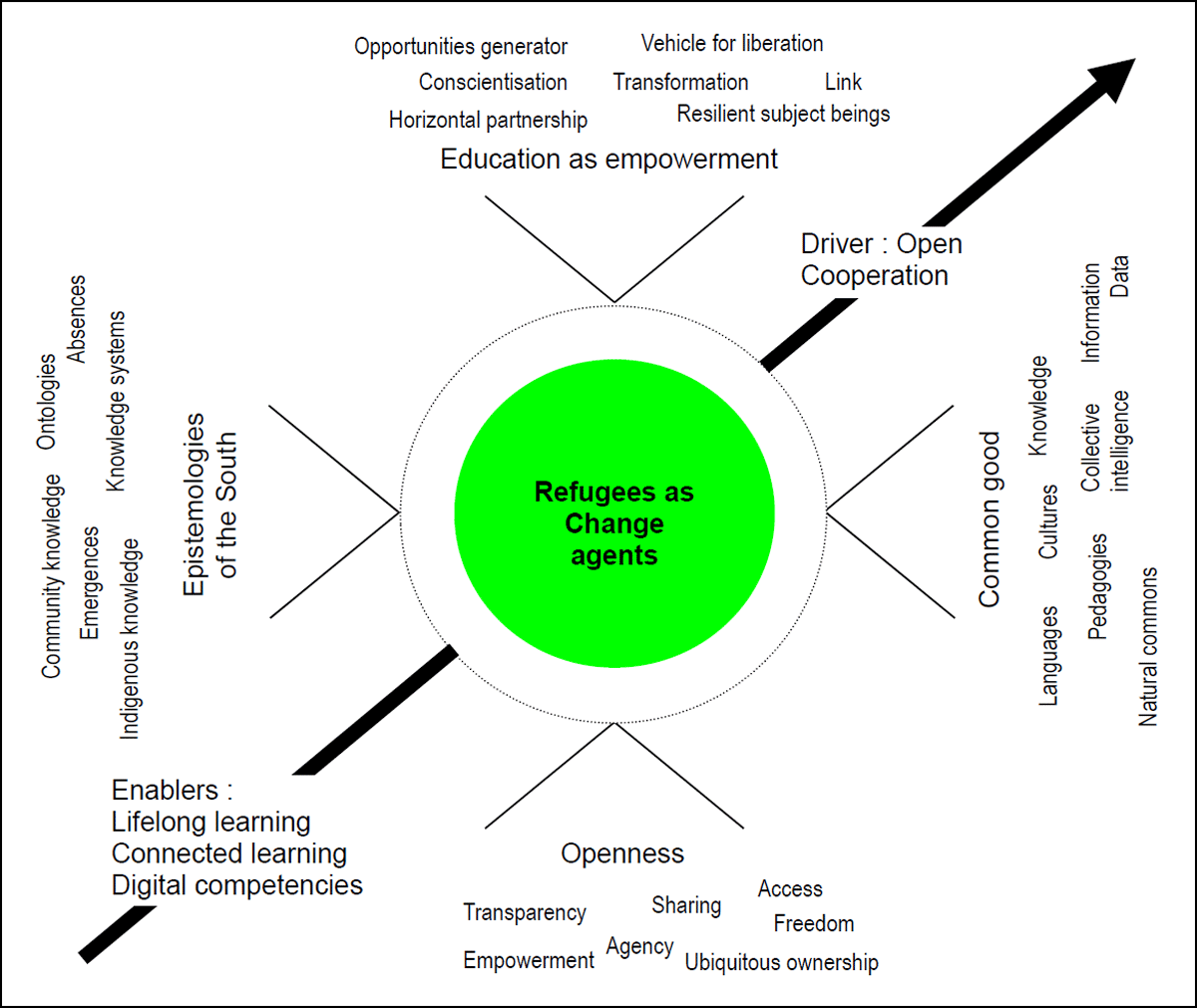
Figure 1
Conceptual framework: Empowering refugees through liberation-oriented education.
In addition, including two sets of skills and knowledge, i.e. education to live decently in the host country on one hand, and on the other hand, knowledge and ties to the home country seems a balanced compromise (Maadad, 2019). Technology, and especially open digital education, can help foster both (Padilla-Zea et al., 2022; Zlatkin-Troitschanskaia et al., 2021). This two sets of skills approach empowers refugees to discuss education “beyond the connotation of temporariness and statelessness” (Yeo & Yoo, 2022, p. 5).
The conceptual framework extends the previous literature review and has been elaborated with a theory of change (ToC) method. ToC is used in diverse fields and organisations to promote social change (Wikipedia, NoDate). The framework guides the design of the first edition of the COS (Class 2023) and it is explained below.
Epistemologies of the South
Epistemologies of the South (de Sousa Santos, 2016; de Sousa Santos & Meneses, 2020) provide a first input for the conceptual framework. It is a lever to move away from the concept of development to harness existing potential of local education, languages, cultures and pedagogies. As a reminder, the concept of development has been created by Western-centred sociology (de Sousa Santos, 2021), defining what counts as developed and under-developed. It resulted in placing “the majority of countries on the wrong side of history, the world of underdevelopment” (de Sousa Santos, 2021, p. 291). This is the reason why efforts to recognise absences and let new knowledge emerge, in a sane, caring, trustful and respectful overall axiological, ontological and epistemological framework, is a priority (Ramose, Accepted). Openness towards knowledge systems (UNESCO, 2021) and deep cognitive justice (M Bali et al., 2020; Katz & Van Allen, 2022; Piron et al., 2016) represent means to contribute to collective intelligence (Innerarity, 2015; Levy, 2015) and the common good.
Common good
The second input is precisely an overall conceptual approach to education as a common good (Ostrom, 1990). Common goods are understood as shared resources produced and/or maintained by a community of knowledgeable and concerned persons with regard to this resource, governed according to the rules and norms of that community (Bauwens & Manski, 2020; Brando et al., 2019; Ostrom, 1990). A variety of commons exist, currently studied within categories, i.e. “natural commons”, “information commons” or “knowledge commons” (Hess & Ostrom, 2007). Since natural commons are the most studied, learning from this literature to extend it to education as a commons might be a first step. A more advanced and longer-term step will be to move beyond the modern nature-culture divide (Latour, 2006) and consider commons holistically, including spiritual components (Haller, 2019). Similar to efforts made to revitalise the management of natural commons by local communities after decades of imposed extractivist policies (Chambers et al., 2021; Haller et al., 2019), it is important to envisage cooperation in knowledge domains with participatory agility in view of preserving and nurturing languages, cultures, pedagogies and traditions (Chambers et al., 2022).
Empowerment
The third input refers to empowering human beings through education that makes sense (Akkari et al., 2022). Freire’s pedagogy of conscientisation roots educational practices in learners’ reality and postulates the ability to change it through educational engagement (Freire, 1994). His conception of empowering humans as “resilient subject beings” and not as “restricted” objects of educational interventions (McConnachie, 2016, p. 407 cited by Yeo et al. 2022) is here understood as offering them the possibility to freely express their educational needs through the recognition of diverse knowledge systems, ontologies and epistemologies. Re-establishing the link (Piron, 2019) with knowledge systems empowers them as human beings far beyond constructed identities of refugees which are sources of instability and severely hinders capacities to imagine constructive futures for themselves and for their communities. Re-establishing a link, i.e. Edgard Morin’s concept of reliance in French, between ancestral and community knowledge on one hand and the future on the other. The importance to be connected and/or aware of authoritative knowledge and ancestral knowledge transmitted within communities, in some way or another, for education and learning to happen has been documented and we want to leverage this (Camara, 2002; Damus, 2020; Niane, 2021).
Open Cooperation through Open Education
The fourth and last input, Openness, has been detailed in previous sections together with Open Science and Open Education.
In-line with the concepts of Open Science and Open Education, Open Cooperation is deliberately stated without any additional adjective. In addition, cooperation is to be understood etymologically, i.e. “the act of working together to one end” with the op Proto-Indo-European root meaning “to work, produce in abundance” (OnlineEtymologyDictionary, NoDate).
Open Cooperation through Open Education is an opportunity to leverage open values and promote ontological and epistemic sustainability, conceiving education as a means for liberation. In addition, an orientation towards abundance (versus scarcity) is part of Open Education’s essence (Weller, 2011, Chapter 8). Working with true and deep participatory approaches (e.g. Godrie et al., 2022; Udoewa, 2022) represents a starting point to operationalise the approach in concrete praxis.
Acknowledgements
This article stems from a SNSF project proposal submitted under the funding instrument Solution-oriented research for development.
Competing Interests
The authors have no competing interests to declare.