
Introduction
Faced with a requirement to boost numbers of health professionals with the skills to improve the health of populations in low- to middle-income countries (LMICs) and the inability of both local and international educational opportunities to fully meet this need (Crisp & Chen, 2014; Ijsselmuiden et al., 2007; Dlungwane et al., 2017), an innovative fully online master’s programme in public health was designed, based on volunteers and outside the traditional higher education sector.
The People’s Open Access Education Initiative (Peoples-uni https://www.peoples-uni.org/) was established as a UK charity in 2007 (Heller et al., 2007). Its mission was “To contribute to improvements in the health of populations in low- to middle-income countries by building Public Health capacity via e-learning at very low cost” with the following objectives:
Provide Public Health education for those working in low- to middle-income countries who would otherwise not be able to access such education, via Internet based e-learning
Utilise a ‘social model’ of capacity building, with volunteer academic and support staff and Open Educational Resources available through the Internet, using a collaborative approach and modern Information and Communication Technology
Offer education at the ‘train the trainers’ benchmarked to the master’s degree level, for those with prior educational and occupational experience
Provide education that meets identified competences which help with the evidence based practice of Public Health and are action oriented, to assist in tackling major health problems facing the populations in which the students work
Create an educational portfolio including Continuing Professional Development modules and awards of Certificate, Diploma and Master of Public Health
Work with the graduates of the educational programme, and other relevant partner organisations, in teaching, research, implementation of evidence based health policy and advocacy to improve the health of their populations.
Central to the concept was online learning, so that students could learn where they lived and maintain their jobs and family life, and an international cadre of academic and support staff could be assembled. Facilitating this was the existence of an open source educational platform on which the courses could be built and run (Moodle, n.d.), while the Open Educational Resource movement provided access to globally best practice educational resources (Berti, 2018). An IT and administrative structure was set up to support this, and educational programmes were developed and delivered by volunteer academics.
We have previously described the theoretical basis of our model of global learning as “[…] an extension of Connectivism to offer an innovative and practical approach to the enormous problem of global Public Health human resource shortages” (Madhok et al., 2018, p. 95).
Peoples-uni closed in March 2021. For the last few years before closure the Trustees had been exploring options for partnership with a like minded organisation with whom to continue the existing programme, develop future services and ensure sustainability. Discussions were held with NextGenU.org a larger and more financially secure organisation who shared goals for online global capacity building in Public Health. This led to the transfer of the educational programmes to them in March 2021, however with no further input from the originators of Peoples-uni, although tutors were encouraged to continue with the new administration and have continued to do so. We believed that this was in the best interests for the long term sustainability of the programme. This report pulls together the experience up until the time of that transfer, with the aim of drawing lessons from the experience of the development, operation, outcome and sustainability of this innovative fully online global educational programme.
No ethical approval was sought for this report which includes de-identified student demographics and quotations. During the enrolment process, students were informed that their data may be analysed to improve the course and that in any resultant publication, it would not be possible to identify individual students.
Among the authors of this paper, RFH and RM were Trustees of Peoples-uni, OO and AB led the IT infrastructure, and JH contributed to the analysis and writing of the paper.
The educational programme
Course development
Early on, it became apparent that there were no lists of the competences relevant to Public Health professionals working in LMICs that could be used to guide course development (although some have been proposed subsequently, Zwanikken et al., 2014). A curriculum was created by core volunteer academics who had extensive experience of capacity building in LMICs, with advice from the UK Royal Society of Public Health, and feedback following the delivery of a pilot course module (Reynolds & Heller, 2008). The master’s level was the academic benchmark at which the progamme was set. The curriculum, and the structure of each of the contributing modules, was designed to meet objective number 4 above, that is to support an evidence based, action orientated approach to tackling the major health problems facing LMIC populations. Having identified the broad outlines of a curriculum, a number of modules were developed in two main areas – the Foundation Sciences of Public Health, and Public Health Problems facing populations in LMICs. Each module had a standard structure starting with the identification of headline competences, or learning outcomes, and assessment criteria to guide what the student would have to be able to do to pass the assignments. Modules had 5 main topics, each to be covered over a two-week period, with a number of online resources and a discussion forum to be led by an expert tutor. A narrative was written to help the student navigate through Open Educational Resources – to which hyperlinks were provided. All key resources were also available as pdf files for download for those with limited Internet access. An assessment, usually in essay format, was made available towards the end of the module timetable. A development team was responsible for the production of each module, with oversight by the academic coordinator, and each team had at least one representative working in an LMIC setting. The development team then morphed into a delivery team when the time came to offer the module to students. One of the tutors assumed the function of leader in each module, and module leaders came together as an education committee to approve results and set and monitor policies. A number of volunteers also provided support to students as Student Support Officers. All operations were conducted online.
Various modules were added over the time that the programme was developed, largely in response to an assessment of the competences that a graduate of a master’s programme would require but also in response to the serendipitous interests of those who volunteered to develop modules and act as tutors. Altogether 9 modules were developed for the Foundation Sciences and 10 for the Public Health Problems groups, as well as a Dissertation. To allow students to select modules that were appropriate to their needs, there were only two core modules, as well as the Dissertation, all others were options, provided that at least two modules came from the ‘Problems’ group.
Consistent with our own use of Open Educational Resources and an open access educational platform, each module was published under a Creative Commons Licence, and the code that underpinned the administrative software is published in the GitHub repository.
The programme ran from 2008 to 2020, with two timetabled semesters a year, or 24 semesters in total. Figure 1 is a screenshot to show the home page of the legacy courses site. Students, tutors and alumni could access various support activities as well as the modules in which they were enrolled.
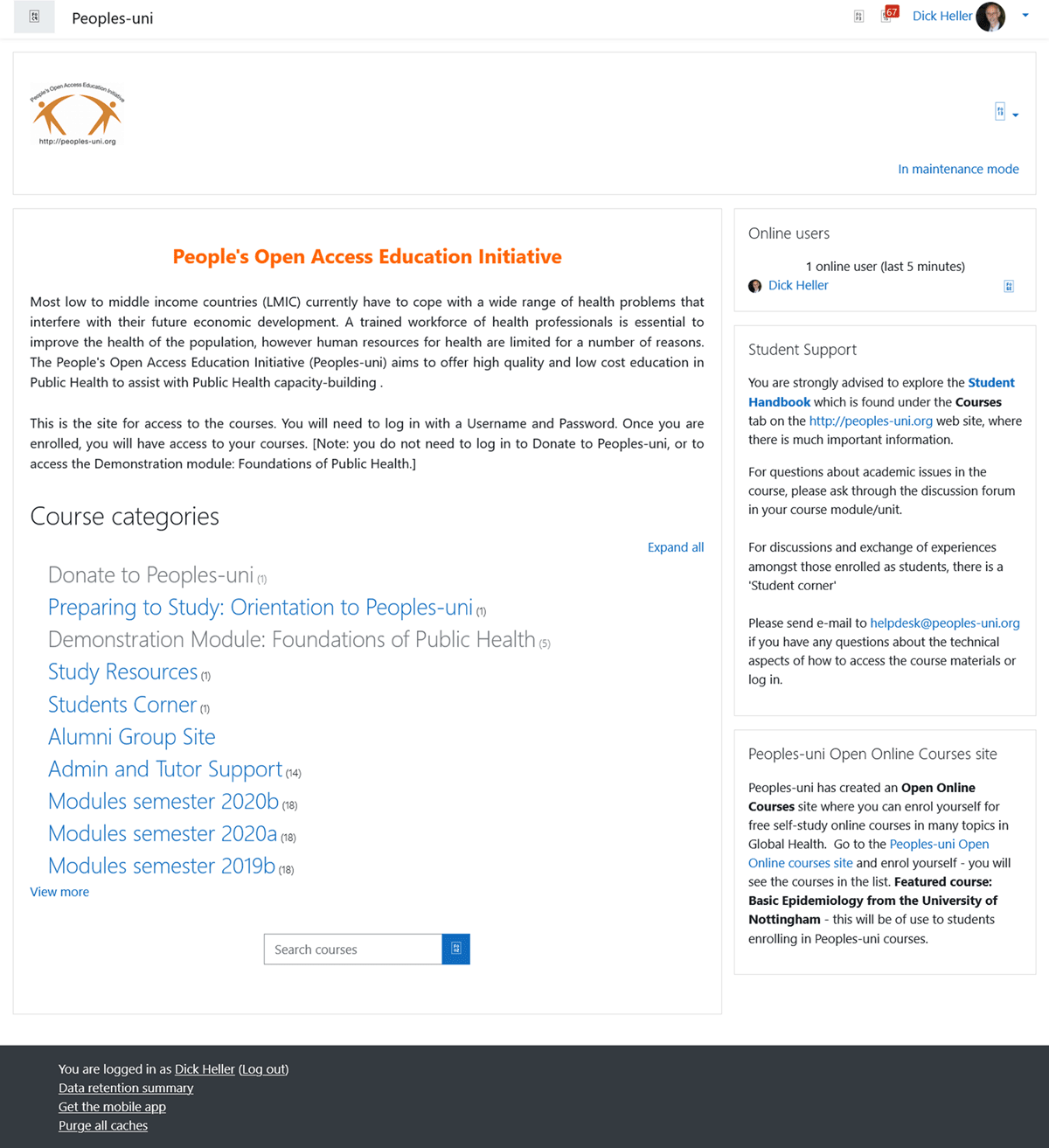
Figure 1
Screenshot of home page of Peoples-uni courses site.
Finding volunteer tutors
Tutors were identified largely through word of mouth with the occasional call through professional bodies. By the second semester in 2020, a total of 429 individuals had acted as tutors, of whom 65 also functioned as a module leader. 31 tutors were active in 15 or more of the 24 possible semesters – the distribution of numbers of semesters taught is shown in Figure 2. Many of those active in only one semester functioned as Dissertation supervisors. Not all modules were offered each semester, as some were first introduced after the programme started and others were rested for revision – during which tutors may also have been actively involved in the revision.
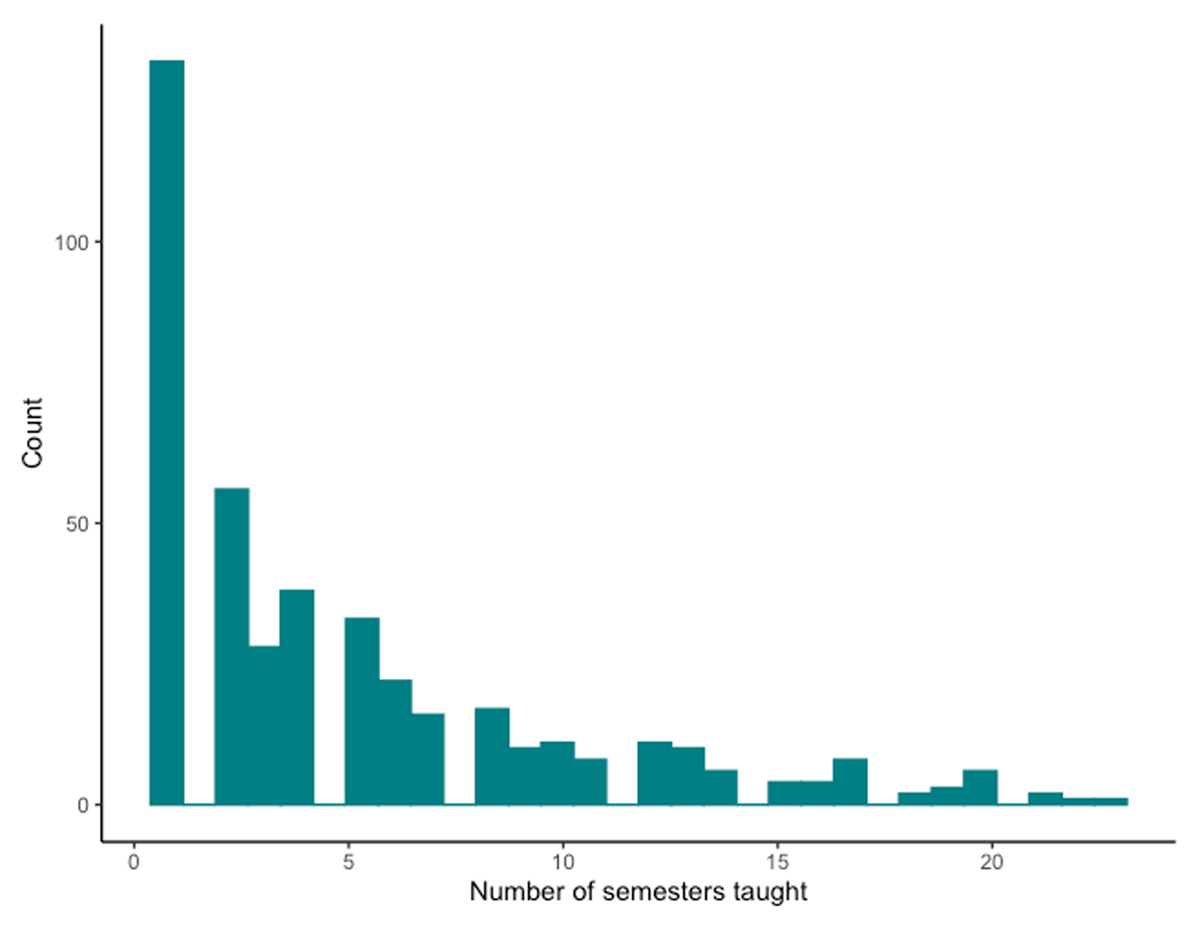
Figure 2
Distribution of number of semesters taught by each tutor.
Tutors came from 55 different countries. The UK contributed the largest number, with Australia and the USA next. Over time, a number of graduates of the programme joined as tutors, broadening the geographic, professional and cultural diversity of the tutor group. Figure 3 shows the geographical distribution of the tutors, with the scale showing the number of tutors in each country.
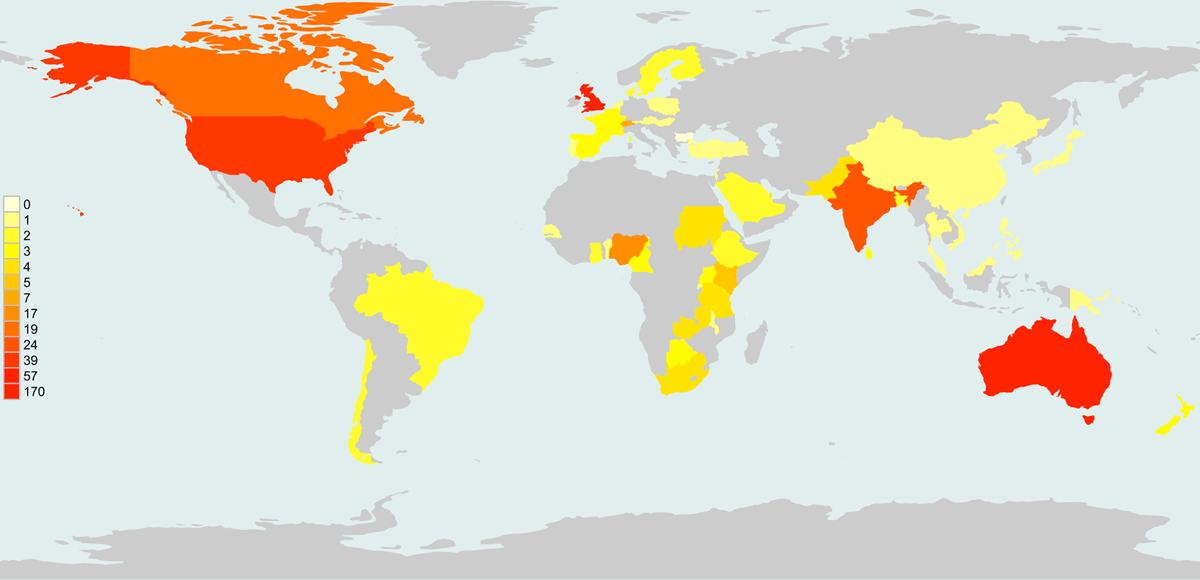
Figure 3
Geographical distribution of tutors.
We have previously reported a survey among volunteer tutors where a majority said that they enjoyed their experience and planned to continue (Heller et al., 2019a). In response to a message to tutors about the closure of Peoples-uni and transfer to new management, many messages were received from tutors. The main themes to emerge from these messages were the impact on the tutors’ own personal development as educators, gaining knowledge about educational theory and online learning as well as in leadership. Appreciation of the opportunity to help others, and of the values expressed by Peoples-uni as well as being part of a family of educators also came through.
Comments included:
‘Peoples-uni also helped facilitate its voluntary tutors into on line educators, a skill so in need in today’s world. It’s a skill that remains embedded in my CV. In fact it helped me as a teacher myself doing all that home schooling in the UK last year, as the format chosen by my school was quite similar to Peoples-uni.’
‘Even though my association with Peoples-uni was brief, it played a significant role in getting me to where I am today. It was Peoples-uni that gave me my first exposure to teaching and curriculum matters. Student learning was the ultimate goal, and I am still to find a program that provided so much support to help them reach their potential. I am sure there are so many tutors around the world who would have learnt so much about curriculum delivery and online teaching methods, through their participation in this program.’
‘This email also brought back for me so many happy memories of my own learning as a Peoples-uni tutor, all thanks to you. It was my first real experience of leading a module and was such a good experience for teaching in my current job.’
‘I am very thankful for the opportunity you gave me and I’m glad I was part of Peoples-uni family. You trusted me with a leadership position despite the fact that I’m at an early stage of my career, and this means a lot to me. I can’t thank you enough for this.’
‘Peoples-uni taught me some of the most precious lessons and inspired me to a few of my important steps. It was a world-changing initiative, literally.’
‘I wanted to express my gratitude to you for giving us the teachers and the students the opportunity of being involved in such a valuable initiative. Witnessing its development from its conception has been a wonderful experience for me. It has been an encouraging experience for those who have ideals.’
‘…it has been a pleasure to be part of a value driven initiative. I feel very grateful to have been part of the team and to facilitate continued learning for so many students who may not have had opportunities to engage in master level education in a different format.’
‘I am feeling to have hiccups after reading the email. I do not know what to say because I enjoyed/learnt a lot from this ‘Peoples-uni family’.’
Finding students
Again, word of mouth was the most common way that students came to enrol. We report students who enrolled up to and including first semester 2020, as their results were available for analysis at the time of transfer of the programme away from Peoples-uni.
To keep the opportuities for study open, there were no entry requirements (although towards the end of the programme students had to complete a ‘preparing to study’ course to ensure that they could navigate an online course). Entry to the master’s programme required a pass in at least two of the modules. We report on the 562 students who passed at least one module – a further 1174 students enrolled, but did not pass at least one module and are not reported here further. Students were asked to pay a fee of GBP40, and later GBP50, per module, although a bursary scheme allowed those who could not afford these low fees to enrol at a reduced or no fee (Machingura et al., 2019).
Of the 532 students where information was known, 220 (41%) were female, and the average age was 36 years. 193 (36%) had a medical degree, 172 (32%) a non-medical degree in health, 116 (22%) a non-health related degree and 51 (10%) had a prior qualification (not a degree) in the health field. 11 students had a previous PhD and 126 (24%) reported a previous master’s degree. 211 students (40%) reported that they were working in public health, 138 (26%) were clinicians, while 48 (9%) were primarily academics.
Students came from 66 countries (75% from Africa with the largest number from Nigeria) and their distribution is shown in Figure 4.
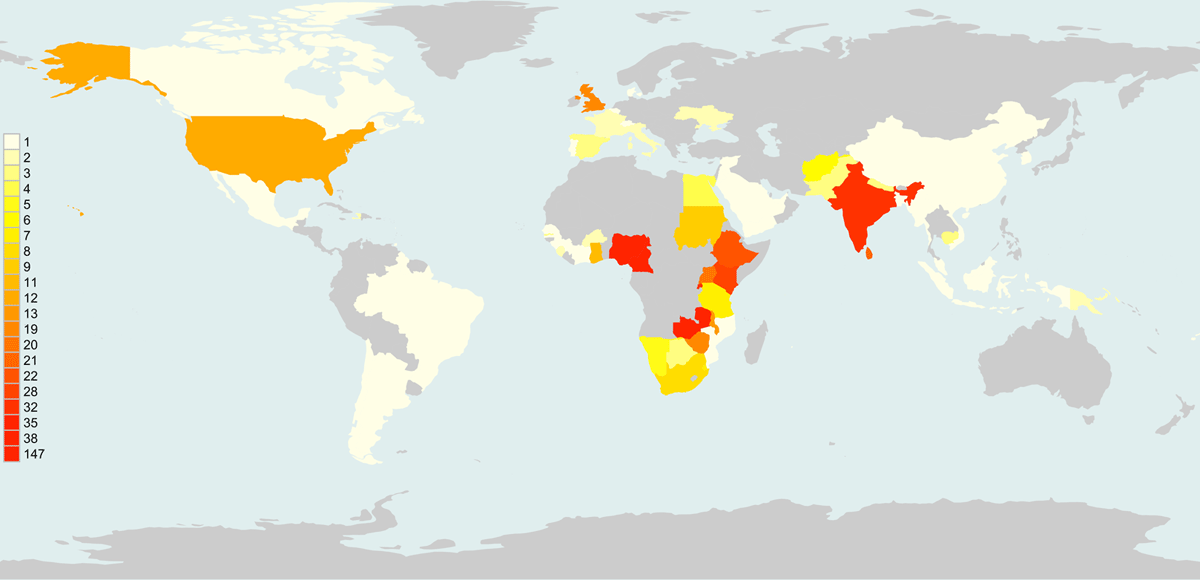
Figure 4
Geographical distribution of master’s students.
159 students passed with a master’s award – 94 with the MPH from our initial academic partner Manchester Metropolitan University, 37 with the MPH from our later academic partner Euclid University, and 28 with the Peoples-uni master’s award. Please see below for a discussion on finding academic partners.
A further 45 students gained a Diploma (passing the requisite number of coursework modules, but not progressing to the Dissertation) and 96 students gained a Certificate (passing half the number of modules required for the Diploma).
We have previously reported on student feedback (Heller et al., 2019a) and on the positive results of an external evaluation of the impact on students (Sridharan et al., 2018). A message about the closure of Peoples-uni to graduates produced a number of responses. The main themes included the impact on individual career development especially in Public Health, the quality of the education and the low cost which provided educational opportunities for disadvantged populations. Here is a sample:
‘I am grateful for the role the Peoples-uni had in shaping my career.’
‘Peoples-uni help me as the foundation for my academic career!!!’
‘As a beneficiary from Peoples-uni, my career development advanced thanks to this institution.’
‘The life that i am enjoying now its because of Peoples-uni and the Team’
‘I am writing to express profound gratitude and deep respect. You may never know the REAL WORLD impact your altruism has made. Nonetheless, I am personally very grateful for Peoples-uni It is because of your work that I have a career today.’
‘I am however grateful for the opportunity that you and your team provided to us on this unique platform. To learn and empower us with world class education in public health at a very affordable rate which is exclusive reserve for the rich.’
“I take this opportunity to thank you very much and your team for making it possible for us to get a word class education in public health. Peoples-uni maybe closing but it’s impact will last for generations to come.”
‘Even after post graduation from a reputed college of India, I had enrolled in MPH and I could learn so much more!! Many others like me has benefited from Peoples-uni too.’
‘…high-quality low-cost education to the disadvantaged population, which has been hitherto a reserve to the rich. I am a beneficiary of this goodwill and without which I wouldn’t have the competitive edge to … as a visiting postdoctoral fellow.’
‘Peoples-uni has made a huge difference in my life and work. I had identified some gaps in my training and knowledge, Peoples-uni allowed me to fill these gaps and made me better. Peoples-uni was a wonderful initiative and as others have said provided a unique opportunity for those from disadvantaged backgrounds.’
‘My life and professional carrier have been impacted positively by you and your colleague. The exposure to your courses has brought me out of my clinician mindset and led me to a combined experience in public health and clinical service. The skill has helped me in my work in the ministry of health top management and as a clinical researcher in the academic world.’
Alumni
Each student who graduated with a master’s award was enrolled in an Alumni group (Heller et al., 2015). A number of Alumni joined the programme as tutors, and various collaborative research programmes were discussed. At the time of writing, two collaborative research projects among Alumni have been completed and published in the peer reviewed literature (Machingura et al., 2014; Musa et al., 2019). A group of Alumni have subsequently formed the Steering Committee of an African NGO, itself created to leverage the skills and knowledge of graduates to improve the health of their populations (Heller et al., 2021). There is considerable potential for building on the skills gained in a master’s programme, in our case to improve the health of resource poor populations through education and research.
Open Online Courses for continuing professional development
Separately from the master’s programme, a sister site was established from 2014 for open access to online courses available for continuing professional development. Courses were available to anyone at no cost for self-paced learning. Most were developed by Peoples-uni, but a number were developed by others and hosted on our site. Courses led to an automated certificate of completion based on accessing the resources and taking, or passing, a multiple choice question test. The early experience is described elsewhere (Heller et al., 2017) and this report updates the early experience to March 2021.
32 courses were developed and offered at various times over the period, 21 of these were developed by Peoples-uni. There were 4259 students enrolled in 7007 courses, as a number of students took more than one course. Students could self enrol and access the courses at any time. Students came from 155 countries, as shown in Figure 5.
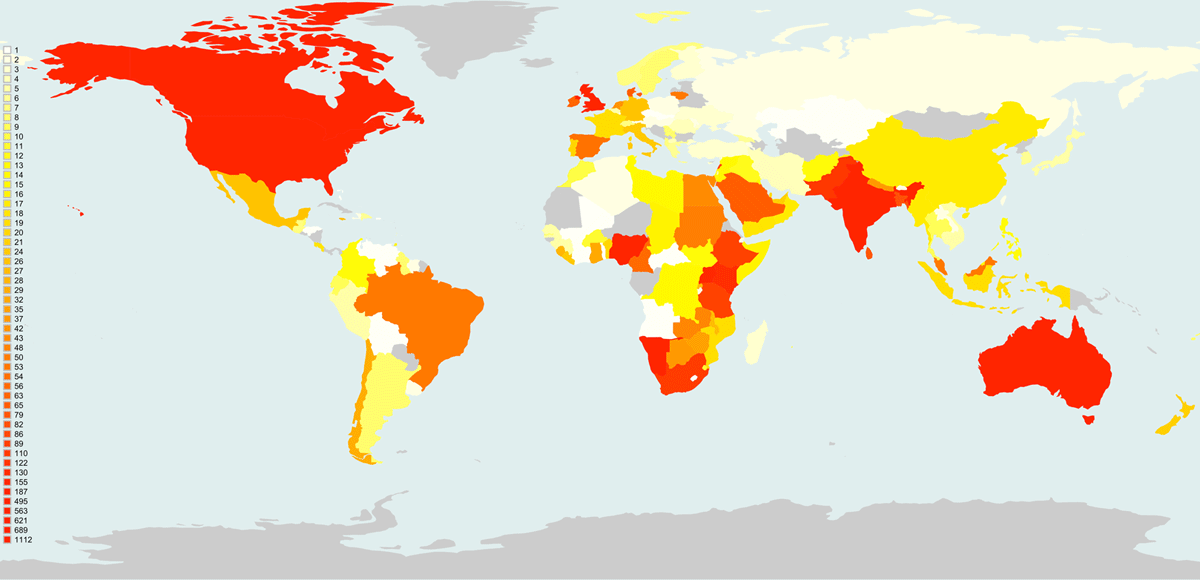
Figure 5
Geographical distribution of enrolments on Open Online Courses.
The geographical distribution of the students was quite different from the master’s students and tutors as Table 1 demonstrates.
Table 1
Comparison of geographical regions between students and tutors.
| REGION | MASTER’S STUDENTS N = 562 | TUTORSN = 429 | OPEN ONLINE COURSE STUDENTS N = 4259 |
|---|---|---|---|
| Africa | 424 (75%) | 39 (9%) | 1231 (29%) |
| S Asia | 69 (12%) | 36 (8%) | 576 (14%) |
| UK/Europe | 44 (8%) | 202 (47%) | 1040 (24%) |
| Australia/NZ/US/Canada | 13 (2%) | 128 (30%) | 978 (23%) |
[i] Note: Percentages are of those with data.
A certificate of completion was gained by Open Online Course students in 1768 courses, a completion rate of 25%. Although courses were usually offered without tutor support, two of the courses were offered both with and without tutor faciliation of discussion forums, and demonstrated no difference in outcomes (quiz scores and course completion) (Heller et al., 2019b).
Finding academic partners
Pressure from students for an accredited award led us to seek partnerships with educational and professional organisations. The UK Royal Society for Public Health was very helpful at the start of the programme with course development, but was not auhorised to provide formal acceditation at the master’s level. Manchester Metropolitan University in the UK assisted us to adapt the course so that it met master’s level quality standards and they offered a Master of Public Health (MPH) award to students who enrolled over a four semester period, as well as providing a quality assurance function. After this partnership ceased, Euclid Univeristy, created under a UN charter, took over in offering an MPH to our graduates. Despite numerous attempts to seek other partnerships with universities and professional bodies, none were forthcoming.
Conclusions
Our experience has demonstrated that it is possible to develop and run an online programme outside the traditional higher education system, using volunteer faculty and open source materials and infrastructure, leading to validated university awards and positive student outcomes. Although there are now a number of master’s courses in public health aimed at LMIC populations (Rabbani et al., 2016; Zwanikken et al., 2016), and at least some are by distance or online (Chastonay et al., 2015; Alexander et al., 2009), we are not aware of fully online master’s programmes similar to ours outside the formal higher education system. The ability to offer a formal qualification was in demand from the student body for their own professional development, and this was partially successful through two progressive universities with whom partnerships were established. However, approaches to many other universities were unsuccessful, as were proposed partnerships with other organisations.
The use of volunteer faculty and open source materials and infrastructure allowed this programme to be offered online at affordable cost to health professionals from low- to middle-income countries. The need for increasing Public Health capacity at scale has become more apparent with the Covid-19 pandemic and so has the need for online education. Covid-19, like many other public health problems, shows that ultimately what is needed is strengthening of health systems. The starting point for strengthening health systems is workforce development, and new models of quality, affordable and accredited education are needed beyond that offered by the the current and established university system. Whilst many of the obstacles to the access of information are being overcome in various ways through open science (UNESCO, n.d.), the biggest block that still remains is accreditation of education. We hope that the experience of Peoples-uni will encourage others to experiement with innovative online educational programmes to meet global workforce shortages.
Despite the positive results we report on our experience of online education, it is important to note a number of limitations. For some students in LMICs, there is still inadequate IT access, as well as poor preparation for self-directed adult learning. Language (our courses were in English) may also be a barrier. These may have contributed to the failure by a number of students to progress through the courses after registration. This indicates the need for a comprehensive system of Public Health capacity building, starting with attention to the basics of language, readiness for adult learning, use of IT, and then finding a way to utilise the skills of those completing an education programme. The biggest problem with this is the lack of funding – unless governments themselves have the vision and a strategy, organisations such as Peoples-uni can only play a small part in capacity building. While the Covid-19 pandemic has demonstrated the importance of online education (Pokhrel & Chhetri, 2021) and could add relevance to innovations such as we describe, it may perversly reduce the need for programmes such as ours through the resulting increase in provision of online education.
To build on our experience, we, with others, are going on to explore ways in which master’s level graduates can be encouraged and supported to work together to use their knowledge and skills to improve the health of their populations and become future leaders.
Competing Interests
The authors have no competing interests to declare.