
Table 1
Selection criteria for participants.
| INCLUSION CRITERIA | EXCLUSION CRITERIA |
|---|---|
| Employed in a higher education institution | Not employed in a higher education institution |
| Compulsory or voluntary teaching activities | no teaching activities |
| Uses or has used OER in teaching activities | Has not used OER in teaching activities yet |
| Engagement in any of the 5R activities of OER | Not engaged in any of the 5R activities of OER |
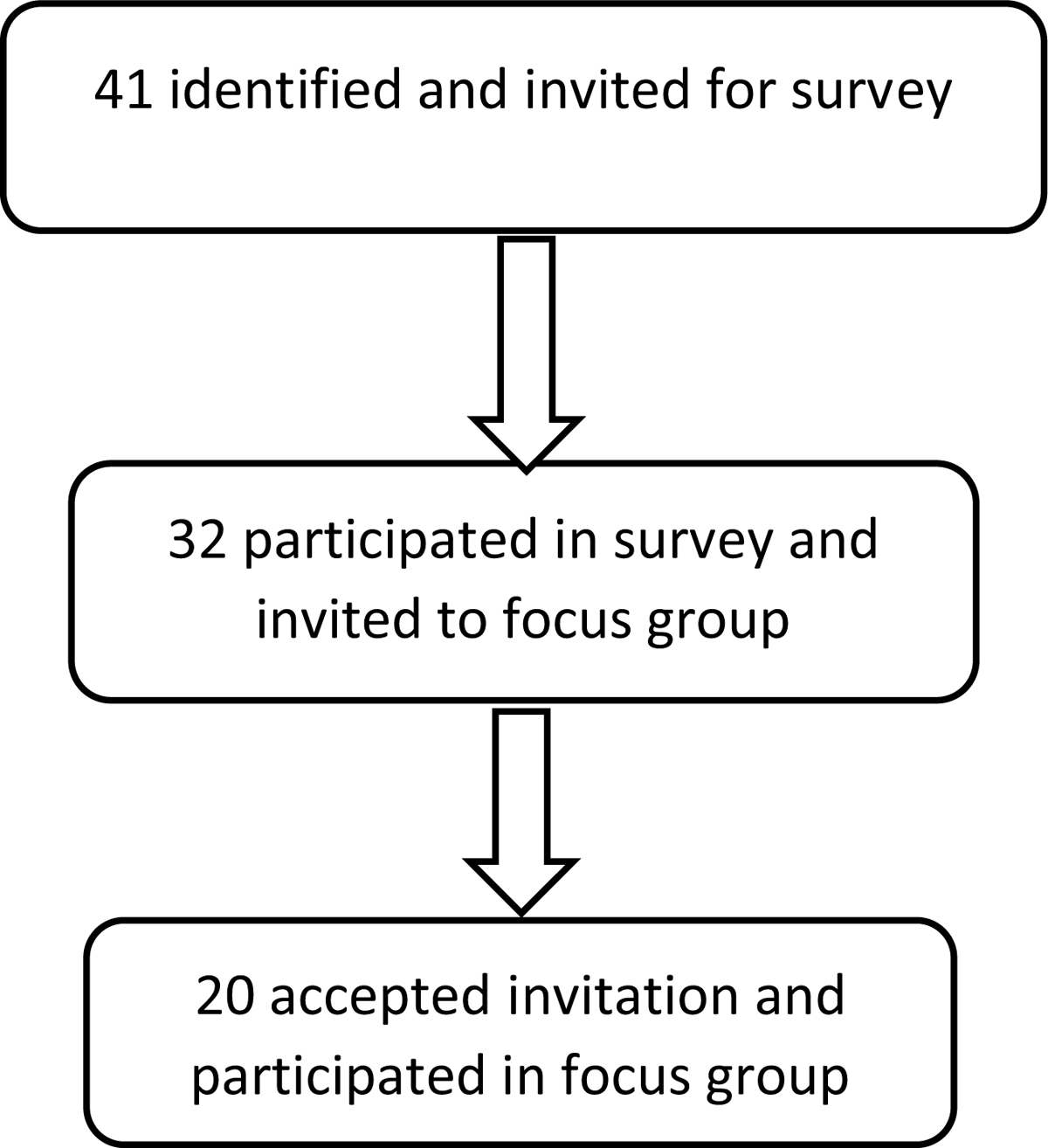
Figure 1
Illustration of the selection process for survey and focus group.
Table 2
Measures on an institutional level to promote OER.
| MEASURES TO PROMOTE THE USE OF OER IN HIGHER EDUCATION (N = 32) | PRIORITY | IMPACT |
|---|---|---|
| Free legal advice for teachers to create and use OER. | 4.56 | 4.28 |
| Development of a cross-institutional metasearch engine for OER. | 4.48 | 4.26 |
| Funding programmes for the creation of OER. | 4.28 | 4.53 |
| Use of open textbooks in higher education teaching. | 4.04 | 3.93 |
| One contact office/person in higher education institutions for OER. | 4.00 | 3.60 |
| Establishment of an OER repository at every higher education institution. | 3.90 | 3.55 |
| Research semester for teachers to create OER. | 3.81 | 4.06 |
| Consideration of OER activities in appointment procedures for professorships | 3.58 | 3.77 |
| All results of research projects must be published as OER. | 3.52 | 3.64 |
| Compulsory OER training for teachers in higher education. | 3.48 | 3.38 |
| Introduction of an OER Citation Score. | 3.30 | 3.40 |
| Obligation for teachers to publish all created teaching materials as OER. | 2.77 | 3.20 |
Table 3
Measures to increase the usability of ROER.
| MEASURES TO INCREASE THE USABILITY OF ROER IN HIGHER EDUCATION (N = 32) | PRIORITY | IMPACT |
|---|---|---|
| Changes/improvements to OER materials can be communicated back to the creator. | 4.13 | 3.77 |
| The repository only allows the use of open licenses. | 4.07 | 3.69 |
| Creators are informed about the use and modification of their OER material. | 4.06 | 3.84 |
| Quality control when materials are uploaded into the repository. | 4.03 | 3.76 |
| Changes/improvements to OER material is reported back to the creator. | 4.00 | 3.90 |
| A tool/app exists for the assignment of OER metadata and OER licenses. | 3.93 | 3.73 |
| Other users can comment on OER materials. | 3.81 | 3.68 |
| There is a possibility to inform others about changes to one’s own OER material. | 3.81 | 3.61 |
| The repository is integrated into the institution’s learning management system (LMS). | 3.75 | 3.43 |
| Peer-review process for uploading materials into the repository. | 3.63 | 3.55 |
| Tool/app for creating and uploading OER materials to the repository. | 3.60 | 3.53 |
| Other users can rate uploaded OER materials. | 3.30 | 3.40 |
| The previous versions are still publicly available when uploading updated material. | 3.27 | 3.07 |
| Badges are awarded to users for their activities in the OER repository. | 2.79 | 2.96 |