
Introduction
Orthostatic tremor (OT), also known as “shaky legs syndrome,” was first described as a distinct entity by Heilman [1], although similar cases had been reported previously [2]. OT is characterized by unsteadiness and leg shaking while standing, with symptoms typically improving after sitting or walking [3]. Although the legs are predominantly involved, upper-limb, truncal, and facial muscle involvement has also been reported. Compared with more common tremor syndromes, such as essential tremor, OT remains rare [4, 5].
The diagnosis of OT requires electrophysiological confirmation with electromyography (EMG) [6]. Historically, a standing tremor frequency of 13–18 Hz was considered essential for diagnosis [7]. Using this criterion, Gerschlager et al. [8] divided OT into two categories: primary OT and OT plus, the latter referring to OT associated with other neurological conditions. Several alternative classification schemes have subsequently been proposed, including distinctions based on tremor frequency (slow, intermediate, and classical OT) and association with neurological disorders, reflecting uncertainty regarding the optimal framework. [9, 10, 11].
The 2018 consensus statement of the International Parkinson and Movement Disorder Society (MDS) classified tremor syndromes along two axes: Axis 1, based on clinical features, and Axis 2, based on etiology. Within this framework, OT was classified as primary orthostatic tremor (13–18 Hz and isolated), primary orthostatic tremor plus (13–18 Hz with additional neurological signs), or pseudo-orthostatic tremor (<13 Hz, often associated with other neurological conditions) [6].
Despite these classification systems, several limitations remain. Primary OT is defined by a 13–18 Hz frequency range, yet cases with frequencies above 18 Hz have also been reported [12, 13, 14, 15]. Frequency may also fluctuate over time or within the same recording, making classification dependent on the timing and duration of measurement [9]. Overlap between intermediate (10–13 Hz) and classical frequency ranges further blurs subtype distinctions [16]. Additionally, isolated cases in the intermediate range appear to share more features with primary (classical) OT (≥13 Hz) than with other slow tremor syndromes [17, 18]. In addition, the distinction between primary OT, OT-plus, and pseudo-orthostatic tremor may not always be straightforward, with associated non-neurological conditions not represented. The current classification also may not adequately account for this possible longitudinal progression, where isolated presentations may progress to more complex or secondary forms over time [19].
Given these limitations, it remains uncertain whether current classification frameworks fully capture the clinical heterogeneity of OT. In particular, rigid frequency thresholds and a binary distinction between primary OT and OT-plus may not adequately reflect cases with fluctuating or boundary-spanning frequencies or non-neurological systemic associations. Hence, there is a need to evaluate whether frequency-based and etiological classifications adequately reflect the observed clinical heterogeneity in published cases of OT. The present review therefore evaluates the relationships between tremor frequency, associated conditions, and clinical parameters to better characterize the clinical and electrophysiological heterogeneity through a systematic review of published case reports. We hypothesize that orthostatic tremor represents a heterogeneous disorder and that its clinical expression is better captured through an integrated framework incorporating clinical phenotype and frequency variability.
Methods
This systematic review was conducted in accordance with the Preferred Reporting Items for Systematic Reviews and Meta-Analyses (PRISMA) guidelines.
Search Strategy
A comprehensive search of PubMed/MEDLINE was conducted from database inception through February, 2026. The search string used was: (“orthostatic tremor”) OR (“shaky leg syndrome”) OR (“shaky legs syndrome”) OR (“slow orthostatic tremor”) OR (“pseudo-orthostatic tremor”) OR (“orthostatic tremor plus”) OR (“secondary orthostatic tremor”).
Selection Criteria
We included case reports, case series, and original studies that provided individual patient data for patients with EMG-confirmed OT, defined as rhythmic lower-limb muscle activity occurring during standing. Outcomes of interest included demographic data, OT frequency, and other associated conditions/disorders at presentation. Studies were excluded if they did not provide individual patient data or did not report or measure OT frequency. Orthostatic myoclonus cases were excluded.
Data Extraction
Two reviewers independently screened the titles and abstracts of all identified articles after deduplication. Full-text articles of potentially relevant studies were retrieved and assessed for eligibility. Each case was classified according to the MDS OT classification [6]. In addition, cases were operationally classified as isolated or non-isolated based on associated conditions at presentation. This study grouping was used for analysis and was not intended to establish causality. When frequency was reported as a range for a single patient, the average of the range was taken for analysis.
Statistical Analysis
Statistical analyses were performed using IBM SPSS Statistics, version 22.0 (IBM Corp., Armonk, NY, USA). Normality was assessed by visual inspection of histograms and Shapiro-Wilk tests. Continuous variables are presented as mean (SD), and categorical variables are summarized as frequencies and percentages. Receiver operating characteristic (ROC) analysis was used to evaluate the ability of tremor frequency to distinguish isolated from non-isolated OT presentations. The Youden index was calculated to determine the optimal frequency threshold. Spearman’s correlations, Chi-square and Mann-Whitney U tests were used to assess associations between variables. A p value < 0.05 was considered statistically significant.
Results
Cohort characteristics and clinical Profile
A total of 100 articles fulfilled the inclusion criteria and were included in the analysis (Figure 1), comprising 244 patients (Supplementary table 1 and References [9, 10, 12, 13, 14, 15, 17, 20, 21, 22, 23, 24, 25, 26, 27, 28, 29, 30, 31, 32, 33, 34, 35, 36, 37, 38, 39, 40, 41, 42, 43, 44, 45, 46, 47, 48, 49, 50, 51, 52, 53, 54, 55, 56, 57, 58, 59, 60, 61, 62, 63, 64, 65, 66, 67, 68, 69, 70, 71, 72, 73, 74, 75, 76, 77, 78, 79, 80, 81, 82, 83, 84, 85, 86, 87, 88, 89, 90, 91, 92, 93, 94, 95, 96, 97, 98, 99, 100, 101, 102, 103, 104, 105, 106, 107, 108, 109, 110, 111, 112]). The cohort had a mean age of 62.61 ± 13.43 years. Age ranged from 7 to 86 years. A female predominance was observed with 96 male patients and 148 female patients. A positive family history of OT was present in 17 patients. Mean disease duration among cases which reported the same (n = 222) was 7.83 ± 6.72 years.
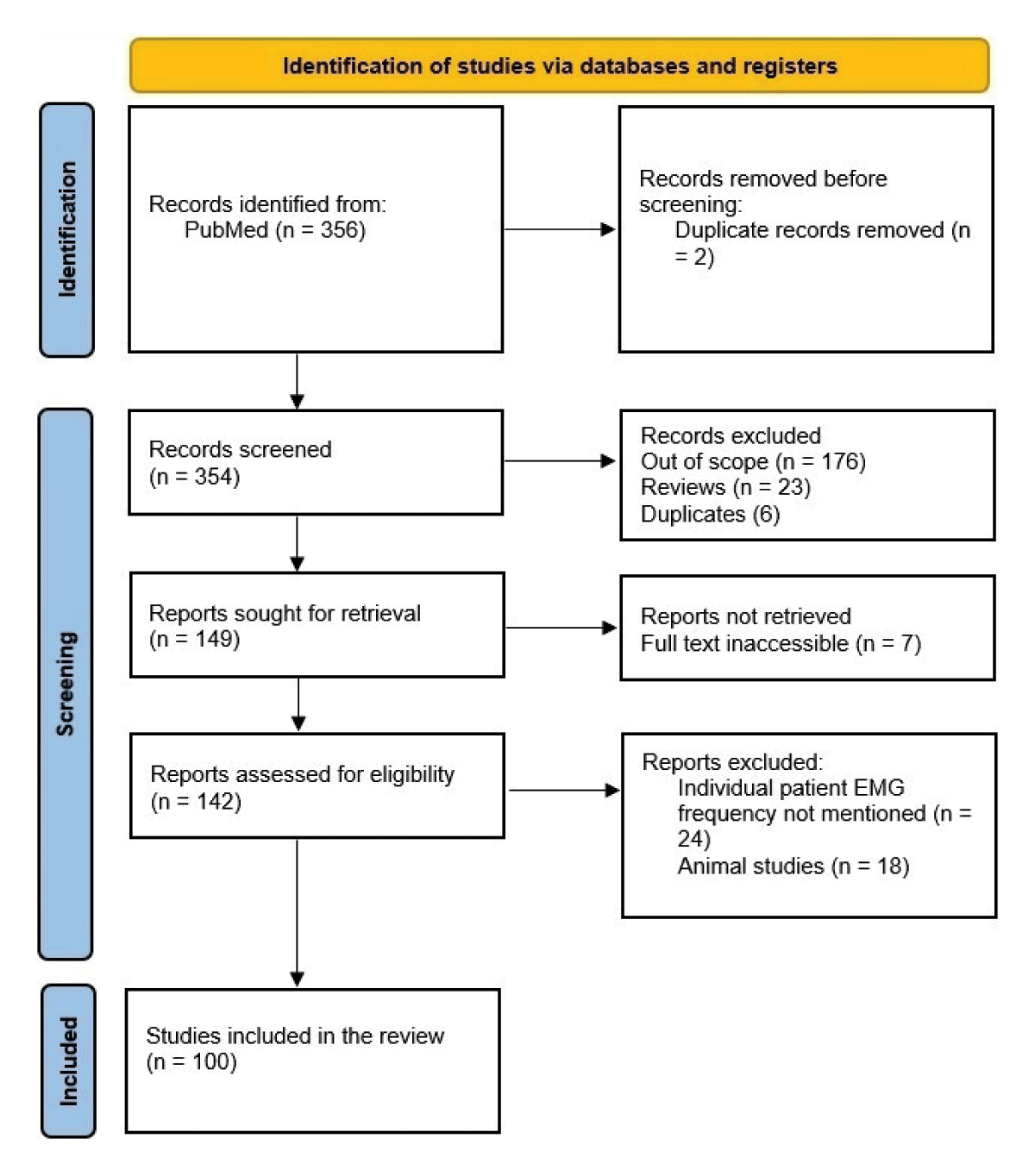
Figure 1
PRISMA flowchart.
Frequency distribution
The mean tremor frequency across all cases was 13.32 ± 4.15 Hz, with a range of 3–20 Hz (Figure 2). According to the current MDS classification, we grouped 127 patients as having primary OT. 39 had OT plus, and 61 had pseudo-orthostatic tremor. 17 cases could not be definitively classified within the existing framework: 12 showed frequency fluctuations across the 13-Hz threshold, and five exceeded the upper frequency limit of 18 Hz (Table 1). Using our operational clinical grouping, 148 patients were classified as having isolated OT and 96 as having non-isolated presentations (Table 2).
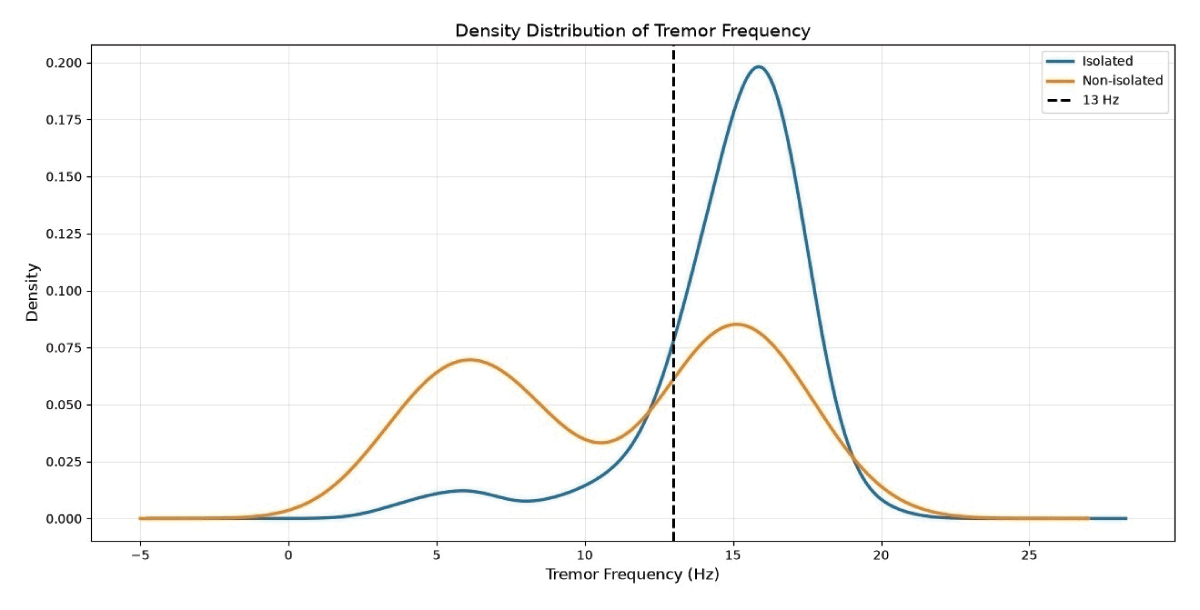
Figure 2
Density plots of tremor frequency for isolated (blue) and non-isolated (orange) OT.
Table 1
Clinical spectrum of OT cases according to the MDS classification.
| PARAMETER | PRIMARY OT | OT PLUS | PSEUDO OT | UNCLASSIFIABLE (FLUCTUATING FREQUENCY) | UNCLASSIFIABLE (>18 Hz) |
|---|---|---|---|---|---|
| N | 127 | 39 | 61 | 12 | 5 |
| Age (SD) | 64.13 (11.25) | 64.41(13.55) | 58.56 (16.03) | 61.67 (17.48) | 61.80 (13.05) |
| Sex (M/F) | 50/77 | 14/25 | 25/36 | 4/8 | 3/2 |
| Mean Tremor Frequency in Hz (SD) | 15.58 (1.26) | 15.46 (1.41) | 6.82 (2.36) | 13.12 (1.17) | 18.92 (0.71) |
| Familial history of OT | 13 | 2 | 2 | 0 | 0 |
Table 2
Clinical spectrum of OT cases based on isolated/non-isolated phenotype.
| PARAMETER | ISOLATED OT | NON-ISOLATED OT |
|---|---|---|
| N | 148 | 96 |
| Age (SD) | 63.97 (11.35) | 60.51 (15.96) |
| Sex (M/F) | 60/88 | 36/60 |
| Mean Tremor Frequency in Hz (SD) | 14.80 (2.82) | 11.03 (4.81) |
| ≥13 Hz/<13 Hz | 129/19 | 49/47 |
| Familial history of OT | 12 | 5 |
Patients with non-isolated OT had significantly lower tremor frequencies compared to those with isolated OT (11.03 Hz vs. 14.80 Hz, p < 0.001). In contrast, age and sex were not associated with tremor frequency or phenotype. A positive correlation was observed between tremor frequency and reported disease duration (Spearman’s ρ = 0.366, p < 0.001).
Receiver operating characteristic analysis showed that tremor frequency had the discriminatory ability to distinguish isolated from non-isolated OT (AUC = 0.72, p < 0.001, 95% CI, 0.60–0.85). The optimal frequency threshold identified using the Youden index was 10 Hz with a sensitivity of 45% and specificity of 93%.
To determine whether tremor frequency independently predicted clinical phenotype, a multivariable logistic regression model was constructed with non-isolated OT as the dependent variable and age, sex, disease duration, and tremor frequency as covariates. Tremor frequency was the only independent predictor with frequency inversely associated with non-isolated orthostatic tremor (OR = 0.78, 95% CI 0.71–0.85, p < 0.001), whereas age, sex, and disease duration were not significant predictors (Nagelkerke R2 = 0.27).
Conditions associated with OT
Parkinsonism and related disorders were most commonly associated with OT (n = 38). This was followed by essential tremor, cerebellar disorders and lesions, and unilateral brainstem lesions (midbrain and pons). Non-neurological disorders such as hyperthyroidism and musculoskeletal injury (knee injury) were also associated with OT. The frequency distribution of OT associated with other conditions is presented in Table 3.
Table 3
Disorders associated with OT.
| ASSOCIATED DISORDERS | TOTAL NUMBER | <13 Hz N (%) | ≥13 Hz N (%) | MEAN TREMOR FREQUENCY | SD | MINIMUM FREQUENCY | MAXIMUM FREQUENCY |
|---|---|---|---|---|---|---|---|
| Parkinson’s disease/Parkinsonism/PSP | 38 | 22 (57.9) | 16 (42.1) | 10.07 | 5.171 | 3 | 18 |
| Essential tremor | 10 | 3 (30) | 7 (70) | 13.50 | 3.752 | 6.5 | 19 |
| Cerebellar disorders/lesions | 10 | 2 (20.0) | 8 (80.0) | 12.73 | 3.382 | 4.5 | 15 |
| Brainstem lesions | 6 | 2 (33.3) | 4 (66.7) | 12.37 | 5.258 | 4.25 | 17.5 |
| Hyperthyroid states | 5 | 3 (60.0) | 2 (40.0) | 10.50 | 4.213 | 6 | 15 |
| Musculoskeletal injury | 2 | 1 (50) | 1 (50) | 10.75 | 7.425 | 5.5 | 16 |
| Hereditary spastic paraplegia | 3 | 1 (33.3) | 2 (66.7) | 14.00 | 4.583 | 9 | 18 |
| Stiff person syndrome | 2 | 0 (0.0) | 2 (100.0) | 16.00 | 0.000 | 16 | 16 |
| Dementia | 2 | 0 (0.0) | 2 (100.0) | 15.00 | 2.828 | 13 | 17 |
| Miscellaneous | 18 | 13 (72.2) | 5 (27.8) | 8.98 | 4.502 | 3.5 | 16 |
| Isolated OT | 148 | 19 (12.8) | 129 (87.2) | 14.80 | 2.821 | 3.5 | 20 |
Discussion
OT has long occupied an uncertain position within the broader landscape of tremor disorders, initially regarded as a rare and relatively homogeneous condition [1, 3]. This review, which synthesizes published individual cases across the clinical spectrum of OT, suggests that the disorder is more heterogeneous than previously thought.
Although the pathophysiology of OT remains incompletely understood, the disorder is widely thought to involve a pathologically active oscillator within the cerebello-thalamo-cortical network [39, 113]. Functional imaging and connectivity studies have demonstrated abnormal coupling within lateral cerebellar and supplementary motor area networks in patients with OT, implicating a distributed network rather than a single anatomical node as the likely substrate of rhythmic tremor generation [113]. The ventralis intermedius nucleus of the thalamus occupies a critical position within this circuit, and the therapeutic efficacy of Ventralis intermedius nucleus deep brain stimulation supports its relevance to OT oscillations [52, 68].
Our cohort was broadly representative of the OT population described in the literature: predominantly middle-aged to older adults with a female preponderance [3]. However, a meaningful subset of patients could not be assigned to existing categories without ambiguity. Two patterns of nonconformity emerged. In one group, tremor frequency fluctuated considerably across the 13-Hz boundary used to distinguish primary OT from lower-frequency variants, making single-point classification dependent on when the recording was obtained. In a smaller group, tremor frequencies exceeded the upper 18-Hz limit, for which the current criteria designates no formal category.
The finding that some patients fluctuate across the 13-Hz boundary is consistent with a dynamic oscillator model and has precedent in the tremor literature [114, 115]. Thompson et al. provided early electrophysiological documentation of patients with primary OT at 14–16 Hz who exhibited intermittent oscillatory episodes at approximately half that frequency [9]. They noted that the primary 16-Hz tremor appeared as a fine ripple beneath the skin because of partial fusion of muscle contractions, whereas the 8-Hz subharmonic produced a more clinically apparent oscillation and worsened the patient’s subjective unsteadiness. Although the mechanism was uncertain, the overall 16-Hz frequency supported a central rather than peripheral origin. The authors proposed that the tremor arose from abnormal feed-forward postural signals required for standing, implicating central oscillatory structures such as the inferior olive or thalamus. Subsequent reports have reinforced the clinical relevance of an 8-Hz subharmonic arising from a 16-Hz primary oscillator, suggesting that subharmonic states may have functional consequences rather than representing electrophysiological artifacts [115]. Multimode oscillatory behaviour is not unique to OT. In Parkinsonian and essential tremor, simultaneous recordings have shown coherent activity at both the tremor frequency and its harmonic, indicating that harmonic and subharmonic modes can operate within the same network [116, 117].
Density plots of tremor frequency (Figure 2) showed a bimodal distribution of frequencies for the non-isolated group. The lower and higher frequency clusters of non-isolated OT observed from the plot did not differ distinctly in the spectrum of OT-associated etiologies. However, this does raise the question of why frequencies cluster in a bimodal distribution and whether the two clusters differ in tremor phenomenology. Further studies are needed to validate and explain the same. On the other hand, the majority of the isolated OT patients were found in the ≥13 Hz range. We found that among these patients with isolated OT, those with tremor frequency below 13 Hz had a lower average age than those with higher frequencies (58.78 vs 64.73 years). This raises the possibility that isolated sub-13-Hz OT, in some patients, may represent an early manifestation of neurodegenerative disorders such as Parkinson’s disease, with patients initially presenting with isolated OT before later developing symptoms of neurodegenerative disease, and hence, a non-isolated phenotype with time. Although our study design prevents us from making definitive conclusions, previous studies support this hypothesis. Ganos et al. reported that seven isolated OT cases subsequently developed additional neurological signs, including one patient who developed Parkinson’s disease [19]. In another case series, four patients with sub-13-Hz OT later developed parkinsonism, and all had a marked response to levodopa [10]. We also observed a positive correlation between tremor frequency and disease duration, which potentially may suggest that tremor frequency evolves with disease. Because disease duration and tremor frequency were assessed cross-sectionally, this association should be interpreted carefully.
Although tremor frequency independently distinguished isolated from non-isolated OT, its discriminatory performance was limited. These findings indicate that while tremor frequency is a significant electrophysiological marker, it may be insufficient as a standalone classifier of clinical phenotype. Furthermore, the data-driven exploratory threshold (≈ 10 Hz) differed from the conventional 13 Hz boundary, and approximately 6.97% of EMG-confirmed patients remained unclassifiable using the existing frequency-based criteria. These findings suggest that while tremor frequency remains an important electrophysiological biomarker, rigid frequency thresholds alone incompletely capture the clinical and electrophysiological spectrum of orthostatic tremor.
The distribution of orthostatic tremor (OT) frequencies across associated neurological and systemic conditions demonstrates substantial overlap between traditionally defined clinical categories. While Parkinsonian disorders accounted for the largest subgroup, a nearly even split between <13 Hz and ≥13 Hz tremors was observed. The frequency distribution was found to be bimodal, similar to the distribution observed for non-isolated OT. Similarly, essential tremor, cerebellar disorders, and brainstem lesions exhibited wide frequency dispersion with substantial proportions of cases exceeding 13 Hz, further supporting a continuous rather than categorical frequency spectrum. Additionally, hyperthyroid states and musculoskeletal injuries, conditions not inherently neurological in nature, also demonstrated both low and high frequency OT [37, 51, 71, 98, 106]. Collectively, these findings indicate marked phenotypic overlap across diverse groups of disorders associated with OT.
A small number of published cases fell outside the 18 Hz defined range, raising questions about how strictly existing EMG frequency cutoffs should be applied. Patients with tremor frequencies exceeding 18 Hz otherwise resembled patients with primary OT, supporting the notion that the current upper frequency limit may represent an arbitrary boundary. We also observed that the MDS classification forced every ≥13 Hz patient into one of two categories: Primary OT (Isolated) or OT-plus. This creates a classification gap for non-neurological diseases such as hyperthyroidism and musculoskeletal injuries, which are neither isolated (Primary OT) nor qualify as neurological symptoms (OT plus). However, their causal or contributory relationships remain uncertain [37, 106]. The MDS consensus also does not clearly define whether stable neurological sequelae, for example, old polio count as OT-plus [50]. It also does not clarify whether incidental MRI abnormalities should count, or whether unrelated neurological symptoms such as neuropathy secondary to diabetes mellitus qualify as OT-plus, resulting in inconsistent classification [42]. However, we acknowledge that not every neurological comorbidity necessarily has a mechanistic relationship with OT, making it challenging to assign a specific classification category for every possible associated disorder.
Several limitations should be acknowledged. The available evidence is derived largely from case reports and case series, which may disproportionately reflect unusual or atypical presentations rather than commonly encountered cases. Reporting bias/publication bias may therefore influence estimates of frequency distribution and associated clinical features. Cases with subharmonics may also be misrepresented if clinicians regard an 8-Hz component as diagnostically insignificant or if they do not report the full frequency range. A related ambiguity is whether the 16-Hz or 8-Hz component should be regarded as the primary frequency, a question with direct implications for classification. In addition, because frequency ranges were converted to mean values for analysis, within-patient variability may have been reduced.
Our review found that the large majority of published cases could be accommodated within the current MDS classification. However, a small subset demonstrated frequency fluctuations across the 13-Hz boundary or frequencies above 18 Hz, highlighting limitations at the margins of the current frequency-based framework. Although tremor frequency remains an important diagnostic feature of OT, our findings indicate that rigid frequency thresholds alone do not adequately distinguish isolated from non-isolated presentations or account for patients with frequency variability, boundary-spanning frequencies, or frequencies outside the currently accepted range. The substantial overlap in tremor frequencies across diverse neurological and non-neurological conditions further suggests that frequency should be interpreted within its clinical context rather than as the primary determinant of disease subtype.
Supplementary table 1
| SL NO | AUTHOR | YEAR OF PUBLICATION | AGE | SEX | FREQUENCY (HZ) | ISOLATED/NON-ISOLATED | ASSOCIATED CONDITION | MDS CLASSIFICATION |
|---|---|---|---|---|---|---|---|---|
| 1 | Tseng et al. [20] | 2025 | 34 | Male | 3 | Non-isolated | Butane induced encephalopathy, Parkinsonism | Pseudo OT |
| 2 | Swinnen et al. [21] | 2022 | 57 | Female | 4–5 | Isolated | - | Pseudo OT |
| 3 | Grobe-Einsler et al. [22] | 2020 | 53 | Female | 14–16 | Isolated | - | Primary OT |
| 4 | Verriello et al. [23] | 2020 | 82 | Male | 15–16 | Isolated | - | Primary OT |
| 77 | Male | 15–16 | Isolated | - | Primary OT | |||
| 5 | Yoshii et al. [24] | 2020 | 62 | Female | 5–6 | Isolated | - | Pseudo OT |
| 6 | Yoo et al. [25] | 2020 | 69 | Female | 4–6 | Isolated | - | Pseudo OT |
| 7 | Chaithra et al. [26] | 2019 | 72 | Female | 15–16 | Non-isolated | Parkinson’s disease | OT Plus |
| 8 | Wadhwa et al. [27] | 2019 | 62 | Female | 17–18 | Isolated | - | Primary OT |
| 9 | Iovino et al. [28] | 2019 | 23 | Male | 10.5 | Isolated | - | Pseudo OT |
| 10 | Santus et al. [29] | 2019 | 73 | Female | 17 | Non-isolated | Frontotemporal dementia | OT Plus |
| 11 | Mousele et al. [30] | 2018 | 66 | Male | 11–12 | Isolated | - | Pseudo OT |
| 12 | Yoo et al. [31] | 2019 | 48 | Male | 4–6 | Non-isolated | Parkinson’s disease | Pseudo OT |
| 13 | Wuehr et al. [32] | 2018 | 62 | Male | 14.5 | Isolated | - | Primary OT |
| 55 | Female | 14 | Isolated | - | Primary OT | |||
| 75 | Male | 17.5 | Isolated | - | Primary OT | |||
| 75 | Male | 14 | Isolated | - | Primary OT | |||
| 56 | Female | 17 | Isolated | - | Primary OT | |||
| 75 | Female | 16.5 | Isolated | - | Primary OT | |||
| 66 | Female | 14 | Isolated | - | Primary OT | |||
| 75 | Male | 13.5 | Isolated | - | Primary OT | |||
| 76 | Male | 15 | Isolated | - | Primary OT | |||
| 14 | Evidente et al. [33] | 2018 | 73 | Male | 10–14 | Isolated | - | Unclassifiable(fluctuating) |
| 68 | Male | 5–12 | Non-isolated | Essential Tremor | Pseudo OT | |||
| 15 | Shirai et al. [34] | 2018 | 60 | Male | 4–5 | Non-isolated | Machado-Joseph disease | Pseudo OT |
| 16 | Ruiz-Julián et al. [35] | 2018 | 75 | Female | 14 | Isolated | - | Primary OT |
| 17 | Lehn et al. [36] | 2017 | 68 | Male | 16 | Isolated | - | Primary OT |
| 18 | Larrosa Campo et al. [37] | 2019 | 81 | Male | 14–16 | Non-isolated | Thyrotoxicosis | Primary OT |
| 19 | Chiang et al. [38] | 2017 | 74 | Female | ~16 | Isolated | - | Primary OT |
| 73 | Male | ~16 | Isolated | - | Primary OT | |||
| 20 | Vidailhet et al. [39] | 2017 | 46 | Female | 17 | Isolated | - | Primary OT |
| 21 | Schöberl et al. [40] | 2017 | 56 | Female | 17.2 | Isolated | - | Primary OT |
| 64 | Female | 16 | Isolated | - | Primary OT | |||
| 72 | Male | 14 | Isolated | - | Primary OT | |||
| 73 | Male | 16.7 | Isolated | - | Primary OT | |||
| 68 | Female | 15.5 | Isolated | - | Primary OT | |||
| 74 | Male | 14.2 | Isolated | - | Primary OT | |||
| 73 | Male | 13.5 | Isolated | - | Primary OT | |||
| 73 | Female | 16.5 | Isolated | - | Primary OT | |||
| 73 | Male | 14.5 | Isolated | - | Primary OT | |||
| 73 | Female | 14.2 | Isolated | - | Primary OT | |||
| 22 | Benito-Léon et al. [41] | 2016 | 74 | Female | 16–18 | Isolated | - | Primary OT |
| 64 | Female | 10–12 | Isolated | - | Pseudo OT | |||
| 57 | Male | 16–18 | Isolated | - | Primary OT | |||
| 68 | Female | 16–18 | Non-isolated | Parkinson’s disease | OT Plus | |||
| 78 | Female | 16–18 | Non-isolated | Parkinson’s disease | OT Plus | |||
| 62 | Female | 12–16 | Isolated | - | Unclassifiable(fluctuating) | |||
| 37 | Female | 16–18 | Isolated | - | Primary OT | |||
| 76 | Female | 12–16 | Isolated | - | Unclassifiable(fluctuating) | |||
| 75 | Female | 12–16 | Non-isolated | Parkinson’s disease | Unclassifiable(fluctuating) | |||
| 77 | Female | 12–16 | Non-isolated | Parkinson’s disease | Unclassifiable(fluctuating) | |||
| 38 | Male | 16–18 | Isolated | - | Primary OT | |||
| 81 | Female | 12–16 | Non-isolated | Parkinson’s disease | Unclassifiable(fluctuating) | |||
| 65 | Female | 16–18 | Isolated | - | Primary OT | |||
| 57 | Female | 16–18 | Isolated | - | Primary OT | |||
| 23 | Blahak et al. [42] | 2016 | 58 | Female | 15 | Non-isolated | Diabetic neuropathy | Primary OT |
| 72 | Male | 14 | Isolated | - | Primary OT | |||
| 73 | Female | 17 | Isolated | - | Primary OT | |||
| 67 | Male | 17 | Isolated | - | Primary OT | |||
| 24 | Coleman et al. [43] | 2016 | 61 | Female | 14 | Isolated | - | Primary OT |
| 74 | Female | 13–18 | Isolated | - | Primary OT | |||
| 25 | Athauda et al. [44] | 2017 | 46 | Female | 16 | Isolated | - | Primary OT |
| 73 | Male | 16 | Isolated | - | Primary OT | |||
| 66 | Male | 17 | Non-isolated | Parkinsonism | OT Plus | |||
| 26 | Contarino et al. [45] | 2015 | 70 | Female | 16 | Isolated | - | Primary OT |
| 27 | Erro et al. [46] | 2014 | 63 | Female | 15 | Non-isolated | Hereditary spastic paraparesis | OT Plus |
| 28 | Mazzucchi et al. [47] | 2014 | 70 | Female | 8 | Non-isolated | Graves’ disease | Pseudo OT |
| 29 | Adebayo et al. [48] | 2014 | 57 | Female | 16 | Isolated | - | Primary OT |
| 30 | Vetrugno et al. [49] | 2013 | 77 | Female | 16 | Non-isolated | Stiff Person Syndrome | OT Plus |
| 55 | Female | 16 | Non-isolated | Stiff Person Syndrome | OT Plus | |||
| 31 | Bhattacharyya et al. [50] | 2013 | 12 | Male | 15–16 | Non-isolated | Poliomyelitis | Primary OT |
| 7 | Male | 14–15 | Non-isolated | Essential tremor | OT Plus | |||
| 32 | Coffeng et al. [17] | 2013 | 86 | Male | 10–11 | Isolated | - | Pseudo OT |
| 33 | Lin et al. [51] | 2013 | 26 | Male | 8–9 | Non-isolated | Graves’ disease | Pseudo OT |
| 34 | Lyons et al. [52] | 2012 | 75 | Male | 13 | Isolated | - | Primary OT |
| 35 | Virmani et al. [53] | 2012 | 79 | Male | 13.5 | Isolated | - | Primary OT |
| 75 | Female | 13.3 | Isolated | - | Primary OT | |||
| 36 | Lee et al. [54] | 2012 | 64 | Male | 11–13 | Non-isolated | Spinal Schwannoma | Unclassifiable(fluctuating) |
| 37 | Lee et al. [55] | 2011 | 81 | Female | 4–9 | Non-isolated | Parkinson’s disease | Pseudo OT |
| 38 | Kumar et al. [56] | 2011 | 60 | Male | 16 | Isolated | - | Primary OT |
| 39 | Hegde et al. [57] | 2011 | 69 | Male | 3–4 | Isolated | - | Pseudo OT |
| 40 | Yaltho et al. [58] | 2011 | 78 | Male | 14 | Isolated | - | Primary OT |
| 41 | Magariños-Ascone et al. [59] | 2010 | 68 | Female | 12–18 | Isolated | - | Unclassifiable(fluctuating) |
| 42 | Williams et al. [60] | 2010 | 70 | Female | 9 | Non-isolated | Cerebellar atrophy | Pseudo OT |
| 43 | Vetrugno et al. [61] | 2010 | 58 | Female | 16 | Non-isolated | Left midbrain lesion | OT Plus |
| 44 | Raudino et al. [62] | 2009 | 59 | Male | 13–14 | Isolated | - | Primary OT |
| 45 | Baker et al. [63] | 2009 | 38 | Female | 8–15 | Non-isolated | Multiple Sclerosis | Unclassifiable(fluctuating) |
| 46 | Kang et al. [64] | 2009 | 61 | Female | 6 | Non-isolated | Parkinson’s disease | Pseudo OT |
| 60 | Female | 6–7 | Non-isolated | Parkinson’s disease | Pseudo OT | |||
| 61 | Female | 4–5 | Non-isolated | Parkinson’s disease | Pseudo OT | |||
| 45 | Female | 3–4 | Non-isolated | Parkinson’s disease | Pseudo OT | |||
| 47 | Female | 16–17 | Non-isolated | Parkinson’s disease | OT Plus | |||
| 47 | Ramtahal et al. [65] | 2008 | 78 | Male | 13–14 | Isolated | - | Primary OT |
| 65 | Male | 15–16 | Isolated | - | Primary OT | |||
| 65 | Female | 15 | Isolated | - | Primary OT | |||
| 48 | Wegner et al. [66] | 2008 | 61 | Male | 16–18 | Isolated | - | Primary OT |
| 61 | Female | 16–18 | Isolated | - | Primary OT | |||
| 49 | Espay et al. [67] | 2008 | 73 | Female | 15 | Isolated | - | Primary OT |
| 67 | Female | 15 | Isolated | - | Primary OT | |||
| 50 | Guridi et al. [68] | 2008 | 55 | Female | 16 | Isolated | - | Primary OT |
| 51 | Trocello et al. [69] | 2008 | 49 | Male | 16 | Isolated | - | Primary OT |
| 76 | Female | 17 | Isolated | - | Primary OT | |||
| 55 | Female | 17 | Isolated | - | Primary OT | |||
| 66 | Male | 16 | Isolated | - | Primary OT | |||
| 66 | Female | 15 | Isolated | - | Primary OT | |||
| 49 | Female | 15 | Isolated | - | Primary OT | |||
| 75 | Female | 16 | Isolated | - | Primary OT | |||
| 62 | Female | 16 | Isolated | - | Primary OT | |||
| 74 | Female | 16 | Isolated | - | Primary OT | |||
| 78 | Female | 17 | Isolated | - | Primary OT | |||
| 70 | Female | 18 | Isolated | - | Primary OT | |||
| 70 | Male | 15 | Isolated | - | Primary OT | |||
| 52 | Stich et al. [70] | 2009 | 57 | Female | 17.5 | Non-isolated | Demyelinating lesion involving the right brainstem, Biclonal gammopathy of undetermined significance | OT Plus |
| 53 | Tan et al. [71] | 2008 | 50 | Female | 14–16 | Non-isolated | Graves’ disease | Primary OT |
| 54 | Leu-Semenescu et al. [72] | 2007 | 72 | Female | 18 | Non-isolated | Parkinson’s disease | OT Plus |
| 77 | Female | 16 | Non-isolated | Parkinson’s disease | OT Plus | |||
| 79 | Male | 13.5 | Non-isolated | Parkinson’s disease | OT Plus | |||
| 75 | Female | 17 | Non-isolated | Parkinson’s disease | OT Plus | |||
| 76 | Female | 7.5–9 | Non-isolated | Parkinson’s disease | Pseudo OT | |||
| 85 | Female | 5 | Non-isolated | Parkinson’s disease | Pseudo OT | |||
| 57 | Female | 5–6 | Non-isolated | Parkinson’s disease | Pseudo OT | |||
| 54 | Female | 4.3–5 | Non-isolated | Parkinson’s disease | Pseudo OT | |||
| 55 | Fischer et al. [73] | 2007 | 69 | Male | 16–17 | Isolated | - | Primary OT |
| 68 | Male | 16–17 | Isolated | - | Primary OT | |||
| 63 | Male | 16–17 | Isolated | - | Primary OT | |||
| 56 | Thomas et al. [10] | 2007 | 47 | Female | 6–7 | Non-isolated | Parkinsonism | Pseudo OT |
| 52 | Male | 6–7 | Non-isolated | Parkinsonism | Pseudo OT | |||
| 52 | Male | 6–7 | Non-isolated | Parkinsonism, Kearns-Sayre syndrome | Pseudo OT | |||
| 26 | Female | 6–7 | Non-isolated | Parkinsonism | Pseudo OT | |||
| 57 | de Bie et al. [74] | 2007 | 67 | Female | 16–17 | Non-isolated | Progressive supranuclear palsy | OT Plus |
| 58 | Krauss et al. [75] | 2006 | 58 | Female | 15–16 | Isolated | - | Primary OT |
| 72 | Male | 14 | Isolated | - | Primary OT | |||
| 59 | Contarino et al. [76] | 2006 | 68 | Male | 13 | Isolated | - | Primary OT |
| 68 | Male | 13 | Isolated | - | Primary OT | |||
| 60 | Gilhuis et al. [77] | 2005 | 55 | Female | 3–5 | Non-isolated | Small cell carcinoma of lung | Pseudo OT |
| 61 | Karlberg et al. [78] | 2005 | 46 | Female | 12 | Isolated | - | Pseudo OT |
| 36 | Male | 8.5 | Isolated | - | Pseudo OT | |||
| 63 | Female | 12.5 | Isolated | - | Pseudo OT | |||
| 64 | Female | 15.5 | Isolated | - | Primary OT | |||
| 73 | Female | 18 | Isolated | - | Primary OT | |||
| 62 | Bacsi et al. [79] | 2005 | 59 | Female | 15.9 | Isolated | - | Primary OT |
| 73 | Male | 17.3 | Isolated | - | Primary OT | |||
| 50 | Female | 15.2 | Isolated | - | Primary OT | |||
| 57 | Female | 16.5 | Isolated | - | Primary OT | |||
| 64 | Female | 18.1 | Isolated | - | Unclassifiable(>18 Hz) | |||
| 68 | Female | 17.3 | Isolated | - | Primary OT | |||
| 51 | Female | 17.3 | Isolated | - | Primary OT | |||
| 69 | Female | 16.8 | Isolated | - | Primary OT | |||
| 75 | Female | 15.6 | Isolated | - | Primary OT | |||
| 66 | Male | 15.7 | Isolated | - | Primary OT | |||
| 63 | Rodrigues et al. [12] | 2005 | 68 | Female | 19 | Isolated | - | Unclassifiable(>18 Hz) |
| 70 | Female | 14 | Isolated | - | Primary OT | |||
| 74 | Female | 16 | Isolated | - | Primary OT | |||
| 53 | Male | 15 | Isolated | - | Primary OT | |||
| 63 | Female | 14 | Isolated | - | Primary OT | |||
| 65 | Female | 13 | Isolated | - | Primary OT | |||
| 64 | Trip et al. [80] | 2003 | 43 | Female | 16 | Isolated | - | Primary OT |
| 65 | Apartis et al. [81] | 2001 | 75 | Female | 18 | Non-isolated | Parkinson’s disease | OT Plus |
| 66 | Finkel et al. [13] | 2000 | 76 | Male | 18–19 | Isolated | - | Unclassifiable(>18 Hz) |
| 67 | Cavallazi et al. [14] | 2000 | 42 | Female | 16 | Isolated | - | Primary OT |
| 41 | Male | 20 | Isolated | - | Unclassifiable(>18 Hz) | |||
| 59 | Female | 17 | Isolated | - | Primary OT | |||
| 48 | Female | 15 | Isolated | - | Primary OT | |||
| 68 | Benito-Leon et al. [82] | 2000 | 68 | Male | 15 | Non-isolated | B12 deficiency | OT Plus |
| 69 | Manto et al. [83] | 1999 | 49 | Male | 14 | Non-isolated | Pancerebellar atrophy | OT Plus |
| 62 | Female | 15 | Non-isolated | Pancerebellar atrophy | OT Plus | |||
| 64 | Female | 14 | Non-isolated | Pancerebellar atrophy | OT Plus | |||
| 70 | Wills et al. [84] | 1999 | 74 | Male | 14.5 | Non-isolated | Parkinson’s disease | OT Plus |
| 71 | Sander et al. [85] | 1998 | 79 | Female | 15–17 | Isolated | - | Primary OT |
| 64 | Male | 15–17 | Isolated | - | Primary OT | |||
| 72 | Setta F et al. [86] | 1998 | 48 | Male | 14 | Non-isolated | Cerebellar atrophy | OT Plus |
| 63 | Female | 14 | Non-isolated | Cerebellar atrophy | OT Plus | |||
| 61 | Female | 15 | Non-isolated | Cerebellar atrophy | OT Plus | |||
| 73 | Tsai et al. [87] | 1998 | 58 | Female | 16 | Isolated | - | Primary OT |
| 68 | Female | 16 | Isolated | - | Primary OT | |||
| 74 | Benito-Leon et al. [88] | 1997 | 49 | Female | 7–8 | Non-isolated | Right pontine lesion | Pseudo OT |
| 39 | Male | 14–15 | Non-isolated | Left pontine lesion | OT Plus | |||
| 75 | Hanna et al. [89] | 1997 | 33 | Female | 17.5 | Isolated | - | Primary OT |
| 76 | Poersch et al. [90] | 1994 | 60 | Female | 14 | Isolated | - | Primary OT |
| 77 | Britton et al. [91] | 1992 | 63 | Female | 16–18 | Isolated | - | Primary OT |
| 25 | Female | 8–16 | Isolated | - | Unclassifiable(fluctuating) | |||
| 68 | Male | 16–17 | Isolated | - | Primary OT | |||
| 57 | Female | 15–16 | Isolated | - | Primary OT | |||
| 47 | Female | 16–18 | Isolated | - | Primary OT | |||
| 64 | Male | 15–16 | Isolated | - | Primary OT | |||
| 78 | Willeit et al. [92] | 1991 | 77 | Male | 14–16 | Isolated | - | Primary OT |
| 57 | Male | 14–16 | Isolated | - | Primary OT | |||
| 79 | FitzGerald et al. [15] | 1991 | 60 | Male | 18–20 | Non-isolated | Essential tremor | Unclassifiable(>18 Hz) |
| 46 | Male | 12–14 | Non-isolated | Essential tremor | Unclassifiable(fluctuating) | |||
| 70 | Male | 12 | Non-isolated | Essential tremor | Pseudo OT | |||
| 56 | Female | 14 | Non-isolated | Essential tremor | OT Plus | |||
| 80 | Walker et al. [93] | 1990 | 79 | Male | 15 | Isolated | - | Primary OT |
| 81 | Gabellini et al. [94] | 1990 | 68 | Female | 14–16 | Isolated | - | Primary OT |
| 56 | Female | 14–16 | Isolated | - | Primary OT | |||
| 45 | Female | 14–16 | Isolated | - | Primary OT | |||
| 75 | Female | 6–7 | Isolated | - | Pseudo OT | |||
| 64 | Male | 6–7 | Isolated | - | Pseudo OT | |||
| 66 | Male | 6–7 | Isolated | - | Pseudo OT | |||
| 59 | Male | 6–7 | Non-isolated | Aqueduct stenosis hydrocephalus | Pseudo OT | |||
| 47 | Female | 6–7 | Non-isolated | Chronic relapsing radiculopathy | Pseudo OT | |||
| 82 | Oda et al. [95] | 1989 | 79 | Female | 4 | Non-isolated | Vascular Parkinsonism | Pseudo OT |
| 83 | Uncini et al. [96] | 1989 | 73 | Male | 8–10 | Isolated | - | Pseudo OT |
| 64 | Female | 16 | Isolated | - | Primary OT | |||
| 84 | Papa et al. [97] | 1988 | 63 | Female | 16 | Non-isolated | Essential tremor | OT Plus |
| 72 | Female | 16 | Non-isolated | Essential tremor | OT Plus | |||
| 68 | Female | 16 | Non-isolated | Essential tremor | OT Plus | |||
| 85 | Thompson et al. [9] | 1986 | 55 | Male | 8–16 | Isolated | - | Unclassifiable(fluctuating) |
| 86 | Kim et al. [98] | 2023 | 18 | Male | 5–6 | Non-isolated | Knee contusion | Pseudo OT |
| 87 | Park et al. [99] | 2020 | 79 | Female | 4–4.5 | Non-isolated | Right pontine lesion | Pseudo OT |
| 78 | Female | 6.5 | Non-isolated | Parkinsonism | Pseudo OT | |||
| 74 | Female | 8 | Non-isolated | Brain lesion | Pseudo OT | |||
| 46 | Female | 9 | Non-isolated | Parkinson’s disease | Pseudo OT | |||
| 63 | Male | 13.5–14 | Non-isolated | Restless leg syndrome | OT Plus | |||
| 62 | Female | 6 | Non-isolated | Drug induced parkinsonism | Pseudo OT | |||
| 59 | Male | 5–6 | Non-isolated | Tardive dyskinesia | Pseudo OT | |||
| 68 | Female | 15 | Isolated | - | Primary OT | |||
| 49 | Male | 4–5 | Non-isolated | Arteriovenous malformation | Pseudo OT | |||
| 65 | Female | 4 | Non-isolated | REM sleep behaviour disorder | Pseudo OT | |||
| 67 | Male | 8–8.5 | Non-isolated | Parkinsonism with Normal Pressure hydrocephalus | Pseudo OT | |||
| 58 | Female | 16 | Isolated | - | Primary OT | |||
| 72 | Male | 13 | Non-isolated | Dementia | OT Plus | |||
| 61 | Male | 13 | Isolated | - | Primary OT | |||
| 56 | Female | 13 | Isolated | - | Primary OT | |||
| 72 | Male | 8 | Non-isolated | Parkinson’s disease with Essential Tremor | Pseudo OT | |||
| 68 | Male | 6–7 | Non-isolated | Essential tremor | Pseudo OT | |||
| 65 | Female | 4–4.5 | Non-isolated | Parkinson’s disease | Pseudo OT | |||
| 88 | Comolli et al. [100] | 2024 | 65 | Female | 6 | Non-isolated | Graves’ disease | Pseudo OT |
| 89 | Li et al. [101] | 2022 | 22 | Male | 6–8 | Non-isolated | Hyperphenylalaninemia | Pseudo OT |
| 90 | Lv et al. [102] | 2022 | 67 | Male | 16 | Non-isolated | Primary malignant melanoma of the spinal cord | OT Plus |
| 91 | Bhattacharyya et al. [103] | 2003 | 70 | Male | 18 | Isolated | - | Primary OT |
| 92 | Jones et al. [104] | 2011 | 65 | Male | 16 | Isolated | - | Primary OT |
| 93 | Manrique-Huarte et al. [105] | 2012 | 65 | Female | 14–16 | Isolated | - | Primary OT |
| 69 | Female | 2–9 | Non-isolated | Psychogenic dizziness | Pseudo OT | |||
| 45 | Female | 10 | Isolated | - | Pseudo OT | |||
| 63 | Female | 8 | Non-isolated | Migraine with aura | Pseudo OT | |||
| 94 | Yague et al. [106] | 2011 | 47 | Female | 16 | Non-isolated | Surgery to left meniscus following trauma | Primary OT |
| 95 | Sanitate et al. [107] | 1993 | 72 | Female | 14–15 | Non-isolated | Head trauma, demyelinating lesions in the periventricular region and subcortical white matter, Ischemic changesin the right pons and the right cerebellar hemisphere | OT Plus |
| 96 | Marechal et al. [108] | 2024 | 73 | Male | 14 | Non-isolated | Restless leg syndrome, PSP | OT Plus |
| 97 | Myers et al. [109] | 2003 | 72 | Female | 16 | Isolated | - | Primary OT |
| 98 | Sarva et al. [110] | 2016 | 81 | Male | 13.8–15.9 | Non-isolated | Cerebellar degeneration | OT Plus |
| 57 | Male | 13 | Non-isolated | Spinocerebellar ataxia | OT Plus | |||
| 99 | Picillo et al. [111] | 2017 | 74 | Female | 18 | Non-isolated | Hereditary spastic paraplegia (SPG31) | OT Plus |
| 30 | Female | 9 | Non-isolated | Hereditary spastic paraplegia (SPG15) | Pseudo OT | |||
| 100 | Brotman et al. [112] | 2000 | 65 | Male | 3–4 | Non-isolated | Neurosyphillis | Pseudo OT |
Data Accessibility Statement
The datasets generated and analyzed during the current study are available from the corresponding author on reasonable request.
Author Contributions
Leroy D’Souza: Conceptualization, Data curation, Formal analysis, Methodology, Writing – review and editing.
Niharika B R: Data curation, Formal analysis, Writing – original draft.
Julián Benito-León: Supervision, Writing – review and editing.
Samarth B R: Data curation, Formal analysis, Writing – original draft.
Rishika Das: Data curation, Formal analysis, Writing – original draft.
Muskan Kotwal: Data curation, Formal analysis, Writing – original draft.
Kruthika Reddy: Data curation, Formal analysis, Writing – original draft.
Pranav Anil Katti: Data curation, Formal analysis, Writing – original draft.
C S Pranav Bhat: Formal analysis, Writing – original draft.