
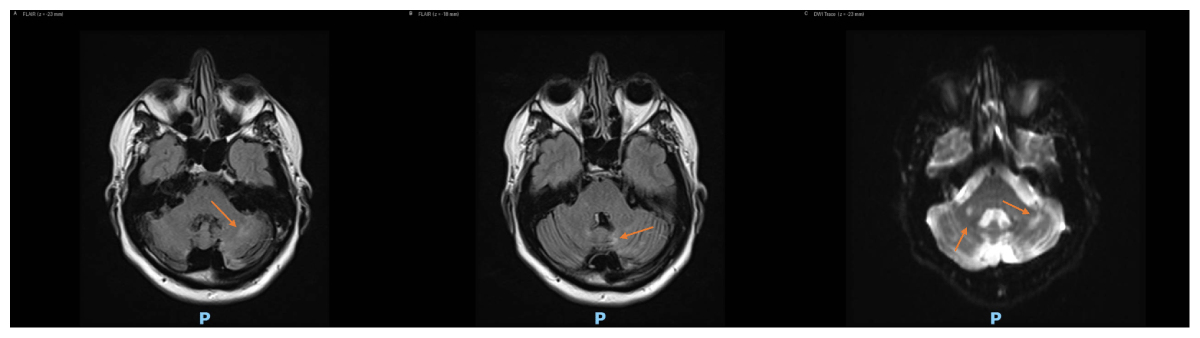
Figure 1
Brain MRI. (A) and (B): Axial FLAIR sequence at two infratentorial levels showing small T2/FLAIR hyperintense foci in both cerebellar hemispheres and the right middle cerebellar peduncle (red arrows), with cerebellar atrophy. (C): Diffusion-weighted imaging (DWI Trace) at the same level demonstrating absence of diffusion restriction, excluding acute ischemic etiology. Findings were stable over a 26-month interval. Images fully deidentified with written patient consent.
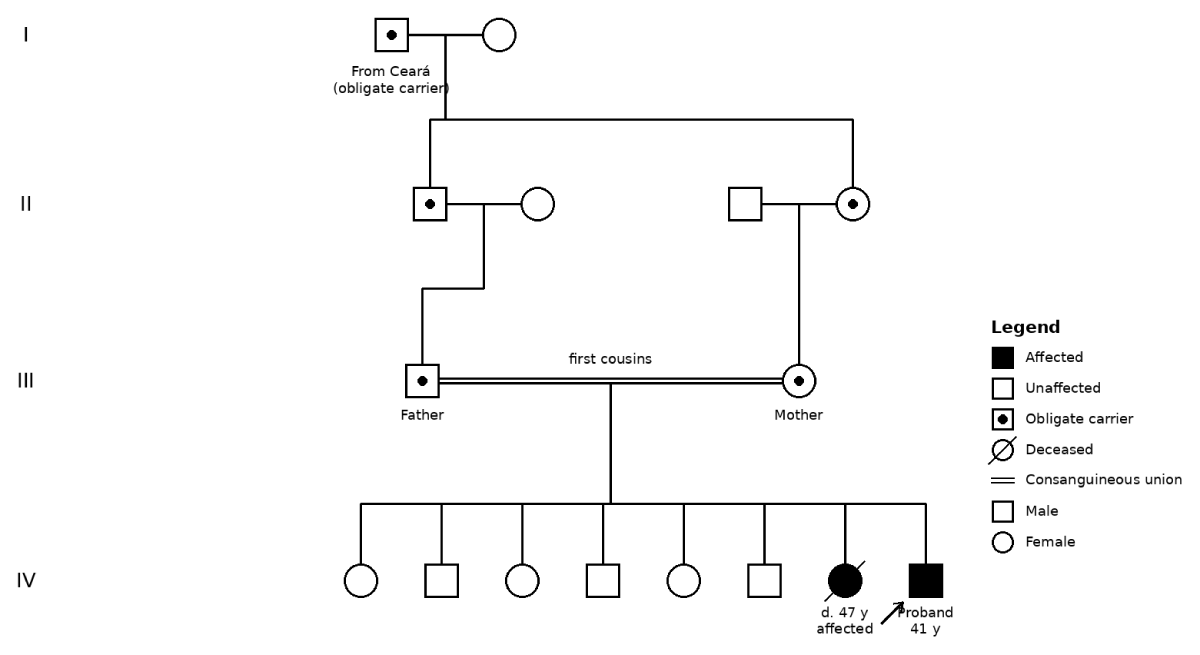
Figure 2
Pedigree of the family. The proband (arrow, generation IV) is an affected male; an affected sister died at age 47. Parents are first-degree cousins (consanguineous union, double line). The paternal great-grandfather from Ceará (generation I) is the presumed obligate carrier through whom the European founder allele entered the lineage. Squares = males; circles = females; filled symbols = affected; central dot = obligate carrier; diagonal line = deceased.
Table 1
Summary of genetic and molecular findings (Mendelics®, BRP448-001).
| PARAMETER | RESULT |
|---|---|
| Laboratory | Mendelics Análise Genômica (CRM-SP 955.471), São Paulo, Brazil |
| Test/Code | Hereditary Neuropathy Panel — BRP448-001 (101 genes) |
| Method | NGS (Illumina) — probe-based target capture; alignment to GRCh38 |
| Quality metrics | 100% target bases ≥ 10 reads; mean depth 87×; 28,860,918 sequences generated |
| Gene (OMIM) | POLG — DNA Polymerase Gamma, Catalytic Subunit (OMIM* 174763) |
| Genomic position | chr15:89,323,426 (GRCh38) |
| cDNA variant | c.2243G>C (ENST00000268124) |
| Protein change | p.Trp748Ser |
| Zygosity | Homozygous (2 copies) |
| ClinVar classification | Pathogenic — Variation ID 13507; score 5/5 |
| Population frequency | Heterozygous in 124/~141,000 individuals (gnomAD); homozygosity extremely rare |
| Molecular diagnosis | Mitochondrial DNA depletion syndrome type 4B (OMIM #613662) |
| Release date | July 20, 2020 |
Table 2
Comparison of the present case with published cases of POLG disease harboring the p.Trp748Ser variant.
| REFERENCE | POLG GENOTYPE | ONSET (YRS) | AXONAL NEUROPATHY | ATAXIA | OPHTHALMOPLEGIA | EPILEPSY | OTHER FINDINGS | OUTCOME |
|---|---|---|---|---|---|---|---|---|
| Hakonen et al., 2005 | p.W748S/p.E1143G hom. | 20–40 | Yes (sensory) | Yes | Yes | Common | Dysarthria; Finnish ancestry | Progressive |
| Hakonen et al., 2007 | p.W748S hom. — multiple European populations | 15–45 | Yes (sensory) | Yes | Yes | Common | Single European founder haplotype confirmed | Progressive |
| Tzoulis et al., 2006 | p.W748S hom. vs A467T/W748S het. comp. (n = 26) | Median 30 | Yes | Yes | Yes (late) | 66% | Longer survival in homozyg. (p = 0.006) | Progressive |
| Van Goethem et al., 2004 | p.W748S + other variants | Adult | Yes (axonal) | Yes, cerebellar | Yes | Yes | No myopathy | Progressive |
| Nuzhnyi et al., 2021 | p.W748S hom. 72.7%; Russian cohort (n = 11) | 30–50 | Yes (axonal) | Yes | Some patients | Rare | Consanguinity in 3/11 | Progressive |
| Present case (Brazil) | p.W748S hom. (c.2243G>C) | 40 | Yes (sensorimotor axonal) | Yes, cerebellar | Fragmented saccades | No | Patient of African descent; N. Minas Gerais/Jequitinhonha Valley; great-grandfather from Ceará; first-degree consanguinity; sensorineural hearing loss; first report in a patient of African descent | Independent ambulation; stable over 2.5 years |
[i] hom. = homozygous; het. comp. = compound heterozygous; NGS = next-generation sequencing.