
Introduction
Mitochondrial diseases associated with POLG gene mutations present a broad clinical spectrum, ranging from severe infantile hepatoencephalopathy to adult-onset ataxic neuropathy syndromes [1, 2]. The POLG gene (chromosome 15q26.1) encodes the catalytic subunit of mitochondrial DNA (mtDNA) polymerase gamma, essential for mtDNA replication and repair. Over 300 pathogenic variants have been identified, causing at least six phenotypic spectra [3, 5].
The ataxic neuropathy spectrum (ANS) — which encompasses the mitochondrial recessive ataxia syndrome (MIRAS) and the sensory ataxic neuropathy, dysarthria, and ophthalmoplegia (SANDO) syndromes — is the most common adult-onset presentation, characterized by the triad of cerebellar ataxia, sensory axonal neuropathy, and ophthalmoplegia, often accompanied by dysarthria, epilepsy, and cognitive impairment [4, 6]. Epidemiological studies suggest that POLG mutations account for a significant proportion of recessive and sporadic ataxias in adults.
The p.Trp748Ser (c.2243G>C) variant is among the best-characterized pathogenic variants in POLG. Haplotype analysis has confirmed that all known carriers in European populations — including Finland, Norway, the United Kingdom, Belgium, Australia, and New Zealand — share a single ancient European founder chromosome [7, 8]. No prior report has documented this variant in a patient of African descent. Critically, POLG-related disorders carry an absolute contraindication to valproic acid (VPA), with fatal outcomes documented in 52% of exposed patients with recessive POLG mutations [10].
We report the first case of the p.Trp748Ser variant in homozygosity in a patient of African descent and discuss the diagnostic, therapeutic, and epidemiological implications.
Case Report
A 41-year-old man of African descent from the Northern Minas Gerais/Jequitinhonha Valley — a region characterized by geographic isolation, predominantly Afro-Indigenous ancestry, and high rates of consanguineous unions — was referred for progressive distal numbness, gait instability, and dysarthria over approximately one year. He described loss of plantar sensation, progressive slowing of cognition, and difficulty with fine motor coordination. He denied smoking; alcohol use was social. Medical history included hypertension, dyslipidemia, and an anxiety disorder, managed with enalapril, rosuvastatin, and paroxetine.
Notably, the anxiety disorder may not be incidental: affective and neuropsychiatric symptoms, including anxiety and depression, are increasingly recognized as part of the phenotypic spectrum of POLG-related disease, and may antedate or accompany the neurological manifestations [2].
Family history was highly informative: his parents were first-degree cousins (he was their eighth child), and a sister had died at age 47 following a progressive, undiagnosed neurological syndrome with phenotypic features identical to his own, ultimately wheelchair-dependent. His paternal great-grandfather was from the state of Ceará — a northeastern Brazilian state with documented European colonization and complex Afro-European genetic admixture since the 16th century — providing a plausible route for the introduction of a European founder allele into the family lineage. The pedigree is shown in Figure 2.
Neurological examination revealed cerebellar dysarthria, mild-to-moderate ataxic gait, areflexia in the lower limbs, preserved upper limb reflexes (2+/4+), and distal length-dependent sensory loss. No fasciculations, muscle atrophy, or pyramidal signs were present. Over the course of follow-up, slowing of ocular movements with fragmented saccades and left-sided sensorineural hearing loss emerged.
An extensive workup to exclude acquired and alternative hereditary causes was unremarkable. Serum lactate and vitamin B12 (473 pg/mL) were normal. A comprehensive immunological screen — including antinuclear antibodies (ANA), extractable nuclear antigen (ENA) antibodies, and anti-transglutaminase (coeliac) antibodies — was negative, as were the thrombophilia screen and urine porphobilinogen. Infectious serologies for HIV, hepatitis B and C, and toxoplasmosis were negative; IgG positivity for cytomegalovirus, Epstein–Barr virus, herpes simplex virus types 1 and 2, and varicella-zoster virus indicated past exposure without evidence of active infection. Notably, genetic testing for hereditary transthyretin (TTR) amyloidosis — a key differential for progressive axonal sensorimotor neuropathy — was negative; this same next-generation sequencing investigation subsequently identified the causative POLG variant (see below).
Three serial electroneuromyographic studies were performed. The first study (lower limbs) demonstrated complete absence of sensory action potentials in the bilateral sural, superficial fibular, and medial plantar nerves, with preserved motor conduction and F-waves. Needle EMG revealed chronic denervation-reinnervation with large-amplitude, long-duration motor unit potentials, reduced recruitment, and sparse spontaneous activity (positive sharp waves) in distal lower limb muscles. This coexistence of chronic reinnervation with sparse active denervation reflects an ongoing, slowly progressive axonal process in which continued denervation is only partially compensated by reinnervation — a pattern consistent with the chronic but active neuropathy of POLG-related disease. The second study (upper limbs) showed mildly reduced sensory amplitudes in median, ulnar, and radial nerves bilaterally with normal conduction velocities and fully preserved motor conduction. The third study (four limbs) confirmed stability without significant electrophysiological progression over seven months.
Brain MRI with gadolinium demonstrated small T2/FLAIR hyperintense foci in both cerebellar hemispheres and the right middle cerebellar peduncle, hypointense on T1, without diffusion restriction or contrast enhancement, associated with cerebellar atrophy (widening of the posterior fossa cerebrospinal fluid spaces). The supratentorial parenchyma was preserved. A follow-up study confirmed stability of these findings over a 26-month interval (Figure 1). The imaging was archived as an axial-only protocol; a dedicated sagittal sequence was not available, which constitutes a minor limitation of the retrospective imaging documentation.
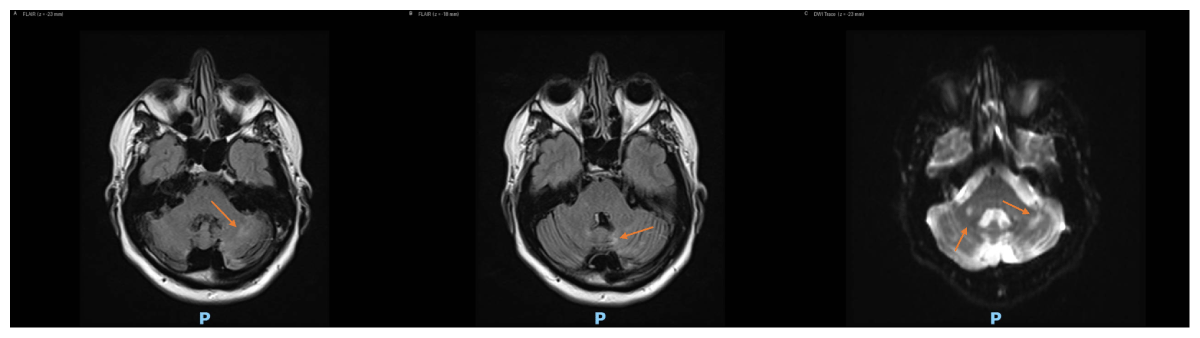
Figure 1
Brain MRI. (A) and (B): Axial FLAIR sequence at two infratentorial levels showing small T2/FLAIR hyperintense foci in both cerebellar hemispheres and the right middle cerebellar peduncle (red arrows), with cerebellar atrophy. (C): Diffusion-weighted imaging (DWI Trace) at the same level demonstrating absence of diffusion restriction, excluding acute ischemic etiology. Findings were stable over a 26-month interval. Images fully deidentified with written patient consent.
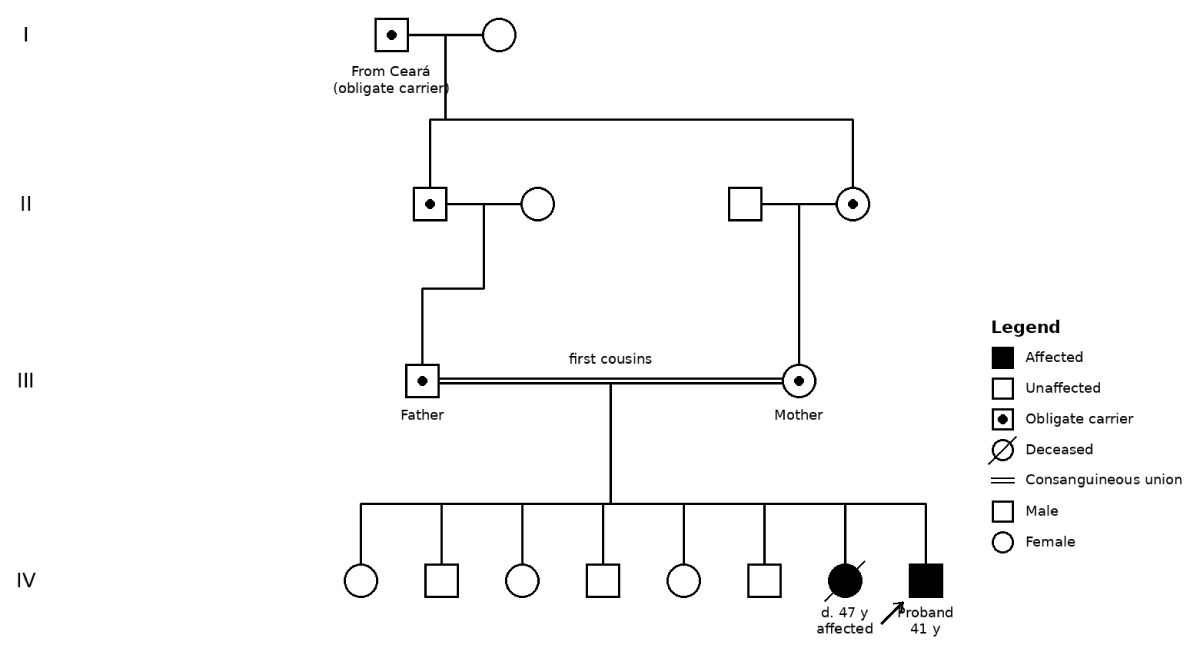
Figure 2
Pedigree of the family. The proband (arrow, generation IV) is an affected male; an affected sister died at age 47. Parents are first-degree cousins (consanguineous union, double line). The paternal great-grandfather from Ceará (generation I) is the presumed obligate carrier through whom the European founder allele entered the lineage. Squares = males; circles = females; filled symbols = affected; central dot = obligate carrier; diagonal line = deceased.
In light of the progressive axonal neuropathy, cerebellar signs, oculomotor abnormalities, and family history consistent with autosomal recessive inheritance in a consanguineous setting, a 101-gene hereditary neuropathy NGS panel was requested (Mendelics Análise Genômica, São Paulo). Technical quality was excellent: 100% target base coverage ≥ 10 reads, mean depth 87×, 28,860,918 sequences generated. A homozygous pathogenic variant was identified in POLG: c.2243G>C (chr15:89,323,426; GRCh38), p.Trp748Ser (ClinVar ID 13507 [12], pathogenic score 5/5), present in heterozygosity in only 124/~141,000 individuals in gnomAD and extremely rare in homozygosity (Table 1).
Table 1
Summary of genetic and molecular findings (Mendelics®, BRP448-001).
| PARAMETER | RESULT |
|---|---|
| Laboratory | Mendelics Análise Genômica (CRM-SP 955.471), São Paulo, Brazil |
| Test/Code | Hereditary Neuropathy Panel — BRP448-001 (101 genes) |
| Method | NGS (Illumina) — probe-based target capture; alignment to GRCh38 |
| Quality metrics | 100% target bases ≥ 10 reads; mean depth 87×; 28,860,918 sequences generated |
| Gene (OMIM) | POLG — DNA Polymerase Gamma, Catalytic Subunit (OMIM* 174763) |
| Genomic position | chr15:89,323,426 (GRCh38) |
| cDNA variant | c.2243G>C (ENST00000268124) |
| Protein change | p.Trp748Ser |
| Zygosity | Homozygous (2 copies) |
| ClinVar classification | Pathogenic — Variation ID 13507; score 5/5 |
| Population frequency | Heterozygous in 124/~141,000 individuals (gnomAD); homozygosity extremely rare |
| Molecular diagnosis | Mitochondrial DNA depletion syndrome type 4B (OMIM #613662) |
| Release date | July 20, 2020 |
The definitive diagnosis of mitochondrial DNA depletion syndrome type 4B (OMIM #613662) was established. Mitochondrial supportive therapy with coenzyme Q10 was initiated. During 2.5 years of follow-up, the patient showed gradual progression of cerebellar ataxia and scanning dysarthria but maintained independent ambulation throughout. Valproic acid was never prescribed; the patient and family were counseled regarding its absolute contraindication.
Discussion
POLG-related diseases represent one of the most heterogeneous groups within mitochondrial encephalomyopathies [2]. The present case illustrates the ANS/SANDO phenotype in a young adult: progressive axonal sensorimotor neuropathy with cerebellar ataxia, dysarthria, and oculomotor involvement in an autosomal recessive consanguineous setting — fully concordant with established diagnostic criteria [4, 6].
The most significant contribution of this report is the identification of the p.Trp748Ser variant in homozygosity in a patient of African descent without documented European ancestry. This variant is one of the most emblematic European founder mutations in rare neurological disease: Hakonen et al. demonstrated by haplotype analysis that all known carrier chromosomes across Finland, Norway, the United Kingdom, Belgium, Australia, and New Zealand trace back to a single ancient European ancestor [8]. To our knowledge, no prior publication has reported this variant — in any zygosity — in a patient of African descent (Table 2).
Table 2
Comparison of the present case with published cases of POLG disease harboring the p.Trp748Ser variant.
| REFERENCE | POLG GENOTYPE | ONSET (YRS) | AXONAL NEUROPATHY | ATAXIA | OPHTHALMOPLEGIA | EPILEPSY | OTHER FINDINGS | OUTCOME |
|---|---|---|---|---|---|---|---|---|
| Hakonen et al., 2005 | p.W748S/p.E1143G hom. | 20–40 | Yes (sensory) | Yes | Yes | Common | Dysarthria; Finnish ancestry | Progressive |
| Hakonen et al., 2007 | p.W748S hom. — multiple European populations | 15–45 | Yes (sensory) | Yes | Yes | Common | Single European founder haplotype confirmed | Progressive |
| Tzoulis et al., 2006 | p.W748S hom. vs A467T/W748S het. comp. (n = 26) | Median 30 | Yes | Yes | Yes (late) | 66% | Longer survival in homozyg. (p = 0.006) | Progressive |
| Van Goethem et al., 2004 | p.W748S + other variants | Adult | Yes (axonal) | Yes, cerebellar | Yes | Yes | No myopathy | Progressive |
| Nuzhnyi et al., 2021 | p.W748S hom. 72.7%; Russian cohort (n = 11) | 30–50 | Yes (axonal) | Yes | Some patients | Rare | Consanguinity in 3/11 | Progressive |
| Present case (Brazil) | p.W748S hom. (c.2243G>C) | 40 | Yes (sensorimotor axonal) | Yes, cerebellar | Fragmented saccades | No | Patient of African descent; N. Minas Gerais/Jequitinhonha Valley; great-grandfather from Ceará; first-degree consanguinity; sensorineural hearing loss; first report in a patient of African descent | Independent ambulation; stable over 2.5 years |
[i] hom. = homozygous; het. comp. = compound heterozygous; NGS = next-generation sequencing.
The identification of the patient’s paternal great-grandfather as a native of Ceará — a Brazilian state with a complex colonial history of Afro-European admixture — provides the most parsimonious biological explanation: the European founder allele likely entered the family lineage through this ancestor in heterozygous state, circulating silently across generations and reaching homozygosity in the proband through first-degree parental consanguinity. This mechanism mirrors other founder allele dynamics described in admixed Afro-Brazilian populations and exemplifies how pathogenic variants of European origin can propagate cryptically in non-European lineages [8].
Electrophysiological stability over seven months and imaging stability over 26 months are consistent with the slowly progressive course documented by Tzoulis et al. in p.W748S homozygotes, who showed significantly longer survival compared to compound heterozygotes (p = 0.006) [9]. The present patient maintained independent ambulation throughout 2.5 years of follow-up, further supporting the relatively favorable prognosis of this genotype.
From a pharmacological standpoint, the diagnosis permitted avoidance of VPA — a critical outcome given the 52% fatality rate documented in POLG-mutation carriers exposed to valproate in a 2023 systematic review [10, 11]. The scoping review by Kalampokini et al. (2025) — published in this journal — reinforces that POLG-related cerebellar ataxia should be systematically included in the differential diagnosis of slowly progressive ataxias, regardless of the patient’s ethnic background [13].
This case also highlights a broader concern in neurogenetics: the underrepresentation of populations of African descent and admixed populations in rare disease genetic research. The presumption that p.Trp748Ser is exclusively European could lead to its omission from diagnostic panels in non-European patients with compatible phenotypes, perpetuating diagnostic invisibility. Our report challenges this assumption and supports expanding POLG screening to patients of any ethnic background presenting with axonal neuropathy and cerebellar signs, particularly in consanguineous settings.
Conclusions
We report the first known case of the POLG p.Trp748Ser variant in homozygosity in a patient of African descent, from the Northern Minas Gerais/Jequitinhonha Valley, Brazil. The probable route of allele introduction via an admixed great-grandfather from Ceará, amplified to homozygosity by consanguinity, exemplifies how European founder variants can manifest in non-European populations. This case underscores the importance of early POLG genetic testing in patients with axonal neuropathy and cerebellar signs regardless of ethnic background, and reinforces the clinical urgency of the diagnosis to prevent fatal valproic acid exposure.
Ethics and Consent
This case report was conducted in accordance with the Declaration of Helsinki. Formal ethics committee approval was not required under applicable Brazilian regulations for deidentified case reports.
Written informed consent for publication of this case report and associated images was obtained from the patient. Images were fully deidentified prior to submission.
Author Contributions
CFM was the treating neurologist, requested and interpreted all diagnostic investigations, established the diagnosis, and drafted the manuscript. LTV and LABE critically revised the manuscript for important intellectual content. All authors approved the final version and agree to be accountable for all aspects of the work.