
1 Introduction
In recent years, artificial intelligence (AI) has moved to the forefront of public and policy debates about the future of music, largely due to the rapid emergence of generative systems and the societal, economic, and legal questions they raise. Public, media, and policy discussions, however, often frame ‘AI and music’ through a narrow lens focused on automated content generation and commercial deployment. This narrowing has contributed to widespread skepticism toward AI technologies in the music sector (Herington et al., 2025). Musicians and creative professionals frequently express concerns about job displacement, loss of artistic agency, cultural homogenization, and the erosion of creative labor, while the music industry faces significant challenges to established business models and copyright frameworks (Oğul, 2024). In this polarized context, broader discussions of AI applications in music—beyond generation and beyond commercial narratives—remain largely underrepresented.
This article argues that the music information retrieval (MIR) community has an important, though unevenly recognized, role to play in these debates. MIR has developed computational approaches for the analysis, understanding, access, and interaction with music, alongside community initiatives and research practices concerned with openness, comparative evaluation, reproducibility, and cultural awareness. These experiences are directly relevant to current questions about how music‑AI systems are documented, evaluated, governed, and used responsibly. They are also relevant to a distinction often blurred in public debate: exploratory research and deployed commercial systems do not raise identical technical, legal, or societal questions, and treating them as equivalent can obscure both the responsibilities of large‑scale deployment and the value of research.
From an MIR perspective, AI in music encompasses far more than generation. It includes music analysis and representation, retrieval and recommendation, education and practice, creative augmentation, and the study and preservation of musical heritage. In this article, AI is used in a broad and pragmatic sense to refer to computational systems designed to perform tasks that typically require human intelligence, most commonly implemented today through machine learning and, in particular, deep learning techniques. Likewise, music is understood not merely as a commercial product, audio signal, or collection of computational objects but as a culturally embedded human practice encompassing diverse traditions, forms of labor, and modes of creation and circulation. This distinction is important because public debate often reduces music to data or commodified outputs. The development and application of AI to MIR tasks should support musical analysis, understanding, creativity, interaction, and access while remaining attentive to the human and cultural processes from which musical data emerges (Holzapfel et al., 2018).
Our aim is therefore not to offer a technical survey of music‑AI but to reposition contemporary debates within a broader research and community context. The article is addressed primarily to the MIR community: researchers, practitioners, educators, and institutions involved in the computational study of music and in the development of music‑AI systems. At the same time, we hope that the discussion will be relevant to adjacent fields, including musicology, human–computer interaction, AI ethics, law, policy, and the creative industries. We briefly introduce MIR as a field and summarize the breadth of its engagement with music‑AI. The main focus of the article is then on how MIR can contribute to current debates on ethics, regulation, and governance and on the concrete priorities through which the community can help shape more trustworthy, open, and culturally inclusive music‑AI.
2 Background
This section situates MIR as a research field and community of practice, focusing on the norms and infrastructures that shape its approach to evaluation, openness, and responsibility in music‑AI.
2.1 The MIR community
The International Society for Music Information Retrieval (ISMIR) is a central institutional hub for the MIR field, supporting research and education through its conferences, publications, and community initiatives (Dixon et al., 2018). These structures have encouraged interdisciplinary exchange, open knowledge‑sharing, methodological reflection, and collaboration across technical and music‑related disciplines. However, interdisciplinary work remains difficult because of differences in methods, terminology, and research practices across fields, limiting the uptake of MIR research in areas such as musicology and highlighting the need for stronger methodological and communicative bridges (Borsan et al., 2023; McKay and Cuenca Rodríguez, 2026).
2.2 Methodological evolution in MIR
MIR is a research field concerned with developing computational methods for processing, analyzing, searching, organizing, and accessing music‑related data, as well as supporting interaction with musical materials. It has developed as an interdisciplinary field combining musicology, information science, cognitive science, signal processing, and statistical modeling (Müller et al., 2011). Its methods have evolved from hand‑crafted features and relatively interpretable models toward data‑intensive deep‑learning approaches centered on learned representations, training protocols, and large datasets (Müller et al., 2019; Peeters et al., 2025). This transition has advanced many established tasks while intensifying questions about generalization, interpretability, scale, and evaluation validity (Gómez et al., 2024).
2.3 Evaluation practices and structural constraints
A distinctive feature of MIR has been its collective approach to comparative evaluation and reproducibility. MIREX established shared tasks, benchmarks, and evaluation procedures (Downie, 2008), while tools such as mir_eval and mirdata have supported standardized evaluation and reproducible dataset use (Raffel et al., 2014; Bittner et al., 2019). These practices operate under persistent structural constraints, including copyright restrictions; annotation costs; and limited access to large, diverse, and multimodal datasets (Gotham et al., 2025). Such constraints distinguish many academic research settings, which have often emphasized openness and shared evaluation, from industrial development based on proprietary resources and deployment‑oriented benchmarks (McFee et al., 2019).
MIR has also increasingly questioned the adequacy of accuracy‑based evaluation alone. Recent work emphasizes the validity of experimental conclusions and the need for perceptual, cultural, repertoire‑aware, and context‑sensitive assessment (Sturm and Flexer, 2023; Weck et al., 2024). These developments support a broader understanding of evaluation aligned with trustworthy and culturally inclusive music‑AI.
2.4 Data and software infrastructures
MIR research relies on shared datasets, repositories, and software spanning audio, symbolic music, metadata, annotations, and multimodal materials. Widely used resources include the RWC Music Database, GTZAN, the Million Song Dataset, MedleyDB, FMA, Freesound1, and Dunya2 (Goto et al., 2002; Tzanetakis and Cook, 2002; Bertin‑Mahieux et al., 2011; Bittner et al., 2014; Defferrard et al., 2017). Other important infrastructures include IMSLP3, MusicBrainz4, Discogs5, Wikipedia6, and OpenScore7, which support symbolic analysis, metadata enrichment, entity linking, and corpus construction.
Because many influential datasets remain copyrighted or non‑redistributable, including resources used for chord recognition and structural analysis, openness in MIR has always involved legal and practical compromises (Harte et al., 2005; Burgoyne et al., 2011; Smith et al., 2011). Concerns about dataset flaws, bias, representativeness, and benchmark overfitting have consequently motivated stronger attention to documentation, cultural diversity, and multimodal coverage (Morreale et al., 2023; Born, 2020; Gotham et al., 2025).
Open‑source software has complemented these resources by enabling transparent and reproducible workflows. Examples include MIRtoolbox, Sonic Visualiser, Essentia, librosa, Humdrum, music21, and Partitura (Lartillot et al., 2008; Cannam et al., 2010; Bogdanov et al., 2013; McFee et al., 2015; Huron, 2002; Cuthbert and Ariza, 2010; Cancino‑Chacón et al., 2022). By contrast, the open release and governance of music‑AI models remains less mature, particularly for large generative systems (Batlle‑Roca et al., 2025).
The methodological evolution and supporting infrastructures discussed in this section, together with the principal application areas introduced in the following section, are summarized in Table 1.
Table 1
Overview of the methodological evolution, shared infrastructures, and main application areas of MIR, from music analysis and representation to interactive systems and generation.
3 AI in MIR: Analysis, Interaction, and Generation
MIR research has engaged with AI across a broad range of musical representations and applications, including audio, symbolic scores, lyrics and text, metadata, images, performance data, and multimodal combinations of these materials. Its applications extend from analysis and retrieval to education, interaction, creative support, and cultural heritage. These areas reflect concerns central to contemporary music‑AI, including interpretability, evaluation, cultural awareness, and human‑centered design.
These applications rely on computational representations that are necessarily selective and culturally situated, particularly when systems make claims about musical meaning, similarity, emotion, creativity, or cultural value.
MUSIC DATA ARE NOT MUSIC ITSELF
Recordings, scores, lyrics, metadata, and annotations are partial and situated representations of musical life. Their interpretation and responsible use require attention to the people, practices, and contexts from which they originate.
3.1 Music analysis and representation
A central contribution of MIR has been the development of computational methods for analyzing and representing music across audio, symbolic, textual, visual, and multimodal forms. These include automatic transcription, harmonic and structural analysis, source separation, tempo and beat tracking, and music similarity, among other tasks (Benetos et al., 2019; Pauwels et al., 2019; Nieto et al., 2020; Rouard et al., 2023; Foscarin et al., 2024; Volk et al., 2016). Such methods produce structured representations that support scientific inquiry, retrieval, musicological analysis, education, recommendation, and creative applications. These representations are necessarily selective, however, and their validity depends on how appropriately they relate computational outputs to the musical phenomena and contexts being studied.
3.2 MIR systems for access, interaction, and musical practice
MIR has also developed systems that support access to musical collections; interaction with musical materials; and participation in learning, listening, performance, and creative practice. Recommendation, retrieval, categorization, visualization, and browsing systems enable users to navigate large collections and discover relationships among recordings, scores, metadata, and other musical resources (Schedl et al., 2022; Knees and Schedl, 2016; Knees et al., 2020; Goto and Dannenberg, 2019). Related research addresses performance analysis, educational feedback, score‑following, accompaniment, and interactive machine learning, often emphasizing human control and collaboration rather than autonomous content production (Lerch et al., 2020; Dannenberg and Raphael, 2006; Nistal et al., 2024). MIR methods have also supported the study, documentation, and preservation of Western classical, popular, and culturally diverse musical traditions (Weiß et al., 2019; Oramas et al., 2025; Serra, 2011; Duan et al., 2023).
3.3 Music generation
Music generation is connected to MIR research through symbolic modelling, statistical learning, analysis, and interactive systems. Generative and discriminative approaches frequently share representations and model architectures, with related methods being applied to transcription, beat‑tracking, representation learning, source separation, transformation, and generation (Hawthorne et al., 2018; Zhao et al., 2022; Flores Garcia et al., 2023; Li et al., 2024; Rouard et al., 2023). Contemporary generation spans audio, symbolic, and multimodal settings, including score and event‑sequence generation; harmonization; accompaniment; performance rendering; and systems connecting language, notation, and sound.
What distinguishes recent generative music‑AI is therefore less the appearance of entirely new modeling principles than a shift in scale, modality, accessibility, and degree of autonomy. Among recent audio‑generation systems, common approaches use either continuous latent representations combined with diffusion models or discrete representations derived from neural audio coding and autoregressive models (Pasini et al., 2024; Agostinelli et al., 2023; Défossez et al., 2023). Although these systems offer substantial generative capabilities, their limited transparency, controllability, accessibility, and reproducibility create important challenges for scientific scrutiny and meaningful human–AI interaction.
4 Ethics and Regulation in Music‑AI Research
Building on the methodological, evaluative, and infrastructural practices discussed earlier, the increasing prominence of AI in music brings ethical, legal, and broader policy questions to the center of music‑AI research. Policy may include not only regulation but also public investment, education and skills development, research funding, standards, and institutional governance. This section focuses primarily on the relationship between ethical principles, which generally provide non‑binding guidance, and regulation, which establishes legally enforceable obligations. These considerations shape how systems are designed, evaluated, deployed, and interpreted by society. In MIR, engaging with ethics and regulation is therefore not merely a matter of compliance but a core dimension of responsible scientific practice. This section situates music‑AI within broader ethical and legal frameworks, highlights challenges specific to music as a cultural domain, and argues that emerging regulatory and governance requirements open up important research directions for MIR.
4.1 Ethical and legal frameworks
The rapid expansion of AI applications in music both intensifies existing ethical and legal questions and introduces new ones that extend beyond technical performance or usability. Ethical frameworks articulate values, responsibilities, and societal expectations, whereas legal frameworks define enforceable rules and compliance requirements (Floridi et al., 2018). Both are essential for guiding responsible innovation.
Across policy, standards, and research communities, these concerns have converged around the concept of trustworthy AI. International and regional frameworks developed by UNESCO (2021), the European Commission (2019), the Organisation for Economic Co‑operation and Development (OECD, 2019), IEEE (2019), and the National Institute of Standards and Technology (NIST, 2023) emphasize principles such as human rights, transparency, fairness, accountability, human oversight, technical robustness, and environmental sustainability. UNESCO’s Recommendation on the Ethics of Artificial Intelligence is particularly relevant as a globally adopted framework that connects ethical principles with concrete areas of policy action. In the music domain, these principles acquire specific meaning through data practices, evaluation methodologies, cultural representation, and deployment contexts that MIR research has long engaged with.
4.2 Ethical challenges specific to music‑AI
Ethical challenges in music‑AI stem from music’s role as a creative, cultural, and social practice. Respect for creative integrity is central: AI systems should support musicians and musical communities rather than obscure authorship or replace human agency. Closely related are issues of attribution and credit, particularly when systems are trained on musical corpora whose provenance and labor histories are not always visible.
These concerns extend beyond the status of musical works and datasets to the people whose activity makes those materials possible. Recordings and other musical resources embody the labor and decisions of composers, performers, producers, engineers, annotators, and other cultural workers. When such materials are treated primarily as training data, these contributions may become obscured, particularly when consent, attribution, compensation, and control over reuse are unclear. Ethical analysis should therefore consider not only what data a system uses but also whose work and agency are represented in that data, who benefits from its use, and who bears the resulting risks (Hubbles et al., 2026).
Cultural sensitivity constitutes a further ethical concern. Music is shaped by culturally specific meanings, practices, and structural conventions, and computational approaches risk misrepresentation when context is ignored (Holzapfel et al., 2018; Huang et al., 2023). Bias awareness therefore extends beyond technical fairness to questions of representation, visibility, and access across repertoires (Porcaro et al., 2021).
A further challenge is the opacity of many music‑AI systems. Limited information about training data, model design, evaluation procedures, and system limitations can make it difficult for researchers, musicians, and users to understand how outputs are produced, assess their reliability, or contest harmful or misleading results. Transparency is therefore not only a technical requirement but also an ethical condition for informed use, meaningful scrutiny, and accountability (Bryan‑Kinns et al., 2025).
Ethical responsibility also includes how humans interact with music‑AI systems. Systems should support informed use by communicating limitations, uncertainty, and appropriate contexts, thereby enabling meaningful human–machine collaboration. Finally, ethical reflection must address power and governance: the concentration of data, models, and infrastructures raises questions about who controls musical technologies and whose interests they serve (Morreale, 2021).
4.3 Research and development contexts
Public debate often blurs a key distinction between exploratory research and the commercial deployment of music‑AI systems. Although the boundary is not always clear and legal treatment varies across jurisdictions, the two contexts differ in their typical purposes, scale, responsibilities, and consequences, as summarized in Table 2. In some jurisdictions, scientific research benefits from specific exceptions or limitations, particularly those related to text and data mining. In the European Union, such exceptions permit the analysis of copyrighted works for research under defined conditions (EU, 2019, 2024), while the AI Act also excludes certain research, testing, and development activities from its scope. In particular, Article 2(8) provides that the Act does not apply to activities concerning AI systems or models before they are placed on the market or put into service, although the exclusion does not cover testing in real‑world conditions and remains subject to other applicable EU law (EU, 2024; Meszaros et al., 2026). The Act separately excludes systems or models specifically developed and put into service solely for scientific research and development under Article 2(6). These provisions nevertheless leave important ambiguities around mixed academic–commercial projects, evolving intended uses, and the transition from laboratory research to real‑world deployment (Meszaros et al., 2026). In the United States, related research practices have been enabled through interpretations of ‘fair use’ (Sag, 2019).
Table 2
Indicative distinctions between exploratory research and commercial deployment in music‑AI; their boundaries vary across jurisdictions and use cases.
| Exploratory Research | Commercial Deployment | |
|---|---|---|
| Purpose | Scientific exploration, methodological development, and validation | Operational use, market delivery, and sustained user‑facing services |
| Scale and context | Prototypes, controlled studies, restricted access, and pre‑deployment testing; datasets and models may still be large | Systems placed on the market or put into service, often with broad access, continuous operation, and substantial impact |
| Legal context | May benefit from research exceptions or exclusions, including text and data mining provisions, fair‑use interpretations, and some pre‑deployment activities under the EU AI Act; other laws still apply | Subject to applicable licensing, contractual, consumer‑protection, risk‑management, and sector‑specific requirements |
| Responsibilities | Research integrity, documentation, reproducibility, ethical review, disclosure of limitations, and legal compliance | Licensing, accountability, user transparency, risk management, monitoring, consumer protection, and regulatory compliance |
| Evaluation | Scientific validity, robustness, generalization, and reproducibility | Real‑world reliability, user impact, safety, fairness, and ongoing monitoring |
| Failure risks | Invalid claims, misleading results, and wasted research resources | Harm to users, creators, communities, markets, and public trust |
By contrast, commercial deployment is subject to stricter legal and ethical obligations, including licensing, accountability, and consumer protection (Oğul, 2024). Research prototypes typically prioritize exploration and validation rather than scale or market impact. Treating exploratory research as equivalent to deployed products risks constraining legitimate research without addressing the responsibilities associated with large‑scale commercial use.
4.4 Copyright and generative music‑AI
Copyright law has become one of the most contested areas in relation to generative music‑AI (e.g., District Court of Massachusetts, 2024). Designed for pre‑digital modes of creation and distribution, its assumptions about authorship, originality, and human intent are increasingly challenged by data‑driven generative systems (Sobel, 2017). Legal questions surrounding training data, model outputs, attribution, and rights allocation remain unsettled and vary across jurisdictions (Sturm et al., 2019).
These tensions have prompted continuing debate about whether and how existing legal approaches should be clarified or adapted to distinguish research from commercial use, improve consistency, and balance the interests of creators, users, and technology developers (Lucchi, 2025).
Copyright provides only a partial account of these concerns. Even where the use of musical material may be legally permitted, questions remain about consent; recognition; compensation; creative labor; and the distribution of benefits and harms among musicians, producers, platforms, and technology developers.
4.5 Regulation as a research driver
Recent regulatory developments are actively shaping music‑AI research agendas. The AI Act (EU, 2024), for example, introduces transparency obligations for generative AI and explicitly calls for mechanisms to mark and identify AI‑generated audio while also acknowledging the absence of mature technical solutions. Similar priorities appear in international frameworks such as the Organisation for Economic Co‑operation and Development (OECD) AI Principles (Oğul, 2024) and the National Institute of Standards and Technology (NIST) AI Risk Management Framework (NIST, 2023).
For MIR, these developments represent research opportunities rather than mere compliance challenges (Serra et al., 2026). Topics such as content marking, watermarking, fingerprinting, metadata management, provenance tracking, and forensic analysis overlap with established areas of MIR expertise and create opportunities for the field to contribute methods for more auditable and trustworthy music‑AI systems.
4.6 Scientific principles
Based on the ethical and legal frameworks reviewed above, the music‑specific challenges identified in Sections 4.2 to 4.5, and the scientific practices discussed earlier in relation to MIR evaluation and research infrastructures, we identify four principles that are particularly relevant to current debates on music‑AI: transparency, accountability, provenance, and sustainability, as summarized in Table 3. These principles were selected through discussion among the authors as a concise synthesis of recurring concerns across trustworthy AI frameworks and MIR research. They are not intended as an exhaustive or entirely novel framework, nor as independent or mutually exclusive categories. Rather, they provide an organizing structure for connecting broad ethical and regulatory expectations with areas in which the MIR community has relevant methodological experience, while also making visible important limitations and gaps in current practice. Fairness, diversity, and bias awareness are not presented as a separate fifth principle but instead as cross‑cutting concerns that should inform the interpretation and application of all four principles.
Table 3
Proposed and interconnected principles for critically assessing current MIR research practices and guiding future work in trustworthy music‑AI.
These principles are not unique to AI ethics or recent regulatory frameworks; they are also long‑standing aspirations of responsible scientific practice across disciplines. Within MIR, they acquire a particularly concrete meaning because of the field’s engagement with complex musical data, subjective and culturally situated evaluation criteria, copyrighted materials, and computationally demanding methods. Elements of these principles can be found in existing MIR research practices, infrastructures, and community initiatives, but their adoption remains uneven and is often constrained by technical, legal, institutional, and economic factors. We therefore present them not as a description of established community‑wide practice but as criteria against which current practices can be critically assessed and future work can be guided.
Transparency in music‑AI refers to making the assumptions, inputs, and limitations of systems explicit. This includes clear documentation of model architectures and design choices; evaluation protocols; and the communication of known biases, uncertainties, uneven performance across repertoires and communities, and appropriate use contexts. Such transparency is particularly important in benchmark‑driven research, where improvements in aggregate metrics may obscure design complexity or fail to reflect the underlying musical problem. Transparency enables meaningful scrutiny of system behavior and supports reproducibility and informed interpretation of results.
Accountability concerns the ability to assign responsibility for the development, evaluation, and deployment of music‑AI systems. It can be supported through documented datasets; reproducible experimental pipelines; appropriate and culturally diverse benchmarks; and explicit reporting of failure cases and limitations across repertoires, populations, and contexts. In practice, however, benchmark‑driven and publication‑oriented incentives may discourage methodological simplicity, replication, negative results, and the reporting of unsuccessful projects. Accountability therefore depends not only on research procedures, but also on publication and institutional structures that make claims, errors, and failures open to scrutiny and correction.
Provenance addresses the traceability of musical data and model outputs: where they originate, how they were curated or annotated, and which processing steps they have undergone. From an MIR perspective, provenance encompasses licensing and data origin; annotation procedures; preprocessing operations such as segmentation, augmentation, cleaning, and deduplication; model lineage; and output traceability. Metadata standards, fingerprinting, watermarking, and identification techniques can contribute to verification, attribution, and auditing, but they do not guarantee complete provenance. Large‑scale web collection, automated curation, incomplete metadata, and repeated dataset reuse make traceability an increasingly difficult and unresolved challenge.
Sustainability has both environmental and infrastructural dimensions. Environmentally, it involves awareness of the computational and energy costs of training and deploying music‑AI systems, including transparent reporting of model scale and resource use. Infrastructurally, it concerns the long‑term viability of the scientific ecosystem—the maintenance; governance; and accessibility of datasets, tools, benchmarks, and educational resources beyond individual projects or funding cycles.
Taken together, these principles provide criteria for critically assessing current MIR practices and identifying priorities for future work. Progress will require more than individual commitments: it will depend on community‑level incentives, sustained infrastructures, appropriate governance mechanisms, and institutional support. This is particularly important for early career researchers, who may face strong pressure to prioritize short‑term publication outcomes over activities such as documentation, replication, infrastructure maintenance, and the reporting of negative results. Recognizing and rewarding these contributions is therefore necessary to make transparent, accountable, traceable, and sustainable research feasible across different institutions, resource levels, and career stages.
5 Interconnected Priorities for Trustworthy Music‑AI
Building on the preceding principles and ethical considerations, we identify six interconnected priorities for the MIR community, summarized in Table 4. They address the infrastructures, research practices, institutional arrangements, and collaborations through which music‑AI is developed and governed while also recognizing that progress requires engagement with musicians, industry, policymakers, and adjacent academic fields. Given the rapid deployment of generative music systems and the ongoing development of regulatory and industry practices, these priorities require near‑term community attention as well as sustained long‑term commitment.
Table 4
Six interconnected and mutually reinforcing priority areas for advancing trustworthy music‑AI that is open, culturally inclusive, and ethically grounded.
5.1 Collective and mission‑oriented collaboration
Many of the key challenges in music‑AI—including transparency and provenance, cultural representation, copyright ambiguity, evaluation complexity, and environmental sustainability—cannot be addressed through isolated projects or short‑term initiatives. They call instead for mission‑oriented efforts that bring together machine learning, signal processing, musicology, human–computer interaction, ethics, law, policy, and artistic practice. Such initiatives require durable collaborations and shared agendas that extend beyond individual projects or funding cycles. From an MIR perspective, an important contribution lies in helping ensure that technological development remains connected to musical knowledge, ethical reflection, and engagement with diverse musical communities while also strengthening the mutual intelligibility needed for sustained exchange with adjacent fields.
Within the ISMIR community, such shared agendas can be shaped through conference themes and calls for papers, special sessions and community initiatives, funding priorities, peer‑review criteria, and recognition or incentives for forms of work that support collective goals.
5.2 Sustaining open infrastructures
Open datasets, models, and tools have been central to music‑AI research, but their long‑term viability increasingly depends on stable funding, institutional stewardship, and collaborative governance. Key challenges include long‑term hosting and curation; clear documentation of provenance and licensing; and governance structures that support maintenance, inclusivity, and accountability. As proprietary models and closed datasets become more prevalent, the continued availability of robust public infrastructures is essential to preserve reproducibility, transparency, and scientific independence—while also acknowledging the practical limits and responsibilities associated with openness. These infrastructures should also be guided by FAIR principles—making research resources Findable, Accessible, Interoperable, and Reusable (Wilkinson et al., 2016)—as a basis for improving their accessibility, interoperability, documentation, and long‑term reuse.
OPENNESS IS MORE THAN RELEASE
Making datasets, models, and tools available is only a first step. Sustainable openness requires documentation, maintenance, governance, clear provenance and licensing, and long‑term institutional support.
In the context of ISMIR, dedicated grants and collective funding mechanisms could support shared datasets, software, benchmarks, and repositories, while distributing maintenance and governance across institutions rather than individual laboratories.
5.3 Toward rigorous and context‑ sensitive evaluation
Evaluation plays a decisive role in shaping research incentives and deployment decisions. In music‑AI, meaningful evaluation extends beyond accuracy metrics to include perceptual relevance, cultural validity, fairness, robustness across repertoires, and ecological validity. Future work should therefore prioritize transparent and auditable evaluation pipelines; benchmarks that reflect musical diversity and context; and explicit documentation of assumptions, limitations, uncertainty, and failure cases. At the same time, it is important to acknowledge that evaluation—especially for generative systems—remains an open and difficult problem, requiring continued methodological research and critical scrutiny rather than definitive solutions.
Within ISMIR, community‑supported open‑source tools, benchmarks, repositories, and reporting templates could facilitate maintenance, auditing, replication, and the gradual inclusion of new repertoires and evaluation criteria. Conference and peer‑review guidelines could encourage their use and contribution.
5.4 Cultural diversity, inclusion, and responsibility
Music‑AI systems influence how musical cultures are represented, accessed, and valued. Ensuring that these systems do not reinforce existing forms of inequity or distort cultural practices is both a scientific and ethical challenge. Work in this area must emphasize the inclusion of underrepresented repertoires, sustained collaboration with musicians, cultural practitioners and community experts, culturally informed annotation and evaluation practices, and safeguards against extractive or exploitative data use. Rather than treating diversity as an auxiliary concern, music‑AI research must integrate cultural responsibility into its core methodological choices.
Within the ISMIR community, this could be supported through dedicated conference topics and calls for papers, special sessions, workshops, and community‑led initiatives focused on underrepresented musical traditions and research perspectives. Travel grants, fee waivers, mentoring schemes, and targeted support for researchers and practitioners from underrepresented regions could lower barriers to participation.
5.5 Bridging research, industry, policy, and society
As music‑AI becomes increasingly entangled with legal, economic, and cultural structures, sustained dialogue across sectors is essential. Research alone cannot determine acceptable uses, resolve questions of attribution and rights, or establish appropriate governance arrangements, while policy and industry discussions risk becoming technically unrealistic when disconnected from research evidence and musical practice. MIR can contribute by clarifying the capabilities and limitations of current technologies; developing shared vocabularies around transparency, provenance, attribution, and robustness; and providing empirical evidence for standards and policy discussions. Cross‑sector engagement should also examine how music‑AI systems redistribute visibility, income, labor, control, and bargaining power, since recommendation, rights‑identification, source‑separation, and generative systems can affect which artists are discovered, whose work is monetized, and who controls the conditions of musical production and circulation. Shared approaches to documentation, metadata, licensing, content identification, and traceability are therefore important for supporting attribution, auditing, regulatory compliance, and responsible reuse across research and commercial settings.
Within the ISMIR community, this engagement could be strengthened by establishing a dedicated policy and governance strand in the conference program, comparable to the existing industry program. It could include invited panels, policy‑oriented papers, workshops, and structured discussions involving researchers, musicians, industry representatives, policymakers, legal experts, and civil society organizations.
5.6 Education and capacity‑building
The long‑term impact of music‑AI will depend on the capacity of musicians, researchers, educators, and policymakers to critically engage with these technologies. Education should combine MIR and machine learning with musical knowledge, ethics, law, cultural studies, and reflection on the social and economic contexts in which AI systems operate. Capacity‑building should be reciprocal: musicians and cultural practitioners need opportunities to understand and influence AI systems, while technical researchers need to recognize forms of musical, cultural, and professional knowledge that cannot be reduced to computational data. This requires accessible tools and documentation, interdisciplinary curricula, participatory design activities, and opportunities for exchange between technical and non‑technical communities. It must also address unequal access to technical and financial resources so that a wider range of institutions and communities can participate in shaping datasets, models, standards, and research agendas.
Within the ISMIR community, these goals could be supported through tutorials, summer schools, doctoral consortia, mentoring programs, and conference activities that bring together technical researchers, musicians, educators, legal scholars, and policymakers. Dedicated grants, fee waivers, travel support, open educational resources, and partnerships with institutions in underrepresented regions could broaden access to training and participation.
These priorities form a connected agenda. Open infrastructures support transparent and reproducible evaluation; meaningful evaluation depends on culturally appropriate data, concepts, and expertise; responsible governance requires collaboration across research, industry, policy, and musical communities; and education is a factor determining who can participate in these processes. Advancing trustworthy music‑AI therefore requires coordinated investment in people, infrastructures, methods, and institutional arrangements, together with incentives that recognize transparency, cultural responsibility, interdisciplinary collaboration, and long‑term stewardship. These efforts should ultimately be assessed by whether they contribute to music‑AI that is scientifically robust, ethically grounded, culturally inclusive, human‑centered, openly governed, and sustainable.
6 Conclusion
This article has argued that the MIR community has both relevant experience and significant responsibilities in current debates on AI and music. Recent generative systems intensify, rather than replace, long‑standing questions about evaluation, transparency, cultural representation, and the relationship between computational systems and musical practice. Addressing these questions requires technical innovation together with interdisciplinary reflection on how music‑AI systems are built, evaluated, governed, and embedded in cultural and societal contexts.
Music poses distinctive challenges for AI research that make these issues particularly acute. Musical structure is rich and hierarchical, yet much of it is tacit and resistant to explicit formalization. Musical meaning admits multiple, context‑dependent interpretations, complicating evaluation and the notion of ground truth. Music is a cultural practice rather than a neutral data domain. As a result, diversity, representation, and power relations become central concerns. It is also closely tied to creativity and human agency, which heightens ethical questions around authorship, attribution, and control. Finally, music provides a demanding test case for transparency and provenance, where data origin, rights, and transformation histories are both technically complex and socially consequential. MIR should therefore treat music data as partial and situated representations, whose validity and responsible use depend on their relationship to the people, practices, and institutions from which they originate.
For the MIR community, this implies not only an opportunity but also an obligation: to confront unresolved methodological limitations, move beyond narrow benchmark optimization, and develop evaluation practices that meaningfully reflect musical, cultural, and societal values. It also implies engaging more directly with questions of traceability, responsibility, sustainability, fairness, and power asymmetries as music‑AI systems scale beyond research contexts. These concerns should inform both individual research and the community structures through which priorities and incentives are established.
Figure 1 summarizes the article’s central argument: the ethical, legal, cultural, and scientific challenges of music‑AI should inform principles for assessment, which in turn should guide priorities for collective action. These priorities are intended to advance music‑AI that is scientifically robust and transparent; ethically grounded, fair, and socially accountable; culturally inclusive and human‑centered; and open, collectively governed, and sustainable.
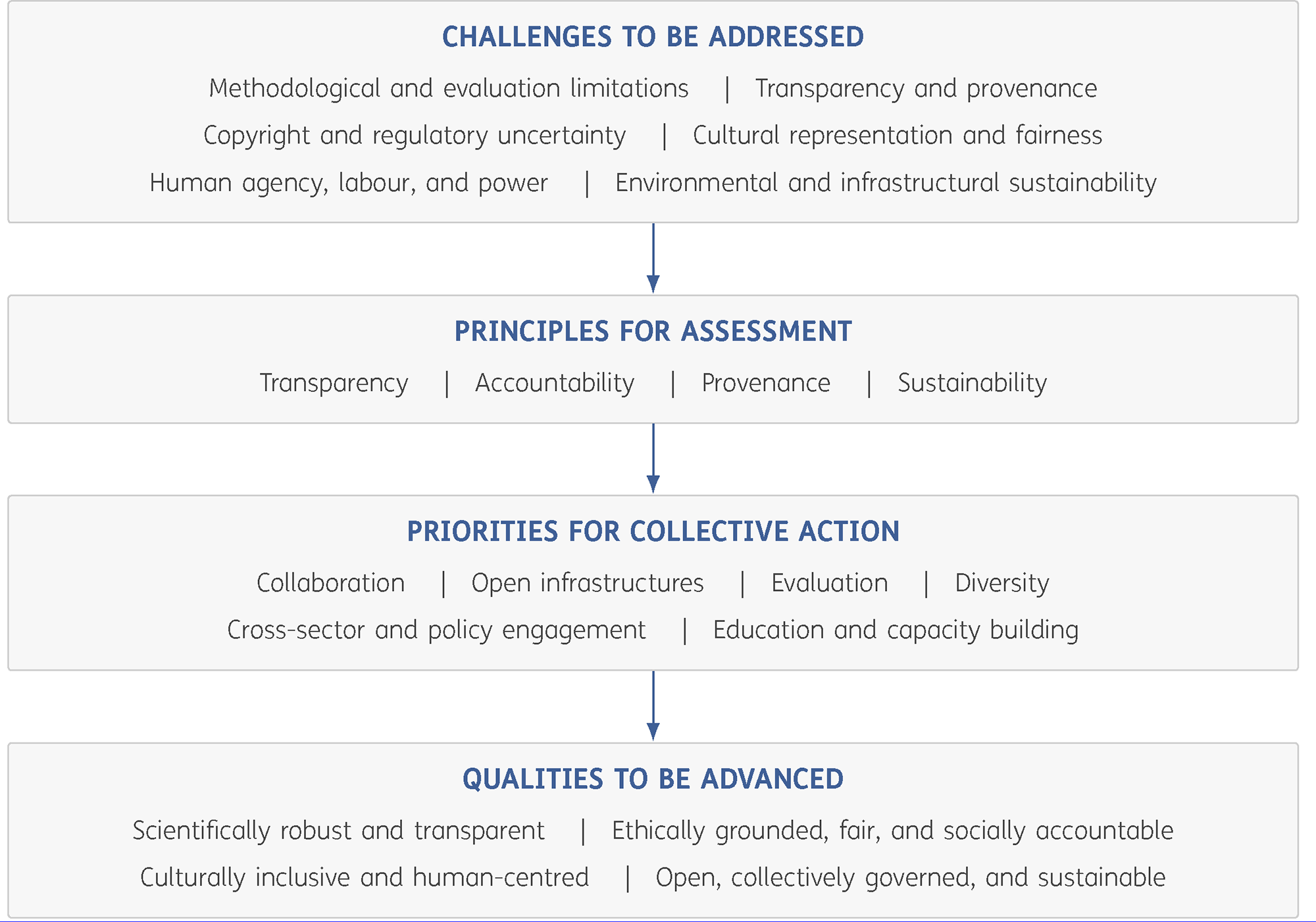
Figure 1
Conceptual framework connecting music‑AI challenges with principles for assessment, priorities for collective action, and the desired qualities of trustworthy music‑AI.
The path forward is therefore not one of merely consolidating past practices but of extending and reworking them. Progress will depend on sustaining auditable, open‑source, and collectively governed infrastructures for data, models, tools, and evaluation; developing more transparent, context‑sensitive, fair, and culturally responsible research practices; strengthening long‑term collaboration among researchers, musicians, cultural practitioners, humanities scholars, policymakers, industry, and civil society; and creating reciprocal forms of education and capacity‑building. For MIR to play a constructive role in shaping the future of music‑AI, it should do so not by claiming authority but instead by taking responsibility: guiding research and development in ways that respect musical practices; acknowledge cultural plurality; make power and resource asymmetries visible; and contribute to scientifically robust, socially accountable, and ethically grounded uses of AI in music.
Notes
[1] https://freesound.org/, Accessed 2026‑02‑08
[2] https://dunya.compmusic.upf.edu/, Accessed 2026‑02‑08
[3] https://imslp.org/, Accessed 2026‑02‑08
[4] https://musicbrainz.org/, Accessed 2026‑02‑08
[5] https://www.discogs.com/, Accessed 2026‑02‑08
[6] https://www.wikipedia.org/, Accessed 2026‑02‑08
[7] https://fourscoreandmore.org/openscore/, Accessed 2026‑04‑14
Ethics and Consent
Not applicable. This article does not report research involving human participants, personal data collection, or experimental procedures requiring ethical approval or informed consent.
Data Accessibility
No new data were created or analyzed specifically for this article. The datasets, software resources, and other research infrastructures discussed in the article are publicly described in the cited references and associated resources.
Competing Interests
The following authors are part of the TISMIR editorial team: Meinard Müller (Editor in Chief), Arthur Flexer (Editorial Board), Dasaem Jeong (Editorial Board), Juhan Nam (Editorial Board), Geoffroy Peeters (Editorial Board), Preeti Rao (Editorial Board), Bob L. T. Sturm (Editorial Board), and Li Su (Editorial Board).
Authors’ Contributions
Xavier Serra initiated and led the article’s development and coordinated its overall framing and drafting. All authors contributed through open discussion, critical review, and revision of the manuscript, which was also substantially refined in response to the reviewers’ comments. The extended author list is intended not to represent a closed or formally representative group but to reflect broad engagement with and endorsement of the position advanced in the article by researchers with diverse experience across the MIR community.