
Figure 1
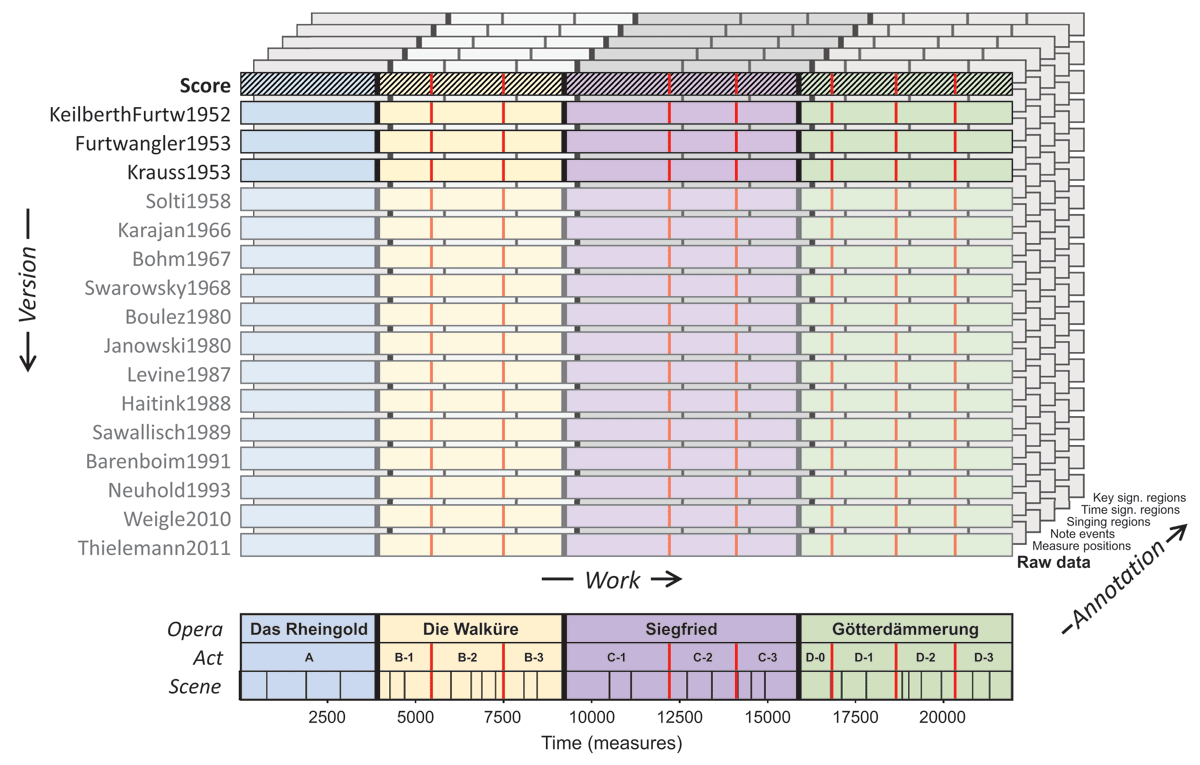
Overview of the WRD. The lower part sketches the Ring’s hierarchical structure according to operas, acts, scenes, and measures. We consider the act level as the crucial layer for organizing our data (acts separated by red lines). The cell width is proportional to musical duration given in measures. The upper part illustrates the multitude of versions (score and 16 recorded performances) as well as the available annotations.
Table 1
Organization of Richard Wagner’s Ring cycle introducing our naming convention.
| Catalogue No. | Opera | OperaID | Act | ActID | Full WorkID | ShortID | # Measures |
| WWV 86 A | Das Rheingold | WWV086A | – | – | Wagner_WWV086A | A | 3897 |
| WWV 86 B | Die Walküre | WWV086B | Act 1 | 1 | Wagner_WWV086B-1 | B1 | 1523 |
| Act 2 | 2 | Wagner_WWV086B-2 | B2 | 2065 | |||
| Act 3 | 3 | Wagner_WWV086B-3 | B3 | 1732 | |||
| WWV 86 C | Siegfried | WWV086C | Act 1 | 1 | Wagner_WWV086C-1 | C1 | 2983 |
| Act 2 | 2 | Wagner_WWV086C-2 | C2 | 1910 | |||
| Act 3 | 3 | Wagner_WWV086C-3 | C3 | 1789 | |||
| WWV 86 D | Götterdämmerung | WWV086D | Prologue | 0 | Wagner_WWV086D-0 | D0 | 892 |
| Act 1 | 1 | Wagner_WWV086D-1 | D1 | 1844 | |||
| Act 2 | 2 | Wagner_WWV086D-2 | D2 | 1704 | |||
| Act 3 | 3 | Wagner_WWV086D-3 | D3 | 1600 | |||
| WWV 86 | –FULL RING– | WWV086 | – | – | Wagner_WWV086 | 21939 |
Table 2
Performances of the Ring contained in the WRD. In performance 01, W. Furtwängler only conducts Die Walküre (which differs from performance 02), the other parts are conducted by J. Keilberth. † For performance 01 (KeilberthFurtw1952), we found no ReleaseID for the full Ring in MusicBrainz but instead use the ReleaseID of Die Walküre.
| No. | PerformanceID | Conductor | Year(s) | Orchestra | Label | MusicBrainz ReleaseID | Duration |
| 01 | KeilberthFurtw1952 | J. Keilberth/W. Furtwängler | 1952–54 | Bayreuther Festspiele | ZYX | 7955db62-60d2-4c1f-8f4d-2a8ac69ff104† | 14:19:56 |
| 02 | Furtwangler1953 | W. Furtwängler | 1953 | Orch. Sinfonica Roma RAI | EMI Rec. | 66ebc811-49b3-4de2-b6eb-1f56f0995c29 | 15:04:22 |
| 03 | Krauss1953 | C. Krauss | 1953 | Bayreuther Festspiele | Orfeo | c988df46-9359-4148-836b-4c67cc5e280e | 14:12:27 |
| 04 | Solti1958 | G. Solti | 1958–65 | Wiener Philharmoniker | Decca Rec. | 3b6b44dd-2779-4166-9640-8cb458e7cfdc | 14:36:58 |
| 05 | Karajan1966 | H. v. Karajan | 1966–70 | Berliner Philharmoniker | Dt. Gram. | 2f165cc6-bda7-4e07-b4da-505f8f1d4bd7 | 14:58:08 |
| 06 | Bohm1967 | K. Böhm | 1967–71 | Bayreuther Festspiele | Decca Cl. | e0d1091d-fe3d-4253-a025-6f3c85db95e5 | 13:39:28 |
| 07 | Swarowsky1968 | H. Swarowsky | 1968 | Grosses Symph.-Orch. | Profil | 9b832029-8bc1-3726-8ef6-a33411fec63a | 14:56:34 |
| 08 | Boulez1980 | P. Boulez | 1980–81 | Bayreuther Festspiele | Philips Cl. | 51816ee1-07e9-40b1-ae82-5faa4dc85367 | 13:44:38 |
| 09 | Janowski1980 | M. Janowski | 1980–83 | Staatskapelle Dresden | Sony Cl. | 3a08830e-6a2d-4bce-b880-68bcc3d6ef32 | 14:08:34 |
| 10 | Levine1987 | J. Levine | 1987–89 | Metropolitan Opera Orch. | Dt. Gram. | e8fcafe9-374d-31bf-8da8-29cb524507b5 | 15:21:52 |
| 11 | Haitink1988 | B. Haitink | 1988–91 | Symph.-Orch. Bayer. Rundf. | EMI Cl. | 635c8961-10f0-4960-af11-c70768d449c6 | 14:27:10 |
| 12 | Sawallisch1989 | W. Sawallisch | 1989 | Bayer. Staatsorchester | EMI Cl. | 058c6660-b1c8-4b33-8b7c-9f6f28eb5120 | 14:06:50 |
| 13 | Barenboim1991 | D. Barenboim | 1991–92 | Staatskapelle Berlin | Warner Cl. | 908ecf81-20e9-4c87-ba15-7c746d72743f | 14:54:55 |
| 14 | Neuhold1993 | G. Neuhold | 1993–95 | Badische Staatskapelle | Brilliant Cl. | 468d27f6-b1c2-4c4e-be5e-591703800a60 | 14:04:35 |
| 15 | Weigle2010 | S. Weigle | 2010–12 | Frankf. O. u. M.-Orchester | OEHMS | 872e56a1-e7aa-47cf-b2a8-12c1f8d21f39 | 14:48:46 |
| 16 | Thielemann2011 | C. Thielemann | 2011 | Wiener Staatsoper | Dt. Gram. | 7ed1935c-ab07-499f-999d-edc6ef5cbe83 | 14:31:13 |
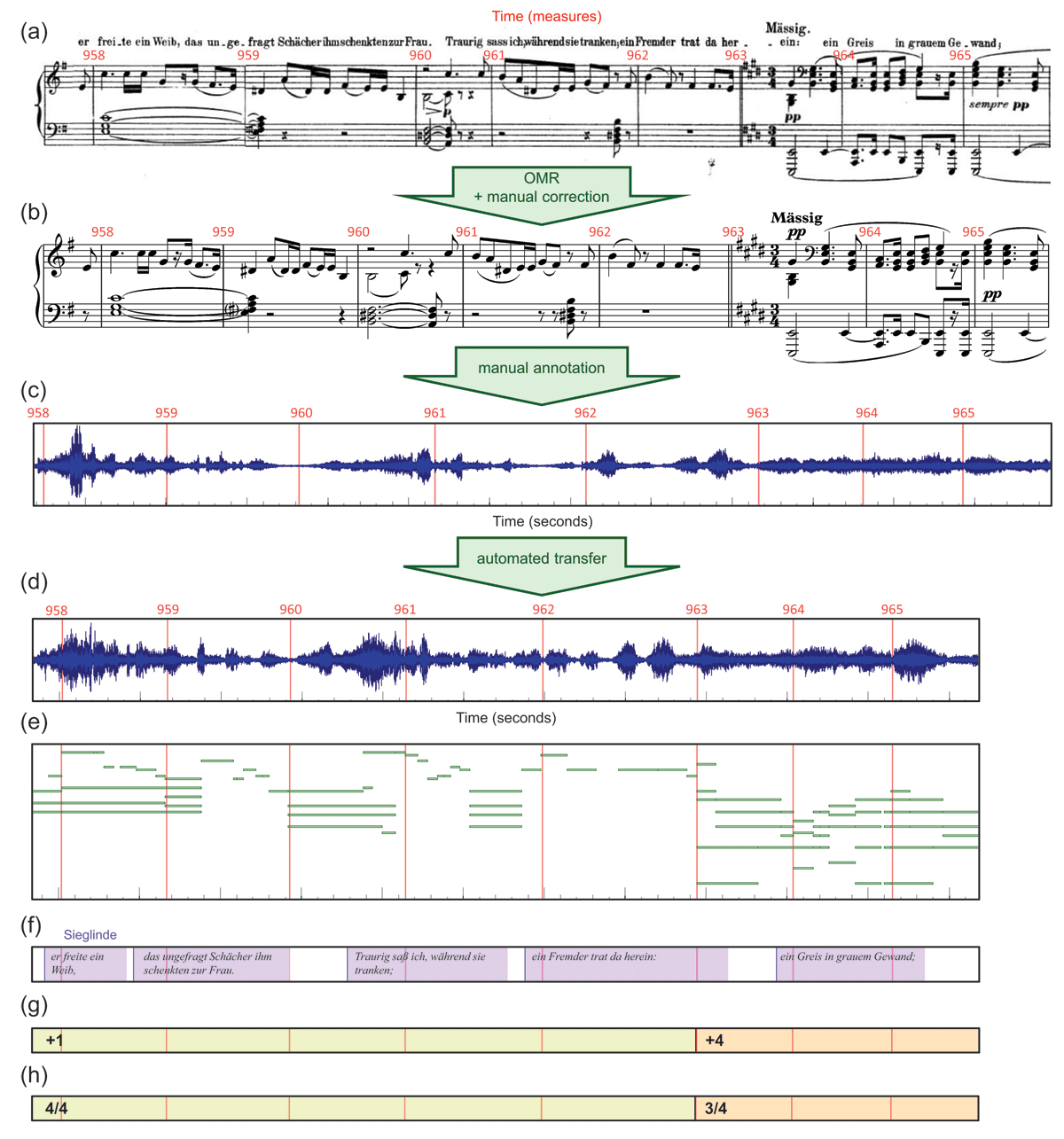
Figure 2
Example passage from Die Walküre, WWV086B-1, measures 958–965. (a) Scan of the piano reduction by R. Kleinmichel (image). (b) OMR-processed and corrected score (symbolic). (c) Performance Karajan1966 (waveform) with manual measure annotations. (d) Performance Krauss1953 with automatically transferred measure annotations. (e) Note events based on the piano reduction (MIDI) synchronized to Krauss1953. (f) Singing voice regions with libretto (text). (g) Key signature regions (see Section 7.3). (h) Time signature regions.
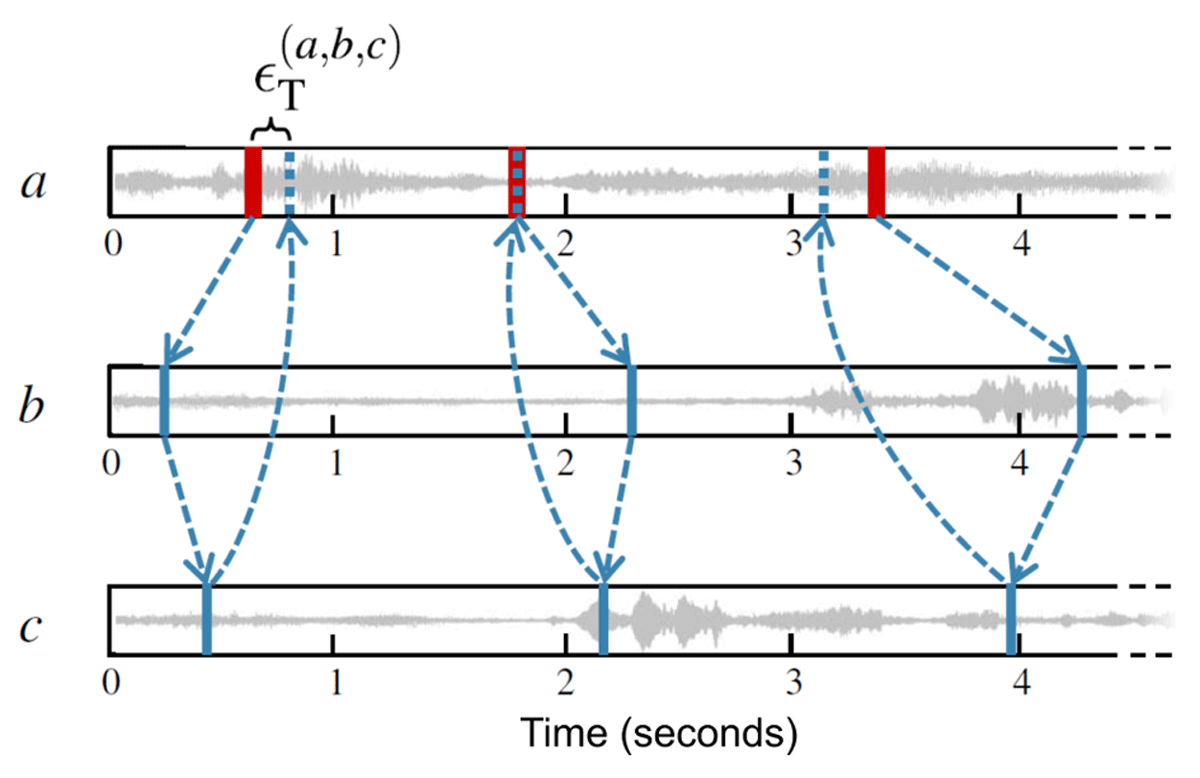
Figure 3
Triple-based transfer of measure annotations between performances, derived from Zalkow et al. (2017b).
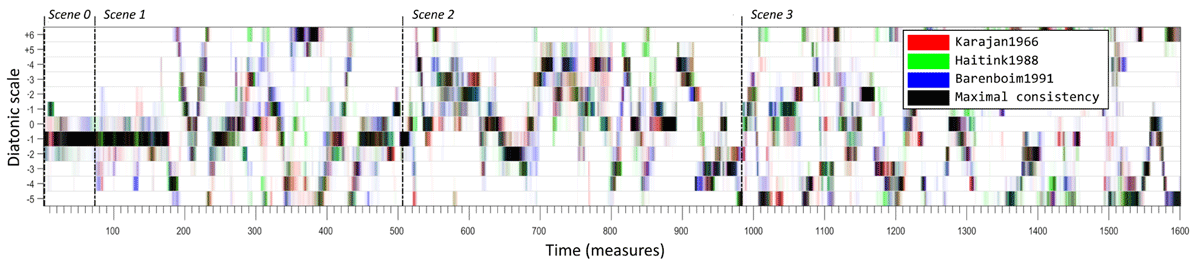
Figure 4
Cross-version harmonic analysis regarding diatonic scales (Weiß et al., 2017). The analysis result is based on three versions, visualized with different colors that add up to black in case they are consistent.