
Table 1
Huff (2003) conceptualizes the constraints on system design along four levels. Higher levels relate to increasingly wider circles of society.
| Level 4 | Larger “impact on society” issues (e.g. privacy, property, power, equity) |
| Level 3 | Anticipated uses and effects: interactions with other technologies and systems |
| Level 2 | Company policies, specifications, budgets, project time-lines |
| Level 1 | System design issues, trade-offs in design and performance |
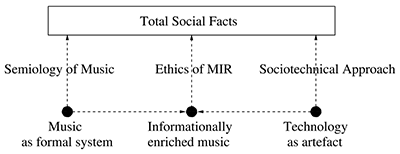
Figure 1
The interpretation of technology as total social fact and not as neutral artefact is established by the sociotechnical approach, whereas the semiology of music makes the analogous connection in the context of music. With information enrichment as a process that merges music and technology — symbolized by the two horizontal arrows — Ethics of MIR will interpret informationally enriched music as total social fact (i.e., establish the middle vertical arrow). We suggest that the ethics of MIR should be inspired by both the semiology of music and the sociotechnical approach.

Figure 2
MIR value chain: MIR research outcomes represent a pool of ideas. Some of the ideas are chosen to be incorporated into software solutions that aim at a specific task. In the steps that follow, the software is shaped into a product that targets specific user groups and purposes (Product Design), and which then needs to be marketed and distributed to the users (Publishing). MIR research, as most engineering research, is often not immediately involved in the following steps through the value chain. This leads to a barrier between MIR research and the higher levels of constraints on system design (Table 1).