
Table 1
Typology of relationships between illegal actors and criminal economies. Source: Compiled by the author, based on Lupsha 1996.
| Type of relationship | Description | Activities |
|---|---|---|
| Predatory | Appropriation of existing profits. Theft of legal or illegal products. In the case of the guerrilla groups, activities are subordinate to political interests. | Theft and extortion of local populations and business people. |
| Parasitic | Control of a series of profit-generating activities, generally through payment of illegal tax in exchange for ‘protection.’ Mediation functions with legal authorities. | Charging of ‘taxes’ in exchange for protection. |
| Symbiotic | Management of criminal relationships (influence on connections and transactions). Capacity to create nexus between legal and illegal, as well as formal and informal markets and businesses. Political groups depend on criminal groups. | Regulation of the illegal market. Management of one or more links in the chain. |
Table 2
Typology of relationships between the illegal actor, the criminal economy, and the territory. Source: Written by the author.
| Competitive environment | Agreements/Arrangements | Control | |
|---|---|---|---|
| Predatory | X | ||
| Parasitic | X | ||
| Symbiotic | X |
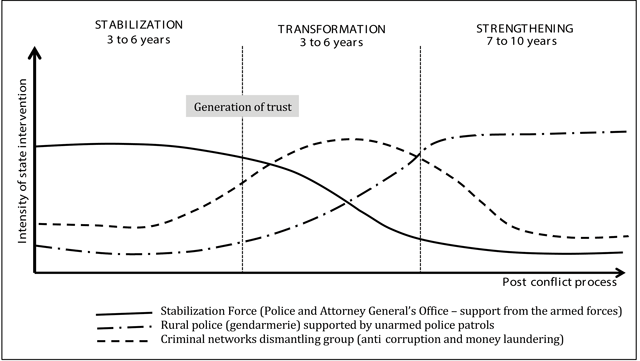
Figure 1
Interim Stabilization Measures (ISM). Source: Created by the author.