
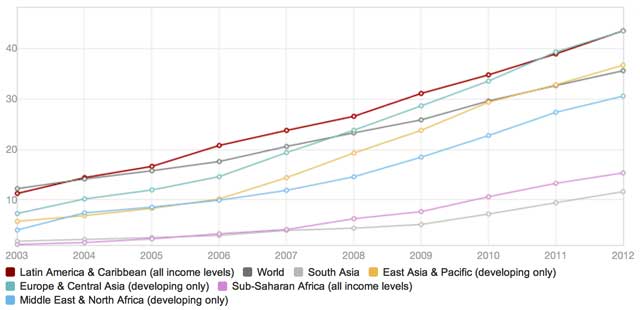
Figure 1
Internet penetration in the developing world by region (Internet users per 100 people) (Source – The World Bank – 2003–2012)
Table 1
Internet penetration in Latin America (Caribbean not included) (Source – Internet World Stats - June 30, 2012 - and UNDP 2013)
| Country | Internet Users | Penetration (% of population) | HDI7 (global ranking 2013) |
|---|---|---|---|
| Argentina | 28,000,000 | 66.4 | 45 |
| Colombia | 26,936,343 | 59.5 | 91 |
| Chile | 10,000,000 | 58.6 | 40 |
| Uruguay | 1,855,000 | 55.9 | 51 |
| South America average | 189,982,457 | 48.2 | --- |
| Brazil | 88,494,756 | 45.6 | 85 |
| Ecuador | 6,663,558 | 43.8 | 89 |
| Costa Rica | 2,000,000 | 43.1 | 62 |
| Panama | 1,503,441 | 42.8 | 59 |
| Venezuela | 12,097,156 | 41.0 | 71 |
| Mexico | 42,000,000 | 36.5 | 61 |
| Peru | 9,973,244 | 36.5 | 77 |
| Central America average | 51,452,595 | 32.6 | --- |
| Suriname | 179,250 | 32.0 | 105 |
| Guyana | 250,274 | 32.0 | 118 |
| Bolivia | 3,087,000 | 30.0 | 108 |
| El Salvador | 1,491,480 | 24.5 | 107 |
| Paraguay | 1,563,440 | 23.9 | 111 |
| Belize | 74,700 | 22.8 | 96 |
| Guatemala | 2,280,000 | 16.2 | 133 |
| Honduras | 1,319,174 | 15.9 | 120 |
| Nicaragua | 783,800 | 13.7% | 129 |
Table 2
Vertical and horizontal applications of ICTs for violence prevention in Latin America28
| Type | Approach | Functions | Examples |
|---|---|---|---|
| Vertical: government -government | ICTs developed by and for intra- and intergovernmental use | Real-time and social media surveillance and big-data analytics for hot-spot mapping and internal accountability (data gathering) | Infocrim, Igesp, Terracrime (Brazil), Sala de Evaluación del Desempeño Policial (Mexico), CUIVD (Colombia) |
| Vertical: government-citizen | ICTs developed in cooperation with governments and citizens to enhance security delivery | Tailored data fusion systems to enhance mapping of incidents, bespoke applications for citizen reporting (data gathering/data analysis) | Procuraduría General de Justicia and Secretaría de Seguridad Pública of Coahuila (Mexico), IADB and UNICEF initiatives, and Igarapé Institute assistance (Brazil) |
| Horizontal: citizen-government | ICTs developed by private or nongovernmental groups with applications for governments and citizens | Tailored (open) data systems using a combination of ICTs that allow for anonymous reporting on actual or suspected crimes (data gathering/data analysis) | Disque-Denuncia, Unidos pela Segurança (Brazil), Citivox-Monterrey (Mexico), UN Women–assisted interventions |
| Horizontal: citizen-citizen | ICTs developed by private, nongovernmental, and activist groups for citizen safety and security | Social media and network systems using existing models (Google, Facebook, and Twitter) or bounded systems (data analysis) | Blog del Narco, NAR, Notinfomex, Tehuan platform, Narcowiki (Mexico), Hollaback! Say no to Violence, Bem Querer Mulher (Brazil) |
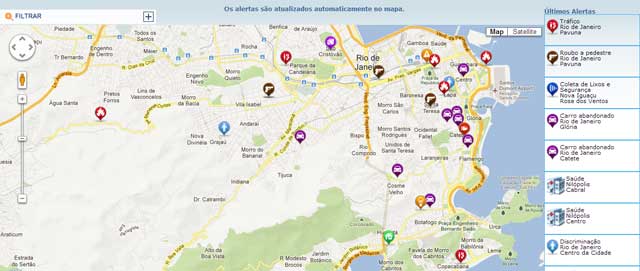
Figure 2
Mapping violent incidents using crowdsourcing in Brazil36
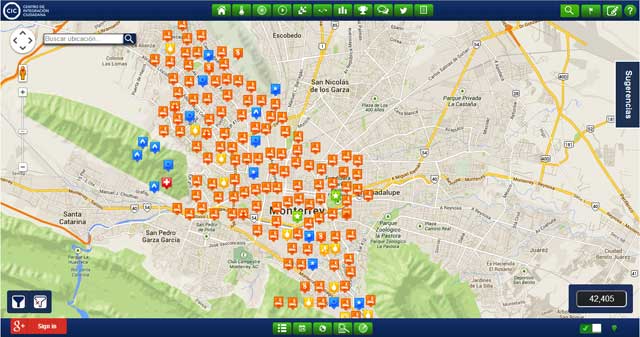
Figure 3
Platform developed by Citivox in Monterrey (Mexico)37