
1 Introduction
Marco Borradori is one of the most beloved figures in the history of Lugano and Canton Ticino in Switzerland. Borradori began serving as mayor of Lugano on April 14, 2013, and died prematurely on August 11, 2021, while still in office. This paper explores the role of local political leadership and the use of emotions and rationality in public communication by focusing on the case of Marco Borradori. The participation and popular support shown by citizens from all political positions after Borradori’s death makes him an interesting subject for studying the role of emotions in local political leadership.
The research question addressed in this paper is: How do mayors use emotions and rationality in public communication? Our main hypothesis is that the drivers of public leadership have moved from the use of messages based on a technical-administrative rationality toward the use of emotional messages driven by the peculiarities of social media logic (Sancino 2021). In particular, sentiment analysis is used to examine a sample of speeches and official statements made by Mayor Borradori from 2013 to 2018.
Studies of local political leadership investigate the behaviors, roles, and contexts in which local politicians exercise their leadership capabilities (e.g., Sørensen & Torfing 2019). Exemplary works on this topic can be found in edited books on different elements of Western local governments, such as the role of city managers (Klausen & Magnier 1998) and of mayors (Bäck, Heinelt & Magnier 2006; Heinelt et al. 2018). We can identify four main approaches to the study of local political leadership. The first takes what we label a (neo)institutionalist perspective. Within this stream of research, scholars study how formal institutional rules and structures shape the context and behavior of local political leaders. This research is often comparative. The second approach directly explores the role of political leaders by investigating, for example, their capabilities (Hartley 2002) and their leadership styles (e.g., Hlepas, Chantzaras and Getimis 2018) as well as their relationship with tenured officials (Svara 1999) and/or citizens (Sancino, Carli & Giacomini 2022). The third approach studies practices of governance and their performance (e.g., Avellaneda 2009). The fourth approach takes a more macro perspective in examining local political leadership in the wake of policy reforms, focusing on the reforms’ effects on the role of local government and local political leaders (Stoker 2011; Sullivan 2007).
In this paper we contribute to the second and third streams of literature by conducting a sentiment analysis of 40 public discourses made by the mayor of Lugano during his first term (2013–2018), and by relying on several semi-structured interviews conducted with people who worked in close cooperation with Mayor Borradori. The aim of this paper is to open a first reflection on the relevance of emotions in public leadership, a topic that has assumed crucial importance recently, especially in relation to emergency management during the COVID-19 pandemic (Garavaglia, Sancino & Trivellato 2021). The paper draws from and reports data presented in Curti (2021), supplemented by new empirical materials (Boxes 1 and 2 in the Appendix). The findings are discussed from the perspective of local political leadership and, in particular, mayoral leadership (e.g., Bäck, Heinelt & Magnier 2006) and public communication (Pasquier & Villeneuve, 2018). The paper proceeds as follows. Section 2 briefly describes research on mayoral leadership, while Section 3 presents the research methods. Section 4 discusses the main findings, and Section 5 provides some concluding remarks.
2 Theoretical backdrop
Mayors are considered the figureheads of cities and communities (Latham et al. 2009) and, given their increasing influence at the regional, national, and global scales (Acuto 2013; Barber 2013; Beer et al. 2019), they are now some of the most visible public and political leaders. Mayors play a key role in the implementation of effective local political leadership, and the success of their leadership depends heavily on their public communication and leadership styles. The issue of mayoral leadership has received considerable critical attention, especially in recent years (e.g., Heinelt et al. 2018). This conversation is embedded in the broader debate on public leadership, which is also becoming more prominent in public administration studies (Chapman et al. 2016; Crosby & Bryson 2018; ‘T Hart 2014; Hartley 2018; Hartley et al. 2019; Orr & Bennett 2017; Ospina 2017; Tummers & Knies 2016; Van Wart 2013).
The study of mayors and their leadership can be described as relatively new, despite being part of the well-developed and vast research on public and political leadership. The first analyses of mayors’ roles and leadership styles were conducted as case studies in the 1950s–1960s, but it was only in the 1970s that the topic started to develop significantly in the United States and then worldwide (Persons 1985). As Persons (1985) pointed out, there were two main bodies of literature and reasons for this interest: (1) the general development of models of mayoral leadership, and (2) the analysis of Black mayors’ leadership and governance, and their comparison with white mayors. Although the latter studies can explain why American researchers first focused on and developed the topic, it is the former research topic that has spread worldwide and has gained prominence in recent decades.
Our analysis of the literature highlights that there are at least three primary perspectives used to study the topic of mayoral leadership: the formal perspective, the behavioral perspective, and a mix of the two. The formal perspective is mainly concerned with the electoral and institutional arrangements of the mayor (e.g., Sancino & Castellani, 2016; Wollmann 2004). In other words, it focuses on how and by whom the mayor is elected and what formal authority they have within the local government organization (Hambleton 2014). In terms of mayoral leadership, two principal typologies can be identified (Steyvers 2012): in the strong leadership style, which often arises when the mayor is directly elected, the mayor dominates the council and the administration and has a presidential or notable role (e.g., those found in Japan and in mayor–council systems in the US and Canada); under weak leadership, control is often shared among actors and committees (northern Europe) or mostly delegated to a city manager, with the mayor playing mainly an ambassadorial role (e.g., in the council–manager format in the US). As Sweeting (2017) has highlighted, directly elected mayoral positions have been introduced as a reform to improve local governance in some countries (e.g., New Zealand, Germany, Italy, Poland, and England), and this format is under consideration in Ireland and India. Switzerland, and specifically Canton Ticino, can be considered to have a leadership format that falls between the strong and weak leadership models.
Research that takes the behavioral perspective focuses on the roles and relationships of mayors. Kotter and Lawrence (1974) were the first scholars to take this approach, and they developed a model of mayoral behavior. Basing their analysis on mayors’ agenda-setting, network-building, and task-accomplishing processes, they identified five mayoral types: the ceremonial pattern, the caretaker mayor, the personality/individualist, the executive, and the program entrepreneur. Svara (2003) pointed out that the type and effectiveness of mayoral leadership depend on three factors: the roles that the mayor performs, how well they perform them, and their ability to promote a “facilitative leadership model.” The latter represents the ability and willingness of mayors to effectively advance and promote their own vision while encouraging and strengthening other actors in participating in the governing process to achieve shared goals (Svara 2003). More recently, Hlepas, Chantzaras, and Getimis (2018) focused on the time horizon of mayoral leadership (i.e., the leadership orientation, or a strategic versus reproductive orientation) and on the exercise of power (i.e., an authoritarian versus cooperative approach) to identify four ideal types of mayors: the visionary, the city boss, the consensus facilitator, and the protector.
Other authors have instead taken a hybrid perspective, combining their focus on formal/institutional and behavioral patterns. Larsen (2000) proposed four types of mayoral leadership styles by focusing on how mayors create and maintain authority, both formally and when relating to others. Avellaneda (2009) studied how mayoral qualifications affect municipal performance and mayoral decision-making under different conditions of issue salience, context, and constraint (Avellaneda 2013). Jan Verheul and Schaap (2010) focused on the “pitfalls and challenges” of mayoral leadership and on mayors’ endless need to balance: a) the necessity of creating a shared sense of community and identity while respecting the multiple identities within the local community; b) the demand for strong leadership and networked, multi-actor local governance; and c) the public expectations of strong independent leadership that, at the same time, has to stand accountable for the decisions made.
These dilemmas—especially the demand for both a strong, individualistic mayoral leader and a shared, collective one (Steyvers 2012)—create fundamental challenges in terms of mayoral leadership. This is principally due to the existence and influence of several other actors within local governance, actors that mayors need to consider and with whom they must relate to implement effective public leadership. As Svara explained (2003: 170):
The lesson for mayors is that effective leadership is built upon combining their vision with strengthening the other participants in the governing process rather than controlling or supplanting them. This attitude, along with emphasis on developing a shared commitment to goals, is the essence of the facilitative leadership model.
3 Research Methods: Sentiment Analysis
The sentiment analysis technique, also called opinion mining, is used to analyze opinions, emotions, and attitudes that emerge from texts (Liu 2015). We performed a sentiment analysis through the use of the National Research Council of Canada (NRC) Emotion Lexicon list created by Saif M. Mohammad. We chose this because, in addition to the multiple contexts in which it has already been successfully adopted (e.g., in marketing and consumer behavior studies), the list has also been used in analyses of political discourse and election campaigns (Mohammad & Turney 2013). The NRC Emotion Lexicon is a list of 14,182 English words (also available in 40 other languages), that are associated (0 for “unassociated,” and 1 for “associated”) with eight basic emotions: anger, fear, anticipation, trust, surprise, sadness, joy, and disgust (Mohammad & Turney 2013).
The text analysis was conducted using Wordstat8, which is content analysis and text mining software that enables qualitative content and opinions analysis. To finalize the sentiment analysis, three basic steps were followed:
the texts were loaded;
the sentiment dictionary (NRC Emotion Lexicon) was inserted in the software; and
the results were analyzed.
Specifically, Mayor Borradori’s speeches were selected by one of the authors, Giulia Curti, in collaboration with the Communication and Institutional Relations Division of the City of Lugano. In total, we considered 40 texts that cover Mayor Borradori’s first term of office (2013–2018). The sentiment analysis technique enabled us to reveal the type of emotions embedded in the words used in his speeches by using the NRC Emotion Lexicon list (in Italian). Moreover, we were able to detect the “rationality” element when we considered texts containing economic and financial data.
4 Results
Figure 1 highlights the results of our analysis. The distribution of the various emotions is as follows: trust appeared in 4.68% of the text (n = 1,313), anticipation in 2.85% (n = 799), joy in 2.44% (n = 686), surprise in 1.20% (n = 336), rationality in 1.03% (n = 289), fear in 0.75% (n = 211), anger in 0.65% (n = 182), sadness in 0.62% (n = 175), and disgust in 0.38% (n = 108). These results show that the mayor used positive emotions (trust, anticipation, joy, surprise) more than negative emotions (fear, anger, sadness, disgust). The “rationality” element is found in the middle of the distribution: it was used less frequently than the positive emotions, but more frequently than the negative emotions. Both positive and negative emotions tend to appear in the same texts but with different frequencies, as shown in Table 1.
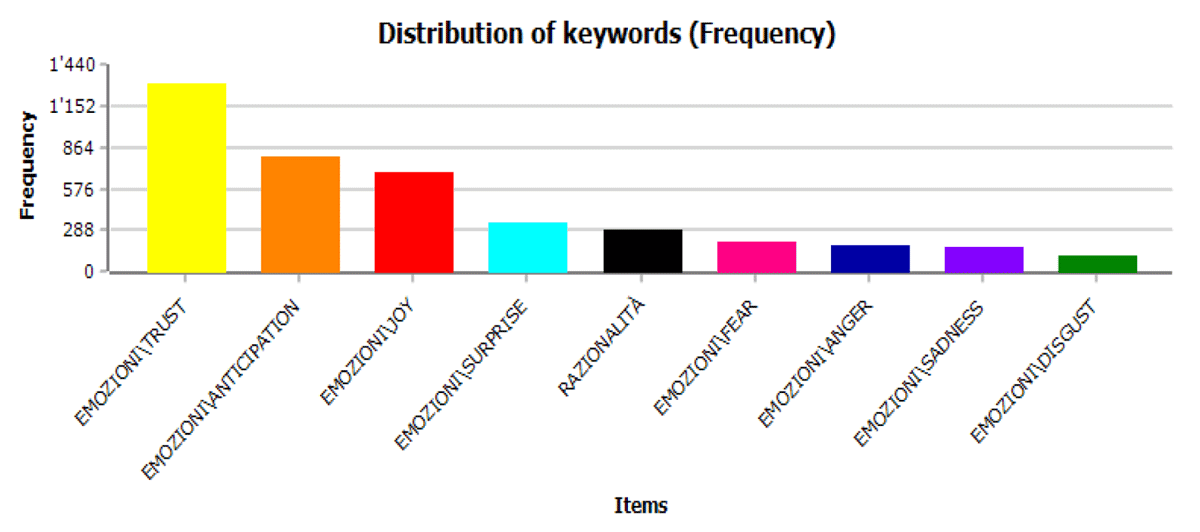
Figure 1
Emotions identified in Mayor Borradori’s speeches (2013–2018).
Table 1
Main topics of the mayor’s term of office (2013–2018).
| 1) National identity |
| 2) Research and innovation |
| 3) Economy |
| 4) Culture |
| 5) Religion |
| 6) Health |
The prevalence of positive emotions fits with some of Borradori’s leadership traits that were highlighted during the interviews with the new mayor. Specifically, the interviews noted “visioning,” “positioning toward the future,” and the “ability to listen and be persuasive and kind” (see Boxes 1 and 2 in the Appendix).
With reference to the element of “rationality” (which was measured only through the use of numbers), it instead seems that it is mostly used in economic, financial, and historical contexts, due to the presence of dates and numbers to support the credibility of the speeches. the main topics of the mayor’s term of office are listed in Table 1; these were extracted using WordStat8 software. The results are in line with the fact that Borradori had a liberal political orientation, even though he was born and raised politically as a conservative and nationalist (a member of the political party Lega dei Ticinesi).
Table 2 below summarizes the results related to the frequency of the use of emotions and “rationality” (i.e., numbers) in Borradori’s speeches. During his term, Mayor Borradori used mainly positive emotions. “Trust” was used to give legitimacy to the speeches; “anticipation” was employed to offer hope about the present and future course of government; and “joy” was used to maintain a connection with the public (Searles & Ridout 2011). Based on the analyses, Borradori appears to have been a politician who leveraged positive emotions; this is strictly related to the behavioral perspective in the literature and is linked to the “caretaker mayor” profile described earlier.
Table 2
Emotions and “rationality” during Borradori’s term of office (2013–2018).
| EMOTIONS AND RATIONALITY | FREQUENCY | % TOTAL |
|---|---|---|
| 1. Trust | 1,313 | 4.68% |
| 2. Anticipation | 799 | 2.85% |
| 3. Joy | 686 | 2.44% |
| 4. Surprise | 336 | 1.20% |
| 5. Rationality | 289 | 1.03% |
| 6. Fear | 211 | 0.75% |
| 7. Anger | 182 | 0.65% |
| 8. Sadness | 175 | 0.62% |
| 9. Disgust | 108 | 0.38% |
Accordingly, what considerations can be drawn with regard to the concepts of emotions and rationality in public leadership and communication? Our analyses show that, even in a local context, Borradori tended to mix emotions and rationality in order to be more persuasive when speaking to citizens. In this regard, the emotion/rationality dichotomy that has been advocated for many years in the political arena should rather be considered as a pair of complementary elements that support each other, not only to engage the audience, but also to make political discourse more credible and effective.
5 Conclusions
Our study confirms the increasingly important role in contemporary public leadership and communication of generating positive emotions in the political leadership discourse. This makes the experience of Mayor Marco Borradori of Lugano relevant not only at the national level in Switzerland, but also at the European and international level. From the case study of Borradori, we found that leading and communicating in public speeches seems to require not only the demonstration of administrative rationality through the use of numbers, but also appeals to and the generation of positive emotions, particularly joy and empathy. This leadership and communication style is indeed becoming an increasingly important element of political leadership (Sancino, 2021). Specifically, the interviews we conducted pointed out the key emotional role of the mayor of Lugano in addressing the management of the COVID-19 emergency and in the economic and financial recovery of the city of Lugano.
Positive emotions, including trust and empathy, have become a central feature of a new type of modern political leadership. The case study of Mayor Borradori shows the possibility of combining rationality and emotions in political discourse aimed at engaging the public in the traditions and challenges faced by a city such as Lugano and a region such as Canton Ticino. In some ways, Borradori’s experience highlights the possibility of establishing a direct relationship with followers, including through new technological tools, but also by maintaining an institutional profile. Of course, our paper has many limitations, and it should be considered a preliminary and exploratory case study. For example, models other than the NRC could be used for the sentiment analysis. Future studies could also compare Borradori’s leadership with that of other mayors of Ticino or other Swiss municipalities. Research could also explore the effects of political leadership provided through speeches in traditional institutional arenas and in social media, or it could use other research methods, such as for example critical discourse analysis and topic modeling.
Additional File
The additional file for this article can be found as follows:
Competing Interests
The authors have no competing interests to declare.
Author Contributions
All persons listed as authors have contributed to the design and writing of the present study, and they reviewed and approved the final manuscript.