
1 Introduction
Citizen participation has been used for decades by governments to improve legitimacy, public trust in government, and transparency in decision-making processes (Fedotava et al. 2014; Lourenço & Costa 2007; Wirtz et al. 2018). According to Biedermann (2006: 116), citizen participation can be defined as voluntary participation in public decision-making processes, whereby the process is based on discursivity and characterized by a clearly defined, balanced distribution of power among all participants and the assumption of responsibility by all participants.
In addition to traditional on-site participation, there is also technology-assisted citizen participation. Participation tools have changed due to advances in communication and information technology (Alawneh et al. 2013). According to the United Nations (2014: 61), electronic participation (e-participation) is “…the process of engaging citizens through ICTs in policy and decision-making in order to make public administration participatory, inclusive, collaborative, and deliberative for intrinsic and instrumental ends”. Technological progress now enables the widespread use of e-participation to engage “citizens in contributions to and deliberation on public policies and services” and to empower “citizens through co-design of policy options and co-production of service components and delivery modalities” (United Nations 2014: 197). Shihab et al. (2021: 2) further emphasized key stakeholders in their definition: “e-participation can be understood as a technology-mediated interaction between civil society and formal politics, and between civil society and the administrative sphere.”
Today, the term e-participation is used to refer to various activities intended to increase citizen involvement: e-voting, e-petitions, e-consultations, e-deliberations, online discussion platforms, and hackathons are all examples of activities covered by the blanket term “e-participation” (Le Blanc 2020: 8). Not only are there different forms of e-participation, but the activities can have different levels of participation: citizens can be informed, they can be consulted, and they can even have a say in the final decision (for more detailed information about various levels of e-participation, see Fischer et al. 2020: 131 or Arnstein 2015). In this study, the focus is on e-participation in informal consultative settings.
A growing body of studies has identified several advantages of e-participation initiatives over non-digital forms of participation, for instance, cost reduction and independence of location for participation (Fischer et al. 2020, 2021a; Kakabadse et al. 2003; Mossberger et al. 2008). Keen on harnessing these advantages, governments worldwide have established e-participation opportunities to engage citizens in various topics such as spatial planning and budgeting. However, it has been suggested that e-participation worldwide is struggling to attract much popular support (Naranjo Zolotov et al. 2018a), and unless citizens are willing to participate, governments would appear to be unable to benefit from the advantages of e-participation. Consequently, there is a need for a study of what factors contribute to citizens willingness to engage in e-participation activities.
Several studies have looked into what motivates people to engage in e-participation initiatives (Edelmann et al. 2021; Quintero-Angulo et al. 2020; Royo et al. 2020; Panopoulou et al. 2014; Susha & Grönlund 2012; Smith et al. 2011; Macintosh & Whyte 2006). A novel approach to studying e-participation compared to non-digital alternatives is provided by Zheng and Schachter (2017), who examined the influence of perceived advantages of e-participation on citizen willingness to participate, which has only rarely been central to research into e-participation. However, Zheng and Schachter (2017) only considered submitting a form via website as e-participation activity, which does not cover the broad spectrum of e-participation initiatives used by governments. This study aims to further develop their promising approach by including three different scenarios of e-participation that cover different levels of citizen participation. This study follows the UN’s E-Participation Index (2022) in identifying three levels of citizen participation:
Information represents the level with the smallest time commitment of the stakeholders. Giving information to stakeholders provides the basis for participation.
Consultation is the level with a low time commitment of the stakeholders; citizens can contribute and deliberate on ideas.
In decision-making, citizens can co-design policy options and co-produce service components, which is a high level of citizen participation.
In the scenarios studied, the focus is on consultation (idea finding and discussion) and decision-making as citizen representatives in meetings. The three scenarios are (1) a participatory budgeting process, (2) participatory strategy development and (3) participatory spatial planning. Idea submission in a participatory budgeting process (consultation) reflects a lower level, while participation as a representative in meetings for participatory spatial planning (decision-making) shows a comparatively higher level of citizen participation.
This study will address the following research questions:
What are the perceived advantages of e-participation from the perspective of citizens?
To what extent does the perception of advantages of e-participation lead to a greater willingness to take part in e-participation initiatives?
By answering these research questions, this study adds new insights to the current body of research on e-participation and the role of perceived advantages. This study not only seeks to validate the research conducted by Zheng and Schachter (2017), but also expands it by examining various scenarios of e-participation at different levels of citizen participation. Furthermore, this research is of great practical relevance. By identifying the perceived advantages of e-participation that also increase the willingness to participate at different levels of citizen participation, recommendations for governments on how to build e-participation tools and to promote their participation activities can be derived.
The study was conducted in the Canton of Zurich. With 1.56 million inhabitants, the Canton of Zurich accounts for around 18% of the total Swiss population (as of 2021). The distribution of men and women is about 50% each; the proportion of foreigners in the canton is about 27% and thus just slightly above the Swiss average of 25.7%. Thus, the base population of the study represents a good illustration for Switzerland as a whole (Bundesamt für Statistik 2021; Kanton Zürich 2021).
This study is structured as follows: The first section outlines a literature review on e-participation covering both advantages of e-participation and studies on citizen willingness to participate. This is followed by a presentation of the data collection process and methods of data analysis. After that, we present our findings. The paper concludes with a discussion of the results, the limitations of the study and future research avenues.
2 Previous research
Alongside the digital transformation of public administration (e-government), e-participation has become an increasingly important topic on government agendas (European Commission 2020; Mellouli et al. 2014; Schmidthuber et al. 2017; United Nations 2014). Shaping the future through e-participatory processes could add value to society in a number of ways. It brings together people with different interests, opinions and ideas who might not have otherwise interacted. It generates more comprehensive knowledge about the various facets of a project among all participants. Impending decisions take into account different perspectives and are thus better prepared (Nabatchi 2012; OECD 2020; Wirtz et al. 2018).
However, e-participation also comes with challenges. Based on a literature review, Quintero-Angulo et al. (2020) identified challenges among others in the context of quality and evaluation of e-participation. The quality of information that must be delivered to users is unknown, as well as which opinions must be considered in the decision-making process. There is also the need to ensure the security and privacy of the information of users (Quintero-Angulo et al. 2020: 549). A key challenge addressed in this study is how to achieve a sufficiently high level of citizen participation in e-participation initiatives. As Naranjo-Zolotov et al. (2019) pointed out, e-participation initiatives often fail to ensure lasting citizen participation. It is therefore important to look more closely at the factors that lead to a greater willingness to participate.
2.1 Citizens’ willingness to participate
The literature has described several ways to approach the study of factors that lead to citizen engagement in e-participation initiatives. For example, Vicente and Novo (2014) examined the role of demographic characteristics, habits and skill regarding the use of online participation, concluding that people living in cities with a high disposable income and a high level of education are more likely to participate digitally. Not surprisingly, digital skills, online social networking activities and a political interest are also predictors for one’s willingness to engage in digital participation. Lee and Kim (2018) confirmed these findings in a study of citizen participation in online agenda-setting activities. They also found that the perceived usefulness of citizen participation, trust in the government, and perceived responsiveness also positively influence willingness to participate. Wijnhoven et al. (2015) also studied citizens’ motivations to engage in e-participation activities by looking at different levels of participation (information, consultation, and co-operation); this study finds that citizens’ motivations are higher for low-level participation initiatives.
Zheng and Schachter (2017) examined the role of perceived advantages on citizens’ willingness to participate. The authors argue that when citizens are given two choices, in this case, a digital and non-digital way to participate, they essentially perform a cost/benefit analysis to decide which channel they should use (Zheng & Schachter 2017: 410). The authors found that the perception of certain benefits influences whether citizens participate digitally or non-digitally. However, different perceived advantages seem to have varying effects on public willingness to engage in e-participation activities. For example, it appears that “time savings” affect participation, while “cost savings” do not (Zheng & Schachter 2017). However, their study relied on the submission of forms through a government website or via e-mail. Consequently, the validation of these findings and their transferability to other scenarios of participation is questionable.
Despite these shortcomings, this approach to studying whether perceived advantages of e-participation lead to greater willingness to participate in such participation scenarios seems promising, as it combines two of the main research areas in the field of e-participation: advantages of e-participation compared to non-digital alternatives and citizen willingness to participate. We build on these preliminary considerations from Zheng and Schachter (2017) and take this hypothesis as the starting point for our analysis (Figure 1).
The level of perceived advantages of e-participation over non-digital participation positively influences the willingness to participate digitally rather than non-digitally.

Figure 1
Influence of perceived advantages on the willingness to participate digitally (Zheng & Schachter 2017).
For the purpose of our research, we want to be able to determine more specifically which concrete perceived advantages of e-participation lead to a higher willingness to participate digitally compared to non-digital forms of participation. Therefore, we now discuss perceived advantages of e-participation in more detail. We also discuss potential advantages of non-digital participation to check whether applied rationality can be further grounded by investigating whether perceived advantages of non-digital participation also have an influence on the willingness to participate non-digitally compared to digital forms of participation.
2.2 Advantages of e-participation compared to non-digital participation
Several studies have discussed the advantages of e-participation (Fischer et al. 2020, 2021a; Kakabadse et al. 2003; Le Blanc 2020; Lupia 2009; Mossberger et al. 2008; Steinbach et al. 2019; Zittel 2007). These studies shed light on the advantages of e-participation compared to non-digital alternatives. Several concrete advantages of e-participation compared to traditional forms of participation described in the literature are outlined below. Based on these advantages, we then derive propositions with perceived benefits as the independent variable and willingness to participate as the dependent variable. These propositions form the main part of the analytical framework of this study, which we then test by means of regression analysis.
Simplicity (Ease of Use): Perceived ease of use is a very important factor for technology acceptance (Davis 1989). The use of digital solutions for participation can be perceived as more user-friendly, especially for technologically savvy people, than the alternative of participating via traditional face-to-face interactions. Also, for persons with physical impairments, the use of more adaptable digital user interfaces can be an essential advantage of e-participation. Through e-participation, users can participate through electronic devices. Panopoulou et al. (2014: 204) analysed success factors for the design of e-participation initiatives to promote political participation and civic engagement, concluding that users want a technical system that is appealing, yet simple and easy to use. Case studies such as those by Shihab and Hidayanto (2021) and Macintosh and Whyte (2006) also confirm this success factor.
| Proposition 1: | If simplicity is perceived as an advantage of e-participation, the willingness to participate digitally increases. |
Time Saving: Fischer et al. (2020) also pointed out that e-participation is less time-consuming compared to traditional form of participation. Pina and Torres (2016) argued that e-participation is more efficient and less-time consuming in general. Smith et al. (2011) distinguishes the advantages of e-participation according to the providers and users in the participation process, and also establishes that users benefit from more time savings when using e-participation tools.
| Proposition 2: | If time saving is perceived as an advantage of e-participation, the willingness to participate digitally increases. |
Independence of location: Kakabadse et al. (2003) highlighted that e-participation promotes independence of location. According to Alcántara et al. (2014), e-participation can also attract people who might otherwise be unable or unwilling to participate in on-site initiatives, such as citizens living abroad or young people. E-participation via PC or smartphone enables a broad mass of the population to participate, no matter where they live. Naranjo-Zolotov et al. (2019: 542) stated “…since e-participation is place and time independent, it allows the inclusion of more citizens in the participatory process in a much wider geographical area”.
| Proposition 3: | If independence of location is perceived as an advantage of e-participation, the willingness to participate digitally increases. |
Cost reduction: Pina and Torres (2016) argued that e-participation is less expensive than non-digital initiatives. Fischer et al. (2020) evaluated different participation activities that exist digitally and non-digitally. They concluded that the digital form of these activities is less expensive. For example, if an incident (e.g., road damage) is reported via a mobile app, the resources required to perform this task are less demanding than the resources required to submit a report via a platform or go to an office (Naranjo-Zolotov et al. 2018b: 365–368). Viborg et al. (2007) emphasized that cost savings must be viewed in a differentiated manner. Administrative costs must be included in transferring e-participation practices. Here, the important distinction between cost consequences from the provider’s point of view and cost consequences from the user’s point of view becomes apparent.
| Proposition 4: | If cost reduction is perceived as an advantage of e-participation, the willingness to participate digitally increases. |
2.3 Advantages of non-digital participation compared to e-participation
Having discussed the major advantages of e-participation, we also want to consider potential advantages of non-digital citizen participation, to enable us to investigate whether the underlying rationality (perceived advantages lead to greater willingness to participate) also applies to non-digital participation. Furthermore, it will allow us to determine for each scenario the differences between both variants and analyse the added value of e-participation compared to non-digital citizen participation in detail. These findings could then be used for the design of a citizen participation process. For example, the weaknesses of e-participation can be specifically mitigated by complementary on-site citizen participation. For the design of continuous citizen participation with different topics, the generated knowledge can provide immediate benefits. In the following, we will devote particular attention to the technical components.
Data protection: According to Fischer et al. (2021a), a comparison between e-participation and non-digital participation processes reveals that the major advantages of non-digital participation lie in the protection of personal information and technical security. When using e-participation tools, user trust in government institutions plays a role, as does broader confidence in the internet and participation platforms. In reference to private social media platform providers and the data protection scandals affecting, for example, Facebook, general concerns have been expressed about the widespread use of online platforms (Le Blanc 2020: 19–20; Omar et al. 2014; Quintero-Angulo et al. 2020). This is one of the main reasons why data protection is seen as an advantage of non-digital participation.
| Proposition 5: | If data protection is perceived as an advantage of non-digital participation, the willingness to participate non-digitally increases. |
Data security: Royo et al. (2020) analysed the Madrid City Council’s e-participation initiative Decide Madrid to identify critical success factors and key barriers. The platform was analysed after several e-participation projects. The study identifies, in part, concerns about the security of the platform and verification processes. Kakabadse et al. (2003) noted that e-participation includes a risk of hacking and of exclusion of people without online access. Furthermore, results on e-participation show that in some cases, there is a fundamental mistrust of online activities; likewise, there are reservations about the e-participation process itself (Diffley et al. 2015; Fischer et al. 2021b; Rottinghaus & Escher 2020). Therefore, data security can be seen as an advantage of non-digital participation over e-participation.
| Proposition 6: | If data security is perceived as an advantage of non-digital participation, the willingness to participate non-digitally increases. |
2.4 Analytical framework
From these literature-derived propositions, the following analytical framework (Figure 2) can be developed for the analysis below:
This study follows on from this framework to further investigate the connection between perceived advantages and willingness to engage in e-participation activities as well as in non-digital participation activities.
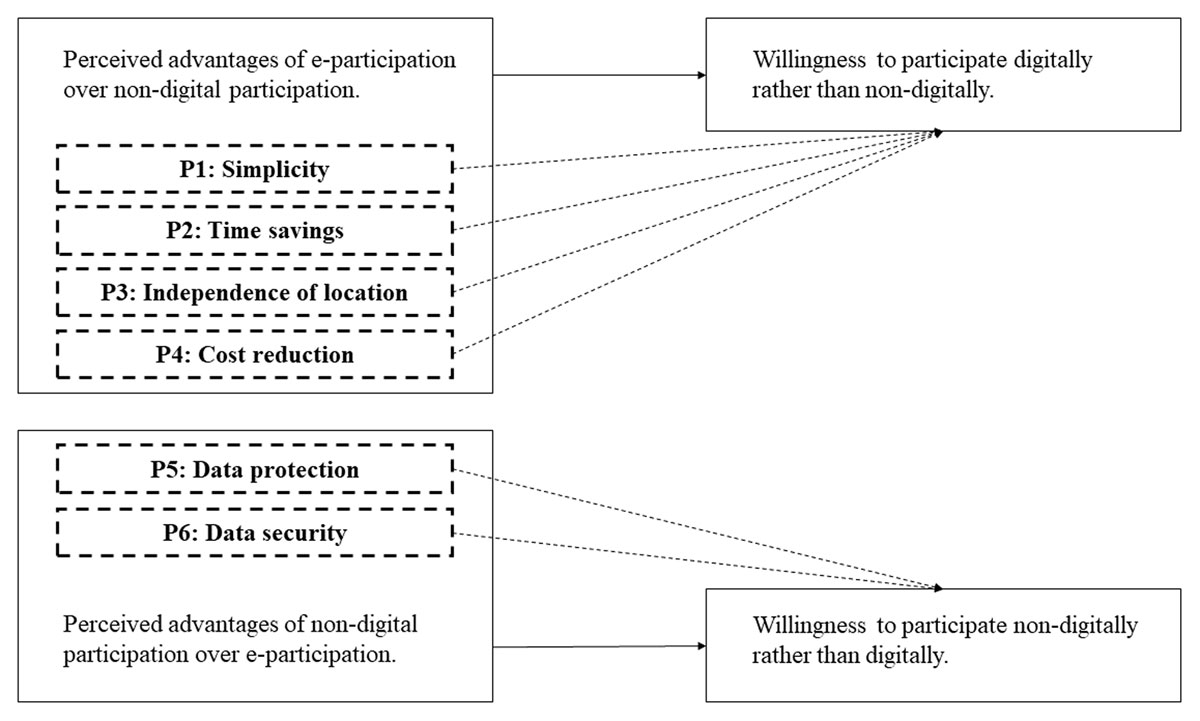
Figure 2
Analytical framework of this study.
3 Data and Methods
This study used an empirical research design to answer our research questions. First, data was gathered using a survey that was accessible online and offline; second, data were analysed using primary logistic regression models. The following subsections provide detailed accounts of both stages.
3.1 Data collection
In March 2021, 7,000 people with a minimum age of 16 were randomly selected from the Canton of Zurich resident list and personally invited via mail to participate in an online questionnaire. Each received a unique access code to log in to the survey. Those without online access were sent printed questionnaires on request. Thus, this procedure allowed us to draw on a true randomised sample to then test our propositions for Zurich – the results may also be transferred to other regions, as we will discuss later. Data collection took two weeks, and a reminder letter was sent to participants after one week. The survey contained 41 questions covering participation and digitalisation in general, the perceived advantages of e-participation, intention to participate, and socio-demographic characteristics. Data were analysed using the statistical software R.
3.2 Variables
The dependent variable is a willingness to participate in three different scenarios. The following responses were offered: (1) yes, I would participate digitally; (2) yes, I would participate non-digitally; and (3) no, I would not participate. Since we only considered people willing to participate, respondents stating that they would not participate were excluded from the study. Ultimately, our dependent variable is included as a dummy variable.
The independent variable is the perceived advantage. The independent variable was measured using various attributes. These attributes of digital or non-digital participation could be evaluated in terms of their benefits. For each attribute, participants could indicate whether they agreed to the benefit on a scale from 1 (do not agree at all) to 7 (fully agree). Based on our literature review, the following benefits were included in the survey.:
Simplicity
Time savings
Independence of location
Cost reduction
Data security and data protection
We also tested for people’s opinions concerning the importance of participation and if they understood digitalisation as an opportunity by asking, “How important is it to you to be involved in political issues in the Canton of Zurich?” and “What do you think about the following statement: ‘On average, I think digitalisation offers more opportunities than risks?” Respondents could indicate whether they agreed on a scale from 1 (do not agree at all) to 7 (fully agree). The survey also included a question about political interest by asking, “How interested are you in politics in general?” with possible responses from 1 (not at all interested) to 7 (very interested). Based on preliminary discussions with experts, these questions were included as possible alternative explanations.
Finally, we recorded socio-demographic characteristics, including age, gender, and education, which are commonly used when studying participation (see, for example, Lee & Kim 2018; Vicente & Novo 2014). We then tested for the influence of the above-mentioned control variables, and significant results are presented in Chapter 4. Table 1 below provides an overview of all variables.
Table 1
Variables.
| VARIABLE | CATEGORIES/RANGE | |
|---|---|---|
| Dependent variable | Willingness to participate | Model 1: (0) No, I would not participate digitally, (1) Yes, I would participate digitally. Model 2: (0) No, I would not participate non-digitally, (1) Yes, I would participate non-digitally. |
| Independent variable | Perceived advantage of e-participation or non-digital participation | Simplicity (1–7), time savings (1–7), independence of location (1–7), cost reduction (1–7), data security1 (1–7), data protection2 (1–7)* |
| Control variables | Age | 16–99 |
| Gender | (1) Male, (2) Female, (3) Other | |
| Education | (1) No education, (2) compulsory school, (3) vocational apprenticeship, (4) (vocational) Baccalaureate, (5) university degree | |
| Importance of participation Digitalisation as an opportunity Political interest | 1 (= do not agree at all) – 7 (= fully agree) 1 (= do not agree at all) – 7 (= fully agree) 1 (= not interested at all) – 7 (= very interested) |
[i] * 1 = do not agree at all, 7 = fully agree.
3.3 Methodology
Besides descriptive analyses, logistic regressions were used to analyse the data; our dependent variable is categorical and was included as a dummy variable in the analysis. The logistic regression model can identify significant impacts of different perceived advantages of e-participation while controlling for relevant confounding factors (Kronthaler 2016). To ensure the model fitted the data, all models were checked for multicollinearity and linearity of the logits.3 All models presented in the following section fulfilled the assumptions.
In contrast to Zheng and Schachter (2017), we do not test our propositions using just one participation scenario. Wijnhoven et al. (2015) stated that the preferred setting of a participation activity (meaning digitally or non-digitally) depends on its topic and the level of participation. Thus, we argue that citizens might prefer a digital over a non-digital setting and vice versa depending on their level of engagement, which we understand as how many resources they need to dedicate to the participation activity, as well as on the topic. To ensure our results do not depend on the citizens’ level of participation of a certain participation activity, we created three fictitious scenarios which cover a range from low-level participation (Scenario 1: submitting an idea, Scenario 2: taking part in a discussion) to high-level participation (Scenario 3: being a representative). Figure 3 summarizes the three scenarios using the description provided in the survey.
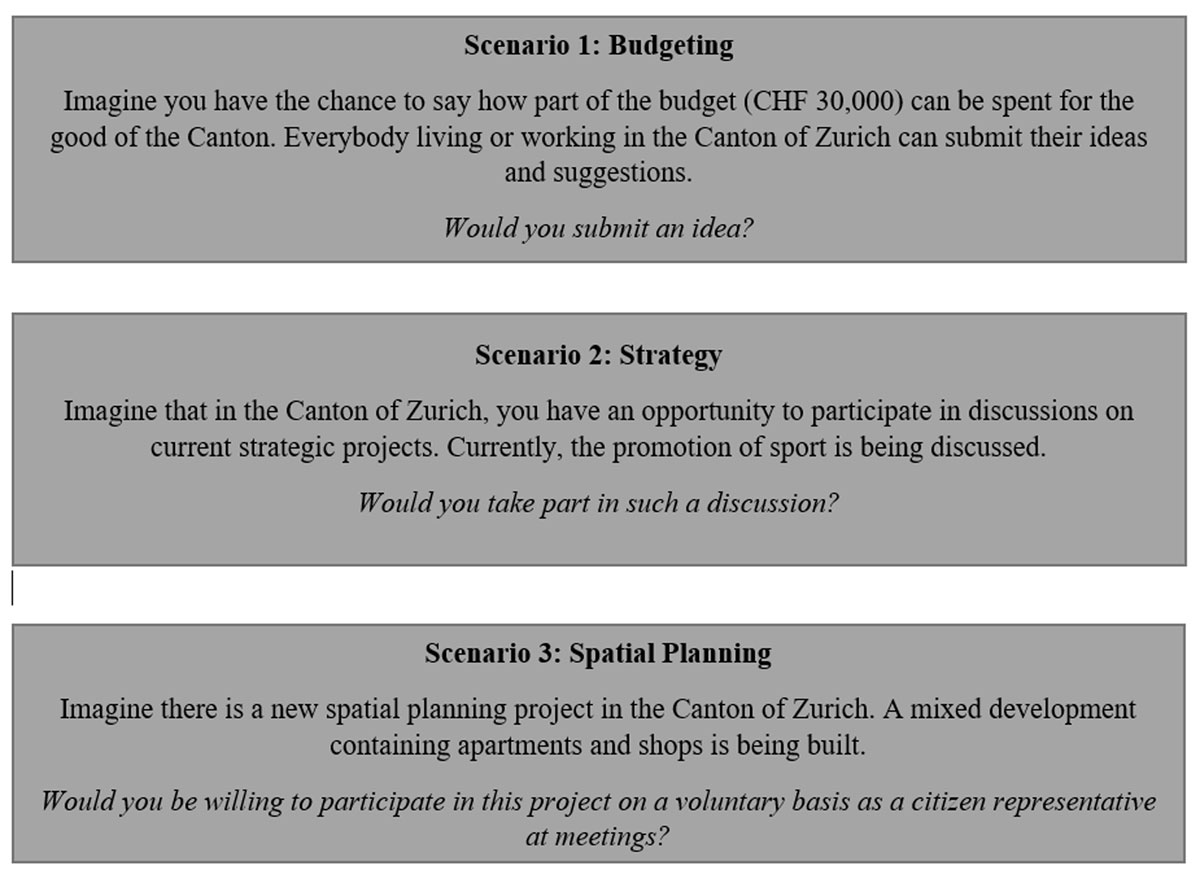
Figure 3
Three scenarios of citizen participation.
4 Findings
The following subsections present our findings. After examining participant characteristics, we present the responses to our research questions.
4.1 Participant characteristics
In total, 1,915 people of an original selection of 7,000 people accessed the survey. After removing individuals who failed to answer the first three questions and duplicates, 1,613 responses remained, leading to a response rate of 23%.
In terms of the participants’ socio-demographic characteristics, the sample is 50.8% male and 49.1% female (N = 1581).4 The average age of the respondents was 48.7 years, the youngest being 16 years and the oldest 93 (SD = 16.735; N = 1502). Overall, 3.5% of participants were between 16 and 19 years old, and 29.3% between 20 and 39 years old. The 40 to 64-year-old category is the best represented, at 47.3%. In addition, 16.7% were aged 65–79 while 3.2% were 80 or over. When comparing these results to actual age distribution in Zurich, it was clear that younger respondents (16–39) and the 80+ age group were slightly underrepresented and the 40–79 age group was overrepresented (see Statistisches Amt Kanton Zürich 2020).
Regarding the respondents’ education, participants most frequently indicated a university degree (41.4%) or vocational apprenticeship (26.0%), followed by a vocational baccalaureate (Berufsmaturität) (7.7%). Compulsory schooling only (in Switzerland 11 years) (at only 3.7%) and other degrees (20.6%) (N = 1566) were the least indicated categories.5
Concerning their opinions, with an average value of 5.08 on a scale from 1 (= do not agree at all) to 7 (= fully agree), respondents also considered participation to be “somewhat important” (SD = 1.627; N = 1757). Regarding digitalisation, respondents tended to agree with the statement “On average, I think digitalisation offers more opportunities than risks”, with an average value of 5.07 on a scale from 1 (= do not agree at all) to 7 (= fully agree) (SD = 1.667; N = 1699). Finally, on a scale from 1 (= do not agree at all) to 7 (= fully agree) and a mean value of 5.01, respondents indicated they were “somewhat interested in politics” (SD = 1.571, N = 1780).
4.2 Perceived advantages of digital and non-digital participation
First, participants were asked to indicate whether they agreed that certain attributes constitute an advantage of e-participation. Then, the same question was asked concerning non-digital participation. This analysis provides an answer to the first research question of this study: What are the perceived advantages of e-participation from the perspective of citizens? From Figure 4 below, it is clear that the qualities of simplicity, time savings, independence of location and cost reduction (all with mean values greater than 5) are considered advantages of e-participation. In comparison, data security and data protection are seen as benefits of non-digital participation. Nevertheless, with mean values of 3.9 and 4.1, respectively, it cannot be said that respondents necessarily considered data protection and data security to be disadvantages of e-participation. These findings are in line with those from our literature review.
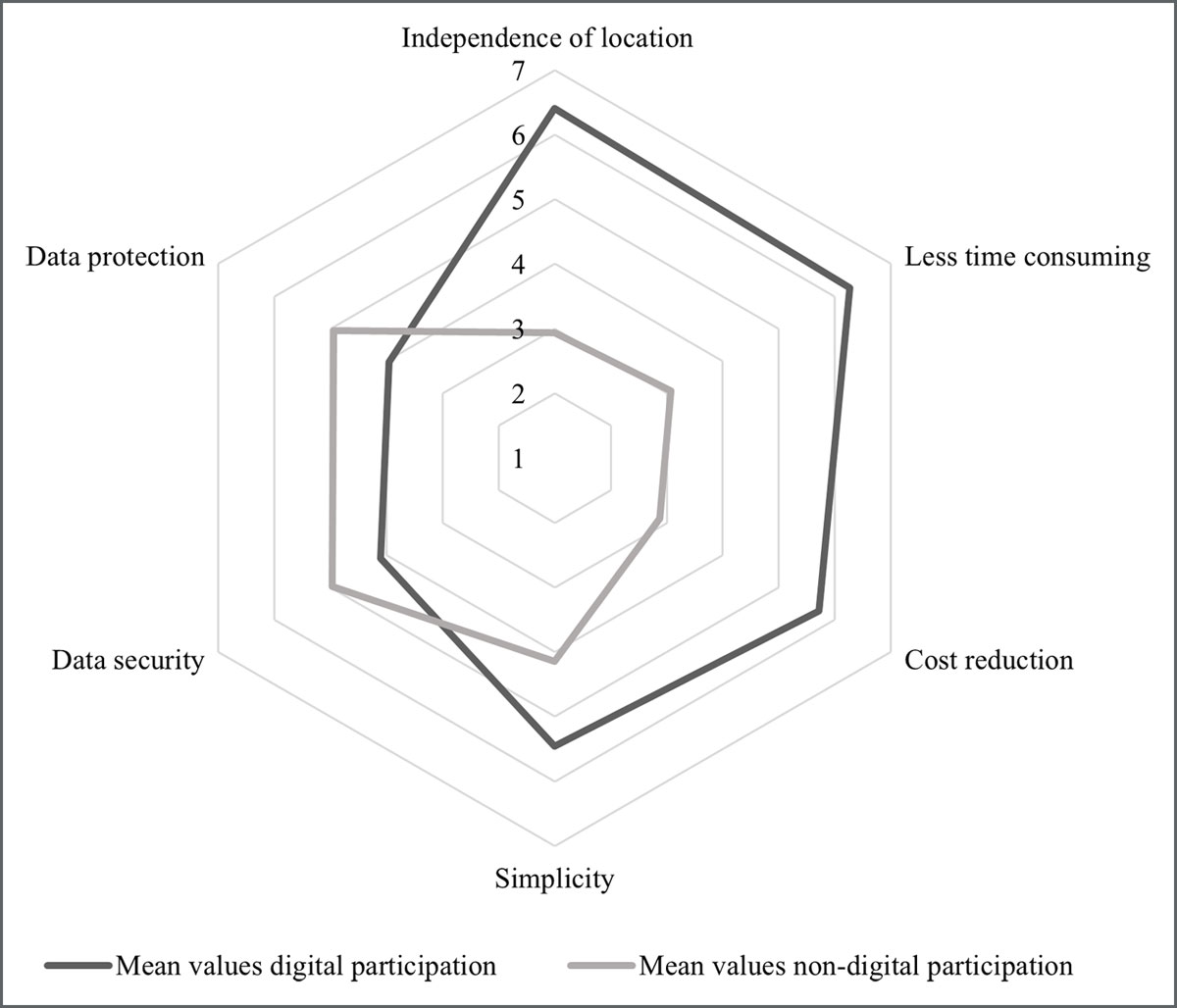
Figure 4
Advantages of digital and non-digital participation.
4.3 The impact of perceived advantages on a willingness to participate
To examine whether, and if so which, perceived advantages of e-participation influence whether an individual is willing to participate in a specific participation activity, we conducted a logistic regression analysis, the results of which are presented in Tables 2, 3, 4 below. As already mentioned, we created three fictional scenarios (see Figure 3), each dealing with a different issue to cover varying levels of participation. This enables us to answer the second research question of this study: To what extent does the perception of advantages of e-participation lead to a greater willingness to take part in e-participation initiatives? In the following paragraphs, we will present our findings for each scenario.
Table 2
Relationship between perceived advantages and willingness to participate (S1: Budget).
| DEPENDENT VARIABLE: WILLINGNESS TO PARTICIPATE | ||
|---|---|---|
| E-PARTICIPATION (1) | NON-DIGITAL PARTICIPATION (3) | |
| Simplicity | 0.38*** | –0.17* |
| (0.10) | (0.10) | |
| Time savings | –0.04 | 0.10 |
| (0.17) | (0.17) | |
| Independence of location | –0.12 | –0.10 |
| (0.13) | (0.12) | |
| Cost reduction | 0.16* | –0.03 |
| (0.09) | (0.10) | |
| Data protection | 0.01 | –0.18 |
| (0.11) | (0.13) | |
| Data security | 0.13 | –0.05 |
| (0.12) | (0.14) | |
| Age | –0.01 | 0.01 |
| (0.01) | (0.01) | |
| Gender [female] | –0.10 | 0.24 |
| (0.22) | (0.25) | |
| Education | ||
| Compulsory school | –0.13 | –0.93 |
| (0.55) | (0.61) | |
| Vocational apprenticeship | –0.23 | –0.17 |
| (0.62) | (0.64) | |
| (vocational) Baccalaureate | 0.002 | –0.69 |
| (0.53) | (0.57) | |
| University degree | –0.20* | 0.17 |
| (0.10) | (0.12) | |
| Political interest | –0.02 | –0.07 |
| (0.10) | (0.11) | |
| Importance of participation | 0.24*** | –0.01 |
| (0.08) | (0.09) | |
| Digitalisation as an opportunity | –2.20** | 0.36 |
| (1.03) | (1.01) | |
| Observations | 473 | 473 |
| Log Likelihood | –279.03 | –217.57 |
| Akaike Inf. Crit. | 588.06 | 465.15 |
[i] Note: * p < 0.1; ** p < 0.05; *** p < 0.01.
Table 3
Relationship between perceived advantages and willingness to participate (S2: Strategy).
| DEPENDENT VARIABLE: WILLINGNESS TO PARTICIPATE | ||
|---|---|---|
| E-PARTICIPATION (1) | NON-DIGITAL PARTICIPATION (2) | |
| Simplicity | 0.20** | –0.11 |
| (0.10) | (0.11) | |
| Time savings | 0.003 | 0.19 |
| (0.17) | (0.17) | |
| Independence of location | –0.07 | –0.04 |
| (0.13) | (0.13) | |
| Cost reduction | 0.26** | –0.17 |
| (0.10) | (0.10) | |
| Data protection | –0.08 | 0.01 |
| (0.12) | (0.13) | |
| Data security | 0.33*** | –0.35** |
| (0.12) | (0.14) | |
| Age | –0.01* | 0.02* |
| (0.01) | (0.01) | |
| Gender [female] | –0.50** | 0.43* |
| (0.23) | (0.25) | |
| Education | ||
| Compulsory school | 0.15 | –0.95 |
| (0.57) | (0.62) | |
| Vocational apprenticeship | –0.53 | –0.04 |
| (0.62) | (0.65) | |
| (vocational) Baccalaureate | 0.11 | –0.47 |
| (0.54) | (0.58) | |
| University degree | –0.11 | 0.06 |
| (0.11) | (0.12) | |
| Political interest | –0.04 | 0.002 |
| (0.10) | (0.11) | |
| Importance of participation | 0.23*** | –0.05 |
| (0.09) | (0.09) | |
| Digitalisation as an opportunity | –3.01*** | 0.41 |
| (1.10) | (1.02) | |
| Observations | 445 | 445 |
| Log Likelihood | –260.13 | –218.89 |
| Akaike Inf. Crit. | 550.25 | 467.78 |
[i] Note: * p < 0.1; ** p < 0.05; *** p < 0.01.
Table 4
Relationship between perceived advantages and willingness to participate (S3: Spatial planning).
| DEPENDENT VARIABLE: WILLINGNESS TO PARTICIPATE | ||
|---|---|---|
| E-PARTICIPATION (1) | NON-DIGITAL PARTICIPATION (2) | |
| Simplicity | 0.50*** | –0.13 |
| (0.13) | (0.10) | |
| Time savings | –0.21 | –0.01 |
| (0.20) | (0.17) | |
| Independence of location | –0.08 | 0.04 |
| (0.15) | (0.13) | |
| Cost Reduction | 0.32*** | –0.14 |
| (0.11) | (0.10) | |
| Data Protection | –0.01 | –0.11 |
| (0.13) | (0.12) | |
| Data Security | 0.23* | –0.09 |
| (0.13) | (0.13) | |
| Age | –0.01 | –0.004 |
| (0.01) | (0.01) | |
| Gender [female] | –0.60** | 0.23 |
| (0.24) | (0.23) | |
| Education | ||
| Compulsory school | –0.19 | –1.00 |
| (0.71) | (0.65) | |
| Vocational apprenticeship | –0.30 | –0.33 |
| (0.78) | (0.70) | |
| (vocational) Baccalaureate | –0.38 | –0.63 |
| (0.68) | (0.62) | |
| University degree | –0.13 | 0.21* |
| (0.12) | (0.12) | |
| Political interest | –0.13 | –0.06 |
| (0.11) | (0.11) | |
| Importance of participation | 0.20** | 0.09 |
| (0.09) | (0.09) | |
| Digitalisation as an opportunity | –3.06** | 0.88 |
| (1.25) | (1.01) | |
| Observations | 422 | 422 |
| Log Likelihood | –233.37 | –239.84 |
| Akaike Inf. Crit. | 496.74 | 509.67 |
[i] Note: * p < 0.1; ** p < 0.05; *** p < 0.01.
Before presenting these findings, we first show the willingness to participate per scenario in Figure 5 below. It becomes clear that while for each scenario a majority is willing to engage, the levels still differ. Two-thirds of the probands would most likely participate in Scenario 1, in which they are asked to submit an idea on how to use a certain budget (66.7%, N = 787). Further, 56.0% are willing to attend a discussion on a strategic topic (N = 1107) and 52.3% would volunteer to become a part of a spatial planning project as a citizen representative at meetings (N = 713). These findings indicate that as the level of engagement increases, the willingness to participate decreases.
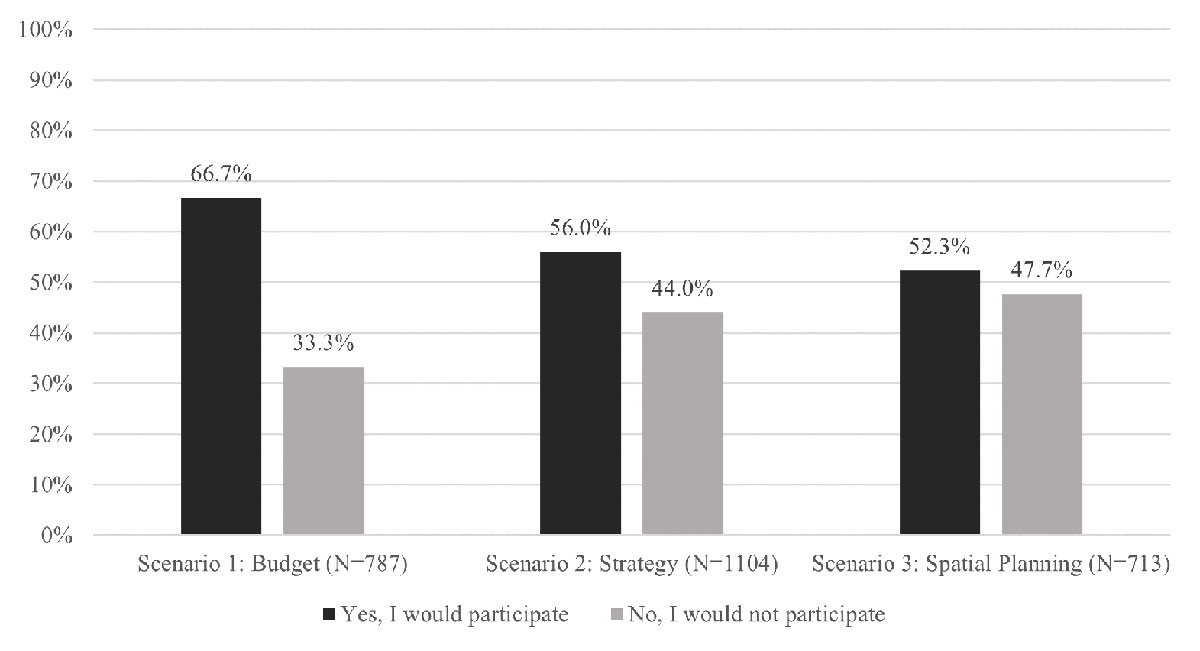
Figure 5
Distribution of the preferred form chosen by the participants for the three scenarios.
Scenario 1: Budget
In the first scenario, people were invited to submit their ideas about spending a given budget. According to Table 2, respondents who consider simplicity and cost reduction as advantages of e-participation exhibited a higher probability of presenting an idea digitally (p < 0.01 for simplicity and p < 0.1 for cost reduction). The other advantages, time savings (less time-consuming) and independence of location did not seem to influence the willingness to participate digitally. Also, data security and data protection have no negative influence. Looking at non-digital participation, those rating simplicity as an advantage of e-participation were significantly less likely to choose a non-digital format when submitting ideas (p < 0.1 for non-digital).
Neither did gender or age influence the probability of preferring a particular setting. The results suggested that respondents with a university degree are less likely to choose a digital setting, and those rating participation as “somewhat important” were more likely to submit an idea digitally (p < 0.1 vs p < 0.01). Lastly, respondents valuing digitalisation as an opportunity showed a significantly lower probability of preferring a digital format to those assessing digitalisation as a risk (p < 0.05).
Scenario 2: Strategy
The second scenario considered an invitation to a discussion about strategic topics, and Table 3 shows that here, simplicity, cost reduction, and data security were the significant factors. When respondents perceived these characteristics as advantages of e-participation, they were significantly more likely to prefer a digital setting for this activity (p < 0.05 vs p < 0.01 for data security). Moreover, younger males preferred e-participation in this scenario (p < 0.1 for age and 0.05 for gender). Regarding non-digital participation, the findings reveal that respondents who considered data security an advantage of e-participation were less likely to prefer a non-digital setting (p < 0.05). Older female respondents also seemed more likely to participate in strategic discussions when these were offered in a non-digital setting (p < 0.1). As in the previous scenarios, people finding participation “important” had a higher probability of participating digitally. In contrast, respondents who saw digitalisation as an opportunity showed a lower likelihood of preferring the e-participation setting (p < 0.01). Finally, Table 3 suggests that respondents viewing digitalisation as an opportunity were less likely to prefer an e-participation setting in this scenario than people who considered digitalisation a risk (p < 0.01).
Scenario 3: Spatial planning
The results for the third scenario are presented in Table 4 below and reveal that simplicity, cost reduction, and data security are significant predictors for respondents choosing a digital format (when acting as a citizen representative on a committee dealing with spatial planning issues) (p < 0.01 and p < 0.1 for data security). The findings further demonstrate that male respondents and those who rated the importance of participation as high were more likely to participate digitally (p < 0.05). Furthermore, respondents with a university degree exhibited a significantly higher probability of taking part non-digitally in Scenario 3 than respondents with no university degree (p < 0.1). Finally, perceiving digitalisation as an opportunity leads to a significantly lower probability of participating digitally, as observed in the previous scenarios (p < 0.05).
5 Discussion
The results show that the characteristics simplicity, time savings, location independence, and presumed cost reduction are generally seen as advantages of e-participation. In comparison, data security and data protection are seen as advantages of non-digital participation. Thus, we confirm the results of previous studies (e.g., Fischer et al. 2020, 2021a; Kakabadse et al. 2003; Mossberger et al. 2008). Detailed analysis further reveals that not all these advantages also lead to a higher willingness to participate. In summary, we find that only simplicity and presumed cost reduction significantly increased the probability of digital participation in all three scenarios. Additionally, when data security was perceived as an advantage of e-participation, this also led to a higher likelihood of preferring digital over non-digital participation in two out of three scenarios. The other perceived benefits of e-participation do not affect the willingness to participate digitally. These findings differ from Zheng and Schachter’s (2017) results, which did not find a positive correlation between saving costs and willingness to participate. An explanation could be that they were looking at a scenario of e-participation (submitting a form) that corresponds to a low level of citizen participation. It can be argued that certain advantages of e-participation only affect citizen willingness to participate from a certain level of citizen participation. This conclusion is supported by the comparison of our findings to those of Zheng and Schachter (2017), but also regarding the three scenarios presented in this study: Data security only mattered in Scenarios 2 and 3, which represent a higher level of participation than Scenario 1. In line with Wijnhoven et al. (2015), our study shows that as the level of citizens’ participation increases, the willingness to participate decreases. This indicates that the level of participation has an influence on citizens’ attitude towards participation. Given that the level of participation also has an influence on citizen willingness to participate in general, this needs to be taken into consideration in further studies investigating e-participation.
Finally, our study further finds that if participation is rated as important, this leads to higher willingness to participate in a digital setting. Additionally, assessing digitalisation as an opportunity led to a significant rejection of e-participation in all three scenarios. This finding is particularly interesting, as it seems that just because citizens recognise digitalisation as an opportunity in general, it does not necessarily mean that this is also true for participation. The significance of this result needs to be examined further in a follow-up study.
The study is characterized by a relatively large number of cases in the sample. Thus, the results are reliable and generalizable in the context of the Canton of Zurich. This distinguishes the study from individual case studies with a lower potential for generalizing the results.
5.1 Limitations
This study reveals new insights into the influence the perception of advantages of e-participation on citizen willingness to participate. Nevertheless, it is important to emphasise some issues concerning the broader generalisability of its findings. As the response rate of 25.6% does not reflect the population of the Canton of Zurich, additional studies will be necessary, especially among the youngest and oldest members of society, to verify our results. For the results to be more generalisable to other countries, the direct-democratic culture in the canton studied must also be taken into account. In countries with other types of democracy, citizen participation could generally be perceived differently than in Switzerland. In addition to these limitations, there is a shortage of studies regarding participation and e-participation by people with disabilities and those from other countries who have settled in Switzerland. Further, we have only taken five possible advantages of e-participation and two possible advantages of non-digital initiatives into account in our analysis. More possible advantages should be added in further studies.
The difference in willingness to participate digitally/non-digitally in the three scenarios cannot therefore be attributed solely to the time commitment, but is very likely also influenced by the topic. Future studies should choose a more adaptable design here to better isolate the two factors. Finally, our study asks about the public’s willingness to take part in participation projects. However, the findings reflect only intended behaviour, and no firm conclusions concerning actual behaviour can be drawn from them.
6 Conclusion
The aim of this study is to contribute to the growing literature on e-participation. We expand the current body of research on this topic by studying various cases of e-participation to gain further insights into the role of perceived advantages on citizen willingness to participate digitally and non-digitally. At the outset, we asked the following questions:
What are the perceived advantages of e-participation from the perspective of citizens?
To what extent does the perception of advantages of e-participation lead to a greater willingness to take part in e-participation initiatives?
Our study shows that citizens see simplicity, time savings, location independence, and presumed cost reduction as advantages of e-participation. Data security and data protection are perceived as advantages of non-digital participation. Our results therefore confirm the results of previous studies. Regarding our second research question, we can conclude that citizens are willing to engage in government-led participation initiatives. For all three scenarios, a majority indicated that they would participate. Our findings suggest that governments need to promote the cost savings and simplicity aspects of digital participation to motivate citizens to participate, as these advantages are positively correlated with one’s willingness to participate in the investigated participation scenarios. Additionally, when using e-participation tools, governments should address simplicity and cost reductions as key aspects of e-participation tools. From a scientific point of view, our study sheds light on the fact that the level of citizen participation (information – consultation – decision-making) seems to influence citizen willingness to participate. Moreover, the level of participation might also play a crucial role on what perceived advantages influence citizens’ motivation to participate. Our study shows that with a higher level of participation, different advantages influence citizens decision to engage digitally or non-digitally. This has not yet been central to studies investigating e-participation. Hence, the level of participation needs to be addressed in further studies to unravel its impact on participation initiatives.
Even though there seems to be a willingness to participate, many governments struggle to attract citizens, which leads to rather low turnouts. Therefore, the full potential of e-participation has not yet been reached. The findings of our study can be the basis for further projects in the Canton of Zurich. For example, guidelines for the implementation of citizen participation in the public arena and for different topics could be created. These guidelines could serve as a standard for all municipalities in the canton and ensure uniform quality. We therefore recommended transferring the knowledge gained from the study and the first participation projects to the cities and municipalities. The next step should be providing the technical tools that can be used by the canton, cities, and municipalities.
Notes
[5] Data security is the practical realization of protecting digital information against unauthorized access, damage or theft.
Competing Interests
The authors have no competing interests to declare.