
Introduction
From an evolutionary standpoint, social networks have been critical in the biological and cultural development of human beings (Pinker, 2010; Hrdy, 2011; Price & Johnson, 2011). Cooperative hunting and food sharing, alloparenting of kin and nonkin, reliance on others during times of sickness or during periods of pregnancy and potential tribal warfare are all staples of the sort of foraging existence within which the human mind evolved (Tooby & Cosmides, 2015). The ultimate punishment meted out by foraging groups is social abandonment, which is certain to result in death (Boehm, 2012), and today in modern societies, socially isolated people experience greater subjective pain and higher rates of mortality (Eisenberger & Lieberman, 2004; Lieberman, 2013; Holt-Lunstad, Smith, Baker, Harris & Stephenson, 2015). Fundamentally, then, humans are a social species, relying on social capital, or the support emanating from social networks, to survive.
Secondarily, from a cultural standpoint, the material security hypothesis suggests that in societies that are unstable or impoverished, people will tend to seek out dense, homogeneous social networks that help to meet needs for food, shelter and protection (Hruschka et al., 2014). Regarding religiosity, this indicates that material insecurity will tend to motivate people to embed themselves into dense, homogeneous religious communities in order to seek safety and material support (Norris & Inglehart, 2011; Barber, 2011). On the other hand, the expansion of impartial and well-funded social welfare institutions will reduce material insecurity and, thus, commitment to these religious communities (Paul, 2009; Immerzeel & Van Tubergen, 2013; Zuckerman, Galen & Pasquale, 2016). The implication is that in relatively more materially secure societies, people will have less of a “need” to form social communities. This, however, discounts three important points. First, a society does not suddenly become secular just because of increases in material security. The US, for example, contains people with high per capita incomes, but is still characterized by distrust of secular people (Cragun, Kosmin, Keysar, Hammer & Nielsen, 2012). Second, even in an increasingly materially secure society, people may still be stigmatized and marginalized on account of their identities—just because poverty has declined does not mean that people cease to perceive threats to their social standing. Third, the assumption that social networks are primarily important for people because of the instrumental resources they offer discounts the importance of positive social interactions in sustaining a stable sense of self-identity and emotional well-being (Burke & Stets, 2009). In short, the material security hypothesis has an important implication that must be further explored as regards secularism and nonreligion: how might materially secure, but stigmatized, secular people be using group/community support to manage this stigma, as well as the health consequences associated with this stigma?
In light of the above, it is surprising that no theoretical work on the social network structure of atheists exists in the research literature (McCaffree & Saide, 2017). Existing work often assumes that religious people have rich social networks, but this appears to have more to do with their habitual attendance at religious services than with religious or supernatural belief per se (Galen, 2018). Herein, I review the current state of research and theory regarding atheist social network structure and health. The under-researched and under-theorized areas of ecology and exchange are also discussed, insofar as each relates to atheist social networks. The article concludes with an integrative theoretical model of these factors as they may relate to self-identified atheists. We begin with a discussion of the concept of social capital.
Social Capital
Social capital is a very broad term that describes the structure of and benefits accrued from a person’s network connections (Putnam, 2000; see also Schultz, 1961; Becker, 1964). This definitional broadness has resulted in a lack of a general consensus among social scientists about how to operationalize social capital in any given study. For purposes of this review and theoretical synthesis, I will be using the term “social capital” in a two-fold manner: to denote (1) the structural aspects of an individual’s social network and to denote (2) the positive, health-promoting normative influences that an individual’s social network may exert on mental and physical health.
In terms of social network structure, I build off of the work of others (e.g., Marsden & Campbell, 1984; Moren-Cross & Lin, 2006; Marsden & Campbell, 2012), and focus this review on the inter-correlated variables of network (a) size, (b) density, (c) time, (d) diversity, and (e) quality, defined as follows (McCaffree and Saide, 2017):
Network size indicates the number of people one perceives to be in their network.
Network density indicates whether (and to what extent) those in one’s network know each other.
Network time indicates the rate and duration of interactions that occur between an individual and members of their network, in addition to interactions among other individuals within a person’s network. Where the rate and duration of time spent with network members is high, ties among network members can be considered to be “strong ties”. On the other hand, when the rate and duration of time spent with network members is relatively lower, ties among network members can be considered to be “weak ties” (see Granovetter, 1977, 1983).
Network diversity can be assessed in two potentially overlapping ways: demographically and ideologically. Demographic diversity describes how varied the composition of a person’s network is in terms of the social locations of those who comprise the network. Demographic diversity refers to how diverse an individual’s network is with regard to sex/gender, race/ethnicity, social class, educational attainment, and so on. Ideological diversity describes how varied an individual’s network is with regard to the ideas held by those who comprise the network. Ideological diversity thus references how diverse an individual’s network is with regard to political identification/beliefs, values, attitudes, and so on. When the degree of demographic or ideological diversity of a social network is high, we can say that the person’s network is rich in “bridging capital” (Putnam, 2000). Alternatively, when the degree of demographic or ideological diversity of a network is low, we can say that this network contains more “bonding capital,” (Putnam, 2000). In Thoits’ (2011; see Granovetter, 1973, 1983) account, ideologically and demographically diverse networks both have a greater potential to expose individuals to health-related or medical information that the person might not otherwise be aware of if their network was more homogeneous.
Lastly, network quality indicates the sense of cohesiveness, trust, or support that networks are perceived to provide.
In general, studies have found that peoples’ social networks influence mental and physical health in at least the following four ways: by bolstering a sense of mattering to others, by providing people with a sense of obligation to take care of themselves (and to help take care of others in their network), by increasing peoples’ perception (and utilization) of social support and by increasing exposure to people with health-relevant resources (e.g., medical credentials) (Granovetter, 2005; Webber & Huxley, 2007; Umberson & Montez, 2010; Song, 2011; Thoits, 2011; Holt-Lunstad & Smith, 2012; Chen et al., 2015).
This paper will conceptualize the above benefits of social capital in theoretically distinct ways. The perception of social support, embeddedness, and trust will be conceptualized as dimensions of network quality. The perception that one is obligated to take care of themselves, that one is subject to the well-meaning health recommendations and advice of others in their network and that one is obligated to seek health-relevant resources when necessary will be conceptualized as dimensions of positive social control.
Regarding the concept of positive social control, research in theoretical criminology (e.g., Hirschi, 1969; Rebellon & Anskat, 2018) suggests that bondedness to normative others tends to reduce the incidence of risky and health-endangering behaviors. Social bondedness has indeed been linked in the empirical literature to better physical health, emotional stability and community integration (Shor, Roelfs & Yogev, 2013; Shor & Roelfs, 2015; Lee, Chung & Park, 2016). As Thoits (2011) notes, close family and friends are most likely to come to a person’s aid when they experience severe financial or physical health problems, and so the cultivation of close relationships like these can serve as insulation from the vagaries of life. On the downside, networks characterized by strong-ties can also lead to unhealthy or risky behavior due to the “contagiousness” of behavior exhibited by close friends and family. When close ties, for example, regularly drink too much, smoke too much, eat too much, or socially isolate themselves, these behaviors may be normalized and granted a certain acceptability so as not to threaten the close bonds one has with their network alters.
Notwithstanding the potential contagiousness of risky and unhealthy behaviors, networks with a greater proportion of strong normative ties tend, on average, to be more punishing of risky and unhealthy behaviors—frequent bouts of interaction typically constitute a form of normative social surveillance (Coleman, 1986; Everton, 2015). Thus, while fully acknowledging the possibility of negative social control (i.e., the emergence of health-harming habits within a social network), this review and synthesis focuses on the role of network structure in producing positive social control insofar as this constitutes a protective effect from risky, health-harming habits and behaviors.
Religious vs. Nonreligious Social Network Structure: A Brief Review of Existing Research
To begin, I provide a brief review of the existing research on differences between religious and nonreligious social networks. Due to the scant amount of existing research, and because nonreligious individuals in this area of research are often lumped into a catch-all reference category (see Frost & Edgell, 2018) the following brief review assumes a broad definition of “nonreligious” (including non-church attenders, religious non-affiliates, and atheists). This generic treatment of nonreligious individuals is a weakness of the current research literature (see Galen, 2015, 2018), however, in order to provide a sketch of the current evidence, this broad use of “nonreligious” will be employed in this section before turning to a more fine-grained analysis of atheist (in particular) social network structure and health.
Religious vs. Nonreligious Network Size
Those who attend religious services on a regular basis have been found to have, on average, a larger number of (non-kin) network ties compared to those who do not attend religious services (Ellison & George, 1994; Bradley, 1995; Hastings, 2016). People who do not attend religious services also have smaller family (kin) network ties; data from the Pew Research Center (2014), for example, indicates that 37% of self-identified atheists are unmarried compared to 19% of the general American population. Other studies have indicated that nonreligious people are more likely to be single (not merely unmarried) and childless (Hout & Fischer, 2002; Bainbridge, 2005; Galen, 2009; Galen & Kloet, 2011; Baker & Smith, 2015).
Individuals who do not attend religious services have been found across studies to have fewer friends and smaller networks overall compared to those who actively attend religious services (Caldwell-Harris, 2012). In one study of 16,000 Twitter users (Ritter, Preston & Hernandez, 2014), those who followed religious leaders such as the Pope, Dinesh D’Souza, Joyce Meyer, Joel Osteen, and Rick Warren were more emotionally positive and discussed social relationships more often (e.g., used the word “friend” more often in Twitter posts) than did Twitter users who followed secular writers such as Richard Dawkins, Sam Harris, Christopher Hitchens and Michael Shermer.
Lastly, from a sex/gender perspective, women have been found across studies to be both more religious and to have more friends than men (Bhattacharya, Ghosh, Monsivais, Dunbar & Kaski, 2016; Edgell, Frost & Stewart, 2017). This is suggestive of a complex religiosity-gender interaction effect on network size; women, especially more devout religious women, are likely to have larger social networks than men.
Religious vs. Nonreligious Network Density
There is currently no direct comparative research on the network densities of nonreligious as opposed to religious social networks. Of the work that exists, regular religious service attenders and especially regular attenders in small, strict religious organizations, tend to have especially dense networks relative to those who attend religious services less often (or not at all) or who attend large-membership, non-strict churches (Stark & Bainbridge, 1985; Iannaccone 1992, 1994; Stroope & Baker, 2014).
Religious vs. Nonreligious Network Diversity
As regards demographic diversity, the social networks of religious people, particularly those who are politically conservative and religiously devout (e.g., evangelical Protestants), tend to be less racially diverse compared to the social networks of non-church attenders (Blanchard, 2007; Porter, 2010; Lewis et al., 2013; Merino, 2014; Porter & Capellan, 2014). Devout Christians in the US have been found to belong to exclusionary “closed communities,” that are intolerant of homosexuals, immigrants and non-whites (Emerson & Smith, 2000; Tranby & Hartmann, 2008; Edgell & Tranby, 2010; Sherkat, 2014).
Regarding ideological diversity, research has indicated that frequent religious service attendees form a larger number of friendship ties with other similarly devout individuals, compared to those who attend religious services less often (e.g., Scheitle & Adamczyk, 2009). Similarly, Baker and Smith (2009, 2015) find that atheists are highly likely to associate with other atheists. These findings are consistent with a general homophily dynamic (McPherson, Smith-Lovin & Cook, 2001), whereby people with self-aware ideological commitments preferentially choose to associate with others of like mind (when possible).
Consistent with this homophily interpretation, Baker, Stroope and Walker (2018) invoke identity theory (i.e., Burke & Stets, 2009) to describe how sustained social interactions between people often develop into “mutual verification contexts,” or contexts within which people seek to have their identities validated and verified by others. Sunstein’s (2002, 2009) “law of group polarization” is also relevant here. Sunstein suggests that the more often members of a network interact across time, the more pressure there is for ideological conformity. In short, peer pressure, and a desire for group inclusion drive ideological differences down among individuals interacting over a period of time. For these reasons, individuals with strong beliefs (i.e., confidently religious or confidently atheist) are expected to contain lower levels of ideological diversity within their social networks. Moreover, insofar as ideological diversity exists within a social network, differences in the degree of this diversity are expected to smooth out overtime if interaction is consistent.
Another important consideration as regards network diversity is that geographic mobility is strongly associated with being nonreligious, especially when this mobility involves moving to urban areas. For example, compared to Americans who live in the rural South, those who move out of the South to an urban area in a different city and state have 332% higher odds of leaving the religion in which they were raised (Sherkat, 2014). Yet, as Bainbridge (2005) points out in his study of religious non-affiliates, geographic mobility may also make it more difficult to maintain friendships and relationships/marriages. These findings are suggestive of a complex relationship whereby geographic mobility (especially to urban areas) may reduce network stability, but may increase network demographic and ideological diversity. Thus, it is possible that individuals who move to urban areas (relative to those who remain living in more rural areas) will have a greater degree of network turnover/transitivity, and that this increase in network turnover/transitivity may facilitate an increase in network demographic and ideological diversity.
Religious vs. Nonreligious Network Time
There is very little extant data on how religious and nonreligious people differ regarding the amount of time spent with members of their social network. Though data exists on how some atheists spend their time (e.g., work on Sunday Assembly, see Smith, 2013, 2017), research has yet to address longitudinally how time spent with individual members of secular social networks is sustained (or not sustained). Some existing work is nevertheless relevant to start answering this question. Using data from the General Social Survey and American Life Study, Hastings (2016) finds that regular religious service attenders spend more evenings with network ties than do non-attenders. This comports with other studies indicating that religious non-affiliates in America have a lower frequency of social interaction and are less likely to spend time with members of their network (Bainbridge, 2005; Horning, Davis, Stirrat & Cornwell, 2011; see Zuckerman, Galen & Pasquale, 2016 for a review). Additionally, at least one study found that those who attend religious services, relative to non-attenders, have more frequent telephone and in-person interactions with network ties (Bradley, 1995).
Critically, the important variable of social stigma has not been sufficiently factored into these analyses—to the extent that nonreligious individuals fear social stigma, they may be more apprehensive about interacting with members of their own network, especially less trusted and less familiar members. This apprehensiveness may be especially pronounced among members of racial and gender minority groups (Scheitle, Corcoran & Hudnall, 2018).
Religious vs. Nonreligious Network Quality
Religious non-affiliates and those who do not attend religious services have been found to have a lower subjective sense of embeddedness and connection with others in their network compared to active religious service attenders, who are more likely to perceive their network ties to be high-quality sources of support (Ellison & George, 1994; Bradley, 1995; King & Furrow, 2004; Zuckerman, Galen & Pasquale, 2016).
This difference appears to be, at least in part, a result of non-religious people perceiving (or anticipating) discrimination from religious people in their social network (Edgell, Gerteis & Hartmann, 2006; Galen 2012; Edgell, Hartmann, Stewart & Gerteis, 2016). Research has shown that Americans harbor significant biases against atheists—the average religious American appears to assume that people who do not believe in god are more likely to commit incest, murder, bestiality, abuse animals, eat human flesh, and to be generally less trustworthy and less capable of moral behavior (Gervais, Shariff & Norenzayan, 2011; Galen, Williams & Ver Wey 2014; Gervais, 2014). Research further indicates that those who openly identify as “atheist” report experiencing discrimination from members of their family, work and school networks (Cragun, Kosmin, Keysar, Hammer & Nielsen, 2012). Non-religious women may be especially prone to discrimination from religious people (Edgell, Frost & Stewart, 2017).
It is also common for nonreligious people to experience conflict with their devoutly religious parents, extended family, and close friends over their lack of religious belief, and for such conflict to reduce relationship quality and produce feelings of loneliness and isolation, both of which are known to have significant health consequences (Galen, 2009; Smith, 2010; Smith, 2013). In fact, adolescents self-identifying as atheist or agnostic suffer from significantly higher rates of mental disorders (Kugelmass & Garcia, 2015). Specifically, atheists and agnostics were twice as likely to be clinically diagnosed with a mood disorder, three times as likely to have been diagnosed with a substance abuse disorder and twice as likely to have been diagnosed with a behavioral disorder compared to adolescents who were religious. Importantly, these mental health problems were associated with these people having been raised by highly religious parents; nonreligious adolescents raised by nonreligious parents exhibited no increase in the likelihood of developing mental health disorders.
It seems that, all else equal, being nonreligious in a close family or friendship network of devoutly religious people will be associated with lower network quality. National survey data from Pew indicates that nearly half of atheists and agnostics report disagreements with their families over religious issues and, perhaps relatedly, self-reported atheists, in addition to those who report simply being nonreligious, are more likely to report “not at all” wanting a family reunion or to “not at all” want to go on a family trip compared to self-identified religious people (Bainbridge, 2005; Baker & Smith, 2015).
These findings are interpretable within the emerging “culture-fit” theory of religion/irreligion and behavior. This theory accounts for why nonreligious people in general, and self-identified atheists in particular, might have lower levels of network quality along with worse mental and physical health outcomes—namely, when a person’s secular identity fails to comport with the surrounding religious culture, this disjuncture can produce lower self-esteem and fewer pro-social impulses along with a corresponding increase in the perception of discrimination (Stavrova, Fetchenhauer & Schlösser, 2013; Gebauer et al., 2017). The important implication of this “culture-fit” theory is that as societies become more culturally secular, the network quality, pro-sociality and self-esteem of nonreligious people will improve to levels analogous to what is today observed among religious people living in predominantly religious cultures (Gebauer, Sedikides & Neberich, 2012; Stavrova, 2015; Gebauer et al., 2017; Galen, 2018).
Narrowing the Scope: Do Religious Service Attenders and Theists Have More Social Capital and Better Health than Self-Identifying Atheists in Particular?
Prior studies have found that religiosity, in particular regular religious service attendance, is positively associated with better physical and mental health (Sullivan, 2010; Shor & Roelfs, 2013; Everton, 2015). Those who attend religious services regularly live longer, suffer less from disease, and are less likely to commit suicide (Hummer, Rogers, Nam & Ellison, 1999; Nelson, Hanna, Houri & Klimes-Dougan, 2012; Hill, Rote, Ellison & Burdette, 2014; Fenelon & Danielsen, 2016; Li, Stampfer, William & VanderWeele, 2016). People who attend religious services also report less cigarette, alcohol and marijuana use and fewer instances of risky behavior (e.g., violence or unprotected sex; Nonnemaker, McNeely & Blum, 2003; Sinha, Cnaan & Gelles, 2007; Garofalo et al., 2015). Implicit in most all of this research is the conflation of religious belief (i.e., cognition) and religious service attendance (i.e., social connectedness; Galen, 2012, 2015, 2018). It is consequently unclear if religious belief per se produces higher levels of social capital and better health, or if community embeddedness is the factor driving both the development of social capital and, consequently, better health outcomes.
Does Belief in God Necessarily Cause Increases in Social Capital and Better Health?
Within the context of a normatively religious culture, espousing affirmative god belief may facilitate the formation of social bonds, consistent with the “culture-fit” theory described above. This is the case because espousing religious beliefs in a religious culture is tantamount to declaring one’s own intended normativity and assimilation into the dominant cultural milieu. However, in a secular or secularizing culture, the espousal of religious beliefs will less effectively identify one as normative/assimilated and should therefore be a less effective facilitator of opportunities to socially bond with others.
Consequently, though the existing literature shows a correlation between religiosity and improved health outcomes (Graham & Crown, 2014; McCullough, Hoyt, Larson, Koenig & Thoresen, 2000; Powell, Shahabi & Thoresen, 2003; Shor & Roelfs, 2013; Fenelon & Danielsen, 2016), this relationship appears to be driven by the large, dense and supportive social networks people develop by attending religious services regularly in a normatively religious society. It is important to consider the possibility, nevertheless, that religious beliefs, independent of religious service attendance, might bolster the size and supportiveness of social networks, or perhaps even impact health independent of social network structure. For example, Hastings (2016) suggests that theists might imbue social interaction with a unique “sacredness” that facilitates the formation of social bonds (though it is, of course, unclear, why only theists could come to see social bonds as “sacred”).
Others have suggested that religious beliefs—insofar as they are beliefs in a caring, loving god—might bolster peoples’ sense of optimism or happiness, leading to increased sociability and a greater orientation to the future and enhanced self-control, all of which may improve health outcomes (e.g., Abu-Raiya & Pargament, 2015; Beit-Hallahmi, 2015; Van Capellen, Toth-Gauthier, Saroglou & Fredrickson, 2016). Unfalsifiable belief in a benevolent god may also help some people cope with psychological trauma and poor physical health (Pargament et al., 1990; Ano & Vasconcelles, 2005; Bryant-Davis & Wong, 2013; Mosher, Ott, Hanna, Jalal, & Champion, 2015). For example, in a recent multi-study analysis, researchers found that the relationship between individuals’ self-reported religiosity and well-being was partially mediated by their tendency to invoke teleological explanations for life events (Ramsay, Tong, Chowdhury & Ho, 2018). Again, however, it is unclear why teleological explanations for life events should be considered unique to god-believers—social psychologists have known for decades that human beings in general invoke teleological reasoning, confirmation bias and self-enhancement tendencies (e.g., Tavris & Aronson, 2008).
It is also important to note the ways in which god-belief might actively discourage the development of social capital and serve as a detriment to health. Belief in a fatalistic, deterministic, or authoritarian god might discourage people with severe anxiety, depression or anger from seeking out social relationships (Musick, 2000; Froese & Bader, 2010; Johnson, Li, Cohen & Okun, 2013). Moreover, belief in a fatalistic or deterministic god may serve as a justification for not reaching out to those members of one’s social network who might be able to help with mental and physical illness (e.g., a friend or family member who is also a nurse or a therapist). God-belief can also cause suicidal behavior and other forms of self-harm in cases where individuals commit “sins” that they believe are too big to be “forgiven” by god (Colucci & Martin, 2008; see also Currier, Smith, & Kuhlman, 2017). Consistent with these caveats, a variety of studies have failed to find a relationship between belief in a god (as distinct from the social capital built through church attendance) and improved mental and physical health (e.g., Berthold & Ruch, 2014; see Galen, 2018 for a review).
Atheism, Social Capital and Health
According to one study from the Pew Research Center (2014), only about 3% of Americans self-identify as “atheist”. These self-identified atheists, however, comprise about 13.5% of religious nonaffiliates. There is an emerging empirical consensus among researchers that these proportions vastly under-estimate the actual number of atheists, because many “closeted” atheists remain wary of expressing a stigmatized identity that might jeopardize relationships with family, as well as at school and work (Cragun et al., 2012; Gervais & Najle, 2018; Scheitle et al., 2018). However, at least in the West, it is becoming easier for atheists to build supportive social networks, in part, because more secular geographic regions (e.g., Northeastern and Northwestern US) are less stigmatizing to atheists, while the religiosity of more conservative geographic regions appears to incentivize the development and spread of atheist support groups and social clubs (Garcia & Blankholm, 2016; Schutz, 2017).
Frost and Edgell (2018) find that self-identified atheists are about twice as likely as those with a religious identity to participate in a secular hobby or interest group. Self-identified atheists are also more likely than those with vague secular self-identities (e.g., “agnostic,” or “spiritual, but not religious”) to join one or more secular support or hobby groups (Langston, Hammer, & Cragun, 2015). Despite the stereotype that nonreligious people are anti-social (e.g., Bainbridge, 2005), emerging research on the secular organization “Sunday Assembly” actually indicates that attendees derive a majority of well-being benefits from their unstructured socializing with other attendees (Price & Launay, 2018). Perhaps related to their tendency to join support/hobby organizations, researchers have found a greater level of social trust among atheists relative to those with more uncertain existential beliefs (McCaffree, 2017; Loveland, Capella & Maisonet, 2017). This latter finding is an important one because generalized social trust is a predictor of healthy cognitive functioning, in part, because generalized trust is associated with lower levels of stress (Abbott & Freeth, 2008; Neumann & Landgraf, 2012; McDougle, Konrath, Walk & Handy, 2016).
Self-identification as an atheist, in addition to being associated with secular group membership and increased trust, has also been found across studies to be associated with better health outcomes relative to those with less certain secular identities (Weber, Pargament, Kunik, Lomax, & Stanley 2012; Garneau, 2012; see Galen, 2018 for a review). Riley, Best and Charlton (2005), for example, found that strongly self-identified atheists reported fewer depressive symptoms compared to those who were more existentially uncertain. Even one study that did not find existentially uncertain people to have worse health outcomes compared to god believers nevertheless found that self-identified atheists have better physical and mental health compared to both god-believers and those who were existentially uncertain (e.g., Baker et al., 2018).
People with vaguely secular self-identities, such as those claiming “nothing in particular” when asked about their identity, are also more likely to be poor, less educated, and a race/ethnic minority compared to self-identifying atheists (Frost & Edgell, 2018). Low income, low educational attainment, and being a racial or ethnic minority are consistently correlated across studies with worse health outcomes due, at least in part, to the stress associated with resource disadvantage and perceived discrimination (Schnittker & Mcleod, 2005; Marmot, 2006). Also, racial and ethnic minorities are less likely to adopt stigmatized identities, such as “atheist” in the first place (Baker & Smith, 2015; Scheitle et al., 2018). The combination of these factors—that racial and ethnic minorities and those who are resource disadvantaged are both more likely to suffer worse health outcomes and less likely to identify as atheist—may be part of the reasons why affirmatively self-identified atheists have been found to have better mental and physical health.
The feeling that one’s life is not under control or not meaningful, in addition to having existential or religious doubts, have all been found to be negatively correlated with mental and physical health outcomes (Taylor, Kemeny, Reed, Bower, & Gruenewald, 2000; Park, 2007). Strongly-identified atheists are thus presumably benefiting psychologically from harboring a more secure and affirmative worldview compared to religious people with doubts (e.g., about their god’s capacity for forgiveness) or secular people with doubts (e.g., “agnostics” or the “spiritual but not religious”). Also, and critically, it follows from this analysis that secularizing countries may experience a decline in mental health (and a corresponding rise in suicide rates) as individuals transition from firm god believers to firm atheists. This intermediate, or “fuzzy” (Voas, 2008) transitional period from devout religiosity to affirmative atheism may be interpreted by individuals as a time of isolation, uncertainty and meaninglessness which could lead to negative consequences for mental and physical health. A spike in depression, anxiety or suicide during such transitional periods would be only temporary—as people develop affirmatively atheist identities, their willingness and capacity to join support or hobby groups and recoup a sense of meaning and social trust may improve.
Additional Factors Important to the Atheist-Social Capital-Health Connection: Ecological Dynamics
Thus far, this paper has briefly considered two ecological dynamics that should theoretically influence the atheist-social capital-health dynamic. The first was the culture-fit hypothesis, which suggests that social capital and health outcomes will improve among secular people as the proportion religious in the larger population declines (Galen, 2018). The second was the emerging research indicating that religious regions sometimes reveal a higher number of secular support groups, likely in response to the elevated levels of perceived discrimination that secular people are subjected to in these locales (e.g., Garcia & Blankholm, 2016). Here, I will explore two additional theoretically grounded ecological dynamics for researchers to consider. The first is neighborhood dynamics and, in particular, the impact of social disorganization on physical health (via violent crime), generalized trust and collective efficacy. The second ecological dynamic relates to using online environments (i.e., social media) to form network ties.
Neighborhood Dynamics
Neighborhoods that are physically and socially disordered reveal lower levels of generalized trust, network cohesion and violent crime, all of which conspire to produce worse physical and mental health among their residents (Ross & Mirowsky, 2009; Sampson, 2011; Bjornstrom, Ralston & Kuhl, 2013; Snedker & Hooven, 2013; Henderson, Child, Moore, Moore Kaczynski, 2016; Porter, Capellan, Chintakrindi, 2015). Physical disorder describes decay or abandonment in the surrounding environment such as, for example, empty or unused buildings, defaced or graffitied walls, uneven or broken sidewalks and trash littered on the streets. Social disorder refers to indicators of instability such as residential turnover, family dissolution and low housing ownership rates. Social disorder is also used to describe the visibility of illegal behavior such as public drinking and drug use, gang activity, or prostitution.
Involvement in secular or religious organizations does not appear to reduce the detrimental impact of neighborhood disorganization on psychological distress (Acevedo, Ellison, Xu, 2014). Because disorganized neighborhoods tend to have lower property values, organizations in such communities tend to struggle financially relative to community organizations in less disordered neighborhoods (Phelan, Link, & Tehranifar, 2010; Cockerham, Hamby, & Oates, 2017). Involvement in secular community organizations in socially disorganized areas may therefore be an inefficient method of finding social support, compared to organizational involvement in less disorganized neighborhoods. Those secular people residing in socially disorganized neighborhoods, ceteris paribus, should harbor lower generalized trust, be exposed to higher rates of violent crime and, consequently, have worse physical and mental health compared to secular people residing in less socially disorganized neighborhoods.
Online Environments
Research suggests that devoutly religious people are less likely to be members of online social networking sites, and that those who are members visit these social networking sites less frequently than do nonreligious people (Miller, Mundey & Hill, 2013). Frequent Bible readers reveal an especially low likelihood of online social network membership. These findings may be explicable by the fact that older people tend to be more religious and less tech/internet savvy relative to younger people. However, religious youth who use online social networks are more idiosyncratic and relativistic in their worldview compared to youth who are not members of online social networks (McClure, 2016). This relativistic, cafeteria-style picking and choosing of religious beliefs may be a result of greater exposure—via internet surfing—to religious traditions different from the one they were raised in.
From a theoretical point of view, there are several dynamics worth considering if, indeed, secular networks are more likely to be established and maintained on the internet relative to church-based religious networks. For example, to the degree that online interactions reduce the inherent anxieties of face-to-face communication, it is possible that people will more readily disclose emotional or personal issues, thus increasing the number or strength of social bonds (Nabi, Preston, & So, 2013). There is at least some evidence that Facebook usage fosters the development of network diversity (i.e., bridging ties), especially among users with low self-esteem (Steinfeld, Ellison, & Lampe, 2008; but see Forest & Wood, 2012). Findings like this suggest that, compared to face-to-face communication, internet-mediated communication serves to reduce the anxiety associated with interacting with demographically and/or ideologically diverse others.
It is possible that, by increasing the absolute number of social ties, internet-mediated communication reduces the quality and depth of these ties due to the fact that such interaction is mediated by the internet instead of being an in-person synchronous exchange of body language, facial expressions, vocal intonations and perhaps especially, physical touch (Parigi & Henson, 2014; Barnidge, 2018). There is some research indicating that offline interactions (telephone calls and in-person interactions), but not online interactions, reduce feelings of loneliness and increase perceptions of social support (Vergeer & Pelzer, 2009). Online social interactions may, in fact, be more effective for fostering a general sense of belonging, as opposed to providing the perception of actual support (Lee et al., 2016). Additionally, some people—perhaps those who have had abusive interactions with religious family members—may use internet communication to avoid face-to-face interaction.
Overall, existing work indicates that internet use facilitates the development of larger (if more superficial) networks, along with more demographically and ideologically diverse network ties. There is also work on the supposed rise of social media “echo chambers” which allegedly reduce ideological and demographic network diversity. However, recent work indicates that echo chambers tend to be created and occupied by a relatively small proportion of internet users and that, among the general public, social media use actually increases ‘incidental exposure’ to ideologically diverse people and information (see Flaxman, Goel, & Rao, 2016; Dubois & Blank, 2018; Fletcher & Nielsen, 2018). Additionally, the tendency to maintain ties to people from one’s past may intermittently lead to exposure to new worldviews and information (for example, maintaining high school “friends” on Facebook who now have very different political views from ego). Thus, in comparison to the number and diversity of people one is likely to encounter offline (especially given residential segregation by race and SES, e.g., Peterson & Krivo, 2010; Logan & Parman, 2017), individuals using online social media will, on average, be exposed to a larger number of demographically and ideologically heterogenous people, even if this exposure is, at times, somewhat incidental and superficial.
Additional Factors Important to the Atheist-Social Capital-Health Connection: Exchange Dynamics
There are at least four ideal-typical forms of exchange relationship identified in the theoretical sociology literature (Lawler, Thye, & Yoon, 2009). Each of these forms of exchange differ by their characteristic rate and duration of interaction (i.e., network time), along with the degree of shared intentionality, both of which are important for social bonding (McCaffree, 2015). For purposes of this review and theoretical integration, I focus here on the most substantive individual and communal forms of social exchange: cooperative and generalized.
Cooperative exchange relationships involve roughly equitable contributions between parties to the exchange, in order to achieve a superordinate goal valued by the parties involved (e.g., charitable goals, volunteering goals, civic engagement goals, creative project goals, fitness goals, etc.). Cooperative exchanges are formed by people in order to achieve a goal that, working alone, would be difficult to achieve. Thus, these forms of exchange require a significant degree of shared intentionality, in addition to a fairly high rate and duration of interaction with others (online or offline). Generalized exchange relationships characterize community cohesion more broadly and involve the exchange of polite niceties (holding doors open for others), conversational small talk, and the occasional favor (of time or money) with no expectation for reciprocation. Unlike, cooperative exchanges, generalized exchanges do not involve individuals pursuing explicitly shared goals and interacting at a high rate and duration of interaction. Rather, generalized exchanges involve the one-off neighborly interactions that help facilitate a sense of shared community. Generalized exchanges are, therefore, both an outcome and a result of generalized trust and collective efficacy (Lawler et al., 2009). Cooperative exchanges promote interpersonal trust along with shared attitudes and worldviews with particular others, while generalized exchanges promote a more diffuse sense of community efficacy and social cohesion. One needn’t juxtapose cooperative and generalized exchange relationships—communities that contain individuals embedded in more cooperative exchange relationships may also reveal a greater number of generalized exchanges and vice versa. Put differently, widespread involvement in pursuing cooperatively shared goals at the small group level facilitates a broader, more diffuse, sense of social integration at the neighborhood level and a sense of social integration at the neighborhood level facilitates the formation of small groups pursuing cooperatively shared goals (Lawler et al., 2009).
Because cooperative exchanges involve a high rate and duration of interaction in pursuit of shared goals, social networks that contain a larger proportion of cooperative exchanges will tend to have higher levels of network time, which can produce perceptions of familiarity and shared goals. Additionally, people whose social network is embedded in a community rich in generalized exchanges, will feel more integrated into and more trusting of unfamiliar people in their neighborhood. Therefore, a consideration of not only network structure (size, density, diversity, time, quality) but also of the proportion of cooperative exchange relationships within networks, as well as the general exchange milieu of the community (generalized exchange) is important when theoretically modeling outcomes for physical and mental health.
An Integrative Model of Secularity, Social Capital, and Health
The schematic model below (Figure 1) depicts variables theoretically influencing the relationships between atheist self-identification, social network structure, and health. Before describing the model, it is important to state first what this model is not intended to be. This model is not intended to be a fully comprehensive model of all possible (or all previously researched) aspects of secularity, social networks, and health. Rather, this model is intended to be a sampling of some of the most important and substantive theoretical concepts and variables influencing the relationships between atheist self-identity, social network structure, and health (as determined by the author’s review of the literature summarized above). This model is also not intended to apply necessarily to all possible manifestations of secular identity, but rather, it is intended to model some of the theoretical variable relationships influencing atheist self-identification in particular. Additionally, this model is not intended to specify all possible paths between theoretical variables—for example, though educational attainment is a variable included in the model, there are undoubtedly antecedent causes of educational attainment (as well as subsequent effects of educational attainment) which are not modeled. The model depicted in Figure 1 is also not intended to be a measurement model, but rather, is intended to be a theoretical model. This means that the theoretical variables in the model can be fruitfully operationalized in a number of ways, perhaps in some ways which might change the suggested theoretical paths depicted. Lastly, to reiterate, this model is not intended to be a fully and absolutely comprehensive depiction of all possible relationships linking secular identity, social network structure, and health. Rather, this schematic theoretical model is meant to be used as a synthetic, integrative tool for researchers to employ, critique, and upgrade as they go about their work further filling in the research community’s collective gaps in knowledge. All models are wrong, some are useful.
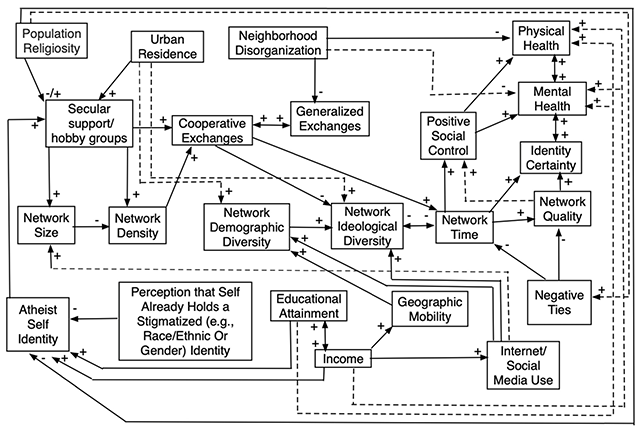
Figure 1
Schematic Theoretical Model Depicting Relationships Between Atheist Self-Identification, Social Network Structure and Health.
Key:
+ = positive effect.
– = negative effect.
–/+ = curvilinear effect.
* crossing paths are marked “- - - -” for ease of visibility.
There are six basic components in the model containing 23 theoretical variables: (1) identity (atheist self-identification, identity certainty, perception of already holding a stigmatized identity); (2) demographic variables (income, educational attainment); (3) social environment/ecological variables (population religiosity, neighborhood disorganization, geographic mobility, urban residence, prevalence of secular support/hobby groups, time spent in virtual internet/social media spaces); (4) network structure (size, density, demographic diversity, ideological diversity, time, quality, negative ties, positive social control); (5) exchange dynamics (cooperative exchanges, generalized exchanges); and (6) health outcomes (mental and physical health). I turn now to a brief description of the model, rooted in the literature summarized above.
Identity Components
Higher SES (typically measured in educational attainment and income) Caucasian males are more likely to self-identify as atheist compared to other groups. This likely has less to do with holding these demographic characteristics per se, and more to do with this profile of person feeling more efficacious, empowered, and safe adopting the stigmatized identity of “atheist”. The implication of this is that those who already hold an identity they perceive to be stigmatized (e.g., a racial or ethnic minority) will be less likely to self-identify as an atheist. Related to this perception of stigma, the religiosity of the larger population will reduce the probability that anyone—of any demographic profile—self-identifies as an atheist due to the potential costs of social exclusion or, in some case, physical retaliation.
Self-identification as an atheist appears to be related to better health outcomes, in part, because those identifying as atheists are more likely to participate in secular support/hobby groups. This participation in support/hobby groups will theoretically increase an individual’s network size and density (i.e., the probability of other people in one’s network knowing one another), as well as the opportunities available for cooperative exchanges with other members of one’s network. Self-identification as an atheist is also related to improved health outcomes due to “atheist” being a more certain, affirmative identity compared to other possible secular identities (e.g., agnostic, spiritual but not religious, etc.). Identity certainty is expected to be a slowly emerging product of both time spent with members of one’s social network and the emotionally supportive and encouraging interactions that can emerge from spending time with members of one’s network (“network quality” in the model). This emerging identity certainty is expected to reciprocally influence mental and physical health, with improved mental health also feeding back on and supporting increased identity certainty.
Demographic Components
There are likely countless demographic influences on the propensity to self-identify as an atheist. Income and educational attainment are two prominent influences, and those are modeled here to represent the role of demographics in atheist self-identification. It is possible, as well, that there is a self-selection effect occurring here such that those more likely to identify as atheist are actually more likely to draw higher incomes and go to school longer. Because these potential self-selection dynamics have not been adjudicated in the literature, educational attainment and income are here modeled as increasing the probability that an individual identifies as atheist. Independent of secular identity, educational attainment rates and higher income are also related in prior work to better mental and physical health outcomes, greater willingness to seek treatment, and lower rates of mortality.
Social Environment/Ecological Components
The proportion of a society’s population identifying as religious is expected to raise the opportunity cost (in terms of social exclusion, ridicule and, in some cases, physical retaliation) of being an atheist, thus reducing the tendency for people to self-identify in this way. The proportion of a society’s population identifying as religious believers is also expected to have a curvilinear relationship with the prevalence of secular support/hobby groups. In other words, the proportion of religious people in an area will be expected to initially reduce the prevalence of secular groups. However, over time, the religiosity of the population will provide an incentive for secular people to establish and maintain their own internal groups of support to avoid or cope with perceived discrimination. Once established, the prevalence of secular support/hobby groups is expected to increase the network size and density of self-identifying atheists, while also providing a context for, and thus facilitating the prevalence of, cooperative exchanges among secular people. Also, and relatedly, the proportion of a society’s population identifying as religious will increase the probability that any given self-identified atheist’s social network contains “negative ties,” or ties that ridicule, demean or are otherwise hostile to the atheist individual.
Research in criminology and urban sociology suggests that neighborhood disorganization will tend to reduce the prevalence of generalized exchanges within a community, while also reducing the mental health (due to stress and the perception of social instability) and physical health (due to higher rates of violent crime) of residents. Urban residency (as an indicator of population density) is expected to be associated with an increased prevalence of secular support/hobby groups, as well as with a greater degree of network diversity among individual atheists compared to those atheists living in more rural areas. Residential mobility (especially those moving out of a rural area and into an urban area) is expected to increase exposure to demographically and ideologically heterogeneous people, thus increasing the potential demographic and ideological diversity of individuals’ social networks. Lastly, ceteris paribus, time spent in virtual internet/social media spaces is expected to increase an individual’s network size (though these network ties may be superficial, with little to no face-to-face correspondence), as well as incidental exposure to people of different demographic backgrounds and ideological beliefs. This incidental exposure to diversity will raise the probability of an individual forming demographically and/or ideologically diverse network ties (social media “echo chambers” notwithstanding).
Network Structure Components
Self-identified atheists who spend more time on the internet using social media and who live in areas with a greater prevalence of secular support/hobby groups (and who spend more time in these groups) are expected to have larger social networks than those who do not. Insofar as an individual’s network is composed of other members of secular support/hobby groups, this will increase network density, or the probability that other members of one’s network know one another. On the other hand, atheists whose network members are not drawn from secular support/hobby groups, but are instead drawn from an array of different groups, clubs, and/or social cliques will tend to have less dense social networks (i.e., the more people in a network who are drawn from different social groups/clubs/cliques, the less likely each person is to know other members of a given individual’s network). Network density itself will increase the probability of members of one’s network forming cooperative exchanges with one another, for example, pursuing civic, creative or fitness goals with one another.
The demographic diversity of an individual’s social network is expected to be greater to the degree that the individual lives in an urban area, is geographically mobile (e.g., has lived in more than one state, left their hometown to go to college, travels frequently, etc.) and uses the internet for social media/networking purposes. In turn, the more demographically diverse an individual’s network is, the more ideologically diverse it will tend to be as well, as people of different social structural locations tend to have slightly different attitudes and worldviews (though it is possible for a demographically diverse network to be ideologically homogeneous and vice versa). Ideological network diversity is expected to be highest among those using the internet for social media/networking purposes, those with more demographically diverse networks, those living in urban (as opposed to rural) areas, those with few cooperative exchanges within their network (i.e., a low rate and duration of interaction in pursuit of shared goals with other network members will produce little pressure for ideological conformity within the network), and, relatedly, those who spend relatively less time with members of their network as this will also produce little pressure for ideological conformity within the network.
Network time (time spent with members of one’s network) is expected to be highest among those with less ideologically diverse network ties (i.e., people have a bias toward interacting with homophilous others—see Mcpherson et al., 2001), those whose social network contains a greater number of cooperative exchanges because it takes time to plan and carry out shared goals/projects and those with fewer negative (i.e., stressful or abusive) social ties. Self-identified atheists who spend more time with members of their network (especially insofar as network members are drawn from secular support/hobby groups and form cooperative exchanges) should, in turn, feel a greater sense of trust and support from members of their network (an indicator of network quality), receive a greater degree of positive social control, and experience a greater sense of identity certainty relative to self-identified atheists who spend less time with members of their network.
Network quality (i.e., trust, perception of support) is expected to be highest among atheists who spend more time with members of their network and who have a lower proportion of negative social ties. Additionally, those with higher quality networks are expected to have a greater sense of identity certainty, and to receive a greater degree of positive social control regarding mental and physical health (e.g., help in coping, or help talking through or finding professional assistance for health concerns).
Exchange Components
Self-identified atheists who participate in secular support/hobby groups and who have more dense social networks are expected to engage in a greater number of cooperative exchanges within their social network. This formation of cooperative exchanges will tend to reduce ideological differences and divisions between network members as well as increase the amount of time individuals spend with members of their network. Atheists with large networks, who engage in more proximate cooperative exchanges within their networks, will also, over time, tend to produce neighborhoods and communities with more generalized exchanges, leading to a greater sense of generalized trust and sense of embeddedness. This is expected to be a reciprocal dynamic such that atheists who harbor a generalized trust and sense of embeddedness in the larger community will subsequently be more willing to form cooperative exchanges within their network. Generalized exchanges (and the generalized trust and sense of communal embeddedness they foster) will, however, tend to be more truncated and less common in socially disorganized neighborhoods and communities, because people in these areas experience a greater degree of stress, uncertainty and criminal victimization.
Conclusion
The comparative study of religious and secular social network structure is in its earliest stages. Ultimately, this research will need to angle toward understanding comparative mental and physical health outcomes, as social networks are many peoples’ primary source of support, encouragement and monitoring regarding health. Given the attitudinal discrimination that nonreligious people face from a predominantly religious public, it may be that nonreligious individuals will be slower to join groups and organizations but that, among those who do (chief among them being self-identified atheists), their resultant network quality and health outcomes will not differ significantly from regular church attenders.
This essay has provided an in-depth overview of the ecological and environmental, network structural, exchange structural, and the social psychological and ideological dynamics that will be key in understanding the comparative differences between secular and religious networks as each relates to health. Each of these factors are embedded in one another: ideologies are an emergent property of interactions and interactions are embedded in exchange relationships which are embedded in network structures which are embedded in ecologies and environments. The future study of atheist social networks and health will need to be, therefore, multi-level and interdisciplinary in approach.
There are several remaining theoretical and methodological issues worth underscoring for the continued study of atheist network structure and health. Though many could be listed, the following three are important: (1) received vs. perceived social support, (2) positive vs. negative social contacts, and (3) subjective vs objective measures of social contact.
Regarding (1), research has shown that received social support and perceived social support are only weakly correlated (Thoits, 2011). This is interesting given that researchers often assume that the perception of social support stems from actual instances of received social support in the past. Yet, this may not be the case. Feeling embedded in a network, feeling a sense of belonging, may provide the perception of social support whether or not social support has actually been forthcoming in the past. Of course, if actual social support is both needed and requested, and it isn’t forthcoming across iterated interactions, then the perception of social support will likely erode.
In other cases, people may perceive a high level of social support, though they haven’t needed (yet) to call upon network members to actually provide any substantive support. Lastly, some people will need more social support than others due to the vicissitudes of unemployment, disease, divorce, perceived discrimination and so on. People who require more social support may interpret their need as burdensome and, as a result, “excuse” their network members for not providing the needed support.
Regarding (2), in the last several years, network researchers have taken seriously the need to distinguish between positive and negative social ties (e.g., Lund, Christensen, Nilsson, Kriegbaum, & Rod, 2014). Network embeddedness can negatively impact health outcomes if network members are overly critical, stressful, or emotionally or physically abusive. Having a greater proportion of negative ties in one’s network will erode network time, network quality and make cooperation (and thus the incidences of cooperative exchanges) more difficult. Researchers studying secular social networks should measure the proportion of negative ties within networks. Widespread discriminatory attitudes toward atheists will increase the probability that any given atheist has negative ties in their social network.
Regarding (3), researchers need to consider both objective and subjective measures for studying secular social networks. As a minority group facing attitudinal discrimination, self-identified atheists in the US may subjectively misinterpret the support offered by their networks. Indeed, prior research indicates that subjective perceptions of social support are significantly influenced by cultural upbringing, indicating that a beleaguered minority group may not accurately perceive network support (Shor & Roelfs, 2015). A more objective measure of social support might involve asking respondents to describe, quantitatively, how many times per week they interact with different members of their network, and for how long (in estimated minutes or hours). Though such a measure of network time still relies on self-reported responses and is, thus, still reliant on respondent subjectivity, it is relatively more objective than asking respondents to assess how “supported” or “included” they feel.
Finally, it will be important for subsequent work to discern whether or not, and to what degree, atheists are developing all-encompassing worldviews or ideologies that provide meaning, purpose and the perception of control over life’s uncertainties. This ideological scaffolding provides a “sacred canopy” (Berger, 1967) that legitimates and grounds peoples’ network structures and the exchange relationships that such networks contain. There is a significant need for research on the network structure and ideologies of people embedded in latently as opposed to manifestly or overtly secular groups and organizations, including self-help, occupational, personal-interest (i.e., sports or art), government-political-aid organizations or science/educational clubs.
Some research (e.g., Larson, Hansen, & Moneta, 2006) indicates that youth involved in church-related activities experience more opportunities to learn about emotion regulation than do youth in sports programs, arts programs or community service programs. Yet, this may be due to a lack of an ideological scaffolding in sports, arts, or community programs relative to the religious ideology encompassing religious service activities. Are atheists developing cohesive ideologies about the virtues of health and teamwork (for those in sports clubs), self-expression and self-transcendence (in arts programs) or social justice (for those in community programs)? Or are religious service programs somehow uniquely conducive to the development of an ideological scaffolding which aids emotion regulation? It is, of course, a possibility that religious ideologies may have characteristics (e.g., supernaturalness, unfalsifiability) that make them truly superior to secular ideologies with regard to their capacity to regulate emotion and bind communities together. However, this is an empirical question, and thus far, evidence does not indicate any inherent advantages to theism.
Competing Interests
The author has no competing interests to declare.