
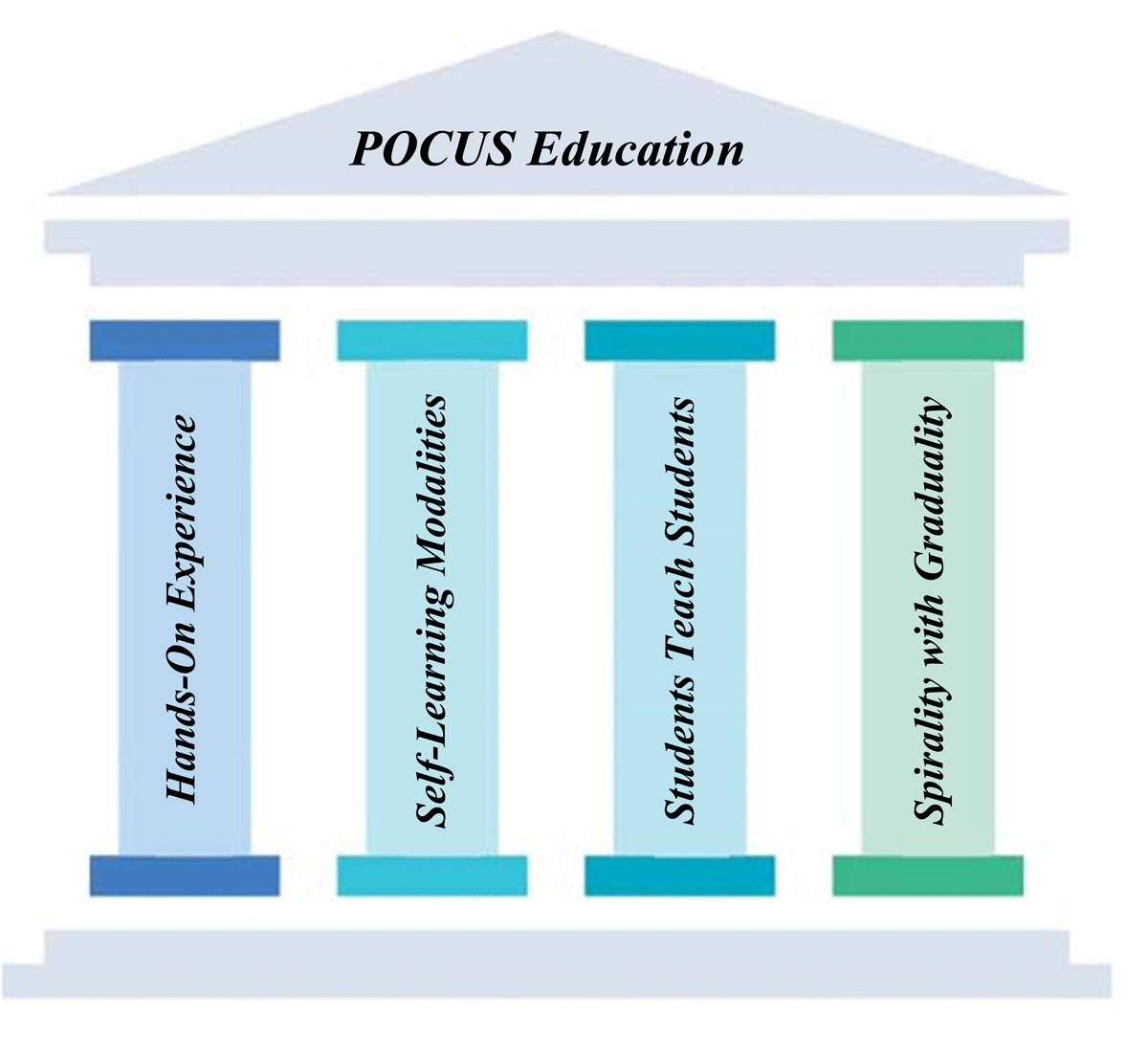
Figure 1
Our Four Pillars of Our POCUS Education Program.
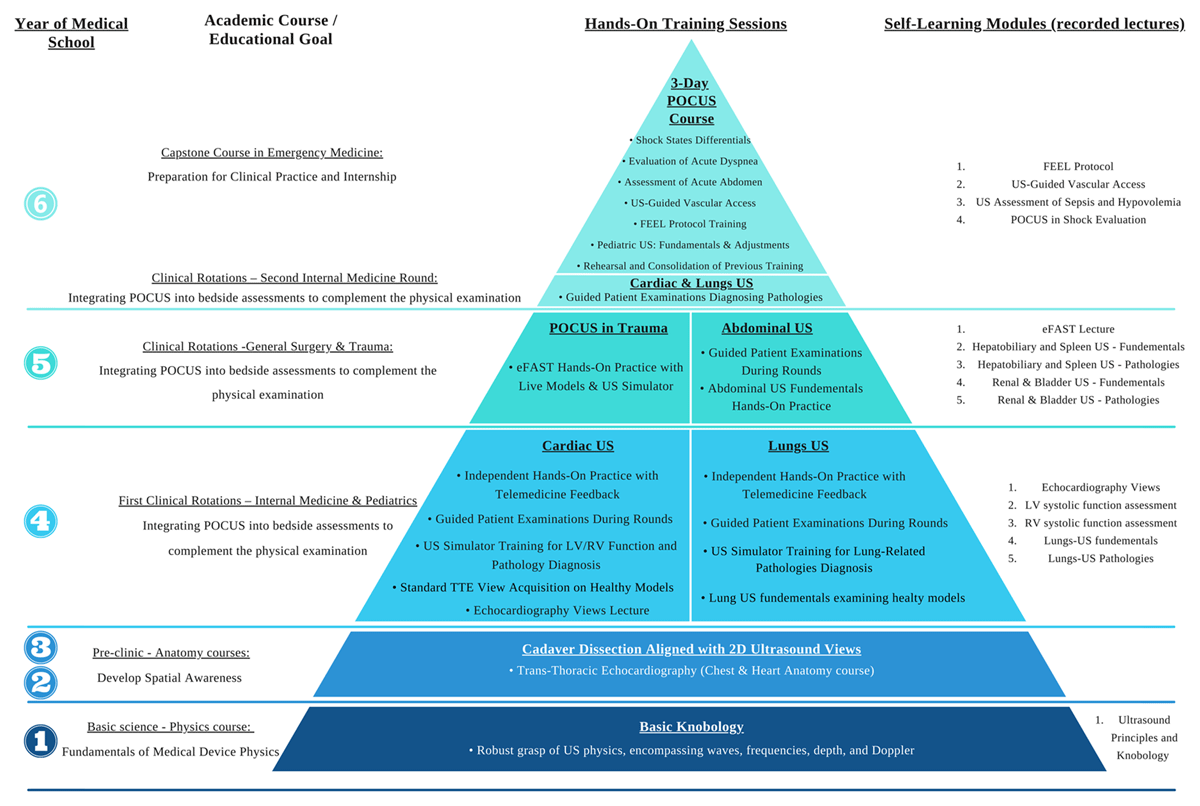
Figure 2
Spirality with Graduality teaching steps via the syllabus pyramid.
*The chart is structured from left to right, outlining the six-year medical school program. Each academic course is underlined, with its corresponding educational goal, relating to POCUS, indicated beneath. Within the pyramid chart, each • represents a single academic hour dedicated to hands-on training (except for telemedicine, which is detailed separately below). On the far right of the chart, a list details pre-recorded lectures that students are required to self-learn in preparation for hands-on training sessions on the respective subject.
For example, during the fourth year, as part of their first clinical rotations in internal medicine and pediatrics, students attend a single in-person lecture on echocardiography views. This is followed by six hours of hands-on training with guided instruction, covering cardiac and lungs POCUS, conducted in small groups with a 6:1 student-to-instructor ratio. To further reinforce skill development, students are also required to submit POCUS examinations they perform during clinical rounds for instructor feedback via telemedicine.
Abbreviations: LV (Left Ventricle), RV (Right Ventricle), eFAST (Extended Focused Assessment with Sonography in Trauma), FEEL (Focused Echocardiography in Emergency Life Support), POCUS (Point-of-Care ultrasound), TTE (Trans Thoracic Echocardiography), US (ultrasound).