
Table 1
Inclusion criteria.
| CRITERION | INCLUSION |
|---|---|
| Population | Adult patients (≥18 years) with a clinical diagnosis of tendinopathy. |
| Intervention | Low-load resistance training with blood flow restriction (LL-BFRT). |
| Comparison | Conventional resistance training, sham-BFR, or no comparator, depending on study design. |
| Outcome | Tendon morphology outcomes (e.g., thickness and vascularization) and/or clinical and functional outcomes (e.g., pain, strength, and patient-reported functional measures). |
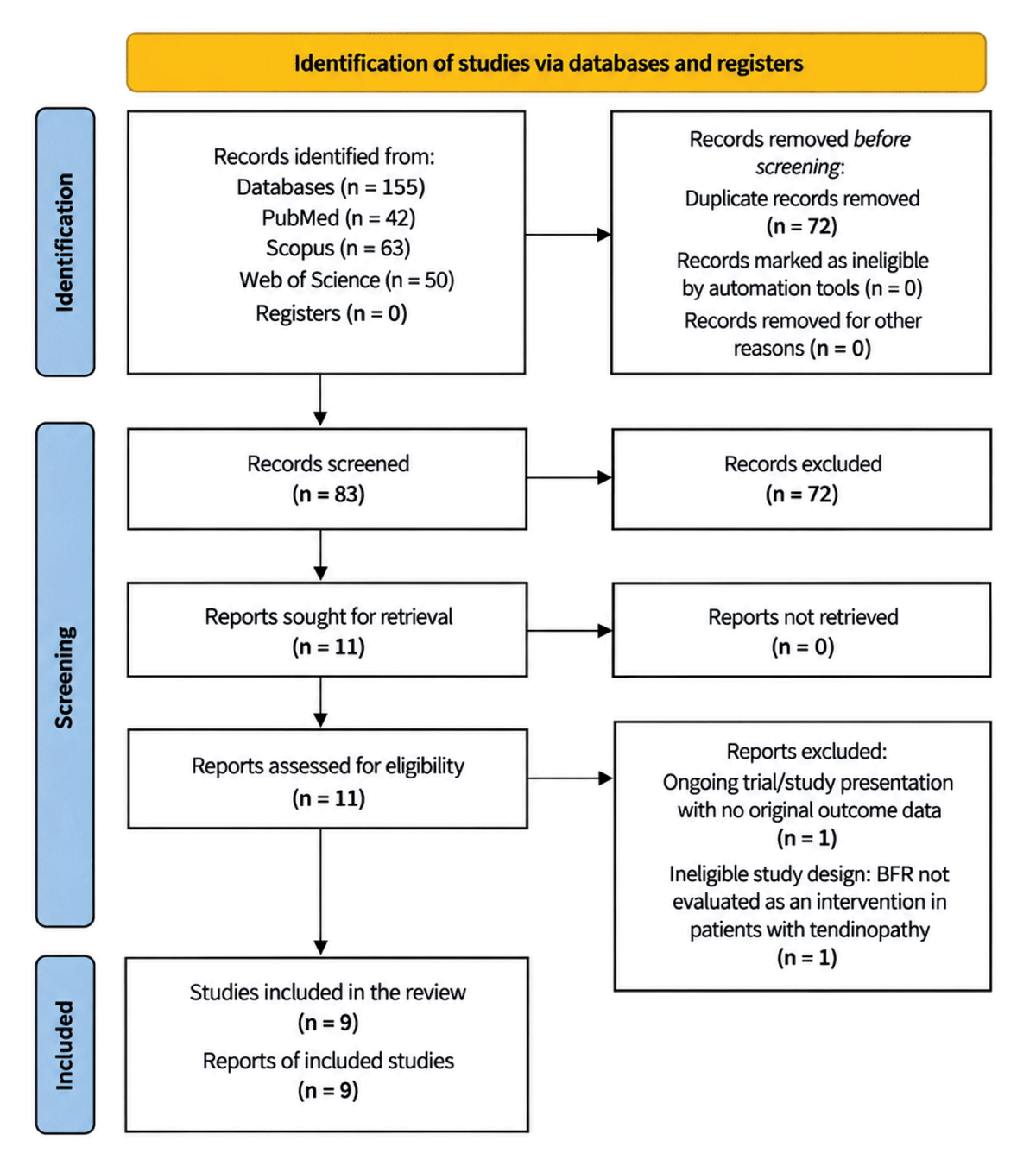
Figure 1
Flow Diagram.
Table 2
Descriptive data of the included RCTs studies.
| AUTHOR, STUDY DESIGN, POPULATION | INTERVENTION, EXERCISES, DURATION | TRAINING PARAMETERS | OUTCOMES | MAIN RESULTS |
|---|---|---|---|---|
| Karanasios et al. 2025 (Karanasios et al., 2025); RCT; n = 20, Lateral elbow tendinopathy | Low-load BFRT: Wrist extensor training, stretches. Single session | Sets: 4; Reps: 30-15-15-15; Freq: Single-session (cross-over), Int: Self-selected; SL: 30 minutes; Rest: 3 min per exercise; LOP: 40% | PPTs: Algometer PFGS; Function: Dynamometer; Cardiovascular response: Blood Pressure Monitor; Perceived exertion: Borg Rating of Perceived Exertion Scale | One session of BFR did not show immediate pain relief compared to exercise without BFR. Also, it may have a positive effect on strength, but it depends on patient characteristics |
| Karanasios et al. 2022 (Karanasios et al., 2022); RCT; n = 46, Lateral elbow tendinopathy | Low-load BFRT: Elbow flexion and extension; pain-monitored exercises (wrist movements in all directions), wall push-ups, ball grips, and wrist stretching exercises, 6 weeks | Sets: 4; Reps: 30-15-15-15 with elbow extension, and 3 sets × 10 reps with wrist extension, Freq: 2 in week; Int: 30% of 1RM with BFR applied; Rest: 1 min per exercise;LOP: 40–50% | Pain: NRS-P; Functional Recovery: PRTEQ; Function: Jamar hand dynamometer, Isometric elbow strength; Tendon Thickness: US, Global | LLRT-BFR was more effective than sham-BFR in reducing pain and improving function and grip strength in patients with LET. No significant differences in tendon thickness. |
| Kara et al. 2024 (Kara et al., 2024); RCT (assessor-blinded); n = 28, Rotator cuff tendinopathy | Low-load BFRT: Biceps curls, scapular retractions, full-can raises, and side-lying external rotations, 8 weeks | Sets: 4; Reps: 30-15-15-15; Int: 30% of 1RM with BFR applied; Freq: 2 sessions/week, LOP: 50%; Rest: 30 s per set, 1 min per exercise | Pain: VAS Function: SPADI, Muscle; Isokinetic dynamometer. Muscle Thickness: ultrasound Strength Assessment: | No significant difference between BFRT and traditional training in improved shoulder muscle thickness, external rotation strength, pain relief, and Shoulder function. |
| Kinandana et al. 2023 (Kinandana et al., 2023); RCT; n = 28, Lateral elbow tendinopathy | Low-load BFR training compared with high-intensity resistance exercise, wrist dorsiflexion and palmar-flexion exercises, 4 weeks | Sets: 4; Reps: 12 per set; Int: 20–40% of 1RM (BFR), 70–80% of 1RM (control); Freq: 3 sessions per week; Rest: 60 s per set; Cuff pressure: 1.2 × systolic blood pressure. | Grip strength: handgrip dynamometer; Functional ability/disability: PrTEEQ | Both groups improved grip strength and PrTEEQ scores. Improvements were significantly greater in the BFR group than in the resistance-exercise group (p < 0.001). |
[i] Note: RCT: Randomized Controlled Trial; BFRT: Blood Flow Restriction Training; Reps: repetitions; Freq: Frequency; Int: Intensity; SL: Session Length; 1RM: 1 repetition maximum; LOP: Limb Occlusion Pressure; PPTs: Pressure pain thresholds; PFGS: Pain-free grip strength; PRTEQ: Patient-Rated Forearm Evaluation Questionnaire; VAS: Visual Analogue Scale; SPADI: Shoulder Pain and Disability Index.
Table 3
Descriptive data of the included non-RCTs studies.
| AUTHOR, STUDY DESIGN, POPULATION | INTERVENTION, EXERCISES, DURATION | TRAINING PARAMETERS | OUTCOMES | MAIN RESULTS |
|---|---|---|---|---|
| Skovlund et al. 2020 (Skovlund et al., 2020) Case series; n = 7 Patellar tendinopathy | Low-load BFRT: Single-leg leg press, knee extension, 3 weeks | Sets: 6; Reps:30-25-20-15-10-5; Freq: 3 sessions per week; Int: 30% of 1RM; Rest: 30 s per set, 1 min per exercise; LOP: 120 mmHg | Pain: NPRS-P; Function: VISA-P; Knee extensor strength (MVC- static dynamometry), SLDS Tendon vascularity and thickness: ultrasound | Intervention was effective for improving clinical outcomes and strength. Pain with SLDS reduced by 50%. Tendon vascularity diminished by 31%. No changes in tendon thickness. |
| Begi et al. 2023 (Begi et al., 2023) Case report; n = 1 Chronic supraspinatus tendinopathy | Low-load BFRT: Scapular stabilization exercises, rotator cuff strengthening, lower limb aerobic exercise, 4 weeks | Sets: 4; Reps: 30-15-15-15; Freq: 3 sessions per week; Int: weeks 1–2: 15–20% of 1RM, Int: weeks 3–4: 30–40% of 1RM; LOP: 50% of limb occlusion pressure; Rest: 30 s–60 s per set | Pain: NPRS; PPTs: algometer; Function: Supraspinatus/scapular stabilizer strength: dynamometer, Image: Supraspinatus thickness: ultrasound | LL-BFR improved strength, endurance, and pain in supraspinatus tendinopathy. Structural changes as increased tendon thickness (2.73%). |
| Cuddeford & Brumitt 2020 (Cuddeford and Brumitt, 2020); Case report; n =2 Patellar tendinopathy | Low-load BFRT: Single-leg leg press, unilateral squat on a 25° decline board, 12 weeks | Sets: 4; Reps: 30-15-15-15; Freq: 2 sessions/week; Prog: Increase resistance (10 lbs increments as tolerated); Int: 30% 1RM; LOP:80%; Rest: 30 s per set | Pain: VAS; Function: VISA-P; knee strength: handheld dynamometry Tendon morphology: ultrasound, hip | BFRT showed significant improvement in pain, function, and muscle strength, with positive changes in tendon structure, enabling the athlete to return to sporting activity. |
| Høgsholt et al. (2022) (Høgsholt et al., 2022); Feasibility study; n = 16 Gluteal tendinopathy | Low-load BFRT: Static abduction, sidestepping, glute bridging, and squats, 8 weeks | Sets: 3; Reps: 20,10,10; Freq: 3–4 sessions with BFR/weeks 3–8; Prog: gradual increase in repetitions and session duration (15–25 min); Int: Bodyweight, LOP: 60% | Pain: NRS; Strength: Dynamometer Function: Sit-to-stand and stair-climb; Patient-reported outcome measures: VISA-G, EQ5D, VAS, OHS, and most HAGOS subscales. | The LL-BFR intervention combined with patient education was feasible, with improvements reported in pain, function, and strength. |
| Karanasios et al. 2023 (Karanasios, Lignos and Gioftsos, 2023); Case report; n = 1; Lateral elbow tendinopathy | Low-load BFRT: wrist extension exercises, soft tissue massage, wall push-ups, rubber bar exercises, grip strengthening, 6 weeks | Sets: 4; Reps: 30,15,15,15; Freq: 2 days/week; Int: progression 0.5–1 kg/week (if pain <2/10, NPRS); LOP:40%; Rest: 30 s per set | Pain: VAS; Pain-free grip strength: Jamar Hand Dynamometer; PPTs: Digital algometer | LLBFR effectively reduced pain and improved strength and function in a patient with Lateral elbow tendinopathy. |
[i] Note: BFRT: Blood Flow Restriction Training; Reps: repetitions; Freq: Frequency; Int: Intensity; SL: Session Length; 1RM: 1 repetition maximum; LOP: Limb Occlusion Pressure; mmHg: millimeters of mercury; NPRS: Numeric Rating Scale; VISA-P: Victorian Institute of Sport Assessment-Patella; MVC: Maximal voluntary contraction; SLDS: single leg decline squat; PPTs: Pressure pain thresholds; PFGS: Pain-free grip strength; PRTEQ: Patient-Rated Forearm Evaluation Questionnaire; VAS: Visual Analogue Scale; SPADI: Shoulder Pain and Disability Index; EQ-5D: EuroQol-5D questionnaire; OHS: Oxford Hip Score; HAGOS: Copenhagen Hip and Groin Outcome Score.
Table 4
Changes in tendon thickness following blood flow restriction interventions.
| AUTHOR (YEAR) | TYPE OF STUDY | TENDON SITE | BASELINE THICKNESS (MM) | POST BFR THICKNESS (MM) | Δ (%) |
|---|---|---|---|---|---|
| Begi et al. 2023 (Begi et al., 2023) | Case Study | Supraspinous | 8.41 | 8.64 | + 2.73 |
| Trapezius | 2.94 | 3.34 | + 13.78 | ||
| Cuddeford & Brumitt 2020 (Cuddeford and Brumitt, 2020) | Case report: Athlete 1 | Left Patellar tendon | 0.39 | 0.28 | –28.39 |
| Case report: Athlete 2 | Left Patellar tendon | 0.35 | 0.38 | +6.98 | |
| Skovlund et al. 2020 (Skovlund et al., 2020)* | A case series: n = 7 | Patellar tendon apex | 6.5 (6.1;7.3) | 6.3 (6.2;6.9) | –1% |
| Patellar tendon max | 6.7 (6.2;7.7) | 6.6 (6.2;7.7) | –1% |
[i] Note: mm: millimeters; BFR: Blood Flow Restriction; Δ: Delta; RCT: Randomized Controlled Trial; * Data are reported as median (95% Confidence Interval).