
Table 1
Search String Terms.
| Transgender | transgender, transsexual, trans men, transmen, trans women, transwomen, nonbinary, non-binary, genderqueer, transmasculine, transfeminine |
| Physical activity | physical activity, sport, physical education, barriers to exercise, facilitators of exercise, exercise promotion |
| (‘transgender’ OR ‘transsexual’ OR ‘trans men’ OR ‘transmen’ OR ‘trans women’ OR ‘transwomen’ OR ‘nonbinary’ OR ‘non-binary’ OR ‘genderqueer’ OR ‘transmasculine’ OR ‘transfeminine’) AND (‘physical activity’ OR ‘sport’ OR ‘physical education’ OR ‘barriers to exercise’ OR ‘facilitators of exercise’ OR ‘exercise promotion’) | |
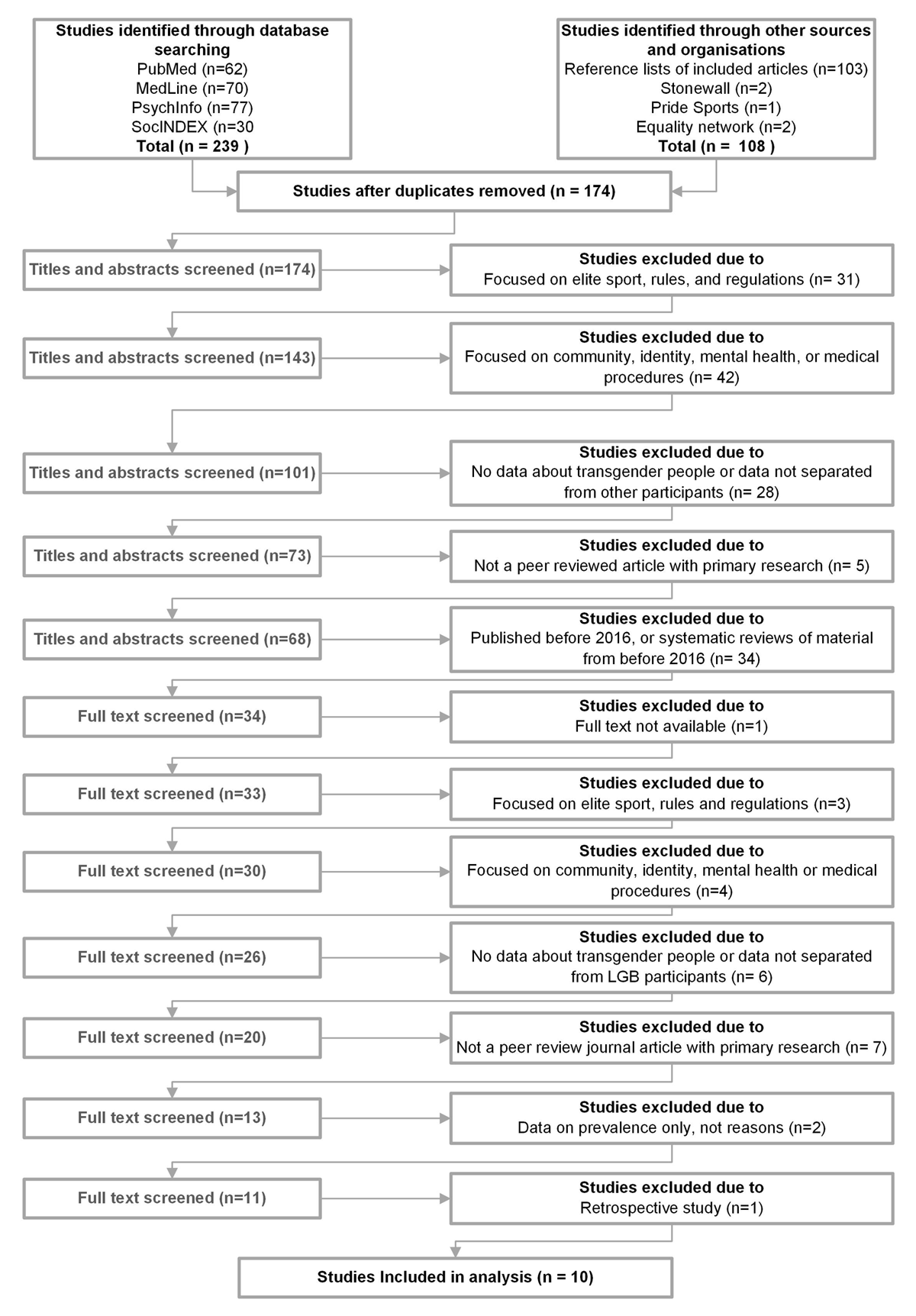
Figure 1
PRISMA diagram.
Table 2
Study details.
| AUTHOR(S) AND YEAR | QUALITY SCORE | METHOD | GENDERS | AGES | BARRIERS | FACILITATORS |
|---|---|---|---|---|---|---|
| Elling-Machartzki, 2017 | + | Qualitative; interviews | 6 trans women, 6 trans men | Ages 27–51 years, Average age 40.5 years |
|
|
| Greenspan et al., 2019 | ++ | Quantitative; surveys | 2 trans female, 3 trans male, 2 genderqueer, 6 other | 13–18 years |
|
|
| Herrick and Duncan, 2018 | ++ | Qualitative; focus groups | 5 non-binary, 2 gender fluid, 2 trans men, 1 trans women, and 1 agender person | 18+ years, Average age 28 years |
|
|
| Herrick and Duncan, 2020 | ++ | Qualitative; surveys | 88 transgender men, 51 transgender women, 183 nonbinary | 18+ years |
|
|
| Jones et al., 2017 | ++ | Qualitative; interviews | 9 trans men, 4 trans women | 18–36 yearsAverage age 22.71 |
|
|
| Jones et al., 2018 | ++ | Quantitative; matched control study using surveys | Matched control sample: 42 transgender men, 42 cisgender men, 95 transgender women, 95 cisgender women Whole trans sample: Sex assigned at birth – 151 female, 209 maleGender identity – 166 female, 131 male, 14 partly male and female, 17 neither male nor female, 18 unsure, 8 other, 6 missing data | Mean age all participants 30.15 years | n/a |
|
| Kulick et al., 2019 | + | Quantitative; surveys | 86 trans participants; genders not specified | High school age | Language/slurs | Feeling safe in toilets/changing rooms |
| López-Cañada et al., 2020 | + | Quantitative; surveys | 93 trans women, 108 trans men, 11 various other labels | 10–62 yearsAverage age 30.63 years | Gender disclosure/early stages transition |
|
| Pistella et al., 2020 | ++ | Quantitative; self report surveys | 357 trans participants; genders not specified | 12–17 years | n/a | Feeling safe |
| Stewart et al., 2020 | ++ | Qualitative; interviews | 20 trans women | 16–65 years | Fears about passing Bullying/harassment/slurs Single gender spaces |
|