
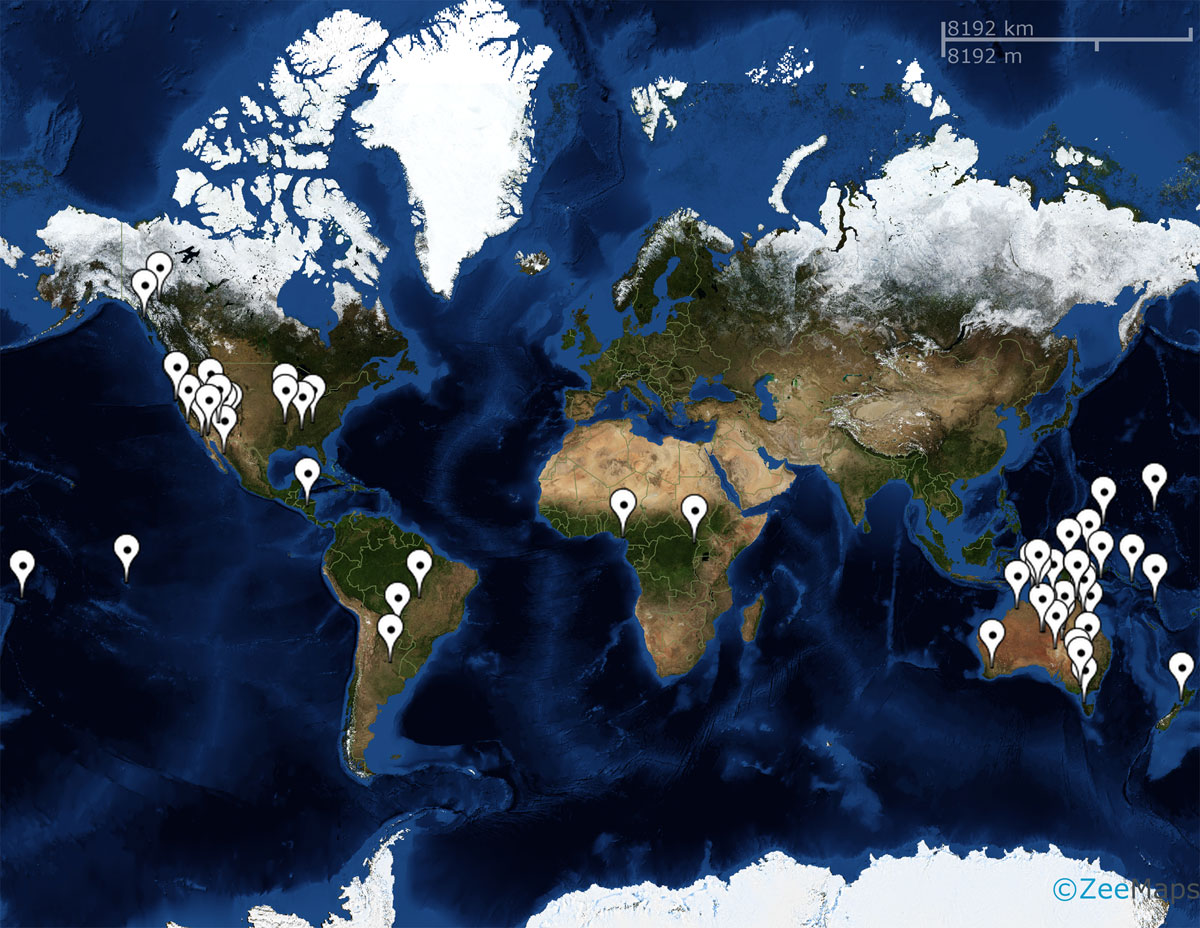
Figure 1
Global distribution of ethnographic accounts of the use of wooden spears listed in the accompanying database. Map produced using Zeemaps©. The online interactive map can be found in the figshare collection: https://doi.org/10.6084/m9.figshare.c.5085284.v1.
Table 1
Climates (Köppen-Geiger classification) in which wooden spears are evidenced to have been used, and number of groups represented for each classification. See accompanying dataset for references: https://doi.org/10.6084/m9.figshare.c.5085284.v1.
| Climate Classification Code | Climate description | Number of groups represented |
|---|---|---|
| Am | Equatorial monsoonal | 3 |
| Af | Equatorial rainforest | 9 |
| As | Equatorial with dry-summer characteristics | 2 |
| Aw | Equatorial with dry-winter characteristics | 7* |
| BSh | Arid, steppe, hot | 4* |
| BSk | Arid, steppe, cold | 3* |
| BWh | Arid. desert, hot | 11* |
| BWk | Arid. desert, cold | 1 |
| Cfa | Warm temperate, fully humid, hot summer | 1 |
| Cfb | Warm temperate, fully humid, warm summer | 8* |
| Csa | Warm temperate, dry summer, hot summer | 1 |
| Csb | Warm temperate, dry summer, warm summer | 6 |
| Dfc | Boreal, fully humid, cool summer | 2 |
| Dsb | Boreal, dry summer, warm summer | 1 |
| ET | Polar, tundra | 1 |
[i] * Several entries in the database pertaining to Australia likely represented multiple groups, and therefore the count by source is an underestimate.
Table 2
Prey hunted with wooden spears. See accompanying dataset for references: https://doi.org/10.6084/m9.figshare.c.5085284.v1.
| Group | Location | Prey |
|---|---|---|
| Kimberly | Kimberly, Western Australia | crocodile (Crocodylus sp.) kangaroo (Macropus sp.) emu (Dromaius novaehollandiae) |
| Aboriginal Tasmanians (multiple sub-groups) | Tasmania, Australia | Forester kangaroo (Macropus giganteus tasmaniensis) wombat (Vombatis ursinus tasmaniensis) pademelon (Thylogale billardierii) bandicoot (Isoodon obesulus, Perameles gunnii) |
| Tiwi | Melville and Bathurst Islands, Australia | wallaby (Macropus agilis) (also called ‘kangaroo’ in certain publications). ‘sea dwellers’ = possibly dugong (Dugong dugon) † possibly crocodile (Crocodylus porosus) † domestic pigs (Sus scrofa) ‡ |
| Admiralty Islanders | Admiralty Islands, Papua New Guinea | wild pig (Sus scrofa) |
| Kaska | Northeastern British Columbia, southeastern Yukon, Canada | bear (Ursus arctos/Ursus americanus) beaver (Castor canadensis) |
| Cherokee | Southeastern USA | white-tailed deer (Odocoileus virginianus) |
| Guayaki, Ynarö group | Paraguay | white-lipped peccary, (Tayassu pecari) jaguar (Panthera onca) capybara (Hydrochoerus hydrochaeris) |
| Ticuna | Brazil, Peru, Columbia | white-lipped peccary, (Tayassu pecari) jaguar (Panthera onca) |
| Wichí (Mataco) | Bolivia, Argentina | tapir (Tapirus terrestris) Chacoan peccary (Catagonus wagneri) jaguar (Panthera onca) |
| Bubis (Edeeya) * | Bioko, Equatorial Guinea | Ogilby’s Duiker (Cephalophus ogilbyi), Red River Hog (Potamochoerus porcus), forest buffalo (Syncerus caffer nanus) porcupine (Atherurus africanus), primates (species unclear) |
| Mbuti | Congo region | African elephant (Loxodonta cyclotis) |
[i] † Also known to be hunted with metal pronged spears by the Tiwi.
‡ Colonists who attempted unsuccessfully to inhabit the Tiwi islands introduced domesticated pigs, cattle, horse and water buffalo, with feral populations of these animals remaining to this day (Woinarski et al. 2003).
* It is unclear which species the Bubi hunted with their wooden spears, as they also hunted with slings (Colell, Maté and Fa 1994), and later with firearms, and sources consulted are conflicting; thus the Bubi prey list should be treated with caution. Body mass data are based on averages for given species (Boitani and Bartoli 1983; Damuth 1987; Garland 1983; Grubb et al. 2000; Grzimek 1972; Jenkins & Busher 1979; Le Mar & McArthur 2005; Marsh 1989; Mayer & Wetzel 1987; 1986; Mones & Ojasti 1986; Pasitschniak-Arts 1993; Poole 1982; Seymour 1989).
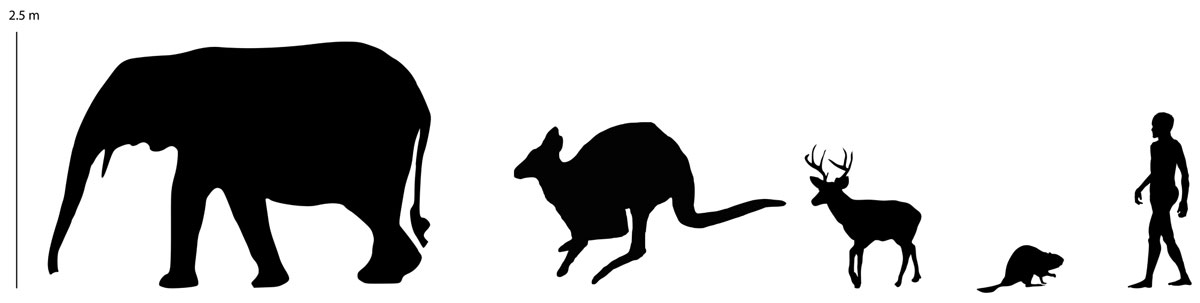
Figure 2
Selection of sizes of prey hunted with wooden spears in ethnohistoric and ethnographic literature in comparison with an average male H. sapiens. From left: African forest elephant (Loxodonta cyclotis), kangaroo (Macropus giganteus), white-tailed deer (Odocoileus virginianus), beaver (Castor canadensis). Image composed by the author using silhouettes from phylopic.org. Loxodonta cyclotis silhouette created by Richard Ruggiero, vectorised by Zimices, available with a Creative Commons Attribution-ShareAlike 3.0 Unported license: https://creativecommons.org/licenses/by-sa/3.0/.
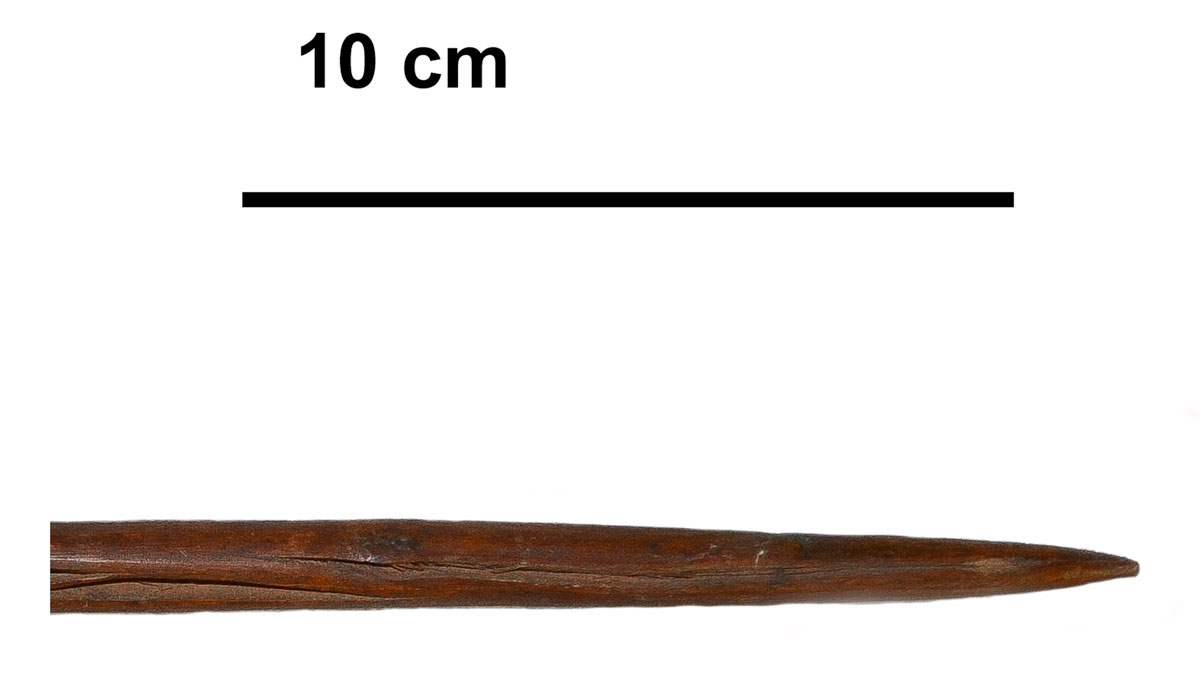
Figure 3
Photograph of one of the remaining Aboriginal Tasmanian spears. Spear held in the Tasmanian Museum and Art Gallery (M.2724). Photo: author’s own, courtesy of the Tasmanian Museum and Art Gallery.
Table 3
Groups recorded to have used wooden spears for violence. See accompanying dataset for references: https://doi.org/10.6084/m9.figshare.c.5085284.v1.
| Group | Location | Source |
|---|---|---|
| Tula | Southern USA | (Swanton 1946) |
| Chickasaw | Southeastern USA | (Swanton 1946) |
| Shoshone | Western USA | (Steward 1941) |
| Sinkyone of S Fork of Eel River | Northwestern USA | (Driver 1939) |
| Eastern Apache, Chiricahua | Southwestern USA | (Opler 1941) |
| Western Apache | Southwestern USA | (Buskirk 1986; Goodwin & Basso 1971) |
| Yuma | Southwestern USA | (Drucker 1937; Forde 1931) |
| Mohave | Southwestern USA | (Stewart 1947) |
| Yaqui | Southwestern USA, Northwest Mexico | (Drucker 1941) |
| Maricopa | Southwestern USA, Northwest Mexico | (Spier 1933) |
| Pima | Southwestern USA, Northwest Mexico | (Drucker 1941) |
| Yavapai (Northwestern) | Southwestern USA, Northwest Mexico | (Drucker 1941) |
| Multiple | Mainland Australia | (Davidson 1934a; Davidson 1934b; Hayden 1979) |
| Aboriginal Tasmanians | Tasmania, Australia | (Noetling 1911; Roth 1890) |
| Tiwi | Tiwi Islands, Australia | (Cameron 1998; Fredericksen 2002; Hart & Pilling 1960) |
| Marquesans | Marquesas Islands, French Polynesia | SIRIS database; see accompanying dataset |
| Marshall Islanders | Marshall Islands | (Erdland & Neuse 1914) |
| Chuuk (Truk) | Truk Islands, Micronesia | (Bollig 1927) |
| Māori | New Zealand | (Tregear 1904) |
| Admiralty Islanders | Admiralty Islands, Papua New Guinea | (Moseley 1877) |
| Massim | Trobriand Islands, Papua New Guinea | (Malinowski 1920) |
| Samoans | American Samoa, Polynesia | Smithsonian CSR database; see accompanying dataset |
| Malekula | Republic of Vanuatu (Formerly New Hebrides) | (Deacon & Wedgwood 1934) |
| Dugum Dani | Western New Guinea | (Heider 1970; Heirder 1974) |
Table 4
Delivery methods recorded for wooden spears. See accompanying dataset for references: https://doi.org/10.6084/m9.figshare.c.5085284.v1.
| Group | Location | Thrusting | Throwing |
|---|---|---|---|
| Ituri Mbuti | Democratic Republic of Congo | Likely | NA |
| Desert Diegueño | Mexico, USA: Ensenada, Mexico; Escondido, California | Yes | No |
| Maricopa | Mexico, USA: Northwest Mexico; Southwest USA (Gila River Indian Reservation, Pinal County, AZ, United States) | Yes | NA |
| Eastern Apache, Chiricahua | USA: Arizona | Yes | No |
| Western Apache | USA: Arizona | Yes | No |
| Tula | USA: Arkansas | Maybe | Maybe |
| Obispeño and Purisimeño Chumash | USA: California (Morro Bay to Malibu) | NA | Yes |
| Shoshone | USA: Nevada, Utah, Idaho | Yes | NA |
| Sinkyone of S Fork of Eel River | USA: Northwest California | Yes | Maybe |
| Mattole | USA: Northwest California (Cape Mendocino) | Yes | Maybe |
| Chickasaw | USA: Southeast | Maybe | Yes |
| Cherokee | USA: Southeast | Yes | NA |
| Yuma | USA: Southern California (Fort Yuma Reservation) | Yes | No |
| multiple | Australia: mainland | Yes | Yes |
| Aboriginal Tasmanians | Australia: Tasmania | Unlikely | Yes |
| Tiwi | Australia: Tiwi Islands | Maybe | Yes |
| Marshall Islanders | Marshall Islands | Yes | Yes |
| Chuuk (Truk) | Micronesia: Truk Islands | Yes | Yes |
| Māori | New Zealand | Yes | Yes |
| Admiralty Islanders | Papua New Guinea: Admiralty Islands | No | Yes |
| Tinputz | Solomon Islands | Yes | NA |
| Dugum Dani | Western New Guinea | Yes | Yes |
| Mataco | Gran Chaco region, Bolivia, Argentina | Yes | Yes |
| Ticuna | Brazil; Columbia; Peru | Yes | Yes |