
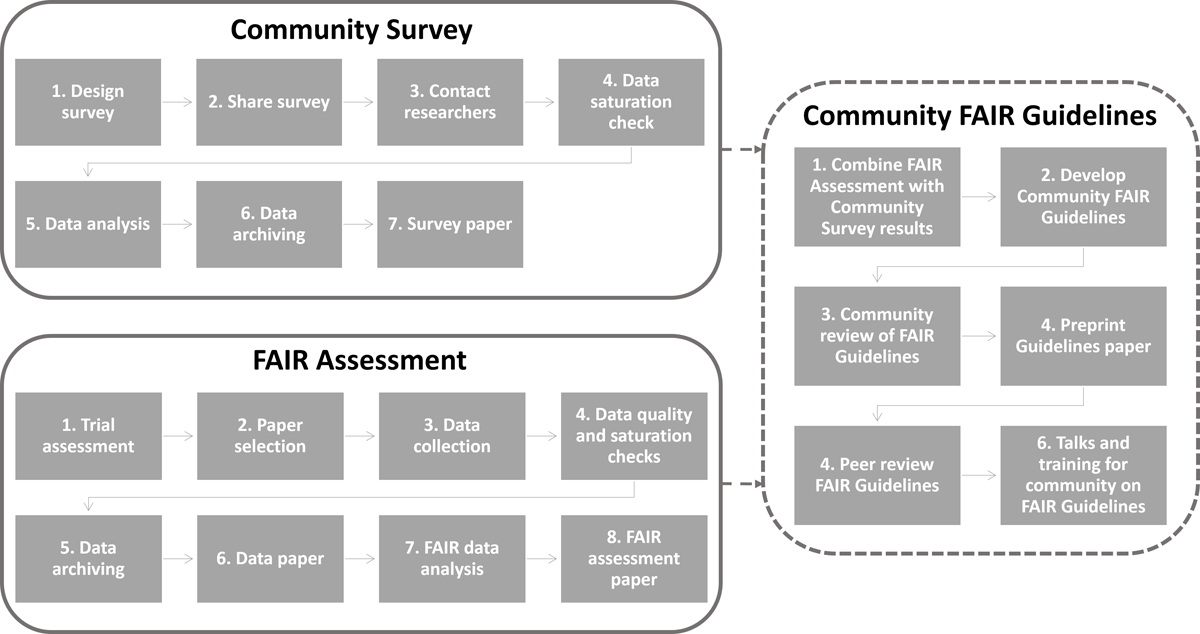
Figure 1
FAIR Phytoliths Project work packages. The Community Survey box shows the workflow for this paper, the results of which will be combined with the FAIR Assessment results to produce the Community FAIR Guidelines in collaboration with the International Committee on Open Phytolith Science (ICOPS) of the International Phytolith Society (IPS).
Table 1
List of variables included in the multiple correspondence analysis (MCA) and their respective codes used for graphing.
| VARIABLE | MCA CODE | DESCRIPTION |
|---|---|---|
| Gender | Male | Male gender |
| Female | Female gender | |
| Other | Non-binary gender or not expressed | |
| Based | Africa | Research activities conducted in an African institution/company |
| Americas | Research activities conducted in an American institution/company | |
| Asia | Research activities conducted in an Asian institution/company | |
| Europe | Research activities conducted in a European institution/company | |
| Oceania | Research activities conducted in an Oceanian institution/company | |
| Field | Past | Expertise in disciplines related to reconstructions of past phenomena (e.g., archaeology, palaeoecology) |
| Modern | Expertise in disciplines focused on currently observable phenomena (e.g., plant physiology, agronomy) | |
| Both | Expertise in both types of disciplines | |
| Position | Junior | Early-stage researcher (undergraduate students to early postdocs) |
| Senior | Consolidated researcher (advanced postdocs to professors) | |
| Professional | Independent researcher | |
| OpenSoftware | OpenSoftware_Yes | User of open access (e.g., Google Docs) and/or open source software (e.g., R) for writing, data analysis and data visualisation |
| OpenSoftware_No | Non-user of open access and/or open source software for writing, data analysis and data visualisation | |
| Publications | Publications_Yes | Authorship (not necessarily as first author) in scientific publications |
| Publications_No | No authorship in scientific publications | |
| PreprintGreen | PreprintGreen_Yes | Experience in and/or predisposition to publish preprints and as green open access |
| PreprintGreen_No | No experience in and/or predisposition to publish preprints and as green open access |
Table 2
Summary results of the survey.
| NUMBER OF PARTICIPANTS | 81 | |||
|---|---|---|---|---|
| Demographic/academic data | ||||
| Gender | Female | 54 (66.7%) | ||
| Male | 25 (30.9%) | |||
| Other (non-binary; prefer not to answer) | 2 (2.5%) | |||
| Based | Africa | 2 (2.5%) | ||
| Americas | 35 (43.2%) | |||
| Asia | 10 (12.3%) | |||
| Europe | 30 (37%) | |||
| Oceania | 4 (4.9%) | |||
| Research location(s)* | Africa | 12 (12.2%) | ||
| Americas | 34 (34.7%) | |||
| Asia | 30 (30.6%) | |||
| Europe | 17 (17.4%) | |||
| Oceania | 5 (5.1%) | |||
| Main research field(s)* | Agronomy | 3 (2.5%) | ||
| Archaeology | 61 (50%) | |||
| Bioinformatics | 1 (0.8%) | |||
| Botany | 21 (17.2%) | |||
| Geochemistry | 5 (4.1%) | |||
| Palaeoenvironment | 27 (22.1%) | |||
| Palaeontology | 4 (3.3%) | |||
| Position | BA/MA student/graduate | 2 (2.5%) | ||
| PhD candidate | 19 (23.5%) | |||
| Junior postdoc | 24 (29.6%) | |||
| Senior postdoc | 5 (6.2%) | |||
| Senior untenured | 4 (4.9%) | |||
| Senior tenured | 23 (28.4%) | |||
| Professional | 4 (4.9%) | |||
| Open research practices | ||||
| Pre-publication | No | Yes | ||
| Open access/source writing software | 41 (50.6%) | 40 (49.4%) | ||
| Open access/source analysis software | 29 (35.8%) | 52 (64.2%) | ||
| Open access/source visualisation software | 20 (24.7%) | 61 (75.3%) | ||
| Knowledge/use of open access repository | 48 (59.3%) | 33 (40.7%) | ||
| At publication** | Never published: 10 (12.3%) | Published: 71 (87.7%) | ||
| Gold open access | No: 4 (40%) | Yes: 6 (60%) | No: 47 (66.2%) | Yes: 24 (33.8%) |
| Preprint/green open access | No: 3 (30%) | Yes: 7 (70%) | No: 29 (40.8%) | Yes: 42 (59.2%) |
| Replicability of published results | ||||
| Methods (level of description)* | Complete description (in publication or repository) | 49 (50%) | ||
| Description of modified protocol | 25 (25.5%) | |||
| Reference to published methods | 24 (24.5%) | |||
| Methods (perception of replicability) | Yes | 70 (98.6%) | ||
| No | 1 (1.4%) | |||
| Percentage of publications including raw data | Zero | 15 (21.1%) | ||
| Twenty | 7 (9.9%) | |||
| Forty | 11 (15.5%) | |||
| Sixty | 10 (14.1%) | |||
| Eighty | 14 (19.7%) | |||
| Hundred | 14 (19.7%) | |||
| Raw data published (where and how)* | Table in main text | 32 (32%) | ||
| Supplementary file | 49 (49%) | |||
| DOI-based repository | 13 (13%) | |||
| Personal repository | 6 (6%) | |||
| Attitude towards open/FAIR research | ||||
| Interest in recognition | Yes | 26 (32%) | ||
| No | 14 (17%) | |||
| Maybe | 41 (51%) | |||
| Interest in receiving more information | Yes | 71 (88%) | ||
| No | 1 (1%) | |||
| Maybe | 9 (11%) | |||
| Interest in collaborating | Yes | 65 (80%) | ||
| No | 16 (20%) | |||
[i] *These categories represent multiple choice questions where respondents were allowed to check multiple answers. **The categories in the subsection express predisposition in the case of participants without publications, experience in the case of participants with gold open access publications, and a combination of predisposition and/or experience in the case of preprints/green open access in participants with publications.
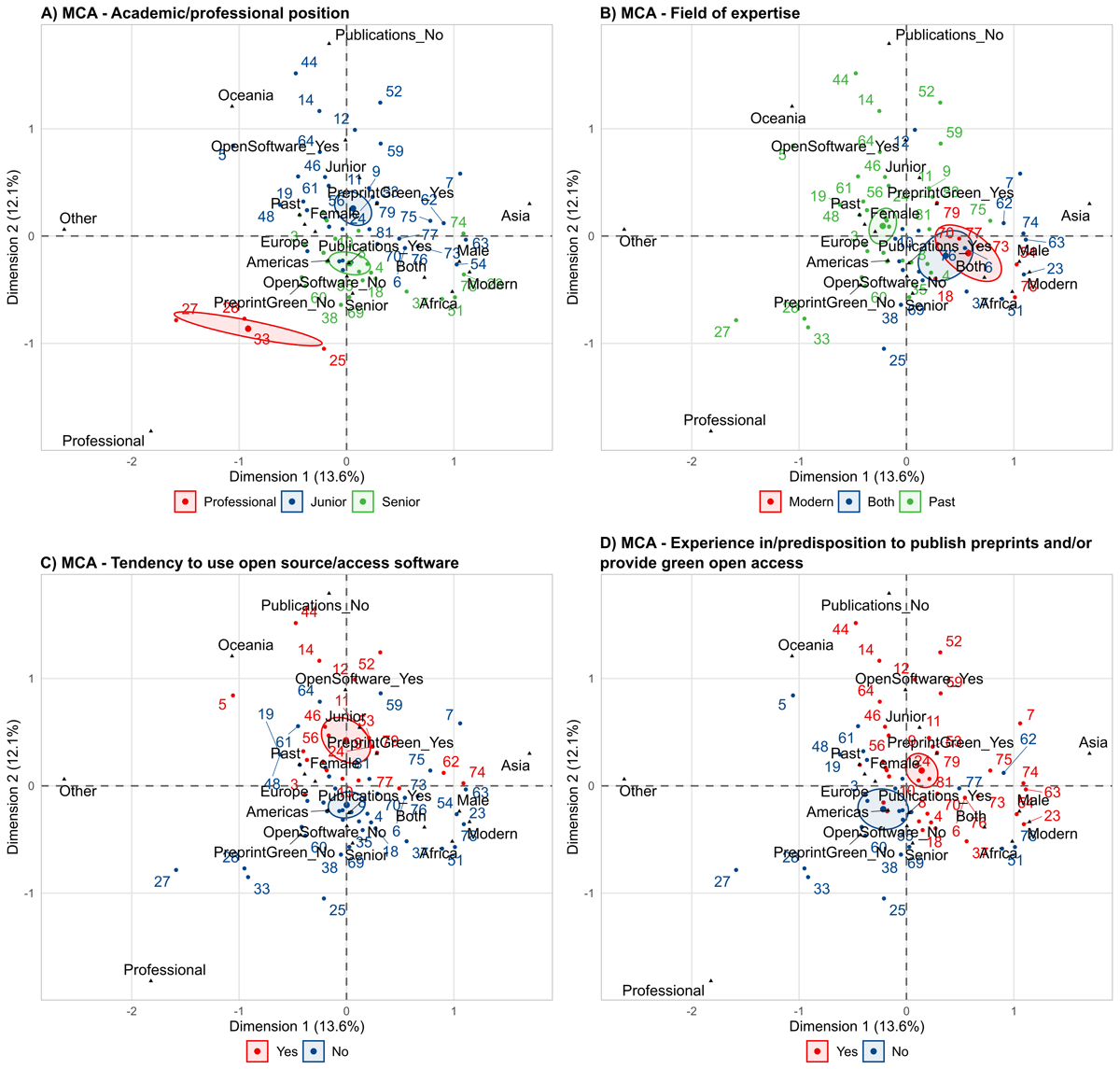
Figure 2
Multiple correspondence analysis biplot displaying results of the first part of the survey. First two dimensions are shown including groups of participants (coloured ellipses of confidence intervals at 95%) according to A) their academic/professional position, B) their field of expertise, C) their tendency to use open source/access software and D) their experience in/predisposition to publish preprints and/or provide green open access. Participants are represented by dots and variables (i.e., descriptions and answers of the participants) by triangles. Each number associated with a dot corresponds to a unique ID of the participant (see File S6 in Ruiz-Pérez et al. 2024). Black text represents each category of the variables under analysis.