
1. Introduction
1.1. Open research
Open research (OR) aims to transform research by making it more reproducible, transparent, reusable, collaborative, accountable and accessible to researchers and wider society (Fecher & Friesike 2014; Stracke 2020; The Turing Way Community 2021). This movement encompasses many practices (Crüwell et al. 2019), including open access research outputs, open and FAIR (i.e., findable, accessible, interoperable and reusable) data, open methods, open source software and hardware, open education, citizen science, and equity, diversity and inclusion.
The implementation of OR practices is slowly growing in many academic disciplines (see, for example, Marwick et al. 2017; Wallach, Boyack & Ioannidis 2018; Womack 2015). Much of this change in practice has been motivated by the increasing use of computational methods and data-driven research, meaning that the collaborative nature and consideration of reproducibility and sustainability of research have been driven to the fore (Bartling & Friesike 2014; Ram 2013). Open research has recently been recognised as a major shift in practice by large organisations, such as the UNESCO (UNESCO 2021), and government funding bodies, such as the UK Research and Innovation (UKRI), the European Research Council (ERC), the USA’s National Science Foundation (NSF), the Japan Science and Technology Agency (JST) and the São Paulo Research Foundation (FAPESP) (ERC Scientific Council 2021; ERC Scientific Council 2022; FAPESP 2024; JST 2022; NSF 2023; UKRI 2023). In addition, public bodies like UKRI, ERC and NSF are increasingly requiring grant holders to implement elements of OR practice, therefore making these practices a mandatory part of grant applications.
The benefits of OR are well documented (Tennant et al. 2016) and focus around two main advantages: first, greater research sustainability through the increased transparency and reproducibility of research; and second, improvements in equity, diversity and inclusion in science, meaning that science is made more available and accessible for scientists and the wider public. Additionally, there are many examples of studies showing that sharing data in repositories and making articles open access (OA) increase citations (e.g., Christensen et al. 2019; Colavizza et al. 2020; Langham-Putrow, Bakker & Riegelman 2021; Piwowar, Day & Fridsma 2007) and the overall rigorously and reliability of research communities (e.g., Anagnostou et al. 2015; Munafò et al. 2017). However, the adoption of OR practices is happening at different speeds due to the skills of researchers, their interests in using computational methods and also the different needs and/or requirements of each discipline to work in an open and transparent manner (Armeni et al. 2021; Houtkoop et al. 2018; Marwick & Birch 2018; Michener 2015; Ross-Hellauer, Deppe & Schmidt 2017; Sayogo & Pardo 2013; Zenk-Möltgen et al. 2018).
1.2. Phytolith research community and the FAIR Phytoliths Project
Phytolith analysis (i.e., the identification and quantification of plant silica cells) has a very wide range of applications and as such the phytolith research community is composed of researchers and professionals from many different disciplines including archaeology, ecology, geochemistry, palaeoecology, palaeontology and plant science (Hart 2016; Piperno 2006). This breadth of applications and disciplines has produced distinct approaches and techniques in phytolith research, often resulting in a lack of consensus on standard methods (Zurro et al. 2016). This lack of standardisation includes field and laboratory procedures (e.g., sampling strategy and extraction protocols), methods of data analysis (e.g., counting strategy and nomenclature) and how data is presented, published and stored (i.e., data stewardship).
Within the community there have been some initiatives to move towards the standardisation of nomenclature and analytical methods such as morphometrics. Through standing committees of the International Phytolith Society (IPS), the second version of the International Code for Phytolith Nomenclature (ICPN) has recently been published (ICPT 2019), which adds to the first ICPN (Madella, Alexandre & Ball 2005). These standardised nomenclatures along with the guidelines for morphometric studies (Ball et al. 2016) have started to move us in the right direction in terms of standardised data analysis and data management. In 2016, Zurro et al. (2016) did a general review on this topic and called for the necessity of greater transparency in phytolith research.
The extent of the adoption of these standardised approaches and other practices was recently assessed by Karoune (2020; 2022), who collected data concerning open access, reusability of data and the inclusion of metadata in phytolith research publications. The study found that 1) the majority of the papers had a summary of the extraction methodology but none had a full laboratory protocol included; 2) the ICPN 1.0 (Madella, Alexandre & Ball 2005) was used by 47% of the studies and integration of some pictures for identification purposes was 74%; and 3) only 4% of the articles examined had reusable data and 13% of the articles were gold OA.
The general lack of data sharing, standardisation and transparency in phytolith studies makes it difficult to fully understand the research that is being published, which in turn limits reusing data or methods from these studies (Munafò et al. 2017; Tenopir et al. 2020). This is preventing phytolith data contributing to larger, collaborative projects, especially if needing to combine data from different research laboratories. It is also hindering our ability to properly validate research when we peer review articles and therefore making it hard to truly assess the quality of the research that is being produced.
The FAIR Phytoliths Project led by the authors aims to further explore the issues concerning methods and data sharing in phytolith research and, particularly, how the FAIR data principles (Wilkinson et al. 2016) can be implemented to improve data sharing and stewardship in the discipline for greater sustainability of research. As in other disciplines, we expect the adoption of OR practices in phytolith research to enhance collaboration (e.g., data reuse and interdisciplinary partnerships), increase transparency and reliability (i.e., sharing methods and data openly promotes reproducibility of research and validation of results), boost impact (i.e., open publishing provides greater exposure and leads to higher citation rates) and wider access to knowledge (i.e., researchers in developing countries and the general public can have unrestricted access to data and publications). The FAIR Phytoliths Project initiative is being conducted in a transparent and community-led manner and includes 1) the formation of a standing committee (International Committee on Open Phytolith Science – ICOPS) within the International Phytolith Society to start a greater community effort around this work and begin training phytolith researchers in OR skills; 2) the understanding of the community’s opinions on OR and current practices through a community survey; 3) a FAIR assessment of publications employing phytolith analysis; and 4) the publication of the Community FAIR Guidelines (Figure 1). In this paper, we present the results of the phytolith research community survey, which aimed to capture information about the current OR practices within the phytolith research community, to gather information about their opinions on these practices and to engage with researchers that would be interested in collaborating with the project team.

Figure 1
FAIR Phytoliths Project work packages. The Community Survey box shows the workflow for this paper, the results of which will be combined with the FAIR Assessment results to produce the Community FAIR Guidelines in collaboration with the International Committee on Open Phytolith Science (ICOPS) of the International Phytolith Society (IPS).
2. Materials and Methods
2.1. Survey
The survey was designed in two parts. The first part was anonymous and included demographic questions, questions about OR practices (i.e., use of open source/access software, experience in and predisposition to open publishing, and methods and data sharing) and opinions on OR. Questions in the first part comprised a mix of closed- and open-ended options. Filling in part two of the survey was optional and it gathered personal details of researchers that would be interested in getting more involved in our project. The two parts of the survey are available in File S1 and File S2 (Ruiz-Pérez et al. 2024).
We conducted the survey through two separate Google Forms hosted on Universitat Pompeu Fabra’s servers (Barcelona, Spain) to be fully compliant with the General Data Protection Regulation (European Parliament and Council of the European Union 2016). The survey was released on 28th May 2021 and closed on 31st December 2021. The link for the Google Form was distributed by posting a message on the International Phytolith Society forum webpage (https://phytoliths.org/) and in a blog on the same website, sending emails to relevant email lists (env-arch@jiscmail.ac.uk and archaeobotany@jiscmail.ac.uk) and emailing individual phytolith researchers and research groups (n = 248). We also advertised the survey in our presentations at the International Meeting of Phytolith Research in September 2021, as well as through our Twitter account (@open_phytoliths).
In total, 82 researchers responded to part one of the survey. Of the 82 responses, one was eliminated from analysis as the researcher declared not to be working with phytoliths but other plant material. The resulting dataset (n = 81) was then simplified by standardising the answers to facilitate data analysis and to avoid specific answers that could expose the participants’ identity. The anonymous cleaned dataset generated from part one of the survey and the criteria for simplification are available in File S3 and File S4 (Ruiz-Pérez et al. 2024).
2.2. Analyses
When dealing with qualitative surveys it is crucial to verify that enough data has been collected and when further data collection will not produce any value-added insights. In this case, data saturation of the dataset resulting from the first part of the survey (File S3) was calculated according to the procedure proposed by Guest, Namey & Chen (2020), a method specifically developed for assessing the adequacy of sample size during or after the collection of thematic data in qualitative research. The approach is based on the definition of three parameters: base size (i.e., the minimum number of responses used to calculate the amount of information already gained), run length (i.e., the number of responses within which new information is collected or not) and new information threshold (i.e., the point in which no new information is gained in the answers). In our analysis we chose a base size of 6 participants, a run length of 3 participants and calculated both new information thresholds of ≤5% and 0% in 15 variables randomly chosen from File S3. Settings and calculations are available in File S5 (Ruiz-Pérez et al. 2024).
The information from the survey was first analysed descriptively to assess the current adherence and general predisposition of the phytolith research community to OR practices. In addition, we performed a multiple correspondence analysis (MCA) (Greenacre & Blasius 2006) on a cleaned subset of the survey data to overall assess whether propension toward OR in the phytolith research community (i.e., use of open access/source software and predisposition to publish preprints or as green OA) is driven by demographic and/or academic background, such as the country of origin of the researcher’s institution/company, position held or main field of research. Questions and answers from File S3 were grouped to eliminate unique entries and to allow us to focus on categories of interest that were shared by participants with and without publishing experience (see Table 1). MCA was computed in R version 3.6.3 (R Core Team 2020) using the packages FactoMineR version 1.34 (Lê, Josse & Husson 2008) and factoextra version 1.0.7 (Kassambara & Mundt 2020). Dataset, criteria for simplification and R code are available in File S6, File S7 and File S8 (Ruiz-Pérez et al. 2024).
Table 1
List of variables included in the multiple correspondence analysis (MCA) and their respective codes used for graphing.
| VARIABLE | MCA CODE | DESCRIPTION |
|---|---|---|
| Gender | Male | Male gender |
| Female | Female gender | |
| Other | Non-binary gender or not expressed | |
| Based | Africa | Research activities conducted in an African institution/company |
| Americas | Research activities conducted in an American institution/company | |
| Asia | Research activities conducted in an Asian institution/company | |
| Europe | Research activities conducted in a European institution/company | |
| Oceania | Research activities conducted in an Oceanian institution/company | |
| Field | Past | Expertise in disciplines related to reconstructions of past phenomena (e.g., archaeology, palaeoecology) |
| Modern | Expertise in disciplines focused on currently observable phenomena (e.g., plant physiology, agronomy) | |
| Both | Expertise in both types of disciplines | |
| Position | Junior | Early-stage researcher (undergraduate students to early postdocs) |
| Senior | Consolidated researcher (advanced postdocs to professors) | |
| Professional | Independent researcher | |
| OpenSoftware | OpenSoftware_Yes | User of open access (e.g., Google Docs) and/or open source software (e.g., R) for writing, data analysis and data visualisation |
| OpenSoftware_No | Non-user of open access and/or open source software for writing, data analysis and data visualisation | |
| Publications | Publications_Yes | Authorship (not necessarily as first author) in scientific publications |
| Publications_No | No authorship in scientific publications | |
| PreprintGreen | PreprintGreen_Yes | Experience in and/or predisposition to publish preprints and as green open access |
| PreprintGreen_No | No experience in and/or predisposition to publish preprints and as green open access |
3. Results
3.1. Data saturation
Data saturation level of ≤5% was reached at response 20 + 3 (5%) and saturation level of 0% was reached at response 27 + 3 (see File S5 in Ruiz-Pérez et al. 2024). This means that no new information emerged after the 30th respondent.
3.2. Demographic data
A summary of the results of the survey can be seen in Table 2. A significant portion of respondents are female (66.7%), and the majority of participants are based in the Americas (43.2%) or Europe (37%). Most respondents are carrying out their research (e.g., archaeological excavations, collection of plant samples) in the Americas (34.7%) or in Asia (30.6%), and in past-related subjects (mainly in archaeology or palaeoenvironmental studies; 75.4%). The survey captured a well-balanced sample of researchers with a junior academic profile (largely PhD candidates or junior postdocs; 55.6%) and a senior one (mostly with tenure-track positions; 39.5%).
Table 2
Summary results of the survey.
| NUMBER OF PARTICIPANTS | 81 | |||
|---|---|---|---|---|
| Demographic/academic data | ||||
| Gender | Female | 54 (66.7%) | ||
| Male | 25 (30.9%) | |||
| Other (non-binary; prefer not to answer) | 2 (2.5%) | |||
| Based | Africa | 2 (2.5%) | ||
| Americas | 35 (43.2%) | |||
| Asia | 10 (12.3%) | |||
| Europe | 30 (37%) | |||
| Oceania | 4 (4.9%) | |||
| Research location(s)* | Africa | 12 (12.2%) | ||
| Americas | 34 (34.7%) | |||
| Asia | 30 (30.6%) | |||
| Europe | 17 (17.4%) | |||
| Oceania | 5 (5.1%) | |||
| Main research field(s)* | Agronomy | 3 (2.5%) | ||
| Archaeology | 61 (50%) | |||
| Bioinformatics | 1 (0.8%) | |||
| Botany | 21 (17.2%) | |||
| Geochemistry | 5 (4.1%) | |||
| Palaeoenvironment | 27 (22.1%) | |||
| Palaeontology | 4 (3.3%) | |||
| Position | BA/MA student/graduate | 2 (2.5%) | ||
| PhD candidate | 19 (23.5%) | |||
| Junior postdoc | 24 (29.6%) | |||
| Senior postdoc | 5 (6.2%) | |||
| Senior untenured | 4 (4.9%) | |||
| Senior tenured | 23 (28.4%) | |||
| Professional | 4 (4.9%) | |||
| Open research practices | ||||
| Pre-publication | No | Yes | ||
| Open access/source writing software | 41 (50.6%) | 40 (49.4%) | ||
| Open access/source analysis software | 29 (35.8%) | 52 (64.2%) | ||
| Open access/source visualisation software | 20 (24.7%) | 61 (75.3%) | ||
| Knowledge/use of open access repository | 48 (59.3%) | 33 (40.7%) | ||
| At publication** | Never published: 10 (12.3%) | Published: 71 (87.7%) | ||
| Gold open access | No: 4 (40%) | Yes: 6 (60%) | No: 47 (66.2%) | Yes: 24 (33.8%) |
| Preprint/green open access | No: 3 (30%) | Yes: 7 (70%) | No: 29 (40.8%) | Yes: 42 (59.2%) |
| Replicability of published results | ||||
| Methods (level of description)* | Complete description (in publication or repository) | 49 (50%) | ||
| Description of modified protocol | 25 (25.5%) | |||
| Reference to published methods | 24 (24.5%) | |||
| Methods (perception of replicability) | Yes | 70 (98.6%) | ||
| No | 1 (1.4%) | |||
| Percentage of publications including raw data | Zero | 15 (21.1%) | ||
| Twenty | 7 (9.9%) | |||
| Forty | 11 (15.5%) | |||
| Sixty | 10 (14.1%) | |||
| Eighty | 14 (19.7%) | |||
| Hundred | 14 (19.7%) | |||
| Raw data published (where and how)* | Table in main text | 32 (32%) | ||
| Supplementary file | 49 (49%) | |||
| DOI-based repository | 13 (13%) | |||
| Personal repository | 6 (6%) | |||
| Attitude towards open/FAIR research | ||||
| Interest in recognition | Yes | 26 (32%) | ||
| No | 14 (17%) | |||
| Maybe | 41 (51%) | |||
| Interest in receiving more information | Yes | 71 (88%) | ||
| No | 1 (1%) | |||
| Maybe | 9 (11%) | |||
| Interest in collaborating | Yes | 65 (80%) | ||
| No | 16 (20%) | |||
[i] *These categories represent multiple choice questions where respondents were allowed to check multiple answers. **The categories in the subsection express predisposition in the case of participants without publications, experience in the case of participants with gold open access publications, and a combination of predisposition and/or experience in the case of preprints/green open access in participants with publications.
3.3. Use of open access/source software and knowledge on open access repositories
Researchers seem to use at least some open access/source software for writing (49.4%) and especially for data visualisation (75.3%) and analysis (64.2%). The most common of these software are Google Docs, Open/LibreOffice and LaTeX for writing, R, Open/LibreOffice, PAST and Google Sheets for data analysis, and R, Tilia and C2 for data visualisation. The survey also showed that 40.7% of respondents declared to know and/or use OA repositories, although the notion of what these are seems to be unclear (see discussion in section 4.3).
3.4. Publication practices
Regarding OR practices at the time of publication, survey responses were split into two groups: respondents who have not yet published a paper even as a co-author (n = 10) and those who have published (n = 71). Most people who had never published a paper would like to publish gold OA (60%) and a larger majority intends to publish green OA and/or deposit a preprint of their work (70%). The main reasons given to publish gold OA are a mix of deliberate intention to secure funding for article processing charges (APCs) and facilitation by co-authors and institutions; reluctance to publish gold OA is mostly caused by lack of funding. Opposition to publishing preprints is caused by fearing plagiarism, considering it as worthless and ignoring how to publish them. None of these respondents knows what kind of preprint server they would use.
Within the group of people who had publications at the time of the survey, most had not published gold OA (66.2%), primarily due to the cost of APCs (70.2%). Some people did not know that the possibility of publishing gold OA existed (14.9%) and a considerable number of respondents thought that this was not a worthy or ethical choice (21.3%). However, 21.3% of participants without gold OA publications expressed an interest in publishing green OA. Of the participants who had published gold OA, most (75%) did so because it was facilitated by one of the authors’ institutions (i.e., by the presence of OA agreements between the institution and the publisher), and 50% planned their project’s budget to include funds for paying APCs.
Few respondents had published at least some of their work as a preprint (28.2%) although some of those who did not (33.3%) intend to do so with their forthcoming papers. Amongst the main reasons for not publishing a preprint version of their work, many respondents (40%) stated that they do not believe non-peer-reviewed work is valid scientific evidence. A similar number of people (31.4%) thought that it was not useful or that it involved too much work, while 28.6% of respondents were denied this possibility by uncooperative co-authors. Fear of plagiarism was also given as a reason for not publishing preprints but only by 17.1% of the respondents.
3.5. Data sharing and replicability
In terms of perceived replicability of their results, almost everyone (98.6%) believed that their methods are fully replicable, however only 49.3% of respondents describe them in full within the paper, in the supplementary information or in a methods repository in all their publications. Most respondents (78.9%) stated that at least some of their publications include raw data. Within this group of respondents, 81% answered that they published tables of raw data (i.e., unprocessed counts of phytoliths) either in the main text or in the supplementary information of their publications. Only 13% of them deposited data in a public repository either institutional, generalist (e.g., Zenodo) or specialised (e.g., Neotoma), and 6% did it in personal repositories (e.g., GitHub or project’s webpage). Only one respondent believed that it is not necessary to publish tables of raw data.
3.6. Interest in open practices
Most people who responded to part one of the survey are interested in knowing more about open data possibilities for phytolith researchers (88%) and are willing to contribute to our community effort to improve data sharing in phytolith research (80%). However, only 32% of participants would be interested in receiving recognition for adopting OR practices, while 51% consider recognition as an incentive to make their work more open/FAIR.
3.7. General demographic trends in open practices
The multiple correspondence analysis captures about 26% of the variability of the data in the first two axes, although the eigenvalues in an MCA tend to underestimate the variance explained especially in the first axis (Lebart 2006). Figure 2 shows the biplots obtained after grouping the participants according to their academic/professional position (Figure 2A), their field of expertise (Figure 2B), their tendency to use open access/source software (Figure 2C) and their experience in/predisposition to publish preprints and/or provide green OA (Figure 2D). The horizontal axis shows a gradient that distributes participants based on their gender, location and type of research field, while the vertical axis groups the participants by their position, publication record/inclination and use of open source/access software.
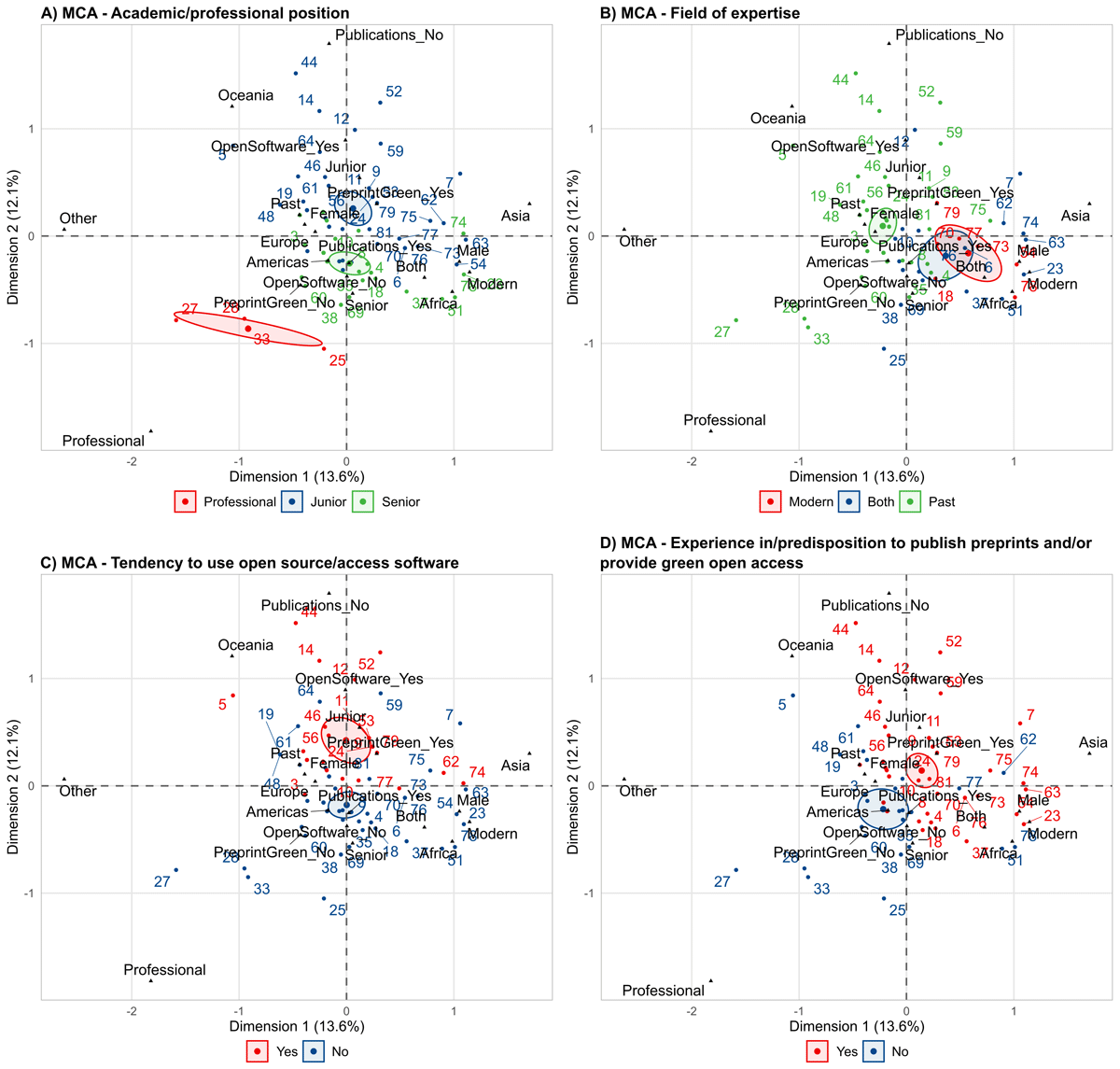
Figure 2
Multiple correspondence analysis biplot displaying results of the first part of the survey. First two dimensions are shown including groups of participants (coloured ellipses of confidence intervals at 95%) according to A) their academic/professional position, B) their field of expertise, C) their tendency to use open source/access software and D) their experience in/predisposition to publish preprints and/or provide green open access. Participants are represented by dots and variables (i.e., descriptions and answers of the participants) by triangles. Each number associated with a dot corresponds to a unique ID of the participant (see File S6 in Ruiz-Pérez et al. 2024). Black text represents each category of the variables under analysis.
The results of the MCA highlight a general trend by which junior researchers with no or few publications have a larger predisposition to adopt open practices by using open software and the intention of or experience in publishing green OA and/or preprints. On the contrary, senior researchers and professionals in the private sector who have more publications are more prone to use proprietary software and less inclined to publish their research with green access or as preprints. Interestingly, this trend seems not to be correlated to other demographic variables such as gender, location of researcher/professional and field of expertise (i.e., the captured pattern is mostly determined by position).
4. Discussion
4.1. Survey data insights
As stated in the introduction, the phytolith research community spans several different disciplines and fields of study. For example, a recent study assessing how much some of the published phytolith data complied with the FAIR guidelines found that the 100 papers analysed were published in 50 different journals (Kerfant et al. 2023; Karoune et al., unpublished). With this wide spread of disciplines, it is unlikely that we could reach all phytolith specialists with this survey and the total number of respondents might appear low. However, the widespread strategy of advertising ensured good coverage of the different fields of research as well as of geographical location, career level and gender. Moreover, the application of the data saturation method from Guest, Namey & Chen (2020) indicates that enough responses were collected beyond the threshold where new responses provide no new meaningful data. Indeed, one of the main advantages of this saturation method is that it does not assume or require a random sample, nor prior knowledge of what are the prevalent themes for the specific target of respondents. As it is a way of checking data validity a posteriori, it provides strong evidence that the total number of responses collected in the survey allow for the drawing of meaningful conclusions.
The survey conducted within the phytolith research community on the adoption or predisposition towards OR practices has revealed interesting patterns, highlighted some pitfalls and shown that the need to improve OR practices is shared by the community at large. Indeed, the vast majority of respondents expressed an interest in knowing more about the FAIR principles and OR practices, as well as having a positive attitude towards learning how to improve their OR behaviour, a trend that has been also observed in other communities (e.g., Anagnostou et al. 2015; Houtkoop et al. 2018; Ross-Hellauer, Deppe & Schmidt 2017; Tenopir et al. 2020). In this sense, our results show that younger generations of scholars seem more prone to use open source/access software and publish openly, while gender and discipline seem not to have a big influence on the attitude towards OR. A comparable pattern has been found in similar studies (e.g., Baždarić et al. 2021; Stieglitz et al. 2020; Tenopir et al. 2020), although there are also cases where early research career academics are more reluctant to share data and that, independently from the discipline, senior male academics share their data more easily (e.g., Zhu 2020).
4.2. Barriers to open research practices
The main barriers to open research practices within the phytolith research community seem to be related to publishing open access rather than data sharing. In the survey we have encountered that only one person does not support raw data sharing and 21.1% of respondents with publications stated that they have never included raw data. Contrary to that, just 33.8% of participants with publications did so at least once as gold OA and 28.2% as preprint, even though 38% of respondents without OA publications expressed a predisposition to publish preprints and/or green OA.
More respondents were not aware of the possibility to publish gold OA (9.9%) than preprints (4.9%), even though the number of articles in both OA options is generally increasing at a similar rate (Piwowar et al. 2018). As observed in other fields (e.g., Ide & Nakayama 2023; Sayogo & Pardo 2013), cost is the most common reason not to publish gold OA: 43.2% of respondents exclude publishing gold OA due to publication costs (i.e., APCs). However, some participants (13.6%) did publish through the green open access route or intend to do so with their future publications. Interestingly, a few researchers (8.6%) expressed ethical concerns in publishing gold OA regarding unequal opportunities to publish gold OA depending on the resources available to them.
Of the respondents with publications who did publish gold OA (33.8%), most did so because it was facilitated by one of the authors’ institutions offering open access funds or having deals with publishers (75%). Half of them did so by planning for it at the moment of application for funding (i.e., they did not have institutional support, but they included specific funding to cover APCs when writing their research grant proposals), a pattern that has similarly been reported in some other communities (e.g., Halevi & Walsh 2021; Solomon & Björk 2012).
Preprints represent another method of OA publishing that, in some disciplines, has grown significatively in the last few years (Narock & Goldstein 2019; Puebla, Polka & Rieger 2021). The benefit of preprints for research and researchers seems to be clear: faster dissemination of free to read results should make research more transparent and accessible. However, the scientific community is not united in this view: several researchers consider preprints as a risk to quality academic production as they have not been assessed through a peer-review system (da Silva 2018). This opinion is somewhat shared by the phytolith research community, given that 17.3% of respondents said that they do not think that non-peer-reviewed papers should be treated as scientific evidence.
Other common issues that inhibit publishing preprints are fear of plagiarism, lack of authorisation, concern about excessive workload and notion of uselessness (e.g., Chiarelli et al. 2019; Graziotin 2014). The results of the survey are in line with these issues, showing that 5% of participants consider publishing preprints overworking, 8.6% are afraid of plagiarism, 12.3% encountered co-authors’ opposition and 13.6% think that it is useless. These concerns represent an inadequate understanding of the publishing process of preprints, possibly as a consequence of ignoring its benefits (e.g., rapid dissemination (Sarabipour et al. 2019)) and outcomes (e.g., most preprints servers assign DOIs (Beck et al. 2020), which provides authorship against plagiarism).
4.3. Perceived versus actual practices
From the results of the survey, there seems to be a great disparity between self-perception and actual performance on some practices. This is particularly evident in the questions related to methodology and the use of data repositories.
When asked whether participants with publications thought that their methods were fully reproducible, almost all respondents (98.6%) answered positively. Contradictorily, the answers recorded on the self-perceived level of description of methods in their publications show that only 49.3% always describe their methods in full detail. This agrees with the results of Karoune’s study on open practices in phytolith-related publications (Karoune 2022), which showed that, although 69% of the articles considered in the study provided details of methods, most of these presented replicability issues. A recent study by this paper’s authors (Karoune et al., unpublished) revealed that most published articles in the study (about 60% of 100 articles) had extraction methods that were not transparent (i.e., fully detailed) and therefore not replicable. Moreover, about 40% of counting methods reported were not replicable, as key information was not included such as the number of single-celled and multi-celled phytoliths counted per slide or whether unidentified phytoliths were included in the counts or not.
A second aspect in which perceived and actual practices seem to differ in the phytolith research community is on the knowledge and use of OA repositories. According to the Directory of Open Access Repositories guidelines (OpenDOAR 2005), OA repositories are defined as sites where content is available at no cost, in full and without barriers such as registering/login requirements. Furthermore, the server must be accessible from any location worldwide and contain outputs with sufficient metadata to make the content reusable. Finally, an important characteristic of OA repositories is that they assign a digital object identifier (DOI) to the material deposited, thus providing a permanent link to the storage location. Slightly less than half of the participants (40.7%) responded positively to the question whether they knew and/or used any OA repository. This question prompted them to list which repository they were familiar with and was left purposely open so as not to influence the respondents. The responses included 24 different alternatives, out of which only 12 are actually OA repositories that fit the description above. Respondents also cited academic networks, such as Academia.edu or ResearchGate, or other websites (e.g., PhytCore, IPS Sample Database) that require registration to log in and have no persistent identifiers for data. A few mentioned OA databases that, without being FAIR data repositories, still represent open sources of data (e.g., GitHub). We believe that this result is mainly due to a lack of training regarding how to implement the FAIR data principles and consequently the poor understanding of the practices underlying sustainable data sharing.
5. Conclusions
Open and FAIR practices are fundamental to improve the quality of research and reduce the misuse of public funding. All the necessary tools are currently available to produce high standard, safe and controlled open research beneficial at both the community and individual levels. These tools encompass a wide range of resources including open access journals, preprint servers, data repositories, collaborative platforms with version control systems and open source software and hardware. According to the results of our survey, the phytolith research community, and especially the younger generations of researchers, recognizes the importance of embracing open research principles and is open to adopting them. However, there seems to be a general lack of knowledge of what open research requires and its long-term benefits. Insufficient open access publishing and use of data repositories has been identified as an important barrier in making phytolith research more accessible and, interestingly, the survey showed that phytolith specialists seem to ignore how frequently non-replicable their methods are in relation to how they report them in the literature. To address the current situation, it is essential to create more awareness of the available resources, what it entails to follow open research practices, and the potential benefits of implementing them. To do so, training the members of the phytolith research community in all aspects of open science, preferably in close collaboration with academic and research entities such as the International Phytolith Society, is a necessary task to promote informed decisions and active contributions to establish a culture of openness and transparency as well as to produce more sustainable and impactful research.
Data Accessibility Statement
Supplementary files are available on Zenodo at https://doi.org/10.5281/zenodo.10814920.
Ethics and Consent
The survey forms and responses submitted were hosted on Universitat Pompeu Fabra’s servers (Barcelona, Spain) in compliance with the General Data Protection Regulation. Personal data was collected only with the participant’s consent for the purpose of this study and further activities within the Fair Phytoliths Project and the International Committee on Open Phytolith Science of the International Phytolith Society.
Acknowledgements
We would like to thank EOSC-Life for funding this project and for their support and training in the open research principles. The FAIR Phytoliths Project is based at two institutions, Universitat Pompeu Fabra and Historic England, and we would like to thank both these institutions for their support and financial commitment to this project. We as well thank the International Committee on Open Phytolith Science and the International Phytolith Society for their support. We also acknowledge the in-kind support from Texas A&M University and the Spanish National Research Council for time on this project by Javier Ruiz-Pérez and Juan José García-Granero, respectively. We are grateful to the participants who kindly filled in the survey.
Funding Information
This project has received funding through EOSC-Life from the European Union’s Horizon 2020 research and innovation programme under grant agreement number 824087. Ruiz-Pérez was supported by the National Science Foundation under award number DEB-1931232 to J. W. Veldman. García-Granero acknowledges funding from the Spanish Ministry of Science, Innovation and Universities (grant number IJC2018-035161-I funded by MCIN/AEI/10.13039/501100011033). Madella acknowledges funding from the Catalan Agency for Management of University and Research Grants (AGAUR 2021 SGR-00950). Lancelotti acknowledges funding from the European Research Council (ERC-StG number 759800).
Competing Interests
The authors have no competing interests to declare.
Author Contributions
Conceptualization: J.R.-P., E.K., J.J.G.-G., M.M., C.L.; data curation: J.R.-P., C.L.; formal analysis: J.R.-P., C.L.; funding acquisition: J.R.-P., E.K., J.J.G.-G., M.M., C.L.; investigation: J.R.-P., E.K., C.K., J.J.G.-G., M.M., C.L.; methodology: J.R.-P., E.K., C.K., J.J.G.-G., M.M., C.L.; project administration: E.K.; validation: J.R.-P., C.L.; visualisation: J.R.-P., E.K.; writing – original draft: J.R.-P., C.L.; writing – review & editing: J.R.-P., E.K., C.K., J.J.G.-G., M.M., C.L.