
1 Overview
Repository location
https://doi.org/10.5281/zenodo.22143305 (version 1.0.4).
Context
The Shījīng 詩經, conventionally translated as the Book of Odes, Book of Songs, or Classic of Poetry, is an anthology of 305 poems transmitted as one of the canonical works of early China (Waley, 1996). The received Máoshī recension supplies the complete textual sequence used as the reference witness in this dataset (Máo Shī Zhèngyì, 2000). The poems have also played a central role in the study of early Chinese literature, ritual, language, and historical phonology.
Excavated manuscripts make it possible to compare the received text with material witnesses separated by date, provenance, and textual practice. The fourth-century BCE Āndà manuscript preserves 58 odes1 and is the earliest substantial manuscript witness currently available (Huáng and Xú, 2019). Its textual stability and variation have already prompted renewed work on the formation, memorisation, and written transmission of the Odes (Smith & Poli, 2021; Meyer & Schwartz, 2022). The Fùyáng manuscript, placed in a tomb closed in 165 BCE, preserves fragmentary material from the early imperial period (Hú and Hán, 1988). Together, the received, Āndà, and Fùyáng witnesses provide a controlled body of parallel text spanning several centuries.
Existing editions and studies present transcriptions, commentary, and photographic plates, but they do not provide a shared machine-readable coordinate system in which corresponding occurrences can be compared directly. The present dataset supplies that layer.
The dataset is extensible to further witnesses as they become available in forms suitable for scholarly reuse. For a complete overview of excavated manuscripts preserving substantial material from the Odes, see Kern (2026, pp. 10–11). Shaughnessy (2025, p. xxviii) reports that the Xiàjiātái 夏家臺 manuscript contains 117 slips covering the first 14 poems of the Airs of Bei, while approximately 300 reconstructed Wángjiāzuǐ 王家嘴 slips contain passages from 154 poems. Preliminary publication also confirms that the Hǎihūnhóu 海昏侯 tomb contained an Odes manuscript (Zhū and Kē, 2021), and its variant readings have already supported phonological analysis (Yè, 2025), but the publication does not contain the manuscript images or a transcription that can be incorporated here. When that material, or transcriptions of other Odes manuscripts, becomes available, we will enter it in the same coordinate and alignment model as that of the present article.
2 Method
The dataset consists of three layers: the transcription of the witnesses, their physical locations in source editions, and finally correspondences across the witness transcriptions. The following sections explain how those layers are established and connected.
Witness selection and reference transcriptions
The corpus currently contains three witnesses. The received Máoshī is based on the text published in the Máoshī zhèngyì 毛詩正義 (2000). The Āndà transcription uses Loh’s (2022) study as its reference transcription and the published edition edited by Huáng and Xú (2019) as its physical source. The Fùyáng transcription uses Chén’s (2019) collation as its reference transcription and the edition edited by Hú and Hán (1988) as its physical source.2 The dataset’s transcription files follow these upstream editions as closely as possible. Table 1 summarises the physical sources and reference transcriptions used for the three witnesses.
Transcription model
Each witness’s transcription is stored in a versioned JSON file divided into ordered units (i.e., odes), paragraphs, and lines. We add punctuation and verse separation for display purposes as an editorial process. These do not reflect the punctuation of the manuscript, and they do not participate in textual alignment across witnesses.3 We encode the transcriptions using Unicode characters whenever a suitable character exists. A graph without a suitable encoded character is represented as one braced expression containing an Ideographic Description Sequence (IDS), the Unicode notation for describing a graph through the spatial arrangement of its components (Ideographic Description Sequences, 2026). For example, the third character extracted from strip 1 of the Āndà version of the Guānjū 關雎 (Huáng and Xú, 2019, p. 5) is shown in Figure 1. Loh (2022, p. 10) transcribes it as  ; because this graph has no suitable Unicode code point, our dataset represents it as {⿰鳥叴}: the character ⿰ specifies a left–right arrangement of the components 鳥 and 叴. The braced IDS expression encodes one graph position. Damaged graphs can retain the same structural notation: for example, {⿰ □ 區} in the Fùyáng witness of Jìng nǚ 靜女 records an unreadable left component beside 區; the generated font renders it as
 , preserving the surviving component and outlining the damaged region with a dashed border. We encode heavily damaged graphs as {?}, rendered as
 .4 Full documentation of IDS notation is outside the scope of this article. We transcribe iteration marks using Unicode’s old chinese iteration mark (= U+16FE3),5 and lacunae using white square (□ U+25A1) for missing single characters and masu mark (〼 U+303C) for lacunae of unknown length. Figure 2 shows the structure of the transcription JSON file along with the first two lines of Guānjū 關雎 as found in the Āndà manuscript.
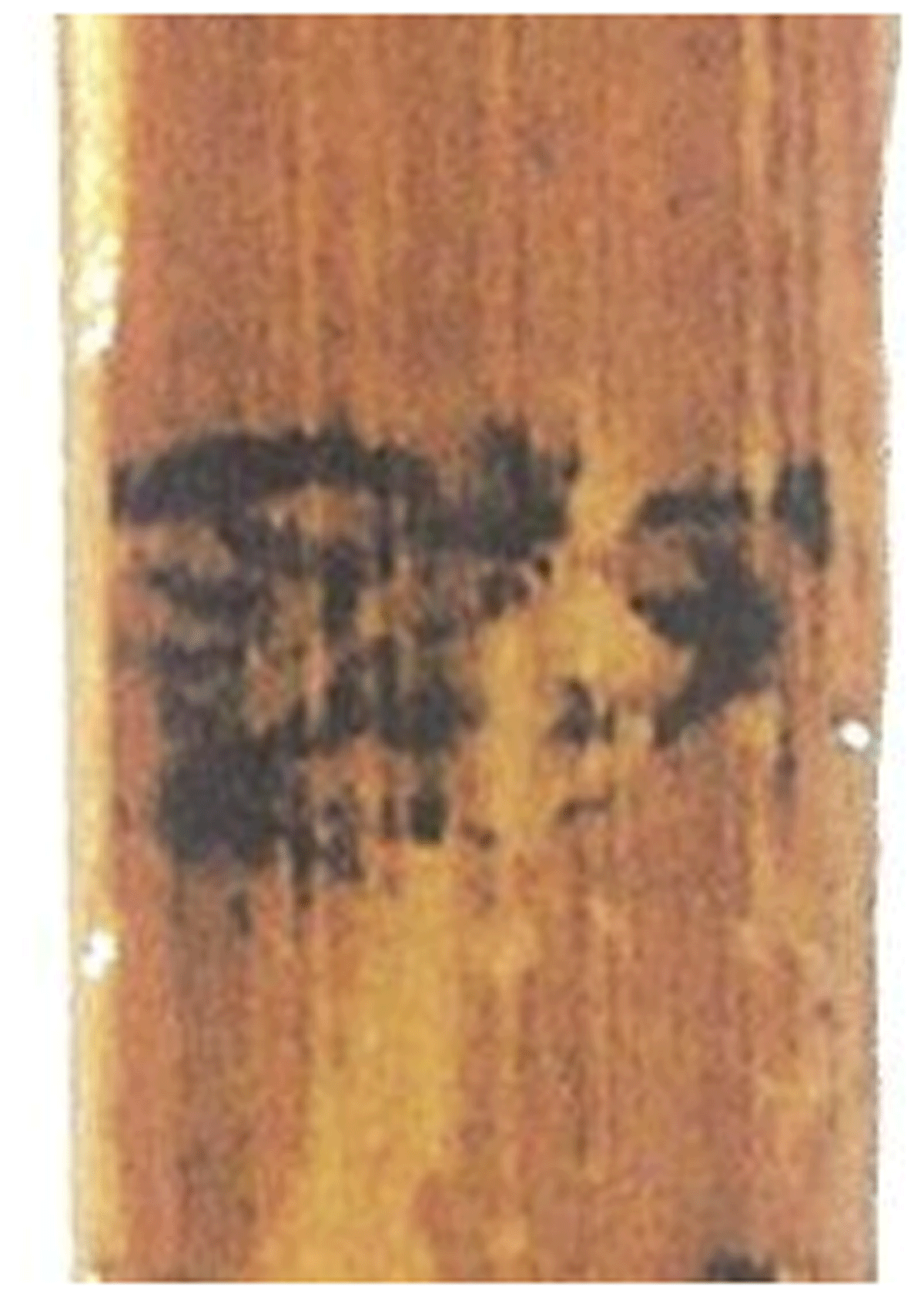
Figure 1
The third character Āndà’s Guānjū 關雎 Ode: ⿰鳥叴.
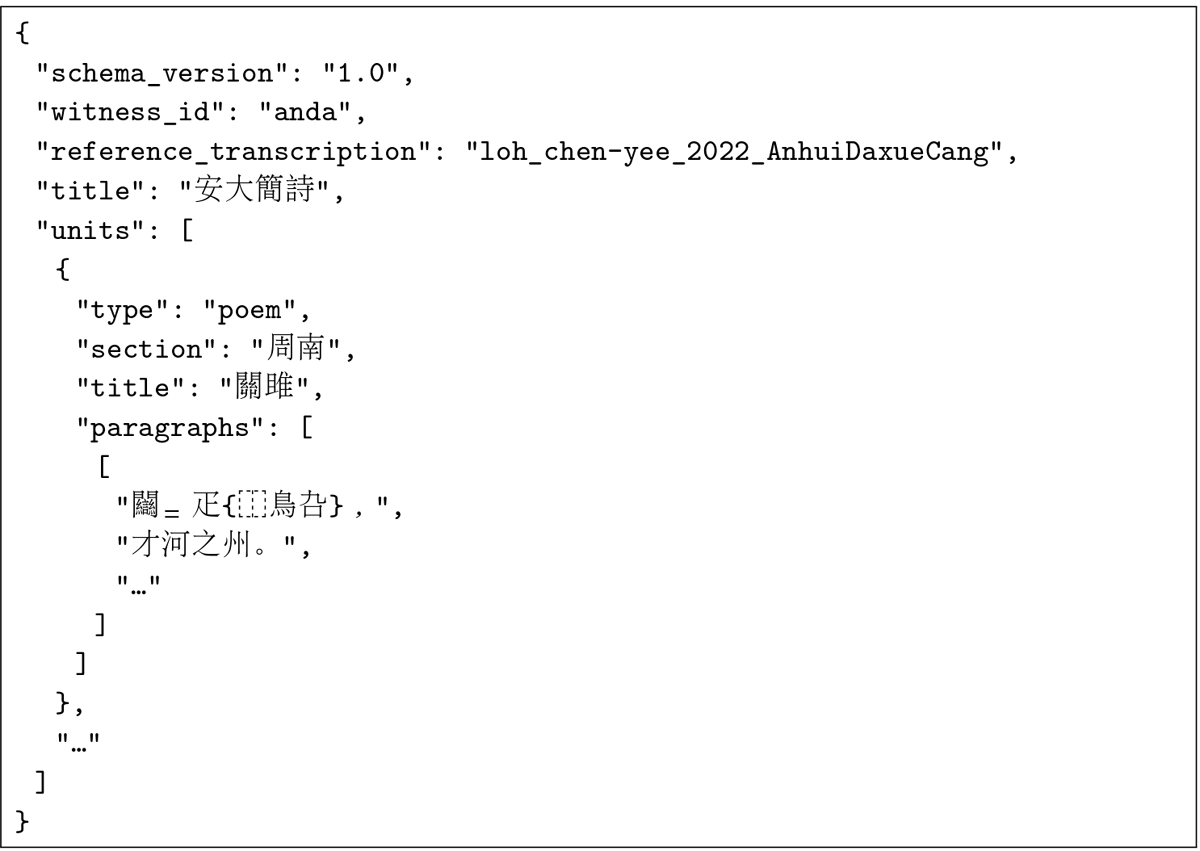
Figure 2
Opening extract of the Āndà transcription.json file. The ordered unit, paragraph, and line structure supplies stable coordinates for individual graph positions; ellipses abbreviate later lines and units.
Image segmentation
The processing of manuscript images proceeds in two steps. First, for each strip, strip_mapping.json records the source-edition PDF page number and the strip’s crop box, which consists of two pairs of (x,y) coordinates for the top-left and bottom-right corners of the rectangle that contains the image of the strip. This crop box is used to extract the image of the strip from the PDF. Second, character_mapping.json records the crop box, classification, and generated filename for each item — graph, section marker, etc. — on that strip. Figure 3 illustrates these operations for the first Āndà strip of Guānjū 關雎. This layer describes image derivation from the PDF; it is independent of the transcription of the graph an item represents. The mappings retain the source coordinates alongside generated filenames, so strip and graph images can be rebuilt from a compatible source PDF when auditing or correcting crop geometry. The classification of items, which distinguishes written graphs from strip numbers and section markers, provides useful physical metadata and could be extended to other forms of punctuation in the future.
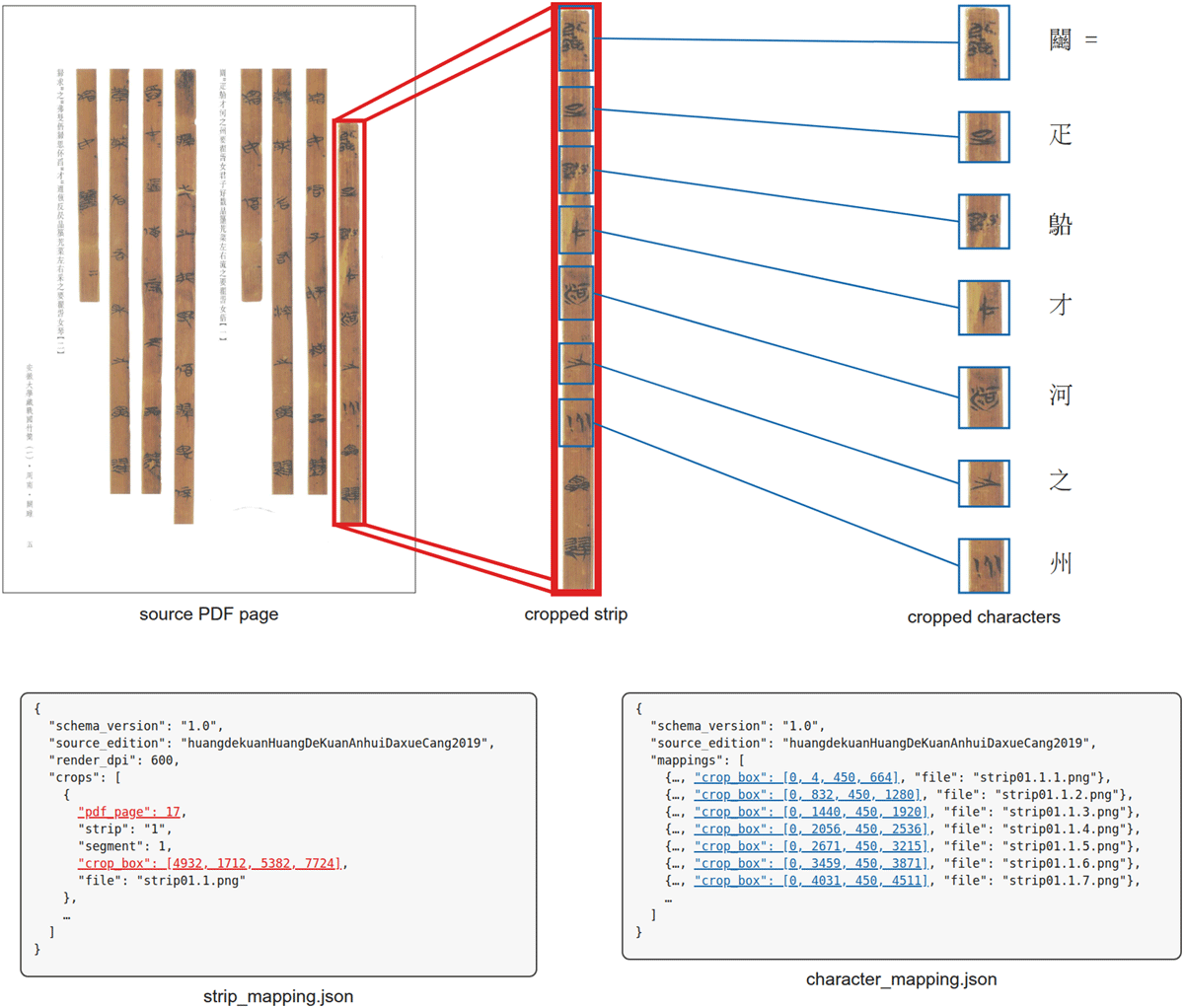
Figure 3
Image segmentation for the first strip of Āndà Guānjū 關雎. Red traces the source page selection to the reconstructed strip; blue traces selected strip locations to individual graph crops. The two mapping files preserve the geometry required to repeat both steps.
The reviewed strip and graph crops are distributed with permission of the respective rights holders of the Āndà and Fùyáng manuscript images; the source PDFs and uncropped plates are not redistributed. Consequently, users can inspect the image layer without obtaining the source editions. The crop recipes remain available as an optional audit path: researchers with lawful access to a compatible source PDF can rebuild the images from the recorded geometry. The reconstruction checks the supplied PDF and resulting images against the reviewed media manifest, so a discovered crop error can be documented as a revised mapping and independently regenerated.
Transcription-to-source mapping
source_mapping.json supplies the editorial connection between a manuscript’s images and its transcription. Each mapping joins a transcription position to a physical occurrence by PDF page, strip, and item number. These mappings were created by hand in a project-specific curation tool, which is not part of this release. The release contains 2,876 Āndà transcription-to-source mappings and 3,004 source-to-image mappings. Fùyáng contains 888 transcription-to-source mappings and 897 source-to-image mappings. The difference between those two numbers is mainly due to strip numbers and other marks being accounted for in source-to-image mappings but not being transcribed. Additionally, some Fùyáng readings transcribed in Chén (2019) are known only through editorial reports of writings on the back of the strips or through later identified strips for which no usable plate image was available. These readings are retained without a source or image mapping. Figure 4 traces this relation for the opening of Āndà Guānjū 關雎: each cropped graph is connected, through its released source-mapping record, to its position in the rendered transcription.
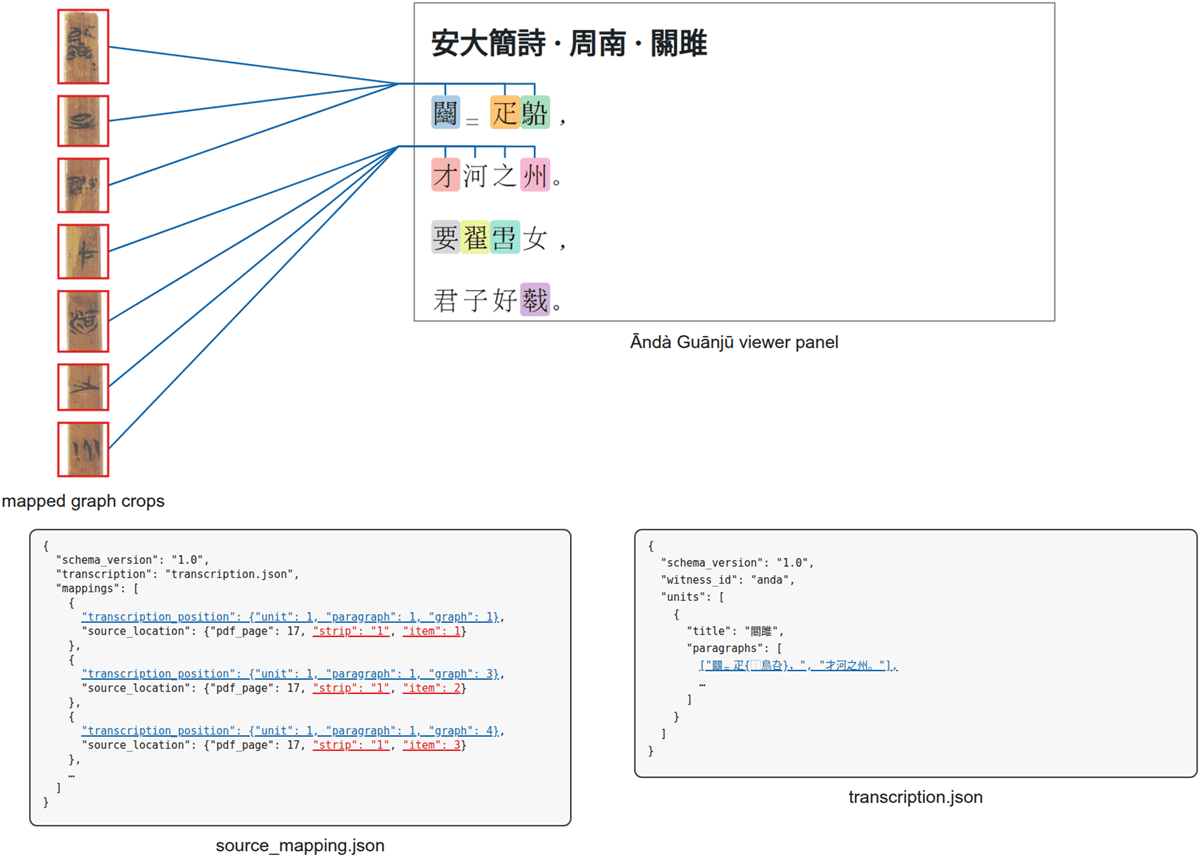
Figure 4
From physical graph crops to the Āndà Guānjū 關雎 transcription. Each source-mapping record connects a cropped graph to one position in the transcription: red identifies its physical location and blue its textual position. Colours are explained below in paragraph Visual inspection.
Transcription alignment across witnesses
The separate alignment.json file records cross-witness transcription correspondence. Each alignment group contains two or more witness locations, each expressed as unit–paragraph–graph coordinates. This supports one-to-one, one-to-many, and many-to-many relationships between the witnesses. A preliminary alignment baseline was produced with GPT-5.6 Terra, then manually corrected and proofread by both authors of the present article. The current release contains 3,466 correspondence groups comprising 7,319 graph locations. Of these groups, 3,256 connect two witnesses and 210 connect all three. Figure 5 shows three three-witness groups for a section of the Chún zhī bēnbēn 鶉之奔奔 Ode in alignment.json, and the resulting view in our local web UI.
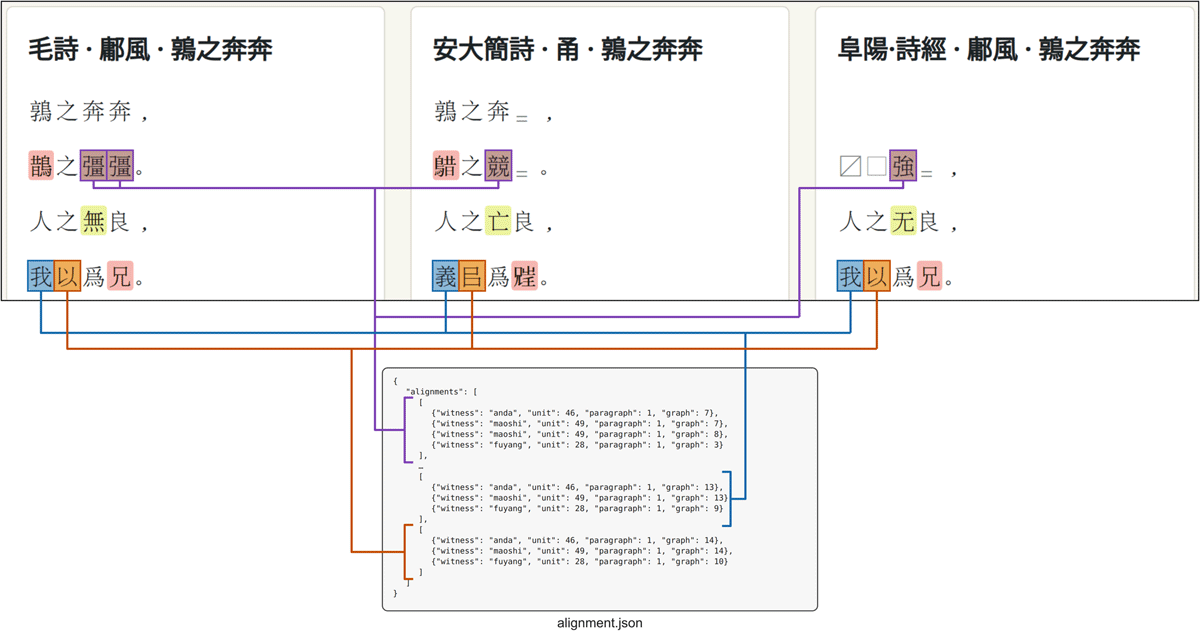
Figure 5
Cross-witness alignment in Chún zhī bēnbēn 鶉之奔奔. The purple correspondence relates Āndà競 and Fùyáng 強 to the two graphs 彊彊 in the received text. The blue and orange correspondences identify the first two graph positions of the received reading 我以爲兄 and its manuscript variants. Each array records the graph positions treated as corresponding. Manuscript images are hidden in this figure for legibility reasons.
Extensible and competing transcriptions
Witness identifiers are not restricted in principle to the three documents in the current release. A later publication could be added as another transcription file and linked to existing or new correspondence groups without altering the unit–paragraph–graph coordinate structure. The same mechanism can preserve more than one scholarly transcription of a manuscript: each transcription is represented as a separate witness, while its graph positions can map to the same physical strip and image locations. Competing graph identifications therefore remain independently citable and directly comparable. Independent studies of the Āndà manuscript already demonstrate how readings of particular graphs and passages can differ after renewed examination (Smith & Poli, 2021).
Release structure
The preceding layers are distributed as separate JSON files. Every witness, including the received Máoshī, has a transcription.json file. The two manuscript witnesses additionally have source_mapping.json, strip_mapping.json, and character_mapping.json; the first records editorial assignments, whereas the latter two record the page-to-strip and strip-to-graph crop operations illustrated in Figure 3. At the cross-witness level, alignment.json joins graph positions from the witness transcriptions into correspondence groups (Figure 5). The received Máoshī has only transcription.json, because it has no manuscript- image layer.
One last file, expected_media.json, acts as a reproducibility safeguard. It records the source-PDF digest and the expected identity of generated strip and graph images, allowing a media build to be checked without distributing the source PDF.
Validation and reproducibility
JSON Schemas define the transcription, alignment, source-mapping, image-mapping, and media-reconstruction formats. The validation suite that comes with the dataset checks schema conformance, bibliography references, graph coordinates, alignment uniqueness, mapping references, and media inventories. The release includes the reviewed strip and character images. Crop recipes can optionally reconstruct them from user-supplied source PDFs, while the expected-media manifests record file and decoded-pixel hashes, dimensions, and image modes. The release also includes a static viewer for poem-level browsing, graph selection, and graph search.
Visual inspection
Along with the dataset, we provide a local browser interface for the visualisation of the data. The interface has two main views: first, its alignment view presents the received and manuscript witnesses in parallel, with a searchable poem selector. Navigation between poems can also be performed using left and right arrow keys. The alignment view highlights the correspondence between graphs across witnesses by assigning identical colours to them, and a toggle can filter this highlighting down to spelling variants only (i.e., identical graphs across witnesses are not highlighted). Selecting a graph or hovering over it highlights its linked locations. The graph image crops are shown alongside the transcription of each witness; clicking on any such graph image brings the user to the second view, the strip viewer.
In the strip view, shown in Figure 6, the user is presented with a fully annotated strip: its graphs, section markers, and strip numbers are shown against the view of the full strip, so that the materiality of the strip can be better studied. Navigation between strips is supported through left and right arrow keys, and clicking on a graph takes the user to the corresponding alignment view. The interface therefore supports direct visual inspection while remaining a view onto the same JSON records available for computational reuse. This joins the manual and computational forms of exploration advocated for digital editions of bamboo manuscripts (Pulini and List, 2025).
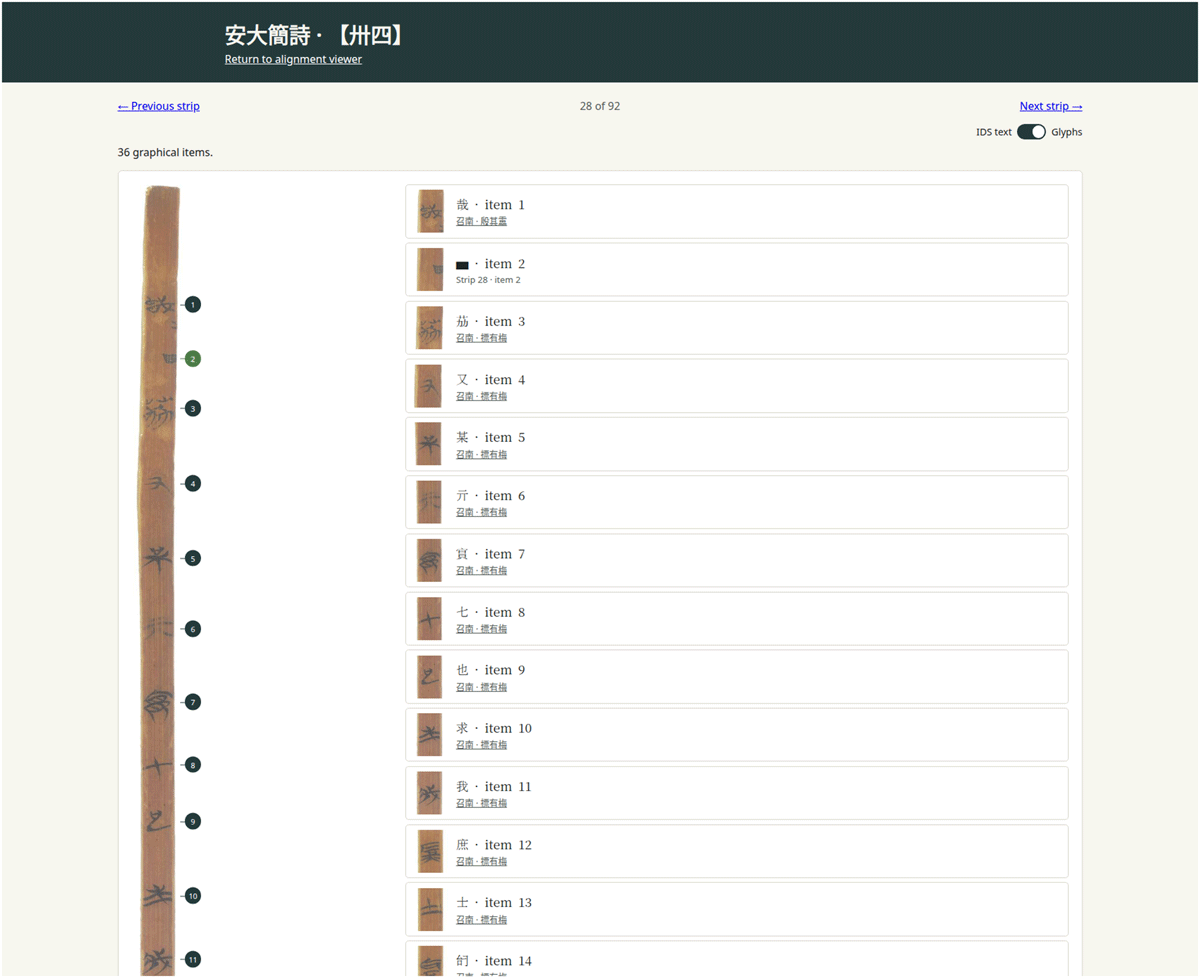
Figure 6
Āndà strip view with physical item overlays and crop metadata.
Finally, a basic corpus-wide graph search feature lets the user search for encoded graphs, braced IDS expressions, and the iteration mark, and links results back to their poem alignments.
3 Dataset Description
Object name
Aligning the Odes: A Character-Level Parallel Dataset for the Anhui University and Fùyáng Bamboo-Slip Manuscripts.
Format names and versions
UTF-8 JSON, JSON Schema Draft 2020-12, HTML, CSS, JavaScript, Markdown, PNG, WOFF2, TrueType, BibTeX, and Citation File Format.
Creation dates
2026-08-06 to 2026-08-29.
Dataset creators
Julien Baley, SOAS University of London: Conceptualization, Data curation, Methodology, Software, Validation, and Visualization. Yīng Jīnqí 應金琦, Trinity College Dublin: Data curation, Investigation, and Validation.
Languages
Classical Chinese and English documentation.
Licence
Creative Commons Attribution 4.0 International applies to project-authored data, code, schemas, documentation, and reproducibility recipes. Third-party source PDFs and uncropped manuscript plates are excluded. Reviewed strip and graph crops are distributed under permission from their respective rights holders and are not relicensed under CC BY 4.0. Permission to publish the project transcriptions based on Chén (2019) and Loh (2022) was obtained from their respective authors. Permission to publish the Āndà crops derived from Huáng and Xú (2019) was obtained from Huáng Dékuān 黃德寬 and the Chinese Character Development and Application Research Center (Ānhuī Dàxué Hànzì Fāzhǎn yǔ Yìngyòng Yánjiū Zhōngxīn 安徽大學漢字發展與應用研究中心). Permission to publish the Fùyáng crops derived from Hú and Hán (1988) was obtained from Shànghǎi gǔjí chūbǎnshè 上海古籍出版社. The release bibliography and image-rights statement record their provenance and reuse terms.
Repository name
Zenodo.
Publication date
26 September 2026.
Dataset inventory
The release contains complete transcriptions of 305 Máoshī poems, 58 Āndà poems, and 113 Fùyáng units: 76 identified poems and 37 entries in the separately identified fragment appendix. These transcriptions contain 29,646 Máoshī, 3,185 Āndà, and 1,416 Fùyáng graph positions. The alignment file links 2,805 Āndà, 884 Fùyáng, and 3,630 Máoshī graph locations.
Contributing
Please email corrections and proposed improvements to the corresponding author.
4 Re-use Potential
The dataset supports direct comparison of corresponding passages across the three major Shījīng witnesses. Researchers can retrieve all recorded variants for a graph or poem, distinguish graphical variation from additions and omissions, and trace each mapped manuscript reading back to its physical source location. Because correspondence is stored independently of character identity, the same data can support philological review without treating variant graphs as automatically equivalent or different. The viewer makes that review accessible without specialist software: a proposed reading can be checked against its corresponding passage and, where available, its reconstructed manuscript image. This combination of structured annotation and direct inspection responds to the complementary manual and computational uses of bamboo-slip data identified by Pulini and List (2025): it provides a structured foundation for full digital critical editions, on which projects can add critical apparatus, discussions of readings, translations, and glosses.
For textual history and manuscript studies, the corpus makes the distribution of stable and unstable passages measurable across witnesses. For palaeography, IDS expressions retain analysable structure where conventional Unicode transcription is insufficient. The recorded crop geometry also lets a researcher inspect a disputed crop, propose a corrected mapping, and, with lawful access to the cited source edition, independently regenerate the image. The reviewed image–transcription links also provide a controlled corpus for testing graph retrieval and handwritten-character recognition methods while keeping outputs traceable to the underlying documentary evidence.
For historical phonology, the aligned positions provide a controlled inventory of spelling variants. These variants can act as evidence for sound mergers or distinction maintenance. A prototype version of this dataset informed the statistical evaluation of Warring States and Han rhyme evidence in Baley (2026a).
The viewer and structured files support complementary forms of reuse. A reader can inspect a poem, its differences, the available graph images, and their positions on reconstructed strips without specialist software. Researchers can use the same records programmatically for corpus queries, statistical analysis, alignment methods, and variant-graph retrieval. The graph-level correspondences also provide a fine-grained basis for investigating structural variation between witnesses, including differing segmentation, expansion or contraction, and stanzaic organisation.
The corpus can grow without replacing earlier releases. We commit to integrating the known Odes manuscripts from Hǎihūnhóu, Xiàjiātái, and Wángjiāzuǐ when their images and transcriptions are published in forms suitable for scholarly reuse. Alternative transcriptions of a witness can coexist as separate documents linked to the same source locations and images. Users can then compare readings with one another and with the underlying graphical evidence. The source and image layers also allow projects with different media rights to share compatible textual and provenance data.
The framework is not restricted to the Odes. We also intend to adapt its separation of transcription, physical evidence, and editorial correspondence to other early Chinese textual traditions, beginning with the Lǎozǐ 老子 and the Yìjīng 易經 (Book of Changes). Such applications would make it possible to compare related manuscript and received-text witnesses without imposing a single normalised transcription on them. For the Yìjīng, we intend to align the received Zhōuyì 周易 with the Mǎwángduī 馬王堆, Fùyáng, Shanghai Museum, and Hǎihūnhóu witnesses, and to include related divination manuals, such as the Wángjiātái Guīcáng 歸藏 (Shaughnessy, 2014), the Shanghai Museum Bǔ shū 卜書 (Mǎ, 2012), or the Tsinghua Shì fǎ 筮法 and Bié guà 別卦 (Lǐ, 2013). This broader comparison will make it possible to study parallel passages across divination manuals as well as variation within the Zhōuyì tradition.
5 Limitations
The alignment represents the present editors’ correspondence judgements and does not eliminate interpretive uncertainty. Damaged text, iteration marks, and one-to-many relations require case-by-case philological interpretation. The received witness is much larger than either manuscript witness, so most Máoshī graph positions necessarily remain unlinked. Fùyáng’s fragment appendix is transcribed but not yet aligned or source-mapped, and a small number of readable Fùyáng positions lack identified image evidence. The release excludes third-party source PDFs and uncropped plates; users who independently reconstruct the permissioned crop set must obtain the cited editions. The current media derives from Hú and Hán (1988); more recent photographs of some Fùyáng strips are published in Chū (2005) and Fùyáng Shì Bówùguǎn (2022), but the available reproductions did not support systematic image segmentation for this release. The current viewer is configured for the three released witnesses; displaying later witnesses or competing transcriptions will require extending its witness configuration.
Notes
[1] We count the unaligned passage on the slip numbered 八十三, headed Zuò yú zhī shī 作魚之詩, as a poem, following Loh (2022, p. 279). It has no counterpart in either the received Máoshī or the Fùyáng witness, but future manuscript witnesses may preserve a parallel to this otherwise unaligned poem. This yields 58 poems, rather than the 57 odes preserved in whole or in part reported by Smith & Poli (2021, p. 530).
[2] Additional Shījīng strips are reported in Chū (2005, vol. 14), and colour photographs of two strips appear in Fùyáng Shì Bówùguǎn (2022, plate 39). The available scans and photographs of the additional material were not adequate for image segmentation, although readings reported in the later scholarship are retained in Chén’s (2019) transcription.
[3] The transcriptions of Loh (2022) and Chén (2019) which we follow do not transcribe the actual manuscript’s punctuation and we have followed them for the present publication. This is an issue we will aim to address in a later update, so that textual segmentation and understanding of the text in these various traditions can be better studied.
[4] The release supplies paired WOFF2 and TTF fonts generated by ids-to-font (Baley, 2026b), which derives its outlines from the Zi.tools API (Zi.tools, 2026); the archived fonts use commit 366cf6d.
[5] See Richter (2023) for a discussion of all the usages of this mark.
Acknowledgements
The authors would like to thank the following: Chén Chén 陳晨 and Loh Chen-Yee 駱珍伊 for permission to use their transcriptions, Professor Huáng Dékuān 黃德寬 and the Chinese Character Development and Application Research Center (Ānhuī Dàxué Hànzì Fāzhǎn yǔ Yìngyòng Yánjiū Zhōngxīn 安徽大學漢字發展與應用研究中心) for permission to include the images of the Āndà manuscript, and Shànghǎi gǔjí chūbǎnshè 上海古籍出版社 for permission to include the images of the Fùyáng manuscript.
Author Contributions
Julien Baley: Conceptualization, Data curation, Methodology, Software, Validation, Visualization, Writing – original draft, Writing – review & editing. Yīng Jīnqí 應金琦: Data curation, Investigation, Validation, Writing – original draft, Writing – review & editing.