
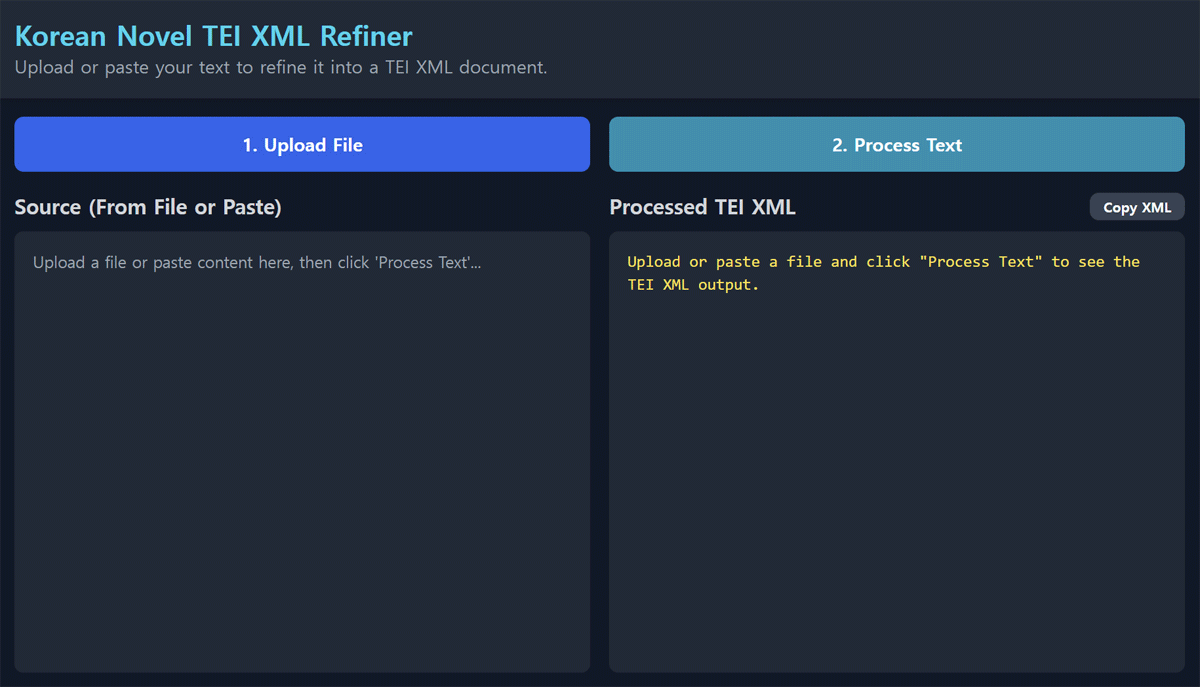
Figure 1
Conversion of Korean Modern Literature xml/tei App Screen.
Table 1
TEI elements and attributes used in the KNoTE dataset.
| CATEGORY | ELEMENT | KEY ATTRIBUTES | FUNCTION |
|---|---|---|---|
| TEI Header | titleStmt | — | Title, author, encoder credits |
| respStmt | — | Encoder/reviewer attribution | |
| sourceDesc/bibl | type | Source provenance | |
| encodingDesc | — | Encoding standard (TEI ALL) | |
| revisionDesc/change | when, who | Encoding/review dates | |
| Characters | listPerson | — | Character registry |
| person | xml:id | Individual character | |
| personGrp | xml:id | Collective character group | |
| persName | xml:lang | Name in Korean or Hanja | |
| Entities | persName | ref | Named character mention |
| rs | ref, type | Pronoun/epithet reference | |
| placeName | — | Place name | |
| orgName | — | Organisation name | |
| date | when, type | Date reference | |
| time | when, type | Time-of-day reference | |
| Speech | said | who, aloud, direct, mode | Direct speech, thought, or monologue |
| Language | foreign | xml:lang="zh", xml:lang="ja" | Hanja preservation and Japanese in Hangul |
| Structure | div | type, n | Chapter/section division |
| p | — | Paragraph | |
| head | — | Chapter title |
Table 2
Period-revealing markup values in the KNoTE dataset; schema-level inventory in Table 1.
| CATEGORY | ELEMENT | KEY ATTRIBUTES | SAMPLE VALUES |
|---|---|---|---|
| Political ideologies | term | type="ideology" | socialism, militarism, humanitarianism, feminism |
| orgName | ref="#COMMUNIST_PARTY" | Communist Party | |
| rs | type="person_group", subtype="communist" | communists, fighters, party members | |
| rs | type="anarchism" | anarchists, seditious thought | |
| Modernization concepts | term | type="concept" | New Woman, bourgeois, feudal aristocracy, cultural-style housing, Four-Pillars fortune |
| Social classes | rs | type="class" | yangban (gentry), sangnom (commoners) |
| rs | type="laborer", "farmer" | farmers, labourers, first-rank workmen | |
| rs | type="intelligentsia" | “high-collar” (haikara, modern dandy) | |
| rs | type="prisoner", "official" | detainees, detectives, guards | |
| rs | type="immigrant" | migrant parties bound for Manchuria | |
| Modern Korean Spaces | placeName | type="city" | Gyeongseong (colonial Seoul), Tokyo, Hsinking, Sinuiju |
| placeName | type="region", "border" | Manchuria, Gando, the colonial border | |
| placeName | type="facility" | detention cells, Special Higher Police interrogation rooms | |
| placeName | type="hotel", "cafe", "bar" | Chosen Hotel, tabang (tearoom), Bar Lily | |
| orgName | type="police" | Special Higher Police, Gyeongbangdan (Defence Corps) | |
| Currency & measures | measure | type="currency" | 1,500 nyang (Joseon); 1 won, 30 jeon, 50 jeon (colonial) |
| measure | type="distance", "age" | 15 ri, 14 years old | |
| Formal architecture | div | type="frame", "embedded" | Dr. K’s Research, The Man Met in the Detention Center |
| div | type="preface", "afterword" | Blood of Flowers (Hwa-ui Hyeol) | |
| div, q | type="letter" | Nostalgia (Hyangsu), The Sorrows of the Weak, Ready-made Life, and four other works | |
| Project extension | said | who="#edcmt" | “Who could have foreseen…” (The Girl of Mystery (Uisim-ui Sonyeo)); “But how could she escape those deep waves!” (Adada the Idiot (Baekchi Adada)) |
Table 3
Selection rationale for the 33 works in the KNoTE dataset.
| NO. | AUTHOR | TITLE (ROM.) | YEAR | FORM | SELECTION RATIONALE |
|---|---|---|---|---|---|
| 1 | Yi In-jik | Tears of Blood (Hyeol-ui Nu) | 1906 | Sinsoseol | Korea’s first sinsoseol (new novel). |
| 2 | Yi Hae-jo | The Iron World (Cheol-segye) | 1908 | Sinsoseol (transl. SF) | First Korean adapted novel and first SF-genre work (after Jules Verne). |
| 3 | Yi Kwang-su | The Heartless (Mujeong – short story) | 1910 | Short fiction | Short-story version preceding the first modern novel, Mujeong. |
| 4 | Yi Hae-jo | Blood of Flowers (Hwa-ui Hyeol) | 1911.04 | Sinsoseol | Sinsoseol written after the 1910 annexation; a “new old-style” novel. |
| 5 | Kim Myeong-sun | The Girl of Mystery (Uisim-ui Sonyeo) | 1917.11 | Short fiction | Debut work of Korea’s first modern woman novelist. |
| 6 | Na Hye-seok | Kyung-hee | 1918.03 | Short fiction | Representative work on the colonial New Woman intellectual before marriage. |
| 7 | Na Hye-seok | To the Revived Granddaughter | 1918.09 | Short fiction | Bears witness to the 1910s from a woman’s perspective (Kwon Bodurae). |
| 8 | Kim Dong-in | The Sorrows of the Weak | 1919.02–03 | Short fiction | Kim Dong-in’s first published fiction. |
| 9 | Yi Ik-sang | The Straggler (Nagoja) | 1919.07.14 | Short fiction | Debut work of Yi Ik-sang, a leading writer of proletarian and neo-tendency (sin-gyeonghyangpa) literature. |
| 10 | Hyun Jin-geon | A Poor Wife (Bincheo) | 1921.01 | Short fiction | Early work of Hyun’s self-reflective realism. |
| 11 | Na Hye-seok | Gyu-won | 1921.07 | Short fiction | Post-marriage work on “the grievances of the inner chamber.” |
| 12 | Hyun Jin-geon | A Society That Drives You to Drink | 1921.11 | Short fiction | Early work of Hyun’s self-reflective realism. |
| 13 | Choi Seo-hae | Nostalgia (Hyangsu) | 1924.04 | Short fiction | A neo-tendency (sin-gyeonghyangpa) story depicting the lives of lower-class people who emigrated beyond Korea—to Siberia and northern Manchuria. |
| 14 | Hyun Jin-geon | A Lucky Day (Unsu Joeun Nal) | 1924.06 | Short fiction | Representative work of Hyun’s naturalist gaze on the common people. |
| 15 | Kim Dong-in | Potato (Gamja) | 1925.01 | Short fiction | One of Kim Dong-in’s 1920s naturalist stories. |
| 16 | Hyun Jin-geon | Director B and the Love Letters | 1925.02 | Short fiction | Satire on the repression of women’s education under colonial rule. |
| 17 | Na Do-hyang | The Watermill (Mullebang-a) | 1925.09 | Short fiction | A later work marking Na Do-hyang’s shift from his early romanticism to realism. |
| 18 | Bang Jeong-hwan | For Our Friends | 1927.02 | Children’s fiction | By a leading children’s-literature writer of the youth-liberation movement. |
| 19 | Bang Jeong-hwan | The Eternal Shirt (Mannyeon Shirt) | 1927.03 | Children’s fiction | Representative children’s short fiction by the same author. |
| 20 | Bang Jeong-hwan | The Gold Watch | 1929.01–02 | Children’s fiction | Representative children’s short fiction by the same author. |
| 21 | Kim Dong-in | Dr. K’s Research | 1929.12 | Short fiction (SF) | Regarded as Korea’s first original (creative) SF story. |
| 22 | Kim Nam-cheon | Water (Mul) | 1933.06 | Short fiction | Short story by a leading writer of KAPF (proletarian federation). |
| 23 | Chae Man-sik | Ready-made Life | 1934.05–07 | Short fiction | Chae Man-sik’s early self-satirical story. |
| 24 | Kang Kyeong-ae | Salt (Sogeum) | 1934.05–10 | Novella | Destitute life of a colonial subaltern woman, set in Manchuria. |
| 25 | Gye Yong-mook | Adada the Idiot (Baekchi Adada) | 1935 | Short fiction | Pure-art-period work; also read in disability-discourse studies. |
| 26 | Kim Yu-jeong | The Camellias (Dongbaek-kkot) | 1936.05 | Short fiction | Representative native, rural-set story by Kim Yu-jeong. |
| 27 | Yi Sang | The Wings (Nalgae) | 1936.09 | Short fiction | Representative work of Yi Sang, leading 1930s modernist (Guinhoe). |
| 28 | Yi Hyo-seok | When Buckwheat Flowers Bloom | 1936.10 | Short fiction | Representative lyrical work by a Guinhoe member. |
| 29 | Chae Man-sik | Uncle Chi-suk | 1938 | Short fiction | Intellectual-satire story from the year of Tangnyu and Taepyeong-cheonha. |
| 30 | Jeong In-taek | Melancholy (Uuljeung) | 1940.09 | Short fiction | A modernist story depicting an intellectual’s inner life in the early 1940s, by Jeong In-taek (later a novelist in the DPRK). |
| 31 | Kim Sa-ryang | The Man Met in the Detention Center | 1941 | Short fiction | By a Korean-Japanese writer grappling with decolonization in the late colonial era. |
| 32 | Ji Ha-ryeon | The Journey (Dojeong) | 1946.07 | Short fiction | By a leftist woman novelist who later defected to the North. |
| 33 | Kang So-cheon | The Photo Studio that Takes Pictures of Dreams | 1954.03 | Children’s fiction | Representative post-Liberation Korean children’s story. |