
1 Overview
Repository location
The KNoTE (Korean Novel TEI Encoded) dataset is publicly accessible through the Zenodo repository: https://doi.org/10.5281/zenodo.18679321.
Context
The dataset was produced as part of a structured training programme in humanities data design at the Academy of Korean Studies (AKS). While TEI-based corpora have been developed for various European literary traditions, notably eighteenth-century French novels (Röttgermann, 2024) and early Holocaust testimony texts and camp literature (Entrup et al., 2013), and while recent data papers have begun to address non-Western modernist literatures in Asian languages (Wong, 2026), modern Korean fiction of 1906–1954 has so far lacked a structured TEI representation. Written across the transitional Hangul–Hanja mixed script and shaped by the colonial-modern experience, these texts present distinctive encoding challenges that existing frameworks do not address. Meanwhile, natural language processing research on Korean novels has advanced through character-centric annotated datasets (Kim et al., 2024), yet no TEI-encoded corpus has been made available for computational analysis of the broader literary structure. KNoTE addresses this gap by providing the first open, TEI-conformant XML dataset of modern Korean novels.
2 Method
The construction of the KNoTE dataset followed a structured workflow divided into data acquisition, semi-automatic encoding, and validation.
Steps
The dataset production involved two main procedures. First, in the data collection phase, source texts were collected from Korean Wikisource using a hybrid approach1 combining the Wikisource XML dump file with the Wikisource and Wikidata APIs. A custom Python-based scraping and parsing script was developed to take a pre-compiled CSV of target works as input and retrieve each work’s wikitext and metadata. For works split across multiple chapters, the script parsed the full dump file, collected and sorted all related chapters, and reassembled them into a single complete text. All wiki markup was automatically stripped, with outputs generated in XML format. Second, in the semi-automatic encoding phase, initial TEI markup was generated using a web application (“Conversion of Korean Modern Literature xml/tei”2) built on Google AI Studio (Gemini 2.5 Flash, Figure 1). This methodology builds on the capacity of large language models (LLMs) to handle TEI annotation tasks; as recent evaluations suggest, these models can now automate labour-intensive markup steps such as structural tagging and entity disambiguation (Strutz, 2026).
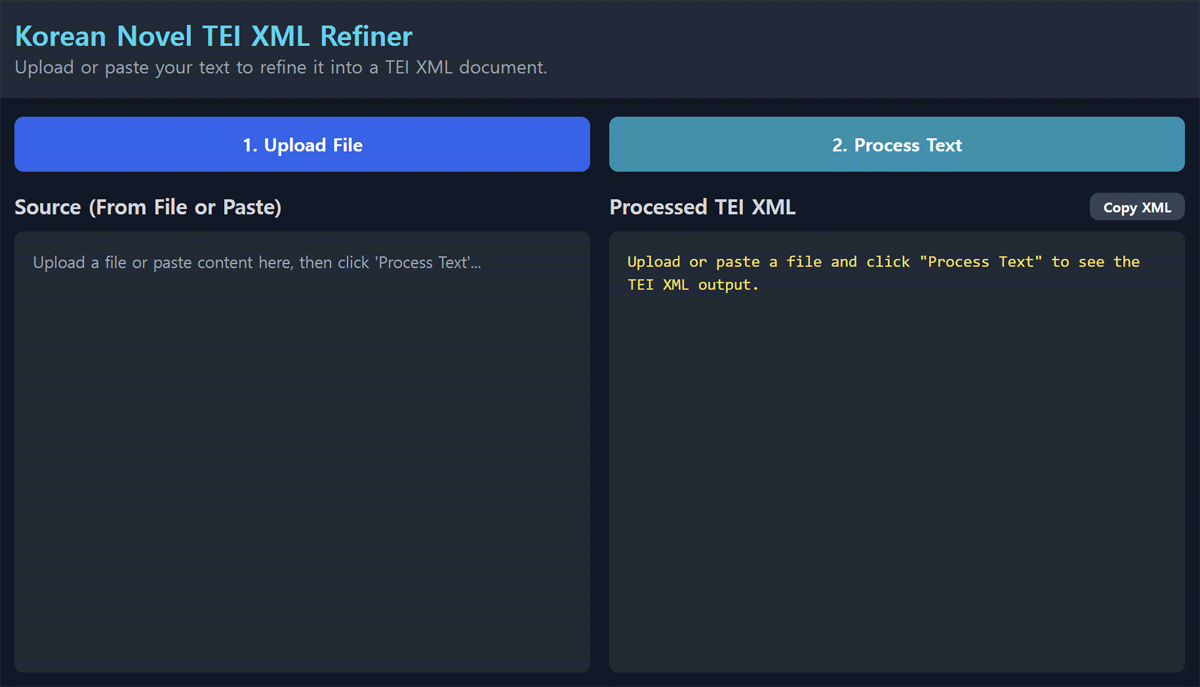
Figure 1
Conversion of Korean Modern Literature xml/tei App Screen.
Table 1
TEI elements and attributes used in the KNoTE dataset.
| CATEGORY | ELEMENT | KEY ATTRIBUTES | FUNCTION |
|---|---|---|---|
| TEI Header | titleStmt | — | Title, author, encoder credits |
| respStmt | — | Encoder/reviewer attribution | |
| sourceDesc/bibl | type | Source provenance | |
| encodingDesc | — | Encoding standard (TEI ALL) | |
| revisionDesc/change | when, who | Encoding/review dates | |
| Characters | listPerson | — | Character registry |
| person | xml:id | Individual character | |
| personGrp | xml:id | Collective character group | |
| persName | xml:lang | Name in Korean or Hanja | |
| Entities | persName | ref | Named character mention |
| rs | ref, type | Pronoun/epithet reference | |
| placeName | — | Place name | |
| orgName | — | Organisation name | |
| date | when, type | Date reference | |
| time | when, type | Time-of-day reference | |
| Speech | said | who, aloud, direct, mode | Direct speech, thought, or monologue |
| Language | foreign | xml:lang="zh", xml:lang="ja" | Hanja preservation and Japanese in Hangul |
| Structure | div | type, n | Chapter/section division |
| p | — | Paragraph | |
| head | — | Chapter title |
Utilising prompt engineering tailored to modern Korean fiction, the application performed automated construction of the TEI header, generation of a character ontology (<listPerson>), named entity tagging (<persName>, <placeName>, <orgName>), distinction between direct speech and interior monologue (<said>), Hanja annotation (<foreign xml:lang="zh">), and Korean postpositional particle separation in entity tagging. Encoding was based on the TEI ALL schema of the TEI P5 Guidelines. Tailored prompt engineering is necessary because, without strict guidance, LLMs frequently produce XML validation errors or bypass external reference data during complex tasks (De Cristofaro & Zilio, 2025). Structuring the prompts in this way reduced such errors and improved markup accuracy.
Table 2 lists representative custom values from this process, including political ideologies, social classes, modern Korean spaces, and a project-specific virtual speaker edcmt for narratorial commentary. Many named entities also carry an external authority link: Korean places, organisations, events, and concepts to the Encyclopedia of Korean Culture (encykorea.aks.ac.kr), and persons to Wikipedia (ko.wikipedia.org) or Wiktionary (ko.wiktionary.org). A complete inventory of all TEI elements and attributes in the corpus is provided in the repository (KNoTE_TEI_tags_full.md) and the Zenodo record.
Table 2
Period-revealing markup values in the KNoTE dataset; schema-level inventory in Table 1.
| CATEGORY | ELEMENT | KEY ATTRIBUTES | SAMPLE VALUES |
|---|---|---|---|
| Political ideologies | term | type="ideology" | socialism, militarism, humanitarianism, feminism |
| orgName | ref="#COMMUNIST_PARTY" | Communist Party | |
| rs | type="person_group", subtype="communist" | communists, fighters, party members | |
| rs | type="anarchism" | anarchists, seditious thought | |
| Modernization concepts | term | type="concept" | New Woman, bourgeois, feudal aristocracy, cultural-style housing, Four-Pillars fortune |
| Social classes | rs | type="class" | yangban (gentry), sangnom (commoners) |
| rs | type="laborer", "farmer" | farmers, labourers, first-rank workmen | |
| rs | type="intelligentsia" | “high-collar” (haikara, modern dandy) | |
| rs | type="prisoner", "official" | detainees, detectives, guards | |
| rs | type="immigrant" | migrant parties bound for Manchuria | |
| Modern Korean Spaces | placeName | type="city" | Gyeongseong (colonial Seoul), Tokyo, Hsinking, Sinuiju |
| placeName | type="region", "border" | Manchuria, Gando, the colonial border | |
| placeName | type="facility" | detention cells, Special Higher Police interrogation rooms | |
| placeName | type="hotel", "cafe", "bar" | Chosen Hotel, tabang (tearoom), Bar Lily | |
| orgName | type="police" | Special Higher Police, Gyeongbangdan (Defence Corps) | |
| Currency & measures | measure | type="currency" | 1,500 nyang (Joseon); 1 won, 30 jeon, 50 jeon (colonial) |
| measure | type="distance", "age" | 15 ri, 14 years old | |
| Formal architecture | div | type="frame", "embedded" | Dr. K’s Research, The Man Met in the Detention Center |
| div | type="preface", "afterword" | Blood of Flowers (Hwa-ui Hyeol) | |
| div, q | type="letter" | Nostalgia (Hyangsu), The Sorrows of the Weak, Ready-made Life, and four other works | |
| Project extension | said | who="#edcmt" | “Who could have foreseen…” (The Girl of Mystery (Uisim-ui Sonyeo)); “But how could she escape those deep waves!” (Adada the Idiot (Baekchi Adada)) |
Sampling strategy
The KNoTE dataset aims to present a reproducible TEI encoding workflow and provide a seed dataset for evaluating automated TEI tagging systems. Texts were therefore deliberately sourced from Korean Wikisource—a freely accessible, public-domain repository—to ensure that the dataset can be independently verified and extended without access restrictions. The dataset comprises 33 works of modern Korean fiction by 22 authors, spanning from Yi In-jik’s Tears of Blood (Hyeol-ui Nu, 1906) to Kang So-cheon’s The Photo Studio that Takes Pictures of Dreams (1954), covering the formative decades of modern Korean literature. Following the corpus-balancing framework of Röttgermann (2024), works were selected by four explicit criteria rather than canonical reputation alone: (i) literary-historical canonicity, operationalised through inclusion in standard literary histories and reference works (e.g., the Encyclopedia of Korean Culture) and the availability of Wikidata/Wikisource records; (ii) representative or “first-of-its-kind” status (e.g., the first sinsoseol, the first original Korean science fiction, and the debut work of the first modern woman novelist); (iii) balance across publication period, narrative form, and literary movement; and (iv) a verifiable public-domain source text suitable for annotation. Table 3 lists each work with its publication year, narrative form, and selection rationale; the resulting corpus ranges from sinsoseol (新小說) and short fiction to early modern science fiction. Women authors remain a minority (6 of 33 works), reflecting the historical scarcity of published women writers; we accordingly included all major available women writers of the period (Kim Myeong-sun, Na Hye-seok, Kang Kyeong-ae, and Ji Ha-ryeon).
Table 3
Selection rationale for the 33 works in the KNoTE dataset.
| NO. | AUTHOR | TITLE (ROM.) | YEAR | FORM | SELECTION RATIONALE |
|---|---|---|---|---|---|
| 1 | Yi In-jik | Tears of Blood (Hyeol-ui Nu) | 1906 | Sinsoseol | Korea’s first sinsoseol (new novel). |
| 2 | Yi Hae-jo | The Iron World (Cheol-segye) | 1908 | Sinsoseol (transl. SF) | First Korean adapted novel and first SF-genre work (after Jules Verne). |
| 3 | Yi Kwang-su | The Heartless (Mujeong – short story) | 1910 | Short fiction | Short-story version preceding the first modern novel, Mujeong. |
| 4 | Yi Hae-jo | Blood of Flowers (Hwa-ui Hyeol) | 1911.04 | Sinsoseol | Sinsoseol written after the 1910 annexation; a “new old-style” novel. |
| 5 | Kim Myeong-sun | The Girl of Mystery (Uisim-ui Sonyeo) | 1917.11 | Short fiction | Debut work of Korea’s first modern woman novelist. |
| 6 | Na Hye-seok | Kyung-hee | 1918.03 | Short fiction | Representative work on the colonial New Woman intellectual before marriage. |
| 7 | Na Hye-seok | To the Revived Granddaughter | 1918.09 | Short fiction | Bears witness to the 1910s from a woman’s perspective (Kwon Bodurae). |
| 8 | Kim Dong-in | The Sorrows of the Weak | 1919.02–03 | Short fiction | Kim Dong-in’s first published fiction. |
| 9 | Yi Ik-sang | The Straggler (Nagoja) | 1919.07.14 | Short fiction | Debut work of Yi Ik-sang, a leading writer of proletarian and neo-tendency (sin-gyeonghyangpa) literature. |
| 10 | Hyun Jin-geon | A Poor Wife (Bincheo) | 1921.01 | Short fiction | Early work of Hyun’s self-reflective realism. |
| 11 | Na Hye-seok | Gyu-won | 1921.07 | Short fiction | Post-marriage work on “the grievances of the inner chamber.” |
| 12 | Hyun Jin-geon | A Society That Drives You to Drink | 1921.11 | Short fiction | Early work of Hyun’s self-reflective realism. |
| 13 | Choi Seo-hae | Nostalgia (Hyangsu) | 1924.04 | Short fiction | A neo-tendency (sin-gyeonghyangpa) story depicting the lives of lower-class people who emigrated beyond Korea—to Siberia and northern Manchuria. |
| 14 | Hyun Jin-geon | A Lucky Day (Unsu Joeun Nal) | 1924.06 | Short fiction | Representative work of Hyun’s naturalist gaze on the common people. |
| 15 | Kim Dong-in | Potato (Gamja) | 1925.01 | Short fiction | One of Kim Dong-in’s 1920s naturalist stories. |
| 16 | Hyun Jin-geon | Director B and the Love Letters | 1925.02 | Short fiction | Satire on the repression of women’s education under colonial rule. |
| 17 | Na Do-hyang | The Watermill (Mullebang-a) | 1925.09 | Short fiction | A later work marking Na Do-hyang’s shift from his early romanticism to realism. |
| 18 | Bang Jeong-hwan | For Our Friends | 1927.02 | Children’s fiction | By a leading children’s-literature writer of the youth-liberation movement. |
| 19 | Bang Jeong-hwan | The Eternal Shirt (Mannyeon Shirt) | 1927.03 | Children’s fiction | Representative children’s short fiction by the same author. |
| 20 | Bang Jeong-hwan | The Gold Watch | 1929.01–02 | Children’s fiction | Representative children’s short fiction by the same author. |
| 21 | Kim Dong-in | Dr. K’s Research | 1929.12 | Short fiction (SF) | Regarded as Korea’s first original (creative) SF story. |
| 22 | Kim Nam-cheon | Water (Mul) | 1933.06 | Short fiction | Short story by a leading writer of KAPF (proletarian federation). |
| 23 | Chae Man-sik | Ready-made Life | 1934.05–07 | Short fiction | Chae Man-sik’s early self-satirical story. |
| 24 | Kang Kyeong-ae | Salt (Sogeum) | 1934.05–10 | Novella | Destitute life of a colonial subaltern woman, set in Manchuria. |
| 25 | Gye Yong-mook | Adada the Idiot (Baekchi Adada) | 1935 | Short fiction | Pure-art-period work; also read in disability-discourse studies. |
| 26 | Kim Yu-jeong | The Camellias (Dongbaek-kkot) | 1936.05 | Short fiction | Representative native, rural-set story by Kim Yu-jeong. |
| 27 | Yi Sang | The Wings (Nalgae) | 1936.09 | Short fiction | Representative work of Yi Sang, leading 1930s modernist (Guinhoe). |
| 28 | Yi Hyo-seok | When Buckwheat Flowers Bloom | 1936.10 | Short fiction | Representative lyrical work by a Guinhoe member. |
| 29 | Chae Man-sik | Uncle Chi-suk | 1938 | Short fiction | Intellectual-satire story from the year of Tangnyu and Taepyeong-cheonha. |
| 30 | Jeong In-taek | Melancholy (Uuljeung) | 1940.09 | Short fiction | A modernist story depicting an intellectual’s inner life in the early 1940s, by Jeong In-taek (later a novelist in the DPRK). |
| 31 | Kim Sa-ryang | The Man Met in the Detention Center | 1941 | Short fiction | By a Korean-Japanese writer grappling with decolonization in the late colonial era. |
| 32 | Ji Ha-ryeon | The Journey (Dojeong) | 1946.07 | Short fiction | By a leftist woman novelist who later defected to the North. |
| 33 | Kang So-cheon | The Photo Studio that Takes Pictures of Dreams | 1954.03 | Children’s fiction | Representative post-Liberation Korean children’s story. |
Quality control
To ensure encoding consistency and accuracy, multiple layers of manual validation were implemented. Following the initial artificial intelligence (AI)-assisted markup, seven annotators reviewed, corrected, and supplemented the tags based on internally developed encoding guidelines. Subsequently, the curator and data manager conducted a full-coverage cross-review of all files, checking <persName>, <ref> consistency, <said> attribute integrity, and <foreign xml:lang> accuracy. Finally, the project supervisor performed a final scholarly review. Each file’s <revisionDesc> records the dates of encoding completion and verification. This encoding and quality control process was carried out as part of a structured training programme in humanities data design at the Academy of Korean Studies (AKS). A preliminary version of this workflow will be presented at a workshop accepted for DH2026 (Daejeon, South Korea): “Building a Korean Literature TEI/XML Database: From Data Acquisition to AI-Enhanced Reading.”
3 Dataset Description
Repository name
Zenodo
Object name
KNoTE dataset (on Zenodo: https://doi.org/10.5281/zenodo.18679321)
Format names and versions
XML, conformant to TEI P5 (TEI ALL schema)
Creation dates
2025-09-01–2026-04-27
Dataset creators
Kim, Gayeon (Data manager, Academy of Korean Studies); Park, Seonyeong (Data curator, Academy of Korean Studies); Ji, Haein (Data collector, Academy of Korean Studies); Lee, Hagyeong (Annotator, Sogang University); Lee, Byeongjoo (Annotator, Republic of Korea Air Force Academy); Jeong, Chaeyeon (Annotator, Korea University); Lee, Jae-yeol (Annotator, Academy of Korean Studies); Jo, Gyungmin (Annotator, Academy of Korean Studies); Lim, Iro (Annotator, Academy of Korean Studies); Ismayilov, Orkhan (Annotator, Academy of Korean Studies); Kim, Byungjun (Supervisor, Academy of Korean Studies).
Language
Korean, with Hanja (Chinese character) annotations marked via xml:lang="zh".
License
Creative Commons Attribution 4.0 International (CC-BY 4.0).
Publication date
2026-04-27
4 Reuse Potential
The KNoTE dataset encodes characters, locations, and temporal markers in TEI XML, complementing recent character-centric dataset work on Korean novels (Kim et al., 2024). This standardised markup makes the texts amenable to quantitative literary analysis. Crucially, the encoding distinguishes spoken dialogue from interior monologue and reported thought, so that the representation of interiority—a defining concern in accounts of the modern Korean novel—becomes a separable object of analysis rather than collapsing into undifferentiated “speech.” The corpus can also serve as a fine-tuning resource for language models trained on historical Korean text, where structured TEI input has been shown to improve encoding accuracy (Strutz, 2026). Because each entity carries a unique identifier linked to external authorities (Encyclopedia of Korean Culture, Wikipedia), the dataset can be integrated into broader knowledge graphs. KNoTE is also a reference implementation for projects seeking to add period-specific metadata layers to literary corpora.
However, because TEI permits considerable schema variation, cross-corpus comparison will require tag mapping between projects that use different encoding conventions. In addition, the reliance on public-domain texts limits the temporal and authorial scope. To offset this constraint, the selection covers a range of genres, from sinsoseol to early science fiction. The dataset should therefore be understood as a representative sample of the early modern tradition rather than an exhaustive archive of modern Korean fiction. A project-specific TEI customisation (ODD) for stricter validation is planned for a future release.
AI Declaration
Generative AI tools were used at two stages of this work. During the data production phase, Google AI Studio (Gemini 2.5 Flash) was employed for semi-automatic TEI encoding of the source texts, as described in the Method section. During the manuscript preparation phase, Anthropic Claude Opus 4.6 was partially used to assist with drafting and editing portions of the text. All AI-generated markup and manuscript content were reviewed, verified, and finalised by the human authors, who bear full responsibility for the accuracy and integrity of the published work.
Notes
Acknowledgements
We would like to express our deepest gratitude to Jae-yeol Lee, Gyungmin Jo, Iro Lim, and Orkhan Ismayilov for their contributions to the initial version of the KNoTE dataset, which laid the foundation for the final version. We are also grateful for the constructive comments provided by the editors and the reviewers, which greatly improved the quality of this work.
Author Contributions
The authorial roles and responsibilities for this research are specified as follows.
Gayeon Kim: Software, Methodology, Writing – original draft.
Seonyeong Park: Data curation, Writing – original draft.
Haein Ji: Data collection, Methodology, Writing – original draft.
Hagyeong Lee: Investigation, Validation.
Byeongjoo Lee: Investigation, Validation.
Chaeyeon Jeong: Investigation, Validation.
Byungjun Kim: Supervision, Project administration, Writing – review & editing.
Gayeon Kim and Seonyeong Park made equal contributions.