
(1) Overview
Repository location
Context
This dataset contains prosopographical and network data of over 21,000 individuals attested in cuneiform tablets from Babylonia during the so-called Neo-Babylonian and Persian periods (c. 620–330 BCE). The data originates from Prosobab (Waerzeggers et al., 2019), an open access, online prosopography of people who lived in Babylonia. The persons in the prosopography have been collected from a large corpus of over 5000 cuneiform tablets. Prosobab was created by multiple researchers under the European Research Council Consolidator Grant project “Persia and Babylonia” at Leiden University in the Netherlands.
The Prosobab database contains three types of information. Firstly, there is information about each person identified in the data, including name, patronym, and gender. Secondly, each attestation of a person in a cuneiform tablet is recorded, providing data about the legal role, title, and family relations of the person in the given tablet. Finally, for every cuneiform text, there is information about its place and time of writing and the ancient archive it belongs to. The rich metadata and unique ID numbers given to each person, attestation, and cuneiform tablet make the data well suited for social network analysis (SNA). However, since the online platform of Prosobab is not intended for network analysis or visualization, the data needs to be downloaded and manipulated to make it suitable for SNA. Thus, we have converted the Prosobab dataset to files that are pre-formatted for SNA.
The online platform of Prosobab (prosobab.leidenuniv.nl) does not allow the user to download the full contents of the database at once, but this needs to be done in several batches using different search queries. Therefore, our network was created from a database dump published by the project (Waerzeggers & Groß, 2022). From the database, we extracted all the data on persons, their attestations, and cuneiform tablets. We transformed this data into files that allow for an easy creation of both directed and undirected social networks, enhanced with rich metadata available on Prosobab. The dataset published and discussed here contains both the raw data extracted from the database dump and the enhanced files intended for SNA. Furthermore, to facilitate the future extraction of the data from the database dump, we also publish the SQL queries used for the extraction. The dataset published here was produced for the research purposes of the Centre of Excellence in Ancient Near Eastern Empires (University of Helsinki).
(2) Method
Steps
We downloaded the SQL database dump of Prosobab available in the DANS data repository (Waerzeggers & Groß, 2022). To access the data in the dump, we created an empty database in the open-source relational database management system MySQL and imported the dump file into the new database. Using MySQL queries we extracted information from the database and saved it as several TSV (tab-separated values) files.
The Prosobab database consists of several tables. We wanted to present this information in a similar fashion as it is available on the Prosobab online platform when one inspects a cuneiform tablet, person, or attestation. This involved extracting information from several tables in the database and combining the items so that all the data was connected to one tablet, person, or attestation. The data was saved as simple TSV files, in which each row contains a single tablet, person, or attestation and its metadata. Furthermore, we consistently provide cross-references from tablets and persons to attestations and from attestations to tablets and persons. Using these files, we produced edge lists showing which people are attested in the same tablet and which tablets are connected by the occurrence of the same person. These edge lists can be used to create undirected co-occurrence networks.
Using the online platform of Prosobab, one can search, for example, for persons who are creditors or somebody’s adoptive parents. One can also download a list of such persons. However, it is not possible to create a list linking creditors to their debtors or adoptive parents to their adopted children. We wanted to facilitate rigorous social network analysis of historical data (Lemercier, 2015) and provide easy-to-use edge lists of persons who are connected via various social relations. We used the data extracted from the Prosobab database to create two types of edge lists. First, the Prosobab data includes several recorded relations between two individuals, such as those between family members, neighbors, or masters and slaves. Using this data, we created an edge list recording each pair of persons linked via such relations. Second, we used the legal roles documented in the data to link people who have related roles in the same text (as an example, we linked creditors to their debtors and lessors to their lessees). The edge lists contain metadata on the tablet in which the social relationship is documented. All these edge lists can be used as directed network data, and the researcher can easily manipulate the edge direction as it fits their research questions and theoretical approach. We also provide a node list that contains information on each person attested in the dataset. Using the node and edge lists, a researcher can prepare their SNA dataset without any programming skills, using a spreadsheet editor.
Quality control
We did not alter the underlying Prosobab data but only combined the existing data in new ways and created some new data by simplifying or augmenting existing data. All these operations were done automatically, and their quality was controlled by manual spot checks.
Our dataset quite accurately reflects the contents of the Prosobab online platform in September 2025. The last major batch of updates to the online platform was published in July 2021, a year before the database dump was made available in June 2022.1 It seems that the contents of the online platform have been only slightly updated since July 2021, raising the number of texts from 5,127 to 5,180. At the same time, the database dump contains some data that has not been made available on the online platform, as the number of attestations in the database dump is 45,042 in comparison to 43,791 attestations on the online platform.
(3) Dataset Description
Repository name
Zenodo
Object name
Social Networks of Prosobab
Format names and versions
RTF, TSV, TXT, XLSX
Creation dates
2022/09/29 – 2025/08/15
Dataset creators
Heidi Jauhiainen (University of Helsinki) was responsible for conceptualization, data curation, investigation, methodology, and validation.
Tero Alstola (University of Helsinki) was responsible for conceptualization, data curation, investigation, and validation.
Language
English, Akkadian; personal names in various other languages
License
Creative Commons Attribution-NonCommercial 4.0 (CC BY-NC 4.0)
Publication date
2025/08/15
(4) Reuse Potential
The dataset is intended to be used primarily in social network analysis (Wasserman & Faust, 1994). Recently, there has been a growing interest in SNA in Assyriology, which has also led to projects on digital prosopography. In addition to the Neo-Babylonian and Persian periods (King & Pirngruber, 2022; Waerzeggers, 2014b), research has been carried out on material from other eras, including the Ur III (Veldhuis, 2021), Old Assyrian (Anderson, 2017), Old Babylonian (Gonçalves, 2021), and Neo-Assyrian periods (Bennett et al., 2024; Jauhiainen & Alstola, 2022; Jones, 2023). However, much work remains to be done to make all prosopographical data from Mesopotamia available in openly accessible digital formats.
The dataset described in this article enhances both the usability and long-term availability of the Prosobab data. First, we provide a set of files that are ready-made for SNA. Although it is possible to download the raw data from the Prosobab online platform, this needs to be done in several batches, as the platform can only display a limited amount of data at a time. More importantly, creating rich network data from the Prosobab raw data is a time-consuming process that requires some expertise in writing scripts. Second, publishing the present dataset on Zenodo ensures the availability of the data in accessible formats. As the Prosobab online platform is an interactive web service provided by a university, it runs the risk of not being actively maintained and available in the long term. Furthermore, the database dump is only accessible to those who can write SQL queries to extract the data.
Our dataset contains node and edge lists for undirected co-occurrence networks and for several directed networks. All the lists contain rich metadata that can be used as node and edge attributes. The co-occurrence networks allow the researcher to study questions about who knew whom and which cuneiform tablets are interlinked by the occurrence of the same people (Figure 1). The utility of such research has already been shown by Wang (2023), who used the Prosobab data to study brokerage in the city of Babylon. We also provide an edge list for a two-mode network showing the connections between persons and the tablets they are attested in.
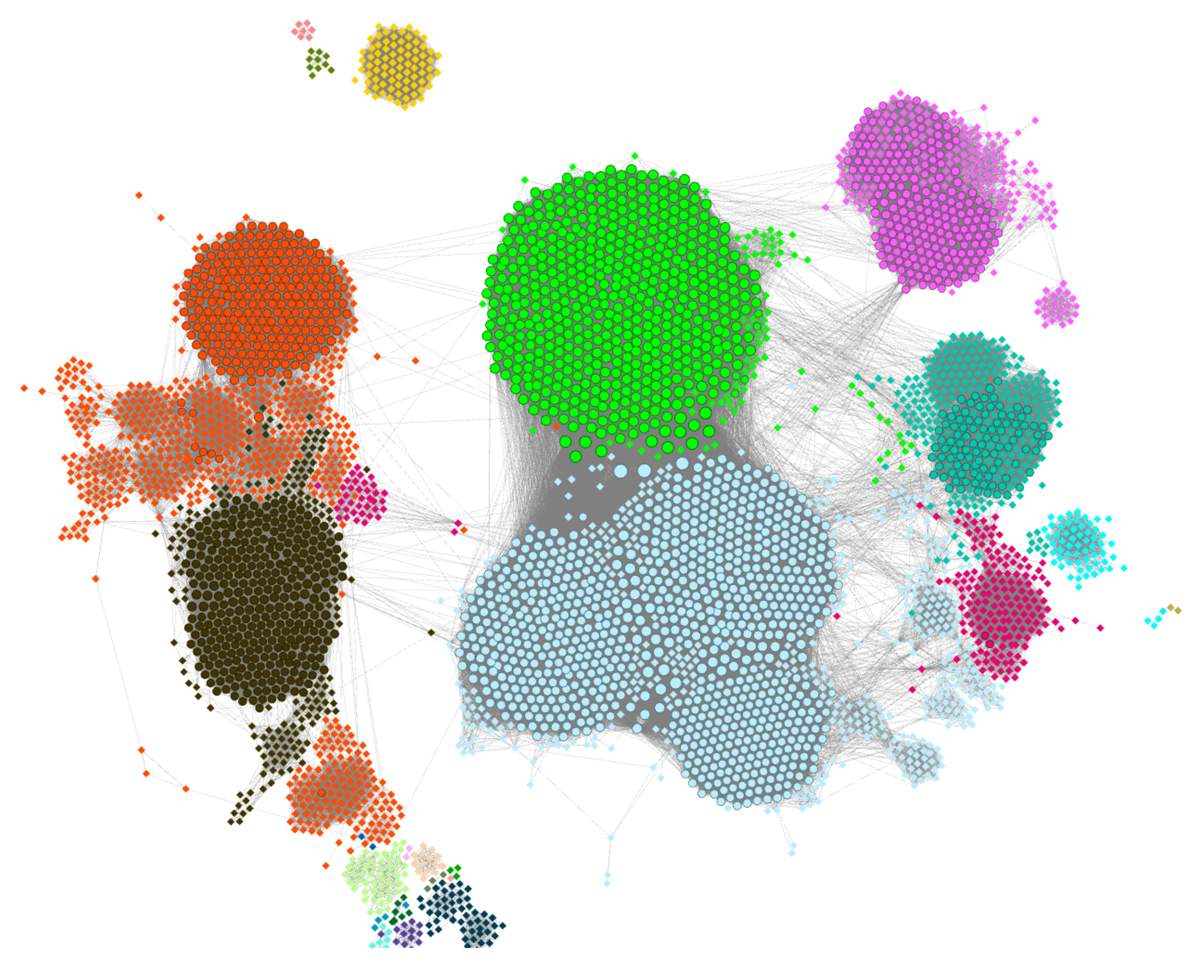
Figure 1
One-mode, undirected network of cuneiform tablets, showing which texts are connected by the occurrence of the same people. The network can be used to study the archival patterns of texts. The coloring represents the communities detected using the Louvain algorithm (Blondel et al., 2008). The network visualization was created using Gephi (Bastian et al., 2009).
Directed networks allow the study of more nuanced and varied social relations (Tambs, 2022). We connected people to each other based on various social roles such as creditor and debtor, bride and groom, and parent and child (Figure 2). Using the directed networks and paying attention to the quality and intimacy of social ties, one can study ancient social relations and structures in great depth. For instance, the research questions can relate to economic exchange and social advancement (Waerzeggers, 2014a), marriage practices (Still, 2019), or the social status of scholarly elites (Jones, 2023).
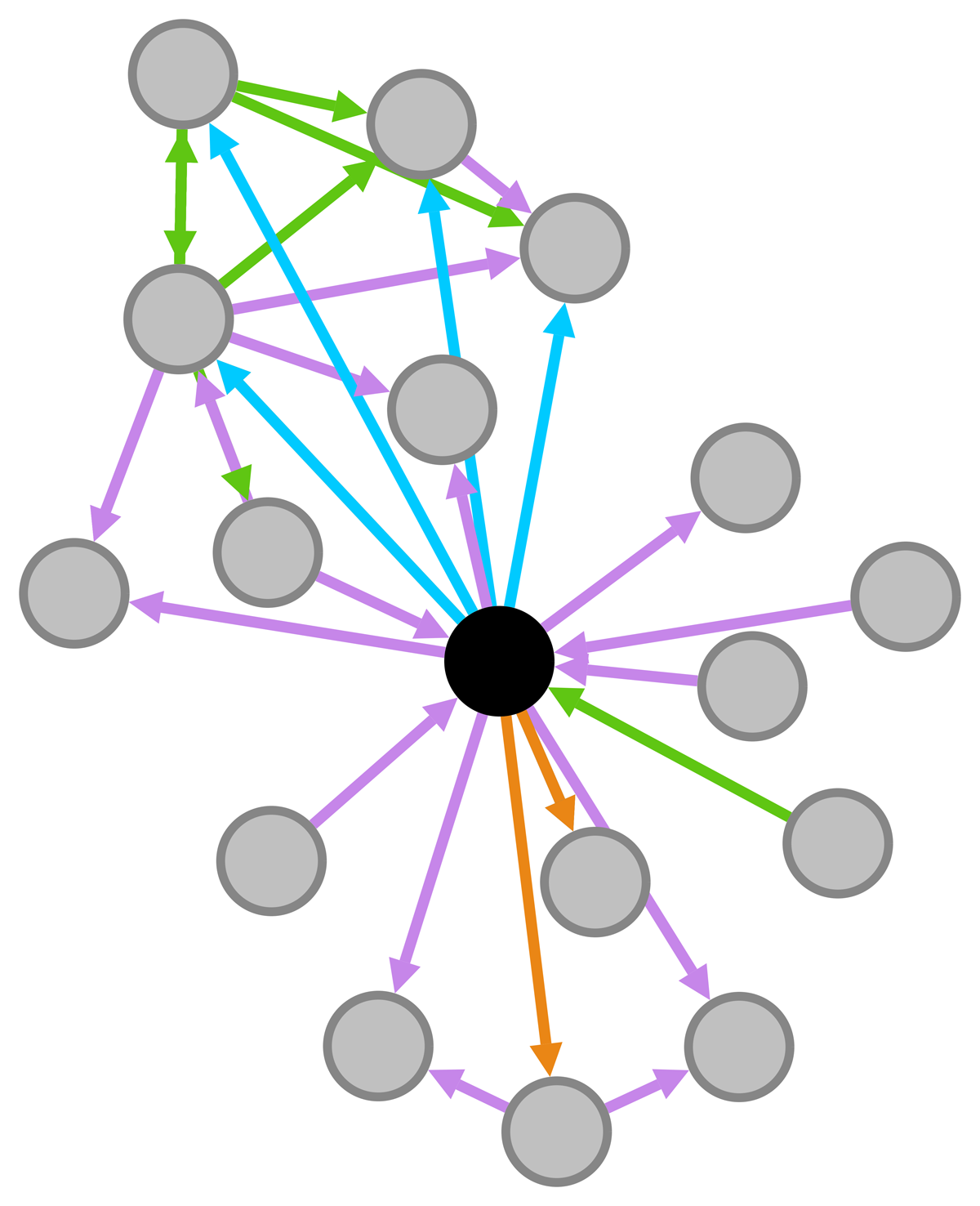
Figure 2
The directed ego network of Šulāya, son of Ṣillāya from the Ilia family. The violet edges represent debts, orange edges donations, green edges payments, and blue edges inheritances. Šulāya is the black node. The network visualization was created using Gephi (Bastian et al., 2009).
In addition to its research contribution, the dataset can be used as a teaching resource in courses related to digital humanities, SNA, or computational Assyriology. Being easy to use, it provides the teachers and students an opportunity to benefit from a large set of high-quality, manually curated prosopographical data.
Notes
[1] https://prosobab.leidenuniv.nl/about.php#phases (last accessed September 23, 2025).
[2] https://prosobab.leidenuniv.nl/about.php#team (last accessed August 5, 2025).
Acknowledgements
We are greatly indebted to the work of our numerous colleagues2 who have manually created the Prosobab prosopography and openly published the database dump. We also thank the members of the Centre of Excellence in Ancient Near Eastern Empires for their helpful feedback on the dataset. Finally, we are grateful to Albion M. Butters for revising the English language of the article.
Competing Interests
The authors have no competing interests to declare.
Author Contributions
Heidi Jauhiainen: conceptualization, data curation, investigation, methodology, validation, writing – original draft
Tero Alstola: conceptualization, data curation, investigation, validation, writing – original draft