
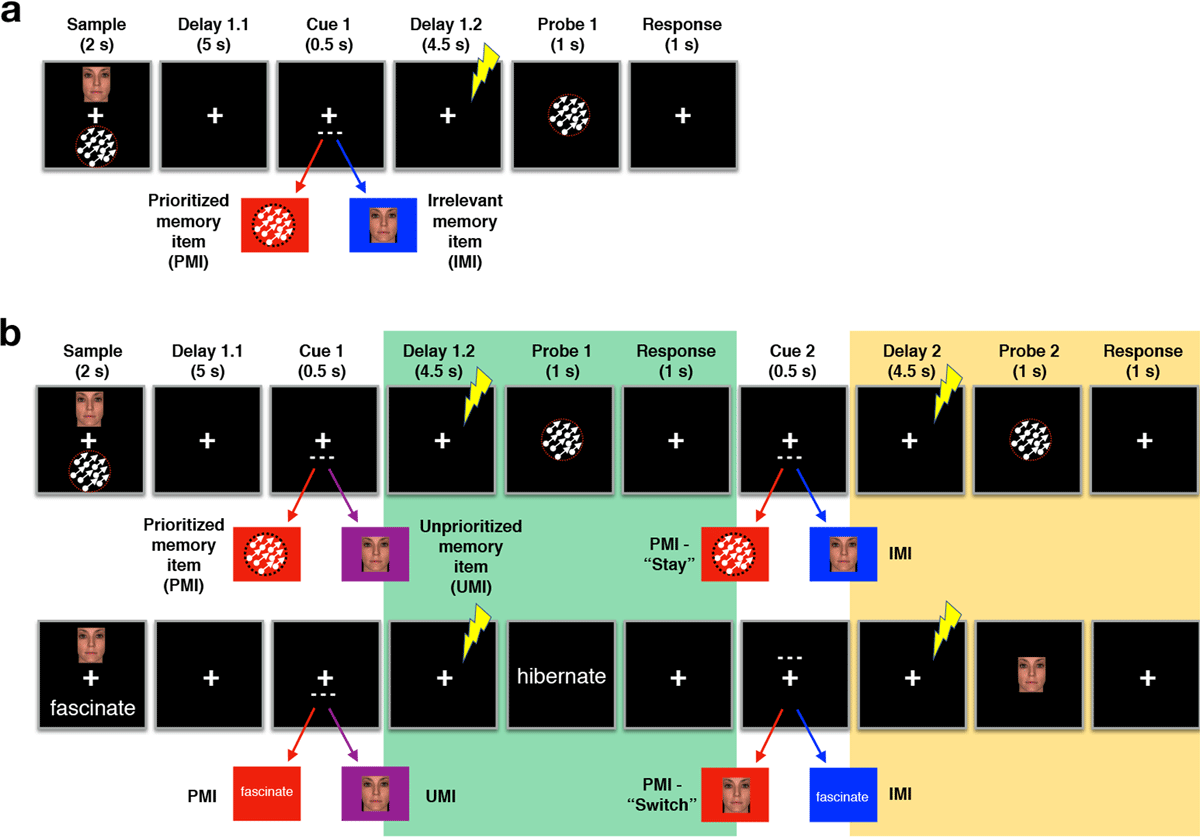
Figure 1
Experimental details. (a) Single retrocue task. Two items, each from one of three categories (faces, translating dots, words) appeared simultaneously for two seconds above and below fixation. After a 5-second delay (Delay 1.1), a dashed line (Cue 1) appeared above or below fixation to indicate which of the two items would be probed for response. The cue was followed by a 4.5-second delay (Delay 1.2), during which a single pulse of TMS was delivered, 2–3 seconds after the offset of the cue, on 50% of trials. After Delay 1.2 a probe stimulus appeared at fixation and subjects indicated whether the probe stimulus was a match or nonmatch to the probed memory item. (b) Dual serial retrocue (DSR) task. The task structure was identical to the single retrocue task until the (first) response period, after which a second cue appeared that referred to the PMI on 50% of trials (upper example) or the UMI on 50% of trials (lower example). spTMS was delivered during Delay 2 on 50% of trials.
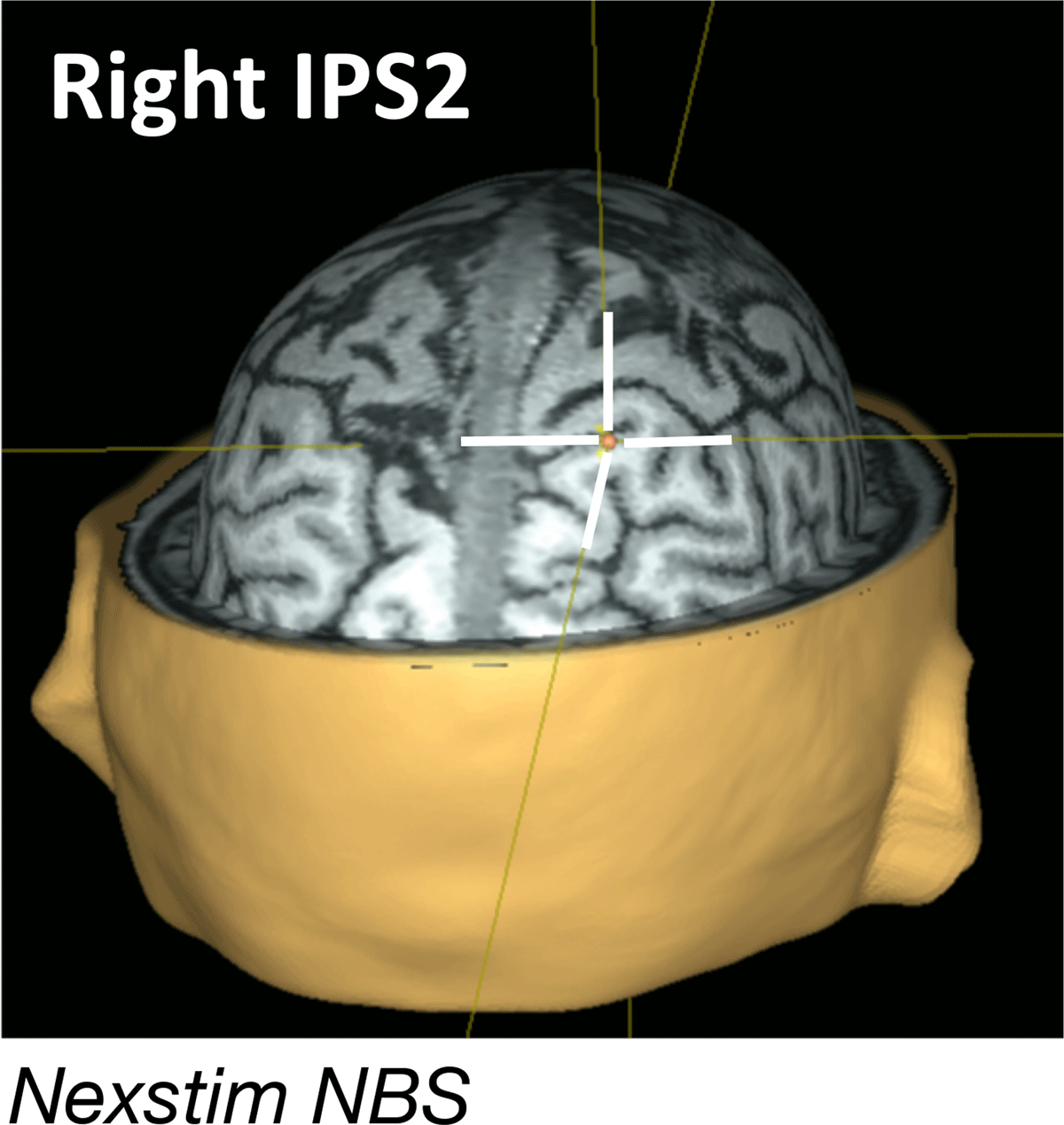
Figure 2
Single-pulse TMS administration. spTMS was administered to rIPS2 (coordinate: –22 70 58) localized for each subject using an anatomical scan and NexStim Navigated Brain Stimulation software. spTMS was delivered unpredictably on 50% of trials during Delay 1.2 of the DSR task, on 50% of trials during Delay 2 of the DSR task, and on 50% of trials during Delay 1.2 of the single retrocue task.
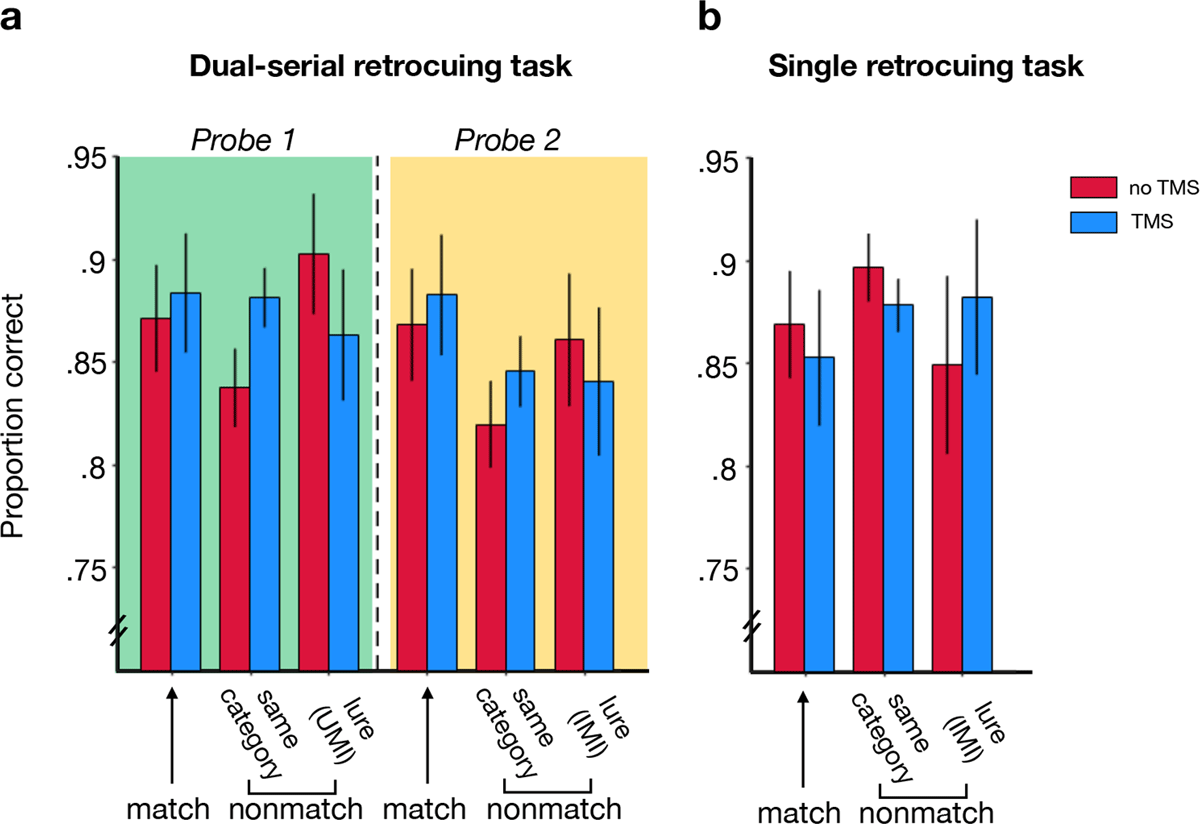
Figure 3
Behavioral performance in the experimental tasks. (a) Accuracy on the DSR task as a function of probe type (match, nonmatching item drawn from same category as the PMI, and nonmatching items that are lures) and spTMS condition. (b) Accuracy on the single retrocue task as a function of probe type and spTMS condition. Error bars correspond to +/– 1 standard error of the mean.