
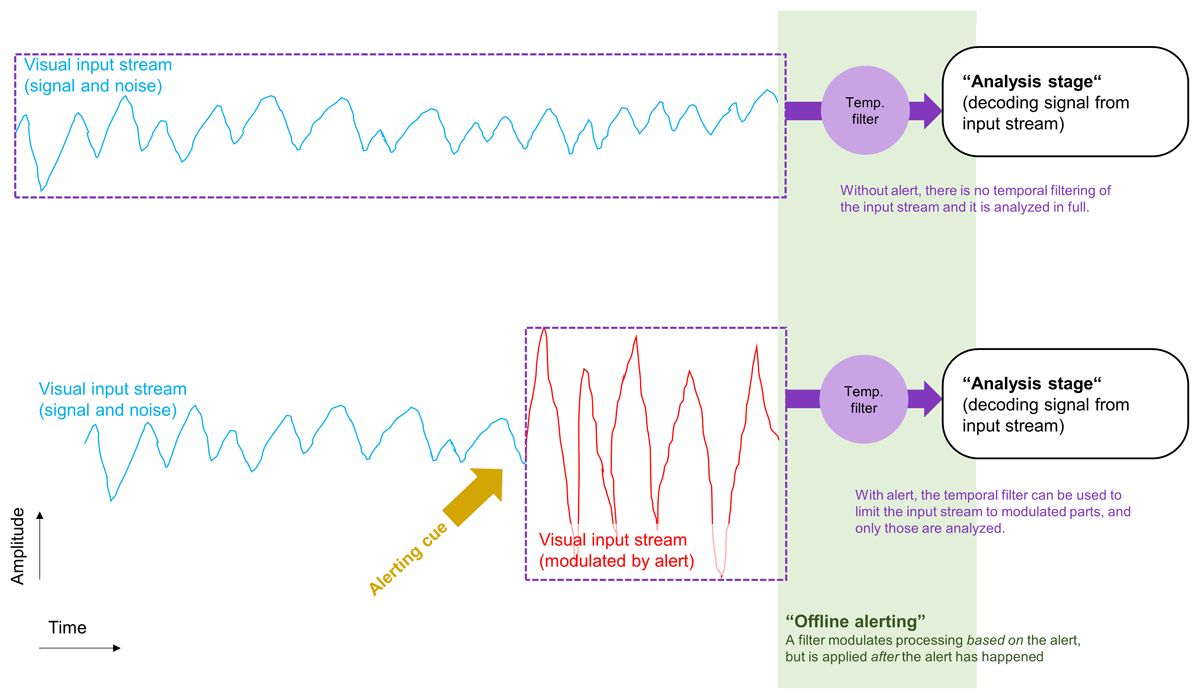
Figure 1
Illustration of hypothetical influences of alerting that happen “offline”, at a later processing stage. A visual input stream consisting in a signal and noise over time is encoded and processed by a later “analysis stage” whose processes aim to decode the signal from the input stream (upper panel). Usually, the complete input stream is analyzed. However, if there is an alerting cue, the input stream (the signal and noise) are modulated (lower panel). Now, a temporal selection process before the analysis stage filters-out the non-modulated parts of the input stream, so that only a small part of the input stream that deviates from the rest (e.g. in relative amplitude) has to be analyzed later on at the analysis stage.
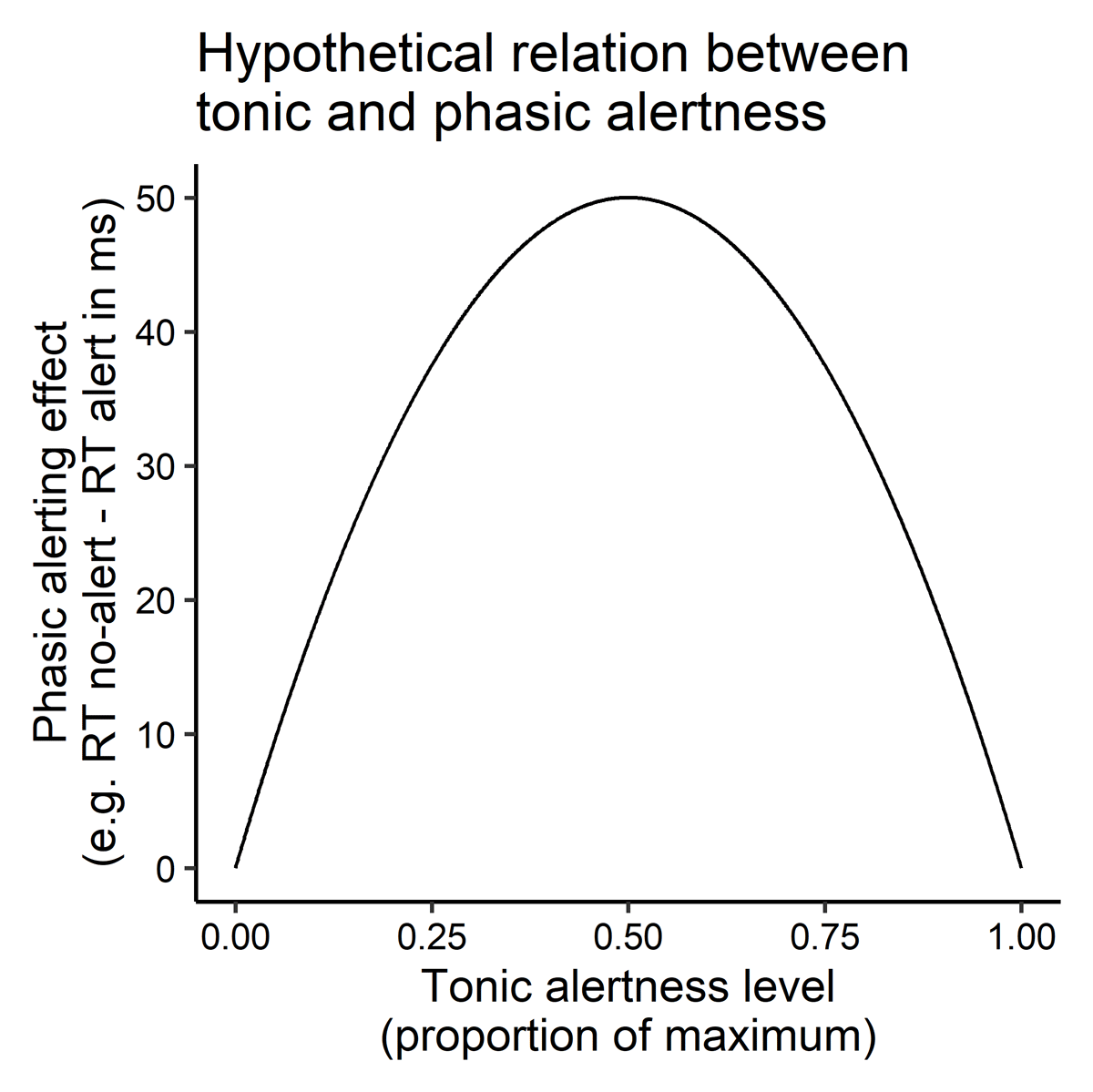
Figure 2
Hypothetical (inverse U-shaped) relationship between the current level of tonic alertness and the effects of phasic alertness on perceptual and cognitive processing and behavioral performance (e.g., alerting effects on reaction times in ms in choice tasks).
Table 1
Testable criteria for assumed alerting mechanisms.
| ASSUMPTION | CRITERION |
|---|---|
| Phasic alertness is a cognitive state of increased readiness for perception and action | Alerting effects should be confined to intermediate levels of tonic alertness, but disappear at low and high levels of tonic alertness |
| Phasic alertness prepares for perception and action in an online, not an offline fashion | Multiple alerting cues should work in concert, rather than interfering with another |
| Phasic alertness is both, short-lived and stimulus-driven and not driven intrinsically | Alerting by means of external stimuli should be independent of manipulations of the intrinsic short-lived state of readiness for peception and action. Otherwise, “extrinsic“ and “intrinsic“ phasic alertness should interact. |
| Phasic alertness is bottom-up, and not driven by temporal expectation | Alerting effects should also appear once we control for temporal expectation using non-aging cue-target intervals. However, alerting may still reflect a rudimentary form of temporal expectation, rendering this a weak criterion still containing ambiguity. |
| Phasic alertness is bottom-up, and independent from the current task and related stimulus expectations | Alerting effects should occur whether or not alerting cues were themselves expected or predicted that a target (rather than no target) was about to appear. Both of these assumptions have been falsified already (Dietze et al., 2024; Poth & Dietze, in prep.) |
| Phasic alertness affects processing at multiple loci in the chain of cognitive processing | Alerting effects on dependent variables representing a specific processing stage should combine (additively, linearly, or nonlinearly). |