
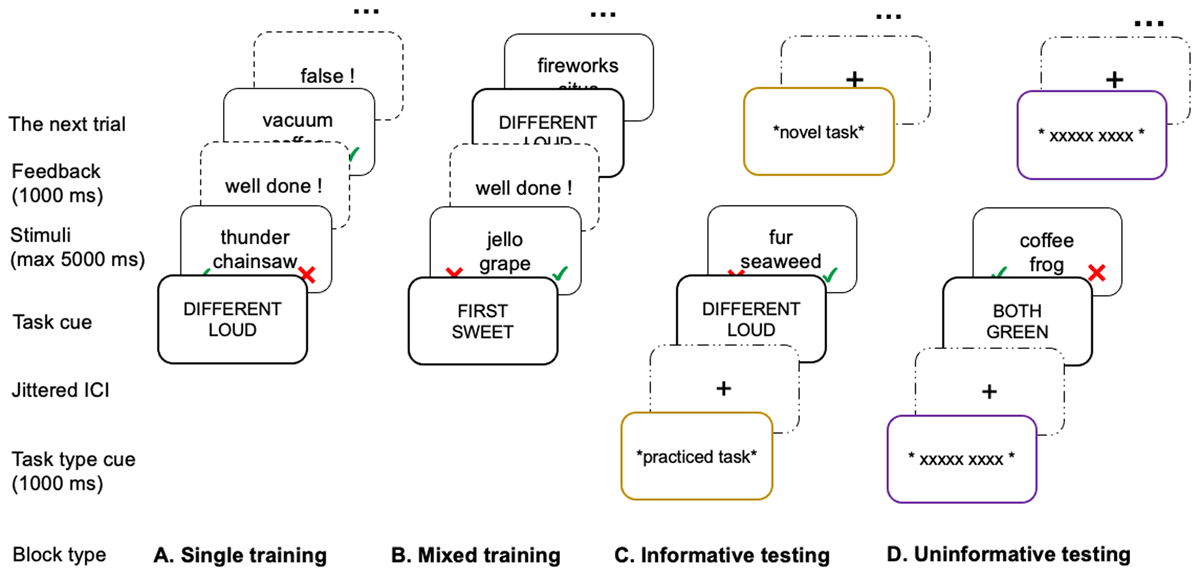
Figure 1
A schematic illustration of the SPRO paradigm.
Note. The SPRO paradigm was used in both Experiment 1 and 2. Six out of thirty-six tasks were selected to be the practiced tasks that participants were trained on, during both A. single training and B. mixed training blocks. After the training session, the test session included C. informative blocks, in which the task type cue was provided at the beginning of each trial, specifying the incoming task being either practiced or novel, and D. uninformative blocks where the task type cue was replaced by an uninformative cue, which served as the control condition in order to examine the effect of task type cue. The two differences between Experiment 2 and Experiment 1 can be summarized as follows: First, the task cue was self-paced in Experiment 1, but had a fixed duration of 1000 ms in Experiment 2. Second, the response mapping of Experiment 1 varied across trials (see the red “cross” and green “tick” in the figure), but was fixed across trials for each participant in Experiment 2.
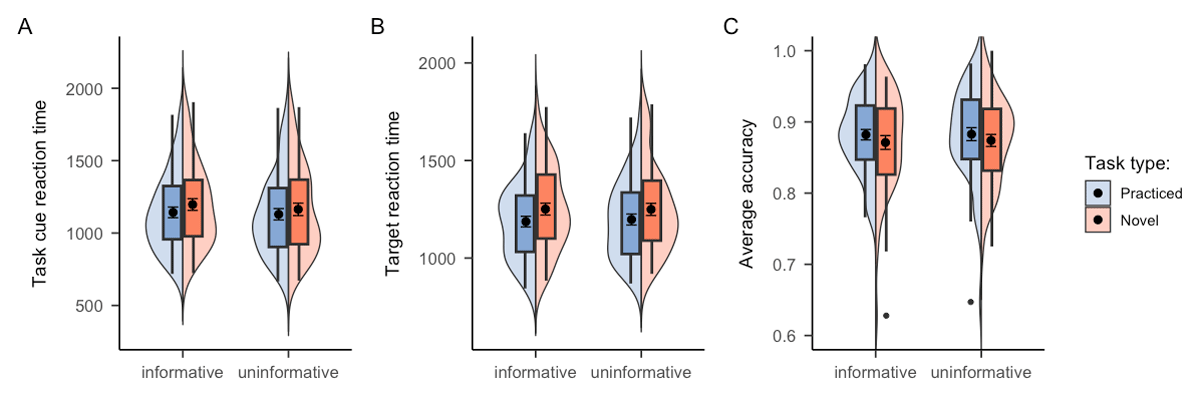
Figure 2
Mean RTs and accuracy of Experiment 1 as a function of cue informativeness and task novelty.
Note. The results of Experiment 1 for A. task cue RT, B. target RT, and C. target accuracy, respectively. The black points within the box plots denote the mean, and the error bar denote standard errors.
Table 1
The cell means and standard errors of RT and accuracy data in Experiment 1 as a function of cue informativeness and task novelty.
| MEASURES | INFORMATIVE | UNINFORMATIVE | ||||||
|---|---|---|---|---|---|---|---|---|
| PRACTICED | NOVEL | PRACTICED | NOVEL | |||||
| M | SD | M | SD | M | SD | M | SD | |
| Task cue RT | 1,142.61 | 263.86 | 1,196.95 | 288.46 | 1,129.62 | 280.08 | 1,163.62 | 308.05 |
| Target RT | 1,186.86 | 195.68 | 1,250.99 | 217.78 | 1,197.55 | 201.00 | 1,249.48 | 223.00 |
| Accuracy | 0.88 | 0.05 | 0.87 | 0.07 | 0.88 | 0.07 | 0.87 | 0.06 |
[i] Note. RT = reaction time; M = mean; SD = standard deviation.
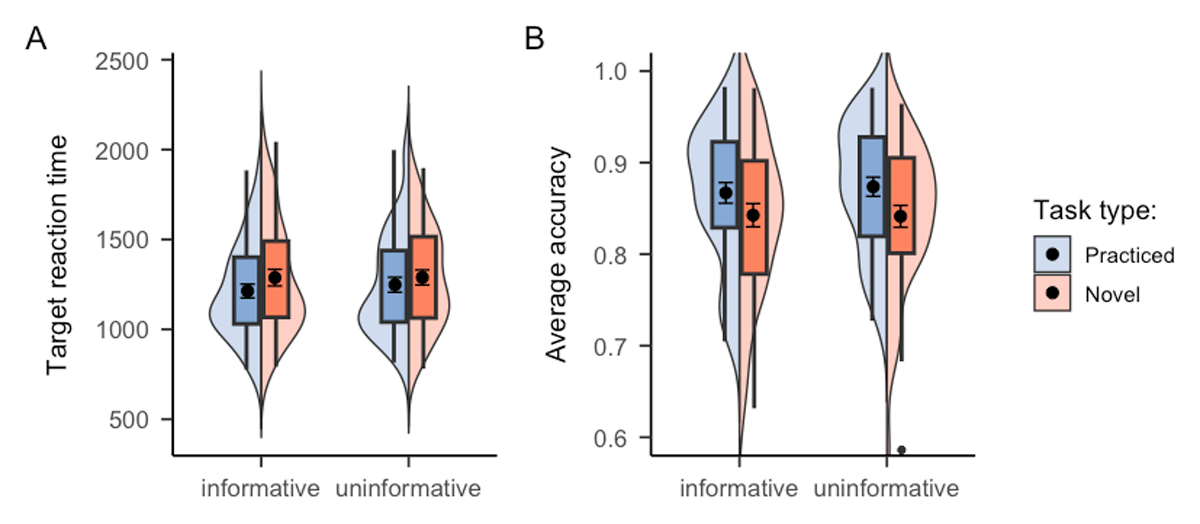
Figure 3
Mean RTs and accuracy of Experiment 2 as a function of cue informativeness and task novelty.
Note. The black points within the box plots denote the mean, and the error bar denote standard errors.
Table 2
The cell means and standard errors of RT and accuracy data in Experiment 2 as a function of cue informativeness and task novelty.
| MEASURES | INFORMATIVE | UNINFORMATIVE | ||||||
|---|---|---|---|---|---|---|---|---|
| PRACTICED | NOVEL | PRACTICED | NOVEL | |||||
| M | SD | M | SD | M | SD | M | SD | |
| Target RT | 1,213.16 | 260.66 | 1,287.68 | 313.04 | 1,248.13 | 282.01 | 1,288.69 | 284.01 |
| Accuracy | 0.87 | 0.08 | 0.84 | 0.09 | 0.87 | 0.07 | 0.84 | 0.08 |
[i] Note. RT = reaction time; M = mean; SD = standard deviation.
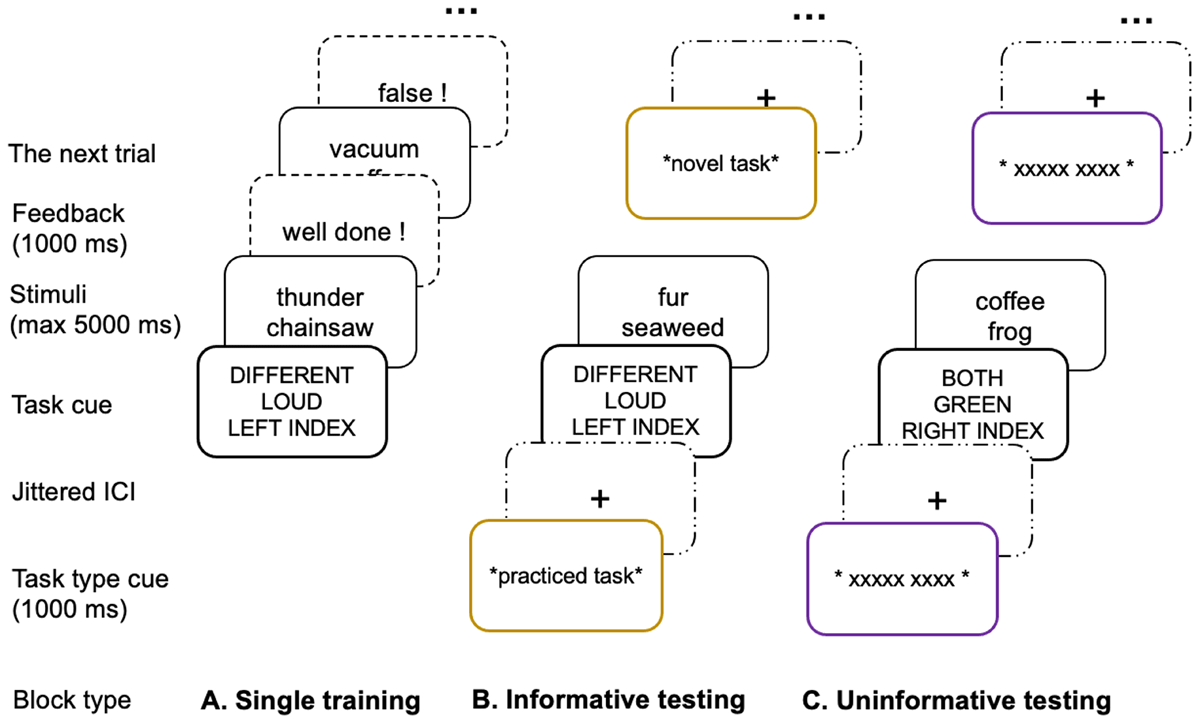
Figure 4
A schematic illustration of the PRO paradigm.
Note. The PRO paradigm was used in both Experiment 3 and 4. The PRO paradigm included 64 tasks in total, 4 of which were selected to be the practiced tasks that participants went through training in the A. single training session. Following the training session, the test session consisted of two types of blocks: B. informative blocks, in which a task type cue was presented at the beginning of each trial, indicating whether the task was one of the practiced tasks or a novel task, and C. uninformative blocks, where the task type cue was replaced by an uninformative cue. This uninformative cue served as a control condition to investigate the impact of the task type cue. Experiment 4 had the exact same design as Experiment 3.
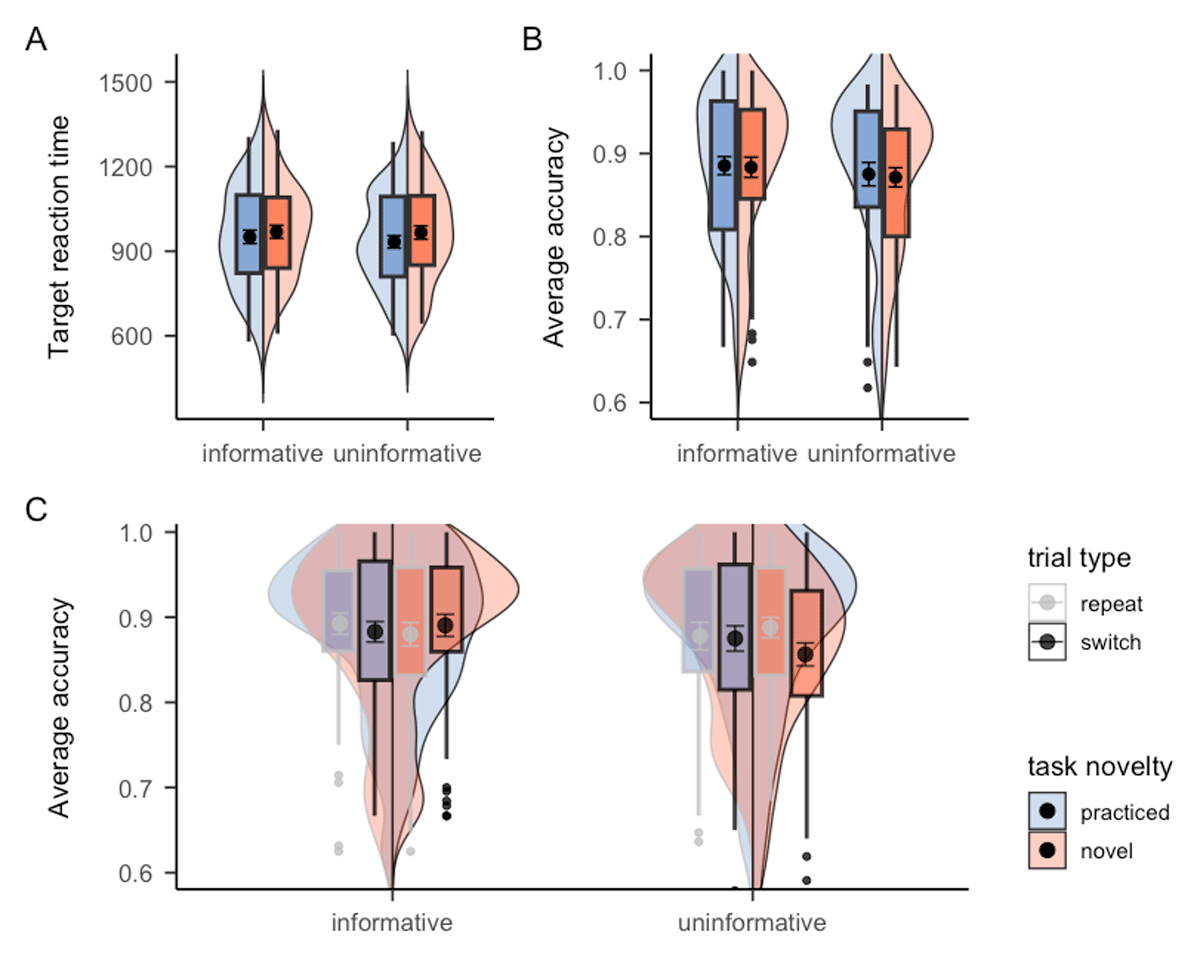
Figure 5
Mean RTs and accuracy of Experiment 3 as a function of cue informativeness, task novelty, and trial type.
Note. The results for Experiment 3 in A. target reaction time and B. accuracy without considering the effect of trial type sequence. In C. accuracy is presented separately depending on the trial type sequence being either a repeat or switch trial in terms of task novelty. The black points within the box plots denote the mean, and the error bars denote standard errors.
Table 3
The cell means and standard errors of RT and accuracy data in Experiment 3 as a function of cue informativeness and task novelty.
| MEASURES | INFORMATIVE | UNINFORMATIVE | ||||||
|---|---|---|---|---|---|---|---|---|
| PRACTICED | NOVEL | PRACTICED | NOVEL | |||||
| M | SD | M | SD | M | SD | M | SD | |
| Target RT | 950.74 | 178.73 | 968.71 | 173.47 | 932.97 | 165.07 | 965.99 | 177.83 |
| Accuracy | 0.88 | 0.08 | 0.88 | 0.09 | 0.88 | 0.11 | 0.87 | 0.09 |
[i] Note. RT = reaction time; M = mean; SD = standard error.
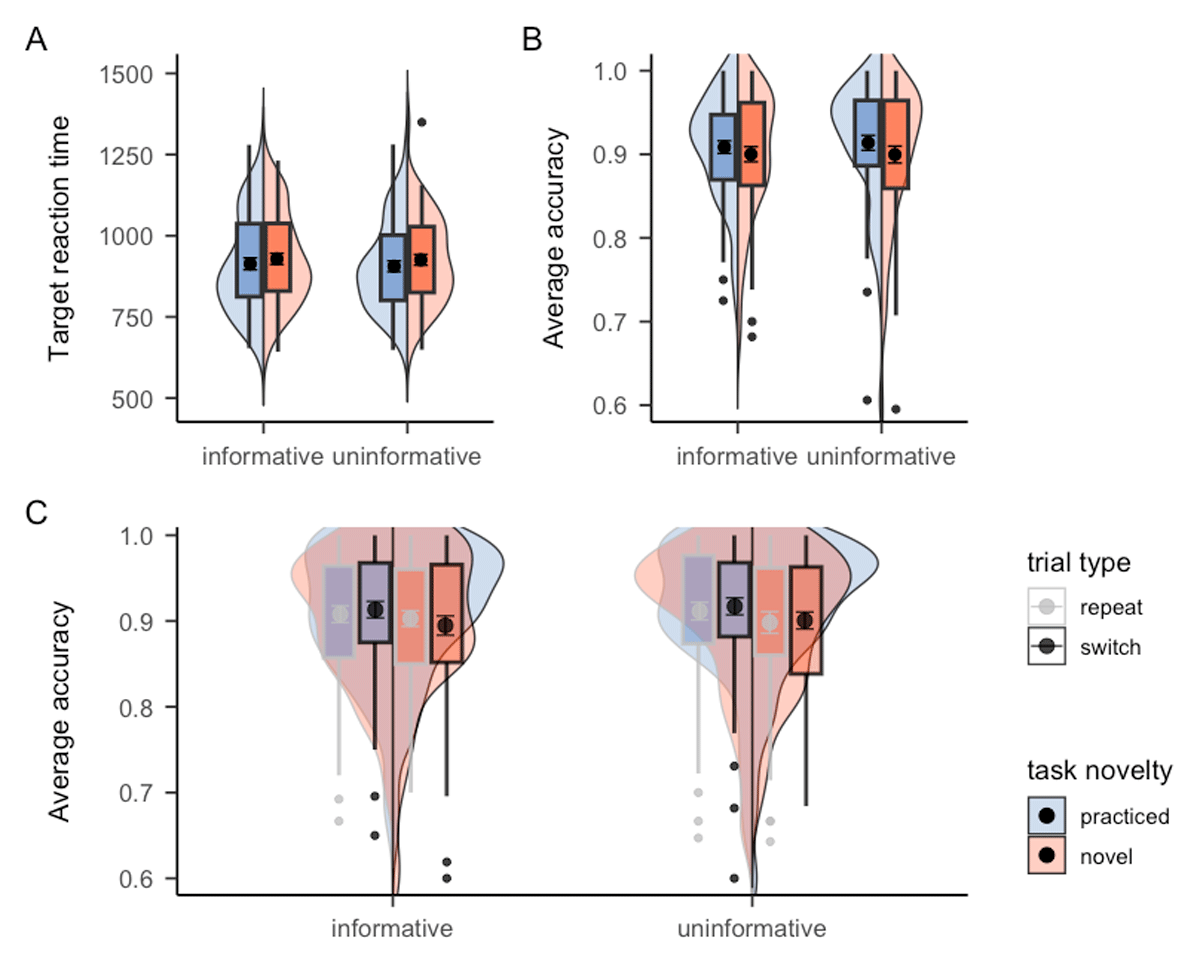
Figure 6
Mean RTs and accuracy of Experiment 4 as a function of cue informativeness, task novelty, and trial type.
Note. The results of A. target reaction time and B. accuracy rate do not distinguish the trial type sequence, whereas the result of C. accuracy rate is presented separately depending on the trial type sequence being either a repeat or switch trial. The black points within the box plots denote the mean, and the error bar denote standard errors.
Table 4
The cell means and standard errors of RT and accuracy data in Experiment 4 as a function of cue informativeness and task novelty.
| MEASURES | INFORMATIVE | UNINFORMATIVE | ||||||
|---|---|---|---|---|---|---|---|---|
| PRACTICED | NOVEL | PRACTICED | NOVEL | |||||
| M | SD | M | SD | M | SD | M | SD | |
| Target RT | 913.46 | 149.97 | 928.73 | 141.74 | 905.86 | 137.83 | 925.75 | 136.69 |
| Accuracy | 0.91 | 0.06 | 0.90 | 0.07 | 0.91 | 0.07 | 0.90 | 0.08 |
[i] Note. RT = reaction time; M = mean; SD = standard deviation.
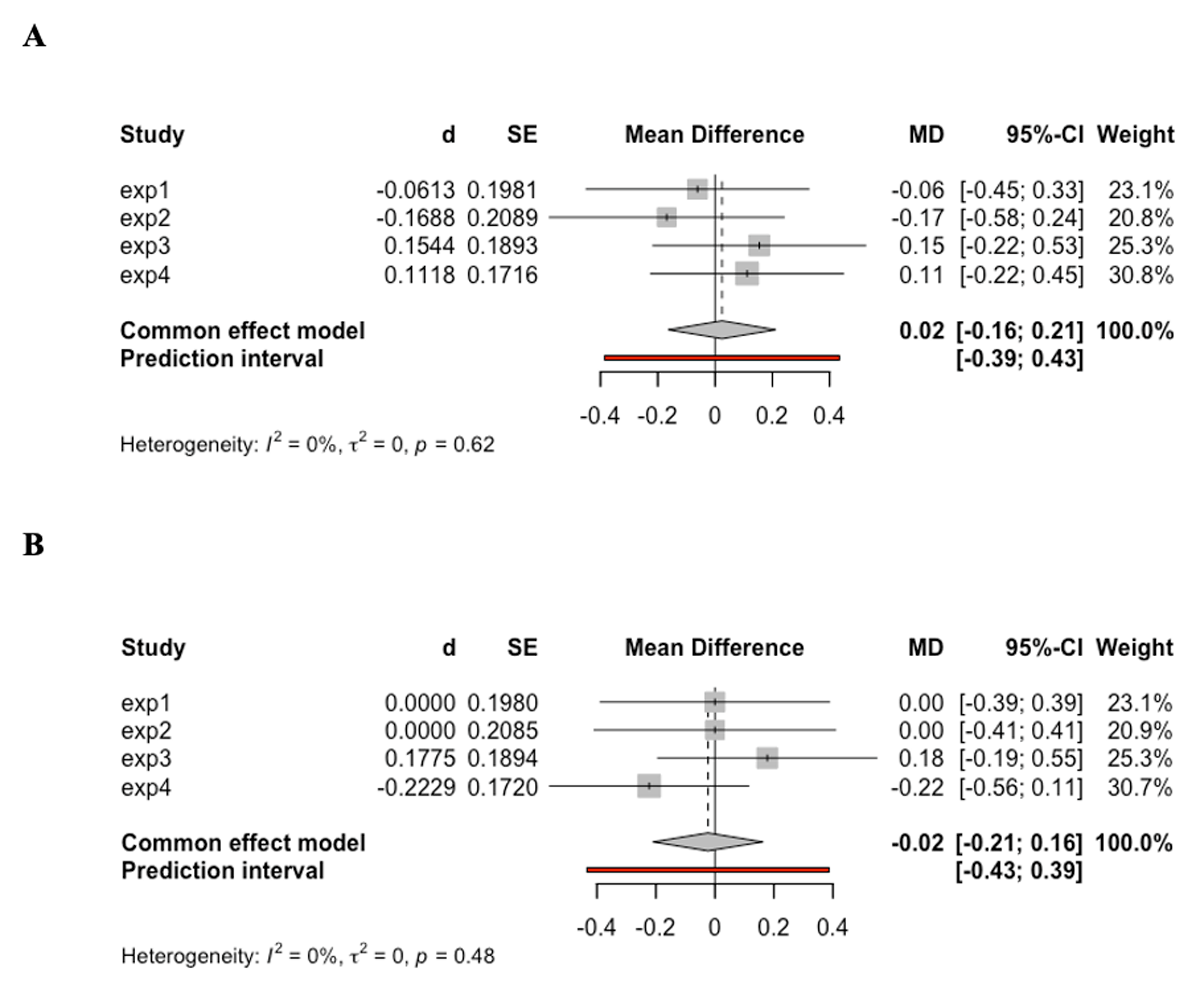
Figure 7
The results of meta-analysis regarding the main effect of task type cue in RT and accuracy across all experiments.
Note. A. Results for RT. Negative mean difference indicates faster RT in informative compared to non-informative blocks. B. Results for accuracy. Positive mean difference indicates higher accuracy in informative compared to non-informative blocks.
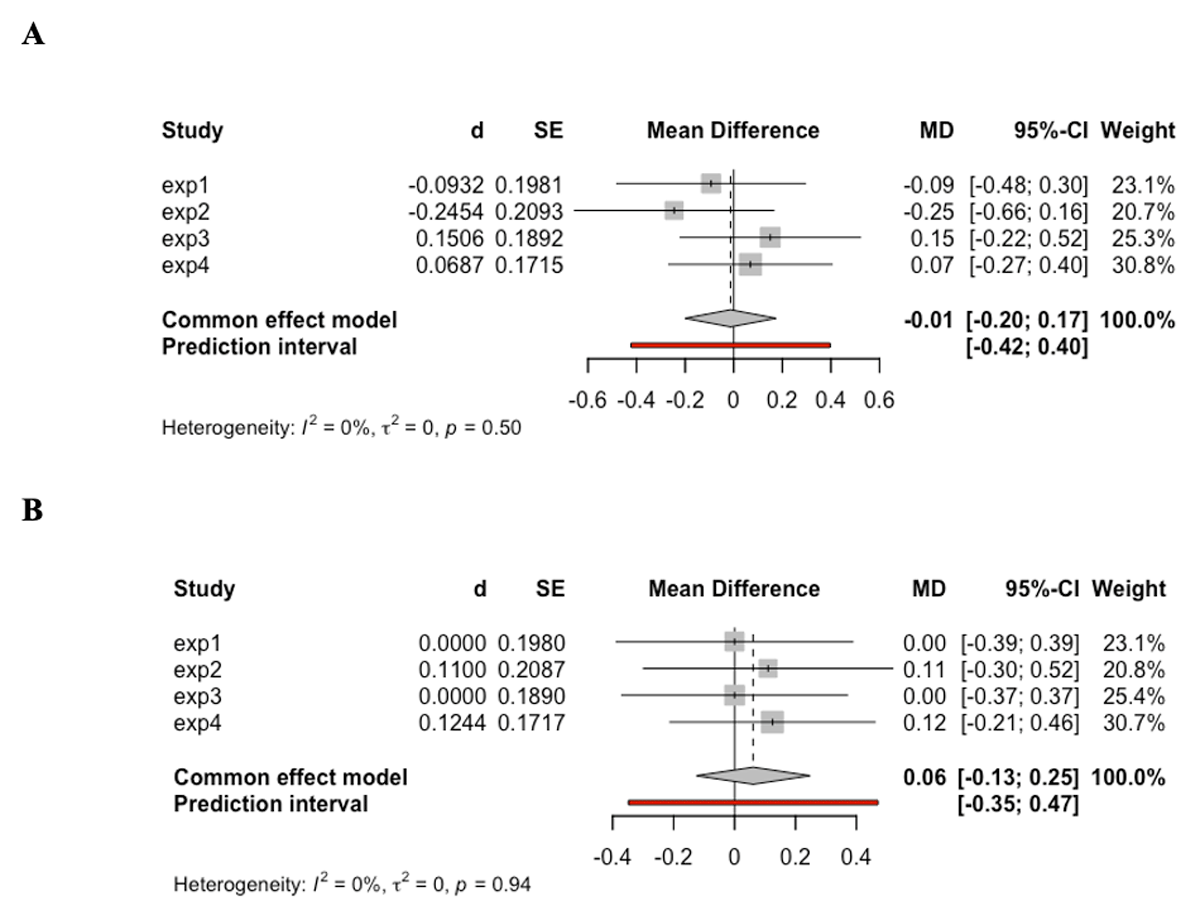
Figure 8
The results of meta-analysis regarding the interaction between cue informativeness and task novelty in RT and accuracy across all experiments.
Note. A. Results for RT. Positive mean difference indicates greater difference in RT between informative and non-informative blocks for novel tasks compared to practiced tasks. B. Results for accuracy. Positive mean difference indicates greater difference in accuracy between informative and non-informative blocks for novel tasks compared to practiced tasks.