
Figure 1
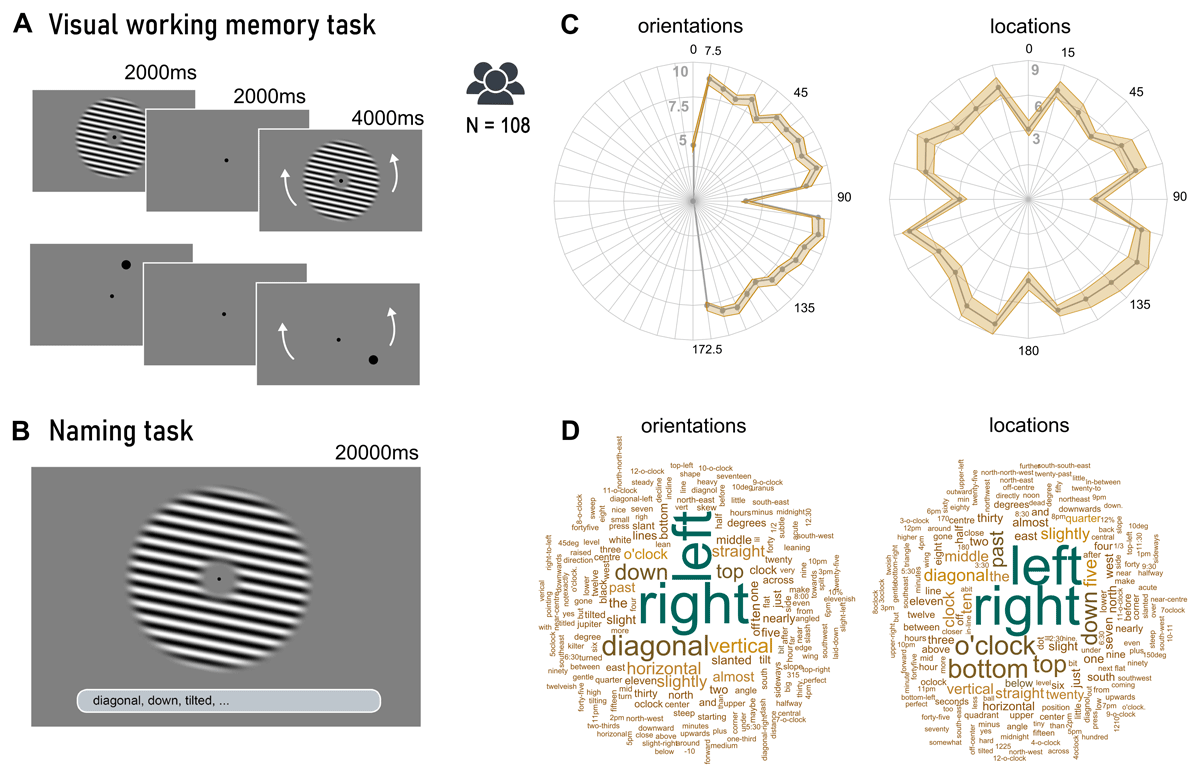
Delayed Estimation and Naming Tasks’ Design and Results.
Note. Delayed Estimation Task, Naming Task, and respective results. (A) Visual working memory paradigm. This was a delayed estimation task where participants were required to memorize the rotation of an orientation or location stimulus and reproduce it after a short delay by rotating a probe. (B) Naming task paradigm. Participants viewed either an orientation or location and were asked to input words that would describe the stimuli and help them memorize that specific stimulus. (C) Recall error for each stimulus in orientation and location trials. Distance from the center to the edge of the plot represents the average error for each stimulus. (D) Word clouds of participants’ answers to the naming task. The size of each word depicted is representative of how often it was employed during the task by the entire participant pool.
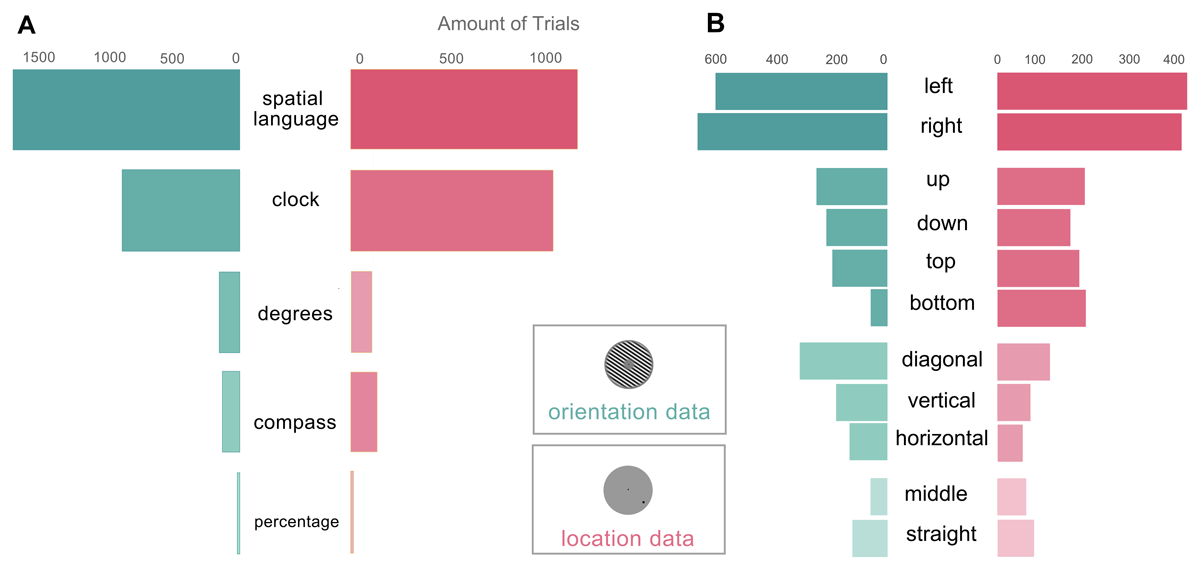
Figure 2
Main Labeling Strategies and Spatial Words Usage During the Naming Task.
Note. Usage of the main strategies and spatial words in the naming task, in both orientation and location stimuli. A Frequency of Label Use in orientation (in green) and location (pink) trials. Amount of total naming task trials with orientation stimuli in the entire participant pool in which words associated with each of the main strategies were employed. B Frequency of Spatial Language terms used in orientation trials (left) and location trials (right).
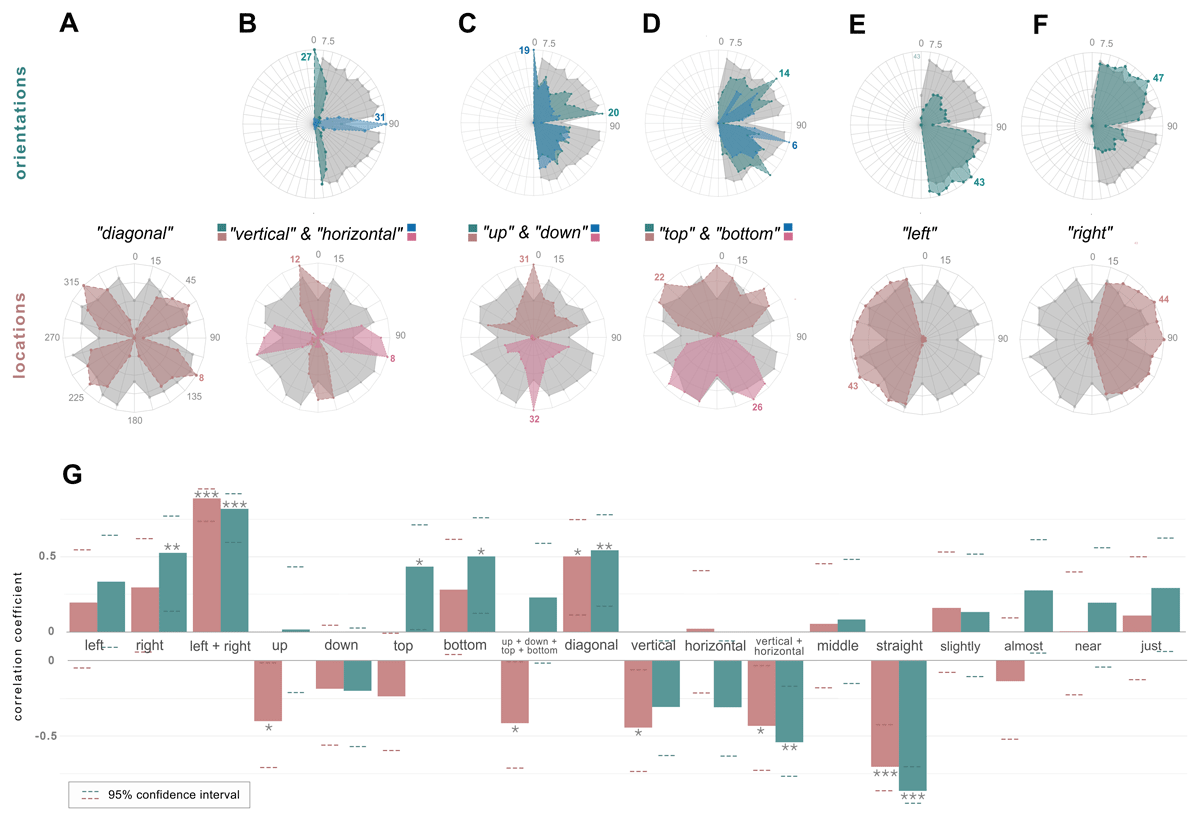
Figure 3
Spatial Language Words Usage During Naming Task and Correlation with Delayed Estimation Task Recall Error.
Note. Distribution of usage of spatial language words across the stimulus space and their correlation to recall error in delayed estimation task. (A) Use of the word ‘diagonal’ in orientation and location trials. The area shaded in color corresponds to the amount of times the word was used for a given stimulus, and the number with matching color indicates (in the stimulus in which it was used more frequently) the number of participants who employed it to describe that specific stimulus. The gray area indicates the average absolute recall error for each orientation stimulus. (B) Use of the words ‘vertical’ (green for orientations, dark pink for locations) and ‘horizontal’ (blue for orientations, light pink for locations) in orientation and location trials. (C) Use of the words ‘up’ (green for orientations, dark pink for locations) and ‘down’ (blue for orientations, light pink for locations) in orientation and location trials. (D) Use of the words ‘top’ (green for orientations, dark pink for locations) and ‘bottom’ (blue for orientations, light pink for locations) in orientation and location trials. (E) Use of the word ‘left’ in orientation and location trials. (F) Use of the word ‘right’ in orientation and location trials. (G) Correlations between recall error for orientations (green bars) and locations (pink bars) and the frequency of use of spatial words across stimuli. Upwards directed bars indicate positive correlations and downward directed bars indicate negative correlations.
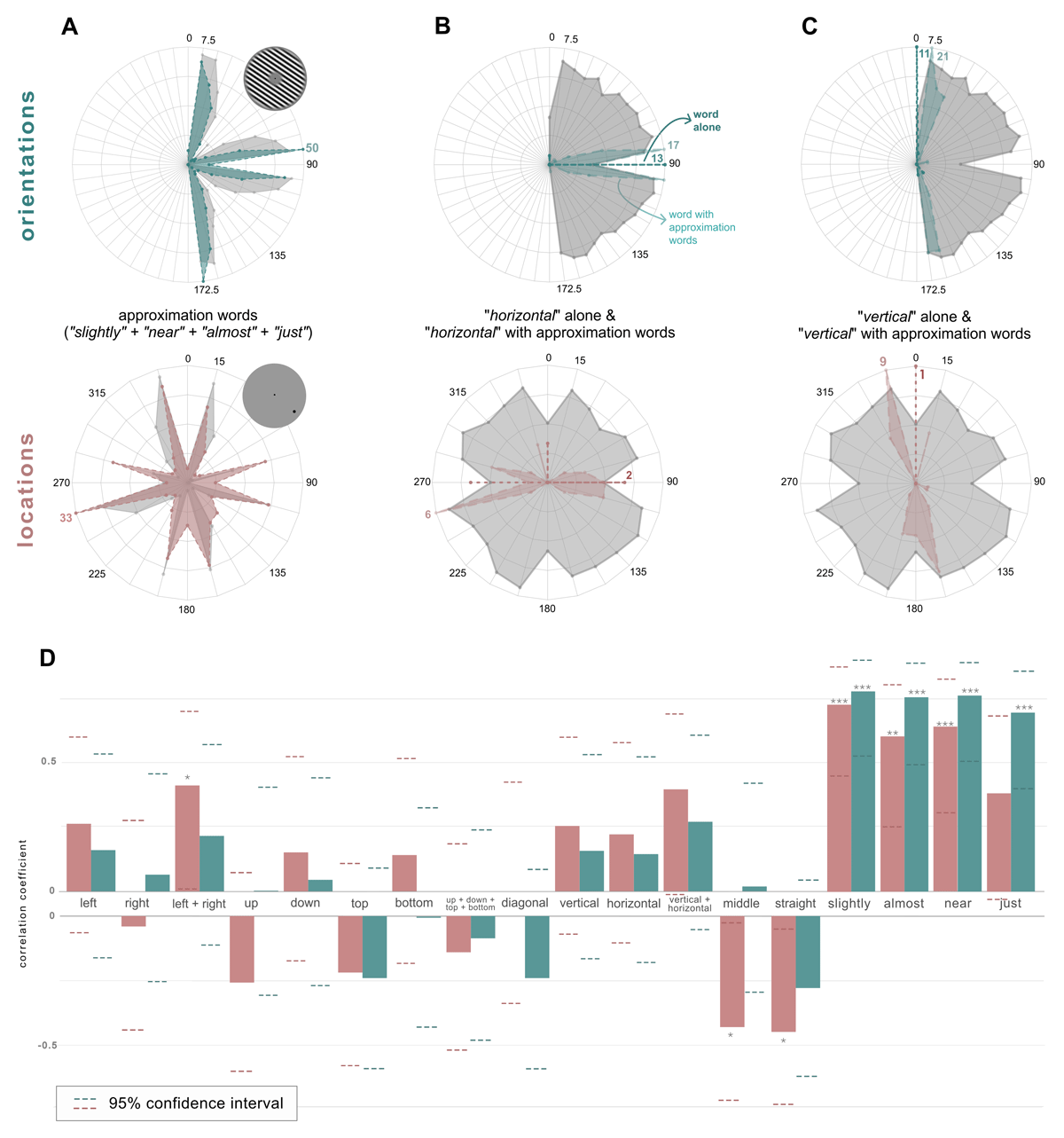
Figure 4
Approximation Words Usage During the Naming Task.
Note. Distribution of usage of approximation words across the stimulus space and their correlation to recall bias in delayed estimation task. (A) Frequency of approximation words use in orientation (upper figure) and location (lower figure) trials during the naming task. The shaded green area corresponds to the amount of times an approximation word was used for a given stimulus, and the number with matching color indicates (in the stimulus in which it was used more frequently) the number of participants who employed it to describe that specific stimulus. The gray area indicates the average recall bias for each stimulus. (B) Usage of the word ‘horizontal’ with and without approximation words in orientation (upper figure) and location (lower figure) trials during the naming task. The green or pink area indicates word use with approximation words, and the dashed line corresponds to use of the word on its own. The gray area indicates the average absolute recall error for each stimulus. (C) Usage of the word ‘vertical’ with and without approximation words in orientation (upper figure) and location (lower figure) trials during the naming task. The green or pink area indicates word use with approximation words, and the dashed line corresponds to use of the word on its own. The gray area indicates the average absolute recall error for each stimulus. (D) Correlations between recall bias for orientations (green bars) and locations (pink bars) and the frequency of use of spatial words across stimuli. Upwards directed bars indicate positive correlations and downward directed bars indicate negative correlations.
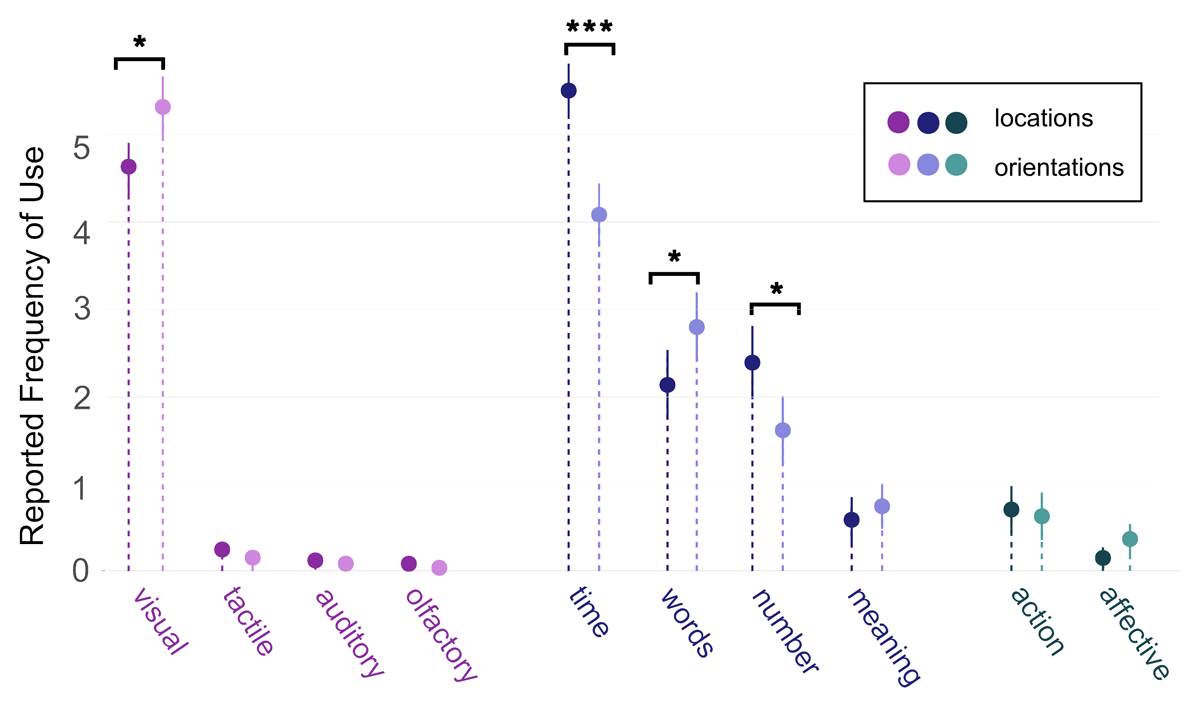
Figure 5
Self-reported Use of Encoding Strategies (in Post-experimental Questionnaire).
Note. Participants’ average rating in response to post-experimental questionnaire about memorization strategies of different modalities. Participants were asked if they used any of the strategies in the x axis in the post-experimental questionnaire (e.g. for ‘action’, the question was ‘I memorized the orientations/location during the delay period through a related action’), and were asked to rate how much they believed they relied on it during the task for orientation stimuli, and for location stimuli (see Appendix A).