
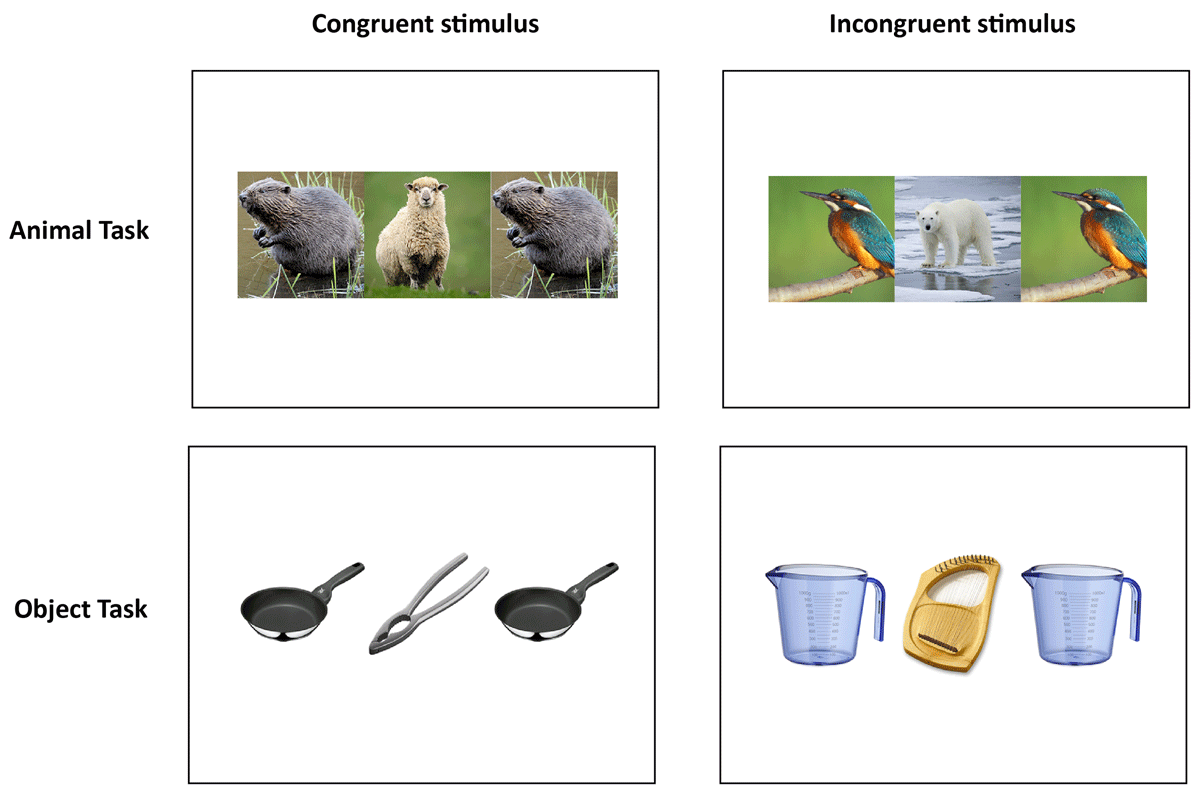
Figure 1
Left column: Congruent trial with a target and two flankers; all items derive from the same category. Right column: Incongruent trial, the target, and the flankers derive from different categories.
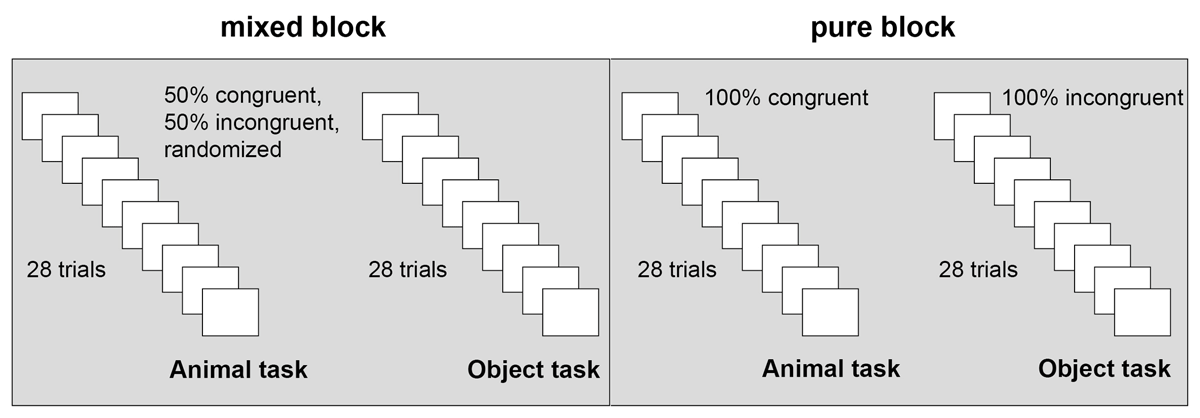
Figure 2
Experimental conditions.
Note: Task order (both blocks) and congruence of the tasks (pure block) were counterbalanced across participants. Congruence was manipulated within participants, the factor block was manipulated between the participants.
Table 1
Means and standard deviations (in brackets) for hit rates of flankers and targets, separately for each condition, and for both experiments.
| MEANS (STANDARD DEVIATION) | |||||
|---|---|---|---|---|---|
| PURE | MIXED | ||||
| CONGRUENT | INCONGRUENT | CONGRUENT | INCONGRUENT | ||
| Experiment 1 | Flanker | .263 (.172) | .235 (.138) | .224 (.124) | .258 (.139) |
| Target | .636 (.213) | .682 (.192) | .675 (.214) | .683 (.215) | |
| Experiment 2 | Flanker | .252 (.145) | .236 (.139) | .200 (.121) | .245 (.140) |
| Target | .697 (.177) | .730 (.174) | .662 (.198) | .665 (.188) | |
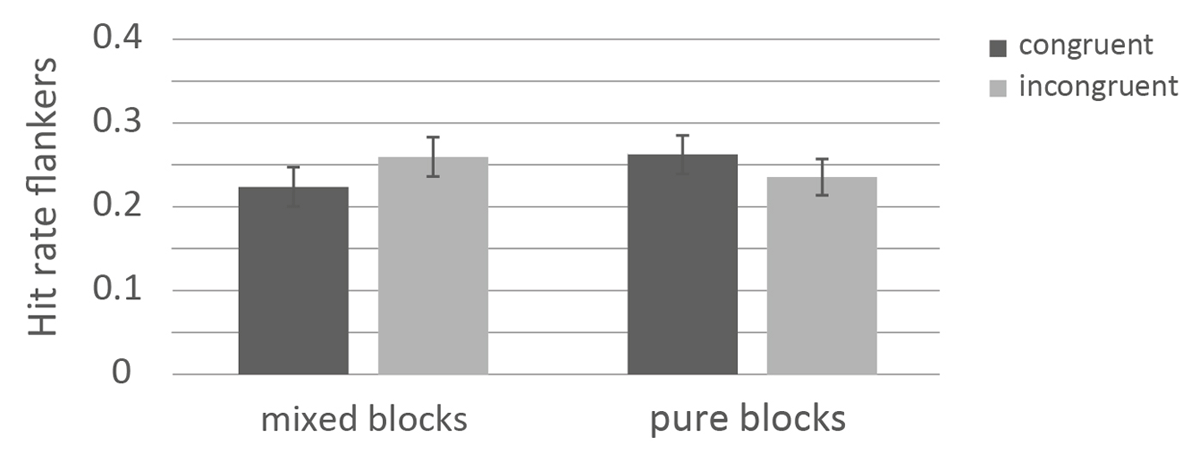
Figure 3
Memory performance for flankers as a function of response-category conflict and control mode.
Note: The error bars represent standard errors.
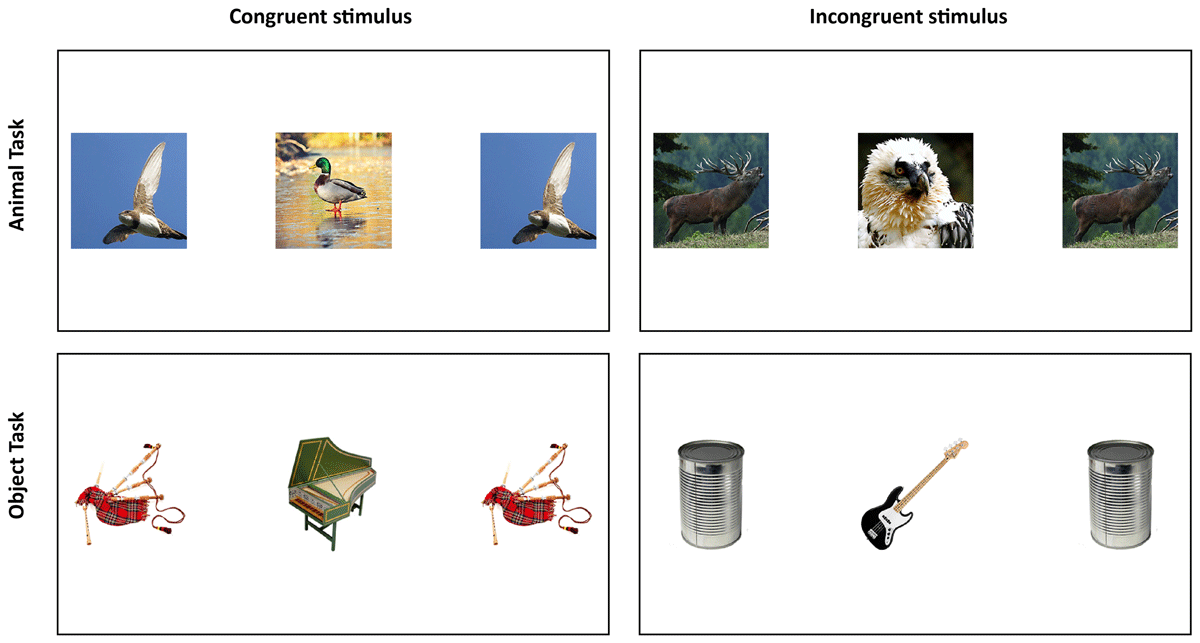
Figure 4
Left column: Congruent trial with a target and two flankers; all items derive from the same category. Right column: Incongruent trial, the target, and the flankers derive from different categories.
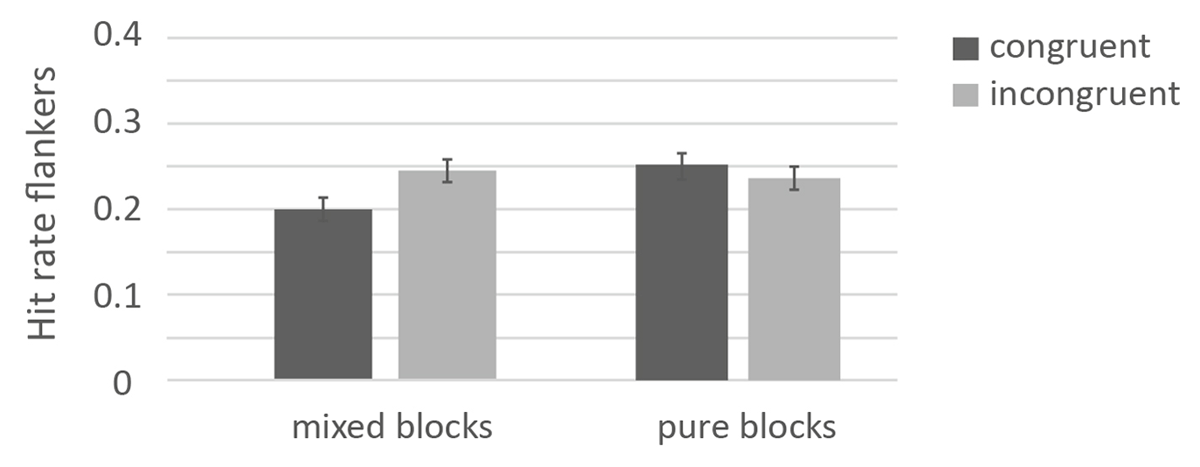
Figure 5
Memory Performance for the flankers as a function of response-category conflict and control mode in Experiment 2.
Note: The error bars represent the standard errors.