
Table 1
Sample size, average age, and gender for each study. “Included N” indicates the final number of subjects analyzed in each experiment; brackets indicate the number of additional excluded subjects not included in the analysis. Average age is shown in the age column; brackets indicate standard deviation. Gender: F = female, M = male, O = non-binary or other. The final row shows the total counts for N, trials, and gender, and the overall average for age. Note, raw data for excluded subjects are still available in the OSF repository.
| EXPERIMENT | INCLUDED N [EXCLUDED N] | TRIALS/PARTICIPANT | AGE [SD] | GENDER |
|---|---|---|---|---|
| 1a | 24 [0] | 1600 | 20.3 [1.8] | F – 18, M – 6, O – 0 |
| 1b | 24 [2] | 1600 | 20.7 [2.1] | F – 17, M – 7, O – 0 |
| 1c | 24 [0] | 1600 | 20.3 [1.7] | F – 16, M – 7, O – 1 |
| 1d | 24 [2] | 1600 | 19.9 [1.9] | F – 16, M – 7, O – 1 |
| 2a | 24 [0] | 640 | 20.3 [2.2] | F – 14, M – 10, O – 0 |
| 2b | 22 [0] | 640 | 20.0 [1.3] | F – 16, M – 6, O – 0 |
| 3a | 24 [1] | 576 | 21.5 [3.0] | F – 16, M – 8, O – 0 |
| 3b | 24 [9] | 576 | 19.8 [1.5] | F – 21, M – 3, O – 0 |
| OVERALL | 190 [14] | 210,688 | 20.3 [2.0] | F – 134, M – 54, O – 2 |
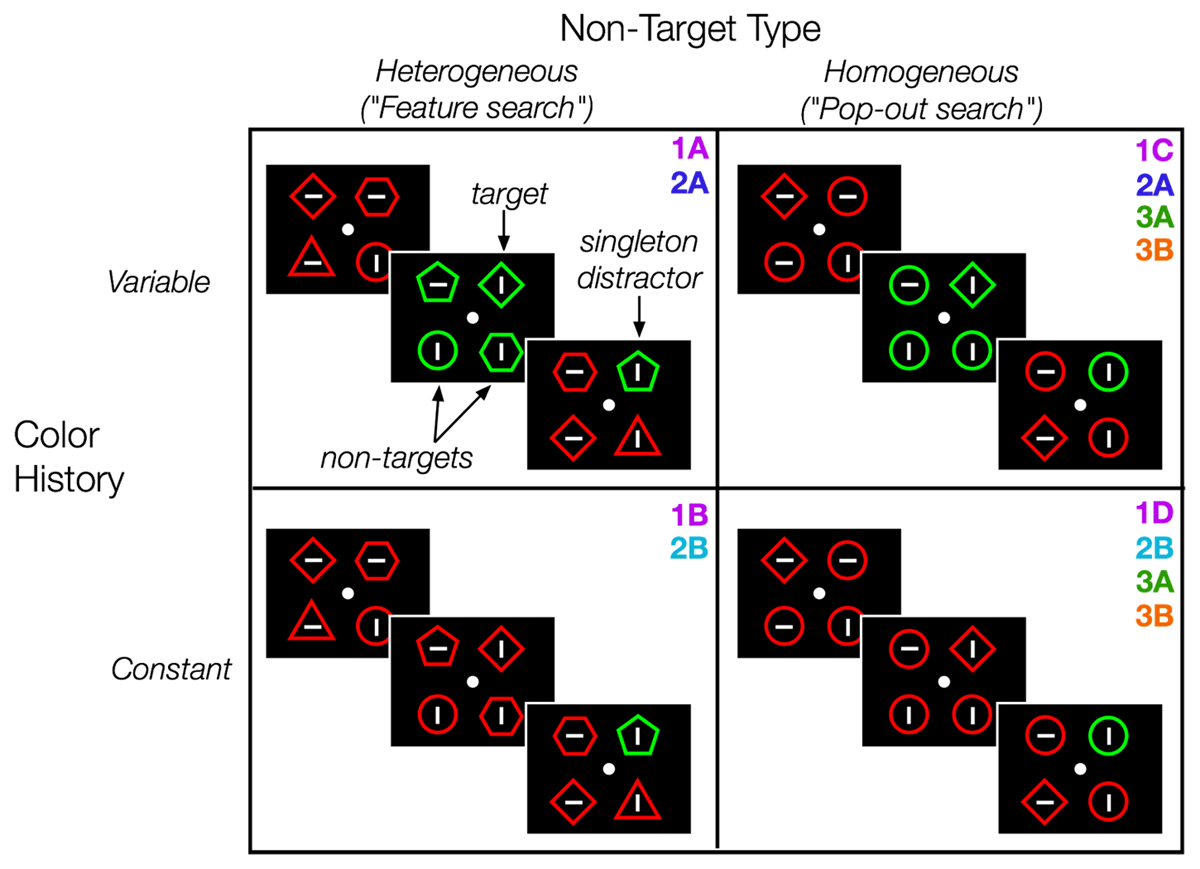
Figure 1
Schematic of the task conditions. On each trial of the task, participants searched for the target (diamond shape) and reported the orientation of the line inside (horizontal or vertical). After a blank inter-trial interval, the next search display appeared. Non-target shapes could be heterogeneous (assorted shapes) or homogeneous (all circles). The display colors could vary randomly from trial to trial (color variable) or stay constant within the entire block (color constant). The four conditions in this figure were collected across-subjects in Experiments 1a–1d. The conditions in the top row (Exp 2A) and bottom row (Exp 2B) were collected within-subjects in Experiment 2. The conditions in the right column were collected within-subjects in Experiment 3A and 3B.
Table 2
Overview of experiments. This table provides an overview of the differences between the experiments. Set Sizes refers to the number of items in the search array (3–6 intermixed, or only set size 4). Colors refers to whether the colors of the target and distractor were fixed across all trials (“color constant”) or randomly swapped from trial to trial (“color variable”). In experiments where both color conditions were included, the column Color Condition Balancing indicates whether the condition switched every other block of trials (“interleaved”) or if the conditions were grouped into the first and second halves of the experiment (“grouped”). The column Non-Target Type indicates whether the non-target shapes were heterogeneous (mixture of circles, triangles, and pentagons) or homogeneous (all circles). The column Timing indicates whether the study used typical behavioral timing (~1 second between trials) or longer timing (2–8 seconds between trials). Finally, the Distractor Present column indicates the proportion of trials where a singleton color distractor was present (50% or 75%). Between-subjects factors of interest are bolded for each experiment (e.g., the color and non-target shapes varied across sub-experiments 1A–D).
| EXPERIMENT | SET SIZES | COLOR HISTORY | COLOR CONDITION BALANCING | NON-TARGET TYPE | TIMING | DISTRACTOR PRESENT |
|---|---|---|---|---|---|---|
| 1a | 3,4,5,6 | Variable | – | Heterogeneous | Short | 50% |
| 1b | 3,4,5,6 | Constant | – | Heterogeneous | Short | 50% |
| 1c | 3,4,5,6 | Variable | – | Homogeneous | Short | 50% |
| 1d | 3,4,5,6 | Constant | – | Homogeneous | Short | 50% |
| 2a | 4 | Variable | – | Heterogeneous & Homogeneous | Long | 50% |
| 2b | 4 | Constant | – | Heterogeneous & Homogeneous | Long | 50% |
| 3a | 4 | Variable & Constant | Interleaved | Homogeneous | Long | 75% |
| 3b | 4 | Variable & Constant | Grouped | Homogeneous | Long | 75% |
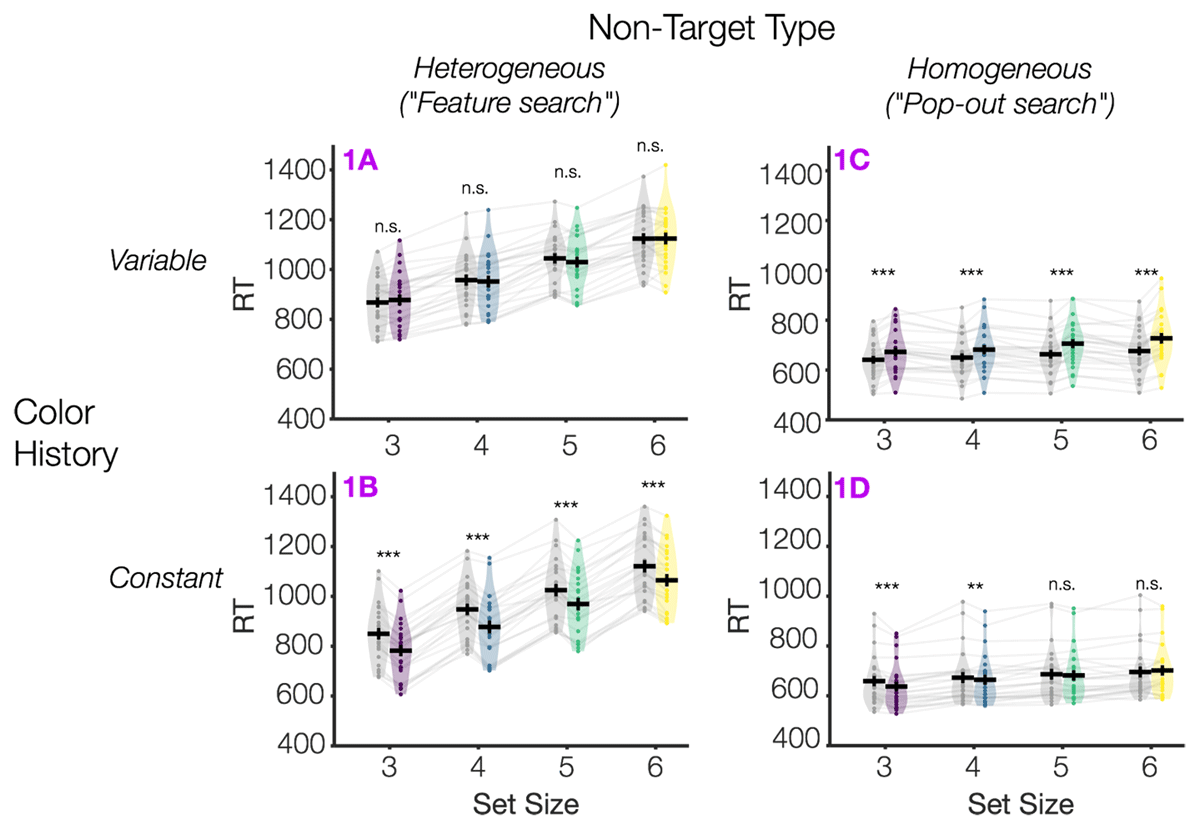
Figure 2
Response times as a function of condition in Experiment 1. We observed expected signatures of a singleton-detection strategy (homogeneous non-target shapes) versus feature search strategy (heterogeneous non-target shapes), and both singleton-detection and feature search were modulated by stimulus history (color constant vs. variable). Gray violins indicate “distractor absent” trials; colored violins indicate “distractor present” trials. Individual participants are shown as dots and transparent gray lines. Each subplot shows the response time data from a sub-experiment (1A–1D). Asterisks indicate uncorrected post-hoc comparisons between each adjacent pair of violins (distractor present vs. absent), n.s. p ≥ .05, ** p < .01, *** p <.001.
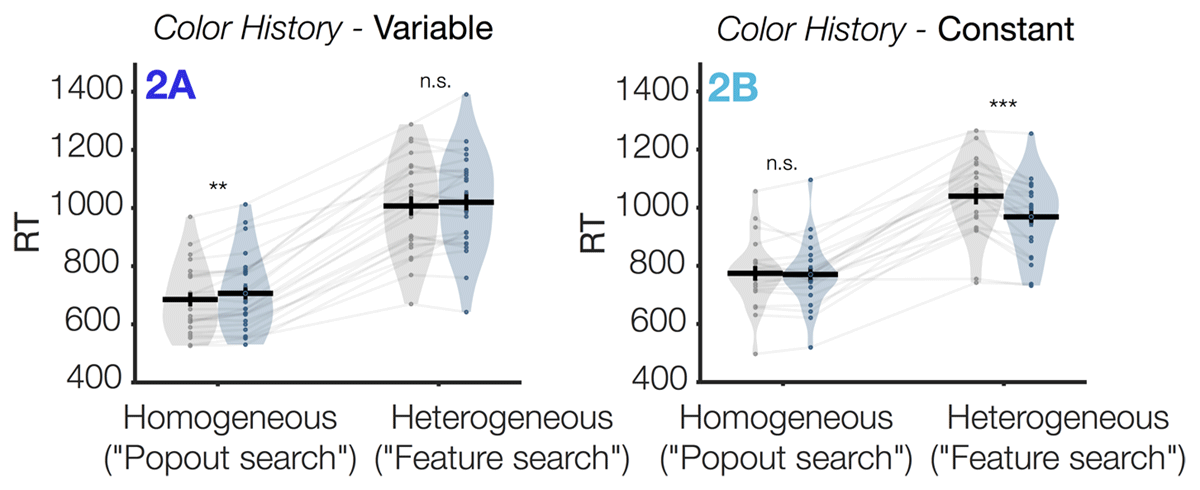
Figure 3
Response times as a function of condition in Experiment 2. Key visual search effects were preserved when a longer inter-trial interval was used (2–8 sec). Each subplot shows the response time data from a sub-experiment In Experiment 2, all displays were set size 4. Gray violins indicate “distractor absent” trials; colored violins indicate “distractor present” trials. Individual participants are shown as dots and transparent gray lines. Asterisks indicate uncorrected post-hoc comparisons between each adjacent set of bars, n.s. p ≥ .05, ** p < .01, *** p < .001.
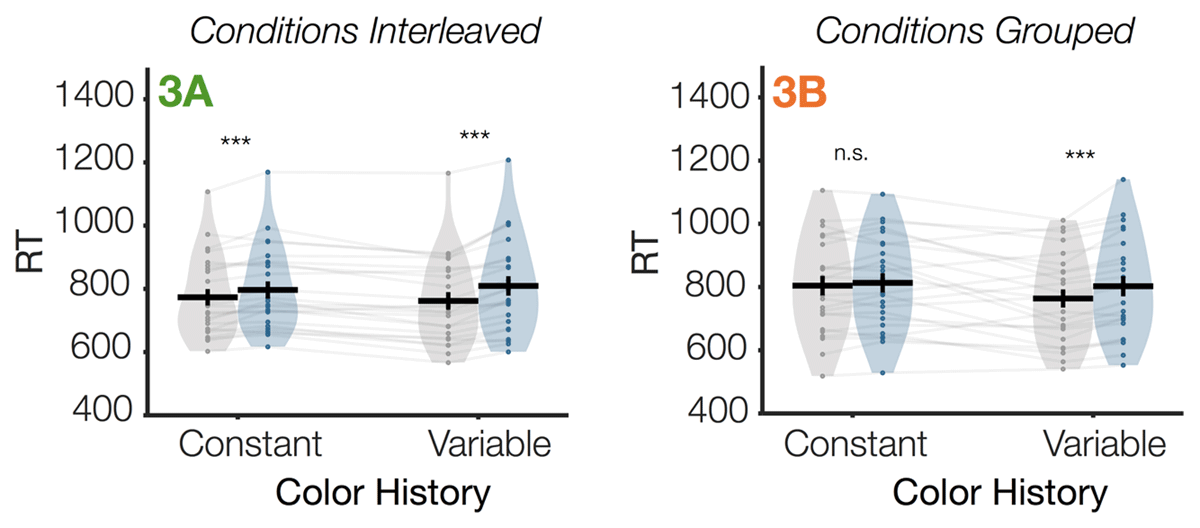
Figure 4
Response times as a function of condition in Experiment 3. When participants are in singleton-detection mode, attentional capture by a salient distractor is attenuated when colors are repeated (Color Constant) compared to when colors randomly vary (Color Variable). This general pattern did not differ as a function of interleaving (3A) versus grouping (3B) blocks of the two stimulus history conditions. In Experiment 3, all displays were set size 4 and non-target items were always homogeneous (singleton-detection mode). Gray violins indicate “distractor absent” trials; colored violins indicate “distractor present” trials. Individual participants are shown as dots and transparent gray lines. Asterisks indicate uncorrected post-hoc comparisons between each adjacent set of bars, n.s. p ≥ .05, **p < .01, ***p < .001.