
(1) Overview
Context
Ten iconic anthropomorphic objects from the Viking Age collections of the National History Museum in Sweden were selected for microwear and Reflectance Transformation Imaging analyses. These miniature metal artefacts have seen significant scholarly attention with regard to their symbolism and identification with Norse deities and beings, largely connected to questions of Viking mythology and religion [e.g. 345].
To complement and challenge previous research, the BODY-POLITICS project (ERC Starting Grant, 2021–2026) analysed these anthropomorphic figures made of silver and bronze to investigate any traces of attachment, use, and repairs on the objects, in order to elucidate human-object engagements [16]. In total, ten objects were subjected to low power microscopic wear analysis and RTI. The main focus of the study was to consider how processes associated with the manufacture, possible use, handling and re-use may have been imprinted on the surface of the artefacts.
Microwear analysis has frequently been applied to understand the manufacture, handling, use-wear, and post-depositional taphonomy of tools and ornaments [e.g. 7]. However, microwear analysis has only to a limited extent been applied to figural depictions and anthropomorphic ‘art’ [8]; and to our knowledge these methods have not been previously applied to Viking-Age artefacts such as those studied by the BODY-POLITICS project. Highlight Based Reflectance Transformation Imaging (RTI) capture and analyses, through raking light and alternative renderings of surfaces it enables, can be applied to determine details in object and material decoration, manufacturing processes, and post-manufacture interactions [e.g. 910]. RTI is now frequently deployed in studies of a wide range of archaeological artefacts and materials, including lithics, stone carvings, rock and tomb art [e.g. 91112], worked bone and antler objects and tools [e.g. 1314] clay and terracotta objects [e.g. 1516], ceramics, bricks, soil [17], textiles [18], clay pipes, glass, coins, and other metallic objects [e.g. 1019 and refs therein]. However, to our knowledge, and as with microwear analysis, RTI has not been applied to anthropomorphic artefacts from Viking Age contexts (although we are aware of its application to later, Norse runes in Ireland [12]).
Further contextual information of the individual artefacts can be found in the .docx file (SMO4). The .docx file also includes a discussion of the detailed analytical results for each artefact, indicating a variety of usage and engagement with the dataset including multi phased-decoration; intentional breakage through active percussion; roundedness and heavier wear in some objects, and little to no trace of suspension or wear in others. Overall, we found substantial variation in object use-life and a significant variability in how artefacts were used, touched, displayed or concealed [1] (Figures 1 and 2).
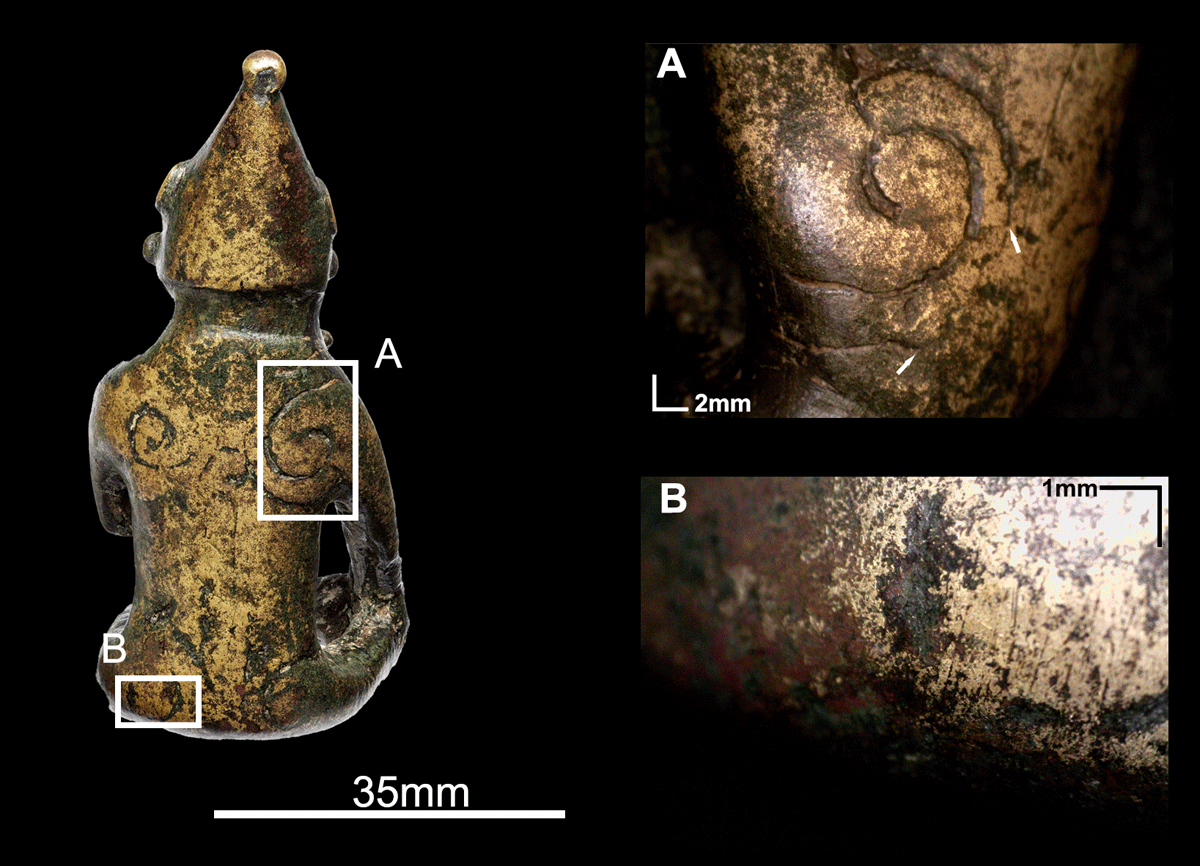
Figure 1
Microwear traces on the Rällinge figurine: A) incomplete spiral groove on the upper back; B) single curved line on the lower back (figure by C. Tsoraki; Rällinge photograph by O. Myrin, Swedish Historical Museums, CC BY 4.0).
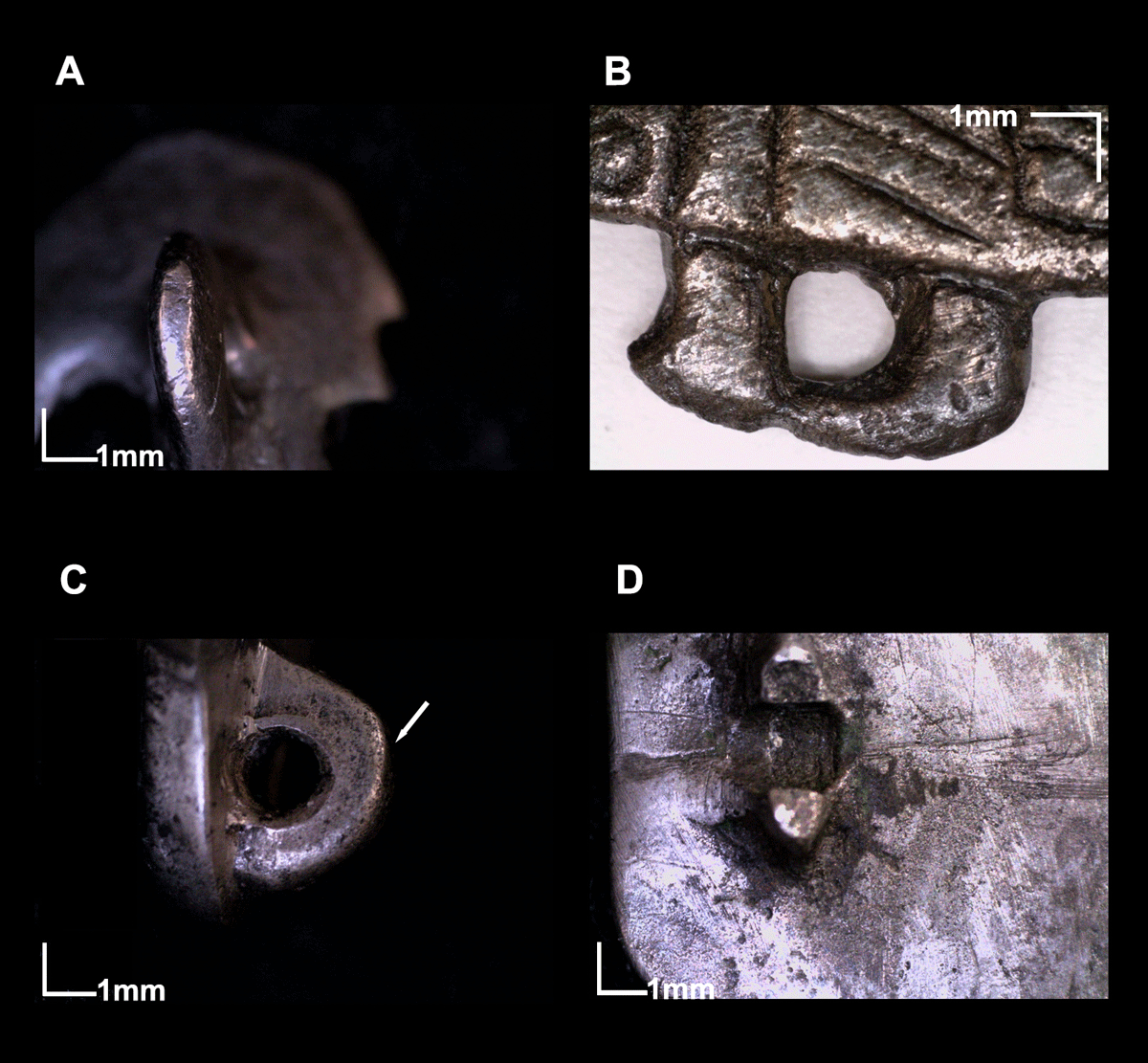
Figure 2
Micrographs showing examples of attachment devices: A) back loop, ‘Valkyrie’ d Klinta; B) loop formed by the feet, Valkyrie’ a Birka I; C) back loop, Klahammar anthropomorphic figurine; D) broken back loop and striations within the loop, ‘Valkyrie’ e Sibble: (figure by C. Tsoraki).
Spatial coverage
Description: All objects were analysed in the collections in the Swedish Historical Museums, Sweden, Stockholm. However, the objects themselves have been found across southern Sweden from the 19th century onwards (Figure 1). For details on the contextual and temporal information of each object, see the contextualizing .docx file in the dataset (SMO4).
Northern boundary: 59.33491424453813 N
Eastern boundary: 18.09099368463755 E
Temporal coverage
The ten analysed artefacts have all been dated to the Viking Age (750–1050 CE). However, as the bronze and silver artefacts are mostly antiquarian finds, and have not been dated directly, the dating is based on relative, contextual, and iconographic dating. For details on the contextual and temporal information of each object, see the contextualizing .docx file (SMO4) in the dataset.
(2) Methods
Steps
Microwear analysis
Microwear analysis is a technique that studies macro- and microscopic modifications on the surface of objects resulting from manufacture, handling, use, and post-depositional processes [e.g. 7].
Objects were subjected to low power microscopic wear analysis (up to 50x magnification) using a stereomicroscope (Nikon Nissho Optical) and analysed by C. Tsoraki (CT). Intentionally, at this stage CT was not provided with any extensive information on previous interpretations on function and use of the artefacts.
Recorded wear traces include linear features (striations, troughs), surface modifications (percussive traces, abraded areas), and deformation of perforation rims (facets, edge rounding).
Micrographs to document wear traces were taken using a Dino-Lite Universal Digital Microscope and DinoCapture 2.0 software by CT. CT created figures to present the microwear traces using the Adobe Photoshop 2025 image editing software. Observed microwear patterns were compared to other studies, such as studies on wear development on ornaments [e.g. 202122232425].
A comparative and contextual study was then conducted by all authors, collating and comparing the wear traces and the RTI models across the selected artefacts, as well as considering the artefacts’ contexts, biographies and the broader literature, to facilitate interpretation.
Reflectance Transformation Imaging (RTI)
RTI captures surface topography through photography using an independent light source positioned at different angles and computational processing to reveal surface details at enhanced visibility, capturing three-dimensional reflectance properties of object surfaces [9]. Photograph images captured through this technique are processed to produce an interactive 2D image (RTI model), analyses of which can determine details in decoration, manufacturing process, and post-manufacture interaction.
RTI capture: 60–80 images per object were captured with a Nikon D850 DSLR camera by BM. We used a setup consisting of a heavy tripod and a Godox V860IIIN flashgun connected to the camera through remote flash triggers, black marbles, and a scale-card, following Cultural Heritage Imaging guidelines [26].
Image processing: Through using Adobe Photoshop 2024, RAW files were converted to JPEG file format format.
RTI model creation: Image files were processed and exported as RTI models by identifying light sources in the Open Access programme ReLight Lab 2024. Subsequently, RTI model files were opened and interpreted in Open Access RTI Viewer by BM and EA, primarily using the rendering mode ‘Specular Enhancement’.
A comparative and contextual study was then conducted by all authors, collating and comparing wear traces and the RTI models across the selected artefacts, as well as considering the artefacts’ contexts, biographies and the broader literature, to facilitate interpretation.
Sampling Strategy
The ten artefacts were selected on the following grounds:
Artefacts central in ongoing debates on body adornment, gender, and Old Norse religion and ritual.
Access, permissions given by the collections holder and logistical concerns (several of the artefacts are on permanent display).
Time constraints: We were given two working days in the collections, and a curator had to accompany us at all times due to the value and significance of the artefacts. The selection of the artefacts was done in collaboration with the curator.
Quality Control
All handling of objects in connection with the analyses was done with use of nitrile gloves to protect the artefacts.
Microwear analysis
Microwear traces were recorded for each object using a stereomicroscope and magnifications up to 50x. Characteristic wear traces were documented with micrographs. Observed microwear patterns were interpreted by reference to other microwear studies including studies focusing on wear development on ornaments and metal objects [e.g. 202122232425].
Reflectance Transformation Imaging
All photograph images were captured with a Nikon D850 DSLR camera, with a setup consisting of a heavy tripod and a Godox V860IIIN flashgun connected to the camera through remote flash triggers, black marbles (from the Culture Heritage Imaging RTI Highlight Capture Starter Kit), and a scale-card. All image processing and RTI model creation was completed using Adobe Photoshop 2024, ReLight Lab 2024, and RTI Viewer [Version 1.1.0]. Image quality of RAW files was checked in Adobe Photoshop 2024 and for JPEG files was checked in ReLight Lab 2024. Any unsuitable images were discarded before RTI models were created to ensure the composite models were of the highest quality possible. The RTI Viewer Specular Enhancement rendering mode was used, with changes in direction of the captured light source employed, to document wear and interaction traces.
Constraints
8/10 of the artefacts are antiquarian finds, and 2/10 stray finds. Limited knowledge of taphonomic processes and post-excavation history means that it is more challenging to interpret the sequence and nature of microwear traces. However, rather than only cherry-picking recently excavated and well-documented objects, we demonstrate the significant knowledge potential of these kinds of analyses on antiquarian and decontextualised finds — which represents the majority of these artefacts, and which may have transferable value for other objects and collections.
We had no access to high-power reflected light (metallographic) microscopes at the collection. Indeed, similar situations may be the case for many publicly funded museums across Europe and beyond, and can pose a challenge for microwear analysis. Moving artefacts from local museums and collections to specialised microscopy labs is an opportunity only for large-scale, well-funded projects, likely hosted in the same country as the artefacts of study, and would not be possible in our case due to the value and national regulations surrounding the objects. As a workaround, we augmented with Dinolite portable microscopes to be able to capture micrographs.
Challenges with RTI modelling: one model was corrupted and unviewable in RTI Viewer. Moreover, several models were slightly out of focus when processed. The impacted models are O2 (reverse), O4 (obverse), O5 (obverse), O6 (obverse), and O7 (obverse). As many of the objects are very small, tiny movements imperceptible to the naked human eye likely occurred during the photography capture process. When the captured images were compiled to create the models, the accumulation of these minute movements meant that the images could not be consolidated into sharp and clear models. However, clarity in particular angles on many of the objects made some observations possible. This has provided a significant learning experience and one which can be applied to future RTI capture, particularly when the objects under study are very small in size. As a consequence, if such a process were to be repeated on these objects, or on objects of a similar size, we would recommend that steps are taken within the methodology to prevent movement of the objects such as situating them on or between material that would absorb or restrict impact.
(3) Dataset description
Object name
SMO1 Microwear analysis_dataset.csv
SMO2 Micrographs.zip (29 .jpg files)
SMO3 RTI models.zip (16 .rti files)
SMO4 Contextual information.docx
SMO5a Microwear images numbering system key.docx
SMO5b RTI Models numbering system key.docx
Data type
Primary data, secondary data.
Format names and versions
.CVS, .JPG, .RTI, .docx, .zip
Creation dates
September 2023–July 2025
Dataset Creators
The dataset was initiated, created, and funded by the BODY-POLITICS project, PI Professor Marianne Hem Eriksen. Dr Christina Tsoraki is a microwear specialist and conducted the microwear analysis and interpretation. Brad Marshall conducted the RTI capture. Brad Marshall and Elisabeth Aslesen took lead in generating and interpreting the RTI models. The RTI capture protocol is based on a workshop co-organized by the BODY-POLITICS project and The Research Centre of Material Worlds Past and Present, both at the University of Leicester, held by Dr Marta Diaz-Guardamino, University of Durham. Further guidance on RTI capture was provided by Dr Rachel Crellin, University of Leicester.
Language
English
License
CC-BY 40.0
Repository location
Zenodo latest version repository: https://doi.org/10.5281/zenodo.15852731
Publication date
18 September, 2025
(4) Reuse potential
The dataset is the first of its kind for Viking-Age anthropomorphic miniatures, and as such has significant research value. Through the application of microwear and RTI analyses the study has generated new data on multi-stage making, use, different forms of attachment, handling practices and intentional breakage of miniature figures made from silver and bronze. The dataset could be used as part of larger, aggregated data on microwear traces on Viking-Age art, as a comparative dataset for other metal objects from other areas and periods, facilitate further analyses of similar objects across Scandinavia, and be used in teaching or outreach activities. More broadly, the dataset presented here can be used to demonstrate how reassessment of museum artefacts, including those with limited or no contextual information, using microwear and imaging analytical techniques can result in renewed understanding of archaeological objects and the multiplicity of ways people engaged with them in the past.
Acknowledgements
The authors warmly thank the Swedish History Museum, and especially Sven Kalmring, for facilitating data collection and analysis. We are also very grateful to Marta Diaz-Guardamino, University of Durham, and Dr Rachel Crellin, University of Leicester, for RTI training.
Competing Interests
The authors have no competing interests to declare.
Author Contributions
Conceptualization: CT, MHE, Formal analysis: all authors, Funding acquisition: MHE, Writing-original draft: MHE, CT, BM, Writing-review and editing: MHE, CT, BM.