
Introduction
Social media (SM) has become a very popular online activity. Globally, more than 4.26 billion people will be using SM in 2022, projected to increase to almost six billion by 2027 (Search Logistics 2023). SM is challenging and disrupting existing educational models (boyd 2014; Greenhow & Lewin 2016) by changing how students and their professors learn, think, communicate, and lead. Most students have embraced SM wholeheartedly, navigate confidently within and across these social and leisure spaces, and rely on it for regular communication (Anderson 2023). Despite the extensive proliferation of SM, higher education faculty use of SM remains unclear. While some have begun to consider SM as a legitimate vehicle for communication within and beyond academic circles, others are uncertain about its uses, benefits, and drawbacks; grapple with cultural or institutional resistance; worry about getting distracted from their main academic duties; and reject it for pragmatic and pedagogical reasons (Manca & Ranieri 2016). Chugh, Grose, and Macht’s (2021) scoping review of articles published between 2014 and 2019 revealed that more academics use SM to network, advance their careers, and disseminate research than those using it to facilitate student learning. We attempt to bridge this gap in the literature by describing how four higher education faculty use SM for teaching and learning.
We begin this paper with a brief synthesis of the literature that describes higher education students’ and faculty’s use of SM and the benefits and barriers that impede SM use. We then describe how our interdisciplinary dialogue within a Teaching Circle at a university in the U.S. led to the design of the Social Media Entry Model – a visual representation of three different approaches we used to integrate SM into the formal and informal curricula across four departments. Our personal narratives describe how student learning outcomes influenced our choice of different SM platforms and entry points. Next, we discuss the ethical, legal, and responsible use of SM. We invite faculty with varying SM proficiency levels to use the Social Media Entry Model to guide entry into the Social Media Stratosphere.
Review of Literature
Scholars have used many labels in the digital age to describe technology use. The term “digital natives,” which Prensky (2001) coined more than two decades ago and later revised, has been criticized. Bennett and Maton (2010) caution instructors about assuming that traditional educational methods cannot reach a ‘tech-savvy’ student or that older generations are illiterate regarding technology. A better way to classify students might be by their technological access level. Samuel’s (2017) framework divides “Generation Z” into three main technology categories:
Digital Orphans: Students who have grown up online but are “raising themselves” due to the overwhelming use of technology at home (para 3).
Digital Exiles: Students whose families have attempted to isolate them from technologies and who may struggle online.
Digital Heirs: Students whose parents are tech-savvy and help their children navigate the line between “tech as a central piece of their kids’ lives” and “the concerns of excessive tech use” (para 5).
Regardless of whether emerging and young adults are digital orphans, heirs, or exiles, young people are using technology more than ever. The Pew Research Center attributes internet use to the prevalence of mobile devices. Vannucci, Ohannessian, and Gagnon (2019) found that emerging adults spend approximately six hours using SM daily, frequently using multiple platforms simultaneously. Of the 1,453 U.S. teens who responded to the Pew Research Center Survey, the majority have access to a smartphone (95%), a desktop or laptop computer (90%), or a gaming console (83%). Anderson (2023) reported that many survey respondents are online almost constantly (46%) or several times a day (47%). Interestingly, Facebook, the most dominant SM platform, has taken a backseat to the more popular YouTube, Instagram, and Snapchat platforms. Approximately 58% used TikTok daily, and half of the sample used Snapchat and Instagram daily (Anderson 2023). While there is a growing body of literature that describes teens’ and young adults’ use of different SM platforms for different purposes (Anderson 2023; Al Fadda Hind 2020; Aloraini & Cardoso 2022; Carpenter et al. 2020; Perifanou Tzafilkou & Economides 2021) there is limited scholarship that describes how K-12 teachers (Gleason & Von Gillern 2018; Greenhow et al. 2020) and higher education faculty use SM to facilitate formal and informal teaching and learning (Erhel et al. 2022; Feito & Brown 2018; Kara, Elci & Cubukcuoglu 2020; Krutka, Nowell & Whitlock 2017; Machado & Jiang 2014). This merits a discussion about the benefits and barriers of SM use in higher education classrooms.
Embracing benefits and overcoming barriers of SM use
It is difficult to ignore the benefits of SM. Hopkinson et al. (2015) report that SM is a quick way to bring research findings to a broader and more diverse group of people than ever before. People can interpret the information presented in context. They can interact with the authors and/or connect with others who have read the same content, unfettered by time or geography. They can also share information quickly and easily within and across SM platforms. Scoping and bibliometric reviews highlight additional benefits. Dennen, Choi, and Word’s (2020) scoping review of articles published between 2009–2018 revealed dominant themes of SM use as “a teaching and learning tool; adoption, use, and beliefs; digital literacy; effects of use; and identity. Outside education, the dominant themes were negative behaviors, health issues, identity development and expression, digital citizenship, and social relationships” (2020: 1635). Using a bibliometric approach, Barrot’s (2021) review of articles published between 2007 and 2019 showed steady scientific output and citation growth, and the expansion of topical foci of the 15 examined platforms, Facebook, Twitter, and YouTube, attracted the greatest attention. Chugh, Grose, and Macht’s (2021) scoping review revealed that academics primarily use SM for research dissemination, personal reasons, and career and network development, and fewer academics use it to improve student learning.
SM has blurred the boundaries between learning, social, and leisure spaces (Manca & Ranieri 2016). Faculty can play a decisive role in college and university students’ lives by teaching them how to conduct themselves professionally in these online spaces so that they do not face negative consequences in the future. Faculty can use SM to design activities grounded in connective learning theory, highlighting the benefits of interest-driven learning with peers via networking technologies (Ito et al. 2013), and situated learning theory, which favors learning in authentic contexts (Lave 1996; Lave & Wenger 1991). Establishing connections between students and teachers has always been an important learning process (Tinto 2012; Zhao & Kuh 2004). Given that SM is “geographically unbounded” (boyd 2014: 8), it can be used to create opportunities for learning that transcend the gap between the classroom and personal contexts (Greenhow & Lewin 2016). SM provides “increased opportunities to communicate with peers, students, and (prospective) collaborators without physical or geographical barriers, which may even lead to increased student satisfaction, new research opportunities, and an increased willingness to publish” (Chugh, Grose & Macht 2021: 996). Users can easily establish connections by cheaply creating and sharing public messages (Hruska & Maresova 2020).
Institutional, individual, and pedagogical barriers may prevent faculty from integrating SM into college and university curricula. Institutional barriers could include significant variations in the rules, regulations, and policies that govern faculty use of SM professionally and personally. Innovative leadership can eliminate some of these institutional barriers. For example, there is evidence to show that SM can be used for recruitment (Weindling 2017), organizational learning (Nguyen 2014), and mentoring (Schwartz et al. 2014). Overcoming individual barriers to using SM in college classrooms may be equally challenging. Scholars have described some of the demerits associated with SM use. Marwick (2015) noted that professional communities often feature the presence of micro-celebrities. While this may serve as an inspiration to some, SM may contribute to teachers developing problematic visions of what it means to be a “good enough teacher” (Pittard 2017: 30). Others are concerned about the ethical dilemmas that arise from promotion of content for sale in lesson marketplaces (Shelton & Archambault 2018). Some faculty and students may dislike, be skeptical of, or refuse to use specific social platforms or SM altogether. Chugh, Grose, and Macht’s (2021) scoping review covering five years of extant literature shows “a lack of enthusiasm or motivation by many academics to combine the facilities available from SM to enhance student learning” (2021: 995). They noted that academics’ use of SM is impeded by:
Fear of uncivil chatter
Inadequate skills and training
Lack of agreement to include it in the curriculum
Lack of trust
Low awareness and interest
Security and privacy fears
Low self-efficacy and confidence
Inadequate time to learn and use new technology
Unclear benefits (2021: 995)
Chugh, Grose, and Macht (2021) encourage higher education faculty to become more aware of and accustomed to using SM for learning and teaching. While there has been a steady change in faculty’s willingness to leverage mobile devices, there continues to be room for improvement. Drawing on survey data from more than 9,500 faculty across 119 higher education institutions in the United States, EDUCAUSE (2019) found that while some faculty encourage and require laptops (50%), others strongly discourage it. Proportionately more faculty ban the use of smartphones (55%) and wearable devices (48%) than laptops (20%) and tablets (27%). Faculty’s reluctance to use SM may also be due to pedagogical barriers. Most faculty may have had only one or two courses related to course design and instruction before teaching. Our discussions with faculty colleagues confirm that many are overwhelmed with finding entry points to start using SM. The personal narratives we present in the following section assume that faculty will want to buy in or be persuadable in their use of SM within and beyond the classroom for teaching and learning.
Reflective Practice SM Teaching Circle Learning Outcomes
At our university, small groups of faculty participate in disciplinary or interdisciplinary, themed Reflective Practice Teaching Circles to enhance and improve their teaching. These Teaching Circles provide faculty a safe place for learning, exploration, change, and accomplishment at various levels. In this section, we describe the purpose of our Reflective Practice SM Teaching Circle, the objectives we established, and the outcomes of our interdisciplinary dialogue.
Purpose and objectives
The four members of our SM Interdisciplinary Teaching Circle (Authors 1–4) decided to meet for an hour each month for nine consecutive months. At our first meeting, we decided to use this time to learn more about how we use SM in our respective classrooms to enhance student learning outcomes. Over time, we discovered that although our disciplines, Education, Food and Nutrition, Sociology, and History, are very different, we had a shared goal – to develop our students’ 21st-century skills. We decided to coauthor a pedagogical paper based on our praxis at our fourth meeting. With this end in mind, we decided to (a) identify an existing framework that we could use to evaluate our praxis; (b) design a model that describes our praxis if we were unable to find one that already exists, (c) draft a pedagogical paper that includes personal narratives that can serve as illustrative examples for faculty who wish to integrate SM in the formal or informal curriculum.
Reflecting on our praxis
We used P21’s Framework for 21st Century Learning, which was developed with the input of teachers, educational experts, and business leaders to reflect on our praxis (see graphic available at https://www.battelleforkids.org/networks/p21). It became clear that we all focused on learning and innovation skills, often described as the 4Cs: creativity, critical thinking, communication, and collaboration skills (Battelle for Kids n.d.). We describe these skills as follows:
Creativity is “the interaction among aptitude, process, and environment by which an individual or group produces a perceptible product that is novel and useful as defined within a social context” (Plucker, Beghetto & Dow 2004: 90).
Critical thinking is the purposeful, self-regulatory judgment process considering evidence, context, conceptualizations, methods, and criteria (Facione 1990).
Communication is the effective use of “oral, written, and nonverbal communication skills for multiple purposes (e.g., to inform, instruct, motivate, persuade, and share ideas); effective listening; using technology to communicate; and evaluating the effectiveness of communication efforts—all within diverse contexts” (Dilley, Fishlock & Plucker 2015).
Collaboration is “working together towards a common goal” (Hesse et al. 2015: 38).
Design of the Social Media Entry Model
Our literature review helped us identify a wide range of technology integration models. Popular models include Hughes’ Replacement, Amplification, and Transformation (RAT) Model (2000), Mishra and Koehler’s Technology, Pedagogy and Content Knowledge (TPACK) Model (2006), Puentedur’s Substitution, Augmentation, Modification and Redefinition (SAMR) Model (2006), and Kimmons, Graham and West’s Passive, Interactive, Creative, Replacement, Amplification, and Transformation (PICRAT) Model (2020). Given that these models did not capture the decision-making process that guides the integration of SM into instruction and service activity, we decided to develop a model based on our praxis (see Figure 1). The Social Media Entry Model illustrates the three strategies or entry points we intuitively used to integrate SM into the formal and hidden curriculum. Like other technology integration models, this model invites educators to make important decisions about the purpose and scope of the instructional activity. As is evident from Figure 1, faculty may use the Integrative entry point and embed SM into short- or long-term graded formative assessments and/or summative assessments. The objective may be to develop one or more 21st-century skills. They could also use the Supplementary entry point and invite students to join virtual spaces they create for their professional development; students learn with and from other professionals in these virtual spaces, but the activity would not necessarily be associated with graded class assignments. As per the third entry point, faculty could integrate SM into service activities and use it for Community Building at the program, department, or college level. The legal and ethical issues educators must consider and plan for at the different entry points will vary. We discuss this further in the sections that follow.
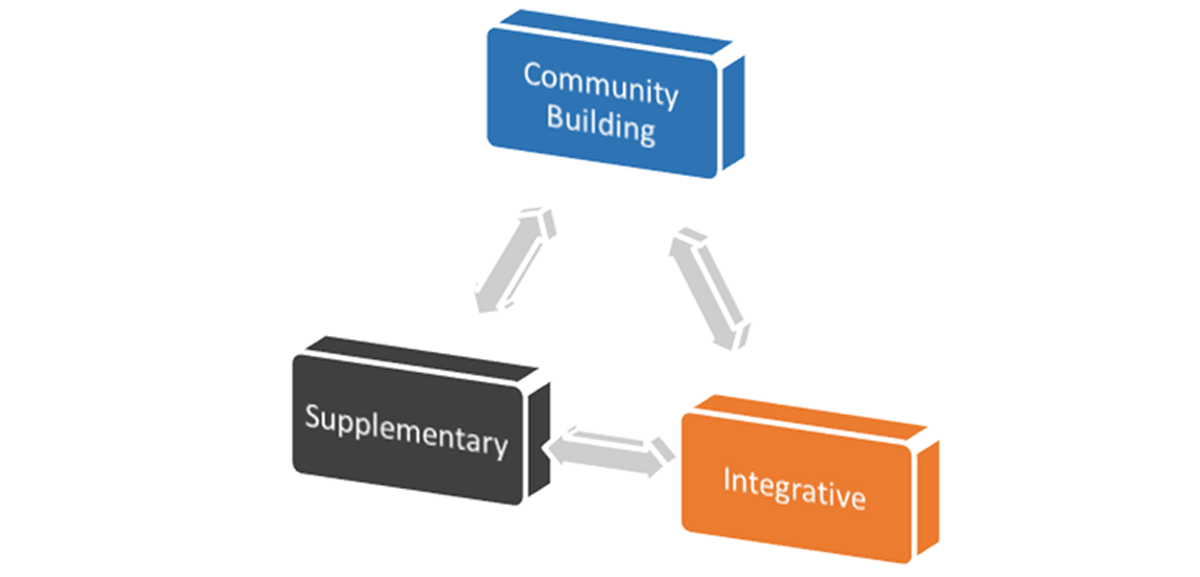
Figure 1
Social Media Entry Model.
Adopting more than one entry point would likely be quite onerous for a faculty member just starting SM integration. As the arrows in Figure 1 suggest, starting with one entry point does not preclude moving to the others next.
Authoring narratives and coauthoring this paper
We used a shared Google Drive folder to store resources and documents related to our SM Teaching Circle. This included scholarly articles we discussed, shared Google Docs we used to draft our personal narratives, and shared Google Docs that we used to coauthor the Social Media Entry Model and this paper. We continued to use this folder long after our SM Teaching Circle ended.
Instructor Narratives
Table 1 shows how we have used SM platforms across four disciplines to develop 21st-century skills. The SM platforms listed in Table 1 can be teamed up with any of the three entry points and used to develop all or some of the four 21st-century skills. Our personal narratives describe the student learning outcomes we aimed to achieve and how they influenced our choices regarding SM platforms and entry points. We organize this section by the three entry points outlined in the Social Media Entry Model.
Table 1
Authors’ Use of Different SM and Entry Points for 21st-Century Skill Development.
| SOCIAL MEDIA DESCRIPTION | ENTRY POINTS | 21ST CENTURY SKILLS | |||
|---|---|---|---|---|---|
| CO | CL | CR | CT | ||
| Pinterest allows users to curate, save, and present digital artifacts in individual and/or group theme-based pinboards similar to collages or scrapbooks. Users can like, follow, comment, and pin others’ content to their own boards. | Integrative | X | X | X | X |
| Instagram, a photo-centric platform, allows users to share images or videos. Users can like, comment on, and bookmark posts. They can also send private direct messages and host private or public live video sessions. | Integrative | X | X | X | |
| X (previously known as Twitter), a microblogging service, allows users to post 280-character posts (tweets), links to websites, or images on their own or others’ timelines. Users can like, comment, and retweet others’ posts and use a variety of hashtags to participate in X chats. | Supplementary | X | X | ||
| LinkedIn is a business and employment-focused global network for professionals. | Supplementary | X | X | ||
| Facebook allows users to connect with people in various ways. They can create and join groups, shop, share photos and videos, create public events, and host live private or public video sessions. | Community Building | X | X | ||
| YouTube is a free video-sharing platform owned by Google. | X | ||||
| Snapchat allows users to enhance the emotional content of photographs and videos (called snaps) by adding filters, lenses, or other effects. Snaps vanish after they are viewed. Users can create Snapchat stories, a collection of snaps captured within the past 24 hours, visible by default to all friends who can view them multiple times. Users can also use Snapchat to chat via text or video and share stories. | Community Building | X | X | ||
[i] Note: CO = Communication, CL = Collaboration, CR = Creativity, CT = Critical Thinking.
Integrative Entry Point
SM can enhance student learning outcomes when integrated meaningfully into the formal curriculum. In this section, Crystal (Author 1), an Education professor, describes how she used Pinterest to engage undergraduate and graduate students in creating and using group and individual boards to facilitate group discussions. Pao Ying (Author 2), a professor in Food and Nutrition, describes how she used Instagram to engage undergraduates enrolled in two food and nutrition courses in active learning.
Education Professor’s use of Pinterest to develop students’ 4Cs
Students typically see Pinterest as a leisure space. Occasionally, some may use Pinterest to curate resources created by practicing teachers. In several courses, I model how Pinterest can be used as a learning space to develop critical thinking, collaboration, communication, and creativity. I demonstrate how Pinterest can be an alternative to other presentation tools like PowerPoint, Prezi, and YouTube clips. I use my Questioning Skills Pinterest Board to show them how teachers across the globe craft and pose questions in many ways. I use my Interactive Bulletin Pinterest Board to engage them in a critique of practicing teachers’ use of classroom walls and bulletin boards. They quickly realize that Pinterest can serve as a window into the classroom of teachers around the globe. Next, I model how a presenter can use Pinterest to co-create boards for mutually beneficial purposes. Together with my students, we created a group board of free e-books they can all use during their field experiences (see Figure 2). This board documents their ability to analyze and select developmentally appropriate e-books that can be used to teach many different content areas. As our board is being developed, we engage in dialogue about the digital divide, representation and misrepresentation of people, and many other topics. Students explain their rationale for their contribution to the group board and model how they would use the board in technology-rich classrooms, as well as those that are not.
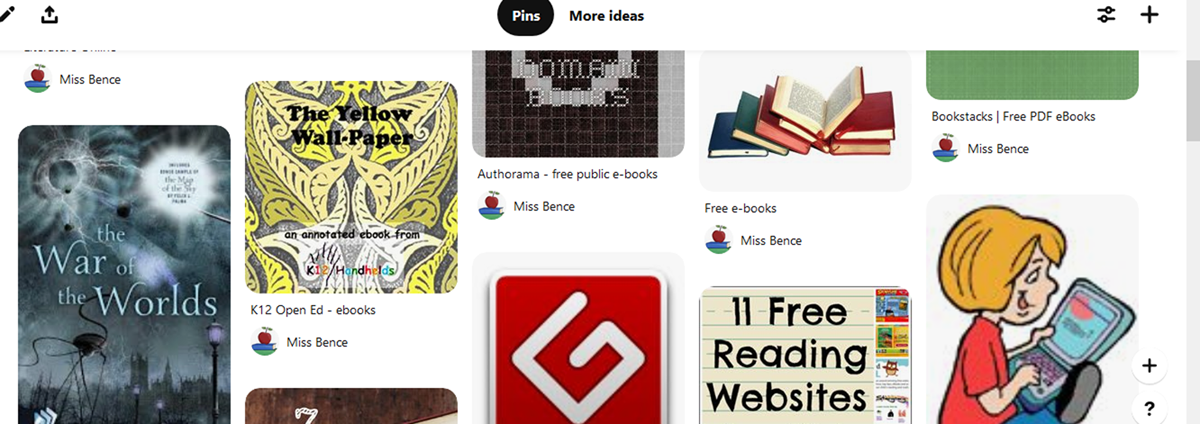
Figure 2
Group Pinterest board of free e-books created by Crystal and her pre-service teachers.
With doctoral students, I used Pinterest to model the skills of application, analysis, synthesis, and evaluation. I also use this activity to educate students about copyright, public domain, fair use, and open licensing concepts. They are encouraged to create an email specially for this activity instead of using their personal or school email. Given that students’ dissertations should be original, we discuss digital privacy, and students are instructed not to share too much about their dissertations on Pinterest. Students add images that depict the theory they hope to use as part of their dissertation’s theoretical framework to my Theory Board (see Figure 3). Since doctoral students are often at varying stages of the dissertation process, this board enables me to literally and figuratively “get everyone on the same page.” While this board is introduced on the first day of class, students may add images to it as and when they like and engage their peers in small and large group critique. I use the board periodically to stimulate different discussions. We use the images to discuss how theories are advanced, tested, and modified over time. Consistent with constructivist principles, I invite students who are further along to orally describe how they plan to use the theory they have selected. Initially, I asked probing questions to scaffold their thinking. Over time, they learn to ask similar questions to their peers and provide feedback. The dialogue that ensues is helpful to students who present their ideas and those who have reservations about their choice of theory. Through this interactive process, they comprehensively understand theory and its important role in research design and analysis. Students who prefer not to use SM are provided with other alternatives.
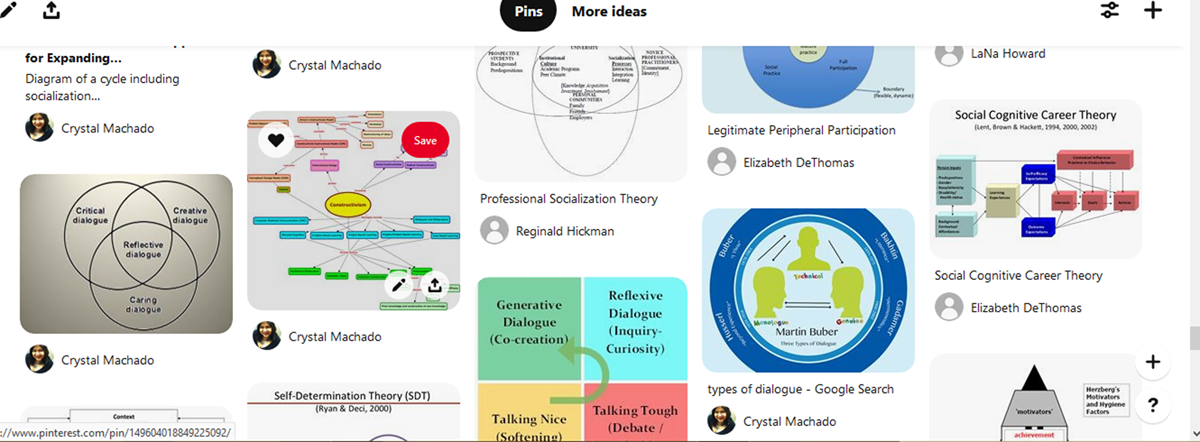
Figure 3
Group Pinterest board created by Crystal and her doctoral students.
Food and nutrition professor’s use of Instagram for long-term engagement outside the classroom
As educators and experts in our respective disciplines, we think about our respective fields and “see” examples of discipline-specific content daily as we read the news and communicate with friends. As an instructor, I want students in my class to engage in dialogue with classmates about the nutritional value of the food they consume – both in and outside the classroom. Recognizing that students spend considerable time on SM, I thought, “If I can’t beat ‘em, join ‘em.” Instagram was the obvious choice for a course focusing on food and nutrition because it is a photo-centric SM platform. Beautiful pictures of food are already very popular on this platform. More importantly, college students widely use this platform (Vannucci, Ohannessian, & Gagnon 2019). This section describes how I use Instagram to engage undergraduate students in lower- and upper-level nutrition courses.
#bewellproject
I integrate the #bewellproject in a general education class on current issues in nutrition and wellness. Approximately 80-100 freshmen and sophomores of non-nutrition majors take this course. This 5-week project, which includes a food/health challenge each week, helps increase students’ awareness of food, nutrition, and wellness and cultivates habits centered around these. Each week’s challenge builds upon the next; for example, in week 1, they are tasked with consuming 8 cups of water daily. The following week, they are challenged to practice meditation for five minutes while consuming 8 cups of water daily (See Table 2).
Table 2
Five Week #bewell Instagram Project Challenges.
| CHALLENGE | DRINK 8 CUPS OF WATER | MEDITATE FOR 5 MINUTES | WALK AT LEAST 10,000 STEPS | EAT AT LEAST 2 VEGETABLES | EAT AT LEAST 2 FRUITS |
|---|---|---|---|---|---|
| Week 1 | X | ||||
| Week 2 | X | X | |||
| Week 3 | X | X | X | ||
| Week 4 | X | X | X | X | |
| Week 5 | X | X | X | X | X |
As students complete each challenge, they document their journey with weekly Instagram posts (i.e., pictures) representing the challenge, weekly comments to their classmates, and a reflection describing their successes and barriers. The comments below illustrate how these active learning opportunities develop their creative, critical thinking, and communication skills.
Student 1: I started going for more walks, and when I want to snack, I go for carrots instead of Cheez-Its. Don’t get me wrong, I still like the occasional treat, but now it is a treat instead of a daily thing. In these past 5 weeks, I feel so much better.
Student 2: I absolutely loved this project. I thought it was a very fun and relevant way of helping us make better choices. Since the beginning of the semester, I have lost 10 pounds, and I owe a lot of it to this project! I am making healthier eating choices and finding smarter ways to exercise at the gym. I also feel mentally healthier after starting daily meditations!
Student 3: My overall thoughts about this project was that it was a fun and creative way to challenge us to do healthy things. It gave us a chance to use modern SM to show that we were doing these challenges. I think it is an interesting way to communicate with classmates as well because it is something different from the discussion boards of replying to someone. There were benefits from this project such as trying new things.
Student 4: … the greatest benefit of this project to me was the introduction to meditation. I was skeptical about it at first and really didn’t think I would get much out of it but now it is something I go straight to after a long day of classes or if I need some reassurance before an exam.
#lettuceeatchallenge project
Health-related majors (e.g., nutrition and nursing) enrolled in a 10-week, higher-level nutrition course participate in the #lettuceeatchallenge project. Each week, I provide them with a challenge that requires them to think critically and apply knowledge related to the assigned reading for that week. In addition to increasing awareness, these challenges require them to look for examples of the new concepts they learn each week. For example, after learning about different types of lipids, students find and post examples of the foods they consume on Instagram.
Given the sheer volume of posts for each challenge, I do not provide a weekly grade. Instead, I require two reflection assignments: one at midsemester and one at the end of the semester. These reflections develop their critical thinking skills. They describe their favorite and least favorite challenges, the impact of the project on their personal lives, meaningful interactions with classmates, and suggestions for future challenges. Additionally, students insert screenshots of their Instagram profile page. This allows me to determine if they completed each challenge successfully. I can click on their individual Instagram profiles to read each photo’s captions if needed.
Supplementary Entry Point
Integrating SM to supplement the regular content of courses to promote 21st-century skills is yet another entry point. In this section, Christian (Author 3), a Sociology professor, describes how he uses X (previously known as Twitter), launched in 2006, to create a learning space to supplement several courses he teaches. Additionally, he describes how he creates a sense of continuous instructor presence in the online environment. Using this strategy, faculty can experiment with the use of SM in a stepwise fashion without much risk to the integrity of their existing course content or structure.
Sociology professor’s integration of his professional X feed in all courses
I want my students to have access to the information that other sociologists post online. This includes cutting-edge research, think pieces, newspaper articles, and exciting web content. I learned quickly that I could share this curated library of resources more expediently with students by adding an X widget to D2L, our learning management system. This allows students in each course to see my X feed when they log onto it. They can also access my X feed directly by following me on X. SM is a tool that connects students to an information network in their discipline and provides a window into the field’s most relevant and current dialog.
I do not require students to follow me or those I follow on X or comment on my tweets. I typically offer students who follow me a bonus opportunity. Approximately 50% follow me while they take the course; 20% follow me indefinitely. Class discussions show that they see how the posts relate to the course material.
I use my curated X library/feed to nurture student autonomy in multiple ways. I reference the content I have shared in my feed during lectures, class discussions, and group activities. When students approach me for advice on their papers, projects, theses, and dissertations, I direct them to various posts in my X feed. They can draw on these to develop course or degree capstone project ideas. Students have found it helpful to explore new developments in the field, many of which may not be well-known or refined enough to be covered within the confines of the course offerings. With limited assistance, students can access a great deal of important information. They may need additional guidance on conducting advanced searches on SM platforms like X.
I have also used my X feed to support students who may need additional scaffolding for course-related activities and campus events. For example, I reach out to students with tips on practicum methods, study skills, and improving writing beyond the classroom walls and confines of the semester. I tweet class announcements and reminders about due dates for exams and assignments. I also use it to provide exam study hints and reminders to focus on important portions of the study guide the evening before an exam. Students have said that these messages are a comforting reassurance that I am thinking about their studying habits while they are preparing for the exam. SM also allows me to highlight important events, programs, and talks that are going on throughout the university; I draw their attention to these and encourage attendance and participation. I have encouraged students to attend multiple talks and programs on campus connected to classroom learning. I have found that students will continue to engage with the content I provide on my SM beyond their completion of the course and, in some cases, continue into their early careers because they find this type of advice and guidance valuable.
Sociology professor’s consistent identity across SM and learning management system platforms
Utilizing SM to supplement face-to-face courses (traditional courses) helps create a sense of presence critical to learning. Students feel comforted knowing that you are present, available, and engaging in the course environment just as they are. However, maintaining a presence in an asynchronous online course can be difficult because students engage in the environment at different times throughout the day, and it is unreasonable to expect instructors to monitor the course continuously on the computer. Similarly, presence can be hindered by the formal communication style of email. I have found that a remedy to these difficulties with building a presence is a strategy of branding and integrating SM platforms into your online course environment.
Creating a consistent SM identity across several platforms and integrating it into your online course environment helps build a sense of continuous instructor presence. I decided my consistent identity would be my “online office space.” I did this with the belief that a virtual office would create an online presence, inviting students to come in, stay for a visit, and learn. The content I post would be the books on my shelves, papers on my desk, the flyers on my corkboard, pictures on my walls, and the face-to-face advising and teaching I would give. The idea would be that students navigating these SM platforms would have the same feelings and cognitions associated with being in my physical office.
To make my online office a beautiful and welcoming space, all my SM platforms include a stock image of a beautiful library reading room and overlaid a fancy border with the title “Dr. Vaccaro’s Office” (see Figure 4). I place this image prominently in each SM site, typically as the “cover photo” or “border photo,” to give the sense that the page is a beautiful, booked-lined office. This creates a consistent identity across my WordPress site, YouTube, Facebook, X, and LinkedIn pages (see Figure 5). I also integrate the image into the courses within my Learning Management System to create the impression that all the platforms are the same space. Students navigating across platforms will find consistency in content and information.

Figure 4
Image representing Christian’s virtual office.

Figure 5
Christian’s consistent professional identity across five SM platforms.
Community Building Entry Point
A third entry point or strategy would be to use SM for Community Building within a program, department, or college. In this section, Christine (Author 4) describes how she created accounts for the History Department on major SM platforms (Facebook, X, Instagram, and Snapchat). She also describes how she uses these learning spaces to advertise departmental activities and engage students in historical analysis of current events.
History professor’s use of Facebook, X, and Instagram to engage stakeholders in discipline-specific civic dialogue
Students need access to professors who can model professional communication and engagement with discipline-specific knowledge in virtual spaces. Facebook, launched in 2004, allows me to communicate with students, alumni, and parents and work towards this goal. I post links to articles, web content, research, and a summary or comment on the History department’s Facebook page. I do this to show students the timeliness of historical topics and model ways to discuss historical analyses online. For example, on Labor Day, I might post an article about the history of the Labor movement to spark discussion of a historical topic with students. This allows students to connect the content they are learning in different history courses with the many debates happening on historical topics in the news, from issues about how to properly commemorate the Civil War to discussions of DNA testing and family genealogies. I also use Facebook to model ways to post questions and opinions in a respectful and civil manner on controversial topics that can turn into contentious debates. These virtual interactions foster communication as well as critical thinking skills.
History professor’s use of Snapchat for creativity and community building
While students follow the History Department on Facebook and X, Snapchat tends to be the preferred SM platform of many students. A survey by Sumpto, a marketing company, revealed that it is used by 77% of college students. I started using Snapchat specifically due to student requests (Wagner 2014). Faculty can harness the potential of Snapchat – an application for sharing videos, images, and texts, which Generation Z is already using in many ways. Snapchat can be used to nurture creativity. Users can post a Snapchat Story – a slideshow of images and videos – that disappears after twenty-four hours. Figure 6 illustrates how the “story” appears on a profile page and how you can access your friends’ “stories.”

Figure 6
Screenshot of Christine’s Snapchat Story.
Snapchat provides my department with an additional strategy to communicate and build community. We post snaps about interesting things happening in the department, news from our majors, and reminders about upcoming events. As is evident from the examples in Figure 7, users can edit their images in many ways by drawing on them, or by applying captions, ‘stickers’, or emojis to emphasize a point or just make the post more fun. Some of the filters are location specific, so users may be able to find filters unique to their university or other significant locations.
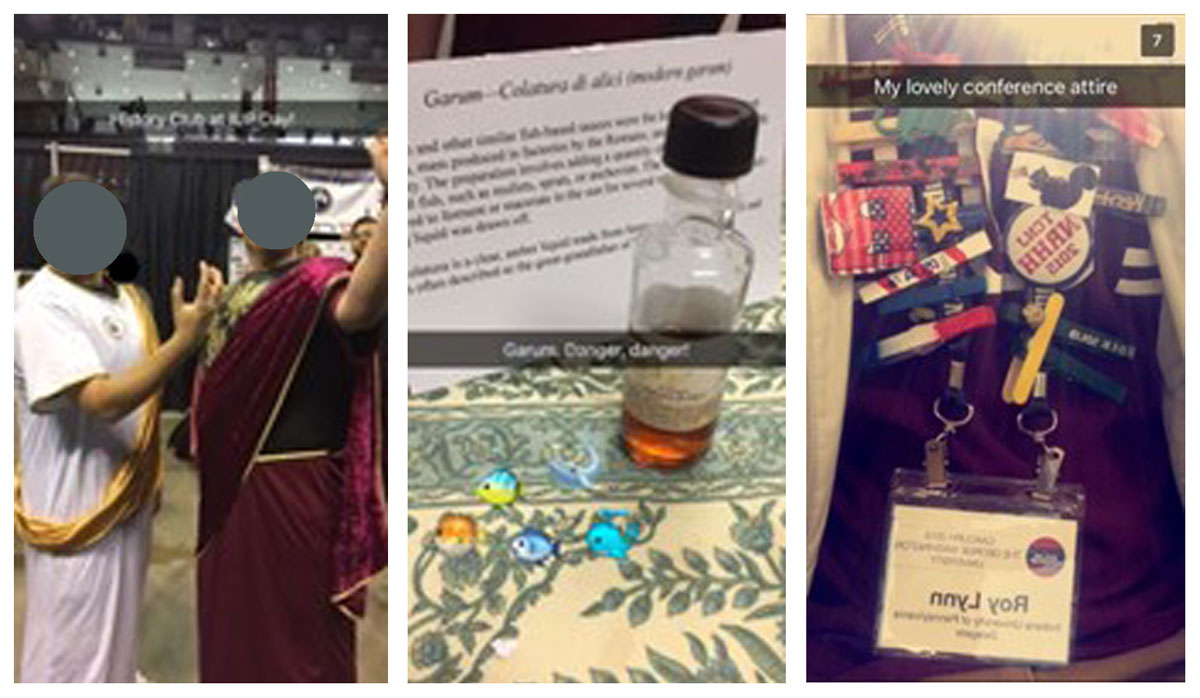
Figure 7
Snaps posted by students on Snapchat.
Once I started using Snapchat for my department, students began reciprocating and sending me ‘snaps’ of themselves engaged in university-related or history-related activities. For example, one student sent me an image of the badges that he received at an academic conference he was attending; another student sent me a picture of the ‘free history book’ pile in the department; and a third sent me an image of The Penn, our student newspaper, on the day when they were publishing articles from The Penn’s history. As a platform, Snapchat has allowed me, as a departmental representative, to connect with students and create an online environment where they integrate history into their daily lives.
Legal, Ethical, and Socially Responsible Use
SM, now the information highway, presents faculty with many pedagogical possibilities. When faculty begin to explore these possibilities, they also need to familiarize themselves with the legal and ethical issues their students may face when using SM for learning, teaching, and networking. Their level of responsibility will vary, depending upon the entry point they choose (see Figure 1). Faculty who select the Integrative entry point and embed SM in short- or long-term graded formative and/or summative assessments may be liable if legal and ethical issues arise in the classroom or students’ personal lives. They can enhance the learning experience and avert unpleasant outcomes in several ways. Firstly, they must be prepared to accommodate students who experience a first- and second-level digital divide. The former includes students who may not have access to the internet or digital devices; the latter includes students who need additional training and technical support to harness the pedagogical benefits of the digital technologies they possess (Ravi, 2020). Before conducting the Pinterest activity (see Figures 2 and 3), Crystal used grant funding to purchase iPads; she lent these to students who did not have digital devices. She also used principles of universal design to meet the needs of students who needed additional support. This included using multiple means of engagement to stimulate interest and motivation and multiple means of representation to present the instructions differently (Michela 2020). Secondly, to avert issues related to copyright infringement, faculty need to educate students about copyright laws, open licenses, copyleft – which allows work to be copied, shared, and remixed (e.g., Creative Commons), the public domain, royalty-free, and fair use (Kimmons, 2020a). Crystal modeled this behavior. Thirdly, faculty must also educate students about online professionalism, safety, and reputation management. Crystal and Pao Ying used a series of activities related to digital citizenship and privacy literacy to help students conceptualize and understand professional identity (Kimmons, 2020b). They also used scenarios to help students deconstruct problematic behaviors (Kimmons, 2020c) before engaging students in using Pinterest and Instagram. Faculty should always be prepared to offer students alternative assignments to ensure that students do not feel coerced into using SM.
Faculty who opt for the Supplementary entry point, like Christian, may choose not to build SM into the formal curriculum. As a result, they may have less responsibility regarding legal and ethical issues students may face when using SM. Nevertheless, they should provide students with some direct instruction about online professionalism and online safety. They should also model the socially responsible use of SM. Christian made specific choices in this respect, such as creating unique social media accounts for students to follow, which only included professional commentary and resources related to the coursework offered at the time. He followed up by enabling privacy restrictions on personal accounts to avoid confusion between personal and professional content. He also ensured that students who opted not to follow the X account had access to critical information, course announcements, bonus assignments, and critical readings through the Learning Management System. Faculty like Christine, who choose to use SM for Community Building within a program, department, or college, may not have access to students in an instructional capacity. In their capacity as SM managers, they can informally mentor students about fair use, copyright infringement, and reputation management. They should also model the socially responsible use of SM.
An Invitation to Join the SM Stratosphere
According to the Pew Research Center survey of 1,435 US teens, the negative headlines and growing concerns about SM’s impact on youth have not deterred them from using these platforms at high rates. Nearly half of these teens describe their SM use as “almost constant” (Anderson 2023: 2). Many teens, and others like them, will pursue a college degree. These teens are in a vulnerable position. People with a sophisticated understanding of human nature and internet technologies can take advantage of the naïve or those with limited knowledge of the threats (Kimmons, 2020c). What role should higher education faculty play in preparing teens and young adults to flourish in a digitally connected world? Higher education faculty can empower these students by designing instruction that provides access to not just disciplinary knowledge and skills but also learning and innovation skills, including the ability to create, think critically, communicate, and collaborate in physical and virtual spaces. Designers, educators, and researchers willing to harness SM’s potential personally and professionally can play a pivotal role in helping college and university students develop an online professional identity that includes these skills.
Technology integration can be daunting, especially involving contact with billions of SM users. A first step would be to consider the appropriateness of integrating SM into their instructional or service activity. If faculty members believe it is worthwhile, they can use the Social Media Entry Model to pick the Integrative, Supplemental, or Community Building entry point. Faculty can critique or draw inspiration from the personal narratives included in this paper, which describe how we used a variety of entry points and SM to meet different objectives. In addition to drawing on a plethora of tutorials available on the internet to learn the basics, faculty could use SM to find mentors who are willing to share resources and pedagogical expertise. Following this, faculty can design meaningful learning experiences that include using SM. This should be coupled with instruction that targets legal, ethical, and responsible use of SM. We recommend that faculty start small and pilot the redesigned instructional and/or service activity, which includes using SM, with a smaller group of students before using it with an entire class. We feel confident that faculty who take this leap of faith will be pleasantly surprised by how students become excellent partners in learning, teaching, and mentoring. Finally, we recommend that faculty use the Scholarship of Teaching and Learning (SoTL) approach to document their journey so that they can publish pedagogical papers that contribute to the advancement of knowledge in the field of curriculum and instruction.
Competing Interests
The authors have no competing interests to declare.
Author Contributions
The four authors’ contributions are in accordance with the adapted ICMJE criteria for authorship and COPE guidelines. They all contributed substantially to the conception of the Social Media Entry Model, drafting the paper and revising the draft for critically important intellectual content. They approved the final version to be published and agreed to be accountable for all aspects of the work. They will ensure that questions about the accuracy or integrity of any part of the work are appropriately investigated and resolved. They also agreed to be named on the author list, and approved the order in which authors are listed.