
Table 1
Newspaper items featuring micro-credentials in English publications.
| YEAR | TOTAL NUMBER | EUROPE | NORTH AMERICA | ASIA | AUSTRALIA AND OCEANIA |
|---|---|---|---|---|---|
| 2011 | 2 | 0 | 2 | 0 | 0 |
| 2012 | 1 | 0 | 0 | 1 | 0 |
| 2013 | 1 | 0 | 1 | 0 | 0 |
| 2014 | 0 | 0 | 0 | 0 | 0 |
| 2015 | 9 | 0 | 6 | 0 | 3 |
| 2016 | 11 | 1 | 7 | 1 | 2 |
| 2017 | 32 | 1 | 12 | 1 | 18 |
| 2018 | 78 | 3 | 21 | 5 | 48 |
| 2019 | 119 | 1 | 44 | 5 | 68 |
| 2020 | 326 | 18 | 96 | 28 | 133 |
| 2021 | 483 | 22 | 239 | 43 | 92 |
| 2022 | 476 | 32 | 261 | 69 | 104 |
| Total | 1538 | 78 | 689 | 153 | 468 |
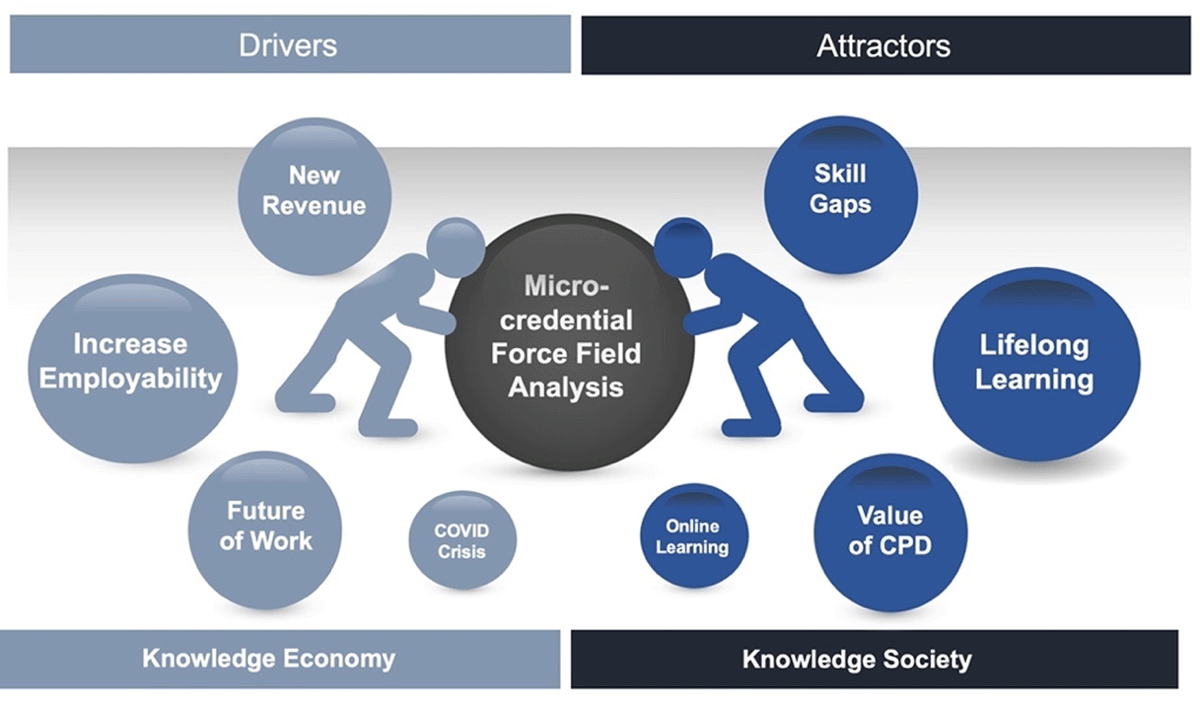
Figure 1
Driver and attractors for the growth of micro-credentials (Brown 2022b).
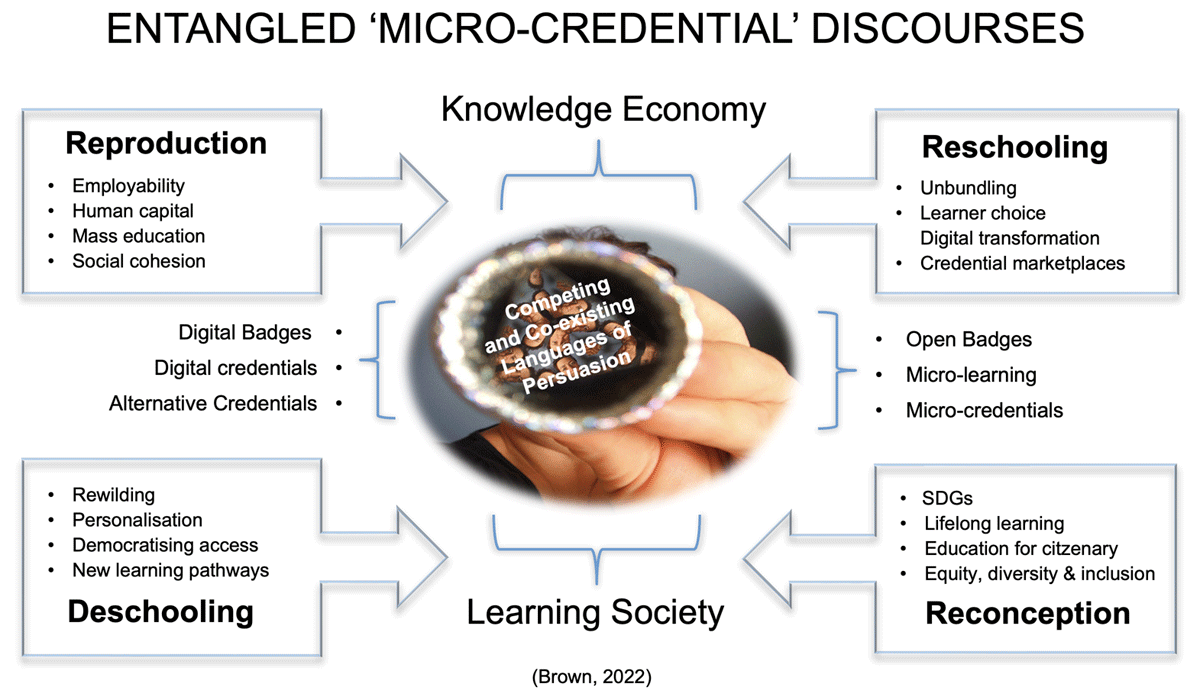
Figure 2
Competing languages of persuasion underlying the micro-credential movement (Brown 2022b).
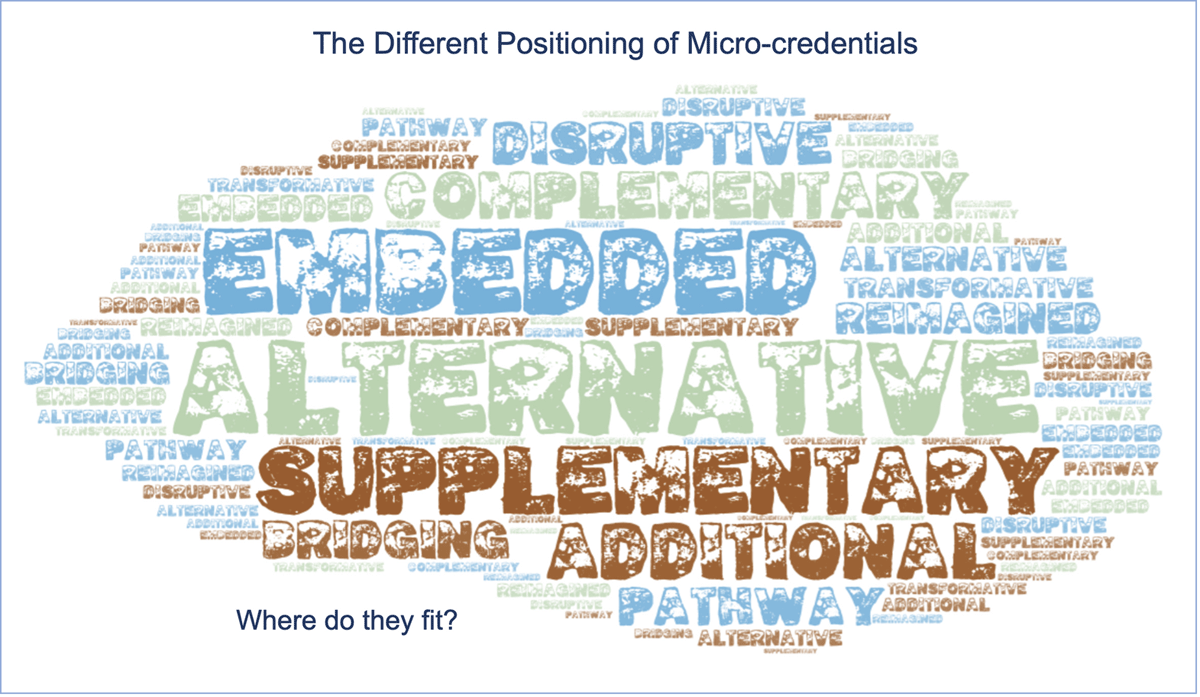
Figure 3
How language positions micro-credentials differently in the credential ecology.
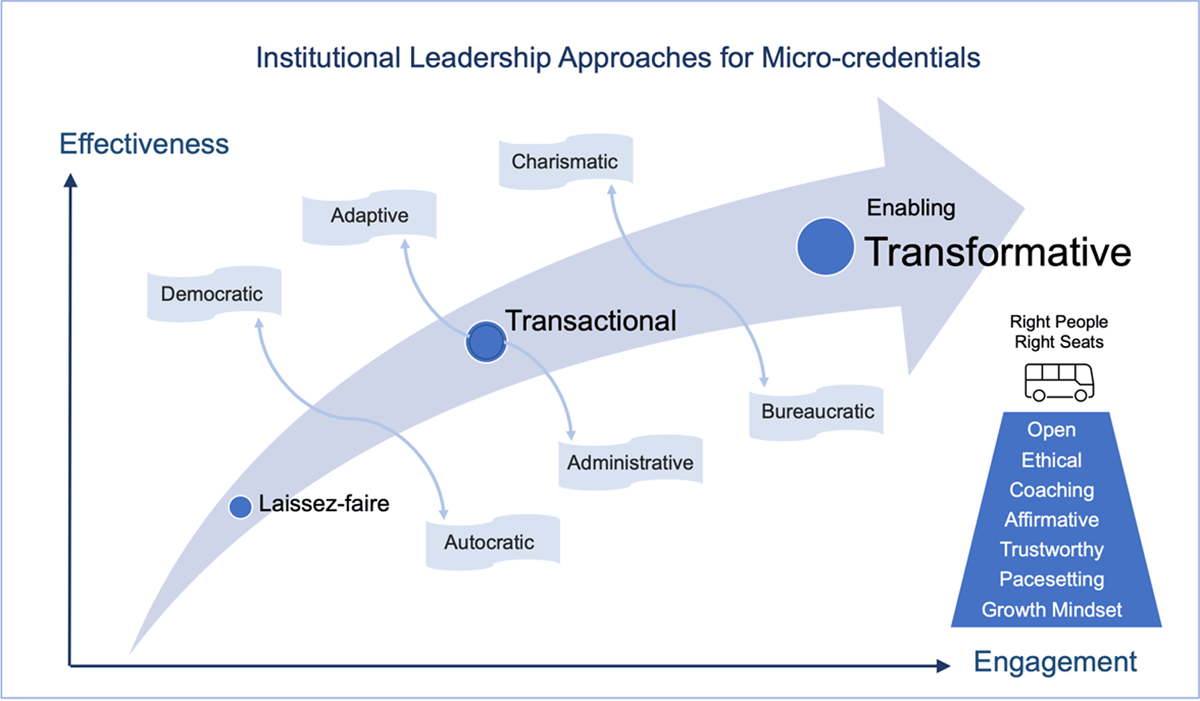
Figure 4
Transformative qualities for leading a micro-credential strategy (Brown 2022b).
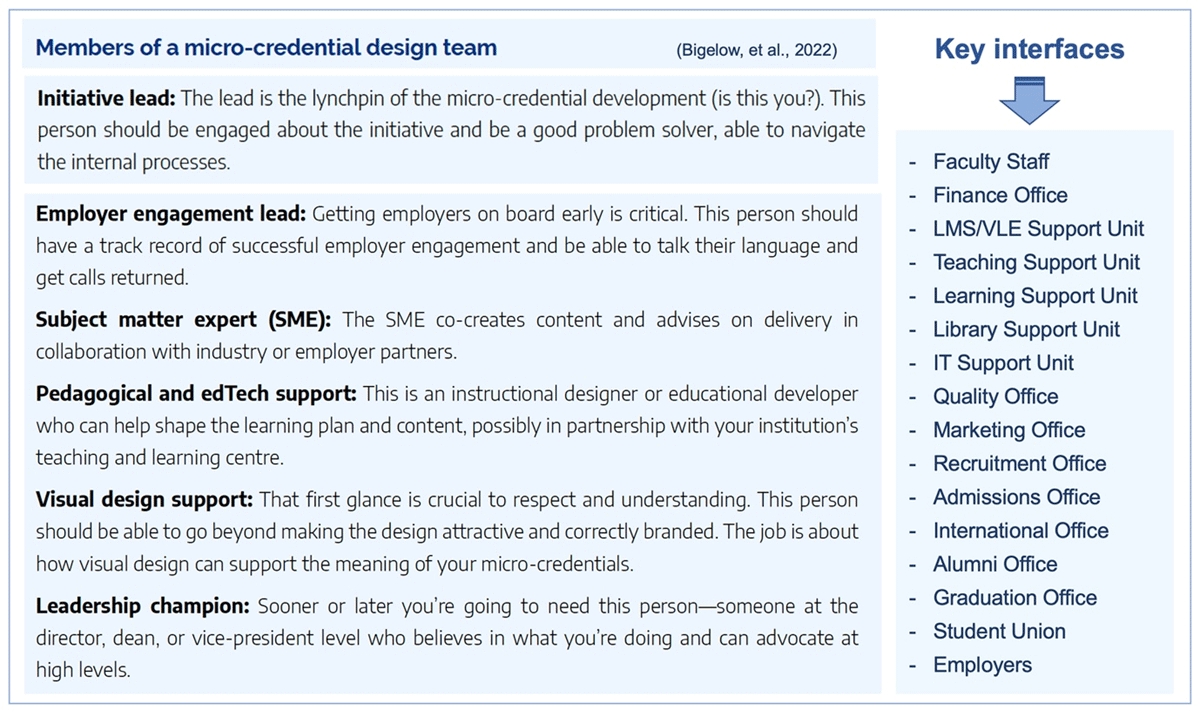
Figure 5
Internal stakeholders who should be included in an effective micro-credential team (adapted from Bigelow et al. 2022).
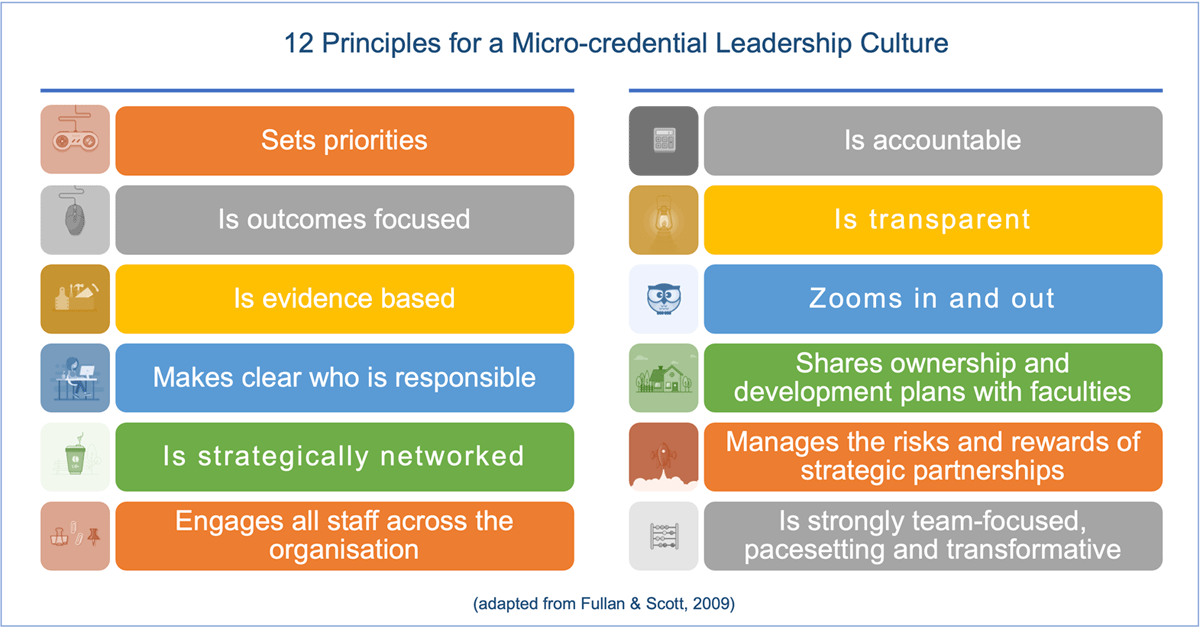
Figure 6
Supporting an enabling culture of leadership for micro-credentials (adapted from Fullan & Scott 2009).
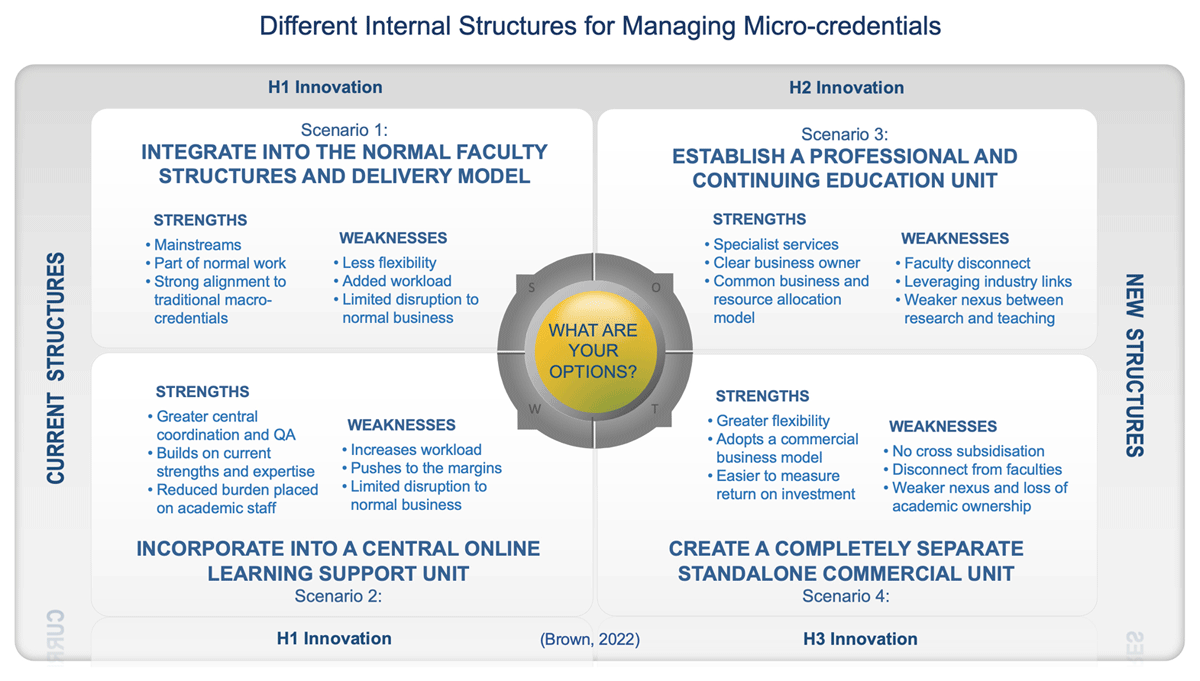
Figure 7
Example of different internal structures for managing micro-credentials (Brown 2022b).
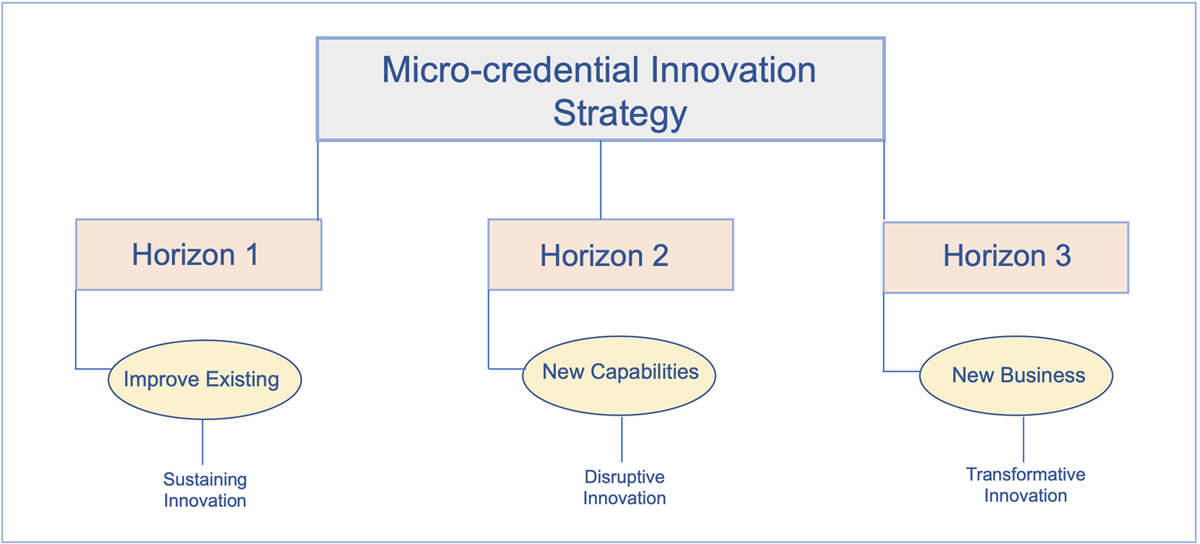
Figure 8
The Three Horizon Framework for planning innovation (adapted from Baghai, Coley & White 2000).
Table 2
Summary matrix of micro-credential business models (adapted from Presant, 2020).
| SOLE INSTITUTION | INSTITUTIONAL BUSINESS UNIT | PEER CONSORTIUM | INDUSTRY LED OR PARTNERSHIP | PROF. BODY LED OR PARTNERSHIP | NGO LED OR PARTNERSHIP | MOOC LED | OPX LED | |
|---|---|---|---|---|---|---|---|---|
| Description | College or university-wide | Commercial unit or Subsidiary | Strategic alliance | Major company or organisation | Discipline or sector body or association | Independent organisation or charitable trust | MOOC platform | Commercial supplier or partner |
| Example | PowerEd | Mentem | ECIU University | Skillnet Ireland | British Mental Health Foundation | Institute of Health Economics | Coursera, EdX, FutureLearn | FourthRev |
| Effort | MED | MED | High | MED | MED | MED | LOW | LOW |
| Horizon | H1 | H2/H3 | H2/H3 | H1/H2 | H1 | H1 | H2 | H2/H3 |
| Risk | LOW | MED | MED | LOW | LOW | LOW | LOW | MED |
| Autonomy | HIGH | HIGH | MED | MED | MED | MED | MED | LOW |
| Speed to Market | MED | HIGH | LOW | MED | MED | MED | HIGH | HIGH |
| Costs | MED | MED | MED | LOW | LOW | LOW | MED | MED |
| Impact/Benefits | LOW/MED | MED/High | MED/HIGH | MED | MED | MED | LOW/MED | MED/HIGH |
| Return on Investment | LOW/MED | MED/High | MED | MED | MED | MED | LOW/MED | MED/HIGH |
| Strengths | Centralised approach with high autonomy over brand, product suite and design and development model | Potential for fast, flexible and “agile” response to changing market needs and opportunities | Bigger footprint, safety in numbers, with shared values and goals driving a vibrant community of practice | Packaged, tested solution with proven brand recognition and cohorts of students | More agility due to one decision-maker and leverages existing community of practice | More agility due to working with just one partner and potential for external funding | Proven online platform and existing market of learners around the globe | Strong industry connections and business model for course development |
| Weaknesses | Constrained by traditional institutional structures, core business model and organisational culture | Disconnection with faculties, weaker research/teaching nexus and potential for mission creep | Governance can be cumbersome and hard to sustain over time without external funding | Loss of autonomy and potential conflicting goals with more of a vocational focus | Loss of autonomy and potentially reputation if you fail to deliver | Loss of autonomy and need signoff for each step of the process | Loss of brand recognition and limited system integration | Loss of autonomy and high percentage of revenue is shared with partner |