
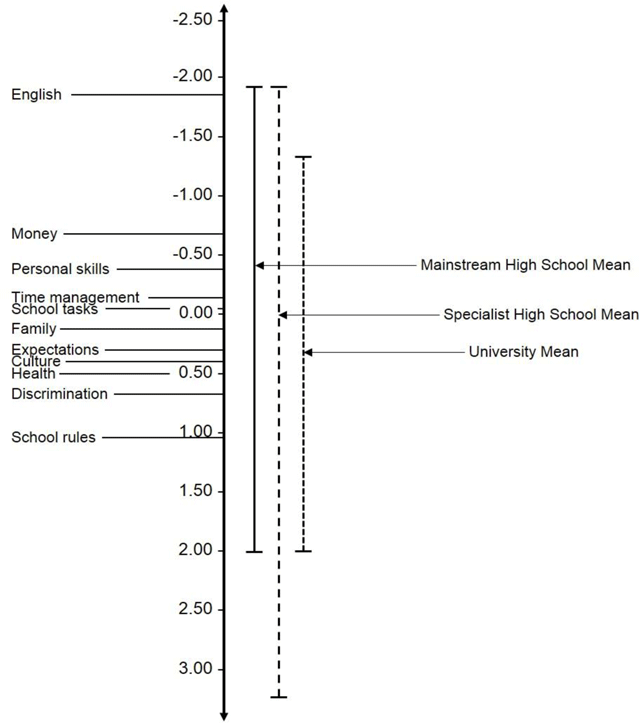
Figure 1
Unidimensional Rasch model of 11 challenges for 74 refugee students in three separate samples.
Table 1
Three themes identified in 47 refugee students’ accounts of their English language challenges.
| Themes | n | Example quote |
|---|---|---|
| Schoolwork | ||
| Assessments | 21 | • “Just sometimes it takes more time to do homework, because I have to look in the dictionary”. (Rwandan, specialist high school student) • “Even I can’t do some of my homework, because I don’t understand what it is about”. (Afghani, mainstream high school student) |
| Study habits | 14 | • “I made my homework done on time. I started early. I studied more than others”. (Karen, university student) • “I practice and study a lot – my time is taken up each day with extra study and other activities”. (Afghani, mainstream high school student) |
| Learning words or tasks | 11 | • “Definitely harder and only focus on the task that I have to work on”. (Karen, university student) • “To learn computing, English, Maths. Because for English some words I don’t know”. (Rwandan, specialist school student) |
| Confidence with school work | 9 | • “It can make me feel like weak about my study and disappointed”. (Afghani, mainstream high school student) • “Sometime really want to run away from school and don’t want to talk to anybody”. (Karen, university student) |
| Communication & social lives | ||
| Social withdrawal | 12 | • “I often don’t talk with other students at school in English because I am worried that my English will be wrong and they will laugh”. (Ethiopian, mainstream high school student) • “In class, and at lunch time, it makes me sad because I want to talk like them and be like them, but I can’t because my English isn’t good enough”. (Afghani, mainstream high school student) |
| Speaking to other people | 12 | • “It is really hard to communicate with others and really hard to express on what I want to say”. (Karen, university student) • “Language is bit hard when you [are] new to it because it hard to communicate with other in everywhere workplace, school and in community centre”. (Afghani, mainstream high school student) |
| Understanding other people | 9 | • “I get a headache often, trying to understand what people say to me”. (Afghani, mainstream high school student) • “Sometimes I can’t understand what the words mean and what the sentences mean. Sometimes I missed understand the questions and answered the wrong thing”. (Karen, university student) |
| Employment | ||
| Job opportunities | 5 | • “I am thinking to improve my English and to get a job and to make my family life better”. (Sudanese, specialist school student) • “I see other students with jobs, who speak English but aren’t as good writing it … I wonder why I’m so different. Why is it hard for me?” (Afghani, mainstream high school) |