
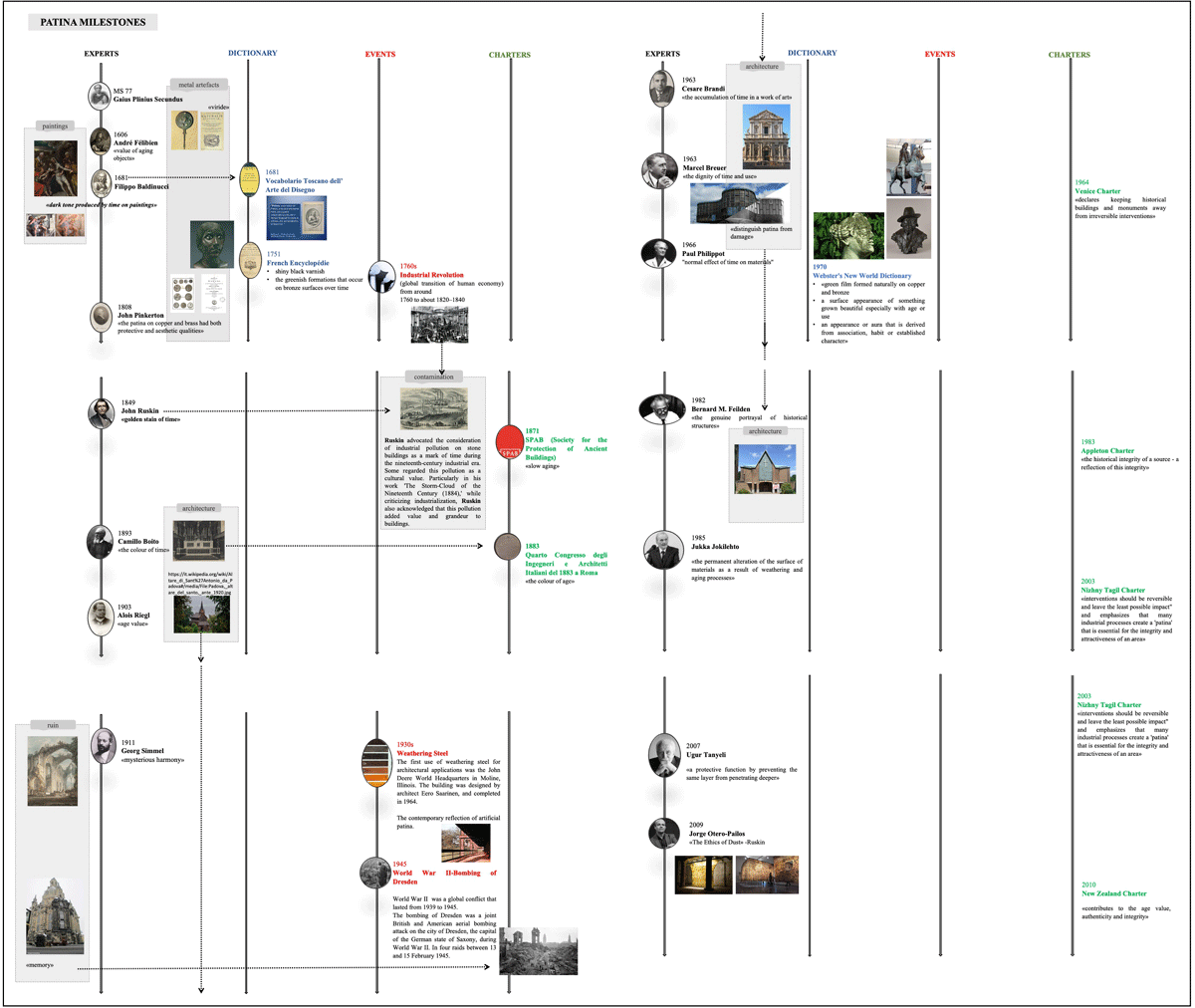
Figure 1
Chronological timeline illustrating the evolution of the concept of patina through experts, dictionaries, events, and charters.
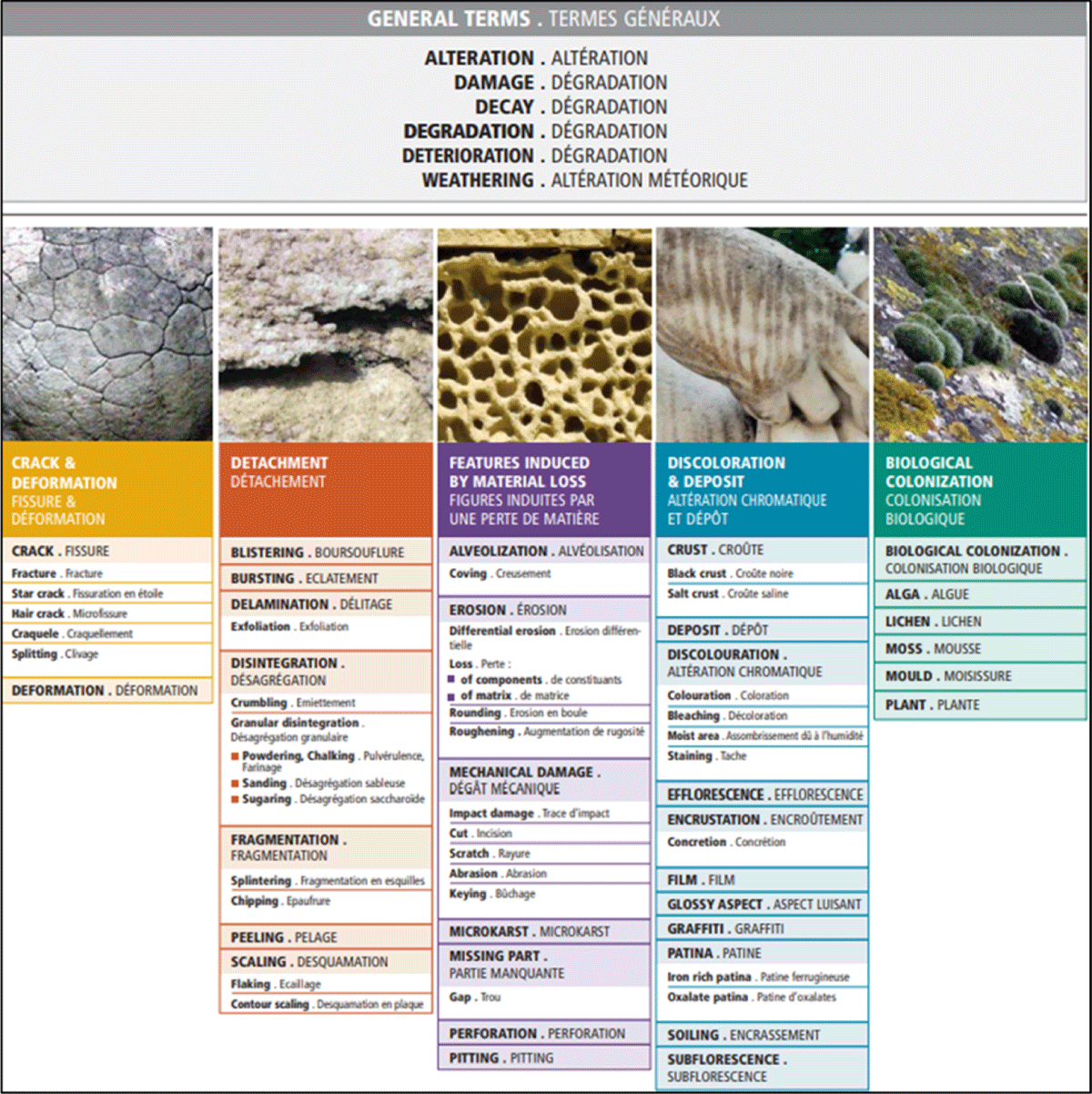
Figure 2
ICOMOS Stone Deterioration Patterns Source: ICOMOS-ISCS (2008).
Table 1
Definition of metal patina in different disciplines.
| DISCIPLINE | DEFINITION | SOURCE |
|---|---|---|
| Bronze craftsmanship (sculpture, figurines, small objects, etc.) | Patina refers to a type of metal rust, a coloured oxide layer that forms on the surface of a bronze alloy. It is a thin surface formation that can occur in different colours as a result of the reaction between copper, a constituent of bronze, and oxygen. The chemical transformation in the copper’s structure is caused by factors such as moisture in the air, various chemical elements in the atmosphere, urban environment, salts present in nature, and variable temperatures. Due to these factors, the bronze surface can exhibit coloration ranging from green, depending on the variability of the factors, to red, brown, and even black. | Demir 2020 |
| Metallurgy | Patina emerges as a process of oxidation, corrosion, or a combination of both. When a material is exposed to environmental conditions such as water, wind, frost, extreme temperatures, or other factors, it begins to undergo the oxidation process that causes darkening on its surface or coating. Patina also forms through aging, wear, and even polishing. | Corrosionpedia n.d. |
| Chemistry | Bronze, iron, and similar metals develop a decorative and corrosion-resistant surface coating through the formation of an oxide film when they are heated. | Sharp 2003 |
| Metal conservation | Chemically, a patina is a corrosion layer; however, the term is often specifically used to refer to an aesthetically pleasing layer that enhances the metal object and should not be removed. Natural corrosion processes also produce, over time, patinas that are often prized and sought after. | Canadian Conservation Institute n.d. |
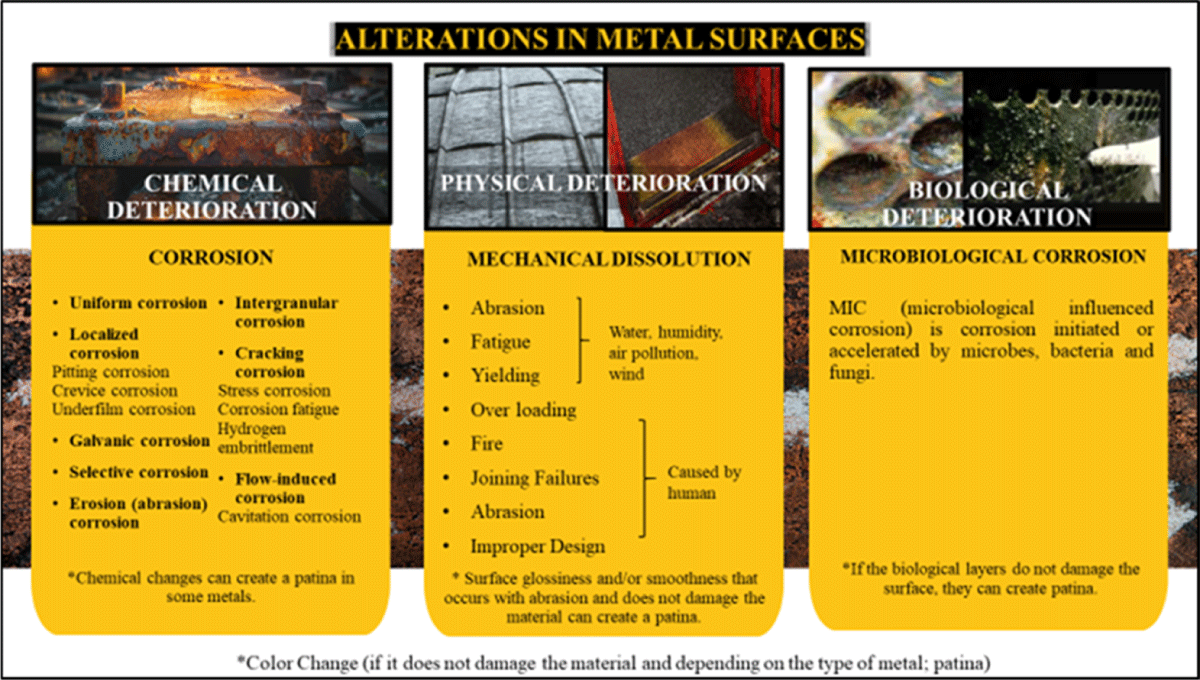
Figure 3
Alterations Occurring on Metal Surfaces. Prepared by authors based on Özdağ (2015), Özer (2021), Sansar (2018) and Uluengin (2006).
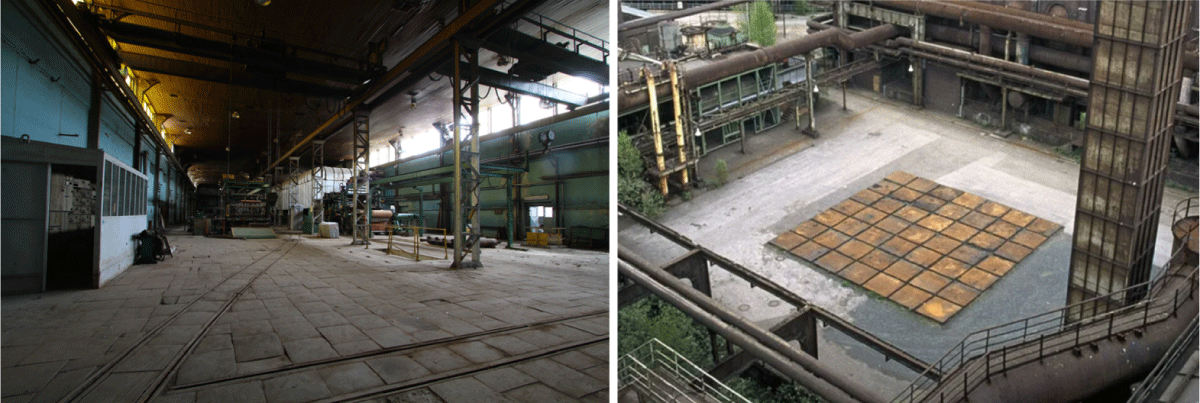
Figure 4
Left image: metal plates in the SEKA Factory (Author’s Archive 2013). Right image: metal plates in the Duisburg-Nord site. (Latz and Partner n.d.).
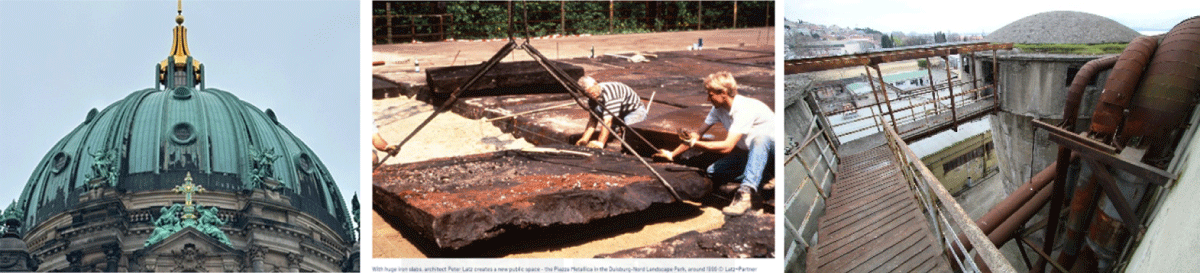
Figure 5
From left to right: the copper roof covering of Berlin Cathedral (Author’s Archive 2026), rusted metal floor plates in Duisburg Nord-Emscher Park (Emscher Park n.d.), and rusted surfaces from the SEKA Factory (Author’s Archive 2013).
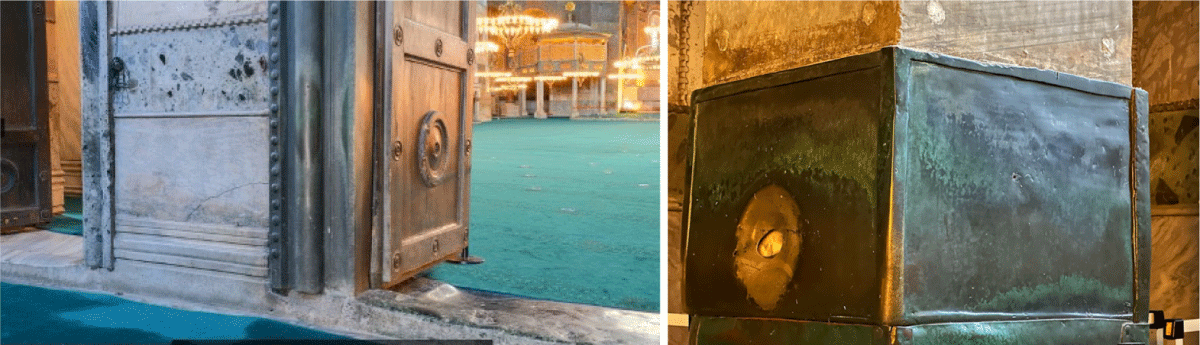
Figure 6
Thresholds made of stone material and metal door mouldings shining from friction in Hagia Sophia (Hagia Sophia Mosque n.d.). The column on the right side is worn and glossy from intense hand contact and friction (Weeping Column, Hagia Sophia Mosque, Author’s Archive 2024).
Table A1
Dictionary Definition of Patina.
| DICTIONARY NAME | DEFINITION | SOURCE |
|---|---|---|
| Encyclopédie | Patine is defined as the beautiful green verdigris colour that copper acquires, which the Italians call ‘patina’. | Weil 1977 |
| Oxford English Dictionary | 1-A thin layer covering the surface of something, typically emerging with age or use. For example, a green film on the surface of old bronze or copper or a glazed surface on ceramics. 2-The surface brightness that results from aging, use, or polishing. For instance, the smooth and shiny surface of a well-used leather chair. 3-A top layer or outer coating acquired over a long period, often carrying connotations of authenticity or references to ancient times, gained through prolonged service in a profession. 4-A type of colour change or staining usually occurring on teeth due to age or dietary factors. 5-In biology, a feature such as colour or pattern on the surface of an organism that assists in camouflage or protection. | Oxford English Dictionary 2025 |
| Merriam-Webster | 1-a. A green film naturally formed on copper and bronze over an extended period of exposure and artificially created with acids, often aesthetically appreciated. 1-b. The surface appearance gained by the aging or use of something, particularly valued for its aesthetic appeal. 2-An appearance or aura derived from a relationship, habit, or established character. 3-A superficial coating or outer surface. | Merriam-Webster n.d. |
| American Heritage Dictionary | 1-A thin, greenish layer typically composed of basic copper sulphate that forms on copper or copper alloys, as a result of natural corrosion or chemical processes. 2-Luster developed on a surface, typically like wood, due to age and use. 3-A superficial outer layer; a coating. 4-A superficial impression, especially one considered to be added or acquired. | American Heritage Dictionary n.d. |
| Online Etymology Dictionary | Since 1748, the term “patina” originates from the French word “patine” in the 18th century, which, in turn, comes from the Italian word “patina.” While it may be related to the Latin “patina,” meaning “shallow dish, plate, pan” (Greek “patane,” meaning “dish, plate”), derived from the PIE *pet-ano-, *pete- “to spread” root, the exact reason for its presence on the surfaces of various ancient objects, including bronze plates and pans, remains uncertain. The term gained an additional meaning in 1933, referring to “refinement, cultural sophistication,” likely due to its significant contribution to the beauty of antique bronzes. It was further expanded in the 1890s concerning the surface textures of decorative artworks. | Online Etymology Dictionary 2025 |
| Dictionary of Art Concepts and Terms | Patina is defined as the worn surface that develops over time on all kinds of old art objects. For instance, it is possible to talk about the patina of stone cladding on a structure. Contemporary conservation understanding prefers to preserve patina if it does not harm the work, rather than eliminating it. | Sözen and Tanyeli 2007 |
| Dictionary of the Royal Academy of the Spanish Language (DRAE) | It is defined as “especially the thin film of oxide or carbonate that forms on the surface of metals, such as bronze or copper, as a result of atmospheric effects, gaining aesthetic value when it acquires some lustre. Additionally, it is described as a transparent or semi-transparent thin layer applied to a work of art, especially a painting, to provide protection or alter its appearance. Moreover, it is expressed as a transparent, olive-coloured coating formed as a result of the aging and oxidation of ancient bronze and copper objects. | Real Academia Española n.d. |
| The Penguin Dictionary of Chemistry | It is a decorative surface coating achieved through the formation of an oxide film when metals such as bronze and iron are heated, providing corrosion resistance. | Sharp 2003 |
| Corrosionpedia | Patina is a type of rust that can be written as Fe2O3.nH2O. Chemically, it is formed by the reaction of oxides, sulphides, carbonates, and other elements in the coatings of materials with environmental factors such as acid, oxygen, rain, compounds containing sulfur, and carbon dioxide. | Corrosionpedia n.d. |