
1. Introduction
Architectural conservation aims to preserve cultural heritage for future generations. As materials are exposed to weather conditions over time and age, certain changes occur on their surfaces that affect their authenticity, legibility and conservation decisions (Avrami et al. 2000; Riegl 1903). In metal cultural heritage objects, the boundary between patina and deterioration is not always clear. Certain forms of physical wear, such as surface lustre caused by long-term use, and some stable corrosion layers, may contribute to an object’s historical character and may not necessarily indicate loss. How such surface conditions should be interpreted in conservation practice is the question addressed here, together with criteria for distinguishing acceptable patina from deterioration.
The concept of patina is encountered in the fields of art history, conservation science, chemistry and materials science. However, the definition of patina on a metal surface depends on the type of metal and its context. The layers formed on the surfaces of cultural heritage objects vary in composition, morphology, and stability depending on the material type, location, and duration of exposure; this makes it difficult to establish a single universal definition.
Compared with stone, metal heritage surfaces present greater conservation challenges because corrosion processes generate diverse surface layers whose stability and protective function vary over time, making the distinction between patina and deterioration particularly complex.
The focus here falls on patina formed through natural processes rather than artificially applied surface treatments. However, it also acknowledges a degree of conceptual ambiguity. Certain engineering materials, such as weathering steel (Corten), are designed to utilise natural oxidation in a controlled manner. Although these materials have not been subjected to patina in the traditional sense, they occupy an intermediate position between exposure to natural weather conditions and deliberate surface manipulation. This tension is examined in Section 3. The investigation concentrates on the conditions under which surface changes in metal heritage objects, including physical wear and stable corrosion layers, can be interpreted as patina rather than deterioration, and it proposes an original evaluation framework for making this distinction in conservation practice. The study draws on theoretical definitions from art history and conservation science, analyses relevant conservation regulations and specifications, and applies the proposed framework to the context of three case studies selected for their relevance to the main argument: surfaces exposed to environmental atmospheric conditions, surfaces altered due to intensive human use, and metal surfaces exhibiting stable corrosion layers. Each case was evaluated according to three analytical parameters: material stability, structural integrity, and conservation value.
The aim is not to survey analytical methods for identifying corrosion products; rather, it is to interpret how naturally formed surface changes should be understood within conservation theory and practice.
2. The Meaning of Patina: From Etymology to Conservation Discourse
The word ‘patina’ derives from the Latin patina, a shallow dish used for offerings or meals in ancient Rome, and ultimately from the Greek patanē, ‘flat surface’. Its figurative use for surfaces arose in seventeenth-century Italy to describe the greenish film on copper and bronze and passed into English in the eighteenth century (Online Etymology Dictionary 2025); by the twentieth century it had come to denote the character which various objects acquire through age and use (Weil 1977). Across these everyday senses, three elements recur: surface change, the passage of time, and an aesthetic or protective function (summarised in Table A1, Appendix). They provide a starting point, but for conservation, where the term must carry analytical weight, such general definitions are insufficient; what is needed is a technical one.
The transition from general to technical usage is illustrated in the Dictionary of Art Concepts and Terms, which defines patina as the weathered surface that develops over time on antique works of art and notes that contemporary conservation practices prioritise preserving this surface (Sözen and Tanyeli 2007). In contrast, the Penguin Dictionary of Chemistry provides a more material-oriented definition, describing patina as a decorative and corrosion-resistant surface coating formed by the oxide layer on metals such as bronze and iron when heated (Sharp 2003). These definitions indicate a progression from aesthetic appreciation to material analysis, reflecting the approaches of conservation science.
Within the fields of conservation science and critical heritage studies, patina has been regarded both as a physical condition and as a bearer of cultural value. Brandi (2005) defined patina as the accumulation of time on a work of art and argued that, in the context of restoration, respect for the work’s potential integrity is inextricably linked to the preservation of patina. Philippot (1996:372) extended this to a broader material principle, defining patina as ‘the normal effect of time on materials’; this definition encompasses not only the accumulation of colour on paintings or bronze but also physical changes across all types of surfaces. The 2019 ICOM-CC metal patina conference further emphasised that patina must be understood as a surface layer that is significant from both a conservation and a visual perspective, and that it requires an active conservation approach rather than being automatically removed (Contreras-Vargas and Cama-Villafranca 2019). The Italian UNI 11182 standard perhaps offers the most practical definition for conservation practice; in this definition, patina is described as ‘a change occurring naturally on the surface of the material, not resulting from deterioration processes, and perceived as a change in the material’s original colour’ (UNI 2006). A key point is that this definition distinguishes patina from deterioration not merely on the basis of appearance, but on the basis of the process. This distinction lies at the heart of the argument developed in this study.
Despite this series of definitions, the application of the concept of patina to metal surfaces remains inconsistent. In the conservation literature, this term is applied most consistently to copper and its alloys. Whilst colour changes in these materials are commonly accepted as patina, similar surface transformations in ferrous metals are generally defined as rust or corrosion without possessing an equivalent conceptual status (Scott 2002; Weil 1977). This asymmetry, based partly on the aesthetic legibility of copper patina and partly on the historically destructive connotations of iron corrosion, is one of the fundamental issues addressed in this study. As Clifford (2009) also notes, for conservation practices to respond consistently to all surface changes encountered on metal heritage, further research is required into the cultural significance of patina across different material types. Building on this asymmetry, this study argues that the conceptual boundaries of patina must be expanded to include stable surface transformations in iron-based materials.
3. The Patina Approach in Cultural Heritage
This section focuses on research aimed at understanding the changes that occur on the surfaces of cultural heritage objects. Research in fields such as archaeology, art history and architectural conservation considers patina to be valuable in providing information about the history of artefacts.
Figure 1, titled ‘Patina Milestones’, brings together the concept of patina, along with its dictionary definitions, experts and institutions that have commented on the subject, and significant events associated with this concept, on a timeline. On the timeline, experts on the subject are coded in black, events in red, dictionary definitions in blue, and regulations, specifications and institutional statements in green.
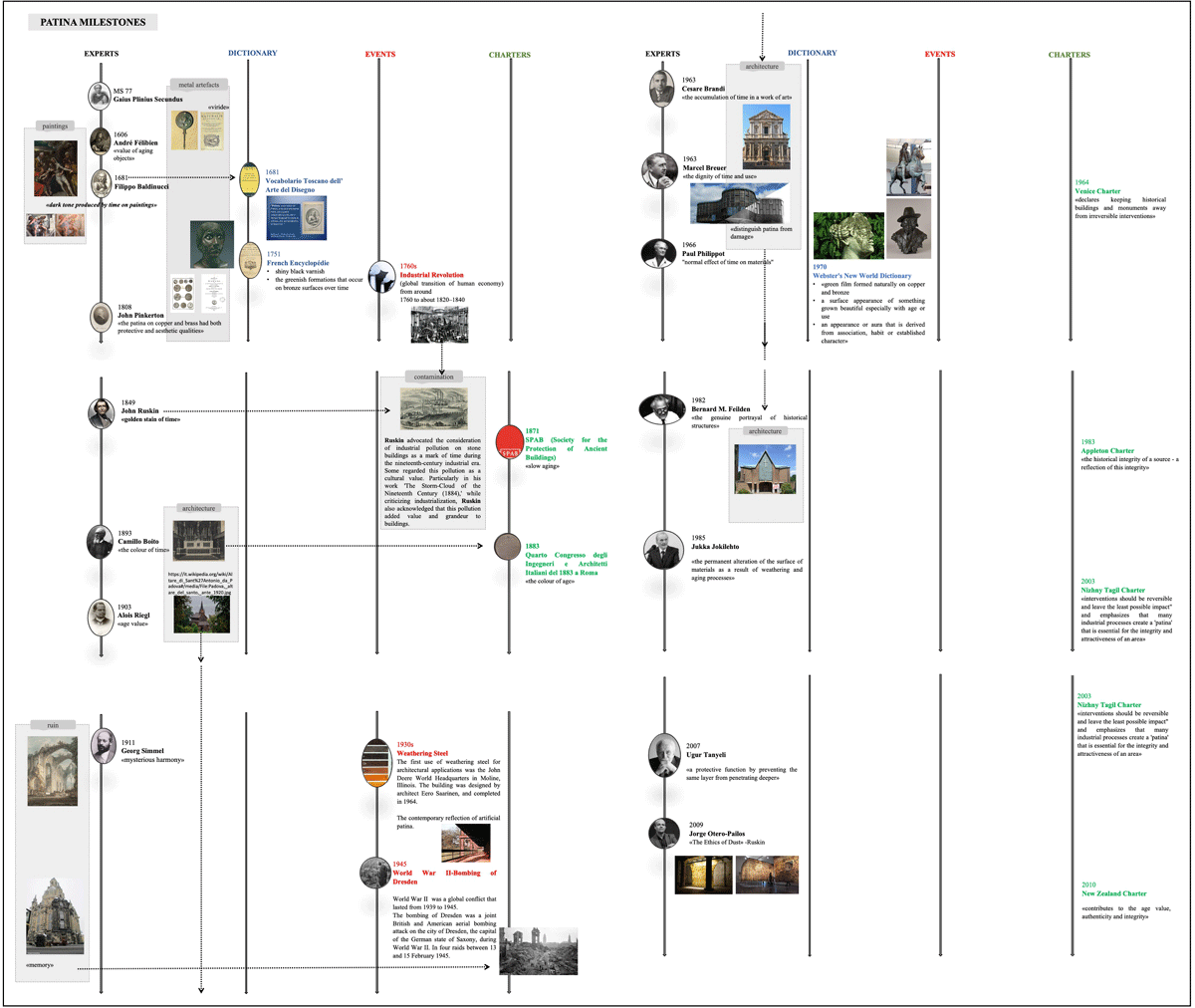
Figure 1
Chronological timeline illustrating the evolution of the concept of patina through experts, dictionaries, events, and charters.
Although the term ‘patina’ first appeared in dictionaries in the 1600s within the context of art history and conservation theories, views on changes in objects date back to antiquity. In the section titled ‘The Natural History of Metals’ in Naturalis Historia, compiled by the Roman naturalist and philosopher Gaius Plinius Secundus, who lived in the 1st century AD, a green patina forming on copper and bronze is mentioned and referred to as ‘viride’ (meaning ‘green’ in Latin).
André Félibien, one of the greatest art critics of his time, was among those who developed classical painting theory. Following in the footsteps of Pliny and Vasari, he conducted research in the field of art history in France. He explained that objects made from specific materials, such as bronze or marble, could develop a desirable patina over time, and that this contributed to the objects’ beauty and value (Weil 1977).
The Italian art historian Filippo Baldinucci first used the term ‘patina’ in its modern sense in his 1681 book Vocabolario Toscano dell’Arte del Disegno. Baldinucci defined patina as ‘a term used by painters’ and noted that the dark tones emerging in paintings over time could lend them an attractive appearance (Baldinucci 1681).
William Hogarth’s 1761 engraving Time Smoking a Picture (Hogarth 1761) has been interpreted in two different ways. According to one interpretation, it satirises the artificial ageing of paintings by implying that only the patina formed by the natural passage of time possesses genuine artistic value. According to another interpretation, however, the image depicts time not as a beautifier but as a destroyer of surfaces; thus, it questions the assumption that only age confers artistic value and criticises collectors who value old and discoloured paintings simply because they are old (Art Gallery of New South Wales 2001). Similarly, Filippo Baldinucci (1681) defines patina as a natural layer formed over time and regards it as an integral part of a work’s historical and aesthetic development. Whilst both perspectives acknowledge the changing role of time in shaping artistic originality, they oppose external interventions that artificially accelerate this process (Weil 1977). Baldinucci’s stance argues that patina acquired solely through natural means enhances a work’s originality and aesthetic depth, thereby reinforcing its cultural and historical significance. Whilst this view finds partial support in Hogarth’s opposition to artificial ageing, Hogarth himself continued to view the beautifying effects of time with scepticism.
In his 1808 article on the preservation of coins, the Scottish historian John Pinkerton noted that a key factor in the preservation of copper and brass coins was the beautiful, varnish-like patina formed as a result of their being buried in the ground (Pinkerton 1808).
John Ruskin, one of the most important art critics of the 19th century, argued in his 1849 work The Seven Lamps of Architecture that the effect of time on building surfaces expressed a true beauty that reflected the building’s age and bore the traces of life (Ruskin 1849). These ideas inspired the founding manifesto of the Society for the Preservation of Ancient Buildings (SPAB), led by the writer and designer William Morris and the architect Philip Webb. SPAB’s approach refers to the surfaces, imperfections and irregularities of old buildings, to the passage of time and to the lives lived within them, noting that the ageing process of materials produces a patina that new buildings can only acquire through the passage of time (SPAB 1877).
In his 1893 work, Boito (2018:124) defines patina as the colour of time and states: ‘Dirt distorts or conceals the true colour of time; therefore, anyone wishing to admire the colour of time must clean it’ Whilst Boito uses the phrase, “the colour of time” for patina, Ruskin (1849: ‘The Lamp of Memory’, Aphorism 30), in discussing its aesthetic value, describes it as “the golden stain of time”.
Although patina is a subject discussed primarily in the fields of art history and conservation-restoration, the term ‘patina’ also appears in the 1911 essay by the German sociologist Georg Simmel entitled ‘Die Ruine’ (Simmel 1919). Simmel suggests that we might view patina as a form of beauty that emerges following decay and deterioration in a structure.
The term ‘patina’ appears frequently in the work Teoria del Restauro by the Italian art historian Cesare Brandi, published in 1963. Brandi (2005) defines patina as the accumulation of time on a work of art, emphasises the need to respect it, and states that the preservation or integration of patina within the context of restoration is an integral part of respecting the work of art’s potential integrity.
Brandi has influenced the ideas of many of his successors. One of these, Paul Philippot (1996:372), defined patina in his 1966 work as ‘the normal effect of time on materials’ As Brandi and Philippot have noted, what most people associate with patina today are the green-coloured corrosion products seen on bronze sculptures and archaeological artefacts.
In his 2007 article, Uğur Tanyeli defines patina as the layer formed on the exterior and interior surfaces of a building through ageing. Tanyeli (2007) states that patina both covers the structure as an atmospheric layer of dirt and as evidence of the building’s history, whilst also serving as a protective coating that prevents the same layer from penetrating deeper.
A very brief summary of the explanations offered by various authors regarding the formation of patina can be listed as follows: Pliny defined patina as green rust on metal surfaces; Félibien, as the value acquired through ageing; Baldinucci, as the general dark tone revealed by time in paintings; Pinkerton, as a decorative and protective layer on copper alloys; Ruskin, as the golden stain of time; Boito, as the colour of time; Riegl, as a concept associated with the value of age; Simmel, as the charm and character imparted to a surface by time and the elements; Brandi, as the documentary quality acquired through the accumulation of time; Philippot, as the normal effect of time on materials; according to Feilden, something acquired over time that encompasses all irregularities in the structure; according to Jokilehto, age that creates a permanent change on the surface; and according to Tanyeli, a layer containing an aura that comes with ageing. In this context, examining the evolution of the concept of patina requires analysing each of these definitions within the framework of the authors’ fields of expertise and the historical conditions in which they lived.
For example, whilst Simmel approaches this from the perspective of the aesthetics of ruins, Ruskin adopts a more romantic approach, whilst Brandi and Baldinucci examine it mainly through the lens of painting; Boito and Feilden, on the other hand, approach it from an architectural perspective. Although reading these definitions within the context of their own eras is the most accurate approach, it is also important to evaluate the concept through Riegl’s notion of ‘kunstwollen’. Each era perceives this layer according to its own values and sensibilities. Furthermore, it should not be forgotten that had these individuals lived under contemporary conditions, their definitions of patina would likely have differed due to changes in perception brought about by surrounding conditions and the passage of time.
The Industrial Revolution, one of the most significant turning points in world history, which took place in the second half of the 1700s, led to the emergence of large factories and a dramatic increase in coal consumption; this, in turn, caused unprecedented levels of air pollution in industrial centres. Ruskin (1849), who advocated for the natural ageing of buildings, viewed grime as a meaningful part of a structure. The grime accumulating on a building’s façade demonstrated that the building had withstood the passage of time and bore the marks of that process. Ruskin praised the layer of black soot as an element bearing witness to the building’s history. The exhibition organised by Otero-Pailos in 2009, inspired by Ruskin’s work The Ethics of Dust, highlighted this surface grime and explored the meanings of its accumulation (Otero-Pailos 2009). In a period when pollution had not yet reached contemporary levels of intensity, such accumulations could be interpreted as visually striking, and at times even aesthetically desirable. In the industrial capitals of the nineteenth century, grime on stone façades was often interpreted as a visible indicator of modernity. The kind of surface deposits noted by Ruskin, however, were likely quite distinct from the heavier emissions associated with industrial production during the Industrial Revolution, as well as from later phenomena such as acid rain.
By the 1930s, weathering steel was being used in the United States primarily in grain wagons and storage facilities; however, its commercial use and architectural applications did not begin until the 1960s. This patented material was primarily used in vehicles exposed to corrosion (for example, in the manufacture of coal wagons) (Godfrey 1988). The material’s suitability for outdoor use and its aesthetic appeal was considered attractive. In fact, this appearance can be seen as a modern manifestation of the efforts to achieve the ‘pleasant appearance’ described by Pliny through artificial methods, such as applying hot vinegar vapour to copper surfaces (Weil 1977). It would not be incorrect to say that the widespread use of weathering steel, which rapidly develops a patina and has become a commercial product, as an extension of efforts dating back to antiquity, has paved the way for the intensive use of artificially produced ‘attractive patina’ today.
It may not always be possible to preserve cultural heritage. Challenges may arise in protecting cultural heritage that has been damaged by natural disasters, war and terrorism. The loss of these works, which have become part of the collective memory, affects not only their intrinsic value but also the communities themselves.
One of the most devastating events in world history, and one that caused immense loss of life, was the Second World War. The 1945 Dresden Bombing caused immense destruction, reducing almost the entire city to rubble (Encyclopædia Britannica n.d.). One of the buildings destroyed was the Frauenkirche. Opened in 1743, the church was reduced to ruins during the Second World War and remained a ruined monument for approximately fifty years until it was rebuilt and reopened in 2004 (Dresden Frauenkirche n.d.). Cities were rebuilt as early as possible to erase the painful memories lingering in people’s minds. However, rebuilding the church after the war was not an option. The 18th-century Baroque masterpiece was left as a memorial ruin for approximately fifty years to commemorate those who died in the war (Conservation Online n.d.).
The stones from the rubble were transported by rail and stacked, and almost half of them were reused in the building. The dark-coloured stones of the building are those that were blackened by the fire and intense heat caused during the bombing. Having acquired a patina and telling the story of the hardships they endured, these stones are easily distinguishable on the building’s façade (Dresden Frauenkirche n.d.).
Views on patina and its conservation have also been incorporated into international regulations and codes of practice. Even in regulations where the term ‘patina’ does not appear explicitly, emphasis is placed on preserving the authenticity of buildings, and it is stated that irreversible interventions must be avoided. The 1983 Appleton Charter of ICOMOS defines patina as part of a heritage site’s historical integrity. Historical integrity is understood as the sum of the work’s past and its authenticity, and patina is regarded as a reflection of this integrity (ICOMOS 1983).
Article 5 of the 2003 Nizhny Tagil Charter of the TICCIH states that ‘interventions must be reversible and have the least possible impact’, and notes that many industrial processes create a ‘patina’ that is important for the integrity and appeal of a site (TICCIH 2003: ‘Principles of Conservation’).
Article 18 of the 2010 New Zealand ICOMOS Charter emphasises the importance of minimising interventions for the conservation of cultural heritage and valuable sites (ICOMOS 2010). This article highlights that the formation of patina constitutes a value for cultural assets and that interventions must not destroy this value. The Declaration emphasises that where patina contributes to the age, authenticity and integrity of a site, or to the structural durability of materials, it must be preserved as a fundamental value of a monument.
International standards for the conservation of historical and archaeological monuments emphasise the importance of preserving the original materials and characteristics of the works (Australia ICOMOS 1979; ICOMOS 1964). The formation of patina is regarded as part of the historical and cultural significance of these assets and represents their authenticity and age (Brandi 2005; Riegl 1903). Consequently, recent conservation approaches prioritise the preservation of patina and other structural features, emphasising the importance of safeguarding the historical and cultural values of cultural heritage (UNI 2006).
Although the development of the concept of patina can be traced chronologically, as shown in Figure 1, the theoretical approaches of the experts and institutions featured in the timeline can be summarised under three thematic schools of thought across different historical periods and interdisciplinary contexts.
The first current, which might be termed the ‘Romantic aesthetic tradition’, regards patina primarily as the visible beauty of time. Pliny’s description of the green patina on bronze as a desirable surface phenomenon, Félibien’s claim that bronze and marble develop a pleasing patina that adds beauty and value, and Baldinucci’s definition of patina as the dark tones emerging in paintings through the passage of time, Ruskin’s exaltation of the golden stain of time as the true light and value of architecture, Simmel’s understanding of beauty as something arising from the struggle between nature and the human spirit during exposure to weather conditions and the process of decay, and Boito’s concept of the colour of time all share a common premise: the surface changes resulting from natural ageing are, by their very nature, valuable and should be preserved rather than removed (Baldinucci 1681; Ruskin 1849; Simmel 1919; Weil 1977).
The second school of thought, which might be termed the ‘tradition of scientific conservation’, shifts its focus from aesthetic evaluation to material analysis and conservation methodology. Brandi’s (2005:69) definition of patina as “a documentary quality acquired through the accumulation of time”, Philippot’s (1996:372) description of patina as “the normal effect of time on materials”, Riegl’s (1903) concept of age value as a theoretical framework for assessing surface changes, and Feilden’s (2003) assessment of all irregularities within a building as part of the character the building has acquired, and Jokilehto’s (1999) understanding that age creates a permanent change on the surface all reflect a focus not only on beauty but also on material evidence, authenticity and the ethical consequences of intervention. This tradition has been further codified in conservation guidelines and standards such as the Venice Charter, the SPAB Manifesto and the Italian UNI 11182 Standard which provide operational frameworks for the preservation of patina in practice.
The third movement, which could be described as an industrial and contemporary tradition, has extended the concept of patina past traditional artistic and architectural materials to encompass engineered surfaces, industrial heritage, and traumatic history. The development of weathering steel (Corten) in the twentieth century gave rise to a new category of surface transformation, occupying an intermediate position between wear caused by natural weathering and deliberate surface treatment. The weathered stones of the Dresden Frauenkirche, which were intentionally preserved on the façade blackened by the 1945 bombing and subsequently rebuilt, represent an even broader interpretation of this concept: here, the patina bears not only the traces of ageing but also those of trauma and collective memory. The deliberate preservation of rusted industrial structures at sites such as the Landschaftspark Duisburg-Nord also demonstrates that, in contemporary conservation practice, the concept of patina has expanded to encompass surfaces whose importance lies not in aesthetic beauty but in historical testimony (Latz and Partner n.d.).
4. Surface Alterations in Stone and Metal Materials
Whilst patina is generally defined as the positive changes that occur over time on all types of surfaces, it is necessary to examine how it is defined in different materials (Brandi 2005; Philippot 1996). Although not in all cases, patina is also defined as a protective coating layer (Scott 2002; UNI 2006). It is clear that the relationship between patina and the surface must be defined specifically for different materials, and its effect on the surface must be analysed in detail.
Two materials commonly found in cultural heritage objects have been selected as examples. The first is stone; stone appears both as a structural element and as the primary material in sculpture. The second is metal; it is used in coins, sculptures, and various objects. This study focuses specifically on metal surfaces in industrial heritage buildings and their patina in the context of the surface.
4.1 Stone patina
Patina is formed either through the direct transformation of the material itself (crusting) or through the accumulation of external material components on the object’s surface (surface deposition) (Rodrigues 2006). Colour variations ranging from green, grey, black, brown, yellow, orange, and red differ depending on crystal size, texture, mineralogy, and environmental factors affecting the various patina layers (Vendrell-Saz et al. 1996).
Chromatic variations ranging from white to yellow tones may be related to the type of precipitation and do not occur in enclosed environments; as the colour darkens, the sediment thickness increases (Pinna, Galeotti and Rizzo 2015). UV light also influences colour changes on stone surfaces (Badur 2017). In highly porous stones, biological formations including algae, mosses, and lichens produce pigments that further influence patina coloration, particularly when the stone’s bioreceptivity is taken into account (Warscheid and Braams 2000). Badur defines stone patina as the result of weathering induced by physical, chemical, and biological processes, noting that its formation is shaped by the combined influence of chemical and mineralogical composition, microstructural characteristics, climatic conditions, and anthropogenic factors. She also emphasises that patina can represent the age of a stone surface and provide protection against wear (Badur 2017). Definitions of deterioration and change for stone materials are included in the ICOMOS Stone Dictionary (Figure 2), which groups surface changes under five main headings: cracking and deformation, delamination, loss of material, colour change, and sedimentation and biological colonisation (ICOMOS-ISCS 2008).
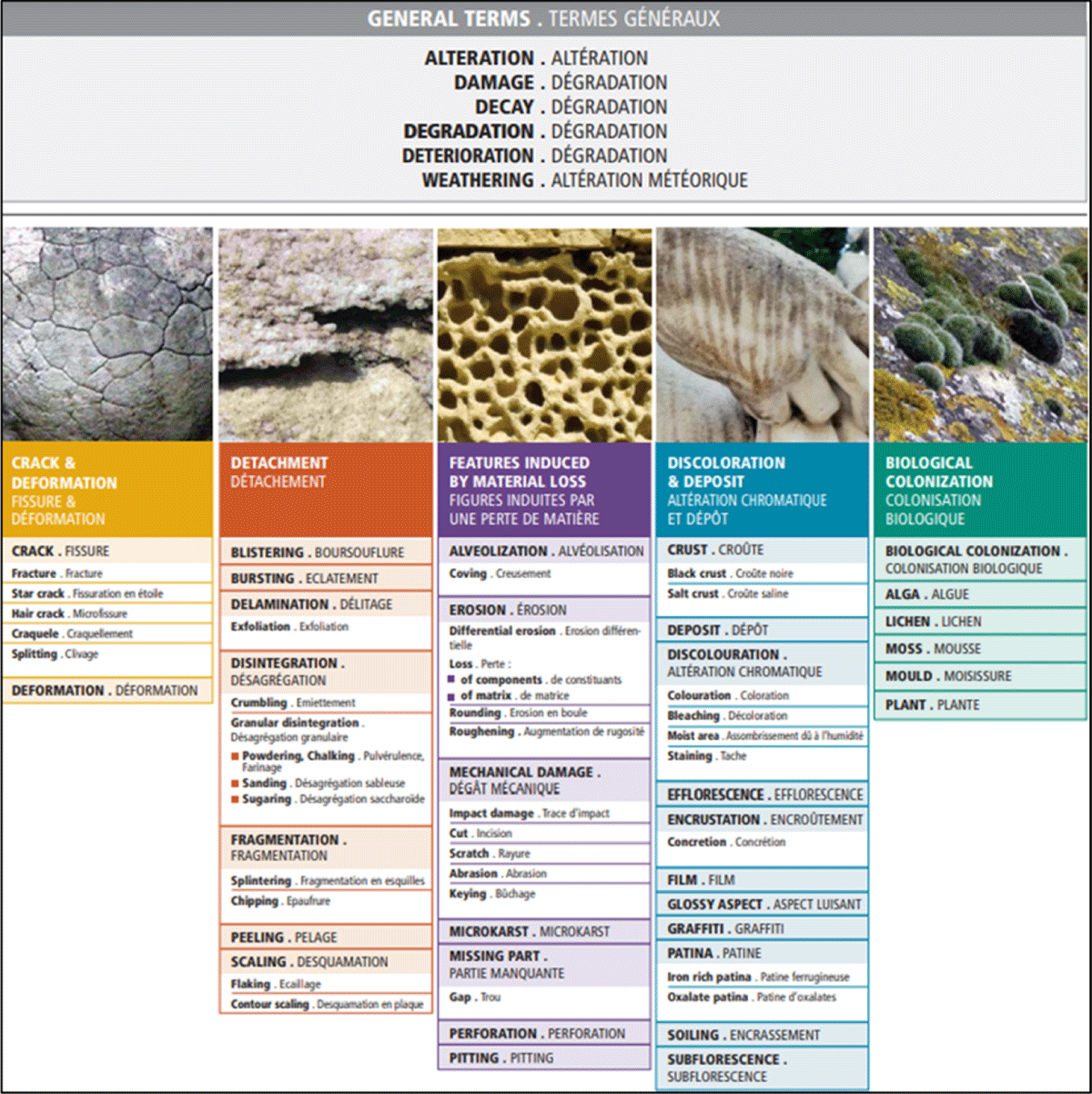
Figure 2
ICOMOS Stone Deterioration Patterns Source: ICOMOS-ISCS (2008).
In the ICOMOS Stone Glossary, patina and surface lustre are listed under the subheading ‘colour change/deposition’, and patina is defined as a surface modification that can generally be perceived as a colour change with positive connotations (ICOMOS-ISCS 2008). However, the glossary evaluates surface wear, lustre and patina separately, without distinguishing whether they cause damage to the main body of the material (ICOMOS-ISCS 2008).
The 2006 Italian Standard UNI 11182 provides a similar framework and defines patina as a change occurring naturally on the surface of a material, not resulting from deterioration processes, and perceived as a change in the material’s original colour (UNI 2006).
The standard also defines biological patina as a thin, homogeneous layer consisting of accumulations of mould, fungi, algae, lichens or bacteria, typically green, black, grey or brown in colour, and usually damp and soft to the touch (UNI 2006). Whilst it is noteworthy that both guidelines define patina primarily as a change in colour, the ICOMOS Stone Dictionary does not classify biological surface changes under the heading of patina (ICOMOS-ISCS 2008).
4.2 Metal patina
Compared with stone, metal heritage presents distinctive conservation challenges because metal surfaces are inherently reactive and continuously undergo physicochemical changes through corrosion processes. Depending on the type of metal and environmental conditions, these processes produce a wide variety of surface layers that differ in composition, morphology, stability, adhesion, and protective behaviour. While some corrosion products remain unstable and promote further deterioration, others become compact, adherent, and protective over time. Consequently, interpreting surface alterations on historic metals is considerably more complex than on stone, making the distinction between corrosion, deterioration, and patina a fundamental issue in metal conservation.
Research into metal patina has generally focused on bronze and copper. The use of copper in bronze tools and sculptures in antiquity, and its subsequent use as a building material (primarily for roofing) has attracted the interest of researchers. The aesthetic colour changes that occur over time in these metals are generally accepted as patina, and methods to preserve this colour change are being investigated (Hughes and Rowe 1991). Recent studies have continued to expand this field, particularly through the characterisation of natural and artificial patinas on copper and bronze surfaces and their conservation behaviour (Petiti et al. 2023).
Studies across various fields, such as chemistry, metallurgy, archaeology and architectural restoration, offer different perspectives on the changes occurring on metal surfaces. Whilst metallurgy generally defines patina as oxidation or decomposition processes (Corrosionpedia n.d.), the chemical terminology dictionary defines the decorative oxide films that form on the surfaces of metals such as bronze and iron when heated as patina (Sharp 2003).
Oxidation occurring naturally on bronze alloys used in sculpture is defined as patina (Demir 2020). Various factors in the atmosphere can alter the chemical structure of copper, causing a colour change from green to brown. Depending on atmospheric conditions and the structure’s location, the patina formed on copper roofs can provide protection for many years. Determining the chemical composition of this patina is described as one of the first systematic studies of corrosion (Scott 2002).
The subject of patina was discussed at the 2019 meeting of the International Council of Museums – Conservation Committee (ICOM-CC). The proceedings of the study on the concept of patina in metals emphasised that patina a protective corrosion layer that offers an aesthetically pleasing appearance should be regarded as a ‘surface layer’ and preserved (Contreras-Vargas and Cama-Villafranca 2019).
Different approaches to metal patina have been examined. Definitions of patina formed on metal materials and developed by various disciplines are listed in Table 1 below.
Table 1
Definition of metal patina in different disciplines.
| DISCIPLINE | DEFINITION | SOURCE |
|---|---|---|
| Bronze craftsmanship (sculpture, figurines, small objects, etc.) | Patina refers to a type of metal rust, a coloured oxide layer that forms on the surface of a bronze alloy. It is a thin surface formation that can occur in different colours as a result of the reaction between copper, a constituent of bronze, and oxygen. The chemical transformation in the copper’s structure is caused by factors such as moisture in the air, various chemical elements in the atmosphere, urban environment, salts present in nature, and variable temperatures. Due to these factors, the bronze surface can exhibit coloration ranging from green, depending on the variability of the factors, to red, brown, and even black. | Demir 2020 |
| Metallurgy | Patina emerges as a process of oxidation, corrosion, or a combination of both. When a material is exposed to environmental conditions such as water, wind, frost, extreme temperatures, or other factors, it begins to undergo the oxidation process that causes darkening on its surface or coating. Patina also forms through aging, wear, and even polishing. | Corrosionpedia n.d. |
| Chemistry | Bronze, iron, and similar metals develop a decorative and corrosion-resistant surface coating through the formation of an oxide film when they are heated. | Sharp 2003 |
| Metal conservation | Chemically, a patina is a corrosion layer; however, the term is often specifically used to refer to an aesthetically pleasing layer that enhances the metal object and should not be removed. Natural corrosion processes also produce, over time, patinas that are often prized and sought after. | Canadian Conservation Institute n.d. |
The use of iron materials in cultural heritage has increased since the Industrial Revolution. However, the use of iron nails dates back much further. Metallographic analyses of nails found in the Perthshire region of Scotland in 1962 (constructed around AD 85) revealed that the outer layer of the nails prevented corrosion from progressing inwards. Similar observations were made during the examination of nails recovered from 17th-century residential sites. Cross-sectional views of the nails revealed that they were covered with a uniform oxide layer, and it is thought that the barrier properties of this adhesive oxide layer played an effective role in the preservation of the nails (Nielsen 1977).
Corrosion is generally accepted as the primary cause of metal degradation and is reported to be significantly detrimental to national economies. A small number of sources also mention the protective nature of the corrosion layer. Whilst some corrosion layers possess protective properties and prevent further corrosion, others are destructive in nature and accelerate the degradation process (Wharton and Kökten Ersoy 2002). The chemical degradation of metals is termed corrosion, the physical degradation is termed mechanical breakdown, and the degradation caused by factors such as microorganisms, algae and bacteria is termed biological degradation (Özdağ 2015).
Thick, visible layers of rust can sometimes act as a protective coating for the metal. If the rust layer forming on iron or low-alloy steels in the atmosphere is thick, it delays the access of water and oxygen which are necessary for the corrosion reaction to continue to the metal surface. Thus, as the impermeability of the rust increases, the corrosion rate decreases (Üneri 1978).
Adopting a similar approach to that of the ICOMOS Stone Dictionary a visual dictionary on stone deterioration the changes occurring in metallic materials are listed below in Figure 3.
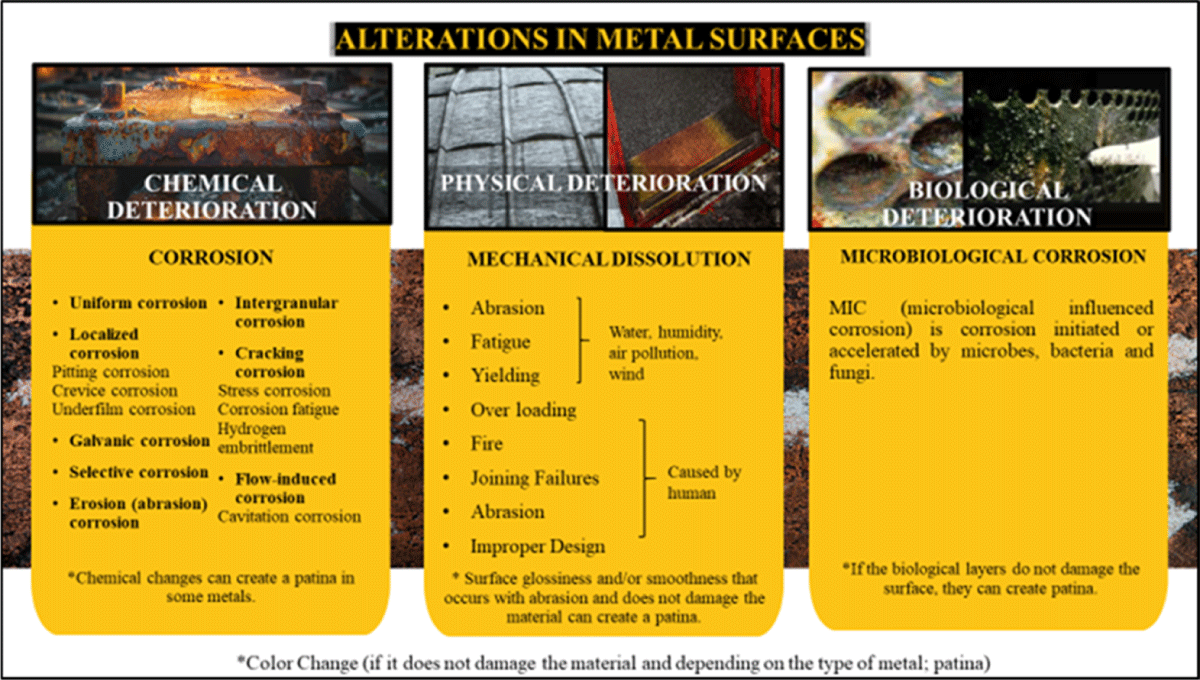
Figure 3
Alterations Occurring on Metal Surfaces. Prepared by authors based on Özdağ (2015), Özer (2021), Sansar (2018) and Uluengin (2006).
Although stone and metal surfaces are subjected to atmospheric conditions in very different ways, the atmospheric conditions causing these changes are common (Rodrigues 2006). These commonalities may include defining similarities from both physical and biological perspectives. The patina approach on metal surfaces varies depending on the metal on which the surface change occurs. Indeed, changes in stone materials also vary significantly depending on the type of material. The weathering of a hard-surfaced material such as granite will not be the same as that of a softer surface such as limestone (Rodrigues 2006; Vendrell-Saz et al. 1996). Just as a soft-textured stone will not undergo the same changes over time as a hard-textured stone, the changes occurring in metals with different properties, such as iron, copper and lead, also differ from one another (Hughes and Rowe 1991; Scott 2002).
The ICOMOS Stone Glossary deals with stone materials in general terms; similarly, a diagram has been prepared for metal by applying a similar generalisation (see Figure 3). It is important to note that the changes will not be the same for the sub-groups of each material. The atmospheric reactions of different metals vary considerably. These reactions, which fall within different fields of expertise, are not addressed in this article. The types of weathering are examined under a single heading, similar to the ICOMOS Stone Dictionary, where stone is treated under a single heading.
In the literature on metals, the term ‘patina’ is used to describe the corrosion products formed by copper and its alloys. Patina is defined as ‘a green-coloured crust formed on metal (usually bronze) due to corrosion; a colour change occurring on the surface as a result of chemical reactions caused by atmospheric effects, which can be accelerated or shaped by the object being buried in environments such as soil or underwater’ (Chilvers 2004). Another source mentions that oxidation causes colour changes in most metals and emphasises that the most striking of these occurs in copper. As a non-ferrous metal, copper absorbs oxygen and moisture from the air, forming an oxide layer on its surface known as patina. Once this layer reaches a certain thickness, corrosion ceases. Depending on the region and climate, copper’s distinctive reddish-brown colour turns green within 5–10 years alongside the patina layer (Özer 2021). Common patina constituents found on copper and copper-alloy surfaces include cuprite (Cu2O), malachite (Cu2(OH)2CO3), and azurite (Cu3(OH)2(CO3)2), which form through atmospheric oxidation and carbonation reactions (Hughes and Rowe 1991; Scott 2002).
The distinction between patina and corrosion is particularly important in terms of the conservation of archaeological metal artefacts. Metals recovered from burial or underwater environments are often covered with layers of corrosion formed as a result of centuries of exposure to soil, moisture and salts. In many cases, these layers contain unique surface details such as tool marks, inscriptions and signs of use which would be permanently lost if removed without prior analysis (Scott 2002). In copper-alloy artefacts, it is generally accepted that the stable green patina components formed in burial environments cuprite, malachite and azurite are protective, and their preservation is widely recommended in archaeological conservation practice (Hughes and Rowe 1991; Scott 2002). In iron artefacts, however, the distinction is more complex: whilst stable magnetite layers can be preserved as patina, chloride-induced active corrosion requires controlled intervention to prevent irreversible material loss. The evaluation framework proposed in this study, based on material stability, structural integrity and conservation value, provides a systematic basis for conducting such assessments across different metal types and contexts of deposition.
This interpretation is also supported by recent studies in materials science and conservation engineering. Research on weathering steel demonstrates that the stable iron oxyhydroxide layer, dominated by goethite (α-FeOOH), which develops under favourable atmospheric exposure conditions, is compositionally distinct from active rust and acts as a protective barrier against further corrosion. In this context, the layer is commonly described as a protective patina in the scientific literature (Crespo et al. 2020). A related discussion is presented by Contreras-Vargas and Cama-Villafranca (2019), who argues that the interpretation of patina on metal surfaces should be based on the stability, adhesion, and protective function of the surface layer rather than solely on the chemical composition of the underlying metal. This interpretation is further supported by Edwards, Vandenabeele and Colomban (2023), who describe the stable surface film formed on metallic artefacts as patina and, in the specific case of weathering steel, refer to the reddish rust layer as “a patina rich in hematite” that is protective under standard atmospheric conditions (Edwards et al. 2023:237). Although patina on copper has been regarded as valuable since ancient times, this change is not viewed in the same positive light for iron, as the deterioration of iron objects follows a different course (Weil 1977). The colour change in copper alloy sculptures due to ageing is considered attractive, and the protective coating formed on historical coins is viewed favourably (Hughes and Rowe 1991; Scott 2002). Similarly, the colour change in copper roofing materials across the green, orange and brown colour spectrum is also aesthetically pleasing.
Colour changes caused by corrosion in iron are generally regarded as a reaction known as rust, which significantly damages the metal, and methods to prevent this rust are sought (Scott 2002). In very few cases has rusted metal, preserved visually, been exhibited as an aesthetic object. Conservation guidelines for iron artefacts acknowledge that a lightly rusted surface in a stable condition can form a natural patina that reveals the object’s history and past use; they recommend that such surfaces be preserved rather than removed, provided that storage and display conditions are strictly controlled to prevent further corrosion (Western Australian Museum 2017).
Both the SEKA Factory and Landschaftspark Duisburg Nord feature metal plate surfaces that have been deliberately left uncleaned and unpolished as part of the conservation and redevelopment approach in both areas. Figure 4 shows the metal floor plates of the Seka Factory in the image on the left. These plates, preserved by their patina, form the fundamental structure of the visible traces of time. In Duisburg Nord, the cast iron plates of Piazza Metallica originally used to close moulds in pig iron foundries have been repositioned at the centre of the park and left in their corroded state, with the understanding that they will continue to be exposed to atmospheric conditions and corrosion through natural physical processes over time (Latz and Partner n.d.). In both cases, the surfaces have not been cleaned, treated or polished; the decision to preserve the existing layer of corrosion is a conscious and deliberate choice.
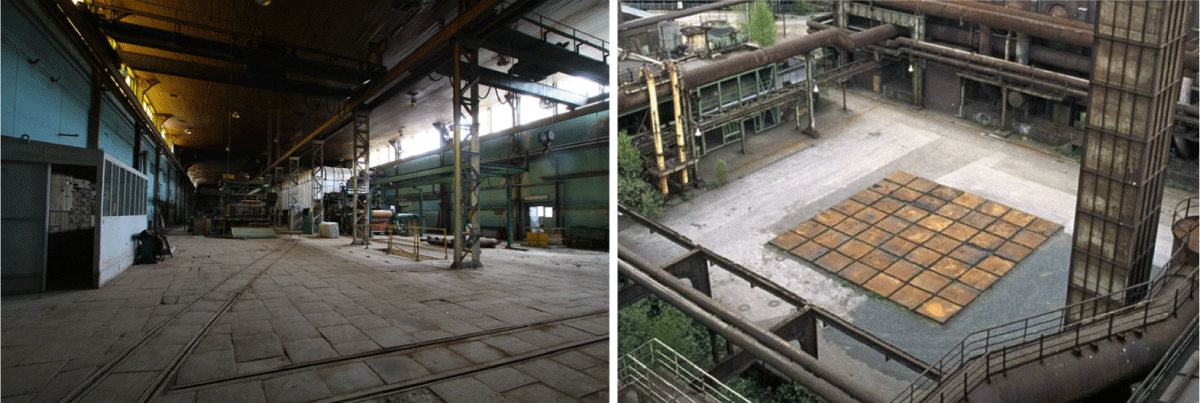
Figure 4
Left image: metal plates in the SEKA Factory (Author’s Archive 2013). Right image: metal plates in the Duisburg-Nord site. (Latz and Partner n.d.).
This approach reflects the understanding that the thick, stable rust layer present on these surfaces serves not only an aesthetic purpose but also a protective function. In iron-based metals, a stable and adherent rust layer that has reached equilibrium with its surroundings can slow down further corrosion by limiting the penetration of moisture and oxygen into the underlying metal (Deck, n.d.; Scott, 2002). The preservation of this metal layer in both samples serves to preserve the surface as a record of industrial history and enables the material itself to continue to play a protective role. The primary morphological elements distinguishing these two examples are the metal plates themselves: although they differ in scale and size, in both cases the preservation of the patina can be interpreted as a concrete manifestation of the triad comprising age value, surface narrative and controlled non-intervention. This shared approach provides a consistent criterion for comparative analysis, both in terms of the continuity of materials from industrial function to public use and in terms of aesthetic continuity, particularly regarding the visibility of the passage of time.
Figure 5 illustrates three categories of surface transformation in the metal heritage that require different conservation assessments. The image on the left shows the copper roof of Berlin Cathedral; the green discolouration resulting from long-term atmospheric exposure is clearly recognised in the literature as patina and is widely accepted as an aesthetically valuable and protective surface transformation. The central image shows the metal floor plates at Landschaftspark Duisburg-Nord; these plates, along with those from the SEKA Factory, are also detailed in Figure 4. These metal floor coverings should be assessed as patina due to their stable, adherent and non-progressive rust layers. In such cases, the rust layer has ceased to be an active degradation process and has transformed into a surface layer that preserves the underlying material from external factors whilst bearing the traces of industrial history. The image on the right, however, shows the exposed fasteners of the SEKA Factory, which are subject to active corrosion. As these surfaces do not form a stable layer and threaten the integrity of the material, they cannot be considered patina and should be classified as deterioration within the evaluation framework proposed in this study.
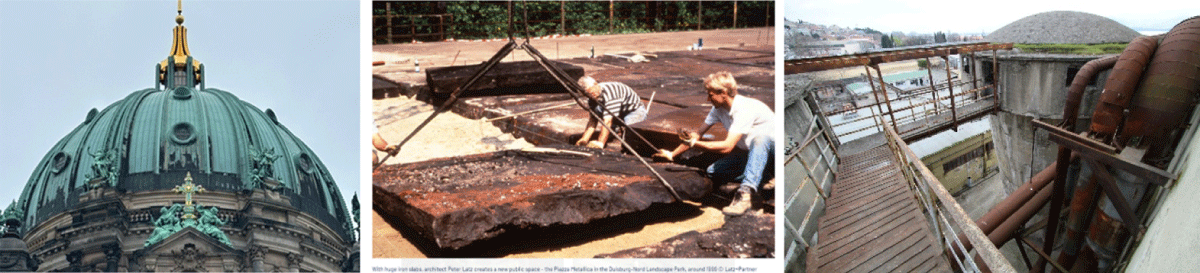
Figure 5
From left to right: the copper roof covering of Berlin Cathedral (Author’s Archive 2026), rusted metal floor plates in Duisburg Nord-Emscher Park (Emscher Park n.d.), and rusted surfaces from the SEKA Factory (Author’s Archive 2013).
4.3 Surface alterations due to excessive use on metal surfaces: gloss and abrasion
Stone surfaces provide a useful point of comparison for understanding the patina resulting from use on metal heritage. In the ICOMOS Stone Glossary, surface lustre, colour change and accumulation resulting from use are classified under this heading and are implicitly treated as a type of patina insofar as they constitute a harmless surface modification generally carrying positive connotations (ICOMOS-ISCS 2008). This classification raises a directly analogous question regarding metal surfaces: can the lustre and wear resulting from prolonged human contact on metal heritage objects be considered patina in the same sense?
The Oxford English Dictionary (2025) defines patina as ‘the lustre of a surface resulting from ageing, use or polishing’, citing as an example the smooth, polished surface of a well-used leather chair. Ruskin (1849: ‘The Lamp of Memory’, Aphorism 30) defined patina as the ‘golden stain of time’ that imparts a building’s true light, colour and value; Philippot (1996:372) defined it as ‘the normal effect of time on materials. The SPAB Report (1877) characterised all imperfections and irregularities on a building’s surface as evidence of age Feilden (2003) has regarded all irregularities within a structure as part of its acquired character); Jokilehto (1999) has argued that ageing creates a permanent change on the surface; Simmel (1919), meanwhile, has defined it as something arising from the struggle between nature and the human spirit. All these definitions support the argument that surface changes resulting from use and ageing including lustre and wear fall within the scope of the concept of patina, provided they do not compromise the integrity of the material.
The Hagia Sophia is examined here as a primary case study to evaluate this proposition. The stone thresholds of the monument, smoothed by centuries of pedestrian use, exhibit surface wear and a lustre that do not compromise the structural integrity of the building’s fabric nor hinder its use (Figure 6, left). Metal door frames, touched repeatedly by human hands over generations, display both colour changes and surface lustre that can be interpreted as manifestations of patina. The Weeping Column, a marble column clad in copper that has been worn and polished over centuries through intense contact driven by religious devotion, provides a further example of how physical wear simultaneously produces a surface condition that serves as a record of use, a mark of time, and an aesthetic feature (Figure 6, right). In each of these cases, the surface change is stable and non-progressive in nature and carries interpretative value as evidence of historical continuity. As seen in this example, wear and polishing do not compromise the structural integrity of the material. Describing the changes in the images as patina rather than deterioration is an acceptable approach, as it does not hinder the conditions of use and may even evoke a sense of sentimentality.
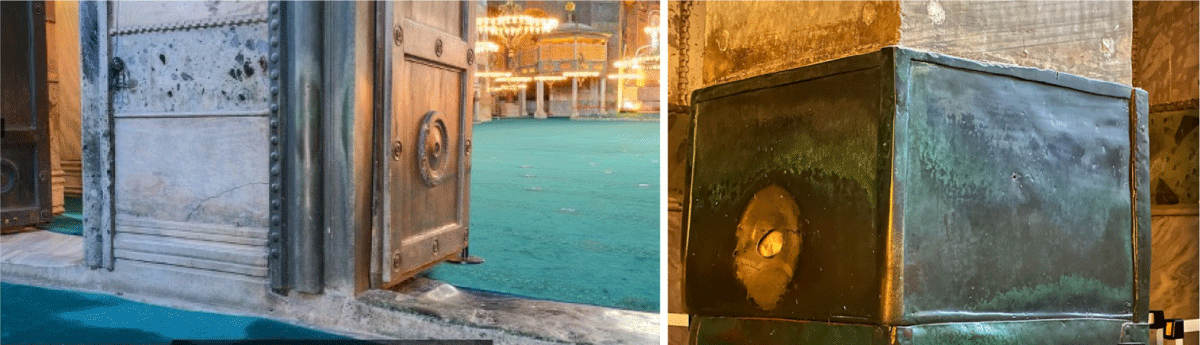
Figure 6
Thresholds made of stone material and metal door mouldings shining from friction in Hagia Sophia (Hagia Sophia Mosque n.d.). The column on the right side is worn and glossy from intense hand contact and friction (Weeping Column, Hagia Sophia Mosque, Author’s Archive 2024).
Not every surface change can be classified as patina. Surface losses that damage the body of the material, impair legibility, or continue to progress actively should be classified as deterioration requiring intervention. This debate surrounding stone façades highlights the complexity of striking a balance. The traces of time can become so extensive that they begin to obscure the object’s formal and historical character (Ersen 2009). As Ersen notes, Ruskin, Riegl and Brandi argued that the patina on building surfaces should not be removed by cleaning.
However, when these approaches were formulated, the processes of deterioration encountered today such as the transformation of limestone into gypsum or the dissolution of surface crusts due to air pollution were not yet an issue (Ersen 2009). Therefore, a careful balance must be struck between preserving the patina and maintaining the physical integrity of the structural material.
To clarify the distinction between patina and deterioration, this study suggests that surface changes should not be judged only by how they look but considered through a set of interconnected criteria. A surface change may be classified as patina when it is stable in terms of the material, does not progress further, and does not jeopardise the structural integrity of the object. In addition, transformations that contribute to the legibility of age, use, and historical continuity, or that form a protective surface layer, can also be considered part of patina. In contrast, surface changes that are actively progressing, lead to material loss, or weaken the structural performance of the object should be classified as deterioration requiring intervention.
Applying this framework is not a purely visual judgement. Although the present study addresses interpretation within conservation theory rather than chemical analysis, establishing the material stability on which the framework depends requires verification in practice: the composition of a corrosion layer can be identified through spectroscopic or diffraction analysis (for example, confirming the goethite (α-FeOOH) that characterises a stable, protective layer on weathering steel, as noted above), and its behaviour over time can be confirmed through long-term visual monitoring. The framework thus supplies the conservation-theoretical criteria for interpretation, while material verification provides the evidential basis on which those criteria are applied.
In order to apply these criteria, the surface transformations observed in the selected case studies are evaluated comparatively in terms of stability, progression, structural impact and conservation value. The weathered stone thresholds and metal door frames of Hagia Sophia exhibit surface changes that have no detrimental structural impact. Similarly, the weathered surface of the Weeping Column within Hagia Sophia reveals a lustre resulting from use, which remains stable in terms of material and culturally significant. These surface changes are referred to as patina. This comparative study demonstrates that the proposed criteria can be systematically applied to distinguish between patina and damage in different material contexts.
This distinction has clear practical consequences for conservation decision-making. When the criteria discussed in this study are applied to the case studies—the metal surfaces and stone thresholds of Hagia Sophia, the copper roof of Berlin Cathedral, and the rusted floor plates at Duisburg Nord and SEKA it becomes clear that patina and surface change cannot really be separated into fixed categories.
The decision as to whether changes occurring on the surface constitute deterioration or patina must be made by taking into account not only the structural and functional deterioration of the material, but also the type of material used, the extent of the change on the surface, and the context of conservation. Where surface wear remains confined to the surface level, has reached a stable state, and does not impair legibility or functionality, it should be preserved rather than intervened upon.
5. Conclusion and Implications
Although patina generally refers to the change that surfaces undergo over time in contemporary dictionaries, in art history and conservation discourse it largely corresponds to a pleasing colour change. This change that occurs on objects has been described as a valuable accumulation because it accompanies the passage of time. The modern equivalent of the beautiful patina that Pliny described as “aerugo nobilis” can be traced back to a commercial material known as weathering steel, which has become widespread both for its capacity to enhance the resistance of iron against atmospheric conditions and for its colour change, which appeals to aesthetic perception.
The term patina is used in different languages, particularly to describe the aesthetic accumulation and positive effects of varnishing on metal objects. The meaning of patina varies both depending on the nature of the material it forms on and the approach of the field of expertise studying it. Since patina is a result of the natural changes materials undergo over time, preserving the object’s legibility becomes crucial when deciding to preserve the patina.
Additionally, if patina causes damage to the material, especially from the perspective of preserving cultural heritage, the approach to this issue must be changed.
Consequently, this study proposes that the concept of patina go beyond mere colour change and should also encompass changes that do not cause deterioration or impair the functionality of the material, such as brightness, wear, and smoothness. To put this proposition into practice, the study proposes an evaluation framework based on three criteria: material stability, structural integrity, and conservation value. Examples covering the metal surfaces of Hagia Sophia, the copper roof of the Berlin Cathedral, and the rusted floor slabs of Duisburg Nord-Emscher Park and SEKA have been interpreted as patinas representing different forms of surface change. This comparative analysis demonstrates that patina and surface change are not mutually exclusive categories.
The weathering marks on metal surfaces of structures with industrial heritage value should be preserved as a patina layer, provided they do not damage the original metal surface. Removal of this weathering layer should only be considered when damage to the metal is evident. Considering that certain iron surfaces naturally develop a rusty and stable layer when sufficiently thick and impermeable, it is clear that the formation of patina on metal surfaces should not be limited to copper and its alloys. Therefore, the concept of patina on metal surfaces needs to be reconsidered and developed through interdisciplinary research that specializes in different contexts. Just as patina on stone is accepted as an integral part of the material’s authenticity and historical significance, a similar perspective should be adopted for metal surfaces.
These findings carry implications on two levels. Theoretically, they suggest that the stability, adhesion and protective function of a surface layer, rather than the chemical identity of the underlying metal, may offer more appropriate criteria for distinguishing patina from active deterioration on historic metals, extending a concept long associated with copper alloys to stable iron and steel surfaces. Practically, this reframing could provide a productive basis for future terminological revision within heritage documentation, including the glossaries maintained by bodies such as ICOMOS and TICCIH, and it could inform site-management practice by encouraging the monitoring and retention of stable, passive corrosion layers rather than their routine removal, while reserving intervention for genuinely active corrosion. Rather than prescribing a single course of action, the framework proposed here is offered as a basis for more consistent and better-informed conservation judgement.
Appendices
Appendix
Table A1
Dictionary Definition of Patina.
| DICTIONARY NAME | DEFINITION | SOURCE |
|---|---|---|
| Encyclopédie | Patine is defined as the beautiful green verdigris colour that copper acquires, which the Italians call ‘patina’. | Weil 1977 |
| Oxford English Dictionary | 1-A thin layer covering the surface of something, typically emerging with age or use. For example, a green film on the surface of old bronze or copper or a glazed surface on ceramics. 2-The surface brightness that results from aging, use, or polishing. For instance, the smooth and shiny surface of a well-used leather chair. 3-A top layer or outer coating acquired over a long period, often carrying connotations of authenticity or references to ancient times, gained through prolonged service in a profession. 4-A type of colour change or staining usually occurring on teeth due to age or dietary factors. 5-In biology, a feature such as colour or pattern on the surface of an organism that assists in camouflage or protection. | Oxford English Dictionary 2025 |
| Merriam-Webster | 1-a. A green film naturally formed on copper and bronze over an extended period of exposure and artificially created with acids, often aesthetically appreciated. 1-b. The surface appearance gained by the aging or use of something, particularly valued for its aesthetic appeal. 2-An appearance or aura derived from a relationship, habit, or established character. 3-A superficial coating or outer surface. | Merriam-Webster n.d. |
| American Heritage Dictionary | 1-A thin, greenish layer typically composed of basic copper sulphate that forms on copper or copper alloys, as a result of natural corrosion or chemical processes. 2-Luster developed on a surface, typically like wood, due to age and use. 3-A superficial outer layer; a coating. 4-A superficial impression, especially one considered to be added or acquired. | American Heritage Dictionary n.d. |
| Online Etymology Dictionary | Since 1748, the term “patina” originates from the French word “patine” in the 18th century, which, in turn, comes from the Italian word “patina.” While it may be related to the Latin “patina,” meaning “shallow dish, plate, pan” (Greek “patane,” meaning “dish, plate”), derived from the PIE *pet-ano-, *pete- “to spread” root, the exact reason for its presence on the surfaces of various ancient objects, including bronze plates and pans, remains uncertain. The term gained an additional meaning in 1933, referring to “refinement, cultural sophistication,” likely due to its significant contribution to the beauty of antique bronzes. It was further expanded in the 1890s concerning the surface textures of decorative artworks. | Online Etymology Dictionary 2025 |
| Dictionary of Art Concepts and Terms | Patina is defined as the worn surface that develops over time on all kinds of old art objects. For instance, it is possible to talk about the patina of stone cladding on a structure. Contemporary conservation understanding prefers to preserve patina if it does not harm the work, rather than eliminating it. | Sözen and Tanyeli 2007 |
| Dictionary of the Royal Academy of the Spanish Language (DRAE) | It is defined as “especially the thin film of oxide or carbonate that forms on the surface of metals, such as bronze or copper, as a result of atmospheric effects, gaining aesthetic value when it acquires some lustre. Additionally, it is described as a transparent or semi-transparent thin layer applied to a work of art, especially a painting, to provide protection or alter its appearance. Moreover, it is expressed as a transparent, olive-coloured coating formed as a result of the aging and oxidation of ancient bronze and copper objects. | Real Academia Española n.d. |
| The Penguin Dictionary of Chemistry | It is a decorative surface coating achieved through the formation of an oxide film when metals such as bronze and iron are heated, providing corrosion resistance. | Sharp 2003 |
| Corrosionpedia | Patina is a type of rust that can be written as Fe2O3.nH2O. Chemically, it is formed by the reaction of oxides, sulphides, carbonates, and other elements in the coatings of materials with environmental factors such as acid, oxygen, rain, compounds containing sulfur, and carbon dioxide. | Corrosionpedia n.d. |