
Figure 1
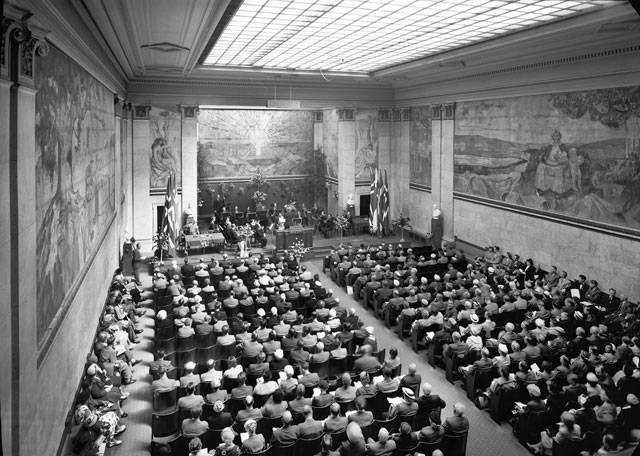
The monumental Munch paintings in the University of Oslo’s Aula, seen during a concert performed in 1955. An uneven deposition of dirt can be seen on the left of the painting History in the form of dark, horizontal stripes. Photo Courtesy: Oslo Museum.
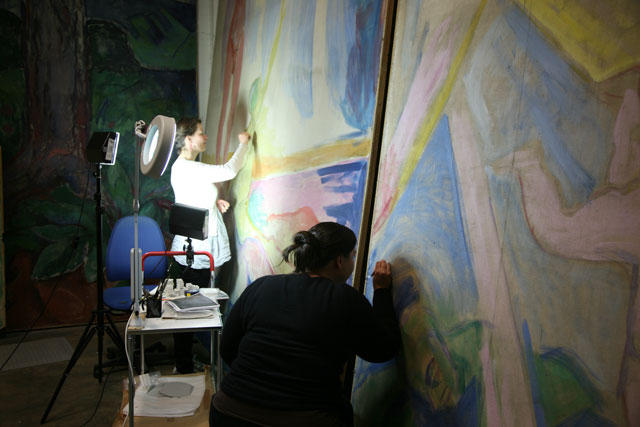
Figure 2
Conservation work being performed in 2009. Conservation on the monumental Munch paintings, Geniuses in Lightstream and Awakening Men in Lightstream, by Mirjam Liu and Hanne Moltubakk Kempton. Photo: Karen Mengshoel, 2009.
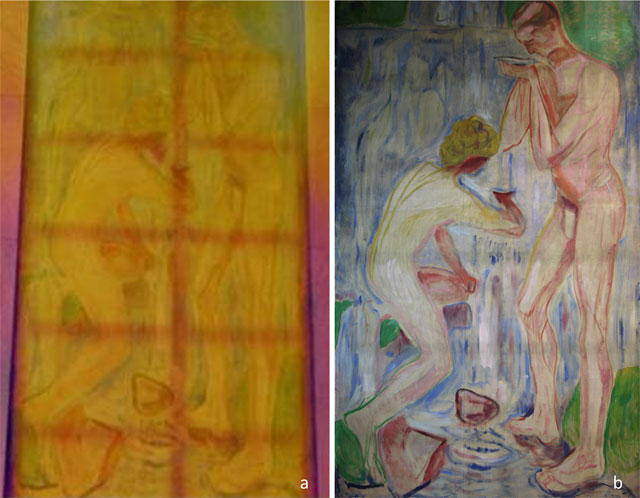
Figure 3
(a) Infrared spectrum of the painting The Source showing thermal bridges formed by a wooden framework behind the paintings. Photo: Dag Dysthe, Olav Gundersen and Karen Mair, 2006. (b) Uneven, thermal soiling caused by the framework. Photo Karen Mengshoel, 2009.
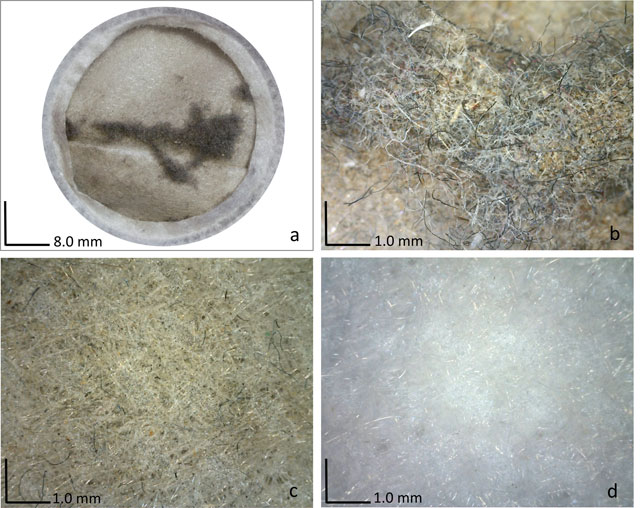
Figure 4
Soil particles from vacuum cleaning. Hose opening of vacuum bag with visible dirt content (a), and the inside surface of a vacuum bag showing large fibrous (b) and smaller (c) dirt particles collected with a brush and low-vacuum from the Aula painting Alma Mater, compared to (d) a clean reference area. DinoLite, 55× magnification.
Table 1
Model parameters and input values.
| Parameter | Value | Explanation |
|---|---|---|
| Start condition in 1916 (%) | 100 | No soiling on the paintings at mounting in 1916 |
| Condition before cleaning in 2009–2011 (%) | 80 | 20% perceived soiling in 2009 (subjective assessment of overall soiling, which was very variable) |
| Condition after cleaning in 2009–2011 (%) | 90 | 10% improvement in the “soiling condition” due to cleaning |
| Reduction in air pollution concentrations from “average 1916–2009” to “average after 2011” (%) | Scenario 1, “Low”:
50 Scenario 2, “High”: 80 | Two scenarios with different future air pollution levels were applied: Reduction to 50% and 20% of the air pollution particulate load on the paintings |
| Importance of air pollution for observed soiling (%) | 90 | 10% of the observed apparent soiling was attributed to unexplained causes other than air pollution |
| Time dependence (0 < x < 1) | 1 | Linearity of the historical, and predicted future, change in the soiling condition was assumed. |
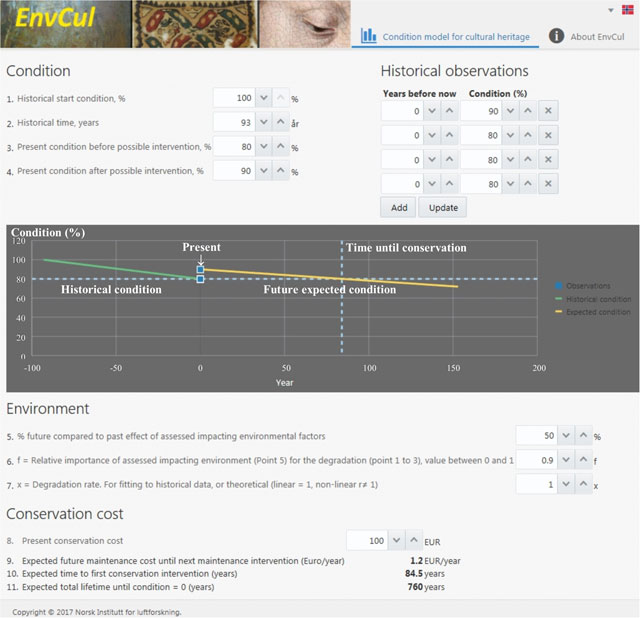
Figure 5
Front page of the EnvCul web model. The model of the soiling damage of the Aula paintings according to Scenario One is shown. Additional explanatory text is included on the model diagram. The only direct observations available from the time until the conservation in 2009–2011 are the extent of soiling before the “present” conservation campaign in 2009, which was judged to be 80%, and after the campaign, which was judged to be 90%.
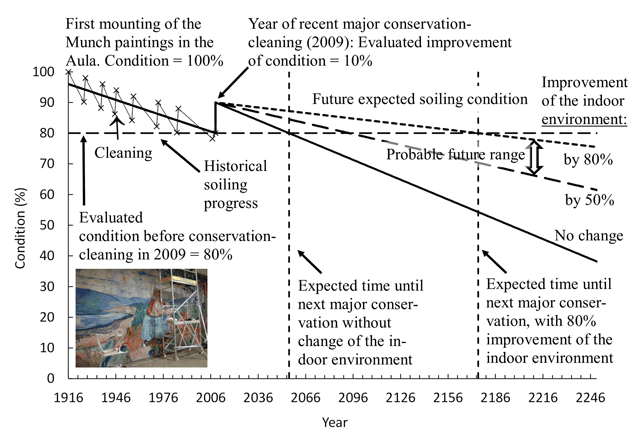
Figure 6
EnvCul modelling projection for the Munch paintings in the University of Oslo’s Aula. Projection of the expected extent of soiling and time until the next major cleaning campaign. Situations with no change and two scenarios with change in the future indoor environment are shown. Photo: Olaf Christensen, The Aula-project: https://www.hf.uio.no/iakh/forskning/prosjekter/aula-prosjektet/.
Table 2
EnvCul estimates of future cleaning costs and lifetimes, due to soiling, for the Munch paintings in the University of Oslo’s Aula.
| Without change of the indoor environment | With reduction (%) in indoor air pollution | Saving/change by improvement of the indoor environment, with 50% to 80% | ||
|---|---|---|---|---|
| 50% | 80% | |||
| Expected future cost for invasive cleaning campaigns (Currency unit, C/year per 100 C investment) | 2.2 | 1.2 | 0.6 | 1.0–1.5 (45–72%) |
| Expected time until the next major cleaning treatment (years) | 47 | 85 | 166 | 38–120 (82–257%) |
| Expected (indicated) lifetime before the object would be completely visually obscured by soiling and related effects – if no future major cleaning treatments were implemented (years) | 418 | 760 | 1494 | 342–1076 (82–257%) |