
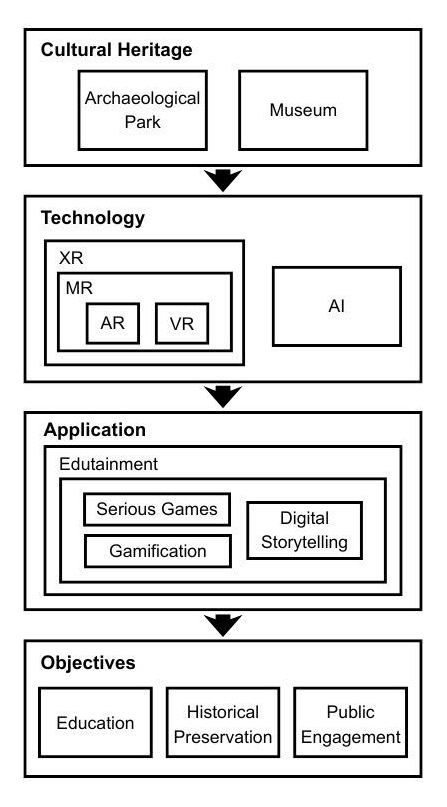
Figure 1
Relationships between cultural heritage, immersive technologies and educational applications.
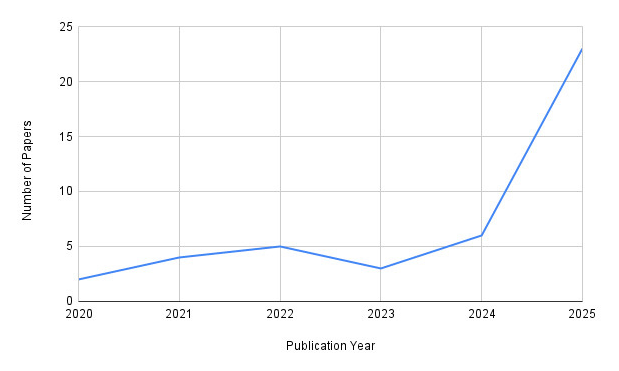
Figure 2
Yearly count of papers produced.
Table 1
Mapping research questions.
| RESEARCH QUESTIONS | MOTIVATION |
|---|---|
| Q1. How do immersive technologies shape visitor engagement, motivation and experiential interaction within archaeological parks? | M1. Relevance and Applicability: This research question seeks to explore whether immersive technologies have the capacity to contribute to the field of archaeology and tourism, sparking interest in visitors and potential researchers. |
| Q2. In what ways do immersive technologies enable broader access, inclusivity and audience expansion in archaeological parks? | M2. Contribution to the Academic Community: This research question seeks to deepen the literature on existing applications of immersive technologies in archaeological park tours and how they can be used in the democratization of heritage. |
| Q3. What impact do immersive technologies have on teaching cultural heritage to students? | M3. Contribution to the Academic Community: This research question seeks to deepen the literature on existing applications of immersive technologies in archaeological park tours for educational purposes. |
| Q4. What gaps persist in the literature regarding the accessibility, inclusion and sustainability of these projects? | M4. Knowledge Gaps: This project seeks to expand knowledge regarding pre-existing gaps in project sustainability. |
Table 2
Main terms and their keywords for creating the search string.
| RELATED TO METHODOLOGIES | Digital storytelling; Gamification; Serios Games; Edutainment |
| RELATED TO TECHNOLOGIES | Virtual Reality; Augmented Reality; Mixed Reality; Extended Reality; Artificial Intelligence |
| RELATED TO CONTEXT | Archaeological Park; Museum; Cultural Heritage |
Table 3
Inclusion and exclusion criteria applicable to research work.
| INCLUSION CRITERIA |
| They apply gamification, digital storytelling, serious games or edutainment as central methodologies. |
| They use immersive technologies. |
| They are implemented in heritage-related and archaeological. Including but not limited to archaeological parks, open-air museums or urban historical spaces. |
| They involve real-world applications with documented user interaction, evaluation or deployment. |
| They are published in peer-reviewed journals. |
| They are written in English, Spanish or Italian. |
| They were published between 2020 and 2025. |
| EXCLUSION CRITERIA |
| They lack practical implementation, such as purely theoretical proposals, conceptual frameworks without case studies or speculative designs without user engagement. |
| They do not provide sufficient methodological information for evaluation. |
| Works that do not focus on cultural heritage as a primary domain. |
| Papers that describe commercial products without scientific analysis. |
| Duplicated studies or extended versions of previously included works. |
| Are not accessible in full text. |
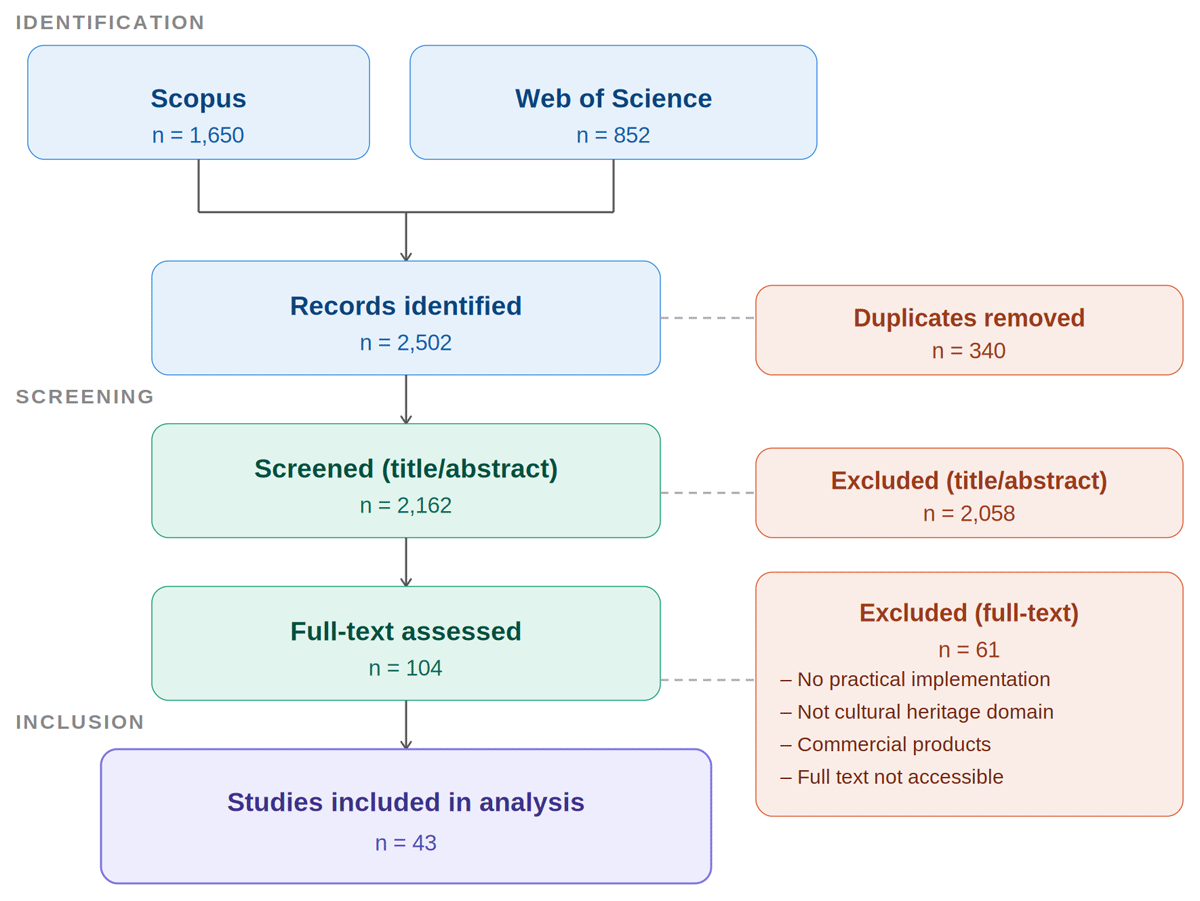
Figure 3
Paper selection process - PRISMA.
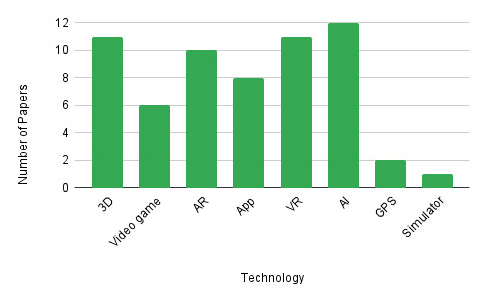
Figure 4
Frequency of technologies used in the papers analyzed.
| ID | SOURCE | TITLE | TECHNOLOGY | APPLICATION |
|---|---|---|---|---|
| P1 | (Ceccacci et al. 2025) | Co-designing a Virtual Museum Application with a Haptic Interface Involving People with Vision Impairments and Blindness | VR | Virtual Reality for museums, aimed to people with vision impairments |
| P2 | (Aricò et al. 2024) | Three-Dimensional Documentation and Virtual Web Navigation System for the Indoor and Outdoor Exploration of a Complex Cultural Heritage Site | 3D digitalization | 3D reconstruction of “Santa Maria della Grotta” for virtual tour |
| P3 | (Bonacini and Giaccone 2022) | Gamification and cultural institutions in cultural heritage promotion: a successful example from Italy | Video game | Mi Rasna, a serious game on the Etruscan society |
| P4 | (Bontchev et al. 2022) | “Let Us Save Venice”—An Educational Online Maze Game for Climate Resilience | Video game | Application of the serious game “Let us save Venice” to raising awareness to climate resilience and built heritage sustainability |
| P5 | (Capecchi et al. 2024) | Augmented reality and serious game to engage the alpha generation in urban cultural heritage | AR, Video game | Application of AR based on a serious game (treasure hunt) and GPS-based app aimed to children to enhance cultural heritage appreciation, in Village of Caldana |
| P6 | (Casillo et al. 2024) | Serious Gaming for Cultural Heritage: the case study of the Domus of Abellinum | 3D digitalization, Video game | Application 3D model of scanned Abellinum Archaeological Park in Atripalda, to a serious game “Exploring Abelli-num” |
| P7 | (Cerreta et al. 2021) | Triggering Active Communities for Cultural Creative Cities: The “Hack the City” Play ReCH Mission in the Salerno Historic Centre (Italy) | App | Mobile app that applies gamification to enhance the appreciation of Salerno historic centre |
| P8 | (Clini et al. 2025) | Inclusive Museum Engagement: Multisensory Storytelling of Cagli Warriors’ Journey and the Via Flamina Landscape Through Interactive Tactile Experiences and Digital Replicas | 3D digitalization, App | Multisensory storytelling applied on a video, an app and the 3D impression based on the 3D digital version of the bronze statuettes at Via Flaminia Museum in Cagli |
| P9 | (Clini etal. 2023) | From point cloud data to HBIM for public performance spaces knowledge, management and storytelling: Palazzo Olivieri in Pesaro | 3D digitalization, AR, VR | An HBIM was used to generate AR and VR experiences of Palazzo Olivieri-Machirelli in Pesaro |
| P10 | (Wang et al. 2025a) | Adopting AR wayfinding in heritage tourism: extending the UTAUT in cultural contexts | AR | Application of AR wayfinding systems in open historic districts in China |
| P11 | (Fazendaet al. 2025) | A sailing simulator for the revival of the Tagus River nautical heritage | 3D digitalization, Other (simulator) | A simulator that recreates how Tagus River sailboats use to sail |
| P12 | (Hu 2025) | AI-curated soundscapes: spatial reconfiguration of intangible cultural heritage music in urban China | AI | Application of AI to redistribute and enhance appreciation of intangible cultural heritage |
| P13 | (Amore et al. 2025) | The Paleontological Heritage as a Mean for Territorial Revitalization: Innovative Communication Modalities for Pietraroja Site (Southern Italy) | AR, MR, VR | AR, MR and VR technologies aimed to create digital spaces where visitors can explore the site and understand its cultural value in Pietraroja paleontological site |
| P14 | (Fiorenzaet al. 2025) | Designing accessible museum experiences in virtual reality for individuals with Autism Spectrum Disorder | VR | Virtual visits using VR specifically suited to the needs of individuals with ASD, providing accessible experiences |
| P15 | (Gaspari et al. 2024) | An Open-Source Web Platform for 3D Documentation and Storytelling of Hidden Cultural Heritage | 3D digitalization, App | Replicable model to explore de 3D reconstruction of Farnese Castle in Piacenza also aimed to provide digital documentation and technical accessibility |
| P16 | (Gonçalves, Dorsch and Figueiredo 2022) | Digital Tourism: An Alternative View on Cultural Intangible Heritage and Sustainability in Tavira, Portugal | App | An app that integrates virtual routes through key locations that revolve around the cultural heritage of the Mediterranean diet in Tavira |
| P17 | (He and Tao 2025) | Applied research on innovation and development of blue calico of Chinese intangible cultural heritage based on artificial intelligence | AI | A program that applies AI-based style transfer to generate innovative blue calico designs, revitalizing traditional textile heritage for modern use in China |
| P18 | (Heath 2022) | Game Engines and Playification at Pompeii and for Roman Art and Archaeology | 3D digitalization | An interactive environment built on a cloud-based game engine that uses the House of the Faun in Pompeii as a playful platform for classroom discussion of ancient domestic spaces through edutainment |
| P19 | (Čejka, Zsíros and Liarokapis 2020) | A hybrid augmented reality guide for underwater cultural heritage sites | AR | An AR guide for divers that visualizes ancient underwater buildings in Baiae |
| P20 | (Zhang, Luo and Pan 2025) | Design and evaluation of touch and touchless interfaces for interactive digital heritage experiences | MR, 3D digitalization | Virtual museum with touch and gesture interfaces to connect and interact with the museum’s heritage in China |
| P21 | (Kleftodimos, Moustaka and Evagelou 2023) | Location-Based Augmented Reality for Cultural Heritage Education: Creating Educational, Gamified Location-Based AR Applications for the Prehistoric Lake Settlement of Dispilio | AR, GPS, App | Two location-based augmented reality apps that use gamification and storytelling to teach cultural heritage at a prehistoric lake settlement of Dispilio |
| P22 | (Kyropoulou et al. 2025) | A 3D geospatial platform and AI tour application for visualizing archaeological, analytical and conservation data: the case of the Vryokastro archaeological ensemble, Kythnos Island | 3D digitalization, AI, GPS | AI-powered virtual tours, 3D geospatial visualization and archaeometric data to interpret and conserve the Vryokastro site in Kythnos island |
| P23 | (Lai, Tian and Zhang 2025) | The impact of AI-generated technologies-driven digital cultural heritage platforms on users’ offline cultural participation intentions | AI | A study of the Cloud Tour of Dunhuang platform that applies AI-driven analysis to show how online experiences influence offline participation, highlighting narrative design as a key driver and privacy risks as suppressors. |
| P24 | (Linchamps et al. 2025) | Reconstructing the palaeoclimate of the Cradle of Humankind in South Africa over the last 3.5 million years using machine learning and mammalian fossil assemblages | AI | A machine learning study using faunal data from the Cradle of Humankind to reconstruct past climates |
| P25 | (Manglis et al. 2021) | Implementing multi-criteria analysis in the selection of auchs for the integration of digital technologies into the tourism offering: The case of medrydive | AR, VR | A methodology from the MeDryDive project for selecting accessible underwater cultural heritage sites in the Mediterranean, promoted through dry dive experiences, serious games and AR/VR applications |
| P26 | (Mantzou, Bitsikas and Floros 2023) | Enriching Cultural Heritage through the Integration of Art and Digital Technologies | App | An open-air, app-driven museum route from the PALIMPSEST project that integrates storytelling, interactive installations and community participation to reshape cultural heritage experiences in Ioannina |
| P27 | (Mauro et al. 2021) | Cultural heritage and storytelling: didactic applications in Trieste with ESRI Story Maps | App | ESRI Story Maps used to create digital storytelling web apps on local cultural heritage, including the Bora wind and the Tram of Opicina. |
| P28 | (Nevola, Coles and Mosconi 2022) | Hidden Florence revealed? Critical insights from the operation of an augmented reality app in a World Heritage City | AR, App | AR app that analyzes user engagement and challenges in using digital tools for managing overtourism at heritage destinations |
| P29 | (Pagano et al. 2020) | ArkaeVision VR game: User experience research between real and virtual paestum | VR | The ArkaeVision is a virtual tour that applies VR to recreate Paestum’s Temple of Hera II with immersive storytelling |
| P30 | (Liamruk et al. 2025) | Development and evaluation of an augmented reality serious game to enhance 21st century skills in cultural tourism | AR, Video game | KideClass an AR serious game that engages children and parents in cultural tourism through mini-games |
| P31 | (Pietroni et al. 2023) | e-Archeo: A Pilot National Project to Valorize Italian Archaeological Parks through Digital and Virtual Reality Technologies | 3D digitalization, VR, MR | The e-Archeo promotes eight archaeological sites in Italy, combining scientific rigor with narrative storytelling. Outputs include a website, a 360° virtual tour app with VR multimedia and a podcast app dedicated to each site |
| P32 | (Ren 2025) | Inheritance and protection of intangible cultural heritage in drama category based on AI human–computer interaction and digital technology | AI | The Heritage Transmission System for Drama Culture model applies neural networks to generate interactive, personalized content for traditional Chinese dramas |
| P33 | (Rizvic, Boskovic and Mijatovic 2025) | Contribution of gameplay elements to the quality of user experience in war heritage virtual reality applications | VR, Video game | The Battle on Kozara is a serious game with VR application that recreates a WWII battle in Bosnia and Herzegovina, combining interactive digital storytelling with gameplay |
| P34 | (Sebastiani 2021) | Digital artifacts and landscapes. Experimenting with placemaking at the impero project | 3D digitalization, AR | AR/3D reconstructions, digital narratives and a dedicated website to engage communities to Etruscan and Roman heritage. |
| P35 | (Suiçmez et al. 2025) | Artificial intelligence application for museum to experiential transformation of cultural heritage and learning | AI | A qualitative study on AI in museums that analyzes how applications enhance accessibility, interaction and cultural heritage preservation |
| P36 | (Vasic et al. 2024) | 3VR: Vice Versa Virtual Reality Algorithm to Track and Map User Experience | VR | The “Vice Versa” VR tracking algorithm analyzes user behavior in the Virtual Museum of Ascoli Piceno, identifying regions of interest and patterns of interaction to guide design and future recommender systems |
| P37 | (Vosinakis et al. 2025) | Designing and evaluating an immersive VR experience of a historic sailing ship in museum contexts | VR | A VR installation reconstructs a historic sailing ship for a museum exhibition |
| P38 | (Wang et al. 2025c) | Can AI replace experts in the evaluation of cultural heritage? Based on the controlled experiments conducted on six architectural heritages | AI | This study evaluates AI’s ability to assess the conservation status of architectural heritage, showing that five mainstream models achieved expert-level performance in analyzing six sites in Kunming, China |
| P39 | (Yang et al. 2025) | Artificial intelligence assists the identification and application of rural heritage wall surface damage in Zhejiang | AI | YOLOv8 deep learning model and a Raspberry Pi 5-based mobile system to detect and monitor damage in traditional dwelling walls of Zhejiang’s rural heritage |
| P40 | (Zhou et al. 2025) | Fine-tuning diffusion model to generate new kite designs for the revitalization and innovation of intangible cultural heritage | AI | An AI-based diffusion model, trained on a custom kite style dataset with a novel loss function, to generate new auspicious-themed kite designs, offering a technical pathway for revitalizing intangible cultural heritage |
| P41 | (Wu et al. 2025) | KaiBiLi: gesture-based immersive virtual reality ceremony for traditional Chinese cultural activities | VR | A gesture-based VR application of the First Writing Ceremony for children |
| P42 | (Yujie, Haotian and Chi 2025) | Kraak porcelain decorative pattern restoration using generative AI: a pilot study | AI | A model enhanced with LoRA and ControlNet, trained on a custom Kraak porcelain image database, to generate and restore intricate Kaiguang patterns, offering a framework for digital preservation and innovation in cultural heritage |
| P43 | (Zhang, Shao and Li 2025) | Play, watch, share: the dissemination of the cultural presence of games on video-based social media | AI | This study analyzes Black Myth: Wukong as a cultural phenomenon, using interactive ritual theory and data from 462 Bilibili videos to build a dissemination model of digital cultural presence across player interactions |