
1 Introduction
In recent decades, the relationship between technology and cultural heritage has undergone a profound transformation. What once seemed an unlikely alliance between the timeless monuments, artifacts and traditions and the fast-paced evolution of digital tools has gradually become one of the most dynamic intersections in contemporary cultural practice. At first, the digital turn in heritage was modest: databases, digitized catalogues and online archives sought to preserve and organize information, ensuring that fragile materials could be safeguarded against the erosion of time (Melnyk et al. 2025). These early initiatives marked the beginning of a shift, where technology was not only a tool for conservation but also a medium for dissemination.
As the internet expanded and multimedia platforms matured, cultural institutions began to experiment with new forms of digital communication. Virtual tours, interactive websites and multimedia exhibitions opened the doors of museums and archaeological sites to audiences far beyond their physical reach. This stage represented a democratization of access, allowing people across the globe to explore cultural heritage without geographical or temporal constraints (Pesce and Franzè 2025). Yet, these experiences remained largely observational, offering information but limited immersion.
The emergence of immersive technologies, such as virtual reality (VR), augmented reality (AR) and later mixed reality (MR), marked a turning point in this trajectory. VR refers to fully computer-generated environments that replace the user’s surroundings, enabling complete immersion in synthetic spaces, while AR overlays digital information onto the physical world, enriching real-time perception without substituting it (Tremosa 2022). MR, in turn, integrates both approaches by allowing digital and physical elements to interact in real time, creating hybrid environments where virtual objects are anchored to and responsive within the physical space (Speicher, Hall and Nebeling 2019). These three modalities fall under the broader umbrella of extended reality (XR), a term that encompasses all immersive technologies and describes the continuum between fully virtual and fully physical experiences (Burke, Crompton and Nickel 2025). Unlike earlier digital tools, these technologies invited audiences to step inside reconstructed environments, to interact with artifacts and to experience heritage in ways that blurred the boundaries between the physical and the digital (Lian and Xie 2024). VR headsets transported users to ancient temples or lost cities, AR applications layered historical narratives onto urban landscapes, and MR combined both approaches to create hybrid spaces where past and present coexisted. These innovations shifted the focus from passive reception to active participation, transforming cultural heritage into an experiential domain.
Italy has played a pioneering role in the development of digital cultural heritage, particularly through the journal Archeologia e Calcolatori, which has published key thematic issues in this domain. The special issue edited by Baldoni (2021) brings together contributions on virtual reconstruction and interpretative modelling, while the issue curated by Arrighetti and Pansini (2022) focuses on digital documentation and management of historical architecture, including HBIM workflows, photogrammetry, 3D reconstruction, diagnostic imaging and preservation strategies. These Italian contributions illustrate a consolidated national ecosystem where archaeological expertise, computer science and conservation converge.
Parallel to these developments, approaches rooted in edutainment, the integration of educational content within entertaining formats (Aksakal 2015), began to reshape how heritage could be communicated and learned. Within this umbrella, serious games introduced game-based environments designed primarily for learning rather than leisure, enabling users to explore historical scenarios through goal-oriented interaction (Dörner et al. 2016). Gamification, by contrast, applied game elements such as points, challenges or feedback loops to non-game contexts, motivating engagement and supporting knowledge acquisition in cultural settings (Deterding et al. 2011). Digital storytelling also emerged as a key edutainment strategy, using narrative structures and multimedia resources to connect personal emotions with collective memory and to foster deeper interpretative experiences (Sadik 2008). Together, these approaches expanded the possibilities of heritage communication, making it not only informative but also interactive, affective and participatory.
Of course, this integration has not been without challenges. The tension between traditional preservation practices and digital innovation raises questions about authenticity, sustainability and inclusivity. Concerns persist regarding the accuracy of reconstructed experiences, the longevity of digital platforms and the accessibility of these tools across diverse communities. Institutional inertia, limited funding and uneven digital literacy often slow down adoption, while the risk of superficial engagement looms when immersive projects prioritize spectacle over rigorous research (Wang et al. 2025b).
These debates have gained new layers of complexity with the recent incorporation of artificial intelligence (AI), a technology that both amplifies opportunities and intensifies concerns within the cultural heritage domain. Machine learning algorithms are increasingly used to analyze large collections of artifacts, detect patterns in archaeological data and support the reconstruction of damaged or incomplete heritage objects (Ghaith 2024). Natural language processing enables the creation of conversational agents that guide visitors through museums and historical sites, while computer vision facilitates the automatic recognition and classification of artworks. When combined with VR, AR and serious games, AI contributes to more adaptive and personalized experiences, tailoring narratives to individual users and enhancing accessibility for diverse audiences (Sánchez-Martín, Guillén-Peñafiel and Hernández-Carretero 2025). This integration signals a new stage in the digital transformation of heritage, where intelligent systems not only preserve and interpret the past but also actively mediate how it is experienced in the present. These examples highlight the importance of user-centered design, participatory methodologies and policy-driven innovation in ensuring that immersive technologies serve as bridges rather than barriers in cultural mediation.
Recent initiatives have also contributed to structuring the digital heritage landscape, although with objectives different from those of a systematic survey. For example, the work by Mancuso et al. (2025) presents a methodological overview of how the H2IOSC project integrates digital tools, workflows and data-management practices to support collaborative research in heritage science. Its contribution lies in describing operational infrastructures and standards rather than analyzing user experience, educational impact or immersive methodologies. There, the Digital Heritage Landscaping platfOrm (DHeLO) is explained to provide an online environment designed to map, classify and disseminate digital heritage resources, functioning as a knowledge base and discovery platform rather than a critical review. Hosted by the Institute of Cultural Heritage Sciences (CNR), DHeLO aggregates projects, tools and training materials to support open science practices in cultural heritage.
It should be noted that the DHeLO initiative originates from a questionnaire-based survey aimed at identifying the needs, priorities and expectations of relevant user and stakeholder communities. This preliminary assessment informed the platform’s structure, taxonomy and functional requirements, ensuring alignment with real-world practices in heritage science.
Another relevant contribution is the doctoral thesis Delamare (2025) deposited in the HAL Open Science repository. This work offers an in-depth examination of 3D modelling practices in archaeology, focusing on methodological challenges, epistemological questions and the transition from field documentation to virtual reconstruction. Although the thesis provides a rich conceptual and technical analysis, its scope is centered on specific case studies and methodological reflections rather than on a broad, cross-project synthesis.
A recent contribution to the field is the survey by Wang and Ametefe (2026), which offers a structured synthesis of VR and AR applications within digital museum environments, focusing primarily on virtual reconstruction, interface design and visitor experience metrics. While this review provides valuable insights into immersive technologies in controlled indoor settings, its scope remains limited to museum-based implementations and does not address broader methodological frameworks such as gamification, serious games or AI-driven personalization. In contrast, the present survey expands the analytical lens to include archaeological parks, open-air heritage sites and educational contexts, integrating immersive technologies with edutainment methodologies and examining their impact on learning, accessibility and public engagement. This broader perspective allows for a more comprehensive understanding of how immersive tools operate across diverse cultural heritage environments, filling a gap not covered by museum-centered reviews.
Unlike the studies mentioned above, this survey addresses three dimensions that are rarely integrated in previous reviews: Firstly, the use of immersive technologies (VR, AR, MR, AI), secondly, their integration with edutainment methodologies, gamification, serious games, and digital storytelling, and thirdly, their specific application in archaeological parks and open heritage environments (see Figure 1). The aim is not only to catalog existing projects but to understand the methodologies that sustain them, the challenges they face and the visions they project for the future. Ultimately, the goal is to show how immersive technologies are reshaping cultural heritage communication, education and public engagement. Transforming the way societies remember, experience and transmit their past.
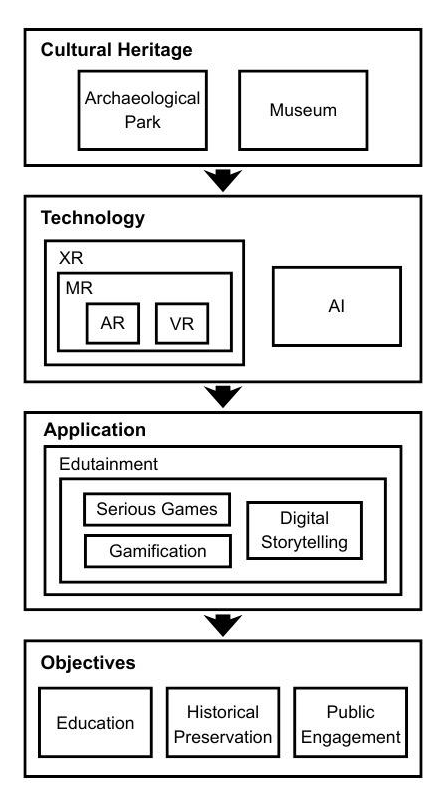
Figure 1
Relationships between cultural heritage, immersive technologies and educational applications.
In this regard, the main contribution of this work lies in offering a structured synthesis that connects technological innovation, experience design, and cultural sustainability, bringing together fields that are typically analyzed separately in the literature. By focusing on recent studies and real-world applications, this survey fills a critical gap: the lack of an integrated vision that allows for an assessment of how immersive technologies are simultaneously transforming heritage education, digital preservation, and public engagement in archaeological contexts. This holistic perspective is particularly relevant at a time when artificial intelligence and extended reality are redefining the ways in which heritage is accessed, interpreted, and transmitted.
The primary studies included in this review were conducted, evaluated and published between 2020 and 2025, reflecting how research has rapidly evolved at the intersection of immersive technologies and cultural heritage engagement. The review allows for the identification of longitudinal trends, technological advancements and shifts in methodological or experiential approaches across different cultural settings and time (see Figure 2). Over the years, the application of immersive technologies in the field of cultural heritage has gained increasing attention, reaching its peak in 2025 with 23 published studies. Several factors may explain this trend, on the one hand, the emergence of new journals dedicated to technology in contexts where it was previously less welcomed has attracted researchers’ interest. On the other hand, the rise of artificial intelligence has prompted a new question among scholars: whether or not AI can be applied to cultural heritage.
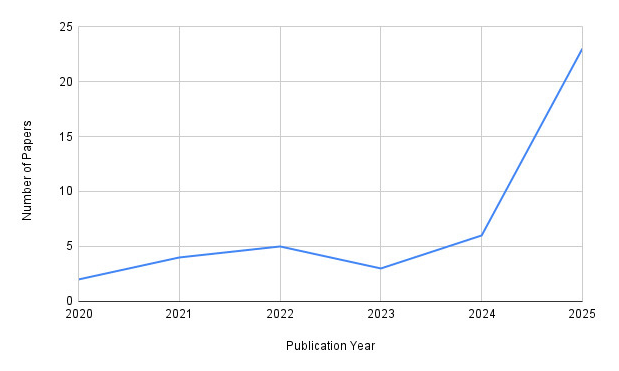
Figure 2
Yearly count of papers produced.
2 Research Questions
The formulation of the present research questions derives from an initial scoping of the literature, which revealed recurring themes related to the use of immersive technologies in archaeological contexts, as well as notable gaps concerning accessibility, educational impact and audience engagement. Following the methodological guidelines proposed by Petersen et al. (2008) for defining research questions in mapping studies, the questions were structured to capture the breadth of existing applications, to identify how these technologies are being implemented in archaeological parks, and to detect areas where empirical evidence remains limited. Thus, the research questions are not based on subjective motivations, but on observable patterns, emerging trends and documented gaps within the current body of knowledge.
Therefore, this analysis process will be guided by the following research questions (see Table 1). As part of this process, each article will be examined not only for its thematic and methodological contributions, but also for its relevance and alignment with the research questions. This will allow us to identify which works offer meaningful insights or practical applications that directly support the objectives of this study.
Table 1
Mapping research questions.
| RESEARCH QUESTIONS | MOTIVATION |
|---|---|
| Q1. How do immersive technologies shape visitor engagement, motivation and experiential interaction within archaeological parks? | M1. Relevance and Applicability: This research question seeks to explore whether immersive technologies have the capacity to contribute to the field of archaeology and tourism, sparking interest in visitors and potential researchers. |
| Q2. In what ways do immersive technologies enable broader access, inclusivity and audience expansion in archaeological parks? | M2. Contribution to the Academic Community: This research question seeks to deepen the literature on existing applications of immersive technologies in archaeological park tours and how they can be used in the democratization of heritage. |
| Q3. What impact do immersive technologies have on teaching cultural heritage to students? | M3. Contribution to the Academic Community: This research question seeks to deepen the literature on existing applications of immersive technologies in archaeological park tours for educational purposes. |
| Q4. What gaps persist in the literature regarding the accessibility, inclusion and sustainability of these projects? | M4. Knowledge Gaps: This project seeks to expand knowledge regarding pre-existing gaps in project sustainability. |
3 Methodology
This review protocol follows a carefully structured sequence designed to ensure methodological rigor and comprehensive coverage. It begins with the formulation of research questions, which serve as the foundation for exploring key digital sources and identifying the most relevant literature. This is followed by the development of a precise and well-planned search strategy, including the construction of effective search strings. Clear inclusion and exclusion criteria are then established to guide the systematic evaluation of the studies retrieved. To gather articles, comprehensive electronic databases were used, covering research from multiple disciplines and institutional repositories. Specifically, two major academic databases were consulted: Scopus and Web of Science (WoS). These platforms were selected for their broad interdisciplinary coverage and their extensive indexing of peer-reviewed literature in the fields of digital humanities, computer science, and cultural heritage studies. The search was conducted simultaneously on both databases using the same search string, yielding 1,650 records from Scopus and 852 from Web of Science, for a total of 2,502 records.
Once the relevant works are identified, they are selected for detailed review and data is extracted and integrated in a consistent manner to generate meaningful insights from the collective body of literature. This entire framework adheres to established best practices for systematic literature reviews, as outlined by Kitchenham and Charters (Kitchenham and Charters 2007) and Petersen et al. (Petersen et al. 2008).
3.1 Terminology
The following terms were used as a basis to define the search string that later led to the retrieval of articles used for the systematic mapping. Table 2 describes the main terms and their respective keywords.
Table 2
Main terms and their keywords for creating the search string.
| RELATED TO METHODOLOGIES | Digital storytelling; Gamification; Serios Games; Edutainment |
| RELATED TO TECHNOLOGIES | Virtual Reality; Augmented Reality; Mixed Reality; Extended Reality; Artificial Intelligence |
| RELATED TO CONTEXT | Archaeological Park; Museum; Cultural Heritage |
The following search string returned 2.502 results.
(“digital storytelling” OR “edutainment” OR “gamification” OR “serious games”) AND (“virtual reality” OR “augmented reality” OR “mixed reality” OR “artificial intelligence” OR “extended reality”) AND (“archaeological park” OR “museum”)
3.2 Inclusion and Exclusion Criteria
The process of article selection is iterative and different selection rules are applied to each article. It should be noted that at this point, a set of relevant articles will be selected and analyzed in depth in the next section when the filters based on the criteria established here are applied. Therefore, to complete the selection of works, inclusion and exclusion criteria were established in Table 3.
Table 3
Inclusion and exclusion criteria applicable to research work.
| INCLUSION CRITERIA |
| They apply gamification, digital storytelling, serious games or edutainment as central methodologies. |
| They use immersive technologies. |
| They are implemented in heritage-related and archaeological. Including but not limited to archaeological parks, open-air museums or urban historical spaces. |
| They involve real-world applications with documented user interaction, evaluation or deployment. |
| They are published in peer-reviewed journals. |
| They are written in English, Spanish or Italian. |
| They were published between 2020 and 2025. |
| EXCLUSION CRITERIA |
| They lack practical implementation, such as purely theoretical proposals, conceptual frameworks without case studies or speculative designs without user engagement. |
| They do not provide sufficient methodological information for evaluation. |
| Works that do not focus on cultural heritage as a primary domain. |
| Papers that describe commercial products without scientific analysis. |
| Duplicated studies or extended versions of previously included works. |
| Are not accessible in full text. |
Primary Articles Selection
The selection of primary studies followed a transparent and reproducible process inspired by the PRISMA 2020 reporting guidelines, which emphasize clarity in documenting identification, screening, eligibility and inclusion procedures (Page et al. 2021). After retrieving the initial corpus of records from major academic databases, duplicate entries were removed and all remaining titles and abstracts were screened according to the predefined inclusion and exclusion criteria. Studies that met the eligibility requirements were then subjected to full-text assessment to verify methodological completeness, relevance to immersive technologies and alignment with the research questions. This multi-stage workflow ensured that only rigorously documented and peer-reviewed contributions were retained. Following deduplication, which removed approximately 340 overlapping records across the two databases, a total of 2,162 records were screened by title and abstract. Of these, 2,058 were excluded as they did not meet the predefined inclusion criteria — primarily due to lack of relevance to immersive technologies in cultural heritage, absence of practical implementation, or publication outside the defined temporal range. The remaining 104 records underwent full-text assessment, of which 61 were further excluded for reasons including lack of documented user interaction, focus on commercial products without scientific analysis, or inaccessibility of the full text. The final corpus of 43 studies was retained for analysis. To further ensure methodological transparency, each included study was assessed against three quality indicators: presence of a user evaluation component or empirical data collection, explicit description of the technology employed, and documentation of outcomes or results. Studies failing to meet at least two of these criteria were excluded during full-text review. The final set of 43 papers (detailed in Appendix A) constitutes a coherent and methodologically robust dataset from which the subsequent analysis was conducted (see Figure 3). Building on this curated corpus, the following section presents the results, highlighting the main patterns, thematic clusters and technological trends that emerged from the reviewed literature.
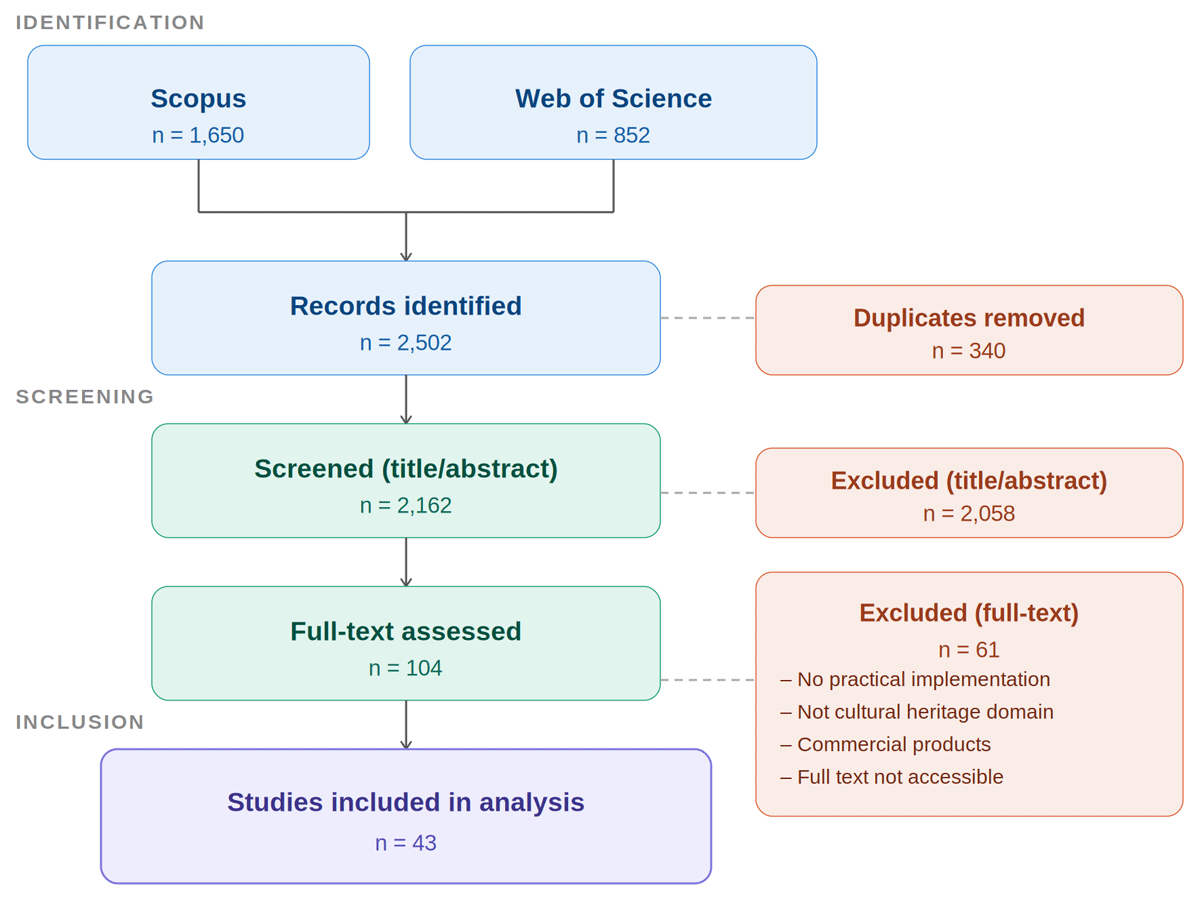
Figure 3
Paper selection process - PRISMA.
4 Results
To better understand how immersive technologies are being applied across cultural heritage projects, we can examine the distribution of technologies used in the reviewed studies (see Figure 4). AI emerges as the most predominant, appearing in 12 papers, followed closely by VR and 3D digitization with 11 each and AR with 10. This upward trend suggests that the field is increasingly focusing on immersive experiences such as virtual tours and customizable environments supported by AI. In contrast, fewer studies explore web or mobile applications that integrate gamification to share heritage knowledge (8 papers), while video games account for 6, GPS-based features for two and only one simulator. These figures indicate that serious games and entertainment-oriented applications remain relatively underexplored within cultural heritage research.
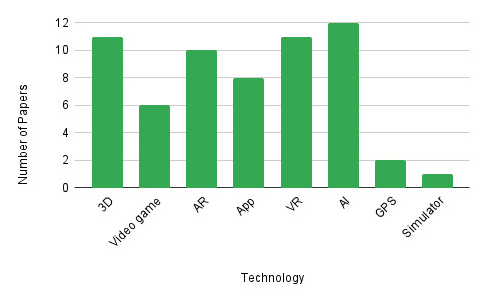
Figure 4
Frequency of technologies used in the papers analyzed.
Beyond listing the technologies used in each study, the distribution shown in Figure 4 helps visualize how unevenly these tools are adopted across the field. The prominence of AI, VR and 3D digitization contrasts sharply with the limited presence of video games, GPS-based systems and simulators, revealing a technological landscape where immersive visualization and computational analysis dominate over playful or location-aware approaches. This visual overview clarifies the internal balance of the corpus and highlights which technologies shape current research trajectories, while also pointing to areas that remain comparatively underexplored. This uneven distribution raises an important question: whether these imbalances reflect technological limitations or rather the specific objectives and contexts in which each project operates. To address this, it is necessary to examine how these technologies are applied across the selected studies.
A first group of papers focuses on the educational potential of immersive technologies. For instance, the studies by Bonacini and Giaccone (2022), Bontchev et al. (2022), Capecchi et al. (2024), Casillo et al. (2024), Clini et al. (2023), Kleftodimos, Moustaka and Evagelou (2023) and Liamruk et al. (2025) explore how serious games and gamified AR applications can foster historical awareness and active learning among younger audiences, whether through simulations of Etruscan society, climate resilience in Venice or treasure hunts in Caldana. The studies by Heath (2022), Pietroni et al. (2023) and Rizvic, Boskovic and Mijatovic (2025) highlight how game engines and national VR projects can transform archaeological sites into didactic platforms. These works collectively demonstrate how gamification and interactive storytelling enhance student engagement and knowledge retention.
Another set of contributions is more closely tied to historical preservation and digital documentation. Papers such as Aricò et al. (2024), Clini et al. (2025), Wang et al. (2025a), Gaspari et al. (2024) and Sebastiani (2021) describe the use of 3D modeling, Heritage Building Information Modeling (HBIM) and open-source platforms to digitally reconstruct sites like Santa Maria della Grotta, Palazzo Olivieri and Farnese Castle, ensuring long-term accessibility and conservation. In the same vein, Kyropoulou et al. (2025) and Linchamps et al. (2025) integrate AI and machine learning to interpret archaeological data and reconstruct paleoclimates, while Wang et al. (2025c) and Yang et al. (2025) apply diagnostic tools, ranging from expert-level AI models to YOLOv8 on Raspberry Pi, for monitoring architectural and rural heritage deterioration. Studies like He and Tao (2025), Zhou et al. (2025) and Yujie, Haotian and Chi (2025) go further by experimenting with generative AI to design new kite patterns or restore porcelain motifs, showing how innovation can coexist with preservation.
A third cluster of papers emphasizes public engagement and accessibility. Marfoglia et al. (2025), Fiorenza et al. (2025), Zhang, Luo and Pan (2025) and Suiçmez et al. (2025), for example, design VR museum experiences tailored to people with vision impairments or autism spectrum disorder. Urban and open-air heritage contexts are addressed in Cerreta et al. (2021), Fazenda et al. (2025), Amore et al. (2025), Gonçalves, Dorsch and Figueiredo (2022), Čejka, Zsíros and Liarokapis (2020), Manglis et al. (2021) and Mantzou, Bitsikas and Floros (2023), where mobile apps and gamified routes activate community participation in Salerno, Tavira and Ioannina. Likewise, Mauro et al. (2021) and Pagano et al. (2020) use digital storytelling and VR/AR apps to manage cultural heritage in Trieste, Florence and Paestum, while Vosinakis et al. (2025) recreate historic monuments and ships in VR for immersive visitor experiences. Wu et al. (2025) highlight the emotional dimension of cultural practices through the gesture-based KaiBiLi ceremony. While Vasic et al. (2024), with Vice Versa VR tracking algorithm, analyze user behavior in the Virtual Museum of Ascoli Piceno, identifying regions of interest and patterns of interaction to guide design and future recommender systems, just like Zhang, Shao and Li (2025) analyze the dissemination of cultural presence in digital games, showing how phenomena like Black Myth: Wukong spread across social media.
Within this broad panorama, AI emerges as a transversal technology. Papers such as Hu (2025), He and Tao (2025) and Lai, Tian and Zhang (2025) illustrate how artificial intelligence can curate soundscapes, generate innovative textile designs or analyze user engagement in digital heritage platforms. Ren (2025) and Suiçmez et al. (2025) explore its role in drama transmission systems and museum accessibility, while Wang et al. (2025c) and Zhou et al. (2025) demonstrate its diagnostic and generative capacities. These studies collectively suggest that AI is not only a tool for preservation but also a driver of new cultural questions, such as whether machine learning can replace expert evaluation or create novel artistic expressions.
Taken together, the 43 papers provide a clear overview of the immersive and intelligent technologies employed across the selected studies, showing how AI, VR, AR and 3D digitization appear with varying frequency and technical complexity. While this mapping clarifies which technologies are used and how often, it does not yet explain why they are adopted in each case or what specific objectives they serve within educational, preservation-oriented or public-engagement contexts. Understanding these underlying intentions is essential for interpreting the broader implications of these technological choices. These contextual and purpose-driven dimensions are examined in detail in the following Discussion section.
5 Discussion
Beyond the thematic differences identified across the corpus, the overall methodological quality of the selected studies shows considerable variability. While some contributions present well-defined research designs, transparent workflows and systematic evaluation procedures, many others rely on descriptive accounts, prototype demonstrations or user studies with limited methodological detail. Several papers do not report clear assessment metrics, sample characteristics or validation strategies, making it difficult to determine the robustness or generalizability of their findings. This uneven methodological rigor suggests that the field still lacks shared standards for evaluating immersive-heritage interventions, and highlights the need for more consistent reporting practices and stronger empirical grounding in future research.
In order to interpret the collective contribution of the selected studies, the discussion categorizes them into three overarching domains: Education, Historical Preservation and Public Engagement. This framework highlights how immersive and intelligent technologies are being mobilized to foster active learning and motivation in school and university contexts, to document and safeguard vulnerable cultural assets through digital reconstruction and diagnostic tools and to broaden accessibility and participation by engaging diverse audiences in inclusive and interactive heritage experiences. By distinguishing these categories, the analysis underscores both the diversity of approaches and the shared objective of reimagining cultural heritage through technological innovation.
These domains are not isolated; many projects operate across multiple pillars, reinforcing the idea of a multifaceted ecosystem where immersive technologies serve overlapping cultural missions.
The technological distribution observed in Figure 4 reinforces this reading. The dominance of AI (12 papers) and VR (11 papers) across the corpus is not evenly distributed among the three categories: AI-driven approaches cluster predominantly within Historical Preservation, where computational tools serve documentation, diagnostic, and generative purposes, while VR appears most consistently in Public Engagement and Education projects, where experiential immersion and narrative-driven interaction take priority. Conversely, the comparatively limited presence of video games (6 papers), GPS-based features (2 papers), and simulators (1 paper) suggests that playful and location-aware approaches remain underexplored across all three domains, pointing to a structural gap that future research should address.
5.1 Education
The studies classified under Education, being a total of 9, focus on projects designed to engage school and university audiences through experiential learning environments. Serious games, gamified applications and immersive technologies such as AR and VR are employed to stimulate curiosity, strengthen motivation and deepen historical awareness. By embedding gamification and interactive storytelling into heritage contexts, these initiatives demonstrate how digital tools can improve knowledge retention and foster active participation. Several projects also integrate location-based AR and real-time interaction, encouraging collaborative exploration and constructivist approaches that transform cultural heritage into a dynamic and meaningful learning experience.
(Kleftodimos, Moustaka and Evagelou 2023): “This study presents two location-based augmented-reality applications used for cultural heritage education and more specifically for educating the public about a prehistoric settlement, the prehistoric lake settlement of Dispilio in Kastoria.”
(Liamruk et al. 2025): “This study employed a descriptive evaluation design, a methodology commonly used in educational and intervention-based research to systematically assess the outcomes and experiences of participants without manipulation of variables. Descriptive evaluation focuses on collecting and analyzing data to describe the effectiveness, usability and impact of an intervention on its intended outcomes, providing a nuanced understanding of its success in real-world contexts. This approach was selected to evaluate the usability and educational impact of an AR serious game in enhancing 21st century skills and promoting cultural tourism.”
5.2 Historical Preservation
This category includes studies (a total of 13) focused on the documentation, conservation and digital reconstruction of cultural heritage assets. Projects often employ 3D modeling, HBIM and diagnostic tools to monitor deterioration, support restoration and digitally preserve vulnerable environments. These works contribute to long-term sustainability by enabling remote access, replicability and preventive strategies, particularly in sites exposed to environmental or human threats.
(Sebastiani 2021): “Some of the material culture that we decided to digitalize was selected in order to represent, as previously mentioned, particular aspects of everyday life at Roman Cannicci that can still be experienced in modern Paganico.”
(He and Tao 2025): “[…] this paper puts forth an innovative image style transfer method with the objective of achieving the digital inheritance and application innovation of the artistic characteristics inherent to blue calico. To assess the practical utility of the proposed method, the research team has developed a series of cultural and creative products in the style of blue calico, which are displayed and promoted on a digital exhibition platform. This practical investigation not only validates the feasibility and efficacy of the proposed method but also expands the presentation forms and dissemination pathways of traditional crafts in the modern context.”
5.3 Public Engagement
The 21 studies in this category aim to enhance visitor participation, emotional connection and accessibility to cultural heritage through immersive technologies. Projects often use AR, digital storytelling and gamified urban experiences to activate public interest and foster inclusive narratives. These approaches are particularly relevant in open-air heritage environments and urban settings, where interaction and co-creation play a central role in shaping cultural memory and identity. At the same time, they emphasize accessibility as a means of disseminating and democratizing cultural heritage, ensuring that broader audiences can engage with and benefit from these digital experiences.
(Marfoglia et al. 2025): “[…] this study aims at deepening the understanding of accessibility requirements of VM applications that integrate haptic feedback to convey tactile and spatial information within virtual environments, allowing for the perception of physical sensations.”
(Pagano et al. 2020): “Relying upon these assumptions, ArkaeVision Archeo can be described through its (a) game-oriented mechanism, which allows users to get to know the VR context and explore it; the game-oriented strategies that users can take advantage of, to know more about the historical period, environment, rituals and beliefs; the game-oriented objectives with the purpose of entertaining users, but especially educate them.”
When examined comparatively, the three categories reveal different objectives and also divergent epistemological assumptions about what immersive technologies should achieve in cultural heritage. Education projects privilege learning outcomes and therefore adopt playful, narrative-driven and motivational strategies, often prioritizing engagement over technical precision. In contrast, Historical Preservation studies operate under a logic of accuracy, fidelity and long-term conservation, where immersive tools serve documentation, monitoring and reconstruction rather than user experience. Meanwhile, Public Engagement initiatives emphasize affect, accessibility and participation, positioning immersive technologies as mediators of emotional connection and social inclusion. These contrasting orientations generate tensions: educational projects may sacrifice rigor for playfulness; preservation projects may overlook usability and inclusivity; and public-engagement initiatives may prioritize narrative impact over methodological robustness. Yet, taken together, they also reveal complementarities, suggesting that a mature digital-heritage ecosystem requires balancing pedagogical immersion, technical conservation and participatory storytelling. This comparative reading highlights the need for integrative frameworks that reconcile these approaches rather than treating them as isolated domains.
Beyond the differences identified across the three categories, the findings also intersect with broader theoretical frameworks in digital-heritage research. The emphasis on immersive learning environments resonates with established models of digital heritage, which conceptualize heritage not only as a set of objects but as a mediated, multisensory experience shaped by technological affordances. Similarly, the focus on accessibility, emotional engagement and interaction aligns with principles of user experience, highlighting how design choices influence perception, motivation and inclusion. Finally, projects that activate community participation or reinterpret cultural narratives reflect ongoing debates in public archaeology, where digital tools are understood as mediators of social value, collective memory and public agency. Integrating these frameworks clarifies how the technological patterns observed in the corpus relate to larger conceptual shifts within the field.
The systematic mapping of primary studies conducted reveals a growing convergence between immersive technologies, playful methodologies and digital narratives aimed at revitalizing the way archaeological heritage is communicated, experienced and preserved. Below, the research questions that guided this review are addressed.
Q1. How do immersive technologies shape visitor engagement, motivation and experiential interaction within archaeological parks?
Immersive technologies such as VR, AR and 3D digitization have been widely applied to transform archaeological parks into interactive environments that stimulate visitor curiosity and emotional connection. Projects like e-Archeo (Pietroni et al. 2023) and ArkaeVision (Pagano et al. 2020) recreate archaeological sites through VR tours enriched with narrative storytelling, allowing visitors to experience monuments in ways that go beyond static observation. Similarly, the Hidden Florence project (Nevola, Coles and Mosconi 2022) integrates a gamified AR app, encouraging exploration through playful interaction. These approaches demonstrate that immersive technologies can increase engagement by offering multisensory experiences, personalized narratives and opportunities for active participation, ultimately reshaping how visitors perceive and connect with heritage sites.
Q2. In what ways do immersive technologies enable broader access, inclusivity and audience expansion in archaeological parks?
Archaeological parks employ immersive technologies to reach broader audiences by lowering barriers to access and providing remote or inclusive experiences. For example, the Palazzo Olivieri HBIM project (Clini et al. 2023) and the Farnese Castle platform (Gaspari et al. 2024) use 3D documentation and AR/VR applications to make heritage accessible to those unable to visit physically. The e-Archeo initiative (Pietroni et al. 2023) combines VR tours, podcasts and apps to democratize knowledge by offering multiple entry points for diverse audiences. Moreover, projects such as Hack the City (Cerreta et al. 2021) and the Ioannina PALIMPSEST route (Mantzou, Bitsikas and Floros 2023) show how gamified urban experiences can activate communities and foster collective participation. By integrating accessibility features and digital dissemination, these parks expand their reach beyond traditional visitors, ensuring that cultural heritage knowledge is shared more inclusively.
Q3. What impact do immersive technologies have on teaching cultural heritage to students?
Educational projects highlight the transformative role of immersive technologies in teaching cultural heritage. Serious games like Mi Rasna (Bonacini and Giaccone 2022) and Let Us Save Venice (Bontchev et al. 2022) demonstrate how gamification fosters intrinsic motivation and historical awareness among students. Location-based AR apps (Kleftodimos, Moustaka and Evagelou 2023) and AR serious games such as KideClass (Liamruk et al. 2025) encourage collaborative and constructivist learning by combining storytelling with real-time interaction. In academic contexts, game engines applied to Pompeii (Heath 2022) and national initiatives like e-Archeo (Pietroni et al. 2023) provide platforms for experiential learning that merge scientific rigor with narrative engagement. These studies consistently show that immersive technologies enhance knowledge retention, stimulate curiosity and transform heritage education into participatory and meaningful processes.
Q4. What gaps persist in the literature regarding the accessibility, inclusion and sustainability of these projects?
Despite significant advances, several gaps remain. Accessibility is often addressed in isolated projects, such as VR museums for people with vision impairments (Marfoglia et al. 2025) or autism spectrum disorder (Fiorenza et al. 2025), but systematic strategies for universal design across heritage technologies are still limited. Inclusion tends to focus on specific audiences rather than ensuring broad adaptability, leaving underserved groups without consistent access. Sustainability also emerges as a challenge: while projects like Gaspari et al. (2024) and Kyropoulou et al. (2025) emphasize replicability and long-term documentation, many initiatives remain pilot studies without clear frameworks for maintenance, scalability or integration into institutional practices. Furthermore, the literature reveals limited exploration of environmental sustainability, particularly regarding the energy demands of AI and VR systems. These gaps suggest the need for future research to prioritize inclusive design, long-term viability and sustainable technological infrastructures.
This review highlights the richness and diversity of immersive heritage practices. It reveals a strong emphasis on education and public engagement, supported by gamified and narrative-driven methodologies. At the same time, it exposes critical gaps in sustainability and inclusion, suggesting that future research and development should prioritize long-term accessibility, institutional support and broader community involvement. These insights lay the groundwork for a more holistic and equitable approach to digital heritage design.
6. Conclusion and Future Works
This systematic mapping contributes a structured overview of how digital-heritage research is evolving, offering a consolidated foundation for future work in a field that is rapidly diversifying. Rather than focusing on the specific technologies identified in the corpus, the broader significance of this review lies in clarifying the conceptual and methodological fragmentation that characterizes current practice. The analysis highlights the need for stronger integrative frameworks capable of connecting technological innovation with historically grounded interpretation, inclusive design and long-term sustainability. These dimensions remain insufficiently aligned across the literature, revealing a gap that future research must address.
At the same time, the review underscores the importance of moving beyond isolated case studies toward more systematic evaluation strategies. Robust assessment methods, whether centered on user experience, learning impact, preservation outcomes or accessibility, are essential for understanding not only what immersive technologies can do, but how effectively they support cultural-heritage goals in diverse contexts. The lack of shared metrics and cross-project comparability remains one of the most persistent limitations in the field.
Looking forward, the rapid expansion of artificial intelligence, multimodal interaction and hybrid physical-digital environments presents an opportunity to rethink how cultural heritage is mediated, interpreted and experienced. However, these developments also demand careful attention to ethical representation, transparency and the long-term stewardship of digital assets. Addressing these challenges will require interdisciplinary collaboration and methodological coherence, ensuring that technological innovation is matched by critical reflection and responsible implementation.
By consolidating current trends and identifying structural gaps, this review provides a foundation for future research agendas aimed at strengthening theoretical integration, improving evaluation practices and supporting sustainable, inclusive and context-sensitive applications of immersive technologies in cultural heritage.
Appendices
Appendix A
The table below summarises the 43 studies included in the final corpus, categorised by technology utilised and application scenario. A close analysis of the corpus reveals several notable structural tendencies.
In terms of technology distribution, Artificial Intelligence (n = 12) is the most frequently employed tool, followed by Virtual Reality (n = 11), 3D digitalisation (n = 11), and Augmented Reality (n = 10). Web and mobile applications appear in 8 studies, while video games appear in 6. GPS-based features (n = 2) and simulators (n = 1) are notably underrepresented. This distribution indicates that the field currently prioritises high-fidelity visualisation and computational analysis, which require substantial infrastructure and technical expertise. In contrast, more accessible, location-aware, and playful approaches have not yet achieved comparable prominence in the academic literature. The limited adoption of GPS- and game-based implementations may result from both the technical challenges of evaluating these systems and an institutional preference for preservation-oriented outcomes over experiential or participatory ones.
The corpus is predominantly European in geographic scope. Italy contributes the most case studies, followed by Portugal, Greece, and Bosnia and Herzegovina. There is also a substantial and growing body of work from China, particularly in the domains of intangible cultural heritage and AI-based design. This geographic concentration has methodological implications: the prominence of Mediterranean and East Asian contexts suggests that findings on visitor engagement, accessibility, and institutional adoption may not be directly transferable to other cultural and political contexts. Future evaluations should intentionally seek contributions from underrepresented regions such as Sub-Saharan Africa, Latin America, and Southeast Asia, where digital heritage practices are emerging but remain underrepresented in indexed academic databases.
Most research is conducted in controlled indoor environments such as museums and archaeological parks, which offer predictable conditions for device deployment and user evaluation. A smaller, yet significant, subset focuses on open-air heritage sites, urban historical centres, and intangible cultural assets. These environments introduce additional complexity regarding connectivity, user behaviour, and content design. This disparity indicates that methodological frameworks developed for museum-based research may require substantial adaptation before they can be effectively applied to more dynamic and spatially dispersed heritage contexts.
Overall, these patterns characterise a field that is technologically diverse yet structurally uneven. Dominant tools and geographic contexts reinforce established research trajectories, while emerging approaches, such as participatory, location-based, and culturally inclusive methods, remain marginal within the indexed literature. These asymmetries should be taken into account when interpreting the following table.
| ID | SOURCE | TITLE | TECHNOLOGY | APPLICATION |
|---|---|---|---|---|
| P1 | (Ceccacci et al. 2025) | Co-designing a Virtual Museum Application with a Haptic Interface Involving People with Vision Impairments and Blindness | VR | Virtual Reality for museums, aimed to people with vision impairments |
| P2 | (Aricò et al. 2024) | Three-Dimensional Documentation and Virtual Web Navigation System for the Indoor and Outdoor Exploration of a Complex Cultural Heritage Site | 3D digitalization | 3D reconstruction of “Santa Maria della Grotta” for virtual tour |
| P3 | (Bonacini and Giaccone 2022) | Gamification and cultural institutions in cultural heritage promotion: a successful example from Italy | Video game | Mi Rasna, a serious game on the Etruscan society |
| P4 | (Bontchev et al. 2022) | “Let Us Save Venice”—An Educational Online Maze Game for Climate Resilience | Video game | Application of the serious game “Let us save Venice” to raising awareness to climate resilience and built heritage sustainability |
| P5 | (Capecchi et al. 2024) | Augmented reality and serious game to engage the alpha generation in urban cultural heritage | AR, Video game | Application of AR based on a serious game (treasure hunt) and GPS-based app aimed to children to enhance cultural heritage appreciation, in Village of Caldana |
| P6 | (Casillo et al. 2024) | Serious Gaming for Cultural Heritage: the case study of the Domus of Abellinum | 3D digitalization, Video game | Application 3D model of scanned Abellinum Archaeological Park in Atripalda, to a serious game “Exploring Abelli-num” |
| P7 | (Cerreta et al. 2021) | Triggering Active Communities for Cultural Creative Cities: The “Hack the City” Play ReCH Mission in the Salerno Historic Centre (Italy) | App | Mobile app that applies gamification to enhance the appreciation of Salerno historic centre |
| P8 | (Clini et al. 2025) | Inclusive Museum Engagement: Multisensory Storytelling of Cagli Warriors’ Journey and the Via Flamina Landscape Through Interactive Tactile Experiences and Digital Replicas | 3D digitalization, App | Multisensory storytelling applied on a video, an app and the 3D impression based on the 3D digital version of the bronze statuettes at Via Flaminia Museum in Cagli |
| P9 | (Clini etal. 2023) | From point cloud data to HBIM for public performance spaces knowledge, management and storytelling: Palazzo Olivieri in Pesaro | 3D digitalization, AR, VR | An HBIM was used to generate AR and VR experiences of Palazzo Olivieri-Machirelli in Pesaro |
| P10 | (Wang et al. 2025a) | Adopting AR wayfinding in heritage tourism: extending the UTAUT in cultural contexts | AR | Application of AR wayfinding systems in open historic districts in China |
| P11 | (Fazendaet al. 2025) | A sailing simulator for the revival of the Tagus River nautical heritage | 3D digitalization, Other (simulator) | A simulator that recreates how Tagus River sailboats use to sail |
| P12 | (Hu 2025) | AI-curated soundscapes: spatial reconfiguration of intangible cultural heritage music in urban China | AI | Application of AI to redistribute and enhance appreciation of intangible cultural heritage |
| P13 | (Amore et al. 2025) | The Paleontological Heritage as a Mean for Territorial Revitalization: Innovative Communication Modalities for Pietraroja Site (Southern Italy) | AR, MR, VR | AR, MR and VR technologies aimed to create digital spaces where visitors can explore the site and understand its cultural value in Pietraroja paleontological site |
| P14 | (Fiorenzaet al. 2025) | Designing accessible museum experiences in virtual reality for individuals with Autism Spectrum Disorder | VR | Virtual visits using VR specifically suited to the needs of individuals with ASD, providing accessible experiences |
| P15 | (Gaspari et al. 2024) | An Open-Source Web Platform for 3D Documentation and Storytelling of Hidden Cultural Heritage | 3D digitalization, App | Replicable model to explore de 3D reconstruction of Farnese Castle in Piacenza also aimed to provide digital documentation and technical accessibility |
| P16 | (Gonçalves, Dorsch and Figueiredo 2022) | Digital Tourism: An Alternative View on Cultural Intangible Heritage and Sustainability in Tavira, Portugal | App | An app that integrates virtual routes through key locations that revolve around the cultural heritage of the Mediterranean diet in Tavira |
| P17 | (He and Tao 2025) | Applied research on innovation and development of blue calico of Chinese intangible cultural heritage based on artificial intelligence | AI | A program that applies AI-based style transfer to generate innovative blue calico designs, revitalizing traditional textile heritage for modern use in China |
| P18 | (Heath 2022) | Game Engines and Playification at Pompeii and for Roman Art and Archaeology | 3D digitalization | An interactive environment built on a cloud-based game engine that uses the House of the Faun in Pompeii as a playful platform for classroom discussion of ancient domestic spaces through edutainment |
| P19 | (Čejka, Zsíros and Liarokapis 2020) | A hybrid augmented reality guide for underwater cultural heritage sites | AR | An AR guide for divers that visualizes ancient underwater buildings in Baiae |
| P20 | (Zhang, Luo and Pan 2025) | Design and evaluation of touch and touchless interfaces for interactive digital heritage experiences | MR, 3D digitalization | Virtual museum with touch and gesture interfaces to connect and interact with the museum’s heritage in China |
| P21 | (Kleftodimos, Moustaka and Evagelou 2023) | Location-Based Augmented Reality for Cultural Heritage Education: Creating Educational, Gamified Location-Based AR Applications for the Prehistoric Lake Settlement of Dispilio | AR, GPS, App | Two location-based augmented reality apps that use gamification and storytelling to teach cultural heritage at a prehistoric lake settlement of Dispilio |
| P22 | (Kyropoulou et al. 2025) | A 3D geospatial platform and AI tour application for visualizing archaeological, analytical and conservation data: the case of the Vryokastro archaeological ensemble, Kythnos Island | 3D digitalization, AI, GPS | AI-powered virtual tours, 3D geospatial visualization and archaeometric data to interpret and conserve the Vryokastro site in Kythnos island |
| P23 | (Lai, Tian and Zhang 2025) | The impact of AI-generated technologies-driven digital cultural heritage platforms on users’ offline cultural participation intentions | AI | A study of the Cloud Tour of Dunhuang platform that applies AI-driven analysis to show how online experiences influence offline participation, highlighting narrative design as a key driver and privacy risks as suppressors. |
| P24 | (Linchamps et al. 2025) | Reconstructing the palaeoclimate of the Cradle of Humankind in South Africa over the last 3.5 million years using machine learning and mammalian fossil assemblages | AI | A machine learning study using faunal data from the Cradle of Humankind to reconstruct past climates |
| P25 | (Manglis et al. 2021) | Implementing multi-criteria analysis in the selection of auchs for the integration of digital technologies into the tourism offering: The case of medrydive | AR, VR | A methodology from the MeDryDive project for selecting accessible underwater cultural heritage sites in the Mediterranean, promoted through dry dive experiences, serious games and AR/VR applications |
| P26 | (Mantzou, Bitsikas and Floros 2023) | Enriching Cultural Heritage through the Integration of Art and Digital Technologies | App | An open-air, app-driven museum route from the PALIMPSEST project that integrates storytelling, interactive installations and community participation to reshape cultural heritage experiences in Ioannina |
| P27 | (Mauro et al. 2021) | Cultural heritage and storytelling: didactic applications in Trieste with ESRI Story Maps | App | ESRI Story Maps used to create digital storytelling web apps on local cultural heritage, including the Bora wind and the Tram of Opicina. |
| P28 | (Nevola, Coles and Mosconi 2022) | Hidden Florence revealed? Critical insights from the operation of an augmented reality app in a World Heritage City | AR, App | AR app that analyzes user engagement and challenges in using digital tools for managing overtourism at heritage destinations |
| P29 | (Pagano et al. 2020) | ArkaeVision VR game: User experience research between real and virtual paestum | VR | The ArkaeVision is a virtual tour that applies VR to recreate Paestum’s Temple of Hera II with immersive storytelling |
| P30 | (Liamruk et al. 2025) | Development and evaluation of an augmented reality serious game to enhance 21st century skills in cultural tourism | AR, Video game | KideClass an AR serious game that engages children and parents in cultural tourism through mini-games |
| P31 | (Pietroni et al. 2023) | e-Archeo: A Pilot National Project to Valorize Italian Archaeological Parks through Digital and Virtual Reality Technologies | 3D digitalization, VR, MR | The e-Archeo promotes eight archaeological sites in Italy, combining scientific rigor with narrative storytelling. Outputs include a website, a 360° virtual tour app with VR multimedia and a podcast app dedicated to each site |
| P32 | (Ren 2025) | Inheritance and protection of intangible cultural heritage in drama category based on AI human–computer interaction and digital technology | AI | The Heritage Transmission System for Drama Culture model applies neural networks to generate interactive, personalized content for traditional Chinese dramas |
| P33 | (Rizvic, Boskovic and Mijatovic 2025) | Contribution of gameplay elements to the quality of user experience in war heritage virtual reality applications | VR, Video game | The Battle on Kozara is a serious game with VR application that recreates a WWII battle in Bosnia and Herzegovina, combining interactive digital storytelling with gameplay |
| P34 | (Sebastiani 2021) | Digital artifacts and landscapes. Experimenting with placemaking at the impero project | 3D digitalization, AR | AR/3D reconstructions, digital narratives and a dedicated website to engage communities to Etruscan and Roman heritage. |
| P35 | (Suiçmez et al. 2025) | Artificial intelligence application for museum to experiential transformation of cultural heritage and learning | AI | A qualitative study on AI in museums that analyzes how applications enhance accessibility, interaction and cultural heritage preservation |
| P36 | (Vasic et al. 2024) | 3VR: Vice Versa Virtual Reality Algorithm to Track and Map User Experience | VR | The “Vice Versa” VR tracking algorithm analyzes user behavior in the Virtual Museum of Ascoli Piceno, identifying regions of interest and patterns of interaction to guide design and future recommender systems |
| P37 | (Vosinakis et al. 2025) | Designing and evaluating an immersive VR experience of a historic sailing ship in museum contexts | VR | A VR installation reconstructs a historic sailing ship for a museum exhibition |
| P38 | (Wang et al. 2025c) | Can AI replace experts in the evaluation of cultural heritage? Based on the controlled experiments conducted on six architectural heritages | AI | This study evaluates AI’s ability to assess the conservation status of architectural heritage, showing that five mainstream models achieved expert-level performance in analyzing six sites in Kunming, China |
| P39 | (Yang et al. 2025) | Artificial intelligence assists the identification and application of rural heritage wall surface damage in Zhejiang | AI | YOLOv8 deep learning model and a Raspberry Pi 5-based mobile system to detect and monitor damage in traditional dwelling walls of Zhejiang’s rural heritage |
| P40 | (Zhou et al. 2025) | Fine-tuning diffusion model to generate new kite designs for the revitalization and innovation of intangible cultural heritage | AI | An AI-based diffusion model, trained on a custom kite style dataset with a novel loss function, to generate new auspicious-themed kite designs, offering a technical pathway for revitalizing intangible cultural heritage |
| P41 | (Wu et al. 2025) | KaiBiLi: gesture-based immersive virtual reality ceremony for traditional Chinese cultural activities | VR | A gesture-based VR application of the First Writing Ceremony for children |
| P42 | (Yujie, Haotian and Chi 2025) | Kraak porcelain decorative pattern restoration using generative AI: a pilot study | AI | A model enhanced with LoRA and ControlNet, trained on a custom Kraak porcelain image database, to generate and restore intricate Kaiguang patterns, offering a framework for digital preservation and innovation in cultural heritage |
| P43 | (Zhang, Shao and Li 2025) | Play, watch, share: the dissemination of the cultural presence of games on video-based social media | AI | This study analyzes Black Myth: Wukong as a cultural phenomenon, using interactive ritual theory and data from 462 Bilibili videos to build a dissemination model of digital cultural presence across player interactions |
Data Accessibility Statement
The data used in this study are available online.