
Introduction
3D digitisation of cultural heritage has been steadily growing with a marked increase since 2015 (Liao, Zhao & Sun 2020, 474) as the required technology to capture and display 3D models has become more available, affordable, and user friendly. A variety of 3D modelling techniques including structured light scanning, laser scanning, handheld LiDAR, and structure from motion photogrammetry are today used by cultural heritage institutions to digitise their material culture collections in the interests of education, public outreach, condition management, and research. Within Australia, universities have been exploring 3D modelling of teaching collections to make their material collections more accessible to students as online and hybrid teaching models grow in prominence alongside pedagogical interest in Object-Based Learning (OBL). A variety of digitisation methods are being adopted by Australian universities with a range of supplementary methods applied to them that can expand their potential as learning media. Supplementary methods to enhance features of the scanned object may elevate the 3D model above the standard role of a digital surrogate, which is intended only to ‘stand in’ for the physical original. By revealing additional information, enhanced 3D models may provide new insight that could not be readily discerned by students handling the originals under classroom conditions, where students are necessarily limited in the liberty they may take with object handling.
Digitisation programmes that preceded or emerged during the COVID-19 lockdowns have mostly continued and today many Australian universities have collections of 3D models available online. While manuals for heritage digitisation are beginning to emerge (Robinson 2024) and international agreements are in development such as the London Charter (Beacham et al. 2006; The London Charter 2009) and the ICOMOS Seville Principles (Lopez-Menchero & Grande 2011), in the absence of widely accepted best practices of 3D model creation, implementation, and metadata management, institutions have developed their own disparate practices and conventions. These variations raise the potential for future incompatibility and difficulty in data exchange, which may present challenges in emerging applications of machine learning and big data analysis. Machine learning algorithms often require large, well-labelled and consistent datasets from which to learn. Without agreed standardisation of file formats and metadata conventions, aggregating data from multiple sources becomes complex; for instance, data normalisation and pre-processing tasks may become more time-consuming and error-prone. It is important for discussions about best practices in the creation and documentation of 3D models within university contexts to begin now lest practices become embedded within parochial norms particular to each institution. This paper presents a discussion of these issues within Australian universities from the professional and academic experience of the authors working at The University of Sydney, The University of Melbourne, The University of New England, and Monash University.
Object-Based Learning
Object-based learning (OBL) has emerged as a transformative approach to teaching in universities, offering students an immersive and hands-on experience that extends beyond traditional classroom methods, emphasising the role of objects in learning and integrating them into teaching practice (Chatterjee, Hannan & Thomson 2016). The multisensory nature of OBL encourages interactive and experiential learning, important components of several pedagogical theories (e.g. Kolb’s Experiential Learning Cycle: Kolb 1984; Cobb et al. 2024; Hannan, Duhs & Chatterjee 2013). In archaeology and cultural heritage studies, engaging directly with artefacts fosters a tangible connection to the material culture of ancient societies and encourages the study of objects as active components in social lives (Chatterjee 2009; Joyce 2012; Witmore 2014) while encouraging critical thinking, observational skills and a nuanced appreciation of historical context (Sharp et al. 2016). Students learn to examine artefacts and critically interpret the narratives they construct, making OBL a useful tool in supporting students to develop the skills necessary to participate in the multidisciplinary heritage sector. Australian universities have been implementing OBL more thoroughly into teaching, conducting curriculum mapping projects (Thogersen et al. 2018), creating specialised OBL classroom spaces (Jamieson 2017), and developing study guides to utilise museum collections (Simpson & Hammond 2012). These initiatives were significantly disrupted by the COVID-19 pandemic lockdowns (Guerry & Thogersen 2023).
As in-person classes were unavailable during the COVID-19 pandemic and student preference has remained in favour of online teaching, universities that wished to continue with OBL were required to re-conceptualise how this can take place in online and hybrid teaching environments. German (2024) has argued that OBL is necessarily centred on authentic experience with real, original objects, rather than digital surrogates; however, preliminary research has indicated that online-only digital OBL produces comparable test results to physical OBL (Tanabashi 2022) and that students respond positively to a digital OBL experience (Tanabashi 2021). Digital models can be manipulated within virtual environments, enabling students to rotate, zoom in and explore objects, much like they would with physical items. 3D model applications often also support collaborative work, allowing students to share their findings and insights in real time, fostering a dynamic learning environment. These platforms support the exchange of observations, hypotheses, and analyses, mirroring the collaborative nature of professional work in the heritage sector.
Virtual and augmented reality (VR/AR) platforms offer another innovative way to enhance OBL. These technologies can create realistic simulations of archaeological sites or museum settings, where students can virtually handle digital objects in a context that mirrors real-life scenarios. For instance, students can visit a digital reconstruction of an archaeological site within virtual reality (Forte & Siliotti 1997; Frischer et al. 2008; Economou & Pujol-Tost 2008; Christofi et al. 2018; Keep 2022a) or can move around rooms furnished with artefacts, providing an alternative means for important discussions about context and reconstructions of the past (Martinez et al. 2019; Pavelka & Raeva 2019; Keep 2022b). At the University of Melbourne, virtual reality was explored in providing students an opportunity to practice translation of hieroglyphs directly from (virtualised) tombs, rather than transcribed texts. In addition to VR/AR, the growing availability of digital archives and collections from universities and museums opens vast resources for OBL (e.g. https://3d.si.edu/; https://sketchfab.com/britishmuseum). These digitised collections can allow students to access a wide array of objects from different time periods and geographical locations, regardless of where the objects or students are physically located. Accompanying metadata may provide detailed information about each object, such as its provenance, usage, and historical context, enriching the learning experience and maintaining a record of relevant processes in the digital object’s life cycle. By integrating these digital strategies, educators can make OBL accessible to a broader audience, including remote learners, while preserving the hands-on, inquiry-based nature of learning in archaeology.
Digitisation Methods in Australian Universities
The University of Sydney
At the University of Sydney, structure from motion photogrammetry has been prioritised as the primary method of digitising archaeological material due to a substantial investment into photography and lighting gear and 3D modelling software in the Discipline of Archaeology. Owing to its availability, portability, ease of learning, and accessibility to photogrammetry software there has been an increase in 3D-modelling projects by research students across a range of applications, from documenting Australian rock art (Roach 2023) and indigenous quarry sites, to analysing European stone monuments, and recording historical architecture (Chauvel 2020; Chauvel & Flexner 2020) and objects (Kuligowski 2021). In addition to photogrammetry, the Discipline also allows for projects using dental scanners and hand scanners which have primarily been used to model faunal remains (Koungoulos 2020; Gündemir et al. 2023), stone tools (Wyatt-Spratt 2022; Way et al. 2023) and museum objects (Whitford et al. 2020).
The investment in photogrammetry equipment facilitated a collaboration with the University of Sydney’s Chau Chak Wing Museum, where Archaeology staff created 3D models of museum objects for use in OBL classes through the New Eyes for Old Objects Project (Wyatt-Spratt & Thoeming 2019; Figure 1). This integration of 3D models into the undergraduate curriculum was established before the lockdown, allowing students to engage with curated objects in the classroom and continue their analyses remotely. The pre-existing framework made the transition to fully online OBL instruction during the 2020 lockdown much smoother, as students could analyse 3D models of objects and continue their studies despite the restrictions. The approach not only allowed students to explore cultural material but also emphasised the importance of conserving heritage and cultural items (Wyatt-Spratt & Thoeming 2019). Post-lockdown, while in-person classes have been prioritised, digital models remain accessible, supporting remote assessments of museum objects. Soon a wider range of museum objects including historical objects, artwork, and zoological specimens were modelled, leading to the creation of an online museum catalogue on SketchFab (https://sketchfab.com/CCWM) accessible to the public. A standard kit was used to conduct the photogrammetry modelling, including a portable lightbox and turntable (the Foldio lightbox and Foldio 360 turntable), a studio tripod, camera rail, radial targets, Canon DSLR bodies, and a selection of macro lenses.

Figure 1
Render of an Etruscan dolium fragment 3D model for use in the New Eyes for Old Objects Project. Model available at https://sydney.pedestal3d.com/r/EOQRTXbg3-.
Photogrammetric modelling completed in Agisoft Photoscan (2018) by Simon Wyatt-Spratt (2018) for the University of Sydney.
Fragment of a stamped dolio, 620–600 BCE, Caere, Etruria, Italy: Donated by Sir Charles Nicholson, 1860. NM98.139, Nicholson Collection, Chau Chak Wing Museum.
Other related 3D modelling projects initiated by the museum include the digital rendering of Egyptian mummified remains generated from their Computed Tomography (CT) scans (Fraser, Lord & Magnussen 2022). The scans allow visitors to engage with 3D renderings through an interactive touch table displaying a 3D photogrammetry model and CT scans of the mummified young boy Horus, to see the skeletal remains within the wrappings. This collaborative project with Macquarie Medical Imaging CT scanned four individuals and a coffin, including the young boy Horus (ca. 100 CE); a woman interred in the coffin of Meruah, possibly Meruah herself (ca. 1000 BCE); a man from the Roman Period (ca. 100–200 CE), interred erroneously in the coffin of Padiashakhet (ca. 700 BCE); and the disarticulated remains of a woman named Mer-Neith-it-es (ca. 600 BCE) in her coffin. The CT scanning of the coffins provides new and unprecedented insights into techniques of coffin construction, with recent advances in CT technology – particularly higher resolution imaging and enhanced precision in data capture – facilitating new insights and discoveries regarding the identities and approximate age of the mummified individuals at death, their state of health and nutrition, and burial practices. These non-invasive developments not only advance academic understanding but also enrich the educational experience of students and museum visitors. At time of writing, the CT imagery and the coffins are on display in the Chau Chak Wing Museum’s ‘Mummy Room’. This project intersects with a wider undertaking by the Chau Chak Wing Museum to conduct a rigorous and holistic review of what constitutes the ethical care and display of Egyptian mummified human remains, which includes their digital presentation.
Recently the Discipline of Archaeology has seen a gradual shift in the focus of 3D modelling projects driven by further investments in advanced scanning equipment tailored to large-scale spatial analysis. Local and international projects in landscape modelling have recently taken off with the acquisition of a BLK360 terrestrial laser scanner (TLS), Matrice 350 RTK UAV, Phantom 4 UAV, Mavic 3, and a YellowScan LiDAR UAV system and associated software, Pix4D (2017). With such new ventures being initiated within the University of Sydney, alongside its history of diverse 3D modelling projects, it is increasingly evident and imperative that standardised methods to archive and store metadata, models, and imagery need to be established, not only within the University but across tertiary institutions nationally. Moreover, the challenge of collecting and documenting high-resolution large-scale spatial data is compounded by the volume of data collected, which in turn brings about further issues with storage and ownership.
The University of Melbourne
The University of Melbourne has hosted 3D models on the Pedestal 3D platform (2025) since 2019. Within the discipline of Classics and Archaeology, 3D virtual reality environments have been explored (Trounson 2017; Maeir 2019), while the newly-developed Object-Based Learning Labs continue to be used for hands-on teaching with materials from the university’s collections (Jamieson 2017). In 2018, digital collections were one of the major interests of the Digital Studio, with two graduate internship projects aimed at upgrading and improving engagement with digitised cultural material, including an early foray into creating 3D models of artefacts from the Classics and Archaeology collection. The COVID-19 lockdowns required a transition to online teaching models and the university further invested in 3D modelling objects from university collections so that educators could continue to teach within an OBL framework. Models are created in response to the needs of teachers, in contrast to the ongoing in-house development seen at the University of New England and Macquarie University.
There is growing recognition of the importance of well-managed and documented 3D model metadata for 3D model analysis, comparison, evaluation, replicability, and re-usability (Guidi et al. 2013; D’Andrea & Fernie 2013; Homburg et al. 2021). The possibility of inconsistent metadata was a concern at the university given that multiple parties were creating models with different workflows and organisational practices. To address these concerns, a 3D model metadata guide was developed (The University of Melbourne 2024) based closely on the Community Standards for 3D Data Preservation guidelines (Moore et al. 2022). The guide is intended to assist future 3D modellers working with the university to create and organise data that is consistent with other models and adheres to the FAIR Guiding Principles for scientific data management and stewardship (Wilkinson et al. 2016).
Several digitisation methods have been explored across the university. CT scanning is favoured for its ability to capture high-resolution spatial details of both interior and exterior structures, indispensable for 3D models of skeletal remains, while photogrammetry is favoured for its high-resolution image textures, often essential to the interpretation of the object. Standard photogrammetry has occasionally proven insufficient to represent fine details that are important for interpretation, and supplementary methods have been explored to make these more discernible, such as the combination of photogrammetry and photometric stereo. While photogrammetry excels at capturing the overall shape of a scanned object, without specialised equipment it is limited in its capacity to capture the surface details that may be integral to the interpretation of certain objects. Sophisticated methods of combining the spatial data obtained from each method have been described by Karami, Menno and Remondino (2021; 2022), while an undisclosed automated method for combination has been demonstrated by Luk van Goor of Restauratieatelier Restaura. Through the Grimwade Centre at the University of Melbourne, Bornstein and Keep (2023) developed a method for combining photogrammetry and photometric stereo data on planar surfaces using only consumer grade hardware and software. The method has now been successfully applied to ancient coins in the Classics and Archaeology collection (Figure 2), providing a level of surface detail not easy to obtain with photogrammetry without specialised macro lenses.

Figure 2
Render of a tetradrachm of Philip II 3D model. Photogrammetry alone (top) and combined with photometric stereo normal map1 (below).
Photogrammetric modelling completed in Agisoft Metashape (Agisoft 2023), photometric stereo in Details Capture v.1.5.2 (VFX Grace 2024). UV unwrapping2 completed in Blender (2023) and normal map combination undertaken in Adobe Photoshop (2023). All modelling by Thomas J. Keep (2023a) for the University of Melbourne. Model available at https://arts.unimelb.pedestal3d.com/r/nBs3HDWN5f.
Philip II 1928.0022: Classics and Archaeology Collection, the University of Melbourne Art Collection. John Hugh Sutton Memorial Bequest, 1929.
Two methods have been explored to emphasise captured detail and make it more readily apparent: multi-scale integral invariants (MSII) filtering and decorrelation stretching. MSII filtering colour-codes captured geometry according to a filtering algorithm that categorises point relations according to curvature measures. The technique is available within the GigaMesh software framework (Krömker & Mara 2013) and has been applied to Assyrian cuneiform tablets to make the inscription more legible (Mara & Krömker 2013). This technique has been applied successfully to Mesopotamian cylinder seals at the University of Melbourne (Figure 3). At present GigaMesh does not have the ability to export the MSII filtering colour map as a UV-wrapped image texture, so it is only possible to export screenshots of the MSII filtered mesh. It remains to be determined how these can be effectively combined with web-hosted 3D models for improved student comprehension.
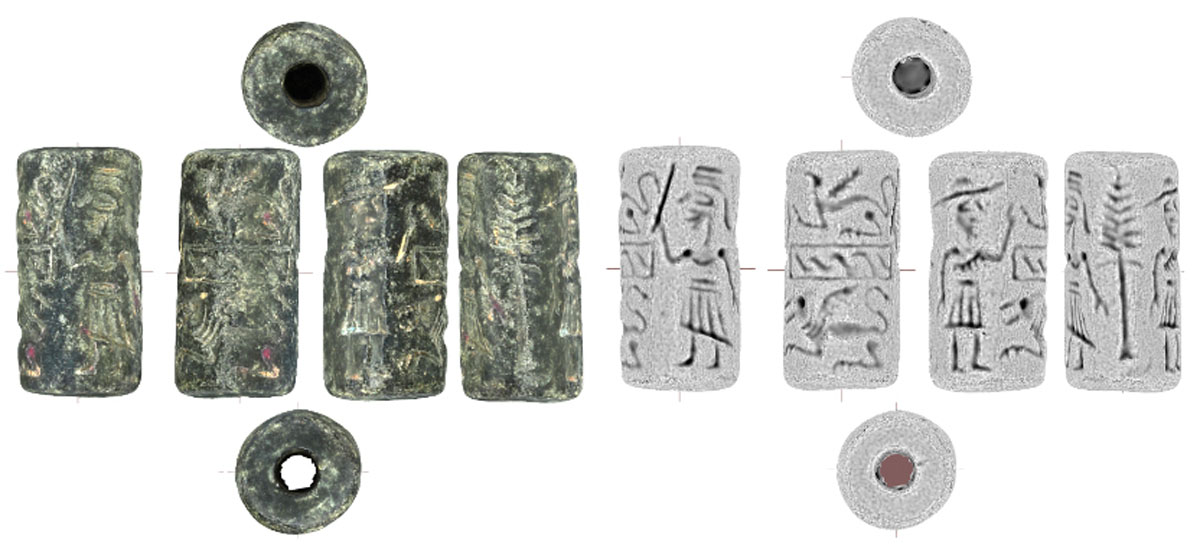
Figure 3
Orthographic renders of a cylinder seal 3D model with MSII filtering (r = 0.5 mm) applied. Photogrammetry alone (top) and combined with photometric stereo normal map (below).
Photogrammetric modelling completed in Metashape, MSII filtering and orthographic renders generated using GigaMesh (2023). All modelling by Thomas J. Keep (2023b) for the University of Melbourne. Model available at https://arts.unimelb.pedestal3d.com/r/UlyjTfcli8.
Cylinder seal 2009.0327: The University of Melbourne Art Collection. Gift of Peter Joseph, Marilyn Sharpe and Susan Rubenstein in honour of their parents Keith and Zara Joseph, 2009.
Decorrelation stretching is an enhancement technique applied to digital images, used within archaeology to make faded colours more pronounced. It is commonly applied to photographs of rock art (Harman 2008; Gunn, Douglas & Whear 2014; Fraile, García & Klink 2016; Almeida & Lovett 2016) and other cultural materials where identification of faded pigments is critical, such as papyrus (Atanasiu & Marthot-Santaniello 2022) and frescoes (Raykovska et al. 2016; Evans & Mourad 2018). Several projects have experimented with applying decorrelation stretching to photogrammetry-produced diffuse textures3 of 3D modelled rock art sites for easier analysis of faded motifs (Fraile, García & Klink 2016: Cabrelles, Lerma & Villaverde 2020; Keep, Gunn & Goodes 2024). Less explored is the potential for applying decorrelation stretching to 3D-modelled objects rather than sites, an application that has been demonstrated to assist with identifying pigments on Bronze Age pottery (Rodríguez González, Pastor & Casals 2019). The software DStretch (Harman 2008) allows for enhanced diffuse textures to be generated, exported, and mapped back onto the UV coordinates of 3D models to present the same 3D model with a variety of DStretch colour grades applied to emphasise different details. The University of Melbourne has been exploring applying this process to New Kingdom canopic jars in the Classics and Archaeology collection (Figure 4).

Figure 4
Orthographic renders of a canopic jar 3D model with DStretch enhanced textures.
Photogrammetric modelling completed in Metashape, texture enhancement completed in ImageJ (2022) using the DStretch v.8.41 plugin. Orthographic renders generated using GigaMesh (2023). All modelling by Thomas J. Keep (2023c) for the University of Melbourne. Model available at https://arts.unimelb.pedestal3d.com/r/63jpCn9-13.
Canopic jar lid with baboon head of the god Hapi 2009.0208: The University of Melbourne Art Collection. Gift of David and Marion Adams, 2009.
The University of New England
The University of New England began digitising at scale in 2017 in the Archaeology & Paleontology departments with experiments in photogrammetry and laser scanning beginning as early as 2015. During this period of initial development, Archaeology developed assets and skills around photogrammetry, valuing the lower upfront costs and the quality assurance of working in house offered, while Palaeontology prioritised the accurate measurements and quicker turnaround found in laser scanning and CT scanning. The different goals and scopes between these departments operating in a vacuum led to diverged expertise that were not apparent until the introduction of Pedestal 3D in 2019 as a universal platform for UNE’s 3D models. Prior to this, models had been hosted on SketchFab or via the Learning Management Systems. With the transition to Pedestal 3D, an increased uptake across disciplines with a historic interest in OBL was seen.
The driving force behind the increased usage of digital surrogates in tandem with and as a replacement to physically-based lessons was, initially, student demographics within UNE. Even before the COVID-19 pandemic, the core of students within these disciplines was shifting from internal to external. Educators found that while intensive schools were received well, supplementary methods were necessary to best prepare students for their learning objectives. The advance of digital based OBL lessons phased out the previous system that had included physical mail outs from teaching collections, reducing admin time, costs and deviation within student’s kits. These instances were first and foremost teaching-led developments, with the goals tied directly to student learning objectives.
By 2021, methods across departments had become entrenched and lacked a sense of unity. A decision was made to create a position detached from any one department across the university. Nested within a department tasked with uplifting teaching across the institution, this position would help to bridge the gap and provide 3D model creation services to otherwise time sensitive educators. This freed up the continued administration and proliferation of these resources from being confined to one discipline, or grant-based contracts. The long-term investment of the university in this position has enabled the development of both of the predominant methods of digitisation, allowing the specific needs of each department to be answered as required. The position has created the opportunity for larger scale multi-media developments, including the creation of virtual reality replicas of field trips, the incorporation of 3D-printed learning resources, and exhibitions built out of on-campus museum resources.
Methods for photogrammetry that predominantly have arisen out of the Archaeology department have chosen Agisoft Metashape (2023). Through the development of these skills, the department has been able to offer student volunteer positions to enhance their own capabilities while contributing to the growing teaching collection. These can be seen in the student contributions to Mark Moore’s Museum of Stone Tools, as well as in PhD student research, though these typically remain unavailable to the public. 2022 saw the use of LiDAR and terrestrial laser scanning expanded upon, with usage focused on sites of first nations and early colonial archaeological ventures. The use of 3D printing has increased with the creation of learning resources, exhibition pieces and marketing material expanding greatly. The acquisition of modern structured light scanning equipment within the discipline agnostic position — an Artec Space Spider (Artec 2021; Figure 5) and Artec Micro (Artec 2024; Figure 6) — has accelerated the digitisation of collections across the institution. An unfortunate consequence of the disparate circumstances of individual department’s forays into 3D digitisation is that metadata practices, much the same as methods, lack any cross referencing. Compounding this issue, many subject matter experts are not directly involved in the digitisation process. The result of this is a continual extra step required to allow interdepartmental cooperation, much the same as collaborating cross institutions.

Figure 5
Artec Space Spider capturing a Globe Theatre Diorama.
Structured light scanning completed in Artec Studio 16 (Artec 2021). Modelling by Jackson Shoobert (2022) for the University of New England. Model available at https://une.pedestal3d.com/r/w_ZnPUKpz5.
Armidale Globe Theatre – base MALoan2021.1.1: Armidale Secondary College, NSW Collection. On loan to UNE Museum of Antiquities’ Ethnographic Collections – Europe.

Figure 6
Artec Micro in the process of scanning a Silver Tetradrachm of Alexander III.
Structured light scanning completed in Artec Studio 18 (Artec 2024). Modelling by Jackson Shoobert (2024) for the University of New England. Model available at https://une.pedestal3d.com/r/rHQSsqp8m-.
Silver Tetradrachm of Alexander III MA1960.37.1: UNE Museum of Antiquities Collection.
Moving forward, further efforts to unite practices across disciplines would greatly benefit UNE’s ability to collaborate internally and externally. Given the 2,200 and counting publicly accessible models currently available on UNE’s Pedestal 3D instance, work should continue to help prepare this growing repository for ease of access to a greater number of users. Expansion into further multimedia outlets for contextualising models seems a promising direction to ensure that these simulacra are being placed into all places of learning as they deserve.
Monash University
Cultural heritage is a multidisciplinary field and therefore efforts to digitise cultural heritage objects and landscapes are distributed across Monash University, within the Centre for Ancient Cultures, the Monash Indigenous Studies Centre, the SensiLab network, the CAVE2 Immersive Visualisation Platform and the Adams Laboratory. The Monash Mediterranean Antiquities Collection (MMAC; Gopnik & Rindi Nuzzolo 2022) has been researched and photographed for inclusion in an online resource. Alongside this resource, Faculty of Arts funding contributed to the production of a selection of 3D models using a structured light 3D scanner (Artec Eva). This work was achieved in collaboration with the Adams Laboratory, which maintains an extensive program producing 3D digital and printed models of palaeontological and anatomical collections, some of which are openly accessible via MorphoSource (Boyer et al. 2016; Adams et al. 2015). The 3D models of ceramic vessels in the MMAC (Figure 7) are made available to students in the Archaeology and Ancient History programme but are not openly accessible. These models are used to familiarise students with essential processes in handling digital data, including storage of files, opening, manipulating and analysing 3D replicas in programs such as MeshLab and Metashape Pro.

Figure 7
Example of 3D modelled kylix used in digital OBL activity.
Structured light scan model produced using an Artec Eva handheld scanner and processed in Artec Studio. Modelling by the Adams Laboratory of Monash University for the Faculty of Arts. Render produced in Meshlab (Cignoni et al. 2008) by Jessie Birkett-Rees.
Attic black-figure kylix 127.007: Monash University Centre for Ancient Cultures Museum. https://doi.org/10.26180/19027757.v2.
3D modelling of cultural landscapes using terrestrial laser scanning, LiDAR and photogrammetry is also an important component of digital heritage work at Monash University. As has been the experience at the University of Sydney, this is an expanding area of research both for digital heritage documentation and research. Such digitisation projects have thus far been achieved alongside specific research projects and using associated funding, rather than there being an internal or integrated approach to digitisation. A recent example is the navigable digital model of Cloggs Cave in GunaiKurnai Country, produced using terrestrial LiDAR and photogrammetry (David et al. 2021; Delannoy et al. 2020). The spatial model of the internal structure of the cave in its broader landscape setting serves GunaiKurnai Elders and other community members to digitally visit this special place, which is fragile and difficult to physically access. This work also allowed the team to reconstruct critical details about formation processes and the uses of the cave and forms a case study for use in classes.
Monash researchers working with the SensiLab network have produced an immersive virtual reconstruction and crowd simulation of the twelfth-century Cambodian temple complex, Angkor Wat (Chandler et al. 2017; Chandler, Morgan & Kuhlen 2018). This model is accessible online and includes educational resources describing the technologies and methods used to build the model, along with thematic teaching modules (https://www.virtualangkor.com/). Similarly, the CAVE2 Immersive Visualisation Platform produced an immersive virtual reality representation of the Plain of Jars, an extensive burial ground in Laos, using drone footage, ground penetrating radar and digital imagery (Metcalfe 2017).
There are also interesting efforts to combine ‘intangible heritage’ with digital representation. In partnership with Indigenous communities across Australia, the Monash Country Lines Archive (MCLA) brought together researchers at the Monash Indigenous Studies Centre and the Faculty of Information Technology (SensiLab). The MCLA used digitisation to curate intangible heritage, languages, stories, and narratives through 3D animation and has established a methodology for facilitating the cross-generational transfer of knowledge. The initiative has built a collection of digitised content that has enabled Elders and younger generations to represent their culture in new ways. The MCLA concluded in 2019 but the animations produced in this collaboration are currently accessible as part of the project Wunungu Awara: Animating Indigenous Knowledges (Kearney et al. 2025) and continue to be used as supporting materials in classes.
Discussion
Australian universities are exploring 3D modelling of cultural materials primarily to develop state-of-the-art educational programs and adapt OBL practices to digital surrogates. A variety of capture techniques have been explored, along with supplementary techniques to capture or enhance fine details. When discussing current 3D modelling practices at their institutions, the authors identified several key areas for the future of 3D-modelled cultural heritage in Australia: funding and long-term planning, sharing practices and data, and the storage and stewardship of 3D model data and metadata.
A persistent trend noted across Australian university digitisation programmes is that in most cases digitisation follows an ad hoc approach where items are modelled in response to demand from educators or for particular projects. This approach differs from the broad scope of 2D digitisation work now regarded as standard practice for museum collections, which are regularly expected to have online-accessible and searchable collections to cohere with Standard C1.7 of the second edition of the National Standards for Australian Museums and Galleries, which reads: “The organisation makes its collection accessible in digital formats and in online environments, as resources permit” (NSAMG 2023). University collection managers have worked hard to develop online catalogues that meet the benchmarks of the National Standards, but 3D models are at present not treated with the same rigour or validity as 2D digital photography. We believe that this is partly an effect of the novelty of 3D digitisation and partly a consequence of funding. 2D digitisation through photography can be rapidly undertaken at a low cost, requiring minimal investment into equipment and training, while 3D modelling requires specialised equipment and training and takes significantly longer to complete. It may be argued that 3D models fall outside the scope of Standard C1.7, which acknowledges that digitisation can only be undertaken “as resources permit”. We have noted two alternative approaches undertaken by Australian universities that have facilitated wide-scale production of 3D models: the investment of the University of New England into dedicated 3D modelling equipment operated by a full-time employee, and the establishment of a 3D scanning internship program at Macquarie University.
The University of New England has a significant body of students that study predominantly online and has invested in ensuring that their online teaching materials match the quality expected by potential students. When developing materials for disciplines that work closely with real-world objects, 3D models present an opportunity to display the materiality of the objects in an online-accessible format. UNE was an early adopter of the Pedestal 3D model platform, where it now hosts over two thousand 3D scans. This extensive collection was produced by a specialised staff member supported by a dedicated 3D scanning space that allowed for continual production in a process more comparable to the large-scale 2D digitisation projects seen in museums in recent years (see Australian Museum 2011) than the project-based ad hoc 3D modelling seen elsewhere. Macquarie University has followed a different approach which likewise allows them to produce an extensive collection of models with centralised management while also developing practical skills for their students. Macquarie has run an internship program within a 3D imaging lab, fitted with equipment necessary to teach photogrammetry, laser scanning, and structured light scanning, where students are able to develop and practise their skills working with objects from the Macquarie University History Museum and partnered institutions. These practices allow for expansive collections to be produced at a relatively low cost per item, with centralised management that ensures consistency and prepares the collections for future re-use. Such projects follow the ‘Golden Rule of Digitisation’ as outlined by Museums & Galleries of New South Wales, which advocates for digitising without a specific output in mind in the expectation that use cases can be developed around digitised assets rather than creating digital assets on demand (Museums & Galleries of New South Wales 2019). While this requires a higher upfront investment in training and equipment, the cost per scan produced by a salaried employee or a supervised intern is significantly lower than those of contractors, and there is a much higher degree of consistency in the production method and management of models and associated metadata.
Without strategic, long-term collaboration, the ad hoc approach to 3D modelling projects will likely continue. From the authors’ experience, digitisation projects often face challenges related to securing long-term motivation to integrate 3D modelling into teaching and education, as well as securing ongoing financial investment. A lack of sustained commitment can impact the purchasing, updating, maintaining and storage of 3D equipment. This can lead to disparities of standards and opportunities, difficulties in data comparison and integration across and within institutions, and result in the accumulation of outdated or poorly maintained equipment, which may become obsolete if not actively utilised and cared for. When projects end and skilled team members move on, purchased equipment may become unusable within departments that lack the expertise among current researchers or students. For high-cost equipment like 3D scanners, the absence of the regular maintenance necessary for cleaning and calibration can render the technology unusable. The ongoing financial demands of maintaining technology might lead departments to prioritise their resources on other investments.
A related consideration is student access to equipment. Without proper training or opportunities for students to learn how to use complex equipment and software, it can be challenging to foster new student users or create research opportunities for both undergraduates and postgraduates. Staff play a crucial role in promoting the use of such equipment, which can be supported through integrating 3D modelling into tertiary courses or workshops or internship programs similar to those offered at Macquarie University. A centralised infrastructure could address these issues by managing and organising equipment, coordinating software licences, and offering educational opportunities. This approach could help individual departments overcome challenges related to securing funds, maintaining interest, and ensuring proper training and upkeep of equipment. Additionally, it could enforce protocols for storing and organising metadata, models, and images.
Digital collections introduce the potential for machine learning or AI-based analyses, already proving to be an interesting avenue of research (Bickler 2021; Byeon et al. 2019; Sipiran et al. 2022). Machine learning training models, especially deep learning models, require large amounts of data to achieve high accuracy. Cultural heritage collections are often of modest size, so integrating multiple categorically similar collections could reasonably be needed to investigate machine learning potential, such as using machine learning to support the production or interrogation of artefact typologies. The same applies to AI-based analysis tools, such as those used to reconstruct missing parts of broken artefacts or predict wear over time. The use of different software tools, file formats and standards may introduce issues if different datasets need to be integrated into larger datasets for machine learning or AI-based analytics. If 3D models from different sources are incompatible in terms of model resolution, level of detail or metadata standards, it becomes challenging to curate data that meets the desired quality thresholds for machine learning tasks. This limits the use of digital collections and the scope for teaching and learning with these interesting materials.
A final point we consider important for the development of 3D modelling of cultural heritage in Australian universities is data sharing, which will require ongoing communication and a concerted effort to regulate and standardise metadata recording. One of the great benefits of 3D models is their ability to be duplicated and shared, potentially opening a range of opportunities for big-data analyses and the establishment of flexible collections for teaching and research. The teaching collection has always been an integral element of archaeological education and we are today in a position to leverage a greater range of examples than has ever been previously accessible – an online Library of Alexandria, replete with digital surrogates from collections spanning the globe – provided that institutions can find the will and organisation to digitise their collections, collaborate on metadata practices, and be diligent in the production and documentation of their collections. Within Australia we have already seen an initial foray in Moore’s ‘Museum of Stone Tools’ (Stock 2023), which allows visitors to view 3D models of stone tools from across the world, searching by region, tool type, production technique, and more. Many of the surrogates were generated at UNE from objects in their collection, but many others were produced in other institutions that made their data available for hosting on the website in a collaborative effort to create a uniquely valuable and accessible repository of stone tool data. With careful metadata recording to ensure data integrity, such collections hold great potential for automated analyses of stone tools (Wyatt-Spratt 2022; Dixon et al. 2024), or a range of other artefact types. There is an untapped potential for unprecedented revelations and research opportunities if only we are able to collaborate and communicate.
Conclusion
3D models have emerged as an important component of object-based learning within Australian universities, supporting hybrid and online-classroom environments and providing an opportunity for students to continue virtually ‘handling’ objects in their own time. While there is great potential for digital surrogates to open new avenues for research and study, at present this potential is limited by a lack of communication and collaboration between institutions and clarity of commitment within universities. Within Australia, 3D models are not yet regarded as a priority for documentation of heritage collections and are typically produced on-demand for a particular subject or project which limits their potential for future re-use. In some instances, dedicated spaces have been established for a period of use but not maintained once their original stated purpose has concluded, with an associated skills shortage emerging that makes it more difficult for the spaces and equipment to be re-established. In other cases, ongoing digitisation projects have generated thousands of objects for use by their host institutions with a wide range of future potential use cases while developing digital literacy skills that will be in increasing demand within the cultural heritage sector in future years. Perhaps most importantly, the emerging potential for large 3D model teaching collections and automated analyses has not yet been realised in the absence of ongoing lines of communication between educators and 3D modelling experts at different institutions, who could advocate for shared standards of data and metadata management and data exchange.
We acknowledge that establishing such collaborations would be no easy task. We point to a comparable initiative in the realm of virtual reality as offering a potential map for the future of 3D modelling in universities: the London Charter (Beacham, Denard & Nicolucci 2006), which established a set of guidelines for the production of virtual reality reconstructions. The London Charter was developed at a 2006 symposium at the British Academy, London and the Centre for Computing in the Humanities, King’s College London, where delegates met to discuss pressing issues in the field and establish guidelines for future practice. Perhaps it is time for 3D modellers working within universities to pursue a similar symposium. We hope that such an arrangement may emerge in the coming years to support 3D modelling of cultural heritage while it is still pliable and filled with potential.
Notes
[1] A normal map is an image used in computer rendering to simulate surface details that are not present in the 3D mesh itself. The map uses RGB colouring to inform the behaviour of simulated lighting to display shadows on the rendered mesh. Although most commonly used to make low-detail meshes appear similar to high-detail versions of the same model, techniques such as photometric stereo can generate normal maps in isolation.
Acknowledgements
The authors would like to thank the Chau Chak Wing Museum for their guidance in the section discussing The Mummy Room exhibition.
We would also like to thank Steve Martin, Collections Manager, Arts Teaching Innovation and Ben Loveridge, Immersive Media (VR/AR) Coordinator for their integral contributions in developing the 3D model collections of the University of Melbourne, and the Museums and Collections Team for their guidance in including items from the University of Melbourne collections in this paper.
The authors would like to thank the reviewers of this paper for their time and attention and the helpful feedback they provided.
Reviewers
This article has been reviewed & recommended by PCI Archaeology (https://doi.org/10.24072/pci.archaeo.100591).
Competing Interests
The authors have no competing interests to declare.