
1 Introduction
The study of Peasantry in Roman times has witnessed considerable expansion in the last decades. This growth is largely attributed to different systematic survey projects (Bermejo & Grau 2022; Bowes 2020; Patterson, Witcher & DiGiuseppe 2020; Reddé 2017; Smith et al. 2016; among others). Contributing further to this increasing interest are the urgent archaeological interventions prompted by the extensive urban sprawl in major metropolitan areas (Bermejo 2017; Novaković et al. 2016). Of specific relevance to this paper is the metropolitan area around the city of Madrid, in the centre of the Iberian Peninsula. In this case, the discoveries of peasant-type settlements (Bermejo 2022) have prompted the reinterpretation of models that previously defined a much more homogeneous economic structure of the Roman rural world, i.e., the well-known villa model.
When we talk about consumption patterns, we refer to how communities acquire, use, and value material goods, and can reflect their economic and social dynamics. Consumption patterns are normally influenced by a wide variety of factors. Kent (1999: 91) stresses that individual households or communities possess distinct consumption patterns, which distinguish them from other households. This observation is important as it gives us a lens to reconstruct past societies in detail, providing a more complete picture of their economic and social structures. Economic considerations often dictate these consumption patterns. For instance, the difference in consumption between peasant and elite settlements reveals much about the interplay between status and material culture. Two overarching perspectives characterise archaeological studies of consumption (Mullins 2011). Firstly, the structural approach concerns itself with the processes that dictate the movement and reception of goods in societies. This method sheds light on the symbolic facets of consumption. Secondly, there is an emphasis on the conscious symbolic agency of consumers. This angle focuses on how individuals assign meaning to goods, even if such interpretations challenge dominant ideologies or interests (Mullins 2011: 134). Such a lens reveals consumption as a dynamic platform for individual expression (Buchli & Lucas 2001). However, while economic status plays a role, it is far from being the sole determinant of consumption. Factors like geography, including climate and proximity to trade networks, play crucial roles. Furthermore, cultural and social variables dictate the valuation of certain items over others. Communities are not static, but constantly changing and adapting concerning how they connect with the territory (Grey 2011). Moreover, the organisation of space may allow for certain forms of passive resistance to state power (Scott 1985). The temporal aspect of habitation (Bowes 2020: 435), whether seasonal or constant, affects consumption patterns, as do post-depositional processes at archaeological sites. Careful analysis of discard patterns can provide clues as to how and why a settlement was abandoned (Deal 1985). The dynamic nature of communities, their spatial organisation and how they can resist dominant powers make understanding consumption a complex task.
Modern interpretative frameworks, such as globalisation and glocalisation, offer researchers alternative tools for understanding consumption patterns, particularly in historical societies. Globalisation seeks to understand the processes through which societies become interconnected on a global scale (Robertson 2014). In Roman studies, globalisation has been instrumental in providing new perspectives on the nature of Roman imperialism (e.g., Witcher 2000). On the other hand, glocalisation—a term that merges ‘global’ and ‘local’—emphasises the simultaneous occurrence of both universalising and particularising tendencies. This concept recognises that while global forces may be at play, local traditions and cultural inertias play a significant role in determining the outcome of these interactions (Homobono 2019: 19–54; Robertson 2014: 16–25; Roudometof 2016: 79). This framework has gained traction recently in Roman studies (Cobb 2022: 28–44; Montoya 2021: 92–114).
When we approach the study of the peasantry, there is a prevailing tendency to view this collective as a cohesive, harmonious entity, largely detached from the overarching societal dynamics. This often overlooks the potential rivalries and competitions latent within different peasant communities (Kearney 1996; Van der Ploeg 2008). For example, Van der Ploeg (2008: 2) has expressed reservations about prevailing theories, that tend to express negative connotations about the peasantry, advocating for a re-examination through the lens of the ‘peasant condition’. He emphasises the struggle for autonomy against the backdrop of dependency and marginalisation, as well as the unique ‘peasant mode of agriculture’. He posits that the ‘peasant condition’ is a byproduct of an ongoing interaction between the peasants’ ambient environment and their adaptive strategies to navigate the challenges of dependency, deprivation, and marginalisation (Van der Ploeg 2008: 42–43).
This paper dives deep into these complexities, analysing the archaeological record from nine peasant settlements in the central Iberian Peninsula. Using network science (Barabási 2002; Freeman 1977; Freeman 1979; Freeman 2004; Newman 2010; Scott & Carrington 2011; among others), a method that has been widely developed in recent years for the archaeological discipline (Brughmans 2010; Brughmans 2013; Brughmans & Peeples 2023; Collar et al. 2015; Mills 2016; Peeples 2019; among others), we represented archaeological actors as nodes and their relationships as edges. The motivation behind using network science, and especially similarity measures, arose from the need to analyse relationships between sites based on the shared archaeological record they contain. This allowed us to create a graphical representation of the interactions between sites which guaranteed us a better image of how they interact with each other. Therefore, we can identify patterns and trends in the dataset that might otherwise go unnoticed in a more traditional examination of the archaeological record. The chosen analyses are similarity measures (Östborn & Gerding 2014) in order to assess similarities and differences between peasant communities in the north of the Carpetania region in relation to shared elements of their archaeological record. Instead of using traditional graphical representations of network science such as nodes and links, we have decided to use matrices representing heat maps, as they more accurately represent the similarity values of the analysed sites.
2 Case Study
In line with previous project publications, we have adopted the same case study (Bermejo 2022; Moreno-Navarro, Brughmans & Bermejo 2023). The research context is geographically rooted in the Madrid basin, tracing the course of rivers that originate from the Sistema Central mountains and flow towards the right bank of the Tagus River (Figure 1). Other tributary rivers have carved fertile terraces suitable for farming. During the Roman era, this was primarily an agrarian region, acting as a transitional area between the territories of three distinct municipia: Complutum (Alcalá de Henares, Madrid), Titultiam, and Mantua Carpetanorum. The precise location of the latter two remains a point of debate (Knapp 1992: 185; Stylow & Von Hesberg 2004). The area under investigation is largely within the current Comunidad de Madrid, encompassing the metropolitan region of Madrid city. In the past few decades, rampant urbanisation led to numerous preventive archaeological digs following the introduction of heritage protection laws.1 These efforts resulted in the uncovering and recording of several Roman-era rural settlements. The opportunity to systematically excavate and document such a wealth of archaeological sites offers an invaluable chance to examine the economic patterns and living conditions of the less affluent rural communities in Roman provinces.
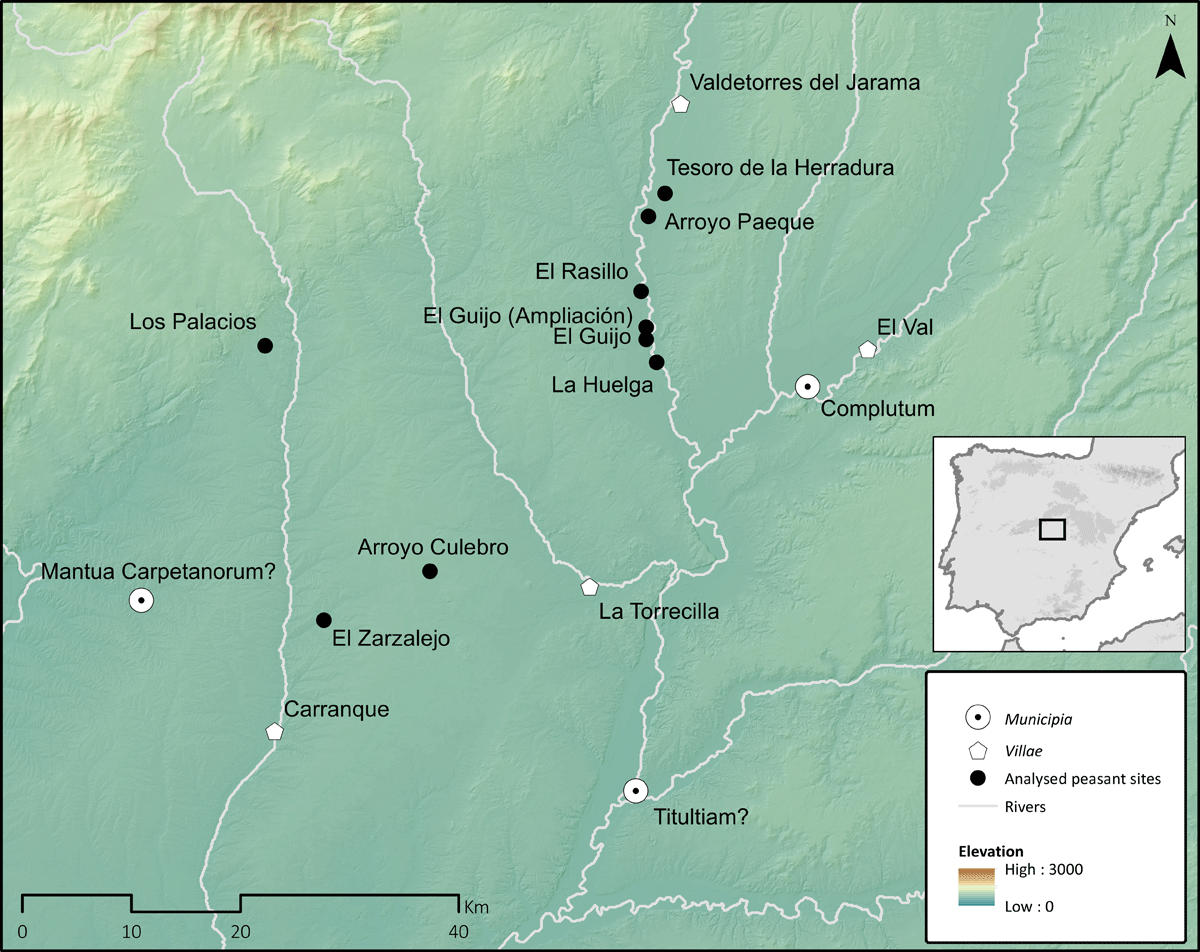
Figure 1
Analysed sites location map. The map shows the location of the analysed sites and other settlements as reference.
Our research involves sampling material contexts from archaeological deposits at nine locations within the study region. The examination of these archaeological materials was conducted between 2018 and 2022 under the umbrella of the project Economías domésticas en el norte de la Carpetania romana (100 a.C. – 400 d.C.): condiciones de vida, redes y desigualdad, led by Dr Jesús Bermejo Tirado.2 The data was sampled and recorded utilising a two-step approach (Allison 2009; Parker & Foster 2012; Wilk & Rathje, 1982). First, we selected specific material contexts from archaeological deposits based on taphonomic criteria. We analysed records forming archaeological deposits comparable to the ‘de facto refuse’ concept (LaMotta & Schiffer 1999; Schiffer 1987: 93), or strata associated with deposits that have been sealed as dumps or silo fills. Consequently, we intentionally omitted finds from other strata to prevent taphonomic skew related to the ‘Pompeii Premise’ (Binford 1981; Schiffer 1985). Secondly, we carried out a comprehensive analysis of all findings, including ceramics, metals, bone artefacts, lithics, glass, etc., considering identification and descriptive formal variables, traditional chronological and typological variables, use wear, and context analysis. So far, we have been able to analyse more than 1550 fragments. These sites are briefly presented below:
First, at El Guijo Ampliación site (Barajas, Madrid) (Domínguez, Rincón & Vigil-Escalera 2004a), analyses revealed a residential structure under a layer of roof tiles, along with four associated pits holding domestic materials. Uncertain-chronology stains from probable earlier grid excavations also appear on the site. The pits likely served for vine cultivation. Near this site, a complete ceramic kiln structure has been recovered at the site of El Guijo (Barajas, Madrid) (Dumas & Redondo 2002). A stratum with Early Imperial ceramic residues was also discovered adjacent to this kiln.
The second site is Arroyo Paeque (Algete-Fuente el Saz, Madrid) (Pérez 2007). Here, the materials analysed come from small structures, one of which has two rectangular rooms located on either side of a series of grid-arranged patches, like those found at El Guijo Ampliación site. These patches are spaced at a distance similar to a decempedus (2.84 m), which could suggest an Early Imperial chronology (Bermejo 2017: 355). It also has two structures lined with hydraulic mortar (lacus) used for decanting wine.
Another lacus with the same characteristics was discovered in Tesoro de la Herradura (Fuente el Saz, Madrid) (Vega et al. 2017). In addition to the lacus, the materials analysed at this site come from a series of square buildings with a stone plinth, and another structure with hydraulic mortar paving and a residential area.
The site of El Rasillo (Barajas, Madrid) (Vigil-Escalera 2004) presents several phases of different chronology. Archaeologists have documented the remains of an imperial building with a rectangular ground plan and at least two living spaces. The materials analysed at this site come from the remains of this Early Imperial phase. A series of waste strata were also documented, one of them chronologically ascribed to the beginning of the 3rd century AD. Subsequently, in the Late Imperial period, a villa with a thermal complex was built (García-Entero, Peña & Zarco 2017: 210). Finally, they documented the remains corresponding to the reoccupation of the villa in Late Antiquity.
At the site of La Huelga (Barajas, Madrid) (Domínguez, Rincón & Vigil-Escalera 2004b), no Early Imperial habitation structures have been detected. The materials analysed come from two pools filled with Early Imperial archaeological material. These pools are not associated with any known habitation structure from the same chronological period.
A similar case is Arroyo Culebro (Leganés, Madrid) (Site B, sector C). In this case, archaeologists have located a series of silos reused as landfills during the Early Imperial period (Penedo, Morín & Barroso 2002).
Finally, the site of Los Palacios (Villanueva del Pardillo, Madrid) consists of several buildings arranged around an open central space (Major & Penedo 2014). The eastern rooms were severely degraded, although a hearth was identified in one of the rooms. The exact use of the remaining rooms is still uncertain, but they are believed to be associated with production activities involving combustion structures (Major, Penedo & Peña 2013). The best-preserved remains at the site are in ‘Estructura 1’, identified as a torcularium—a structure housing a beam press—and a counterweight-powered lathe (Peña 2017; Major and Penedo 2017). The counterweight was reused from a previous funerary structure as evidenced by the presence of an inscription that belongs to a member of the Aelia gens, most probably from the municipium of Mantua Carpetanorum (Villamanta, Madrid), about 20 km from the site (Gorostidi et al. 2016). The torcularium had a grape pressing room (calcatorium) and a wine cellar (cella vinaria) that could hold up to 2900 litres. Analysis of the lacus residue suggests that the site was used for red wine production, at least in its initial chronological phase (Peña 2017: 57). The site was in use over a lengthy chronological period, from the 1st c. AD to the 4th or early 5th c. AD (Major, Penedo & Peña 2013: 363).
3 Methods
Similarity measures are one of the most widely used tools in network science. They allow us to extrapolate relationships formed by the archaeological record. Such tools are crucial for uncovering hidden patterns in our archaeological data that would otherwise be very difficult to discern. Similarity networks, which are one-mode networks, have nodes that represent entities of interest. The edges between these nodes indicate a measure of similarity or distance. This measure is based on shared features, attributes, or associated assemblages among the entities (Östborn & Gerding 2014). Using this approach, we treat sites as nodes and define similarities based on the relative frequencies of specific artefact types (e.g., Blair 2015; Borck et al. 2015; Irwin-Williams 1977). These networks are constructed beginning with a two-mode table (incidence matrix). In our case, we establish a two-mode network where one group of nodes denotes archaeological sites (mode one), and another group represents artefact types (mode two). In this network, connections are formed when an artefact type is found in a certain site (Feugnet, Rossi & Filet 2017; Östborn & Gerding 2014).
To measure the similarity of the archaeological site we use Brainerd-Robinson similarity metric (Brainerd 1951; Robinson 1951). This metric is the most commonly used tool in archaeological similarity network studies, offering a measure of total similarity based on the proportional representation of categories found at each site (Brughmans & Peeples 2023: 84–87). The measure quantifies the similarity between two sites based on the proportional representation of various artefact types found at each site. Depending on the specific nature of the data or questions, other metrics can perform differently (Brughmans & Peeples 2023: 84–87; Östborn & Gerding 2014). However, we chose the Brainerd-Robinson similarity metric to understand the similarities and differences between settlements. This method remains a common and trusted tool for many archaeologists (Mills 2016: 387).
To explore the similarity, we created an R script for use in the RStudio software. The script filters both the archaeological sites and the artefact types to include only the actor of the same chronology. In our case, we have only been able to determine three chronological periods: 1st, 2nd, and 3rd centuries AD. After that, it generates a matrix of artefact-type data for the selected sites. The values within this matrix are normalised on percentages to ensure comparability. Following the preprocessing of the data, we calculate the Brainerd-Robinson similarity coefficient between each pair of sites based on other R scripts (Peeples 2011).3
To evaluate the robustness of our Brainerd-Robinson results, the script performs a bootstrap resampling procedure (Efron 1979), creating 100 new samples from the original data. For each bootstrapped sample, we calculate a new set of Brainerd-Robinson metrics, generating a distribution of the Brainerd-Robinson values for each pair of sites. Then we calculate the mean similarity for each pair of sites across all bootstrap samples. These mean values are subtracted from the original similarity metrics, creating a ‘difference matrix’ that represents the deviation of the original values from the bootstrapped mean. This robustness can also be analysed using other methods such as Monte Carlo simulations (Peeples 2011).
4 Results
The result graphics are heatmaps that visually represent both the original Brainerd-Robinson similarity matrix and the difference matrix. The heatmaps include hierarchical clustering based on the Euclidean distance between sites based on their artefact-type data, enabling a visual assessment of the relationships and differences between the sites. The dendrograms from the first heatmap (representing original similarities) are used to order the rows and columns in the second heatmap (representing the deviation from the bootstrapped mean), providing a consistent visual comparison.
4.1 Analyses considering all the artefact types
During the 1st century AD, the site of Arroyo Culebro stands out for being the site with the least similarity to many other sites (Table 1, Figure 2). The most outstanding dissimilarities are with the sites of El Guijo Ampliación and El Guijo, with coefficients of 67 and 71 respectively. The dissimilarity of Arroyo Culebro with El Guijo Ampliación has a relevant value when compared to the average similarity values of the bootstrapping samples (Figure 3). This lower value signifies lesser similarity, but the level is still substantial enough to consider the existence of shared aspects between these sites. A remarkably high level of similarity is observed between Arroyo Paeque and Los Palacios, with a coefficient nearing 148. This indicates a significant level of shared attributes between the two archaeological sites, and it is highlighted by the result of the difference matrix (Figure 3). In contrast, the similarity levels between Los Palacios and El Guijo, and between El Rasillo and Los Palacios, are relatively lower, with values of about 87 and 96 respectively. El Guijo Ampliación has a moderate similarity with both Arroyo Paeque and Tesoro de la Herradura, showing coefficients around 125 and 120, respectively. Lastly, La Huelga exhibits a relatively high similarity with El Guijo and Tesoro de la Herradura, scoring approximately 133 and 128, respectively. These scores hint at considerable shared features between these sites.
Table 1
Matrix with the Brainerd-Robinson similarity values for the 1st century AD.
| ARROYO CULEBRO | ARROYO PAEQUE | EL GUIJO AMPLIACIÓN | EL GUIJO | EL RASILLO | LA HUELGA | LOS PALACIOS | TESORO DE LA HERRADURA | |
|---|---|---|---|---|---|---|---|---|
| Arroyo Culebro | 200 | 101.961 | 66.762 | 71.221 | 87.129 | 95.469 | 89.693 | 98.862 |
| Arroyo Paeque | 101.961 | 200 | 124.837 | 83.406 | 98.130 | 113.021 | 147.678 | 141.822 |
| El Guijo Ampliación | 66.762 | 124.837 | 200 | 90.400 | 111.005 | 99.533 | 120.192 | 120.163 |
| El Guijo | 71.221 | 83.406 | 90.400 | 200 | 120.816 | 133.372 | 87.009 | 91.088 |
| El Rasillo | 87.129 | 98.130 | 111.005 | 120.816 | 200 | 120.851 | 95.778 | 101.832 |
| La Huelga | 95.469 | 113.021 | 99.533 | 133.372 | 120.851 | 200 | 122.873 | 128.354 |
| Los Palacios | 89.693 | 147.678 | 120.192 | 87.009 | 95.778 | 122.873 | 200 | 151.755 |
| Tesoro de la Herradura | 98.862 | 141.822 | 120.163 | 91.088 | 101.832 | 128.354 | 151.755 | 200 |
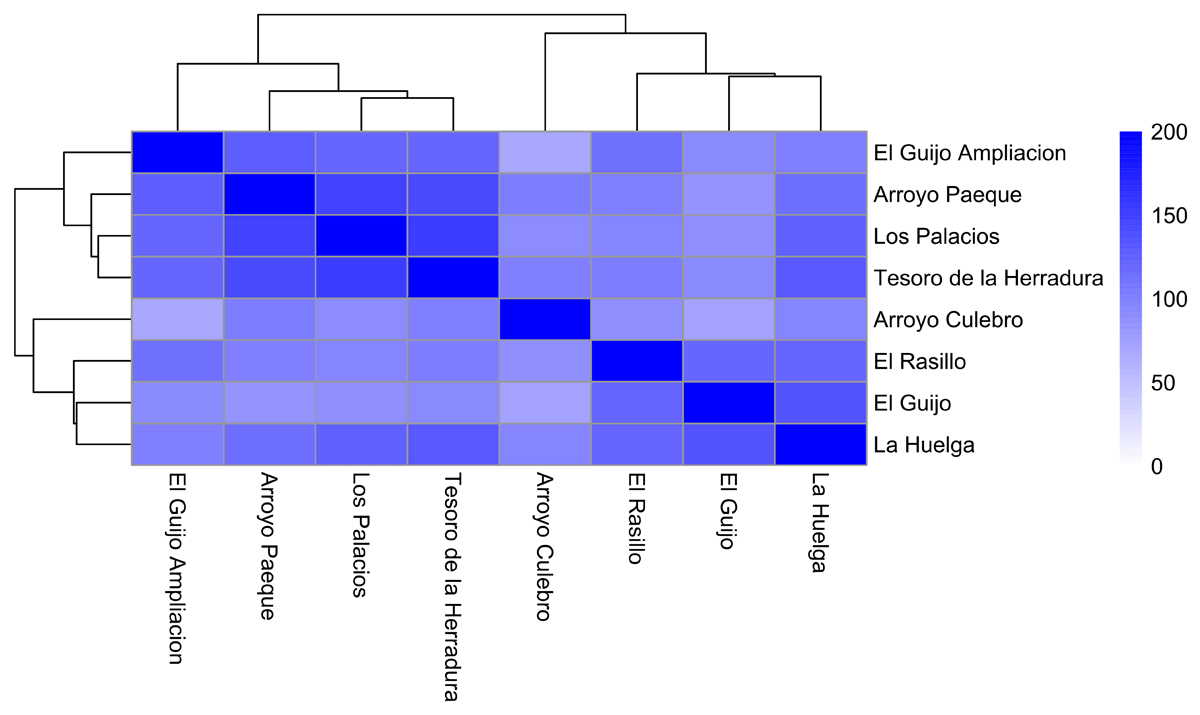
Figure 2
Heatmap of the Brainerd-Robinson similarity values of the archaeological sites during the 1st century AD.
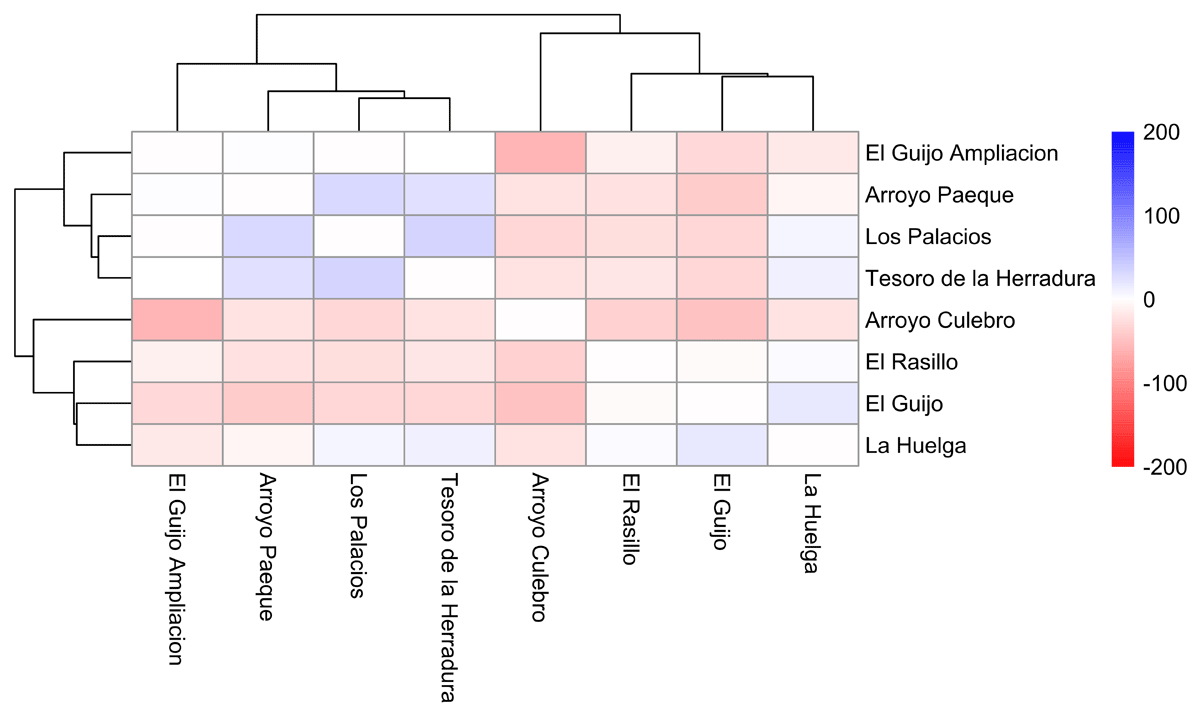
Figure 3
Matrix showing the difference between the Brainerd-Robinson values during the 1st c. AD and the B-R values of the bootstrapped sample.
During the 2nd century AD, Arroyo Paeque had a particularly strong similarity with El Zarzalejo, a site that emerged in this period for the first time, showing a coefficient of around 158 (Table 2, Figure 4). That similarity is also highlighted in the difference matrix (Figure 5). This is among the highest similarities observed in this dataset, suggesting a substantial degree of shared characteristics between these two sites. Also, a high level of similarity is evident between Arroyo Paeque and Los Palacios, with a coefficient of nearly 148. The relationship between Los Palacios and Tesoro de la Herradura also stands out, with a coefficient of approximately 149. The coefficients between La Huelga and El Guijo, and between La Huelga and Tesoro de la Herradura, also show high levels of similarity, with scores of about 134 and 128, respectively. Meanwhile, El Guijo Ampliación shares a similar level of moderate similarity with both Arroyo Paeque and Tesoro de la Herradura, displaying coefficients of approximately 121 and 120, respectively. In contrast, El Guijo and Arroyo Paeque display a lower degree of similarity, with a score of approximately 80. According to the difference matrix, the site of El Guijo is the most dissimilar in comparison with the rest of the sites.
Table 2
Matrix with the Brainerd-Robinson similarity values for the 2nd century AD.
| ARROYO PAEQUE | EL GUIJO AMPLIACIÓN | EL GUIJO | EL RASILLO | EL ZARZALEJO | LA HUELGA | LOS PALACIOS | TESORO DE LA HERRADURA | |
|---|---|---|---|---|---|---|---|---|
| Arroyo Paeque | 200 | 121.395 | 80.092 | 92.686 | 157.594 | 108.687 | 147.990 | 135.167 |
| El Guijo Ampliación | 121.395 | 200 | 88.303 | 108.753 | 107.752 | 98.305 | 119.596 | 119.991 |
| El Guijo | 80.092 | 88.303 | 200 | 119.217 | 82.887 | 134.389 | 83.230 | 88.919 |
| El Rasillo | 92.686 | 108.753 | 119.217 | 200 | 97.023 | 122.494 | 92.547 | 99.863 |
| El Zarzalejo | 157.594 | 107.752 | 82.887 | 97.023 | 200 | 114.767 | 137.066 | 128.383 |
| La Huelga | 108.687 | 98.305 | 134.389 | 122.494 | 114.767 | 200 | 119.430 | 127.542 |
| Los Palacios | 147.990 | 119.596 | 83.230 | 92.547 | 137.066 | 119.430 | 200 | 148.941 |
| Tesoro de la Herradura | 135.167 | 119.991 | 88.919 | 99.863 | 128.383 | 127.542 | 148.941 | 200 |
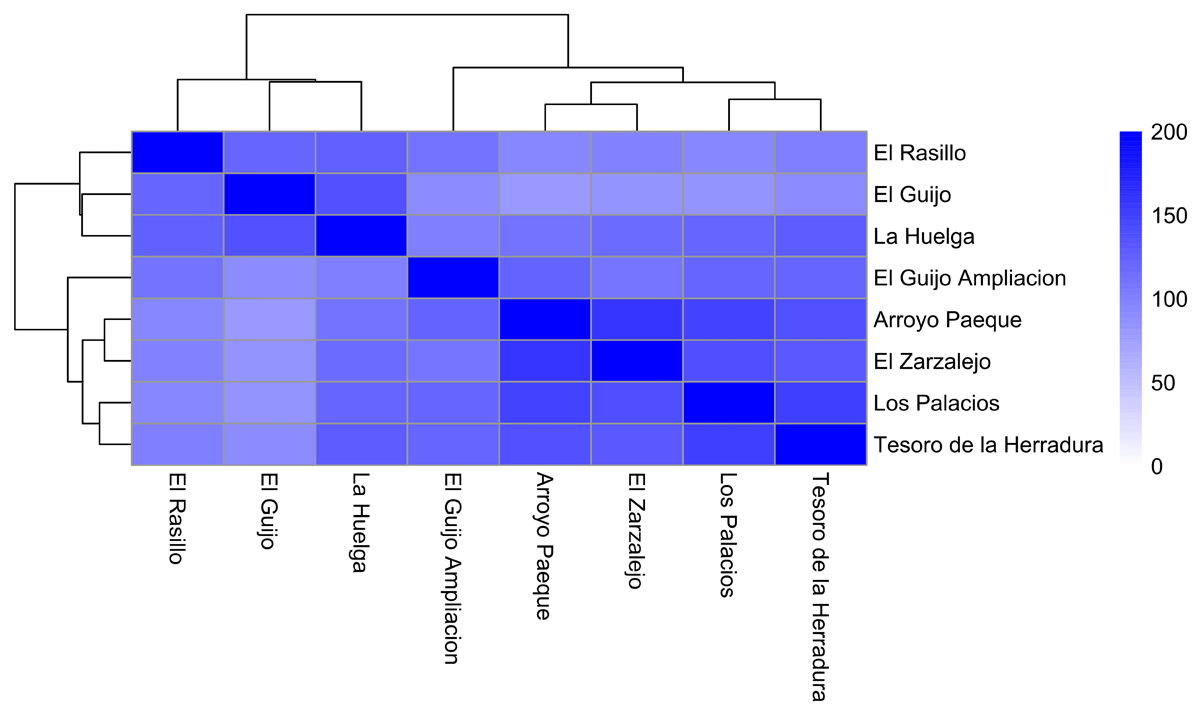
Figure 4
Heatmap of the Brainerd-Robinson similarity values of the archaeological sites during the 2nd century AD.
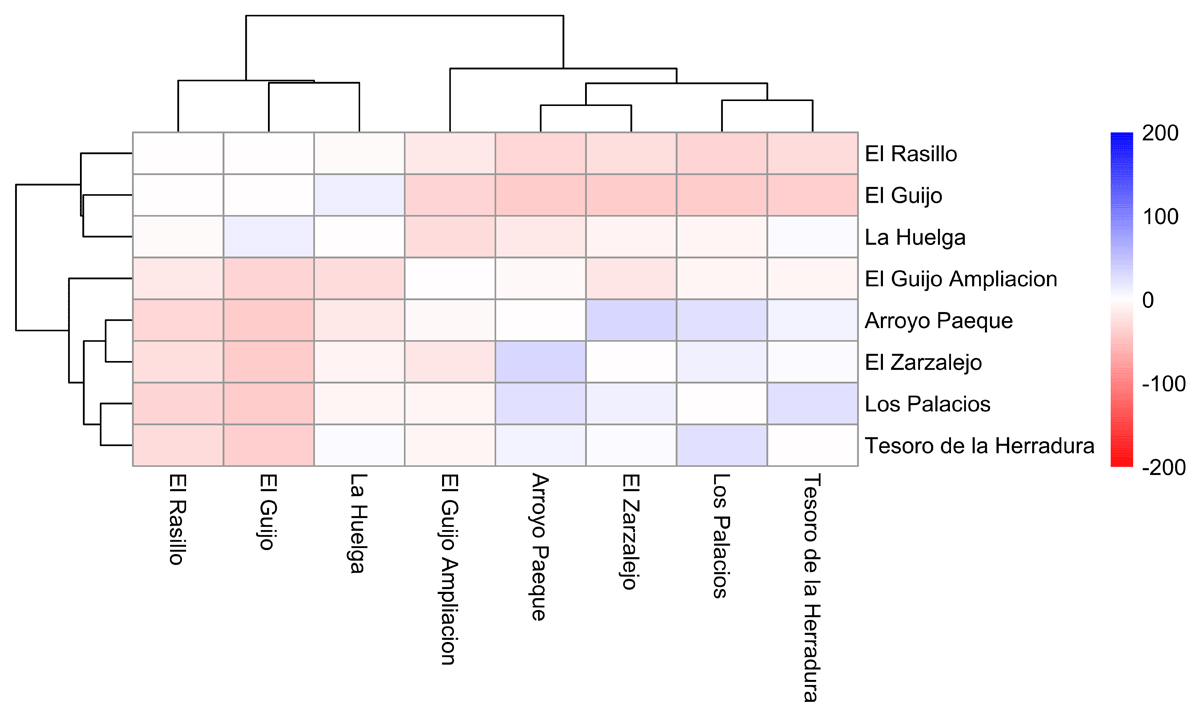
Figure 5
Matrix showing the difference between the Brainerd-Robinson values during the 2nd c. AD and the B-R values of the bootstrapped sample.
In the 3rd century AD, we can only find four active sites: Arroyo Paeque, El Zarzalejo, La Huelga, and Los Palacios (Table 3, Figures 6 and 7). Arroyo Paeque demonstrates the most significant similarity to El Zarzalejo, boasting a substantial Brainerd Robinson coefficient of 165. Less robust, yet still noteworthy, is the similarity between Arroyo Paeque and Los Palacios, with a coefficient of 155. El Zarzalejo also presents a discernible degree of similarity to the other sites. Besides its strong similarity with Arroyo Paeque, it has a relatively lower but noticeable association with Los Palacios (140). The relationship between El Zarzalejo and La Huelga is somewhat less pronounced. As for La Huelga, it presents a lower degree of correlation with all the other sites. The strongest relationship exists with Los Palacios, yet with a value of only 124. When considering La Huelga’s relationship with Arroyo Paeque, the coefficient further reduces to 110.71, indicating a relatively weak similarity. The dissimilarities that the La Huelga site shows with the rest of the sites in this period are also shown in the bootstrapped difference matrix (Figure 7). Los Palacios, in contrast, shows a correlation with all the sites. The highest similarity score is seen with Arroyo Paeque (155), followed by El Zarzalejo (140) and then La Huelga (124).
Table 3
Matrix with the Brainerd-Robinson similarity values for the 3rd century AD.
| ARROYO PAEQUE | EL ZARZALEJO | LA HUELGA | LOS PALACIOS | |
|---|---|---|---|---|
| Arroyo Paeque | 200 | 164.974 | 110.707 | 155.369 |
| El Zarzalejo | 164.974 | 200 | 119.359 | 140.532 |
| La Huelga | 110.707 | 119.359 | 200 | 124.061 |
| Los Palacios | 155.369 | 140.532 | 124.061 | 200 |
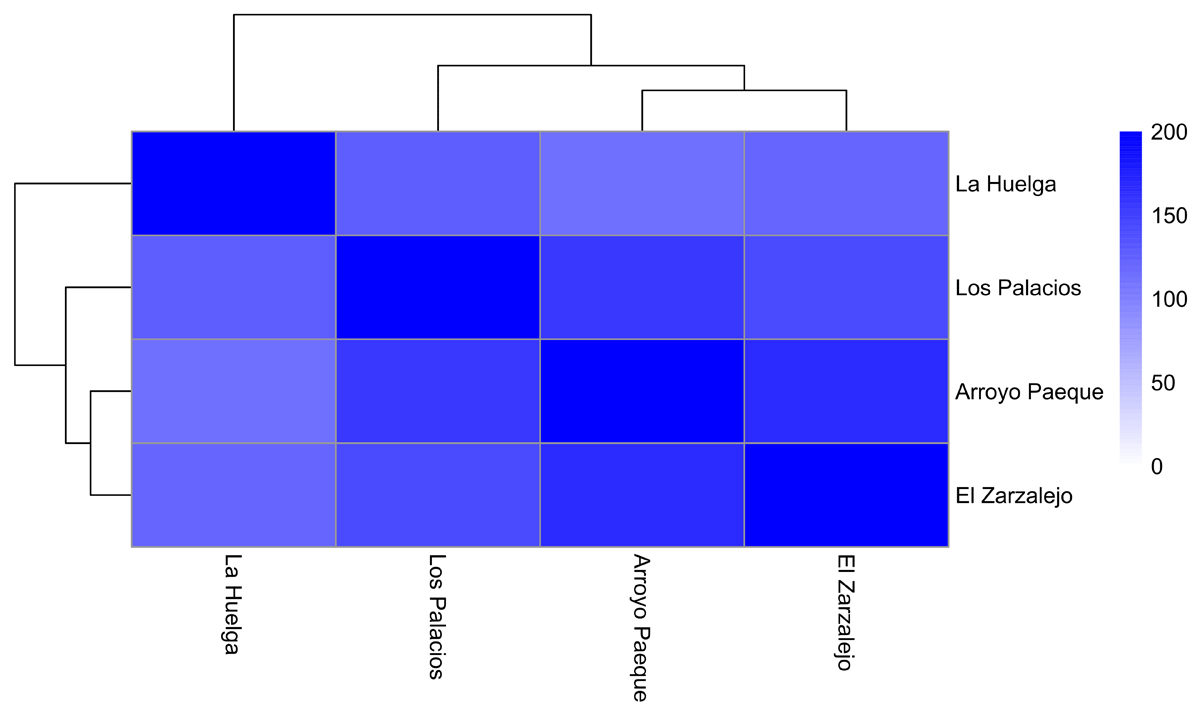
Figure 6
Heatmap of the Brainerd-Robinson similarity values of the archaeological sites during the 3rd century AD.
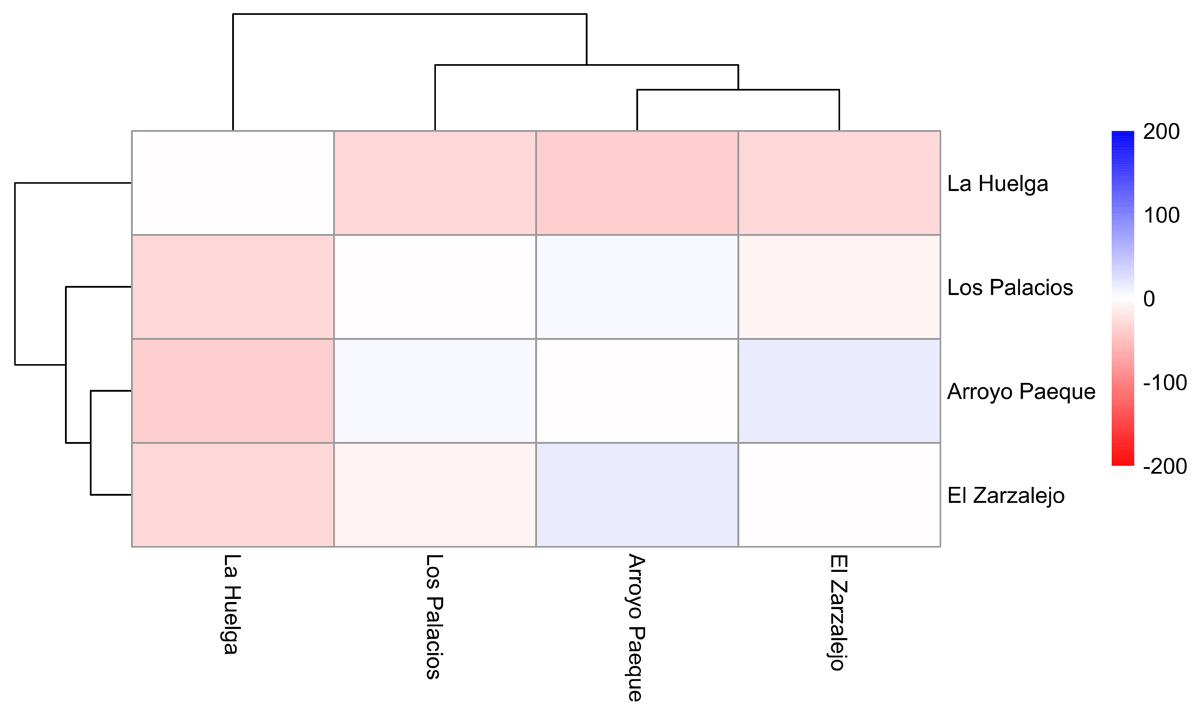
Figure 7
Matrix showing the difference between the Brainerd-Robinson values during the 3rd c. AD and the B-R values of the bootstrapped sample.
4.2 Analyses considering only non-ubiquitous artefact types
What are the results if we remove ubiquitous nodes from the two-mode network? We understand ubiquitous nodes as those belonging to chrono-types that are present in all sites in a generalised way. They can be those general chrono-types such as Hispanic Terra Sigillata (TSH), a general typology that includes many of the fragments for which it has not been possible to identify a specific form and can generate an important distortion in the analyses.
With the removal of ubiquitous nodes, the patterns of similarity during the 1st century AD indeed changed significantly (Table 4, Figure 8). The similarity between Arroyo Culebro and Arroyo Paeque, previously displaying a certain level of similarity, now registers a striking zero, indicating zero common features according to the revised analysis. The pair of El Guijo and Arroyo Culebro display a reduced level of similarity, suggested by the low coefficient of 24.26. The association between Arroyo Culebro and Tesoro de la Herradura also diminishes substantially, presenting a coefficient of 47.65. This points towards a more considerable divergence in characteristics between the two sites. Arroyo Paeque and Los Palacios, which were strongly associated before the removal of ubiquitous nodes, now exhibit a lower yet considerable similarity with a coefficient of almost 77. This reflects a shift in their relationship, although they still maintain a fair number of common features.
Table 4
Matrix with the Brainerd-Robinson similarity values for the 1st century AD without the ubiquitous artefact types.
| ARROYO CULEBRO | ARROYO PAEQUE | EL GUIJO AMPLIACIÓN | EL GUIJO | EL RASILLO | LA HUELGA | LOS PALACIOS | TESORO DE LA HERRADURA | |
|---|---|---|---|---|---|---|---|---|
| Arroyo Culebro | 200 | 0 | 13.559 | 24.265 | 26.667 | 58.514 | 33.333 | 47.647 |
| Arroyo Paeque | 0 | 200 | 58.860 | 48.864 | 26.667 | 42.105 | 76.923 | 58.182 |
| El Guijo Ampliación | 13.559 | 58.860 | 200 | 29.449 | 43.842 | 54.951 | 63.103 | 58.559 |
| El Guijo | 24.265 | 48.864 | 29.449 | 200 | 59.722 | 60.855 | 62.660 | 68.750 |
| El Rasillo | 26.667 | 26.667 | 43.842 | 59.722 | 200 | 61.053 | 50.940 | 60.000 |
| La Huelga | 58.514 | 42.105 | 54.951 | 60.855 | 61.053 | 200 | 57.760 | 56.579 |
| Los Palacios | 33.333 | 76.923 | 63.103 | 62.660 | 50.940 | 57.760 | 200 | 110.641 |
| Tesoro de la Herradura | 47.647 | 58.182 | 58.559 | 68.750 | 60.000 | 56.579 | 110.641 | 200 |
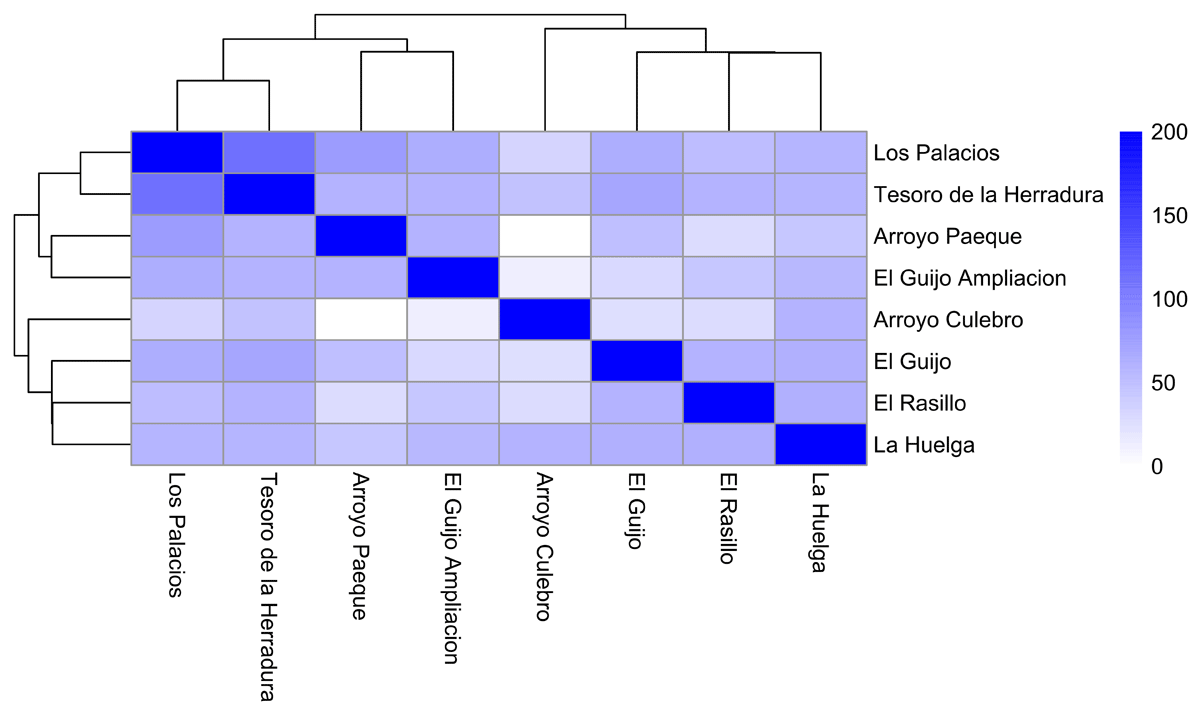
Figure 8
Heatmap of the Brainerd-Robinson similarity values of the archaeological sites without the ubiquitous artefact types during the 1st century AD.
The link between Los Palacios and Tesoro de la Herradura strengthens even further, marked by a high coefficient of 110.64 and highlighted in the difference matrix (Figure 9). This result underscores a strong similarity between the two sites, even more pronounced than what was observed before the removal of ubiquitous nodes. This suggests a notable concentration of shared attributes between these sites that stand independent of the ubiquitous nodes.
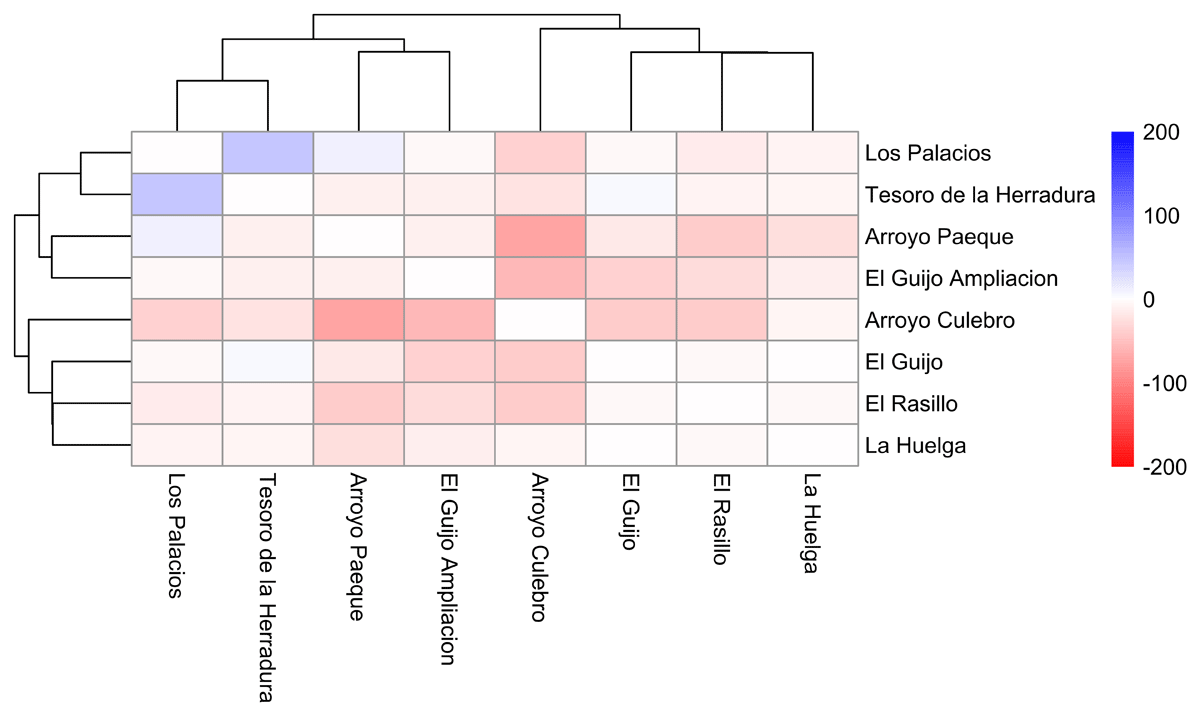
Figure 9
Matrix showing the difference between the Brainerd-Robinson values without the ubiquitous nodes during the 1st c. AD and the B-R values of the bootstrapped sample.
The coefficient between El Guijo and Tesoro de la Herradura also remains relatively low, standing at 68.75. This indicates a short level of shared features between these sites. El Guijo Ampliación demonstrates moderate dissimilarity with both Arroyo Paeque and Tesoro de la Herradura, now showing coefficients of 58.86 and 58.56, respectively.
In the 2nd century AD, the strong similarity of Arroyo Paeque with El Zarzalejo persists, reaching a coefficient of 110.53 (Table 5, Figure 10). It is also highlighted in the difference matrix (Figure 11). The previous strong relationship between Arroyo Paeque and Los Palacios also remains, although with a reduced coefficient of 90. The similarity of El Zarzalejo with other sites is noteworthy. For instance, the correlation between El Zarzalejo and Los Palacios is maintained, though at a relatively reduced level, with a value of 104.98. The coefficients between La Huelga and El Guijo, and between La Huelga and Tesoro de la Herradura, persist at moderate levels of dissimilarity, with scores of approximately 64.33 and 54.31, respectively. The similarity of El Guijo Ampliación to Arroyo Paeque also decreases to 57.26 but remains moderately like Tesoro de la Herradura, with a coefficient of 65.15. A new notable relationship emerges between El Guijo Ampliación and El Zarzalejo, with a coefficient of 74.28. The previously lower coefficient between El Guijo and Arroyo Paeque is now reduced further to 32.16. Finally, Los Palacios and Tesoro de la Herradura now show a higher level of similarity, with a coefficient of 110.80. This is one of the highest coefficients observed in this set, pointing to a significant base of shared attributes.
Table 5
Matrix with the Brainerd-Robinson similarity values for the 2nd century AD without the ubiquitous artefact types.
| ARROYO PAEQUE | EL GUIJO AMPLIACIÓN | EL GUIJO | EL RASILLO | EL ZARZALEJO | LA HUELGA | LOS PALACIOS | TESORO DE LA HERRADURA | |
|---|---|---|---|---|---|---|---|---|
| Arroyo Paeque | 200 | 57.257 | 32.164 | 25.000 | 110.526 | 42.105 | 89.912 | 54.306 |
| El Guijo Ampliación | 57.257 | 200 | 29.293 | 42.803 | 74.279 | 51.356 | 66.856 | 65.152 |
| El Guijo | 32.164 | 29.293 | 200 | 59.722 | 36.179 | 64.327 | 51.389 | 62.121 |
| El Rasillo | 25.000 | 42.803 | 59.722 | 200 | 29.878 | 66.886 | 45.833 | 55.682 |
| El Zarzalejo | 110.526 | 74.279 | 36.179 | 29.878 | 200 | 42.234 | 104.980 | 68.404 |
| La Huelga | 42.105 | 51.356 | 64.327 | 66.886 | 42.234 | 200 | 56.579 | 54.306 |
| Los Palacios | 89.912 | 66.856 | 51.389 | 45.833 | 104.980 | 56.579 | 200 | 110.795 |
| Tesoro de la Herradura | 54.306 | 65.152 | 62.121 | 55.682 | 68.404 | 54.306 | 110.795 | 200 |
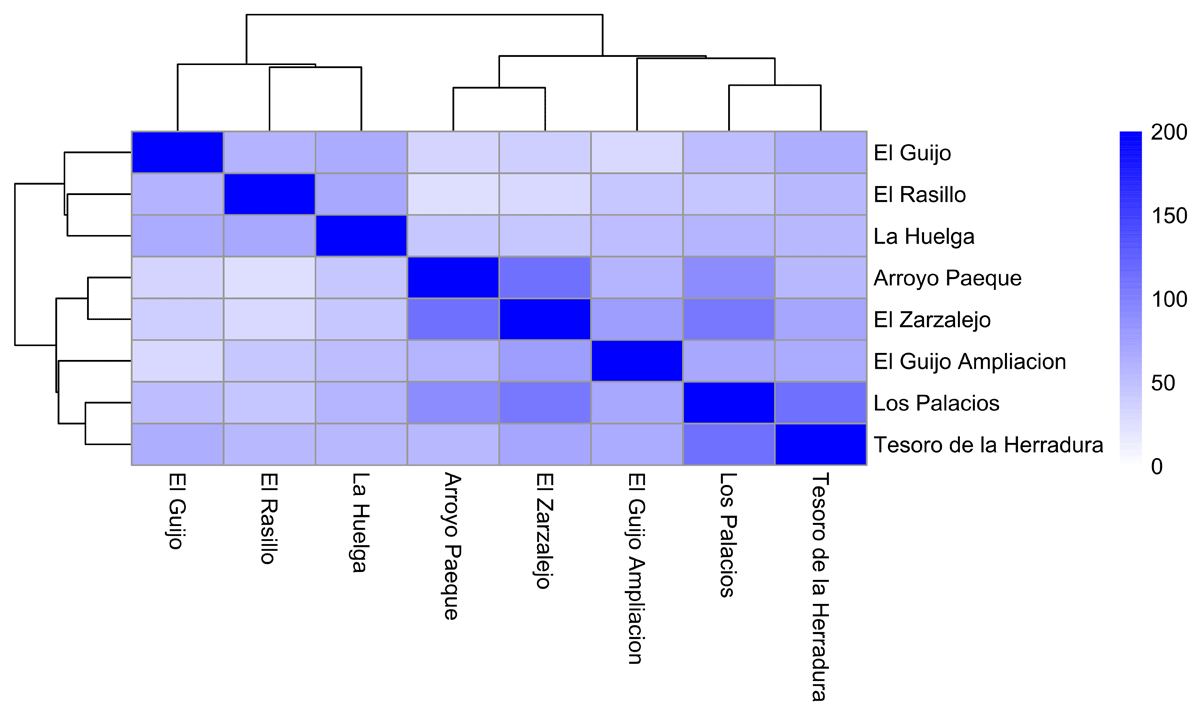
Figure 10
Heatmap of the Brainerd-Robinson similarity values of the archaeological sites without the ubiquitous artefact types during the 2nd century AD.
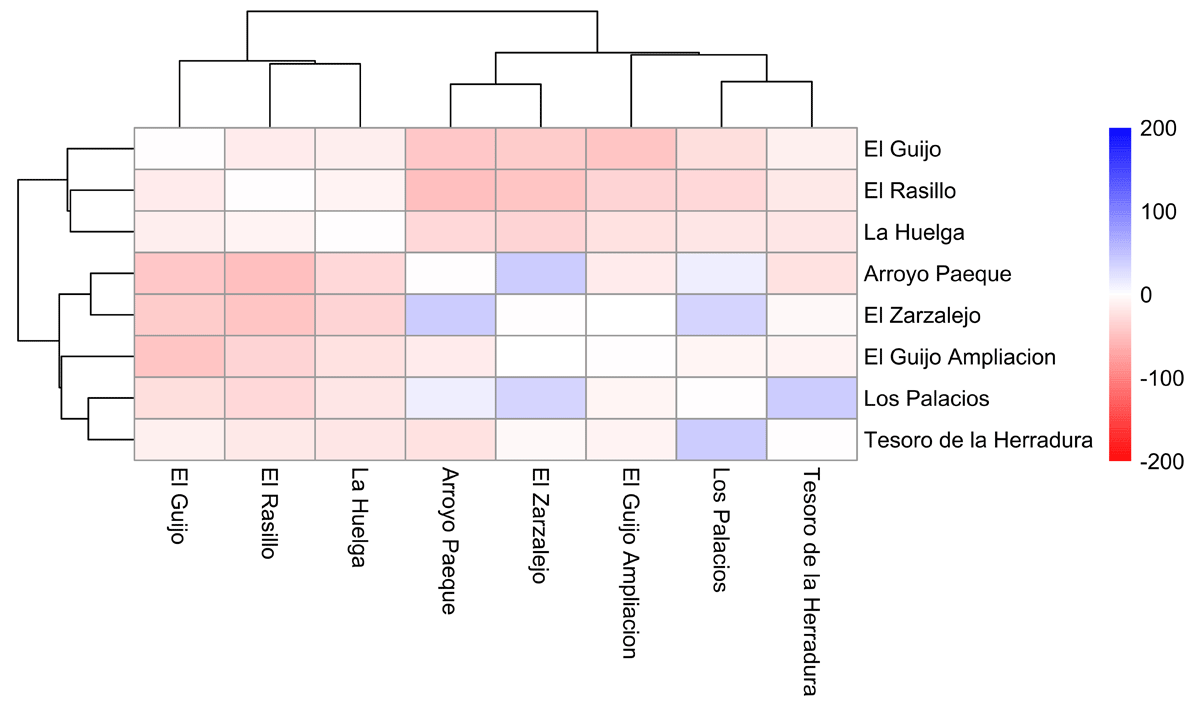
Figure 11
Matrix showing the difference between the Brainerd-Robinson values without the ubiquitous nodes during the 2nd c. AD and the B-R values of the bootstrapped sample.
During the 3rd century AD (Table 6, Figure 12), the trends we saw before the removal of ubiquitous nodes continued, as we can see in the difference matrix (Figure 13). The coefficients between La Huelga and Arroyo Paeque, and between La Huelga and El Zarzalejo, persists at low levels of similarity, with scores of approximately 27 and 39, respectively. The similarity of El Zarzalejo to Arroyo Paeque also decreases to 121 but is one of the highest as we can see in the difference matrix (Figure 13). El Zarzalejo’s association with Los Palacios also dipped from 140 to 100. These coefficients reflect the critical role of ubiquitous nodes in the analyses, especially at the site of La Huelga.
Table 6
Matrix with the Brainerd-Robinson similarity values for the 3rd century AD without the ubiquitous artefact types.
| ARROYO PAEQUE | EL ZARZALEJO | LA HUELGA | LOS PALACIOS | |
|---|---|---|---|---|
| Arroyo Paeque | 200 | 121.429 | 26.667 | 93.269 |
| El Zarzalejo | 121.429 | 200 | 39.286 | 100 |
| La Huelga | 26.667 | 39.286 | 200 | 46.250 |
| Los Palacios | 93.269 | 100 | 46.250 | 200 |
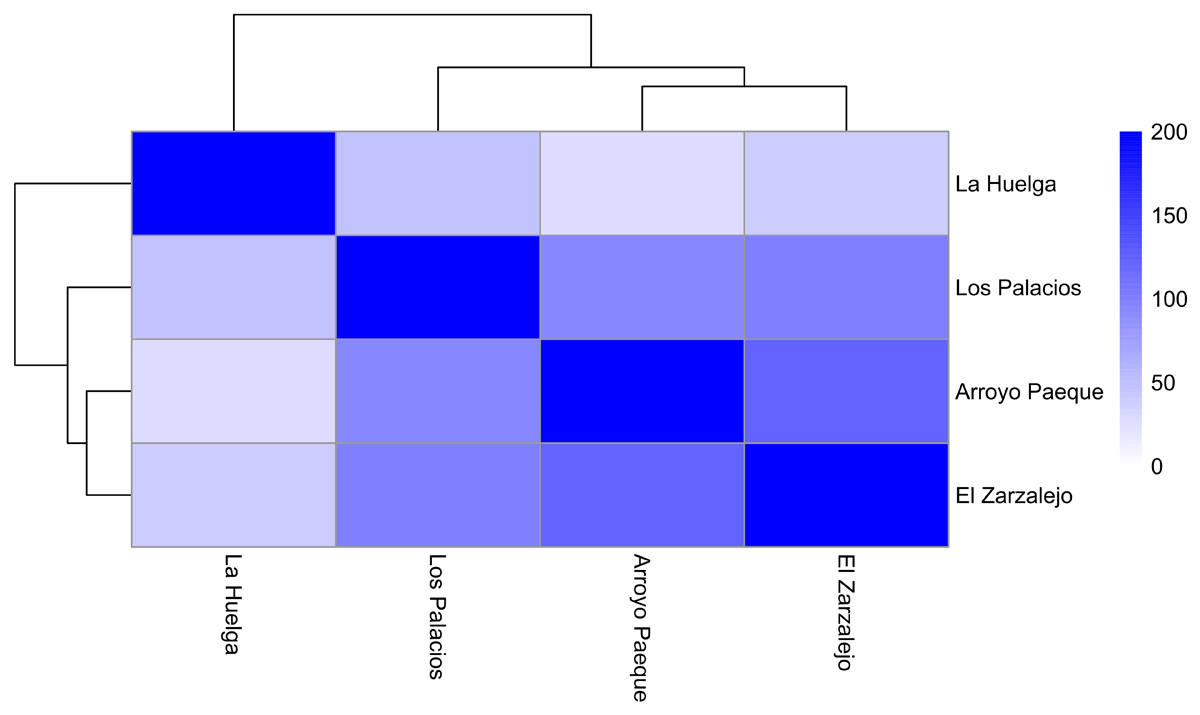
Figure 12
Heatmap of the Brainerd-Robinson similarity values of the archaeological sites without the ubiquitous artefact types during the 3rd century AD.
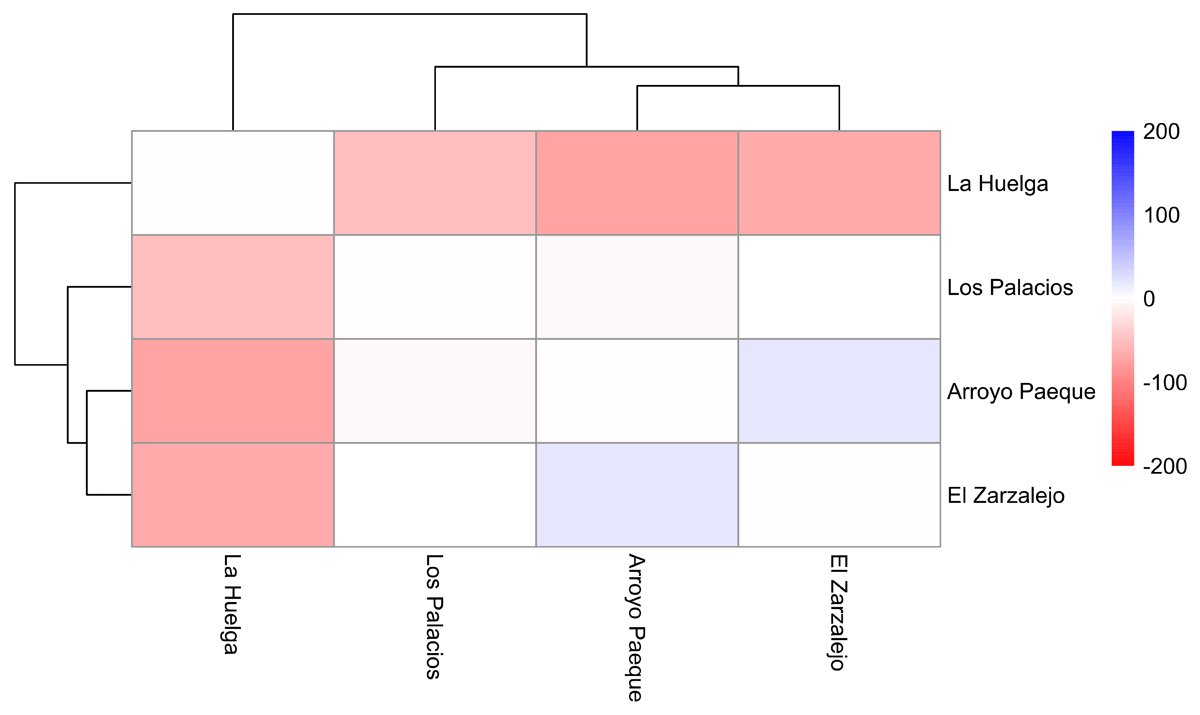
Figure 13
Matrix showing the difference between the Brainerd-Robinson values without the ubiquitous nodes during the 3rd c. AD and the B-R values of the bootstrapped sample.
5 Discussion
Peasant communities in central Roman Hispania, when viewed through their consumption patterns, reveal a complex network of interactions that merge broader global influences with deeply rooted local traditions and inertias. As goods move across regions and provinces, how communities adopt, adapt, or resist them is influenced by a variety of factors. Our results show this complexity in terms of their similarities. They help to illustrate how artefact types shared across sites can suggest common trade networks, and also how local adaptations play a key role in shaping community identities in the face of wider influences.
The results present multiple values that indicate a high similarity between the archaeological records analysed at these sites such as, for example, Los Palacios, Tesoro de la Herradura and El Zarzalejo in the 2nd century AD (Figure 4, Figure 5, Figure 10, and 11). This similarity is due to the large number of artefact types shared by all the sites in this case study, even when we remove ubiquitous objects. This fact indicates, firstly, that the sites in this region have access to the same exchange networks. Moreover, access to these exchange networks does not seem to vary much over the three centuries.
Nevertheless, it is the shared artefact types across these sites, suggesting widespread exchange networks, contrasted against the individual local choices, that provide a richer understanding of the consumption patterns. In addition to the multiple factors that determine consumption patterns in these societies, a fundamental aspect that emerges from our analyses is the local adaptation. We would like to see this pattern from the ‘glocalisation’ prism (Homobono 2019; Montoya 2021; Robertson 2000: 173; Roudometof 2016; Roudometof & Dessi 2022). The mere presence of Roman elements within a settlement does not necessarily denote a homogenisation of Roman material culture. Rather, it is through these ‘local prisms’ (Roudometof 2016: 65–66), that these goods are filtered, allowing local communities to actively shape their own unique identities.
The willingness of these communities to choose certain types of artefacts plays a very important role. This predisposition can be detected in the differences in similarity detected between different sites. For example, in the 1st century AD the site of Arroyo Culebro is highlighted as being the site with the least similarity to many other sites. The most pronounced dissimilarities are with the sites of El Guijo Ampliación and El Guijo (Table 1, Figure 2). These dissimilarities are deeper after removing ubiquitous nodes (Table 4, Figure 8). Dissimilarities are also present in the 2nd century AD, for example between El Guijo and Arroyo Paeque (Table 2, Figure 4), and in the 3rd century AD when the site of La Huelga presents a lower degree of correlation with all the other active sites during this century (Table 3, Figures 6 and 7). In other analyses carried out on this same case study (Bermejo 2022; Moreno-Navarro in press; Moreno-Navarro, Brughmans & Bermejo 2023) we found that the archaeological record of these sites is mainly composed of a small number of forms. These objects may belong to types shared by items also used by the elite, such as Hispanic Terra Sigillata. However, in this case, the forms are adapted to their own consumption patterns, and are recurrently used, as demonstrated by the analysis of their traces of use (Bermejo 2022) and belong to forms that are versatile and do not respond to the supposed revolution in consumption that can be detected more easily in contexts related to the elite (Wallace-Hadrill 2008: 319–329). This process may reveal the resilience of local cultural identity amid wider regional influences. This process of cultural adaptation is further observed in cases where local production competes directly with Roman varieties. The clearest case is Arroyo Culebro where local cerámica pintada de tradición local (CPTL) pottery production predominates as opposed to the rest of the sites where Hispanic Terra Sigillata (TSH) is used (Figures 2, 3, 8, and 9). This fact offers an example of how these communities resisted cultural homogenisation, preserving their local identity (Van der Ploeg 2008: 265). Analogous cases of resistance against cultural homogenisation have been observed in other regions such as Roman Britain (Perring & Pitts, 2013), underlining patterns of glocalisation across the Roman world.
6 Conclusions
This work demonstrates the power of network science in revealing hidden patterns in archaeological data. The use of R and the Brainerd-Robinson similarity metric has proven to be useful for assessing site similarities. The bootstrap resampling procedure used in this study offers a rigorous approach to assessing the robustness of the similarity results.
Our analyses showed pronounced consumption similarities among the studied sites, mainly Los Palacios, Tesoro de la Herradura, and El Zarzalejo. Such parallels go beyond mere economic interconnections, emphasising the profound influences of cultural practices, but also local adaptations. The presence of Roman elements, rather than alluding to homogenisation, shows how peasant communities infused Roman products with their own identities and practices. We also discerned possible cases of cultural resistance, as exemplified by Arroyo Culebro in its apparent divergence from other sites, underscoring a conscious resistance against cultural homogenisation.
Through network science, this study contributes to our understanding of how peasant communities in the Roman world negotiated and dialogued between local inertia and broader regional influences. The application of this and other traditional archaeological methods to the study of Roman peasant communities is proving to be useful and necessary to advance their characterisation.
Reproducibility
To enable the reproducibility of the paper, the dataset and the R script used in this work can be found in the following link: https://doi.org/10.5281/zenodo.8179251.
Notes
[1] Law 16/1985 regarding the Spanish Historical Heritage and the law 10/1998 on the Historical Heritage of the Autonomous Community of Madrid.
[2] Projects ‘Economías domésticas en el norte de la Carpetania romana (100 a.C. – 400 d.C.): condiciones de vida, redes y desigualdad’ Ref. 2017-t1/HUM-5516 and ‘Carpetania rustica: arqueología de los asentamientos campesinos en el norte de la Carpetania romana’, Ref. 2021-5A/HUM-20947.
[3] The R script used in this work can be found in the following Zenodo link: https://doi.org/10.5281/zenodo.8179251.
Acknowledgements
This research was supported by the project Economías domésticas en el norte de la Carpetania romana (100 a.C. – 400 d.C.): condiciones de vida, redes y desigualdad, Ref. 2017-t1/HUM-5516 2018–2021, and the project Carpetania rustica: arqueología de los asentamientos campesinos en el norte de la Carpetania romana, Ref. 2021-5A/HUM-20947, Atracción de Talento Mod. 1, Comunidad de Madrid (Spain), PI: Jesús Bermejo Tirado. Many thanks to Lena Tambs, Marta Lorenzon, Michela de Bernardin, and Arianna Traviglia for the great session at CAA 2023 and for inviting me to this special issue. Many thanks to Jesús Bermejo Tirado for all the help and support, and the material analyses. Thanks to Miguel Contreras, Elena Carrión and Enrique Baquedano for their help with the material analysis at Museo Arqueológico Regional de la Comunidad de Madrid. Many thanks to Tom Brughmans for his help at UrbNet, Aarhus University. Thanks to Giulia Pestarino for the help with the language issues. Many thanks to the anonymous reviewers who have helped to improve this work.
Competing interests
The author has no competing interests to declare.