
Introduction
The Yellow Vests (YVs) movement is an unstructured protest movement that emerged in France in October 2018. It has its origin in the dissemination of calls on digital social networks against rising fuel prices and the high cost of living. Quickly, the movement’s demands were extended to social and political areas. Protest actions consisted of roadblocks in rural and peri-urban areas and of demonstrations every Saturday in metropolises, where several violent episodes occurred. The violence was observed from some participants to the movement, but also from the police (Adam-Troian, Çelebi, et al., 2020). The maximum number of participants in the demonstrations recorded by the Ministry of the Interior was reached in November 2018. Participation has steadily decreased since then. Nevertheless, the movement received extensive media coverage and generated an avalanche of reactions from the public and politicians in the country and also abroad.
The YVs movement attracted research in social sciences and notably in social psychology (with a special collection of papers named ‘The Social Psychology of the Yellow Vests Movement’), because it allows investigation into the causes of social protest movements in general. Jetten and colleagues (2020) proposed the perception of economic inequalities may explain the rise of the YVs movement, as the protest against fuel prices was the source of the first demonstrations. Yet, the authors noted that if economic inequalities increased in France from 1983 to now, the Gini coefficient, measuring the magnitude of economic inequalities in one country, has slightly diminished in France since 2015 to reach levels similar to the 1990s.1 Thus, subjective and objective perceptions of economic inequalities could both be determining factors of engagement in collective action. For example, the perception of a distant elite could foster feelings of unfairness in society.
A second study pointed at the potential role of anti-neoliberal ideology to explain participation in the YVs movement (Girerd et al., 2020), a relation mediated by a lower sense of personal control and the feeling that the system is unjust and illegitimate. This explanation deals with the notion of anomie, a general sociological concept proposed by Durkheim (1897/1967) in his study about social determinants of suicide. He was referring to an individual discomfort caused by a decline of social and religious values. More recently, other sociologists characterized this discomfort as feelings of lack of control on one’s life; distrust towards authorities (Parish, 2001); social alienation, which includes epistemic uncertainty; feelings of powerlessness and social isolation (Smith & Bohm, 2008); and pessimism about future life (Goertzel, 1994). In their study, Morales and colleagues (2020) observed that negative emotions (especially anger, contempt, and disgust) predicted behavioral intentions of support for the YV movement, which in turn could predict radical collective action.
Besides the issues of economic inequalities and anomie, the YVs caused considerable debates regarding the prevalence of conspiracy beliefs among its members. As reported several times in the press,2 the YVs movement has indeed relayed a large number of conspiracy theories (CTs), which can be defined as ‘serious accusations of conspiracy without sufficient proofs’ (Wagner-Egger, 2021). For example, in November 2018, the Facebook pages of the YVs spread unfounded allegations about the ‘Marrakech Pact’ of the United Nations that President Macron was about to sign, claiming that the French government was secretly and intentionally organizing the loss of France’s sovereignty in immigration matters.3 In the same vein, some YVs figures asserted that the terrorist attack in Strasbourg on December 11, 2018, was organized by the French government itself to divert public attention from their movement. A similar theory circulated within the movement concerning the burning of Notre-Dame de Paris Cathedral on April 15, 2019. It might therefore seem that the YVs movement comprises a significant proportion of conspiracy-minded individuals.
However, some commentators (Lordon, 2019; Mazot-Oudin, 2019) argue that opponents of the YVs exaggerated their inclination for conspiracy theories in order to discredit the movement. Given the political implications of such claims, the issue of accurately assessing the prevalence of conspiracy beliefs among the YVs is crucial. Moreover, to the extent that conspiracy beliefs increase support for violent extremism and non-normative collective action (Imhoff, Dieterle, & Lamberty, 2021; Rottweiler & Gill, 2020), their greater prevalence among the YVs could help explain why this movement has been prone to radical action.
Beliefs in conspiracy theories
Numerous studies in psychology investigated the social and psychological factors underlying adhesion to conspiracy theories. It is currently established that conspiracy theories fulfill three types of psychological needs (Douglas et al., 2017). Mainly, individuals will adhere to conspiracy narratives because it provides them with a clear understanding of complex socio-political environments (epistemic needs), it helps them feel in control (existential needs), and it allows conspiracy believers to form communities that offer a source of social support (social needs; see also Sternisko et al., 2020). Because these motives also underlie paranormal beliefs, these are robust correlates of conspiracy beliefs (e.g., Bruder et al., 2013; Wagner-Egger & Bangerter, 2007).
This motivational perspective also highlights how ideological variables may fuel conspiracist ideation. For instance, political extremism and conservatism are both identified predictors of conspiracy beliefs (e.g., van Prooijen et al., 2015). This is partly because political extremism and conservative ideology are both linked with increased cognitive inflexibility, which motivates a preference for simple answers to complex problems (epistemic needs; Zmigrod, 2020).
Besides motivation, some studies clearly point at cognitive mechanisms, which would also explain the success of conspiracy theories. Proportion bias (big effects have large causes; Leman & Cinnirella, 2007; McCauley & Jacques, 1979; Van Prooijen & Van Dijk, 2014), intentionality bias (Brotherton & French, 2015; Imhoff & Bruder, 2014; Douglas et al., 2015; Van der Tempel & Alcock, 2015; Wagner-Egger et al., 2018), and conjunction fallacy (Brotherton & French, 2014; Dagnall et al., 2017; Drinkwater et al., 2018; Moulding et al., 2016) have been related to beliefs in conspiracy theories. Related to these cognitive biases, conspiracist ideation has been observed to be strongly correlated with irrational beliefs, such as paranormal, superstitious, and pseudoscientific beliefs (Brotherton et al. 2013; Brotherton & French, 2014; Bruder et al. 2013; Wagner-Egger & Bangerter, 2007; Wagner-Egger et al., 2018). Some personality traits have also been found to be associated with conspiracist ideation, such as paranoia and schizotypy (Brotherton et al., 2013; Brotherton & Eser, 2015; Bruder et al., 2013; Van der Tempel & Alcock, 2015; Wagner-Egger & Bangerter, 2007).
Societal factors may in turn affect psychological, existential, and social needs. Psychosocial syndromes like anomie also predict adherence to conspiracy theories (Goertzel, 1994; Jolley et al., 2019; Wagner-Egger & Bangerter, 2007). Similarly, political uncontrollability seems to increase anti-Semitic conspiracy beliefs (Kofta et al., 2020) and personal uncontrollability conspiracy theories in general (Van Prooijen, 2017; Whitson, Galinsky & Kay, 2015; Whitson et al., 2019; but see Stojanov et al., 2020). Individuals from lower social status tend to believe more in conspiracy theories, because educational level is often negatively related to conspiracist ideation (e.g., Uscinski & Parent, 2014). Part of that relationship can be explained by the fact that lower education levels are linked with a more intuitive (vs. analytical) cognitive style (van Prooijen, 2017), which in turn favors adherence to conspiracy theories (e.g., Brotherton & French, 2014; Douglas et al. 2015; Swami et al., 2014; Wagner-Egger et al., 2018). Moreover, social status can affect social needs in a way that further fuel conspiracy beliefs. Indeed, individuals from lower socio-economic status tend to have more interdependent selves, collectivistic values, and increased levels of social identification to their groups (Iacoviello & Lorenzi-Cioldi, 2019). In turn, collectivism has been found to increase conspiracy mentality, both at the individual and nation levels (Adam-Troian et al., 2020), especially in threatening competitive contexts (win-lose interpersonal situations; see Liu et al., 2019). Finally, beliefs in conspiracy theories have a political tone. In a recent study by Imhoff, Zimmer, and colleagues (2021) on more than 30,000 people in 26 European countries, it was found that people in the political extremes are more prone to endorse conspiracist beliefs than people in the center, and people on the right side of the political spectrum tend to believe more in conspiracy theories than people on the left, resulting in an asymmetric U-shape curve leaning on the right. In this study, it was also found that the Gini coefficient of the countries was positively related to the national aggregated adhesion to conspiracy theories, pointing at a possible effect of socio-economic inequalities in conspiratorial thinking.
As these societal factors (except educational level) have scarcely been investigated in the literature about conspiracy theory beliefs, this analysis of the YVs movement gives opportunities to explore this crucial domain. In addition, it may give important hints to identify in an exploratory way what social and psychological factors could lead people to adhere to a social movement such as the YVs, and what may be the consequences.
The present research
As we have seen, the causes and consequences of belonging to the YVs movement are both numerous and intertwined, and the issue of conspiracy beliefs among the YVs is important. Upon closer inspection, one can quickly see how the YVs may constitute a ‘fertile’ social ground for conspiracy beliefs (Sternisko et al., 2020). Support for the YVs collective action has been found to correlate with anomie (Mahfud & Adam-Troian, 2019), a psychosocial predictor of conspiracy beliefs; Goertzel, 1994; Wagner-Egger & Bangerter, 2007). Moreover, the YVs are made up of mostly low socio-economic status, less educated individuals and political extremists (Jetten et al., 2020), which all relate to conspiracy mindset (van Prooijen, 2017). Besides, the nature and scope of police response to the YVs (Chauvin et al., 2019) has further fueled their sense of threat and social identification to the movement (Adam-Troian et al., 2020), which has probably increased their levels of conspiracism. Still, no study so far has investigated these factors, especially using representative samples.
Therefore, the present paper aims at exploring the role of socio-economic (such as education and income), psychosocial (such as anomie, authoritarian values), and epistemic factors (such as conspiracist and paranormal beliefs) in the adherence to the YVs movement, taking advantage of a unique opportunity to get access to the only representative sample in France to have been polled on the topic.4 Our main exploratory research question was to identify what social and psychological variables differentiate non YVs members, YVs sympathizers, and YVs members, especially with regards to risk factors for conspiracy ideation. This is not only a descriptive question, as the variables predicting affiliation to sympathizers and to members of the YVs could give scholars indications about the factors that may favor the action of joining a spontaneous social movement, which consists in innovative forms of collective action but also violent and radical action.
Method
Participants
A survey on a representative sample of the French population (N = 1506) was conducted between December 21 and December 23, 2018, by the Institut Français d’Opinion Publique (IFOP) on behalf of the Fondation Jean-Jaurès5 and Conspiracy Watch.6 The representativeness of the overall sample was ensured by the quota method for three criteria—gender, age, and profession—after stratification by region and socio-professional categories. To this sample was added a group of 254 French people aged between 18 and 35, surveyed in parallel between December 21 and December 23, resulting in a total N = 1760. This was done according to IFOP in order to have a larger subsample of young people, who are especially sensitive to conspiracy theories in France. We performed the statistical analyses on the full sample for reasons of commodity, but we verified that the results were identical when weighting participants for representativeness.
Material and procedure
The survey consisted of a self-administered online questionnaire with 140 questions. We analyzed respondents’ endorsement of 10 particular conspiracy theories (CTs: Zionist world conspiracy, Lady Diana’s car crash, the Apollo mission on the moon, the Illuminati conspiracy, Chemtrails, etc.) on 5-point scales from 1 = ‘Not agree at all’ to 5 = ‘Completely agree’. At our request, a standardized generic conspiracy beliefs scale (Conspiracy Mentality Questionnaire, CMQ, 5 items; Bruder et al., 2013) was added to the survey, with general statements such as ‘There are secret organizations that greatly influence political decisions’. The survey included several questions about the personal relations and attitudes of the participants towards the YVs movement. We analyzed only one crucial question, YVs Proximity: ‘And yourself, would you say that you are a YV?’ with three response options 1 = ‘No, you don’t feel that you are a YV’, 2 = ‘No, but you support the movement’s actions’, 3 = ‘Yes’. We named these three groups respectively non YVs, YVs Sympathizers, and YVs Members. ParanormalBeliefs were measured by merging two items asking adherence to affirmations about the existence of the gift of clairvoyance and the possibility of communicating with the dead, using a 5-point scale, from 1 = ‘Not agree at all’ to 5 = ‘Completely agree’.
Socio-demographic variables were included in the analyses: Gender, Age, Education (the highest diploma participants possess, from 1 = Not enrolled to 11 = University diploma), monthly Income (from 1 = Less than 1000€ to 6 = 4000€ and more), and Unemployment. Political orientation (from 1 = Far left to 5 = Far right) was coded from a question asking participants to report the candidate they voted for in the last presidential election in 2017 (PoliticalOrientation). We created a binomial variable PoliticalExtremes by recoding extreme left and right (1 and 5 in the PoliticalOrientation scale) as 1 and center positions (2–4) as 0. More subjectively, participants were asked how many times per year they go on holidays, from 1 = Several times per year to 5 = Never (NoHolidays), and if they manage to make ends meet at the end of the month, from 1 = Very easily to 5 = Very hardly (DifficultEndsofMonth), and if they think that they are dependent on their car in daily life (from 1 = Not dependent at all to 4 = Very dependent (CarDependence).
The concept of anomie was assessed by the aggregation of five items measuring Distrust towards official institutions (the police, justice, army, school, and the media) on 5-point scales from 1 = Very confident to 5 = Not confident at all. Anomie was also assessed by three items asking participants about their personal situation compared to the past (ParentsWorse: if they think that their parents had a better or worse life at the same age, on a 5-point scale from 1 = Far better to 5 = Far worse), about the present (SuccessInLife: if they would say that they succeeded in life, on a 5-point scale from 1 = Not at all to 5 = Completely), and about the future (ChildrenWorse: how do they think the life of their children or nephews will be in the future, on a 5-point scale from 1 = Far better to 5 = Far worse). The participants were also asked how it is for them to live in a democracy, from 1 = Not important at all to 5 = Very important (ImportanceDemocracy).
Media use was also measured in the survey, with a question asking, ‘In order to get informed about current events which type of media do you use first?’ (several answers possible). From this we dummy-coded six variables (Newspapers, Newspapers websites, Television, Youtube, Social media, Google).
Results
YVs Members composed 16% of the sample (N = 285), compared to 32% of Nonmembers (N = 568) and 52% of Sympathizers (N = 907).
The Pearson correlation coefficients between all variables are displayed in Table 1.7 They showed that the YVs (YVs Members and to a lesser extend YVs Sympathizers) overall have a worse social and economic situation than non-YVs, both objectively (they have less income, lower level of education, higher unemployment, significant weak to moderate correlation coefficients, r2 = 0.03–0.04) and subjectively (they experience more difficult ends of month, take fewer holidays, feel more dependency on their car, significant weak to moderate correlation coefficients, r2 = 0.01–0.07). They feel more anomie (they consider that their children will have a worse situation, that their parents’ life was better, and they are less successful in life, significant weak to moderate correlation coefficients, r2 = 0.01–0.07). They also display more distrust (significant weak to moderate correlation coefficients, r2 = 0.05–0.07), paranormal and conspiracist beliefs (significant weak to moderate correlation coefficients, r2 = 0.002–0.14), value democracy less (significant weak correlation coefficients, r2 = 0.01), and tend to be younger (significant weak correlation coefficients, r2 = 0.01). YVs Sympathizers included more women (59%) than YVs Members (55%) and Non YVs (50%), and YVs Members tend overall to have slightly more right-wing political attitudes (significant weak correlation coefficient, r2 = 0.01). Concerning their favourite channels of information, YVs Members tend more often to choose social media and Youtube (significant weak correlation coefficients, r2 = 0.01–.02), and less often to choose official media websites (significant weak correlation coefficient, r2 = 0.01). YVs Sympathizers tend to favour TV to get informed (significant weak correlation coefficient, r2 = 0.003), and non-YVs tend to favour newspapers (and less often TV, social media, and Youtube, significant weak correlation coefficient r2 = 0.005–0.01).8
Table 1
Pearson correlation coefficients between the variables (Cronbach’s alphas are displayed in the diagonal when applicable).
| VARIABLE | 1 | 2 | 3 | 4 | 5 | 6 | 7 | 8 | 9 | 10 | 11 | 12 | 13 | 14 | 15 | 16 | 17 | 18 | 19 | 20 | 21 | 22 | 23 | 24 | 25 |
|---|---|---|---|---|---|---|---|---|---|---|---|---|---|---|---|---|---|---|---|---|---|---|---|---|---|
| 1. NonYVs | – | ||||||||||||||||||||||||
| 2. YVsSympathizers | – | – | |||||||||||||||||||||||
| 3. YVsMembers | – | – | – | ||||||||||||||||||||||
| 4. Gender | –.07** | .07** | –.00 | – | |||||||||||||||||||||
| 5. Age | .08** | –.00 | –.10** | –.18** | – | ||||||||||||||||||||
| 6. Education | .19** | –.04 | –.18** | –.01 | –.14** | – | |||||||||||||||||||
| 7. Income | .16** | –.03 | –.16** | –.17** | .28** | .30** | – | ||||||||||||||||||
| 8. Unemployment | –.07** | .03 | .05* | .06** | –.12** | –.07** | –.22** | – | |||||||||||||||||
| 9. PoliticalOrientation | –.05 | –.03 | .10** | –.00 | .11** | –.19** | .01 | .01 | – | ||||||||||||||||
| 10. ImportanceDemocracy | .11** | –.02 | –.12** | –.06* | .19** | .20** | .21** | –.05 | –.14** | – | |||||||||||||||
| 11. CarDependence | –.12** | –.01 | .17** | –.02 | –.03 | .01 | .10** | –.04 | .09** | –.00 | – | ||||||||||||||
| 12. NoHolidays | –.12** | .05* | .08** | .05* | –.04 | –.31** | –.38** | .12** | .13** | –.13** | .05* | – | |||||||||||||
| 13. DifficultEndsOfMonth | –.27** | .11** | .19** | .10** | –.09** | –.25** | –.43** | .17** | .12** | –.13** | .04 | .42** | – | ||||||||||||
| 14. ParentsWorse | .26** | –.10** | –.19** | –.04 | .16** | .07** | .28** | –.12** | –.09** | .09** | –.08** | –.18** | –.39** | – | |||||||||||
| 15. SuccessInLife | .15** | –.07** | –.10** | –.03 | .15** | .13** | .36** | –.22** | –.01 | .15** | .03 | –.31** | –.41** | .26** | – | ||||||||||
| 16. ChildrenWorse | –.24** | .14** | .12** | .08** | .02 | –.05* | –.03 | .04 | .10** | –.03 | .07** | .13** | .19** | –.25** | –.15** | – | |||||||||
| 17. CTs | –.33** | .12** | .26** | .10** | –.20** | –.27** | –.31** | .07** | .17** | –.29** | .06* | .17** | .27** | –.23** | –.18** | .18** | .91 | ||||||||
| 18. CMQ | –.38** | .20** | .21** | .08** | –.08** | –.14** | –.14** | .04 | .10** | –.03 | .08** | .08** | .19** | –.20** | –.10** | .26** | .53** | .84 | |||||||
| 19. Distrust | –.27** | .09** | .23** | .05* | –.14** | –.10** | –.19** | .09** | .08** | –.23** | .04 | .16** | .24** | –.18** | –.27** | .26** | .32** | .31** | .73 | ||||||
| 20. ParanormalBeliefs | –.15** | .10** | .05* | .14** | –.20** | –.11** | –.22** | .07** | .07* | –.15** | –.01 | .12** | .17** | –.15** | –.07** | .03 | .38** | .20** | .04 | .84 | |||||
| 21. InfoNewspapers | .07** | –.04 | –.04 | –.08** | .04 | .05 | .07** | –.04 | –.03 | .02 | –.04 | –.10** | –.09** | .06** | .05* | –.08** | –.09** | –.11** | –.03 | –.03 | – | ||||
| 22. InfoGoogle | .01 | .02 | –.04 | –.07** | –.01 | .01 | –.01 | –.01 | –.01 | .01 | –.00 | .02 | .01 | –.02 | –.04 | .02 | .00 | .05* | .03 | –.00 | –.06** | – | |||
| 23. InfoMediasWebsites | .04 | .03 | –.09** | –.01 | –.00 | .11** | .08** | –.03 | –.03 | .09** | –.06* | –.06** | –.05* | .01 | –.01 | –.02 | –.10** | –.05* | –.06* | –.06* | –.02 | –.24** | – | ||
| 24. InfoTV | –.07** | .05* | .02 | .06* | .10** | –.15** | –.03 | .06* | .14** | –.00 | .05* | .09** | .05* | –.02 | –.04 | .08** | .03 | .04 | –.08** | –.01 | –.26** | –.02 | –.04 | – | |
| 25. InfoSocialMedia | –.10** | –.02 | .15** | .13** | –.28** | –.06* | –.18** | .11** | .00 | –.09** | .02 | .05 | .10** | –.12** | –.04 | .08** | .19** | .15** | .13** | .08** | –.13** | –.24** | –.29** | –.06* | – |
| 26. InfoYoutube | –.07** | .01 | .08** | –.04 | –.06** | –.11** | –.04 | .00 | –.01 | –.07** | –.01 | .04 | .04 | –.04 | –.07** | –.02 | .10** | .05 | .04 | .07** | –.02 | –.07** | –.09** | –.03 | –.09** |
[i] Note: * Indicates p < 0.05. ** Indicates p < 0.01 (two–tailed tests). Gender was coded 1 = Men, 2 = Women, (CTs = Conspiracy Theories; CMQ = Conspiracy Mentality Questionnaire; YVs Members, YVs Sympathizers, and Non YVs were dummy coded).
Bivariate correlations also showed that conspiracist ideation (CMQ and CTs) is positively related to feelings of anomie (significant weak to moderate correlation coefficients, r2 = 0.01–0.10), paranormal beliefs (significant weak to moderate correlation coefficients, r2 = 0.04–0.14), right-wing political orientation (significant weak to moderate correlation coefficients, r2 = 0.01–0.03) and negatively related to educational level (significant weak to moderate correlation coefficients, r2 = 0.02–0.07), income (significant weak to moderate correlation coefficients, r2 = 0.02–0.10), and age (significant weak to moderate correlation coefficients, r2 = 0.01–0.04), as in previous studies in the literature.
Contrary to most research however (noting few of these studies were carried out on representative samples, as was done here), women tend to have higher scores on both conspiracist measures. This could mirror the classic result that they score higher on paranormal beliefs scales (e.g., Irwin, 1993), probably due to masculine dominance in the technical and scientific domains. On the whole, conspiracy beliefs are also positively associated with the use of social media and negatively with the consultation of newspapers and media websites (CTs more than CMQ) as primary sources of information. Differences between CMQ and CTs are interesting: the former is specifically correlated with getting information from Google, the second from Youtube.
In this dataset, we confirmed the general trend about political orientation and conspiracist beliefs, which consists in an asymmetric U-shape, higher on the right than on the left side (linear + quadratic effects, see Imhoff, Zimmer, et al., 2021; for a similar pattern between dogmatism and political conservatism see Jost et al., 2003). The linear effect of political orientation was significant for CTs, R2 = 0.03, F(1, 1190) = 33.33, p < 0.05, and for CMQ, R2 = 0.01, F(1, 1190) = 13.16, p < 0.05. The quadratic effect of political orientation was also significant and explained more variance for CTs, R2 = 0.13, F(1, 1189) = 88.31, p < 0.05, and for CMQ, R2 = 0.10, F(1, 1189) = 64.89, p < 0.05.
We then explored the relations between the variables in the survey. In this aim, we performed a principal component analysis (with oblique rotation, Promax method) on all psychosocial variables that were included in the survey, because some of them were conceptually very close, such as CTs and CMQ, or the fact of having NoHolidays and experiencing DifficultEndsofMonth. We included Income in the PCA, which is an objective and not psychosocial variable, because we expected that it would be very close to subjective judgements of economic resources (such as NoHolidays or DifficultEndsofMonth). We did not include Education and CarDependance, which we considered as objective predictors, and the YVs Proximity measure, which we consider our criterion.
The PCA was justified (KMO = 0.80, Bartlett test significant, Chi2(66) = 2469.27, p < 0.05) and yielded 4 correlated factors (Kaiser-Guttman criterion). Factor 1, Economic Capital, was related to the economic resources participants have (income, success in life, etc.), Factor 2, Anomie, gathered pessimism about the future and distrust towards authorities. Factor 3, Irrational Beliefs, was mainly composed of paranormal and conspiracist beliefs. Factor 4 was related to Right-Wing Authoritarianism (right-wing political position and minimization of the importance of democracy) (see Table 2). All factors were significantly correlated; Factor 1 was negatively correlated with the three other factors, which were positively correlated (Pearson correlations from 0.14 to 0.34, all p’s < 0.05).
Table 2
Pattern Matrix of the Principal Component Analysis (Promax rotation with Kaiser normalization, saturation < 0.40 were removed from the table).
| FACTORS VARIABLES | ECONOMIC CAPITAL | ANOMIE | IRRATIONAL BELIEFS | AUTHORITARIANISM |
|---|---|---|---|---|
| Income | .71 | |||
| DifficultEndsofMonth | –.71 | |||
| SuccessInLife | .71 | |||
| NoHolidays | –.71 | |||
| ParentsWorse | .45 | –.42 | ||
| ChildrenWorse | .83 | |||
| Distrust | .62 | |||
| CMQ | .54 | .51 | ||
| ParanormalBeliefs | .85 | |||
| CTs | .64 | |||
| PoliticalOrientation | .84 | |||
| ImportanceDemocracy | –.56 | |||
| Eigenvalues | 2.72 | 2.31 | 2.19 | 1.37 |
Then, in order to explore the potential causal relationships between variables, we ran a Simultaneous Equation Modeling with AMOS (Arbuckle, 2017), with CarDependence and Education as predictors, the three factors of the PCA Economic Capital, Anomie, and Irrational Beliefs as mediators (we removed Right-Wing Authoritarianism, which was significantly negatively related to Education, but not in a linear relation to YVs Proximity, as we will see below) and YVs Proximity as criterion.9 The best model achieved a good fit, chi2(6) = 13.54, p = 0.04, CFI = 0.99, RMSEA = 0.03, 90% CI = [0.01; 0.05], SRMR = 0.02 (Figure 1). It confirmed that dependence on a car directly affects adherence to the YVs, as well as a low economic capital. Interestingly, the model was better when putting Anomie and Irrational Beliefs as consequences of the proximity to the YVs rather than predictors. This could suggest that the YVs movement did not help to diminish feelings of anomie and irrational thoughts through participation in social action, on the contrary. It can indeed be stressed that the movement had no wide political consequences—President Macron did large public audiences in 2019 but few measures emerged from this consultation, and not the principal one that was the referendum right—, which may have heightened feelings of anomie among YVs. Similarly, the conspiracy theories circulating on social media among YVs may have encouraged irrational beliefs. The analyses suggested significant indirect effects of Education, β = –0.08 (through Economic Capital) and CarDependence, β = 0.05 (through YVs Proximity) on feelings of Anomie, and indirect effects of Education on Irrational Beliefs, β = –0.13 and on YVs Proximity β = –0.05 (both through Economic Capital). CarDependence, β = 0.07 and Economic Capital had a significant indirect effect on Anomie, β = 0.10 (through YVs Proximity and Irrational Beliefs). Economic Capital had a significant indirect effect on Irrational Beliefs via YVs Proximity, β = 0.08, and YVs Proximity on Anomie (via Irrational Beliefs).
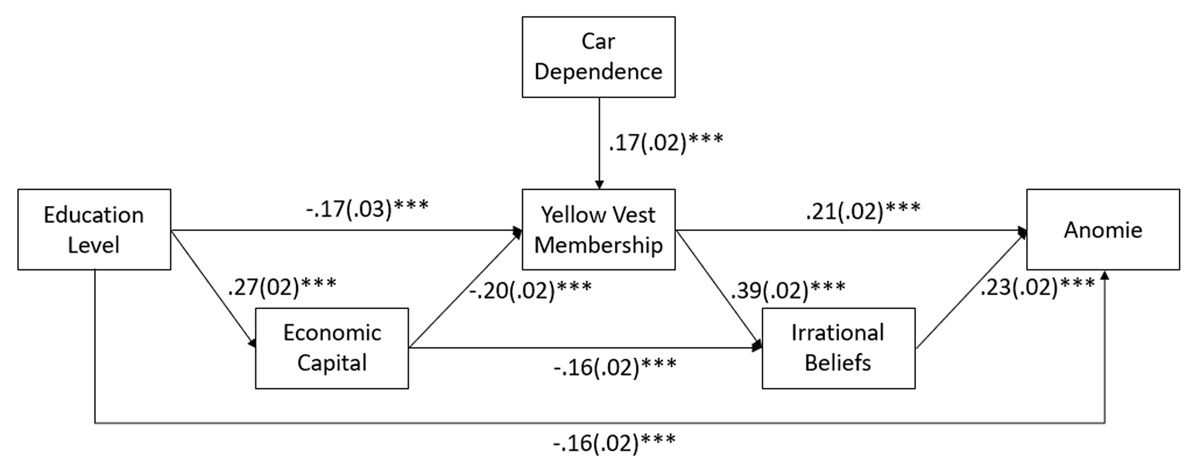
Figure 1
Structural Equation Model of the links between Car Dependence, Education, Yellow Vest Membership, Economic Capital, Anomie, and Irrational Beliefs (N = 1543).
Note: Numbers represent standardized beta coefficients, numbers between brackets represent SE. ** p < 0.01, *** p < 0.001.
We then explored the relationship between YVs Proximity and PoliticalOrientation. Inspection of group means indicated that YVs Members are situated on average slightly more on the right side of the political spectrum (M = 3.54, SE = 0.10) than YVs Sympathizers (M = 3.16, SE = 0.06) and Non YVs (M = 3.10, SE = 0.07), which did not differ (Bonferroni post-hoc tests, p < 0.05), F(2, 1189) = 6.71, p < 0.05, ηp2 = 0.01. The bar charts revealed an increase of extreme leftists from 10% among the Non YVs to 20% among YVs Sympathizers and YVs Members, and a concomitant increase of extreme rightists from less than 10% among the Non YVs to about 25% among YVs sympathizers, and to about 46% among YVs Members, Chi2(8) = 217.49, p < 0.05 (Figure 2). As we found that there is more conspiracist ideation in the political extremes than in the center, and more in the extreme right than extreme left political orientation (Imhoff, Zimmer et al., 2021; van Prooijen et al., 2015), this analysis is congruent with the fact that CTs and CMQ are increasing with YVs Proximity.
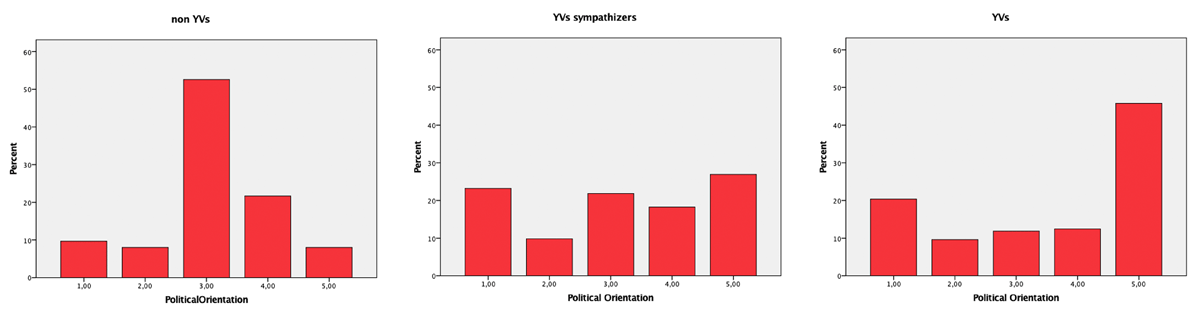
Figure 2
Bar charts indicating percentage of political orientation categories (1 = Left, 5 = Right) among YVs categories (Non VYs, VYs Sympathizers and VYs Members).
In order to be precise about the specific similarities and differences between Non YVs, YVs Sympathizers, and YVs Members, we computed three dichotomic variables (Non YVs vs. YVs Members, Non YVs vs. YVs Sympathizers, and YVs Sympathizers vs. YVs Members) and performed three binary logistic regression analyses for binomial criteria (Backward method, based on Likelihood Ratio) with these three variables as criteria and all the original psychological and sociological variables as predictors (except variables about channel of information because correlations were low). The hierarchical method was used because of the large number of potential explanatory variables and the exploratory focus of our research question (Table 3).
Table 3
Significant regression coefficients from hierarchical binary logistic regression analyses (Backward method, based on Likelihood Ratio) with YVs groups as criteria and the psychological and sociological variables as predictors (empty cells indicate non-significant effects).
| PREDICTORS CRITERIA | NON YVS VS. YVS MEMBERS | NON YVS VS. YVS SYMPATHIZERS | YVS SYMPATHIZERS VS. YVS MEMBERS | ||||||
|---|---|---|---|---|---|---|---|---|---|
| B | SE | ODD RATIO | B | SE | ODD RATIO | B | SE | ODD RATIO | |
| Age | |||||||||
| Gender | |||||||||
| Income | |||||||||
| Education | –.25 | .07 | .78 | –.09 | .04 | .92 | –.12 | .05 | .89 |
| CarDependence | .70 | .18 | 2.02 | .55 | .12 | 1.73 | |||
| Unemployment | |||||||||
| CTs | .36 | .21 | 1.44 | .44 | .13 | 1.55 | |||
| CMQ | .68 | .22 | 1.98 | .76 | .11 | 2.14 | |||
| Distrust | 1.16 | .22 | 3.18 | .35 | .13 | 1.41 | .66 | .14 | 1.94 |
| DifficultEndsofMonth | .50 | .18 | 1.65 | .37 | .10 | 1.45 | |||
| ParentsWorse | –.41 | .15 | .66 | –.19 | .08 | .83 | –.27 | .10 | .76 |
| ChildrenWorse | .44 | .17 | 1.55 | .40 | .10 | 1.50 | |||
| SuccessInLife | |||||||||
| NoHolidays | |||||||||
| ParanormalBeliefs | |||||||||
| ImportanceDemocracy | |||||||||
| PoliticalOrientation | |||||||||
| PoliticalExtremes | .94 | .32 | 2.55 | .93 | .19 | 2.53 | |||
| Constant | –10.08 | 1.73 | .00 | –4.63 | .81 | .01 | –4.60 | .80 | .01 |
| Goodness of fit: Nagelkerke | R2 = .69 | R2 = .40 | R2 = .23 | ||||||
The results showed that Education, Distrust, and ParentsWorse were the predictors that most strongly differentiated the three groups. More interestingly, some variables differentiated only two subgroups: PoliticalExtremes, ChildrenWorse, DifficultEndsofMonth, and CMQ differentiated Non YVs from both YVs Members and YVs Sympathizers; CTs and CarDependence differentiated YVs Members from both YVs Sympathizers and Non YVs; but CMQ, ChildrenWorse, and DifficultEndsofMonth differentiated mostly YVs Members and YVs Sympathizers from Non YVs.
Because we found in the logistic regressions and the PCA that CMQ could reflect a more rational form of accusation of authorities (differentiating YVs Sympathizers and Non YVs on one side from YVs Members on the other side, saturating less than CTs in the Irrational Beliefs factor and more on the Anomie factor), we relied on research by Stojanov and Halberstadt (2019), who were able to distinguish what they called ‘healthy skepticism’, related to beliefs in a more plausible (such as JFK assassination) and rational thinking style, and ‘conspiracy theory ideation’ related to various irrational measures. As here with CMQ and CTs, which correlate at r(1760) = 0.53, p < 0.05, their two factors were correlated, which argue against the existence of a true rational accusation of authorities. But this might happen because the true conspiracist will hold both rational and irrational suspicions. Thus, we median-splitted both variables CTs and CMQ and created four groups: CTs–CMQ–, CTs+CMQ–, CTs–CMQ+, and CTs+CMQ+. Then we computed a one-way ANOVA on ParanormalBeliefs as DV and the four groups obtained as factor. CTs+CMQ+ composed 34% of the sample (N = 591), compared to 18% of CTs+CMQ– (N = 311), 16% of CTs–CMQ+ (N = 282), and 33% of CTs–CMQ– (N = 576). The four groups significantly differed, with the most irrational being the CTs+CMQ– (M = 2.77, SE = 0.07), which differed not significantly from the CTs+CMQ+ (M = 2.73, SE = 0.05), followed by the more rational CTs–CMQ+ (M = 2.14, SE = 0.07), themselves somewhat a bit less rational than the CTs–CMQ– (M = 1.85, SE = 0.05), F(3, 1756) = 73.99, p < 0.05, ηp2 = 0.11 (with Tukey post-hoc tests at p < 0.05). Thus, CMQ may really capture a less (albeit still slightly) irrational accusation of authorities than explicit and classical conspiracy theories, such as about chemtrails or the Apollo mission on the moon. We would then not go up to call it ‘healthy skepticism’ as Stojanov and Halberstadt (2019) did, but rather less irrational accusations than classical CTs.
Discussion
Our analyses of a poll conducted on a representative sample of the French population indicated overall that the proximity of people towards a social movement such as the YVs was mainly related to social and cognitive variables: an objective and subjective low socio-economic status (confirming the theoretical analysis by Jetten et al., 2020), a higher dependency on a car, higher feelings of anomie (distrust toward authorities, nostalgia for the past, and worry about the future), and a higher endorsement of irrational beliefs, such as paranormal and conspiratorial beliefs. As expected, YVs members displayed higher levels of risk factors for conspiracist ideation (low educational level, low socio-economic status, extreme left- and right-side political position, and feelings of anomie), and thus tended to believe more in conspiracy theories. YVs members also get more information from social media and Youtube and less from traditional media, such as TV and newspapers, which may fuel conspiracy theories and irrational beliefs in general (Bronner, 2015). Interestingly, we found that irrational beliefs and anomie probably are consequences, and not causes, of the affiliation to the YVs in our Simultaneous Equation Modelling analysis. Although our data is correlational, we compared the reported model (Figure 1) to models with reversed paths, and the latter achieved a worse fit. This is why we may infer causality direction, which will have to be properly tested in future longitudinal studies about social protest movements.
We next found that some variables more specifically differentiated between the three groups, which could give hints to understand which psychosocial or economic factors could lead to joining a social protest movement such as the YVs, versus staying only a supporter of the movement. The YVs members were different from the simple sympathizers according to the same variables described above (economic difficulties, irrational beliefs, and anomie), but the most specific differences were about conspiracy theory beliefs and dependency on a car, for which sympathizers were different from YVs members but not from nonmembers. YVs members were also more prone to distrust institutions, were more politically extreme (more right-wing but also left-wing), and were more active on social media than simple supporters. We were also able to show that sympathy for the movement was mainly fueled by a more reasonable (or more precisely, less irrational) suspicion of authorities (CMQ instead of CTs), pessimism for the future, and daily economic difficulties. One may conclude from this analysis that the triggering factor for joining the movement was really a very objective factor, dependency on cars, as the origin of the movement was calls against rising fuel prices and the related high cost of living, which grafted on preexisting attitudes, poor social conditions, and extreme political positions. If we draw upon the higher odd ratios in the logistic regressions, these attitudes and social conditions were, in decreasing order, distrust toward authorities, extreme political position, daily economic difficulties, and pessimism toward the future. Indeed, we were able to calculate in this representative survey impressively high rates of such negative feelings. No less than 77.2% of the YVs were pessimistic about the future (thought that their children will live in a worse situation), compared to 71.7% of the sympathizers, and still 49.1% of the nonmembers of the YVs movement. Distrust of media was up to 59% among nonmembers, 72% among sympathizers, and 81% among YVs members.
Our hypothesis that conspiracy mentality would be high among YVs members (and to a lesser extent sympathizers) was corroborated, even when all other variables were statistically controlled in the regression analyses. Consistent with previous research, feelings of anomie (here distrust of institutions, absence of success in life, nostalgia for the past, and worry about the future), paranormal beliefs, a lower educational level, and an extreme right-wing political orientation (and to a lesser extent, left-wing) were related to conspiracy beliefs. As we have seen previously, this prevalence of CTs may explain, in return, the mode of collective action preferred by YVs (non-normative, as well as their emphasis on direct democracy over institutional-representative means of democratic participation, e.g., voting; Jolley & Douglas, 2014).
However, we found an interesting distinction between CMQ and CTs. As we noted above, the former seems to be a more rational accusation of authorities, being held more by YVs sympathizers. Similar to Stojanov and Halberstadt (2019), who were able to distinguish ‘healthy skepticism’ from ‘conspiracy theory ideation’, we confirmed about CMQ a proposal by Swami and colleagues (2017: 22), who in their comparative analysis of various scales for CTs beliefs measurement concluded:
Specifically, we suggest that some items of the CMQ may not tap conspiracist ideation, but may reflect rational beliefs about the current state of the world. For example, given current knowledge, item #3 (“I think that government agencies closely monitor all citizens”) could be construed as factual and requires no conspiracist mentality. The high mean scores for this measure (well above the scale mid-point) suggest that participants in this study were indeed rating some items of the CMQ as factually correct.
This finding has interesting implications for CTs research. Scholars may distinguish more irrational forms of accusation of authorities, and a less irrational suspicion based on real affairs (e.g., alleged illegal practices from politicians, such as former French president Nicolas Sarkozy) and democratic issues (monitoring of citizens). Furthermore, uses of CMQ and CTs may produce partly different results (despite the high correlation between them, due to high and low believers), which will render the analysis of conspiracism more fine-grained.
One question about the endorsement of CTs by the YVs members is whether the YVs movement attracted and aggregated a significant share of conspiracy-oriented individuals from various socio-demographic backgrounds or whether belonging to the YVs movement fosters the development of a conspiracy mentality. Both hypotheses are plausible and are not mutually exclusive. Born out of a protest against a rise in fuel prices, the movement quickly escalated into a contestation of the very legitimacy of the French government and the country’s institutions. The YVs also accuse the major national media of having taken sides with the government. As a result, they are suspicious of the media, and some of them have even assaulted journalists covering the demonstrations. By crystallizing in its rhetoric and claims the loss of trust in institutions and the media, the YVs movement has probably attracted many conspiracy-minded individuals.
Although our data is correlational, our SEM analysis helped us to suggest that economic difficulties, education, and car dependence are more likely causes of belonging to the YVs movement, but anomie and irrational beliefs, such as conspiracist and paranormal beliefs, are mostly consequences of this adhesion (but of course it may not be excluded that they are also, though less markedly, causes). Because anomie is, as we saw, high in every group of French citizens, we may hypothesize that adherence to the YVs movement did not decrease these feelings but, on the contrary, tended to increase them. Similarly, it is also possible that belonging to the YVs movement fostered the development of a conspiracy mentality. The YVs’ digital social networks have relayed numerous conspiracy theories, and we observed that YVs primarily gather information on social media. Moreover, police repression of YVs’ demonstrations, which resulted in many casualties among the protesters, may have reinforced the idea that the government is determined to take any necessary actions to crush the movement. In this context, conspiracy theories contending the government and its alleged media allies are secretly and illegally acting to undermine the movement may have gained credibility among the YVs. Finally, CTs do predict increased tendencies for political violence (Imhoff, Dieterle, & Lamberty, 2021; Rottweiler & Gill, 2020), and displays of protest violence are known to ‘filter out’ individuals who do not support non-normative types of collective action (who are usually less politically extreme and conspiracist before engaging in a social movement; Edwards & Arnon, 2019; Simpson et al., 2018).
A possible negative consequence of the overrepresentation of conspiracy theory enthusiasts among the YVs is that it could be used to discredit in the eyes of the public some of the movement’s legitimate demands for social justice. Sociologists like Boltanski (2012) have underlined that genuine social criticism has to avoid the pitfalls of conspiracism (e.g., entitative suspicion that the ‘Capitalists’ or the ‘Oligarchy’ of leaders in the world intentionally harm the majority of humankind). Instead, critics should conduct informed inquiries in order to shed light on some potential immoral behaviors of leaders, such as corruption. This is precisely what allows for the differentiation between denunciation of actual conspiracies and conspiracy theories (Wagner-Egger et al., 2019).
Importantly, our results about political orientation and YVs proximity may explain why Girerd and colleagues (2020) found that anti-neoliberal attitudes are related to identification with the YVs, and more strongly to YVs engagement (two categories that could respectively be compared to our YVs sympathizers and YVs). Indeed, anti-neoliberal attitudes may be found on the political extremes. As the present study is based on a representative sample, our findings may complete their results and explain why Girerd and colleagues (2020) found no correlation between political orientation and YVs engagement, and even a negative correlation between YVs identification and political orientation. This is probably because this last relation is both curvilinear and linear, resulting in a U-shape curve skewed towards the right, at least in our representative sample. Our results may also explain why, in their study, YVs identification and engagement were related to national identification. Girerd and colleagues (2020) concluded that national identification took the form of a critical attachment to the nation but not glorification. This could be true among the (minority) left-side YVs but certainly not concerning the majority (or largest minority) of extreme right-wing YVs that we identified in our study. As in their study, they tested convenience samples on social media websites, Facebook, and Twitter, their diverging result may be explained by an oversampling of left-wing YVs (social psychologist being traditionally more often located on the left side of the political continuum). Overall, our results do not contradict theirs, but they allow a better understanding and limit their conclusions.
The limits of the present study are mainly that the design is cross-sectional and thus does not allow for certainties about the real causality patterns, even if our SEM model comparisons may give some indications. Second, as the survey was based on self-report, social desirability biases may have distorted some of the responses.
In conclusion, the YVs movement reflects a crisis of confidence in republican institutions and epistemic authorities. It is not surprising to observe that it aggregates a significant share of conspiracy-oriented individuals, because systematic and pervasive suspicion towards politicians, journalists, and scientists is one of the pillars of the conspiracy mentality. This is also the case of far-right people, who compose the most frequent minority of people among the YVs (46%, compared to 20% at the extreme left). We saw that participation in the movement may also have increased distrust towards institutions and adherence to conspiracy beliefs. The origin of the movement, as we observed in our analysis, has objective social causes. A deficit of educational level, and then socio-economic difficulties, as well as dependence on cars will predict entering into the YVs movement, which in turn will reinforce pre-existing anomie and irrational beliefs. Our results echo the findings by Cordonier and colleagues (2021) and Imhoff, Zimmer, and colleagues (2021), who found among 22 Western and non-Western countries, and 26 European countries, respectively, that the Gini coefficient measuring the magnitude of economic inequalities in each country was positively correlated to the national level of beliefs in conspiracy theories. Thus, in order to fight conspiracy beliefs and other forms of irrational accusations of authorities, these objective socio-economic conditions have certainly to be addressed at the political level.
Notes
[2] According to other sources (INSEE, National Institute of economic statistics in France), the Gini coefficient diminished in France from the ‘70s to the 2000s, and from then tend to slightly increase. So objective, and not only subjective, perceptions of economic inequalities may also be a causal factor of engagement in collective action. (https://www.insee.fr/fr/statistiques/2491918).
[3] See for example https://www.lemonde.fr/idees/.article/2018/12/14/gilets-jaunes-et-attaque-de-strasbourg-le-poison-complotiste_5397433_3232.html.
[7] https://www.conspiracywatch.info. The data may be requested at this address.
[8] Considering that some of the variables were not normally distributed, we also computed the non-parametric Spearman correlation coefficients. As the results were very similar, we concluded that the deviation from normality did not bias the parametric tests. We thus displayed Pearson coefficients.
[9] These effect sizes may be considered small, but large samples increase interpersonal variability. As some cross-cultural psychologists put it, ‘A high level of unexplainable variance is part of the price paid in the search for universality’ (Bond, 1998: 1011).
Competing Interests
The authors have no competing interests to declare.