Have a personal or library account? Click to login
Critical Success Factors for Intersectoral Collaboration: Homelessness and COVID-19 – Case Studies and Learnings from an Australian City Cover

Critical Success Factors for Intersectoral Collaboration: Homelessness and COVID-19 – Case Studies and Learnings from an Australian City

Open Access
|May 2024

Figures & Tables

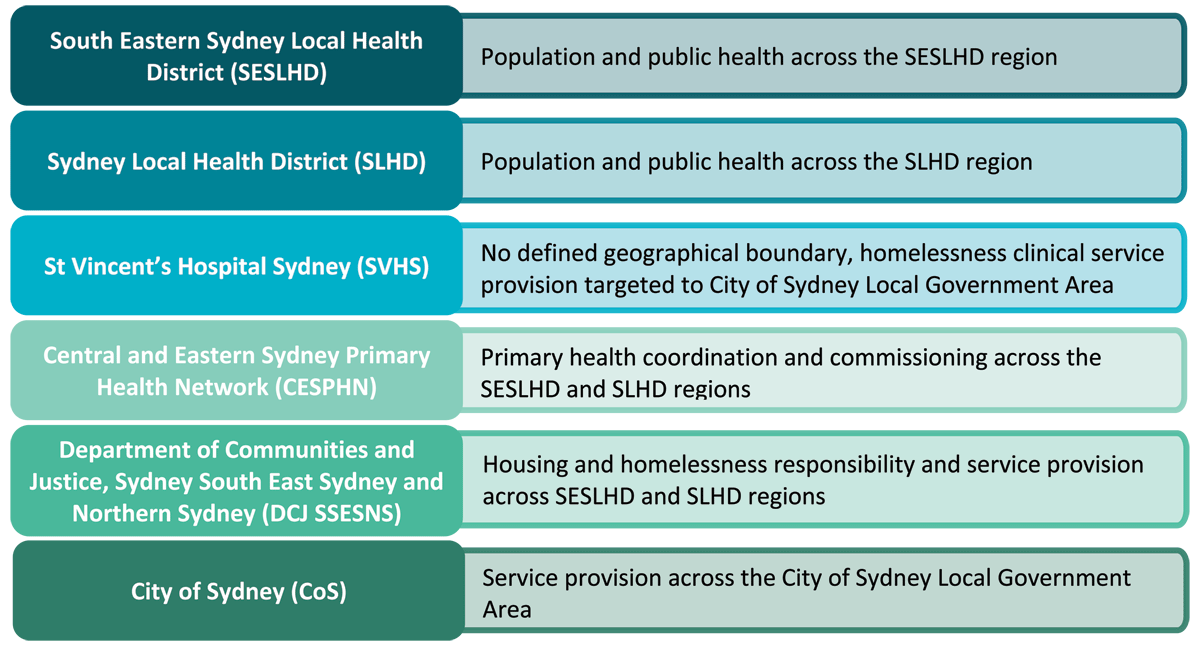
ijic-24-2-7653-g1.png
Figure 1

Intersectoral Homelessness Health Strategy (IHHS) partner agencies and their responsibilities.
ijic-24-2-7653-g2.png
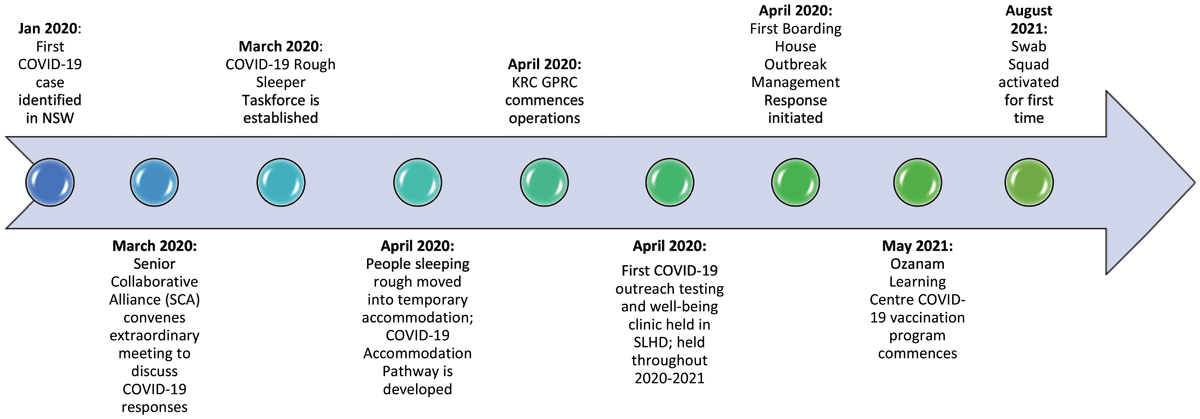
Figure 2

Timeline of significant events.
ijic-24-2-7653-g3.png
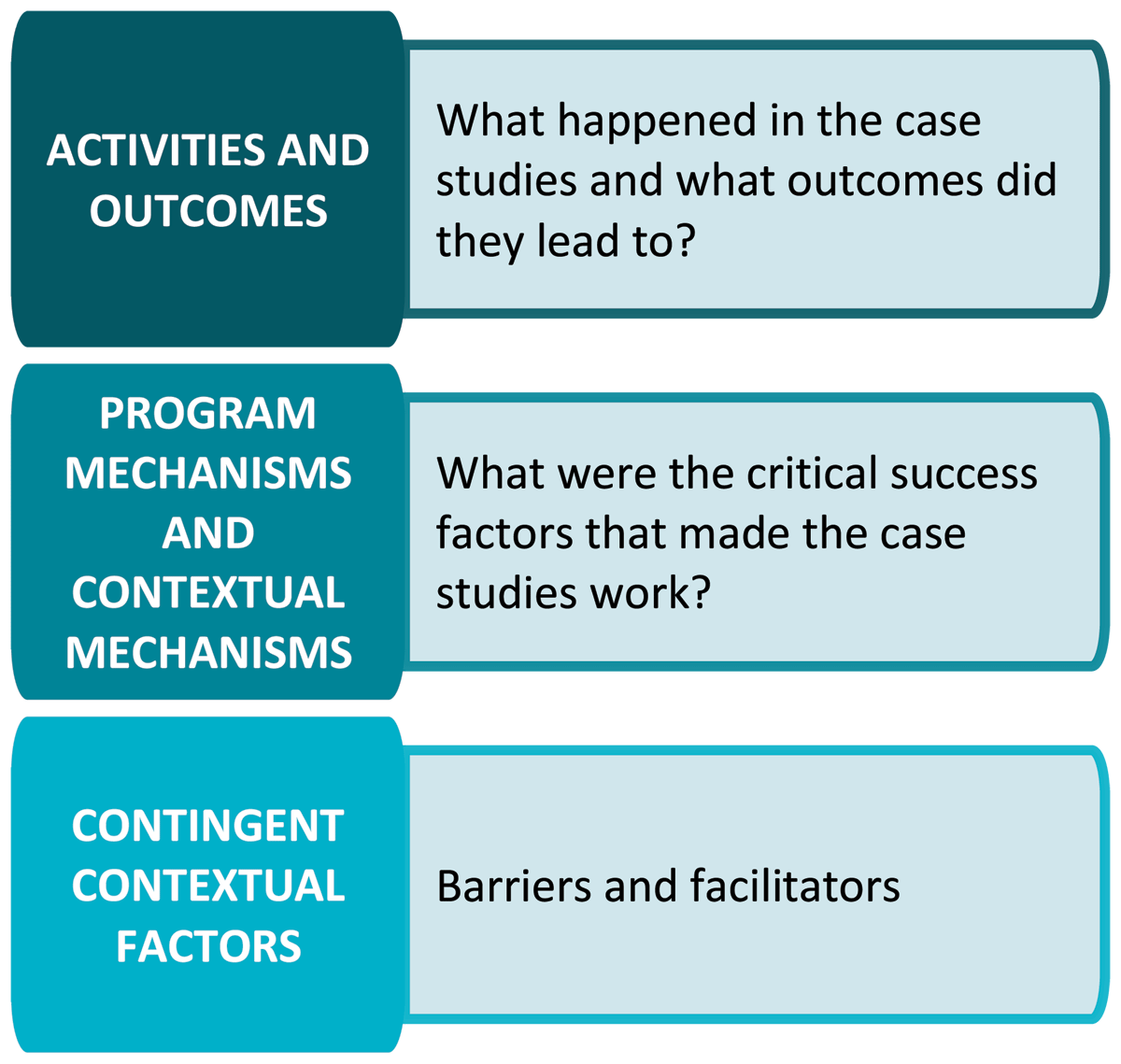
Figure 3

Realist informed framework.

Table 1

Overview of Case Studies.

OVERVIEW OF CASE STUDIES
CASE STUDYCONTEXT & MECHANISMSBARRIERS & CHALLENGES
Inner Sydney Rough Sleeper Taskforce/COVID-19 Accommodation PathwayContext
  • Managing the changing demand and the availability of the Special Health Accommodation

  • Inconsistent messaging between agencies around roles and responsibilities, particularly in the early days with rapidly evolving information

  • Changing public policy settings and public health orders prevented regular consistent messaging, external partner agencies were often confused and seeking regular clarification

  • Managing the demands and expectations of the non-health partner agencies in accessing the accommodation

  • Collaborative leadership

  • Authorising environment

  • Executive level endorsement

  • Urgency

  • Special Health Accommodation was funded

Mechanisms
  • Co-designed pathway

  • Communication mechanisms

  • Taskforce as a coordinating mechanism and advocacy opportunity

Mobile Primary Care ClinicContext
  • Managing the demand from the general population while prioritising target population

  • Managing government approval processes in a time pressured, urgent environment

  • Managing public concern that pop up testing was encouraging people with COVID to travel to the clinics

  • Responding to, and communicating changing testing criteria to people with poor health literacy

  • Engaging people for long enough for transport to pick them up and take them to specialist accommodation for people unable to isolate at home; known as Special Health Accommodation (SHA)

  • Reduction in delivery of broader healthcare to people experiencing homelessness when testing demand was very high

  • Communicating with partner organisations about people who were required to isolate, whilst respecting patient privacy

  • Urgency

  • Shared imperative

  • Existing relationships and trust with client group

  • Media interest

  • Funded initiative

Mechanisms
  • Tailored location based response

  • Effective deployment of finite resources

  • Agile collaboration

  • Specialist clinical teams

Boarding House Outbreak Management ResponseContext
  • Regularly adapting outbreak management responses to align with rapidly evolving public health advice and in the context of the boarding house setting

  • Difficulty standardising processes and responses given the varying standards and environment of boarding houses

  • Gaining the support of boarding house managers to respond to outbreaks

  • Managing the mental health and substance use of tenants who had limited resources to cope with isolation

  • Some tenants did not want other tenants to know of their COVID positive status which required sensitive management in an environment that often inhibits privacy

  • Urgency

  • Shared imperative

  • Existing relationships and trust with client group

  • Authorising environment

Mechanisms
  • Agile collaboration

  • Tailored location based response

  • Specialist clinical teams

  • Shared existing governance structures

Outreach Vaccination ClinicContext
  • Developing a communication strategy that reached the target population and clearly articulated eligibility for the service; required regular refining

  • Asking partner services to commit to the delivery of the clinic without any additional resources

  • Meeting the demand and expectations for vaccination with limited resources in an evolving landscape

  • The flow and delivery of the clinic had to be rapidly re-designed to comply with changing COVID policy settings

  • Vaccine availability was limited in the early weeks, which increased the demand on services by both the target population and the general public

  • Without an existing model to guide a COVID-19 vaccine clinic for homeless populations, the model had to be continually revised and refined

  • Urgency

  • Shared imperative

  • Existing relationships and implied trust (between agencies and with client group)

  • Media interest

  • Unfunded (in-kind) initiative

Mechanisms
  • Pooling of resources

  • Agile collaboration

  • Delivery of vaccine by one key agency

  • Weekly planning meetings attended by key stakeholders

  • Communication materials; marketing to key populations

  • Specialist clinical teams

Swab SquadContext
  • High level relationships established via IHHS; operational relationship/trust was built and strengthened through this process

  • Dealing with stakeholders outside the primary service system (corporate hotel accommodating rough sleepers) was often challenging; difficult to align vision and purpose

  • During peak of the outbreak the demand for the Swab Squad was very high and resulted in a reduction in the delivery of broader healthcare provided by both services

  • Swab Squad not always able to provide a rapid response due to workforce issues

  • Communicating with partner organisations about people who were residing in these accommodation services whilst respecting patient privacy

  • Urgency

  • Shared imperative

  • Shared values

  • Unfunded in-kind initiative

Mechanisms
  • Pooling of resources

  • Established communication mechanisms

  • Agile collaboration

  • Tailored location based response

  • Specialist clinical teams

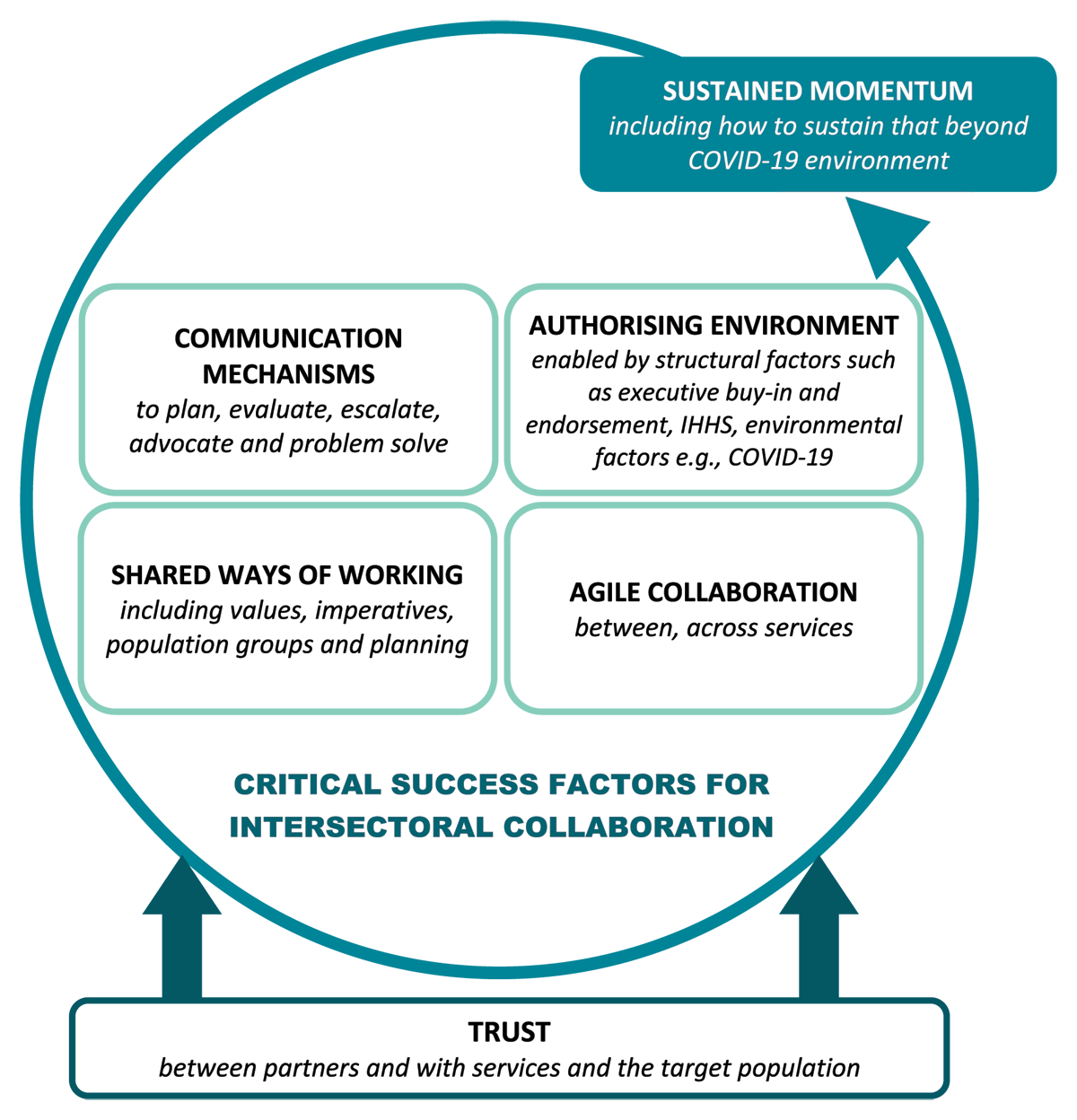
ijic-24-2-7653-g4.png
Figure 4

Critical Success Factors for Intersectoral Collaboration.

ACRONYMS
CESPHNCentral and Eastern Sydney Primary Health Network
CoSCity Of Sydney
DCJ SSESNSDepartment of Communities and Justice Sydney South East Sydney and Northern Sydney
IHHSIntersectoral Homelessness Health Strategy
SCASenior Collaborative Alliance
SESLHDSouth Eastern Sydney Local Health District
SHASpecial Health Accommodation
SLHDSydney Local Health District
SVHSSt Vincent’s Hospital Sydney
DOI: https://doi.org/10.5334/ijic.7653 | Journal eISSN: 1568-4156
Language: English
Submitted on: Apr 28, 2023
Accepted on: May 21, 2024
Published on: May 28, 2024
Published by: Ubiquity Press
In partnership with: Paradigm Publishing Services
Publication frequency: 4 issues per year

© 2024 Stephanie Macfarlane, Fiona Haigh, Lisa Woodland, Brendan Goodger, Matthew Larkin, Erin Miller, Lisa Parcsi, Phillip Read, Lisa Wood, published by Ubiquity Press
This work is licensed under the Creative Commons Attribution 4.0 License.