
Table 1
Categorization of patient outcomesa.
| CATEGORIES OF PATIENT OUTCOMES | EXAMPLES OF INCLUDED OUTCOMES |
|---|---|
| Clinical outcomes | Depression/anxiety scale, HbA1c level, blood pressure, lipids, other clinical outcomes, symptomatology, recovery, remission, mortality, morbidity, survival |
| Medication outcomes | Medication use, medication adherence, compliance with medication, number of prescribed drugs |
| Healthcare use | Hospital admissions, hospital utilization, medical service use, emergency department visits, length of stay, usage, readmission rate, time to readmission |
| Processes of care | Provision of recommended tests and preventive services, adherence to recommended care guidelines (vaccination, monitoring), improved accessibility, reduced waiting times, treatment adequacy, appropriate medications |
| QoL, functioning, other PROMs | Patient quality of life, physical/emotional/and social functioning, patient health behaviors, health practices (lifestyle, self-care), self-perceived health, QALY |
| Patient satisfaction | Patient satisfaction, attitudes and perceptions of care |
[i] a HbA1c: Haemoglobin bA1c; PROMs: Patient-Reported Outcome Measures; QALY: Quality-Adjusted Life Years; QoL: Quality of Life.
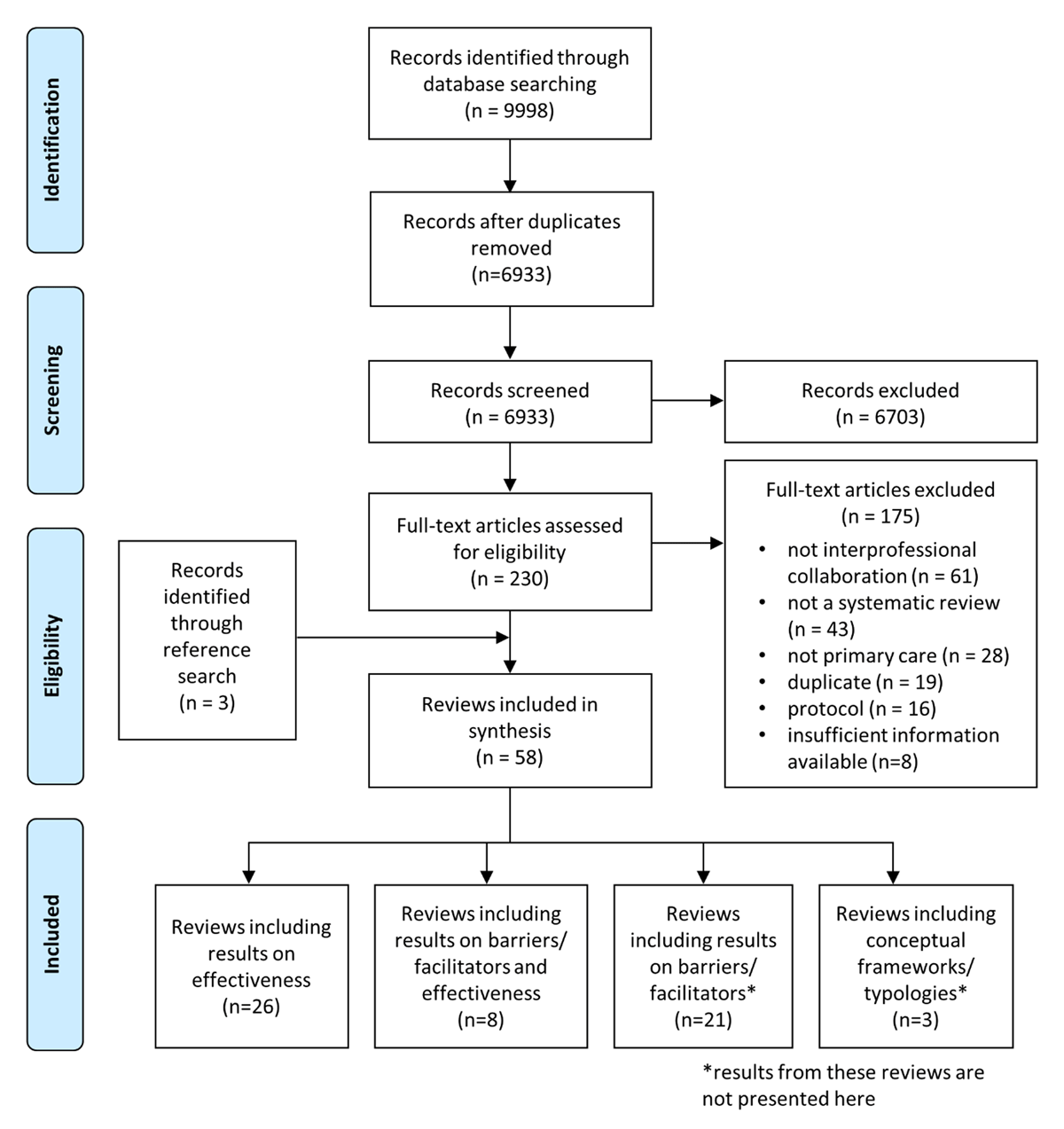
Figure 1
Flow chart.
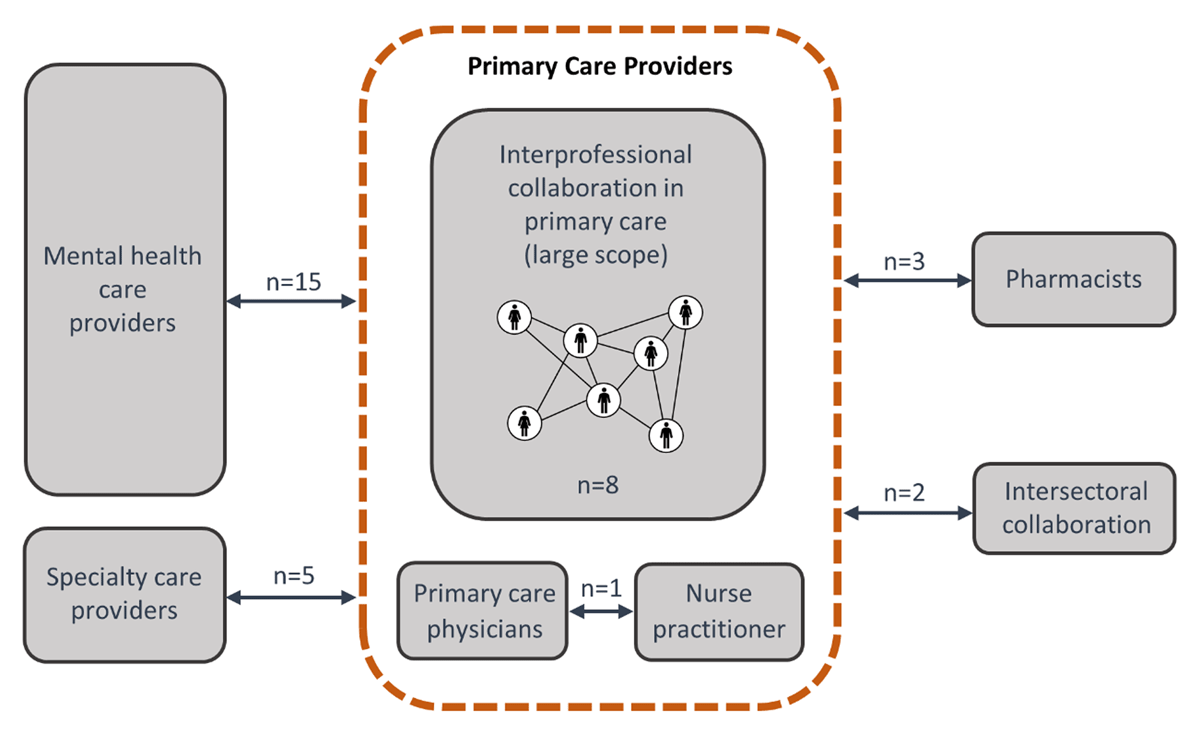
Figure 2
Six types of interprofessional collaboration identified.
Note: professionals working outside the primary care setting collaborate with at least a primary care physician and can include other primary care providers.
Table 2
Results from included reviews for patient outcomes (n = 34).
| TYPE OF COLLABORATION | AUTHORS, YEAR | META-ANALYSIS | CLINICAL OUTCOMES | MEDICATION OUTCOMES | HEALTHCARE USE | PROCESS OF CARE | QOL, FUNCTIONING, OTHER PROMS | PATIENT SATISFACTION |
|---|---|---|---|---|---|---|---|---|
| Interprofessional collaboration in primary care (large scope) | Barrett, 2007 [24] | + | + | + | + | |||
| DeLoach, 2018 [25] | + | |||||||
| Gougeon, 2017 [26] | ? | ? | + | + | ||||
| Martin, 2010 [27] | ? | ? | ? | + | ||||
| Proia, 2014 [28] | + | + | + | + | ||||
| Schepman, 2015 [29] | ? | ? | ? | |||||
| Trivedi, 2013 [30] | ? | ? | + | ? | + | |||
| Wranik, 2019 [31] | ? | ? | + | + | ? | |||
| PCP – nurse practitioner collaboration | Norful, 2017 [32] | ? | + | ? | ||||
| PCP – specialty care provider collaboration | Carmont, 2017 [36] | + | ? | |||||
| Foy, 2010 [37] | √ | + | ||||||
| Mitchell, 2002 [33] | ? | ? | + | ? | + | |||
| Mitchell, 2015 [34] | ? | ? | ? | ? | ? | ? | ||
| Smith, 2017 [35] | √ | ? | + | ? | ? | ? | ? | |
| PCP – pharmacist collaboration | Hazen, 2017 [39] | 0 | 0 | 0 | ||||
| Kwint, 2013 [40] | ? | 0 | ? | 0 | ||||
| Health Quality Ontario, 2009 [38] | √ | + | ||||||
| PCP – mental healthcare provider collaboration | Archer, 2012 [41] | √ | + | + | + | + | ||
| Bower, 2006 [45] | √ | + | + | |||||
| Butler, 2008 [52] | + | |||||||
| Coventry, 2014 [46] | √ | + | + | |||||
| Craven, 2006 [54] | ? | ? | ? | ? | ? | ? | ||
| Dham, 2017 [55] | ? | + | + | ? | ? | |||
| Fuller, 2011 a [53] | + | + | ||||||
| Gilbody, 2006 [47] | √ | + | ||||||
| Gunn, 2006 [48] | + | |||||||
| Huang, 2013 [50] | √ | + | + | |||||
| Muntingh, 2016 [51] | √ | + | ||||||
| Panagioti, 2016 [49] | √ | + | ||||||
| Sighinolfi, 2014 [43] | √ | + | ||||||
| Thota, 2012 [42] | √ | + | + | + | + | |||
| van Steenbergen-Weijenburg, 2010 [44] | + | + | ||||||
| Intersectoral collaboration (primary care with nursing home, public health) | Davies, 2011 [56] | ? | ? | |||||
| Martin-Misener, 2012 [57] | + | + |
[i] + Improvement: a review reports improvements in all outcomes from a category of outcomes (e.g. standardized mean difference, statistical significant difference before/after the intervention or versus a control group).
? Mixed results: a review reports mixed findings (e.g. improvement of one outcome but no change or worsening effect in another) between primary studies reporting the same outcome or between different outcomes of a given category.
0 No change: a review reports no change in the outcomes from a category of outcomes.
√ The review included a meta-analysis.