
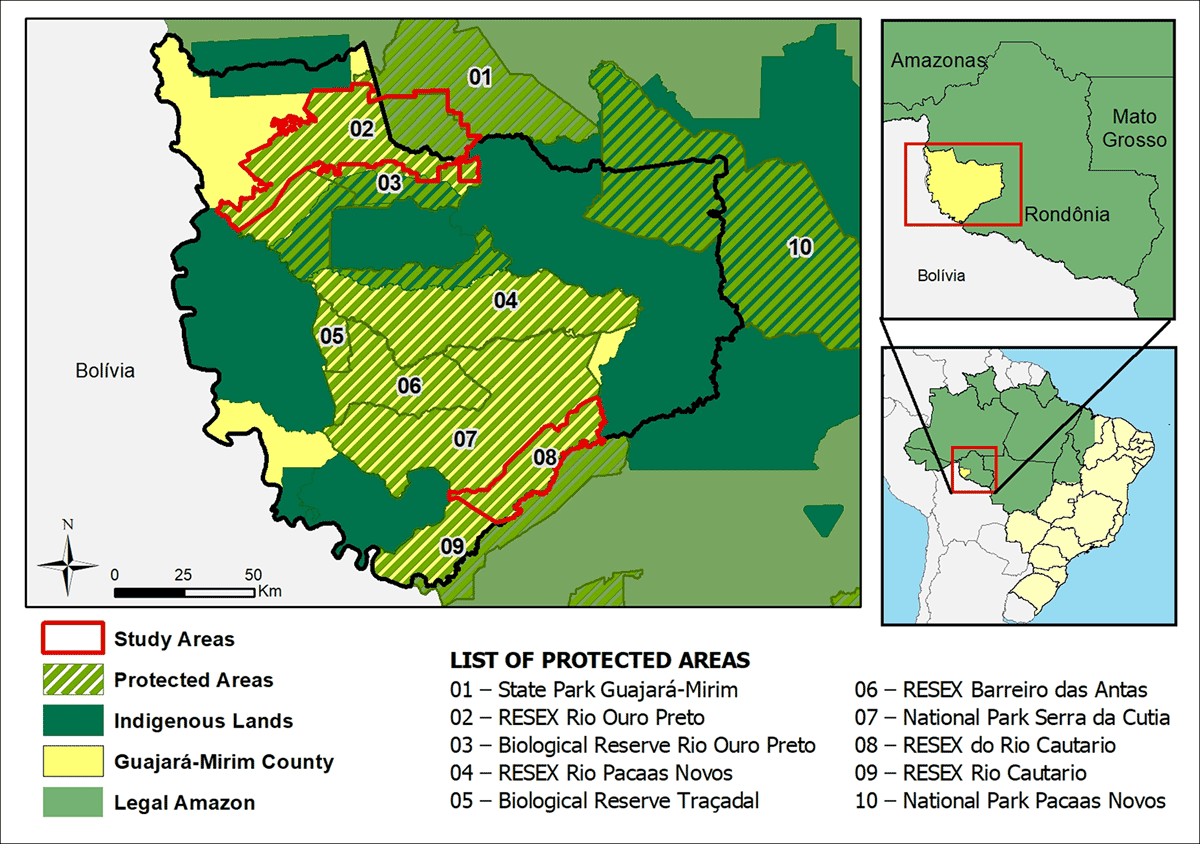
Figure 1
The legal Brazilian Amazon, municipalities, protected areas, and study areas.
Table 1
Focus group implementation script (Rio Ouro Preto Reserve).
| Mister X’s story – Rio Ouro Preto | |
|---|---|
| “Mister X” is 50 years old; he is married and has four children. He is a new resident in Rio Ouro Preto RESEX. He came from Acre State, where he already performed rubber taping and other extraction activities in the RESEX. One month ago, “Mister X” and his family took a place of residence in the community (say the name of the studied community) due to an agreement set with the ICMBio, the leaders and the community. “Mister X” came to Rio Ouro Preto RESEX with the purpose and will to settle down for the rest of his life. As he is new in the reserve, he needs information on how to perform his daily place-of-residence use and management activities. So, he asks the focus group about how to proceed. His questions are presented below: | |
| Management Agreement Rules | Scenarios |
| 45 and 46 | Can I already consider myself a beneficiary or do I need to undergo some period of extractive activity practice? Did I perform the admission procedure correctly? |
| 19 | I thought about using wood from (some tree of the region) to reform the house that already exists in my place of residence, can I cut down 2 trees? Windfall. |
| 11 | I want to plant cassava to make flour and I need to open a planting area in my place of residence. How many hectares can I use to do so? |
| 9 | There are a few açaí, buriti and pequi trees around my residence. If I need to set up a planting area, can I cut down these trees? |
| 10 | Can I use paxiúba to cover my house? Can I trade it? |
| 15, 16 and 17 | Can I breed unconfined chicken and pigs? I used to breed some cattle where I lived, can I do it here too? |
| 23 | Can I fish for my own consumption? I brought with me two casting nets and some longlines, are they allowed? |
| 24 | Am I allowed to take fish to the city? How should I proceed? |
| 33 and 37 | Some of my relatives still live in the Acre State RESEX. They will come to visit me twice a year, during festivities. Is it okay for them to come and stay for a few weeks? Are there restrictions? |
| 39 and 40 | I would also like to visit them from time to time. Can I leave the area? For how long? |
| 4 | Can I buy a place of residence from my neighbor and keep the 2 of them? |
| 4.1, 5 and 43 | My place of residence does not have rubber trails, but I am extremely interested in extracting latex. Can I open some rubber trails in the place of residence of another resident who does not perform rubber taping activities? How many rubber trails can I open at most? Do I need to ask someone’s permission? |
| 8 | What type of cut should I make in the rubber trees? How many cutting days do I have per trail? |
| 22 | Can I trade fruits such as pequi, buriti and bacuri? What do I have to do to trade them? |
| 21 | Can I trade timber products? Do I need forest management? |
| 12 | Can I burn the planting area? Do I need to be careful with chestnut trees? Which ones? |
| 6 | Can I cut down chestnut trees? What do I do when they are in the planting area? |
| 31 and 32 | How does reserve monitoring work? Who does monitor it? |
Table 2
Focus group implementation script (Rio Cautário Reserve).
| Mister X’s story – Rio Cautario | |
|---|---|
| “Mister X” is 50 years old; he is married and has four children. He is a new resident in Rio Cautário RESEX. He came from Acre State, where he already performed rubber taping and other extraction activities in the RESEX. One month ago, “Mister X” and his family took a place of residence in the community (say the name of the studied community) due to an agreement set with the ICMBio, the leaders and the community. “Mister X” came to Rio Cautério RESEX with the purpose and will to settle down for the rest of his life. As he is new in the reserve, he needs information on how to perform his daily place-of-residence use and management activities. So, he asks the focus group about how to proceed. His questions are presented below: | |
| Management Agreement Rules | Scenarios |
| 16 and 17 | Do I need to present documents to prove my extraction origin in order to establish myself in the reserve? Who do I introduce myself to? |
| 56 | I thought about using wood from (some tree of the region) to reform the house that already exists in my place of residence, can I cut down 2 trees? |
| 34 | I want to plant cassava to make flour and I need to open a planting area in my place of residence. How many hectares can I use to do so? |
| 32 and 38 | Can I burn the planting area? Do I need a firebreak? |
| 10 and 20 | I want to tap rubber trees, how many rubber trails can I have in my place of residence? |
| 22 and 25 | What type of cut should I applied to the rubber trees? Are there forbidden cuts? |
| 2 | I noticed that my place of residence does not have açaí trees. Can I extract this product out of my place of residence? How does it work? |
| 27 | How does the chestnut extraction work? Does each resident have his chestnut trail? |
| 39 | Can I extract copaíba? Are there restrictions? |
| 49 and 50 | Can I breed unconfined chicken and pigs? |
| 51 and 53 | How do hunting matters are treated inside the reserve? Is it allowed? Are there restrictions? |
| 45 | Can I fish for my own consumption? I brought with me two casting nets and some longlines, are they allowed? |
| 18 | If the place of residence is a dry line, can the owner go fishing in the river without problems? Is the river a common area? |
| 12 and 14 | I would like to visit some relatives who live out of the reserve once a year. Can I leave the area? How long can I stay away from the reserve? What is the procedure? |
| 57 | Can I trade timber products? Do I need forest management? |
Table 3
Category definitions.
| Rio Ouro Preto RESEX Categories | Rio Cautario RESEX Categories |
|---|---|
| PLACE OF RESIDENCE: It concerns the rubber tapper’s location/place of dwelling. This category comprises the number of places of residence per family; the possibility of having two places of residence; the absence from the place of residence in terms of time and authorization; the extractive activity performed outside the place of residence and the common-use areas within the reserves. (rules: 4, 5, 39, 40, 43) | PLACE OF RESIDENCE: It concerns the rubber tapper’s location/place of dwelling. This category comprises the number of places of residence per family; the possibility of having two places of residence; the absence from the place of residence in terms of time and authorization; the extractive activity performed outside the place of residence and the common-use areas within the reserves. (rules: 2, 12, 14) |
| ANIMAL BREEDING: It concerns rules addressing the breeding of small animals within the reserve. (rules: 15, 16, 17) | ANIMAL BREEDING: It concerns rules addressing the breeding of small and large animals within the reserve. (rules: 49, 50) |
| PLANTING: It concerns the size of the planting area and its opening limits, as well as the cutting of plants and the handling of rubber trees within the planting area. (rules: 6, 9, 11, 12) | PLANTING: It concerns the limits of the planting area and the use of fire within it. (rules: 32, 34, 38) |
| RUBBER TAPPING: It concerns the number of rubber trees each family can have, as well as the allowed and forbidden cuts. (rules: 4.1, 8) | RUBBER TAPPING: It concerns the number of rubber trees each family can have, as well as the allowed and forbidden cuts. (rules: 10, 20, 22, 25) |
| FISHING: It concerns fishing guidelines as for tools and quantity of fish allowed. (rules: 23, 24) | FISHING: It concerns fishing guidelines as for tools and quantity of fish allowed. (rules: 45, 46, 47) |
| TRADING: It concerns the handling and trading of straw and forest products in general. (rules: 23, 10) | TRADING: It concerns the management of chestnut, as well as the trading of chestnut and copaíba. (rules: 27, 39) |
| NEWCOMERS: It concerns new families who want to settle in the reserve, as well as the consent and authorization procedures. (rules: 45, 46) | NEWCOMERS: It concerns new families who want to settle in the reserve, as well as the consent and authorization procedures. (rules: 16, 17) |
| TIMBER: It addresses the exploitation and use of timber and timber products within the reserve. (rules: 19, 20) | TIMBER: It addresses the exploitation and use of timber and timber products within the reserve. (rules: 56, 57) |
| MONITORING: It addresses the rubber tapper-monitoring rules adopted in the reserve. (rules: 31, 32) | ANIMAL SLAUGHTER: It addresses the slaughter of wild animals for non-internal consumption. (rules: 51, 53) |
| VISITS: It addresses the authorization and the responsibility of residents receiving visitors and of those visiting the reserve. |
Table 4
Description of three rule-acknowledgement evaluation points.
| Acknowledgement (10 points) | The “Management Agreement” rule-acknowledgement level refers to the correct answer about a particular rule. Thus, the rule was considered internalized when the group showed knowledge about it by answering to the question in a way that the answer fully complied with the “Management Agreement”. The order of words did not matter in this case, just the content of the answer and the adherence of such content to the formal rule described in the “Management Agreement”. |
| Intermediate Acknowledgement (5 points) | The intermediate “Management Agreement” rule-acknowledgement level translates moments of confusion and doubt among the actors, although they found the correct answer in the end. Although there were wrong individual answers in these moments, the group’s motivation to find and give the correct answer allowed considering it an intermediate internalization. The partial knowledge about the rule – i.e., when the final answer did not contemplate the whole formal rule, either because something was missing or because they went beyond and inserted elements that did not belong to the rule – was also considered intermediate. |
| Non-Acknowledgement (0 points) | The “Management Agreement” rule non-acknowledgement level refers to wrong answers, i.e., when the group confirmed an answer that did not comply with the formal rule. This level also comprised wrong answers emerging in times of doubt and confusion within the group. At such times, although there were correct answers, the mere fact that the wrong answers stood out at the end was the reason to consider it as non-internalization. |
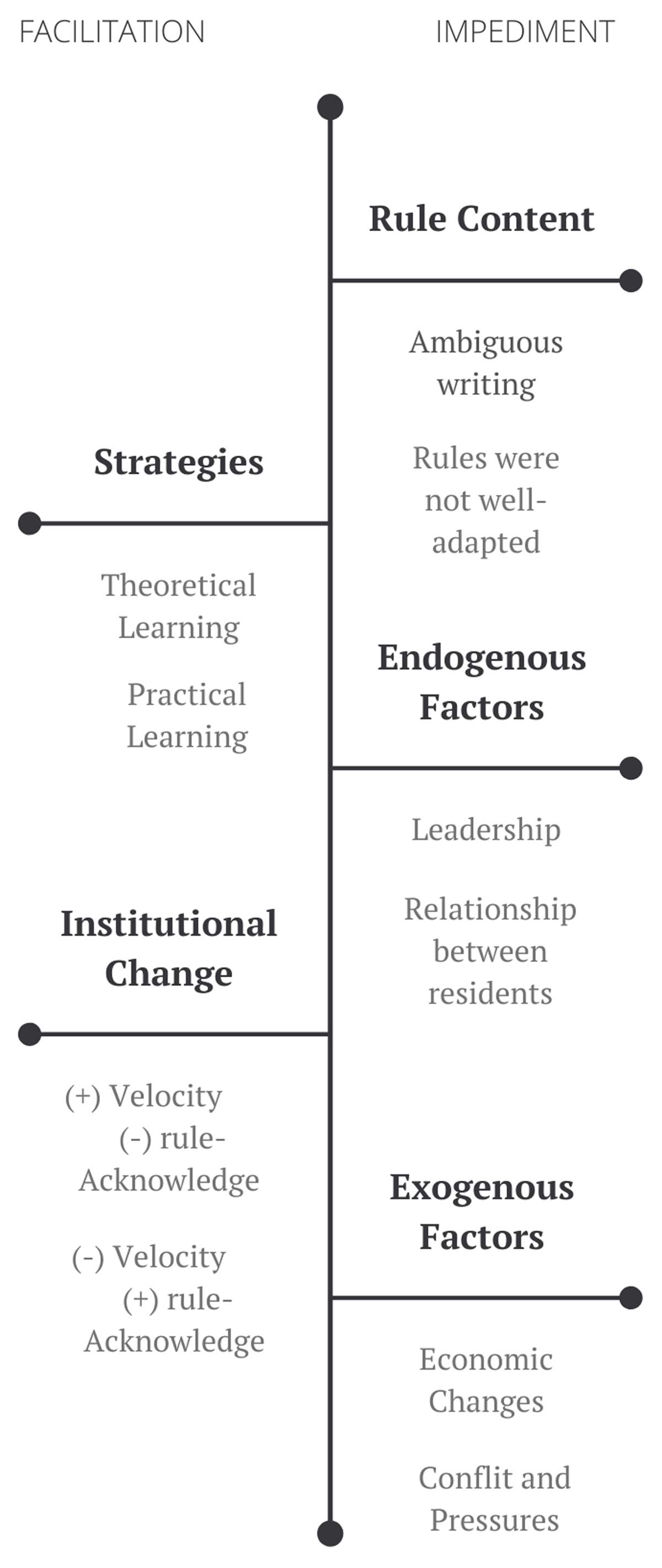
Figure 2
Summary results.
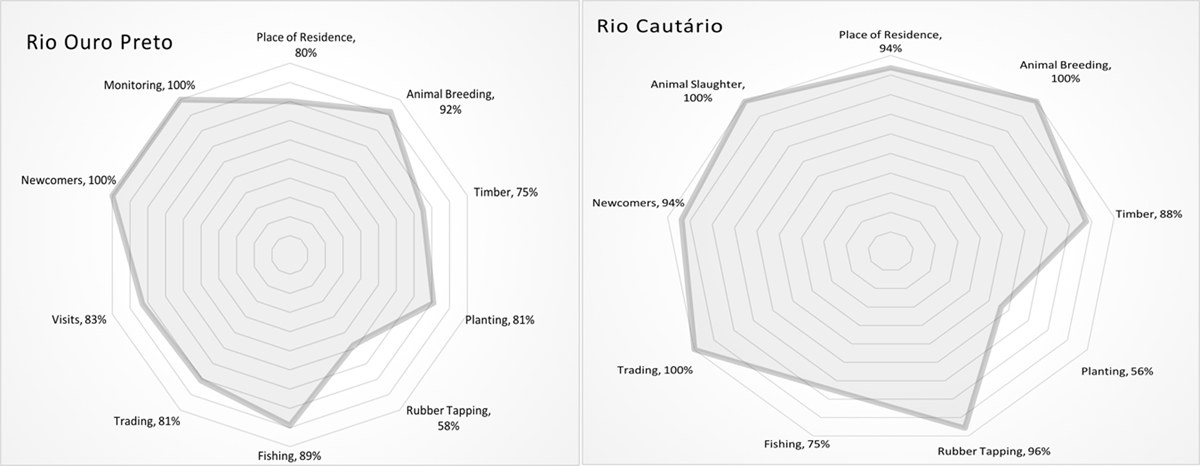
Figure 3
Radar chart of the two study reserves. In each case, we identified the percentage of formal rules acknowledged, by category. The mean level of formal rules acknowledged, as indicated in the text, was 89% for the Rio Cautário Extractive Reserve and 84% for the Rio Ouro Preto Extractive Reserve. The mean level in each reserve was calculated by the sum of the categories (presented in the chart) divided by the number of categories (arithmetic mean). The percentages of the categories were calculated from the um of the each of the four communities surveyed by reserve (totaling eight communities).