
1. Introduction
Nature-based recreation is an increasingly popular pastime. In the United States, participation in nature-based recreation rose from 48.4% in 2014 to 58.6% in 2024 (Outdoor Foundation, 2015, 2025). This increase in participation, paired with the rise in popularity of more destructive recreational mediums (e.g., off-highway vehicles) means managers of recreational systems face mounting challenges and uncertainty in meeting their management objectives (Collins & Brown, 2007; Cordell et al., 2005). Inadequately managed recreation has had serious consequences, including declines in imperiled species, the spread of invasive plants, and violations of American Indian cultural sites (Collins & Brown, 2007; Wilcove et al., 2000).
Much of nature-based recreation occurs on public lands and waterways, which are managed for the collective benefit of multiple user groups. Consequently, these systems are common pool resources; they are non-excludable and subject to multiple competing uses (i.e., are substitutable and rival.) It is therefore important that we broaden our understanding of how different institutions underpinning the management and functioning of these shared spaces arise, evolve, and affect their collective enjoyment.
Traditionally, research on outdoor recreation management has occurred within disciplinary silos. Natural scientists (e.g., ecologists or biologists) have tended to focus on the impacts of human disturbance during recreation on wildlife and ecosystems (e.g., Marion et al., 2020) while social scientists have focused on how biophysical attributes impact recreator satisfaction (Morse et al., 2022). In other words, researchers have limited their investigative scales and treated as static or external elements outside their own disciplines. However, recreation systems and the challenges their managers face are inherently social and ecological and occur at multiple, interacting scales. Consequently, a growing body of literature seeks to move away from the disciplinary silos that have traditionally defined the recreation management literature, and to instead understand nature-based recreation as part of a complex and adaptive social-ecological system (SES) (Blahna et al., 2020; Cash et al., 2006; Fischer, 2018; McCool & Kline, 2020). In recent years, several papers have been published that frame nature-based recreation within an SES (e.g., Creany et al., 2024; Ferguson et al., 2022; Morse et al., 2022).
This study contributes to this research agenda by creating a systems-based typology of social dilemmas that recreation managers must address. This typology is similar to work by Cumming (2018) in that it identifies dilemma archetypes as bundles of institutions and system dynamics rather than as “symptoms” of failure. By focusing on system processes rather than outcomes, this typology can generate knowledge about the institutional arrangements under which certain dilemmas emerge and how management interventions targeted at those dilemmas may impact system processes and outcomes across heterogeneous recreation systems and activities.
We identify four primary and four secondary archetypes and investigate how exogenous shocks, endogenous feedbacks, and system characteristics contribute to their emergence. Using the Coupled Infrastructure Systems Framework (CISF) (Anderies et al., 2016), we code and compare case studies to understand how local context (i.e., institutions, norms, recreator or environmental attributes) shapes outcomes within recreation-hosting SESs. This systems-based comparative approach has been used to investigate sustainable management of, among other things, irrigation districts (Janssen & Anderies, 2013), forests (Poteete & Ostrom, 2004; Wollenberg et al., 2007), and marine fisheries (e.g., Spijkers et al., 2018). However, to our knowledge this is the first such analysis of nature-based recreation management, broadly. The archetypes and themes identified through this analysis can help managers model their own systems to anticipate potential shocks, understand likely dilemmas, and evaluate the intended and unintended consequences of prospective interventions.
In Section 2, we operationalize the CISF for the management of nature-based recreation. Section 3 describes methods for selecting, coding, and analyzing case studies to identify management dilemmas. We describe the eight dilemmas plus themes surrounding their emergence and effective management in the Results and Discussion sections (Sections 4 and 5). Section 6 concludes the paper.
2. Operationalizing the CIS Framework for Management of Nature-based Recreation
The CISF is an extension of the Robustness of Social Ecological Systems Framework (SESF) (Anderies et al., 2004; Ostrom, 2009) that emphasizes system dynamics, making it an ideal analytical framework for identifying commonalities in system processes and outcomes between seemingly disparate cases of resource governance. Accordingly, sustainability scholars have employed the CISF and SESF to archetype analyses in several contexts, including sustainable development (Rocha et al., 2020), water governance (Gotgelf et al., 2020), and the emergence of resource governance generally (Aggarwal & Anderies, 2023).
The CISF (see Figure 1) maps flows of information and biomass (the numbered “links”) that underlie shared governance of natural infrastructure. When information or biomass move across multiple links, this is a “feedback.” Fishers, hikers, and other resource users access natural infrastructure through link 1 to engage in nature-based recreation. The public infrastructure that modifies this resource user-natural infrastructure process through link 5 includes rules, laws, and monitoring and enforcement capacity (soft human-made infrastructure); built features like trails (hard human-made infrastructure); norms that resource users modify through link 6 and that guide their recreation behaviors in turn (social infrastructure); and resource users’ knowledge of the system (human infrastructure). These four elements can directly influence natural infrastructure through link 4, resource users through link 6, or the resource user-natural infrastructure process through link 5. Examples of interventions include stocking or culling species (link 4), information campaigns or fines (link 6), and on-site monitoring and sanctions (link 5). Resource users mobilize private infrastructure to recreate. This is especially important as interventions along link 6 often target when, where, and whether certain types of gear may be used (e.g. trail-specific limits on e-bike top speeds, fishery and species-specific limits on what lures may be used, etc.).
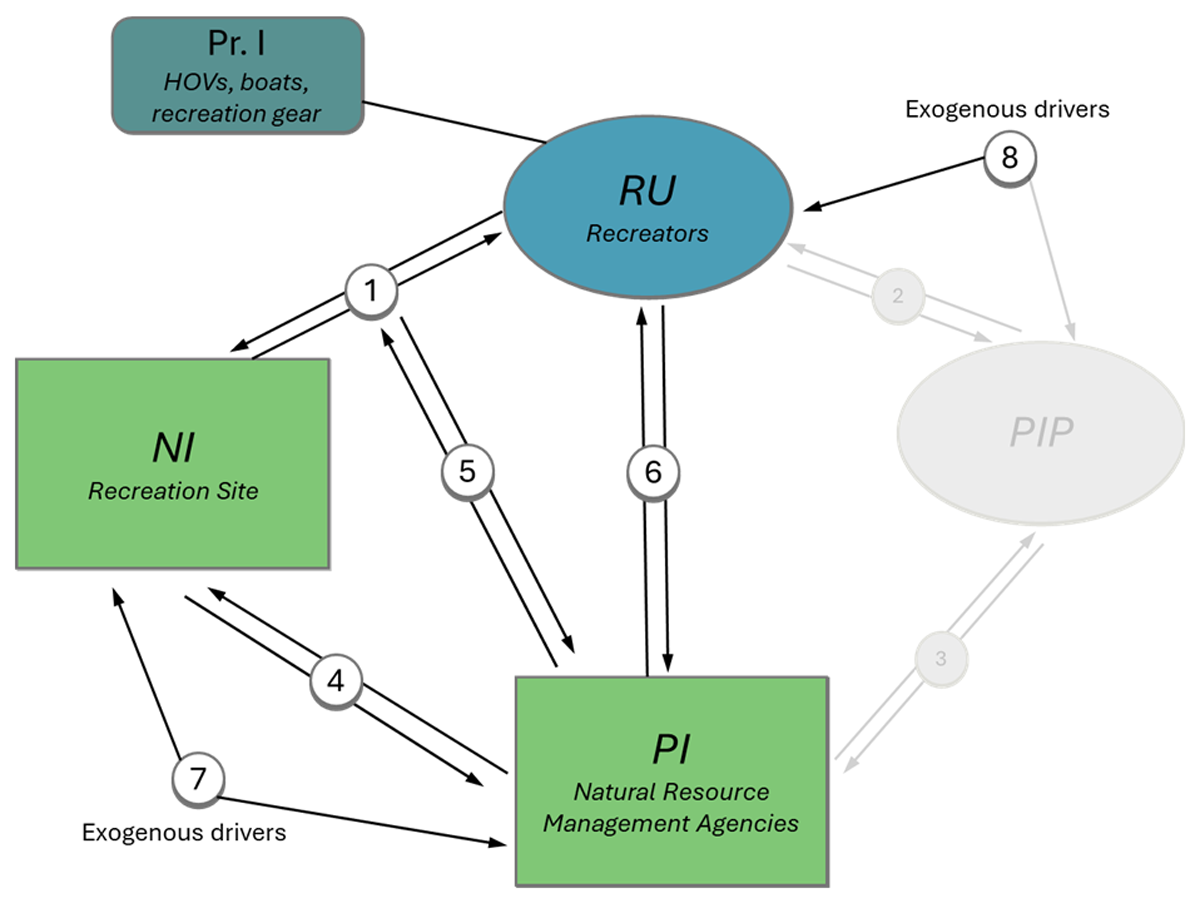
Figure 1
The CIS Framework operationalized for nature-based recreation. The CISF traditionally includes a fourth actor that sets mandates and allocates funding for public infrastructure. We treat this public infrastructure provider as exogenous, because resource managers’ mandates and funding availability are relatively fixed on the time scales of interest here. This is indicated by that part of the framework being greyed out, i.e. these elements are not addressed in this study. See text for more details. Adapted from Anderies et al. (2016).
Any of the elements depicted may be affected by exogenous shocks, which can push the system toward a new equilibrium. If the system flips, a new management challenge (i.e., a symptom of “failure” according to the manager’s mandates) may arise. The same symptom (e.g., biomass decline) may emerge in two systems for different reasons (e.g., recreational harvest vs a climate shock.) While the symptom is the same, the underlying processes and opportunities for intervention differ. The CISF provides a clear template for re-defining challenges according to their underlying feedbacks (i.e., as “dilemmas”).
3. Methods
3.1 Identifying cases
We used the Scopus API to identify publications about nature-based recreation management (Elsevier, 2022). First, we searched titles, abstracts, and keywords using terms related to managing for recreation modes listed in a US Forest Service (USFS) technical report (Cordell, 2012) that are managed by public agencies and involve natural infrastructure depletion or social dilemmas.1 See Table A1 in Appendix A for a list of queries.
We screened 4,645 publications and identified 527 relevant articles using the criteria in Appendix A. From these, we selected 143 case studies published since 2013 (i.e., that featured contemporary management challenges) that examined symptoms of failure at well-defined sites.2 Those case studies featured 27 symptoms of failure (e.g., soil erosion, recreator mortality). We iteratively grouped those symptoms into six overarching management challenges: 1) Recreator harm; 2) Conflict; 3) Equitable access; 4) Extractive degradation; 5) Non-extractive degradation; and 6) Wildlife disturbance (Table A2 in Appendix A provides more detail on these challenges).
Finally, we selected 18 cases for coding using the following criteria:
For each management challenge, choose at least one case per recreation mode to ensure good coverage.
When possible, select cases that address more than one management challenge to investigate how dilemmas interact.
If multiple cases share management challenges and recreation modes, select the case with the most detail on resource users, natural infrastructure, and public infrastructure.
Table A3 in Appendix A provides an overview of the final 18 cases.
3.2 Coding and analyzing case studies
For each case, we first listed the attributes of the resource users, natural infrastructure, and public infrastructure. Historical public infrastructure (e.g., laws, enforcement agency, etc.) is often recorded, so we collected supplemental information on public infrastructure as needed. Next, we noted any management challenges and mapped the feedback(s) (i.e., archetypes) that described those challenges onto the CISF. Finally, we listed management interventions noted by the case authors, the system’s managers, or from personal knowledge and insights.
As we coded the case studies, it became apparent that many challenges arose in response to management interventions targeted at some other challenge. Therefore, we differentiated between primary and secondary feedbacks. See Appendix B for an example of the coding process and a table of all coding outcomes.
4. Results
This analysis identifies four primary and four secondary management dilemmas. Primary dilemmas arise from the recreation process (i.e., the resource user-natural infrastructure interaction) and may be triggered by endogenous dynamics or exogenous shocks. Secondary dilemmas emerge from a primary dilemma or from a management intervention. Most cases feature multiple, interacting dilemmas. We explain the feedbacks that characterize each archetype and potential management interventions in the following subsections.
4.1 Primary dilemmas
Figure 2 illustrates the four primary dilemmas, which are:
Leave No Trace (LNT): resource users degrade natural infrastructure while seeking utility (U) from recreation.
Hell is Other People (HOP): natural infrastructure concentrates recreating resource users who are then harmed by that proximity.
Don’t Poke the Bear (DPB): natural infrastructure harms recreating resource users.
Can’t Get There from Here (CGT): natural infrastructure access is limited or unavailable for certain resource user groups.
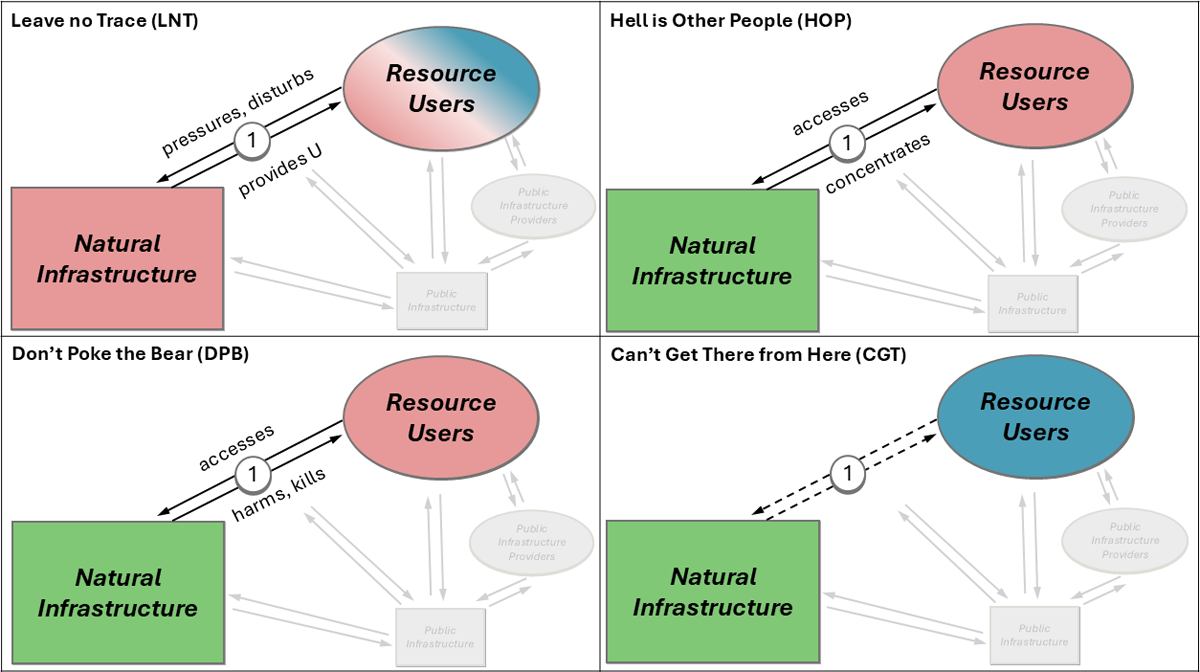
Figure 2
The four primary dilemmas. Verbs along links describe modifying effects between nodes. Red shading indicates the node where symptoms of failure appear. Partial shading in LNT indicates resource users may or may not be worse-off under this dilemma. The dashed line CGT represents a weak or missing recreational link. The small, gray public infrastructure and public infrastructure provider nodes and associated linkages indicate these primary dilemmas are products of institutional context. What these dilemmas have in common across all cases is the nature of the resource user-natural infrastructure interaction.
Each dilemma manifests as multiple management challenges across a range of recreational activities (see Table C1 in Appendix C).
4.1.1 Leave no trace
Resource management scholars across disciplines have identified a recurring tension wherein recreators inadvertently degrade the ecosystems that support their experiences, even when their recreational behaviors are motivated by appreciation for the resource. For example, social scientists have written at length about the incentives that lead to overfishing in recreational commons, while natural scientists have focused on the ecological consequences of that overfishing (Jackson et al., 2001; Wilen, 2006). We refer to this pattern as the LNT dilemma. The degradation associated with LNT is exacerbated when resource user preferences align with natural infrastructure vulnerabilities. In extractive contexts, hunters and fishers may target a single trophic level, reducing biomass and transforming ecosystems in ways that hinder recovery (Chang et al., 2017; Weijerman et al., 2018).3 In non-extractive contexts, features that attract resource users (e.g., crevices for climbing, lagoons for boating, or cliffs for photographing) often coincide with sensitive ecosystems (e.g., cliff-dwelling plants, nursing dolphins, or nesting Golden Eagles) (Bomanowska et al., 2014; Shawky et al., 2020; Spaul & Heath, 2016).
It is worth noting that because we coded cases that contained symptoms of failure the resource users discussed in each study were limited to actual or potential recreators. However, another important group of resource users are residents of gateway communities—towns adjacent to or overlapping National Parks and other public lands used for recreation. It is important to clarify that “use” refers to either active or passive use values. There are many different subgroups within the Resource User node (discussed at length in Anderies et al., (2019)) and many flows along link 1. Consequently, the benefits and costs associated with system failures are unequally borne. Recreational users and some community members that directly interact with the natural infrastructure (e.g., in a volunteer custodial capacity) actively use the resource, while other residents only enjoy passive use benefits (e.g., tax revenues from tourism). Regardless of how they interact with the resource, gateway residents are all potentially harmed by the natural infrastructure degradation associated with recreation (i.e., increases in litter or reduced aesthetic quality), but are also often documented engaging with the natural infrastructure in a volunteer custodian role (Smith & Zakaria, 2026).
LNT also emerges when slow exogenous changes in resource user preferences or natural infrastructure resilience create new problems or undermine existing management solutions. For instance, rising demand for camping and a growing preference for dispersed tent setups have led to more campers and the creation of ‘satellite campsites,’ both of which, for example, damage flora (natural infrastructure), at Boundary Waters Canoe Area Wilderness (Eagleston & Marion, 2017).
Managers can address LNT through links 4, 5, or 6. Link 4 interventions modify natural infrastructure directly, through habitat restoration (e.g., pollutant remediation to support overfished species) (Weijerman et al., 2018), spatial separation of resource users and natural infrastructure (e.g., beach nourishment to create isolated seabird nesting sites or wildlife overpasses to help game species evade hunters) (Burger & Niles, 2014; Chang et al., 2017); and behavioral deterrents (e.g., covering satellite campsites with rocks) (Eagleston & Marion, 2017).
Link 6 interventions use information or sanctions to reduce resource user pressure on natural infrastructure. Two types of information resource managers frequently employ are restrictions on tools (e.g., axes, high-impact fishing gear) (Eagleston & Marion, 2017; Weijerman et al., 2018) or on access (e.g., banning climbing hardware in sensitive areas) (Bomanowska et al., 2014). However, these measures are only effective when enforceable. For example, illegal hunting persists in remote Chinese villages due to weak enforcement (Chang et al., 2017).
Two other link 6 interventions include behavioral bans (e.g., species-specific harvest moratoriums to prevent harvesting down the food web (Chang et al., 2017; Weijerman et al., 2018)) and spatial restrictions (e.g., “no stopping zones” to protect active eagle nests or banning boats near the mouth of the lagoon on Samadai Reef to allow nursing dolphins to escape (Spaul & Heath, 2016)).
Education campaigns, which could be used to encourage some resource users to moderate their own impacts, are yet another link 6 intervention. These campaigns are more likely to succeed when natural infrastructure is charismatic and resource user impacts visible (e.g., a single lingering pedestrian can cause Golden Eagle nest abandonment and chick death) (Spaul & Heath, 2016) than when effects are cumulative and less observable (e.g., the fitness of nursing dolphin pairs is only appreciably impacted over repeated encounters) (Shawky et al., 2020). Where resource users face insufficient private incentives to abide by link 6 interventions (e.g., mandates or education), link 5 interventions like monitoring and enforcement may be necessary. Monitoring and enforcement, modify the resource user-natural infrastructure interaction as it is happening. For example, park rangers could enforce “no stopping zones” by establishing patrols and herding people through. However, monitoring and enforcement are often limited by budget constraints, diffuse access points, and social norms that shield violators. For example, Miscou Island and the forests of Xishuangbanna Dai Autonomous Prefecture (Xishuangbanna) are large with numerous official and unofficial access points, making them difficult to monitor for illegal ATV riding or hunting, respectively (Chang et al., 2017; Hogan et al., 2021). In such cases, enforcement technologies may offer a viable solution. For instance, managers at Samadai Reef might require GPS trackers on boats, negating the norms that keep human monitors from reporting illegal boating activities.
4.1.2 Hell is other people
Recreation scholarship has long documented conflict arising from crowding, norm clashes, and heterogeneity among user groups (Hammitt & Schneider, 2000). We call this trend the HOP dilemma, in which the presence or behavior of fellow resource users, rather than environmental conditions, drives the decline in experience quality. While HOP can be as simple as congestion caused by resource users with homogeneous preferences, we find the harm associated with HOP is often exacerbated by behavioral or value-based heterogeneity. HOP can emerge suddenly, as seen during the COVID-19 pandemic in Brazil, where beachgoers suddenly became hazards to one another (Pereira et al., 2021), or gradually, through repeated negative interactions. At the St. Anthony Sand Dunes (SASD), an influx of newcomers with risky ATV behaviors degraded the recreational experience for legacy riders, prompting their exit and accelerating a transition to dangerous norms (Hughes & Paveglio, 2019). Similar dynamics occur when resource users clash over incompatible values (e.g., recreational vs indigenous fishers) or activities (e.g., hikers vs mountain bikers), eroding empathy and fostering resentment or even violence (Brown, 2016; Nguyen et al., 2016).
Similar to LNT, residents of Gateway communities are a resource user group that is absent from the cases we coded but is relevant to HOP. Recreators flocking to high-value landscapes contribute to seasonal congestion, as well as lasting changes to community culture and increased housing prices (Rumore & Stoker, 2023; Smith & Zakaria, 2026).
Managers can address HOP by: 1) limiting the number of resource users being concentrated, 2) facilitating spatial or temporal dispersion, or 3) mediating the harms of proximity. Limiting concentration may involve direct restrictions, such as closures or capacity limits (soft human made infrastructure through link 6, enforcement through link 5), which are most effective for short-term exogenous shocks like pandemics. For persistent threats, indirect methods like closing parking lots (hard human made infrastructure through link 4, or enforcement through link 5), changing access rules (e.g., disallowing beach access via public transportation), or implementing gate fees can reduce resource user density—though only where access is monitorable (Pereira et al., 2021).
Facilitating dispersion can involve hard human made infrastructure (link 4), such as spaced beach umbrellas, or modifications to resource users’ decision processes around access (link 6), like encouraging vehicle use to spread resource users across a site. Managers can spatially and temporally allocate access by resource user group (e.g., separating indigenous from recreational fishers and hikers from bikers) when threats correlate with observable traits. However, legal constraints (from public infrastructure providers) and ecological constraints (from natural infrastructure) often limit this approach. For instance, the Land Reform Scotland Act of 2003 makes all paths multi-use, which means managers at Cairngorms National Park (Cairngorms) cannot legislate right-of-way to hikers or bikers (Brown, 2016). Similarly, a Supreme Court ruling limits the ability of fishery managers to separate First Nation and recreational salmon fishers on the Fraser River (Nguyen et al., 2016). This type of scalar diversity among environmental management agencies is a common challenge. Because public infrastructure providers often set mandates for several management agencies without specific attention to system context, those mandates may complicate on-the-ground management as is seen in the Cairngorms and Fraser River examples. The fishery case illustrates a further complication—certain natural infrastructure attributes may make spatial zoning impractical. Salmon migrate up-river from the sea to spawn, so access rights to salmon and other non-stationary natural infrastructure must be zoned both spatially and temporally, complicating the manager’s task.
Information-based interventions (link 6) can also help resource users self-disperse, provided spatial or temporal zones are identifiable and monitorable. Managers at Cairngorms could install trail cameras and publicize live trail counts to help hikers and bikers avoid each other (Brown, 2016). However, in open systems like SASD, monitoring capacity is limited and resource users may find it difficult to employ regional resource user counts to avoid busy areas (Hughes & Paveglio, 2019).
To mitigate the harms of proximity, managers can regulate behaviors through speed limits or safety rules (link 6, and monitoring through link 5), or involve long-time users in governance (resource users = public infrastructure or an active link from resource users to public infrastructure via consultative processes or similar) to formalize legacy norms into site-specific policies (Hughes & Paveglio, 2019). Information, like trail etiquette campaigns or live trail counts, may also reduce conflict, especially when it highlights shared values, emphasizes common enemies, or explains the origins of others’ access rights (Brown, 2016; Nguyen et al., 2016). However, both laws and information require enforcement or buy-in. In Brazil, for example, skepticism surrounding COVID-19 undermined compliance with social distancing rules (Pereira et al., 2021).
4.1.3 Don’t poke the bear
Recreation scholars frequently document cases of resource users putting themselves in peril to satisfy their needs for sensation- or thrill-seeking (Haegeli & Pröbstl-Haider, 2016). We classify these instances as examples of the DPB dilemma, which arises when resource users are drawn to inherently risky experiences that offer higher U but expose them to harm from natural infrastructure. This trend is evident on Japan’s Numameguri Hiking Trail (NHT), where hikers seek brown bear encounters (Kubo & Shoji, 2016), and in Western Australia, where beachgoers walk on a sandbar despite known drowning risks (Gstaettner et al., 2017). In both cases, prohibiting the activity outright would reduce U, especially for thrill-seeking resource users.
Managers can intervene by restricting hazard access with soft human made infrastructure (e.g., trail closures or sandbar access bans) or hard human made infrastructure (e.g., trail gates or barricades along the sandbar) that restrict access to hazards (link 5) (Gstaettner et al., 2017; Kubo & Shoji, 2016). However, some managers may consider the reductions in U from such prohibitions to be unacceptable. Instead, managers might use narrative and information campaigns (link 6) to help resource users accurately assess and prepare for their personal risk levels. For example, narrative campaigns that highlight fatalities among strong swimmers may counter the cognitive dissonance of poor swimmers who use the presence of children and other seemingly vulnerable individuals to justify walking the sandbar (Gstaettner et al., 2017). Similarly, publicizing high-risk periods (e.g., the sandbar during high tide) or promoting safer practices (e.g., hiking in large groups in bear territory) can help resource users recreate more safely (Gstaettner et al., 2017; Kubo & Shoji, 2016).
4.1.4 Can’t get there from here
Many studies document how access to natural spaces is unevenly distributed across social groups. We refer to this recurring pattern as the CGT dilemma (Ghimire et al., 2014; Lemieux et al., 2012). This dilemma emerges when certain resource user groups face barriers to accessing natural infrastructure, often due to language, culture, or socioeconomic status. These barriers, while sometimes addressable, can also reinforce inequities. For example, Chinese immigrants in Vienna were hesitant to visit the Wienerwald Biosphere Reserve (WBR), because promotional materials used the term “hiking,” which they associated with strenuous activity, instead of their preferred activity, “taking walks in nature (Höglhammer et al., 2019). At Lake Superior, older, lower income, and first-time visitors were less able to adapt to climate-related weather shocks, making them more likely to exit the system (McCreary et al., 2019).
To address CGT, managers can include underrepresented groups in decision making (resource users = public infrastructure), ensuring outreach materials and access strategies reflect diverse needs and preferences. Recruiting community guides and co-designing promotional content with migrant resource users, as suggested by Hӧglhammer et al. (2019), can improve salience and trust.
When barriers to access are tied to sociodemographic factors, managers should assess what adaptations these groups can realistically adopt. For instance, lower income resource users may lack resources to temporally substitute or invest in technology adaptations, while older resource users may resist new technologies or be unable to physically adapt to extreme conditions. In either case, low-cost and low-tech risk mitigation strategies (e.g., shaded rest areas, gear sharing cooperatives) may help retain access for these vulnerable groups.
4.2 Secondary dilemmas
Secondary dilemmas emerge either from primary dilemmas or from the interventions meant to address them. Figure 3 shows Archetypes A and B with counterclockwise information flows, and C and D with clockwise information or biomass flows. In counterclockwise dilemmas, public infrastructure responds to natural infrastructure signals by acting on resource users or the resource user-natural infrastructure interaction. In clockwise dilemmas, public infrastructure responds to resource user signals by acting on natural infrastructure or the resource user-natural infrastructure interaction. See Tables D1 and D2 in Appendix D for detailed case descriptions for all cases containing counterclockwise and clockwise dilemmas, respectively.
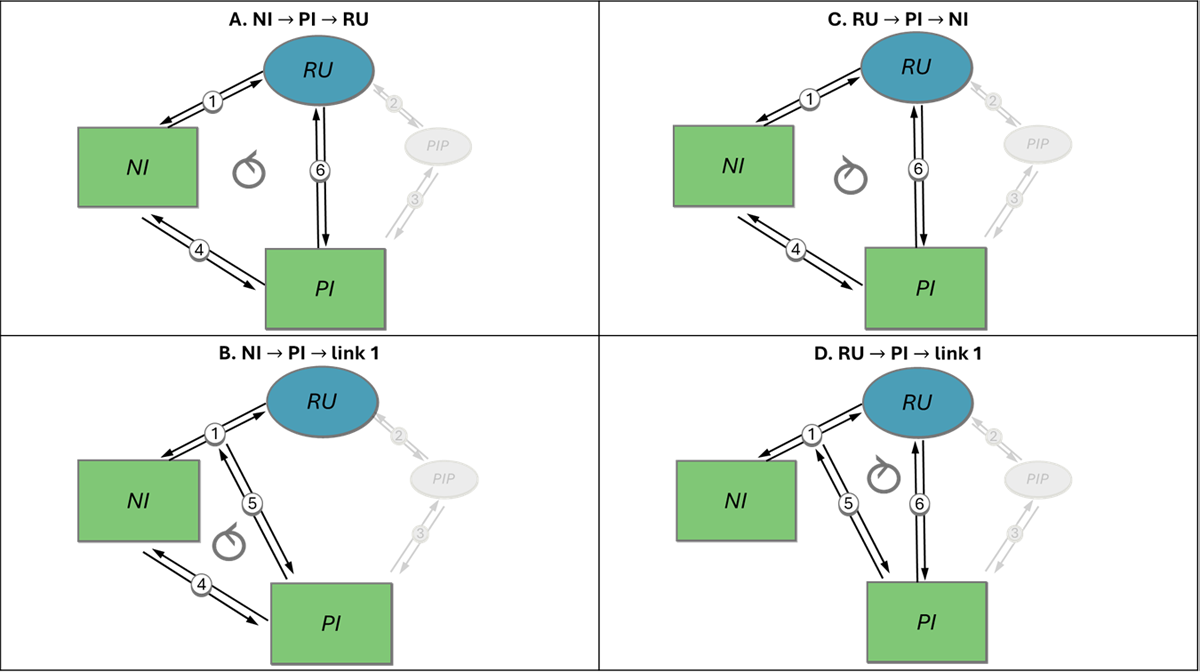
Figure 3
Secondary dilemma system diagrams.
4.2.1 Counter-clockwise dilemmas
These dilemmas often stem from LNT-related challenges. For example, in Alaska, differentiated harvest rules for First Nation and recreational fishers—based on their distinct impacts on salmon stocks—triggered conflict over fairness, a Type A dilemma (Nguyen et al., 2016). Here, identity-based heterogeneity is both a policy target and a source of social tension.
Heterogeneity can be instrumental in determining system outcomes, whether or not it is targetable by policy. At NHT, trail closures after bear sightings disproportionately reduce U for non-locals, who value bear viewing more (Kubo & Shoji, 2016). In this case, differentiating information or rules by local status could improve outcomes. At Lake Superior, however, weather alerts disproportionately deter older and lower-income resource users (McCreary et al., 2019). These sociodemographic characteristics lead to differentiated outcomes but are not an obvious policy target. However, the Minnesota Department of Natural Resources—whose mandates include providing information and technical assistance—could provide gear or promote low-cost adaptation strategies—interventions that would be especially beneficial to older and lower-income resource users—to all Lake Superior recreators.
4.2.2 Clockwise dilemmas
Clockwise dilemmas often arise when interventions to support resource users—especially in CGT or HOP contexts—lead to natural infrastructure degradation. For example, creating ski trails or installing climbing routes involves directly modifying natural infrastructure (Type C) (Bomanowska et al., 2014; Carello et al., 2018), while building marinas increases resource user pressure on natural infrastructure by facilitating the spread of aquatic invasive species (Type D) (Bomanowska et al., 2014; Martínez-Laiz et al., 2019).
Clockwise dilemmas can also intensify HOP. At SASD, the erosion of legacy ATV norms by newcomers led to increased resource user harm (Hughes & Paveglio, 2019). Similarly, long-standing tensions between hikers and bikers at Cairngorms caused bikers to “disengage” and abandon their courteous use norms, degrading all resource users’ experiences (Brown, 2016). These cases illustrate how a collective action feedback loop that mediates or prevents some primary dilemma might be “hidden” to managers until an exogenous or endogenous force transforms norms and thus the nature of the clockwise feedback, rendering it problematic.
5. Discussion
This section identifies cross-cutting processes in recreation systems and explores when and why they break down. We describe the roles of resource user heterogeneity and dilemma visibility in shaping management dilemmas, then examine how system attributes influence the feasibility and effectiveness of potential management interventions.
5.1 Common processes and where they break down
The core feedback in recreation systems is that resource users access and get U from natural infrastructure along link 1. Accordingly, the four primary dilemmas exhibit symptoms of a classic “open access” dilemma in which (recreation) externalities are not managed. Externalities in open access systems tend to be managed with the addition of public infrastructure elements that work through links 4, 5, and 6. The primary dilemmas reflect breakdowns in the resource user-natural infrastructure interaction across extractive and non-extractive recreation modes. For example, LNT occurs in both hunting and hiking contexts, while HOP can manifest as disease transmission or interpersonal conflict. Thus, managers could benefit from studying how dilemmas arose and were addressed across systems that look different from their own but that faced the same dilemmas.
Two trends are especially useful for diagnosing and addressing these intermodal dilemmas: 1) resource user heterogeneity often drives or amplifies dilemmas, and 2) managers can only address dilemmas they can see. We unpack these themes below.
5.1.1 Resource user heterogeneity
Resource user heterogeneity—differences in recreation mode, values, knowledge, culture, or adaptability—can generate externalities by fueling conflict, reducing empathy, and complicating management. For example, tensions between First Nation and recreational fishers (Nguyen et al., 2016) or between legacy and newcomer ATV riders (Hughes & Paveglio, 2019) illustrate how differing values and norms can escalate dilemmas. Vulnerable groups, such as older or lower-income recreators (McCreary et al., 2019) or underserved immigrant communities (Höglhammer et al., 2019), may also be disproportionately affected by shocks or excluded from recreational benefits.
Targeting sources of resource user heterogeneity—when possible—can pose a significant challenge. For example, swimming ability and knowledge of sandbar dynamics—which loosely correlate with local status—affect drowning risk for sandbar walkers, but enforcing access bans only for non-locals would be impractical (Gstaettner et al., 2017). Even when policy can be tailored, other latent sources of heterogeneity may hinder efficacy. On the Fraser River, fishing rules are differentiated by the source of tension (indigenous status), and therefore raise new concerns about fairness that perpetuate inter-group violence (Nguyen et al., 2016).
Heterogeneity also shapes the distributional outcomes of management interventions. At NHT, non-locals who value bear sightings more are disproportionately affected by trail closures (Kubo & Shoji, 2016). Recognizing these asymmetries is essential for equitable and effective management.
5.1.2 Dilemma visibility
Even visible heterogeneity may be overlooked if linked to an invisible dilemma. For example, had managers not noticed the underrepresentation of immigrant resource users at WBR (i.e., if CGT had remained invisible), they might not have recognized cultural characteristics (visible heterogeneity) as relevant policy targets (Höglhammer et al., 2019). Managers can only act on visible dilemmas, so understanding what determines visibility is critical. We discuss how three factors—monitoring capacity, speed of emergence, and presence of mediating feedbacks—drive visibility in the following subsections.
5.1.2.1 Monitoring capacity
Dilemma visibility is shaped by monitoring capacity, which depends on funding, management mandates, and system characteristics. In the United States, recreation funding has not kept pace with rising demand, limiting managers’ ability to detect emergent dilemmas (Watkins, 2019). Funding and management mandates are determined by public infrastructure providers, meaning sudden or sweeping changes in administrative priorities could serve as an external shock to public infrastructure, potentially complicating the management of these already complex dilemmas.
Agency mandates also determine what gets monitored. Agencies with multi-use mandates, like the US Bureau of Land Management (BLM) or Japan’s Ministry of Environment, monitor both resource user fulfillment (link 6) and natural infrastructure integrity (link 4). Accordingly, cases featuring those agencies reflected efforts to balance conservation with access (Kubo & Shoji, 2016; Spaul & Heath, 2016). In contrast, the Yunnan Province Forestry Bureau’s sole conservation mandate led to blanket hunting bans with little consideration of the incentives that subsequently perpetuated illegal hunting (Chang et al., 2017). These cases illustrate that mandates can obscure existing dilemmas and prevent anticipation of dilemmas that may emerge from management interventions.4
An example of sudden shifts to mandates and resources impacting monitoring capacity relates to the U.S. federal government’s restructuring of priorities beginning around 2024. The Department of the Interior (DOI), which houses several agencies that manage recreation systems (e.g., BLM, National Park Service) maintained a relatively consistent workforce from 2016–2024. In 2025 and 2026, however, the number of DOI employees fell by 5% and 14%, respectively (U.S. Office of Personnel Management, 2026). At the same time, implementation of the 2025 EXPLORE Act expanded BLM’s monitoring responsibilities, including requirements to conduct comprehensive federal recreation resource inventories, modernize data systems, streamline permit administration, and improve interagency coordination to manage visitation and congestion (U.S. Bureau of Land Management, 2025). This combination of reduced staffing and expanded monitoring mandates illustrated how shifts in political-institutional priorities can simultaneously constrain and complicate agencies’ abilities to detect emerging dilemmas.
System characteristics matter too. Expansive areas with innumerable entry points like Miscou Island are harder and more expensive to monitor than, for example, narrow beaches with single entry points (Burger & Niles, 2014; Hogan et al., 2021). In such cases, resource user-enforced norms can be a cost-effective substitute for centralized monitoring and enforcement efforts.
5.1.2.2 Speed of emergence
Both fast and slow-emerging dilemmas pose unique challenges for detection. Sudden, probabilistic shocks—like pandemics, coral bleaching events, or the release of new technologies—are hard to predict, but can have severe impacts (Pereira et al., 2021; Weijerman et al., 2018). Despite this uncertainty, SESs must be resilient to sudden shocks. Carpenter et al. (2015) show that managing for outcome consistency can undermine an SESs adaptive capacity, and thus resilience. Therefore, managers should invest in diverse tools to prepare for uncertain futures (Anderies, Mathias, et al., 2019).
Slow-emerging dilemmas may not show symptoms until a tipping point is reached. At SASD, HOP emerged gradually as newcomers eroded legacy norms (Hughes & Paveglio, 2019), while at Cairngorms, repeated negative encounters with hikers led bikers to “disengage” and adopt myopic use norms (Brown, 2016).5
Consistent monitoring and data-collection can inform models designed to anticipate or detect slow-emerging dilemmas. Forward-looking behavioral models (e.g., Jungers et al., 2023) and bioeconomic models that integrate resource user behavior and natural infrastructure dynamics (e.g., Lee et al., 2017; Massey et al., 2006) allow managers to explore how systems might respond to exogenous shocks or endogenous feedbacks and interventions. Recent work emphasizes incorporating resource user heterogeneity in behavioral models, which is especially important for recreation contexts (Fenichel & Abbott, 2014; F. D. Johnston et al., 2010).
5.1.2.3 Mediating feedbacks
Some dilemmas remain hidden due to stabilizing—but equally invisible—mediating feedbacks, often rooted in collective action. These informal agreements help resource users mitigate their impacts on natural infrastructure or each other. For example, mountain bikers in Cairngorms and legacy ATV riders at SASD once upheld responsible use norms (Brown, 2016; Hughes & Paveglio, 2019). In both cases, those norms delayed the onset of HOP but were vulnerable to erosion by exogenous shocks (i.e., new ATV riders and new technology) or endogenous feedback loops (i.e., repeated negative encounters with hikers). Understanding how such feedbacks arise and dissolve is key to identifying hidden dilemmas and avoiding unintended consequences from interventions.6
5.2 A portfolio of interventions
Managers’ disciplinary backgrounds and mandates shape their intervention preferences. While natural scientists or conservation-focused managers may favor link 4 interventions (e.g., habitat restoration, culling invasive species, etc.) or link 5 interventions designed to protect natural infrastructure (e.g., patrolling no stopping zones), social scientists or recreation-focused managers likely prefer link 6 behavioral interventions (e.g., gear restrictions) and “nudges.”7 This section outlines when different intervention types may be most effective.
5.2.1 Link 4: Modify natural infrastructure
Link 4 interventions directly modify natural infrastructure and include installing hard human made infrastructure to deter harmful behaviors (e.g., putting debris on satellite camp pads), reversing degradation (e.g., replacing eroded soil at official camp pads), and enhancing resilience (e.g., supporting overfished species through pollution remediation).
We identify two insights about link 4 interventions. First, they often trigger clockwise secondary dilemmas (e.g., grooming ski trails or installing climbing rings led to degraded natural infrastructure). Accordingly, managers must consider how resource users will perceive and respond to any changes to natural infrastructure. If interventions designed to redirect resource user efforts aren’t binding or lack buy-in, they may fail. For example, beachgoers in Pará ignored spaced umbrellas and tables (hard human made infrastructure) meant to encourage distancing (Pereira et al., 2021).
Second, even minor modifications can degrade natural infrastructure. For instance, the managers who installed marinas in the Mediterranean Sea or who groomed ski trails at Cucumber Gulch certainly did not intend the invasive species incursions that followed their actions (Carello et al., 2018; Martínez-Laiz et al., 2019). Data collection and modeling can help anticipate such unintended outcomes.
5.2.2 Links 5 and 6: Mediate the resource user – natural infrastructure feedback
Link 5 and 6 interventions aim to limit resource user impact on natural infrastructure by limiting access or intensive use (i.e., partially enclosing the commons), restricting technologies, or separating resource users from vulnerable natural infrastructure.
Partial enclosure of a recreational commons can involve limiting resource user quantity, pricing recreation, or limiting individual resource user’s impacts. Quantity-based interventions may be direct (e.g., harvest caps, access quotas) or indirect (e.g., limiting parking or access modes, as in Pereira et al. (2021)) and come with their own set of challenges. For instance, first-come-first-serve systems may allocate access inefficiently, favoring those with easier access over those who get more U from access (Holzer & McConnell, 2014). Tradable harvest tags (e.g., Chong et al., 2024; R. J. Johnston et al., 2007; Jungers et al., 2023) can address this access-U mismatch.
Price-based interventions include congestion pricing, access fees (Holmes & Englin, 2005; Richer & Christensen, 1999), or per-unit fees on intensive use (Jungers et al., 2023). Economists have long favored these interventions for the theoretical efficiency gains that come from rationing resources to those with the highest marginal value (Holzer & McConnell, 2014). However, price-based interventions can run up against issues of political palatability or equitable access.8 System-specific models can help managers assess feasibility and fairness.
Technology restrictions—which limit an individual resource user’s pressure on natural infrastructure—are common in extractive recreation (e.g., barbless hook rules, magazine limits), and increasingly in non-extractive contexts (e.g., e-bike bans) (Mitterwallner et al., 2021). However, these and other policies meant to limit individual impact (e.g., daily harvest limits in recreational fisheries) do not cap total impact, and may need to be paired with price- or quantity-based access restrictions to effectively limit pressure on natural infrastructure (Cox et al., 2002). Moreover, high-tech users are not always the most impactful. For example, Spaul and Heath (2016) found that pedestrians disturbed nesting eagles more than ATV riders. Therefore, recreation managers considering technology restrictions should carefully consider whether such policies will be effective given the resource user and natural infrastructure attributes of their systems.
Finally, managers may use hard human made infrastructure or soft human made infrastructure to separate resource users from vulnerable natural infrastructure. For instance, the New Jersey Department for Environmental Protection maintains a fence around key habitat for migrating shorebirds in the Brigantine Natural Area (Burger & Niles, 2014), and hunting in ecologically-important protected areas is illegal in Xishuangbanna (Chang et al., 2017). However, these interventions require buy-in or enforcement. In Xishuangbanna, hunters disregard bans and use information-sharing to avoid detection. Link 6 strategies, discussed next, may help build compliance.
5.2.3 Link 6: Appeal to resource users
Link 6 interventions influence resource user behavior through information, incentives, access restrictions, and gear restrictions. These strategies can improve compliance and equity, but their effectiveness depends on message design and context.
Information campaigns can raise awareness and promote safer or more sustainable behaviors. For example, McCreary et al. (2019) suggest providing adaptation support to retain older and lower-income resource users at Lake Superior, while Martínez-Laiz et al. (2019) recommend educating Mediterranean boaters about invasive species to encourage proper hull cleaning. However, information alone may be insufficient, especially when behavior change is costly. In such cases, pairing education with incentives (e.g., subsidies for hull cleaning or fines for noncompliance) may be necessary.
Cognitive dissonance can undermine information campaigns. At Mersey Point, for example, even weak swimmers rationalize risk by blaming drownings on others’ poor skills. Therefore, Gstaettner et al. (2017) suggest using counter-narratives (e.g., stories of strong swimmers drowning) to improve message salience.
Narratives and information can also foster empathy between resource user groups (Brown, 2016; Nguyen et al., 2016). However, to avoid unintended consequences, managers should survey resource users or involve them in message design. For example, Hӧglhammer et al. (2019) suggest consulting with resource users to draft multilingual, culturally resonant outreach at WBR, while Hughes and Paveglio (2019) recommend involving legacy users in governance at SASD. However, co-management must be approached carefully. In Xishuangbanna, using local informants for enforcement backfired, incentivizing retaliation. Instead, Chang et al. (2017) propose transferring hunting governance from national agencies to local villages to improve compliance.
While not addressed in our cases, narratives of care and stewardship and targeted information can also be used to encourage resource users to undertake conservation initiatives. For example, volunteers commonly preserve natural infrastructure used for recreation by cleaning up trash or maintaining trails (Propst et al., 2003). If system managers understand the motivations that might drive these volunteer actions, they can use information via link 6 to stimulate volunteer maintenance of recreational systems via link 1. Similarly, recreators can volunteer as citizen science observers, collecting information about the natural infrastructure through link 1 and sharing that knowledge with resource management agencies through link 6 (Rowe et al., 2021).
Finally, public infrastructure may limit access to protect vulnerable, high-demand natural infrastructure. In extractive contexts, this often involves licenses or quotas. In non-extractive settings, gate fees or visitor caps are common (e.g., at U.S. National Parks). Few cases in this analysis discussed limiting extensive use. This omission may suggest an implicit assumption that resource users should not be prevented from accessing natural infrastructure, whether for reasons of ethics or political palatability. Nevertheless, its widespread application in practice suggests access rationing remains a key tool—albeit one that must be balanced against equity and political feasibility.
6. Conclusion
This paper offers an initial exploration of the dilemmas faced by managers of nature-based recreation. These dilemmas and their interventions do not exist in isolation but are embedded within complex SES. As such, they are part of a dynamic network of feedback loops in which dilemmas and interventions co-evolve. While systems may reach a dynamic equilibrium, predicting the nature of that equilibrium (i.e., its processes and outcomes) is inherently difficult.
Our findings primarily relate to “nuisance” dilemmas, meaning dilemmas that are not central to peoples’ livelihoods but that can significantly reduce welfare over time. This attribute makes these dilemmas broadly applicable to other open-access systems beyond recreation. The public spaces in which we live much of our lives are owned in common, meaning we face these types of dilemmas daily. These dilemmas are difficult or impossible to regulate due to high transaction costs borne of individual heterogeneity or limited management capacity. For example, bicyclists and motorists on a shared road, skateboarders and parents of young children at a public park, or neighbors with different preferences for lawn aesthetics may frequently experience disutility from each other’s actions. These externalities are minor in isolation but are numerous enough to wear on us. Because each externality occurs within distinct systems with unique norms and regulatory capacities, it’s useful to envision them as feedbacks within their socio-ecological contexts. This perspective can help public infrastructure (e.g., local governments, HOAs, community groups) assess whether an institutional equilibrium is possible in their particular case (i.e., better understand the root causes and avoid creating secondary dilemmas when addressing them.)
As a descriptive analysis, this study cannot make normative prescriptions. To move toward actionable insights, future work should focus on modeling efforts that incorporate full system feedbacks and can thus generate system-specific recommendations. These models will be increasingly important as the endogenous dynamics and exogenous shocks that managers face continue to evolve.
Effective modeling will require high-quality data and well-supported assumptions about system characteristics. But more than that, these modeling efforts should incorporate an empirically informed understanding of how different interventions tend to succeed or fail, as well as the types of secondary dilemmas they may trigger. The archetypes identified provide a foundation for such efforts, but further comparative case analysis is needed to refine these archetypes and enhance their value for both researchers and practitioners.
Additional File
The additional file for this article can be found as follows:
Notes
[1] For example, hiking often occurs on public land and is subject to congestion dilemmas. Conversely, the private nature of organized team sports usually precludes social dilemmas.
[2] Because our objective was to identify social dilemmas, we coded only cases exhibiting symptoms of failure. This choice necessarily excludes robust or well-functioning systems, which may themselves offer important lessons. Future work should examine those successes to build upon the lessons learned in this study.
[3] Furthermore, if resource users get U from the experience of hunting or fishing, not from successful harvest, their extractive pressure may persist even as natural infrastructure degrades (Chang et al., 2017).
[4] Agencies with multi-use mandates are sometimes not given funding proportional to their mandates, which also impacts dilemma visibility.
[5] This “disengagement tipping point” is analogous to sudden state-shifts in natural infrastructure, such as eutrophication in shallow lakes (Carpenter et al., 1999; Scheffer et al., 2001).
[6] For a discussion of the conditions under which these collective action arrangements emerge and erode, see Ostrom (1990) and others.
[7] “Nudge” refers to the concept from behavioral economics where managers use policy or information to alter peoples’ decision making by tweaking their choice sets (Thaler & Sunstein, 2003, 2009).
[8] For a discussion of the efficacy-equity trade-off in pricing environmental goods, see e.g., Baranzini et al., 2017; Goulder & Parry, 2008; Mansur & Olmstead, 2012.
Acknowledgements
The authors would like to thank two anonymous reviewers for contributing constructive feedback on earlier drafts. Their suggestions significantly improved the clarity and impact of the final manuscript.