
Introduction
Practical knowledge is personal and acquired through participation in practice, which also makes it co-constructed by other participants (Oğuz & Şengün, 2011). Although personal, practical knowledge is not private. Traditionally modelled as a public good, it faces social dilemmas leading to depletion. This study aims to improve the understanding of what drives cooperation in practical knowledge provision and development.
The provision of practical or tacit knowledge (know-how) has gained traction in the knowledge management literature (Venkitachalam & Busch, 2012).1 While this work offers insights into individual incentives and intra-firm knowledge sharing, it largely assumes managerial control (Holste & Fields, 2010). This article instead examines the shared governance of practical knowledge within a knowledge commons perspective.
We focus on makerspaces, defined as “informal sites for creative production in art, science, and engineering where people (…)blend digital and physical technologies to explore ideas, learn technical skills, and create new products” (Sheridan et al., 2014, p. 505). Activities in makerspaces include crafting, woodworking, and engineering, with or without digital technologies (Martin, 2015), and are performed by actors ranging from skilled professionals to novices of all ages. Beyond tangible outputs, a key outcome is shared knowledge through peer learning (Mersand, 2021). A substantial literature examines makerspaces, focusing on peer learning, learning by making, communities of makers, and their objectives (Mersand, 2021). There is also a rich scholarship on knowledge commons in domains such as competition policy, intellectual property regimes and drone technology (Goodman et al., 2025), blockchain (Murtazashvili et al., 2022), and innovation (Potts, 2019), and the evidence base continues to grow with case studies spanning open-source hardware development (Carpentier, 2021) and participatory guarantee systems (Lemeilleur & Sermage, 2020), among others. However, the existing literature centres predominantly on knowledge resources that are, at least in principle, codifiable — design files, standards, software code, or procedural rules — and cross-domain comparative work on sustainability mechanisms remains less developed than the case-study repertoire itself.2 Practical knowledge grounded in bodily skill and tacit knowing (Polanyi, 1966/2009), the kind that is difficult or impossible to inscribe in conventional artefacts, physical or digital, has received comparatively little attention as a commons resource. To the best of our knowledge, this dimension remains underexplored.
Therefore, studying the collectively developed institutional arrangements helps unveil the functioning of a makerspace community, providing a better understanding of why and how social dilemmas that threaten the production of practical knowledge are tackled through collective action. As such, the following research question is addressed: How and through which institutional arrangements are knowledge commons in makerspaces developed, challenged and sustained? As we will show, the central challenge in this case is not the willingness to share practical knowledge but the provision of the infrastructures — projects, communication channels, and governance structures — that make such sharing possible, a second-order social dilemma compounded by the community’s own culture of informality.
The first area of contribution of this study is that of knowledge commons, enriching the repertoire of case studies. Secondly, this study adds to the makerspace literature, connecting it with knowledge commons and, through such a prism, exploring the institutional arrangements in communities of makers, which can help both future researchers and makers themselves in understanding how sharing of practical knowledge occurs in such spaces. Thirdly, it enriches the corpus of knowledge management literature by exploring community-based, less top-down modes of practical knowledge governance.
Literature Review
Practical Knowledge: Basic Definitional Aspects and Shared Practices within Makerspaces
Borrowing from practice theory, practical knowledge originates in shared practices through participation and engagement with other individuals in the performance of an activity (Geiger, 2009; Schatzki, 2005). Although we perceive the world through our bodies, we create its meaning through interaction with other bodies and the world itself (Schatzki, 2005). Given that practical knowledge comes from participation in a specific activity, it is also highly contextual (Venkitachalam & Busch, 2012, Polanyi, 1966/2009). This context is then constructed by the physical and social world. The formation of practical knowledge thus needs to be understood as “mediated both by interactions between people and by arrangements in the world…knowledge is no longer even the property of individuals, but instead a feature of groups, together with their material setups.” (Schatzki, 2005, pp. 20–21).
Activity theory calls the social context of learning a “social scaffolding” (Bevan et al., 2015, p. 110), an environment where individuals intentionally and unintentionally inspire and support one another (Bevan et al., 2015). In the context of makerspaces, the social aspect of learning is not only a theoretical predisposition to knowledge creation and acquisition, but it is cited as one of the most significant advantages of shared workshops (Sheridan et al., 2014; Bean et al., 2015; Mersand, 2021).
The combination of different skills and approaches found in maker spaces promotes innovation and allows for multiple vantage points or sources of inspiration for designing or problem-solving. Makerspaces merge the more structured practice environments (workshops, trainings) and informal individual or community activities. Thanks to such amalgamation of approaches, makerspaces are potent to enable systematic development of practical knowledge, but, at the same time, allow for application and reconfiguration of the knowledge through the informal means of shared community practices, becoming communities of practice (Sheridan et al., 2014). Within communities of practice acquiring knowledge is constant through social activities instead of being left only to dedicated learning (Sheridan et al., 2014; Wenger, 2011). Such social activities may be very mundane or microscopic: asking someone for help, a short discussion about a possible solution, or just mere observation. They are the place of informal social scaffolding.
Practical Knowledge Commons Resource System
Practical knowledge resides in people and is constructed by people through their participation in shared practices. Yet, individuals do not necessarily have all the incentives to participate in a knowledge provision process, even if it benefits all.
First, participation costs are immediate, while the benefits of the generated knowledge may come much later (Van Lange et al., 2013). Second, if the community’s accumulated knowledge is accessible without our participation, the motivation to contribute decreases further, since we can benefit from the shared knowledge without any cost, creating a social dilemma (Hess & Ostrom, 2007).
However, as Kealey and Ricketts (2021) argue, knowledge cannot be accessed by anyone freely due to its tacit nature. In their study of scientific knowledge, they contend that access to scientific knowledge is not open for all, as in the case of pure public goods, but only for those who are knowledgeable enough to understand or use the particular scientific finding. When the scientific knowledge pool reaches a certain volume, the benefits for the individual contributor surpass the costs of the contribution, changing the payoff structure of the public goods game into a pure cooperation game. Nevertheless, before reaching such a threshold, the public goods social dilemma pertains, as the immediate private benefits will be lower than the private costs for the contributors. The challenge for governing contribution goods is therefore incentivising contribution until the threshold is reached (Kealey and Ricketts, 2021).
As Madison et al. argue (2019, p.12), “shared infrastructure appears to be often central to the success of knowledge commons institutions”. Infrastructural resources serve as inputs into the production of knowledge goods. Given their relative nonrivalry and positive externalities, infrastructural resources are subject to social dilemmas similar to the example of knowledge resources above. Infrastructures don’t have to be roads or railways, but also social constructs such as governance structure, also facing public good social dilemma and a collective action problem: “how to continually generate contributions to coproduce the common pool of knowledge governance and to maintain it over time such that the depletion rate of governance does not systematically exceed the replacement rate of governance” (Lopez, 2021, p.92). The solutions to social dilemmas of shared resource production – common governance structure and communication channels facilitating collective action – are themselves subject to cooperation challenges, called second-order social dilemmas (Ostrom, 2015). Similarly to the scientific knowledge pool, the payoffs for contributing to the construction or maintenance of the governance structure differ with the state of the structure. That brings back the challenge of contribution goods in providing incentives for contribution in the initial stage to offset the immediate private cost-benefit imbalance (Lopez, 2021). Unlike the knowledge pool itself, supporting infrastructures may go unnoticed even when their private benefits surpass the private costs, since ‘we don’t pay much attention to infrastructure resources, because they are conveniently obscure part of the background’ (Frischmann, 2012, p. ix). The public good social dilemma may prevail, even though the real private benefits surpass the private costs.
Infrastructures are not static backdrops to collective action but are produced and transformed through the practices they sustain. Institutional and legal infrastructures evolve endogenously: rules and interpretations are jointly shaped by the interactions they enable and constrain (Dekker & Kuchař, 2024). Conventions exemplify this dynamic as shared cognitive infrastructures that stabilize cooperation while delimiting understanding yet can shift when actors recognize unrealized potentials (Choi, 2021, Dalla Chiesa, 2021). In our makerspace case, we therefore expect looping dynamics, beneficial or detrimental, between the practical knowledge pool and its communication and governance infrastructure.
Operationalization
Governing Knowledge Commons Framework
We adopt the Governing Knowledge Commons framework (GKC, Figure 1) in two ways: first, as a guiding tool for operationalization and data collection, and, second, as a vantage point for analysis of the data.
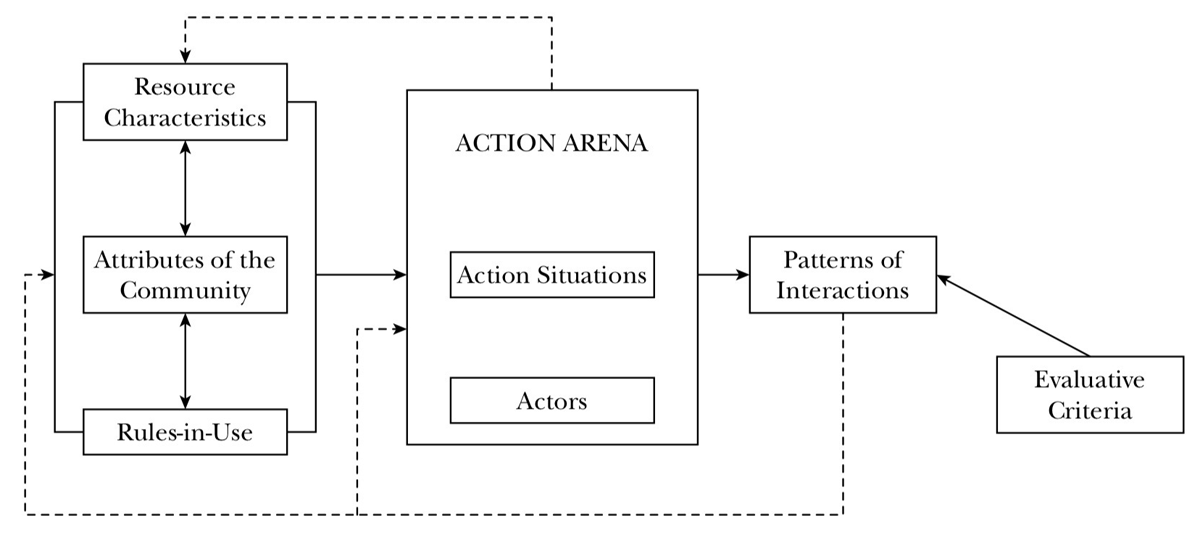
Figure 1
The GKC framework views knowledge commons as governance arrangements established by a community for the institutionalized sharing and management of knowledge resources through formal and informal rules (Frischmann et al., 2014; McGinnis, 2011).
The focal point of the GKC framework is the action arena, where individual actors interact in specific situations. The action arena is the physical and metaphorical place where individual participants make decisions based on the physical properties, community characteristics, and rules that construct the situation. Results of those decisions – outcomes of particular arenas are then aggregated in patterns of interactions and affect the contextual variables and thus change parts or the entirety of the resource system (Frischmann et al., 2014).
Interactions between participants are defined by participants’ positions, available actions, information, potential outcomes, degrees of control, and associated costs and benefits (Figure 2).
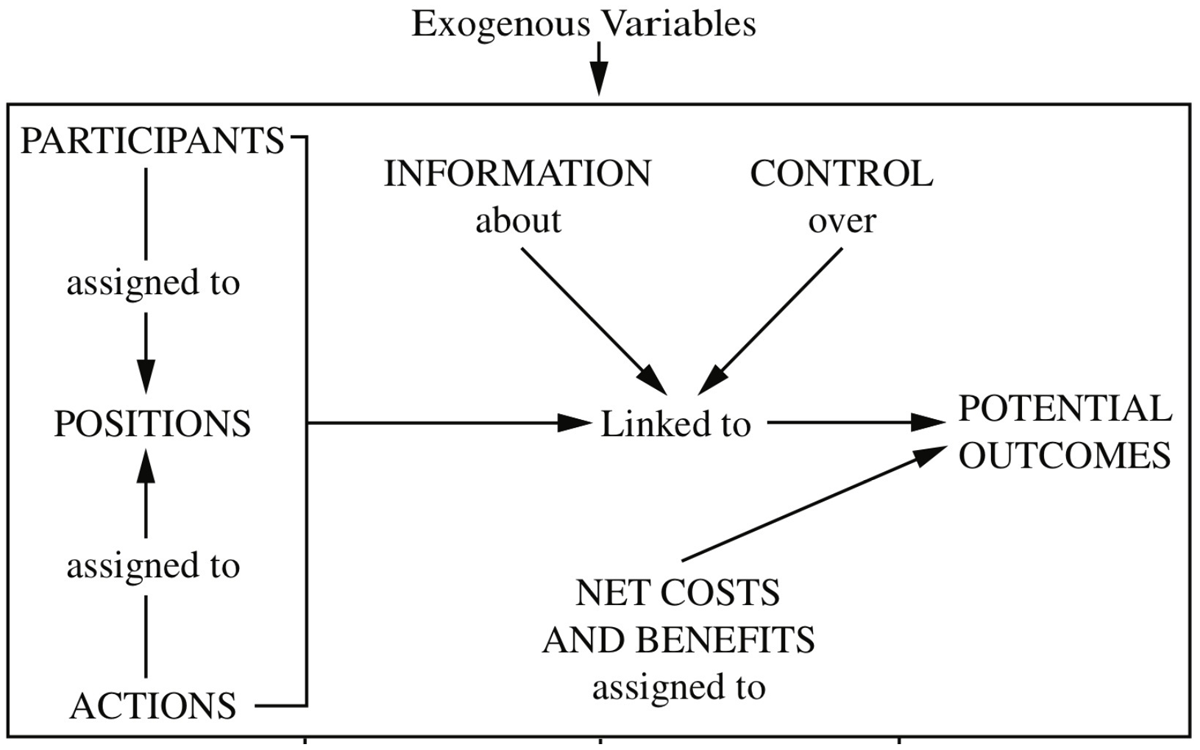
Figure 2
(Adapted from Ostrom, 2005, p. 33).
We focus on the rules-in-use category of the GKC framework to analyse the institutional arrangements of the practical knowledge commons. The rules-in-use contain the particular shared constructed rules. Seven broad categories of rules follow the structure of the action situation. These are position, boundary, aggregation, information, payoff, choice, and scope rules (Figure 3, Crawford & Ostrom, 2005).
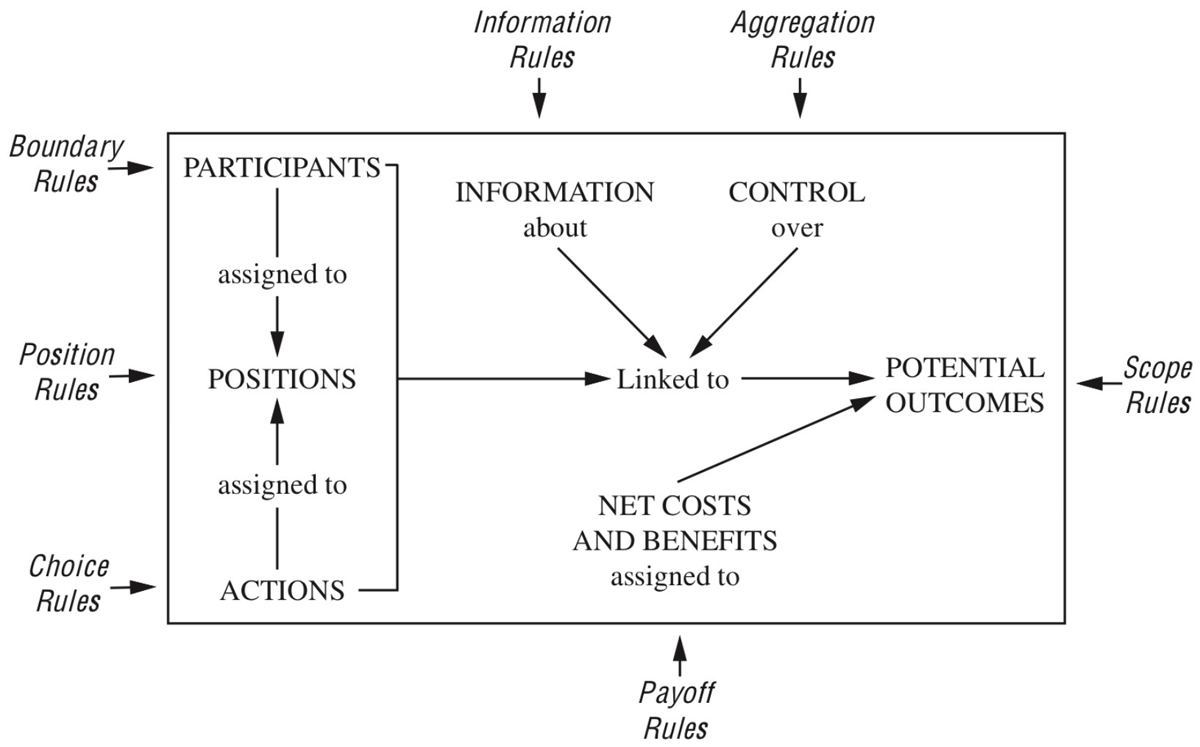
Figure 3
We adopt Cole’s (2017) distinction between rules-in-form (formally enacted regulations) and rules-in-use (the agreed-upon prescriptions that actually guide behaviour), since in makers’ communities formal and working rules are expected to diverge with consequences for coordination.
There are three primary levels of action arenas, each with distinct rules-in-use and rules-in-form: operational, collective-choice, and constitutional (Figure 4, Ostrom, 2005). The operational level concerns direct interactions between actors and the resource system and is governed by rules created at the collective-choice level. The constitutional level defines who can participate in collective-choice processes and thus who is entitled to make operational rules. Resource characteristics and community composition may differ across these levels (Ostrom, 2005; Ostrom & Hess, 2007).
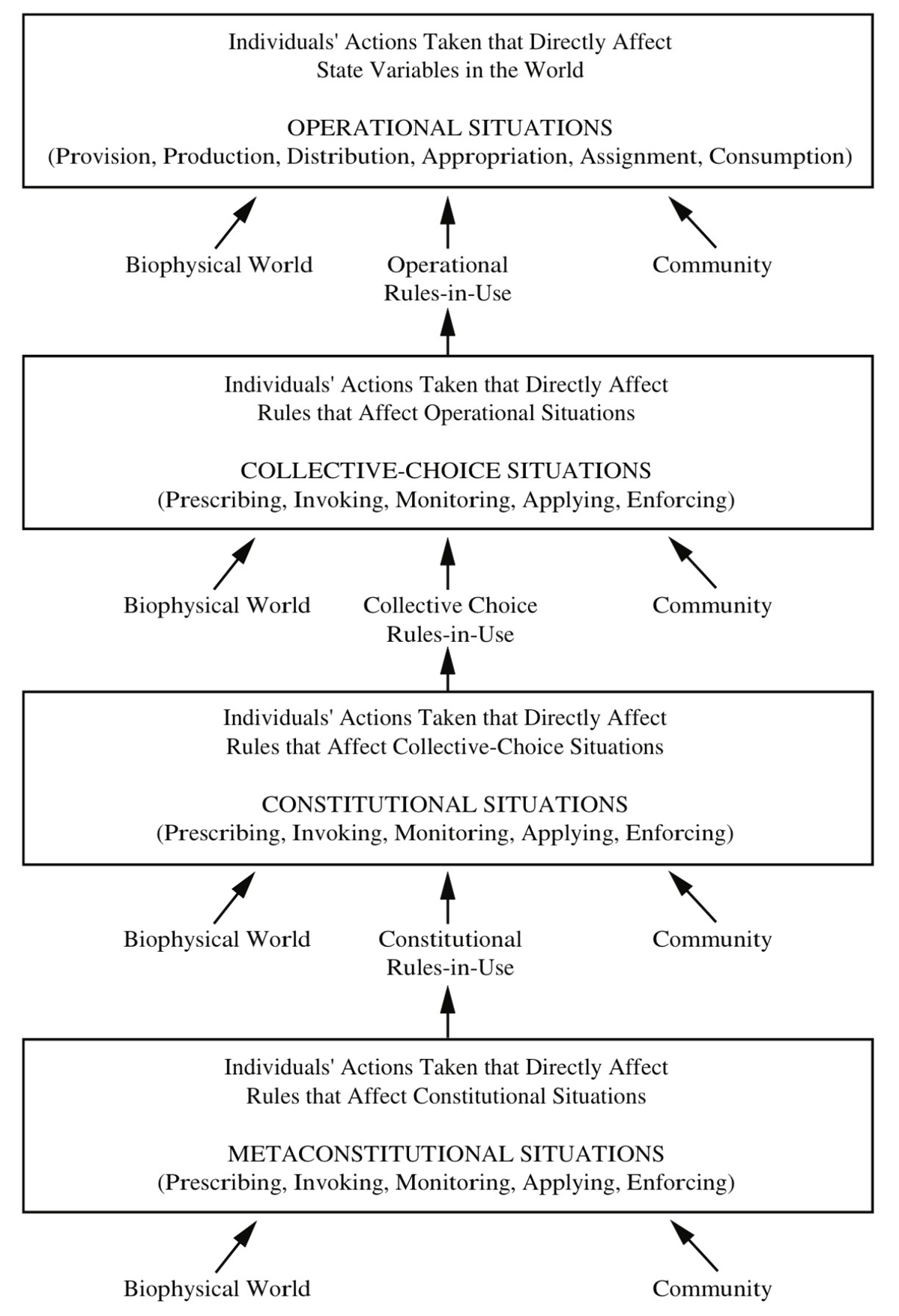
Figure 4
Beyond vertical linkages across levels, action situations may also be horizontally connected within the same level. This is captured by the concept of a network of adjacent action situations (McGinnis, 2011), which extends the operational–collective–constitutional axis. Two action situations are adjacent when outcomes in one influence the rules governing another. As a result, key features of a focal action situation—such as actors, available actions, or evaluative criteria—may be shaped by processes occurring elsewhere. This perspective is particularly useful for maker communities, where actors engage in multiple, interrelated activities that affect the practical knowledge pool without being explicitly oriented toward intentional knowledge production, reflecting communities of practice and informal social scaffolding.
Institutional Design Principles for Sustainable and Resilient Commons
Based on an extensive analysis of natural commons that successfully overcame social dilemmas, Ostrom synthesized a wide variety of specific institutional rules into a set of general design principles that “appear to synthesise core factors that affect the probability of long-term survival of an institution developed by the users of a resource” (Ostrom, 2010, p. 653). The principles presented in Figure 5 reflect the modification proposed by Cox, Arnold, and Tomás (2010), who distinguish between social and ecological conditions for selected principles.
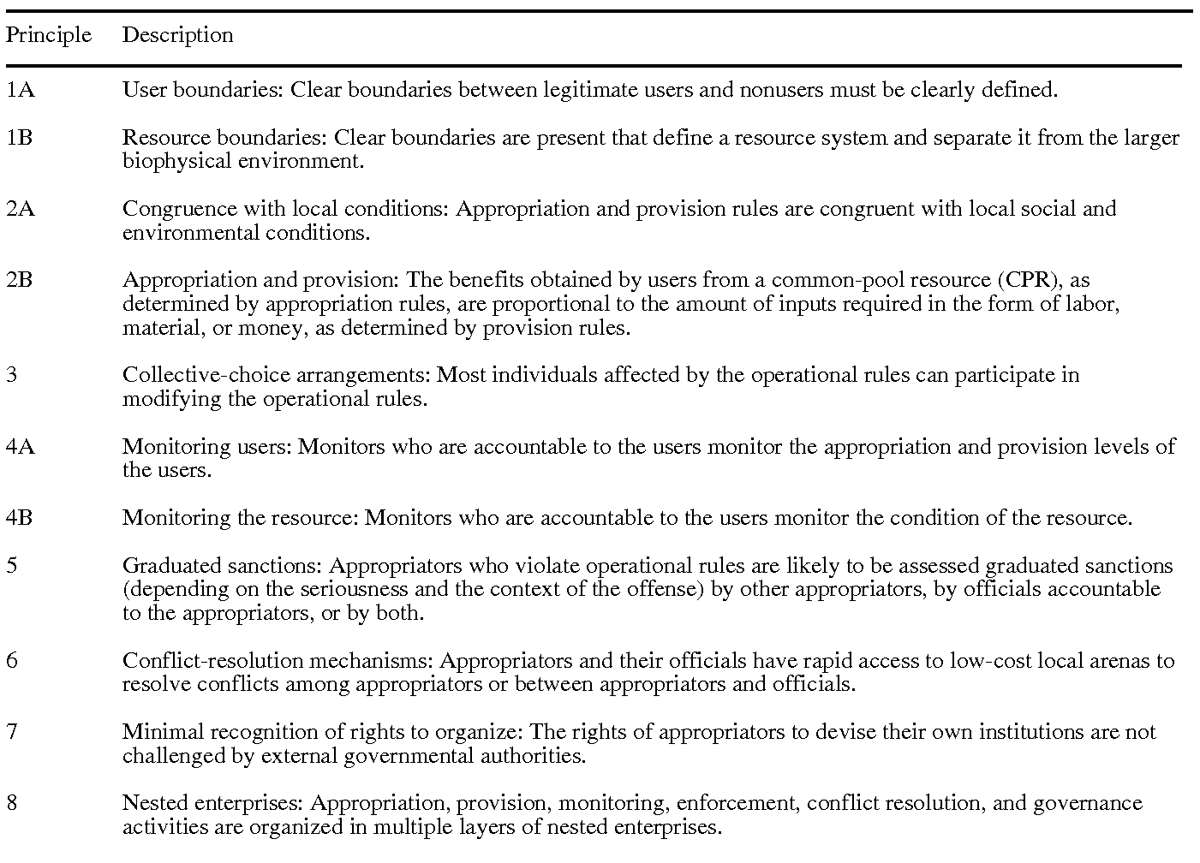
Figure 5
Some of these principles may be less directly applicable to knowledge commons and, in particular, to makerspaces. As Hess and Ostrom note, the design principles are “helpful as a possible place to start an investigation,” while their applicability to complex systems such as knowledge commons remains an open empirical question (Hess & Ostrom, 2007, p. 7). Existing studies nevertheless suggest meaningful parallels.
Research Methods
Makerspace Delft (MSD) was identified through convenience sampling (Bryman, 2016) and purposefully selected as a theoretically relevant case in which community-based knowledge production and self-governance practices are particularly visible, offering a strong empirical fit with the study’s focus on institutional arrangements in knowledge commons as operationalised through the GKC framework. Data were collected through semi-structured in-depth interviews (N = 15). This approach is consistent with prior qualitative research on makerspaces (Bevan et al., 2015; Sheridan et al., 2014; Bean et al., 2015) and knowledge commons (Schweik, 2007; Madison et al., 2019; Ostrom, 2015).
Data were triangulated (Bryman, 2016) with six months of weekly participant observation conducted between February and July 2023. Observation supported contextual understanding of community structure and practices and facilitated rapport with interviewees but did not constitute a primary data source; accordingly, observational material and documents from digital communication platforms are not reported in the results.
Interviewees were selected through purposive sampling (Babbie, 2020), based on membership duration and level of activity. Seven interviewees were current or former Board members; eight had been members for more than one year, while the remainder had joined within the previous year. The sample included 2 women and 13 men, reflecting the gender distribution of the community; gender is therefore not attributed to individual quotes. The median age was 23, and most interviewees were students at Delft University of Technology. The median interview length was 55 minutes.
Interview recordings were transcribed and analysed in Atlas.ti using content analysis, combining deductive and inductive coding approaches (Elo & Kyngäs, 2008). The unit of analysis was the individual interview, and only manifest content was analysed; latent features such as pauses, tone, or body language were excluded. AI tools were used to improve readability and flow in minor parts of the text, with a few instances of structural refinements.
Makerspace Delft – Case Study Context
Makerspace Delft (MSD) was founded in 2020 as an independent initiative by a group of students from Delft University of Technology. It is located in Kabeldistrict, a repurposed industrial complex on the outskirts of Delft (Netherlands) and occupies approximately 75 m² of manufacturing space and 50 m² of collaboration space on an entresol. The space is run by volunteers (“supervisors”), who receive free access to tools and facilities, alongside a subscription model for members who do not participate in maintenance activities.
The main source of funding is provided through grants from Delft University of Technology, making the university the second most important external stakeholder after Kabeldistrict. As of June 2023, the community consisted of 32 active supervisors and 16 active paying members, with supervisors representing 67% of the membership. Supervisors interested in governance form a Board that oversees strategic decisions, coordinates activities, and holds legal responsibility for MSD. Board members also lead task-specific teams, including the Tech Team, PR and Partnerships Team, and Community Team.
Results
As an overview of the findings, Figure 6 presents the IAD frameworks with the main highlights in each dimension.
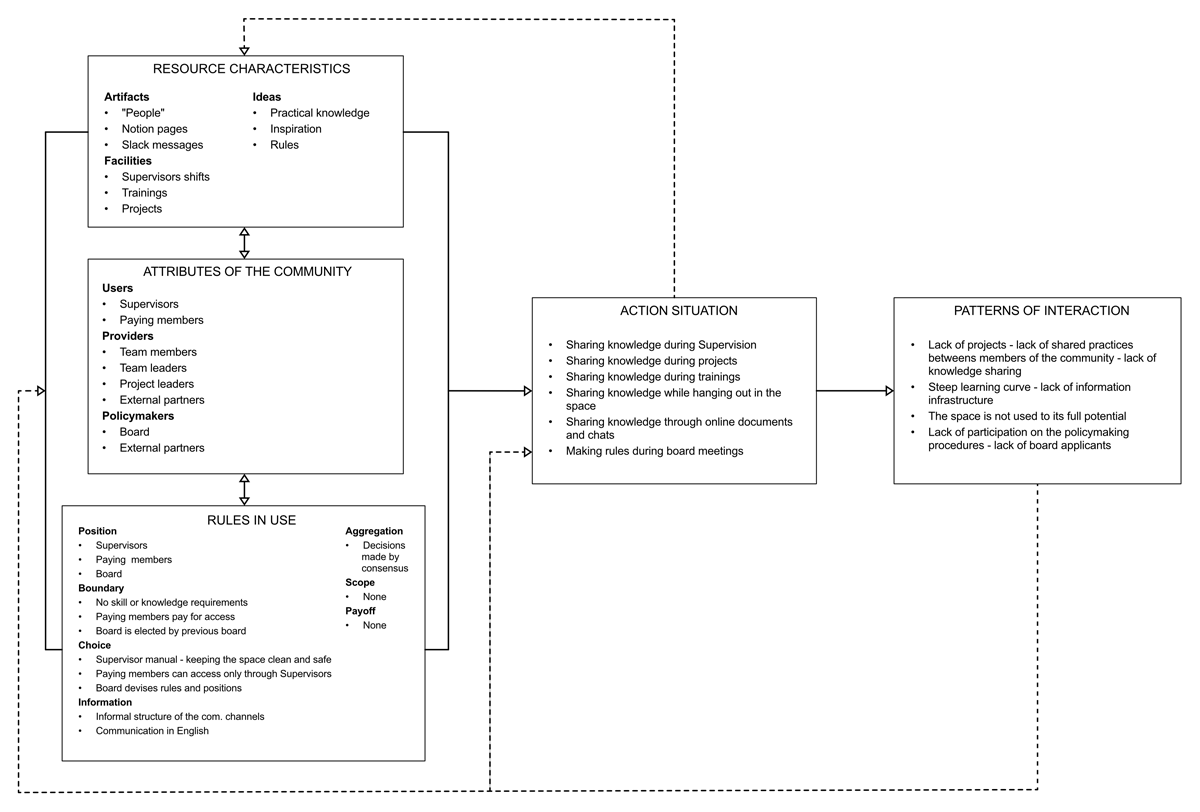
Figure 6
Visual overview of the findings (authors’ elaboration).
Resource Characteristics
Across the interviews, shared knowledge is understood as a collectively maintained, practice-based resource that enables participants to navigate tasks and risks without relying on formal instructions, instead drawing on mutual sense-making, informal explanation, and accumulated experience. One interviewee explains that deciding whether to inquire with supervisors, the tech team, or a general channel “is just something common sense” (Interviewee 13, membership length (ML) < 1 year). Rather than relying on formal rules, they describe a socially distributed sense of “what to do” regarding internal channels and responsibilities.
Shared knowledge also emerges through participation in managerial and organizational practice, where members exchange experience about making things but also about running the space; as one Board member notes, “Figuring out as we go and helping each other.” (Int. 10, ML < 1 year). This is closely linked to safety practices, as experienced members instruct newcomers on equipment use and hazards: “I basically just tell them about soldering stations and trying to eliminate some fire hazards like that” (Int. 4, ML > 1 year).
Members described that practical knowledge is primarily embodied in people and transmitted through practice rather than stored in objects or facilities. When asked about learning tool operation from manuals, one maker stated: “I think specifically for making things in a shop, that [youtube tutorials] wouldn’t work for me because I think a lot of it is the safety concern of physically knowing how the machine works and what sounds mean, what or how to say something if something goes wrong.” (Int. 8, ML < 1 year). Another interviewee emphasized learning through observation of experienced members: “I was afraid with the power tool, so I would be like: Guys, can you do it for me? And then someone would do it and I would see repeatedly how it’s done. And then I became confident.“ (Int. 12, ML > 1 year).
From an analytical perspective, the primary artifacts of practical knowledge are people themselves. Accordingly, the core facilities of the resource system are not repositories or archives but structured opportunities for real-time interaction, such as supervisor shifts, training sessions, and projects, each constituting an Action Arena for knowledge sharing through direct interaction.
Attributes of the Community
The MSD community is characterized by strong social cohesion and intrinsic motivation, high trust, and significant heterogeneity in skills, with informal leadership playing a crucial role in enabling coordination and effective knowledge sharing within an inclusive setting. It consists of students and recent graduates and has grown steadily to approximately 40 supervisors and over 15 paying members. Interviewees consistently described their motivation for joining as extending beyond access to tools to include belonging to a community of like-minded makers. As one participant noted: “I joined mostly because of the community. I was missing an engaging environment at my job and wanted to surround myself with people who are passionate about something” (Int. 6, ML > 1 year). Similarly, incentives for participation include learning new skills and contributing to the community or the space.
Levels of technical proficiency vary widely, ranging from highly experienced members to complete beginners. This heterogeneity creates challenges for knowledge sharing, as it can be difficult to identify members with the relevant expertise for specific practices. At the same time, restricting access based on experience would contradict MSD’s inclusive mission to accommodate a wide range of makers from Delft.
Within the practical knowledge resource system, supervisors and paying members constitute the primary users. Knowledge provision is enabled by team members, the Board, and project leaders, who manage facilities, training, projects, and communication channels. The Board acts as the main policymaker, governing the space both formally and informally through decisions on rules, investments, and activities, while external partners (mainly TU Delft) provide financial and material support.
All interviewees reported the presence of informal leaders within the community. Experienced members, particularly those in the Tech Team, are recognised for their competence and reliability, often acting as consultants and project drivers.
Rules-in-use: Operational Level
Given the size of the MSD community, there are effectively two tiers of action arenas: the operational level, covering most activities, and a combined collective-choice and constitutional level, where formal policymaking occurs through the Board.
The main facilities providing access to rules-in-form are Notion, Slack, and Google Drive, where operational rules are primarily documented. Notion is the dominant repository, containing the Supervision Manual, machine guidelines, and behavioural norms. However, it is not centrally moderated or systematically maintained. Although some basic structure exists, responsibility for updating content is informally delegated to team leaders, without clear expectations. When asked where to find specific rules, most interviewees responded with variations of “somewhere on Notion”, with one comparing the experience to a mining operation: “(…) Notion is like a huge mine where nobody actually knows what is what.” (Int. 2, ML > 1 year).
Most positions within MSD are informal, and more than half were not recognised by at least one interviewee. This lack of clarity complicates orientation within the community, particularly for newcomers seeking guidance or participation in projects.
At the operational level, the supervisor role is the most prominent. Boundary rules are minimal: aside from required safety training, any adult contacting the community can become a supervisor. Interviewees noted that supervisors often “disappear” without notice. Beyond shift-related duties, no further participation in teams, projects, or events is required, and no rewards are attached to supervisory work. Entry rules for team or project leadership are similarly undefined.
The second key operational position is that of paying member. Paying members subscribe to MSD services via a monthly fee, can use facilities during reserved time slots, but are not required to participate in community activities.
Beyond these formal roles, several informal positions exist – team members and leaders, project participants, past Board members, and tool donors – whose recognition and responsibilities vary across the community.
Rules governing projects are sparse. There is no formal process for initiating projects, appointing leaders, or defining scope. Participation is fluid, with members joining or leaving without notice, and projects often lacking clear objectives or timelines. Team and project participation typically adds informal responsibilities to the supervisor role, with the main distinction being access to dedicated Slack channels.
Aggregation rules at the operational level are largely based on consensus, particularly within teams and projects. Although leaders exist, interviewees did not report the exercise of formal authority. Conflicts are rare and resolved informally; there are no formal conflict-resolution mechanisms.
Monitoring and enforcement of operational rules are minimal. Supervisors are not monitored for compliance with the Supervision Manual, resulting in heterogeneous interpretations of responsibilities. While some supervisors actively monitor machine use, others adopt a more passive approach. High levels of trust reduce expectations of opportunistic behaviour but also limit enforcement capacity. As one Board member explained: “We found that in general this stuff isn’t abused. It also takes a while to maintain. And the utility of it is also quite limited because it’s not like everyone checks.” (Int. 7, ML > 1 year). Reluctance to monitor or sanction others is reinforced by close personal ties and the desire to maintain a friendly atmosphere: “You don’t want to be like the boo man that everybody just knows because he tells you to stop, to do something. So can understand how that’s challenging from a personal standpoint” (Int. 4, ML > 1 year).
Rules-in-Use: Collective-choice and Constitutional Level
Formal policymaking authority in MSD rests with the Board, composed of current Board members and occasionally advised by former ones. Board members share many rules with supervisors, including volunteer status and responsibility for space maintenance and safety, but are also subject to specific exceptions. The Board is renewed annually, reflecting the student origins of the organisation. New Board members are selected by the current Board from internal or external applicants, following interviews but without formal admission criteria. As one former Board member recalled: “They’re currently not elected, but (…) interviewed by the last Board and then the past Board and the new Board just discuss until they’re happy with the roles that they’ve come up with. So the roles are fluid.” (Int. 3, ML > 1 year).
Interviewees explained the absence of stricter selection rules by pointing to chronic difficulties in recruiting Board candidates. The Board consists of team managers and a Board Leader, who oversees administration, finances, and legal obligations.
Choice rules are partially formalised: Board responsibilities are listed on the MSD website, and members are expected to attend weekly meetings and emergency sessions. However, absences are handled informally, and responsibilities often shift between Boards. Decision-making occurs by consensus, despite notary documents stipulating majority voting. As one Board member noted: “We could always come to a solution. And for the smaller stuff, you know, we would let John, the team manager, to decide. But nothing was ever so complex where we were so much in disagreement that we had to” (Int. 6, ML > 1 year).
Action Arenas
Based on the data, we conceptualise action arenas as sites where community members share practical knowledge through training, collaborative practice, or impromptu communication. They are supervisor shifts, training sessions, projects, and informal “hanging around” the space.
Supervisor shifts are typically four-hour time slots during which two supervisors ensure the space is open, provide assistance, perform basic maintenance, and intervene in cases of unsafe tool use. Each supervisor holds at least one shift per week. Knowledge sharing during shifts often occurs informally, as one interviewee explained: “I generally share the shift with the same supervisor every time, when we’ve built up this regime that we always talk about our projects and the best way to do this and that.” (Int. 13, ML < 1 year).
Interviewees reported several ongoing and past projects, including building a 3D scanner, refurbishing the kitchen, and participating in a local Makerfaire. However, many noted persistent difficulties in completing projects, often due to overambitious planning: “Because we always get excited and we always want to do too much and then three months later, you’ll only tick like two of the ten boxes and suddenly you have eight more things to do” (Int. 5, ML > 1 year). Of 11 projects mentioned, only four were completed within planned timelines, typically by small groups of highly motivated members. Others stalled or remained incomplete for extended periods. Interviewees linked these outcomes to limited project scaffolding, absence of scope rules, and lack of payoff rules, leaving participation dependent on intrinsic motivation and the presence of a project “driver”.
Knowledge also spreads through simply being present in the space:
“I’d say you’re just at the space. You’ll probably be just messing around with something and trying things out, and then you’re just talking about what project you’re doing, and suddenly you’re talking about what’s the best setting for this thing or what could I do better.” (Int. 13, ML < 1 year).
Patterns of Interaction
In MSD, personal relationships and informal structures function as the primary infrastructure of the community. Practical knowledge is embedded in recognisable individuals, and access to it depends on opportunities for interpersonal interaction- shared shifts, trainings, projects, and presence in the space – rather than on manuals or repositories. Governance similarly relies on interpersonal familiarity and ad hoc negotiation: roles are loosely defined, often unclear to newcomers, and filled based on availability and perceived fit rather than formal procedures. Projects depend on a recognised “driver” whose legitimacy derives from reputation and prior contributions rather than formal authority. Both supervisors and Board members describe “common sense” and mutual trust as sufficient substitutes for detailed rules, monitoring, and sanctions. The small and socially cohesive character of the community discourages confrontational oversight, as it would risk damaging friendly relations. As a result, access to knowledge, opportunities, and decision-making is mediated by social proximity and comfort in approaching others, with informal judgement performing most coordination work.
The most prominent tension in MSD concerns the gap between abundant willingness to share knowledge and limited participation in the collective activities through which such sharing occurs. When participation is left to intrinsic motivation alone, incentives for engaging in projects are often insufficient to sustain moderate or high participation levels. Interviewees cited several reasons for limited engagement. The most frequently mentioned was lack of time, as most supervisors are students balancing academic commitments. Second, the absence of active project management makes it unclear which projects are ongoing or worth investing in, increasing the risk of wasted effort. Third, some interviewees indicated that, as volunteers, they prefer projects that are personally interesting rather than those primarily benefiting the community. This reflects a public good dilemma, in which socially optimal behaviour (project participation) is outweighed by immediate private benefits (time allocation to other activities). At the same time, several interviewees expressed a strong willingness to contribute to the community, constrained mainly by time and information. These patterns suggest that the gap between willingness and participation is shaped not by individual attitudes but by the absence of operational rules structuring engagement.
Information scarcity also produces a steep learning curve for newcomers. Although expertise is widely available, identifying knowledgeable members is difficult. As one participant explained: “You can ask for help, but you have to figure out who to ask if you wanna learn a new skill. Probably you have to figure it out on your own, and if you’re lucky, ask around, you will find the person who can help you or is willing to help. But it’s not all laid out for you.” (Int. 6, ML > 1 year).
Consequently, despite abundant learning potential—accessible space, tools, and expertise—entry into the learning process is hindered by the lack of infrastructures mediating knowledge transfer.
Network of Adjacent Action Situations: the Case of MSD
The action situations in MSD form an interconnected configuration in which outcomes from one arena regularly shape the rules that govern others (Figure 7).
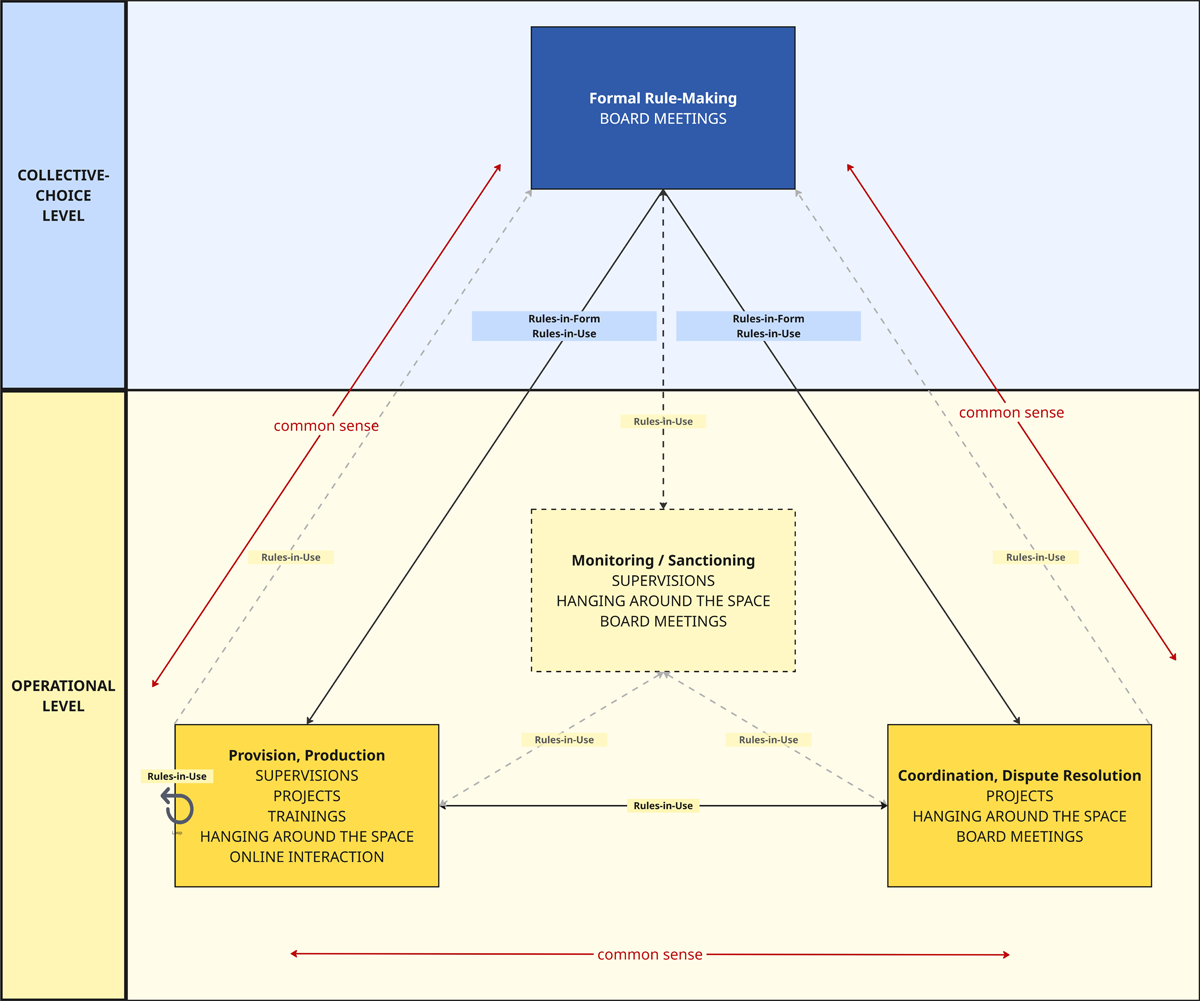
Figure 7
Network of adjacent action situations in MSD (authors’ elaboration).
As the only formal governing body, the Board is the sole arena that can create or modify rules-in-form for all other situations: it can decide who may become a supervisor or Board member and what formal responsibilities these positions carry. However, many practically relevant prescriptions remain as rules-in-use that never crystallise into written procedures. Projects are a clear example: initiating a project requires at least some acknowledgement from the Board, yet there is no codified process for establishing a project, appointing a leader, allocating funds, or setting timelines. Decisions about communication platforms follow a similar pattern, with the shift from Slack to Discord triggered by a few non-committal discussions and effectively settled once one Board member had moved the community far enough along that reversal became socially difficult. Dispute resolution mostly occurs within projects or through everyday interaction in the space, and only afterwards feeds back into collective choice. Monitoring constitutes, at best, a latent action arena (hence the semi-transparent visualisation): sporadic checks during supervision shifts focus on safe tool use rather than on compliance with knowledge-sharing rules. Safety rules similarly emerge from operational practice when experienced makers define acceptable procedures around particular machines and then spread these standards through trainings and online channels, often without any formal ratification. Across these linkages, cross-arena influence is largely carried by “common sense” judgements and interpersonal negotiations, which collectively generate and adjust the working rules that actually guide behaviour, whether or not they ever appear as formal prescriptions. This means that the provision and maintenance of working rules — the infrastructure that coordinates all three operational arenas — depends on the same informal, uncoordinated processes it is supposed to govern, creating a circularity that the Discussion examines as a nested social dilemma.
Discussion and Conclusion
This study shows that in MSD, practical knowledge commons are developed and sustained primarily through interpersonal, practice-based interaction rather than codified procedures. Supervisor shifts, training sessions, collaborative projects, and informal “hanging around” the space function as core action arenas in which makers demonstrate, explain, and co-produce practical knowledge, while digital platforms mainly support coordination rather than substantive knowledge transfer. These processes are loosely organised by a thin layer of Board-made rules and a thicker set of rules-in-use grounded in common sense, trust, and informal leadership.
People and their interactions constitute the core of the resource system. Governance of practical knowledge therefore primarily concerns the community rather than physical or digital artefacts, requiring sufficient numbers of participants and, crucially, sufficient interaction among them. The contribution goods characteristics (Kealey and Ricketts, 2021) of practical knowledge are evident, as the knowledge pool depends on the presence of contributors and on repeated shared practices. While MSD does not face shortages of contributors, it struggles with participation in knowledge provision processes, particularly projects, whereas overcrowding of tools and space does not pose a significant concern in this case.
These findings align with the makerspace literature, which highlights the role of shared practices and social scaffolding in learning practical skills (Sheridan et al., 2014; Martin, 2015; Mersand, 2021). However, participation in such practices is shaped less by members’ skills or willingness to learn than by incentives to engage in organisational and managerial work. MSD hosts many makers but few managers, revealing public goods dilemmas in the provision of infrastructural resources (Frischmann, 2012) that enable practical knowledge sharing. Three such infrastructures are central: projects and other opportunities for co-presence; communication channels that support information exchange; and governance structures that maintain both social and physical infrastructures. Projects function as infrastructural resources (Frischmann, 2012): they are largely non-subtractable, serve as inputs to learning and making, and are driven by downstream productive activities rather than valued as ends in themselves.
All three infrastructures face provision challenges. Projects lack structure and coordination; the Board struggles with recruitment, oversight, and conflict resolution; and communication channels obscure rather than clarify available information. Although rules exist, they are mostly informal, weakly communicated, and neither monitored nor sanctioned. Monitoring is limited to safety compliance during supervision and does not extend to knowledge-sharing practices. Rule-making authority lies with the Board, over which the broader community has little formal control, and no structured policymaking process exists. As a result, participation in projects and communication relies on shared understandings rather than predictable institutional arrangements, limiting reliability and coordination.
The case thus reveals a nested social dilemma. At the first level, practical knowledge sharing depends on participation in collective activities — projects, trainings, shared shifts — yet individual members face a classic public good problem: the private costs of participation (time, effort) are immediate, while the benefits (a richer knowledge pool, a more capable community) are diffuse and delayed. Interviewees acknowledged this tension directly, noting that volunteers prefer personally interesting projects over those primarily benefiting the community, even while expressing willingness to contribute. At the second level, the very infrastructures that could lower participation costs — structured projects, clear communication channels, effective governance — are themselves shared goods requiring costly provision. This is the second-order dilemma identified by Ostrom (2015): the solutions to collective action problems are themselves subject to collective action problems. The community needs organisers, but organising is unrewarded and socially risky work.
So far, we have discussed infrastructures in a largely descriptive manner, identifying existing institutional arrangements and their function in practical knowledge provision. However, what emerges as a leitmotif throughout the case study is a pervasive inattention to governance and formalised rules. We argue that this tendency toward informality is itself a social infrastructure — a set of shared customs and conventions — that serves as both input to and output of the production of practical knowledge and its supporting institutions.
Following Dekker and Kuchař (2019) and Choi (2021), institutional elements such as conventions and shared interpretive frameworks are jointly produced alongside the practices they enable. Actors produce, reproduce, and sometimes transform these social infrastructures not by attending to them directly but as a byproduct of pursuing the activities that these infrastructures make possible (Dekker & Kuchař, 2019). In the same way that rules are maintained by following them, informal arrangements are reproduced through an informal approach to social interactions and their outcomes. For example, supervisors who approach their shifts in a relaxed or lenient manner are actively, albeit largely unconsciously, contributing to a culture of informality and leniency. Similarly, when a group of supervisors initiates a project without any formal procedures, they perpetuate the structurelessness of project management and coordination. The private good each actor pursues — access to tools, social interaction, a finished object — is jointly produced with a shared good: the prevailing interpretation of what community participation looks like.
An important element of the joint production framework is the possibility of transformation at the margin through what might be called institutional entrepreneurship. While drawing on already existing informal arrangements may be privately less costly in the short term, there remains a possibility of innovation — challenging the status quo by introducing more structured practices. For instance, stepping out of the prevailing informal approach during project execution toward a more organised or coordinated effort may be initially costly in time, effort, and social capital — becoming, as one interviewee put it, “the boo man that everybody just knows because he tells you to stop, to do something” (Int. 4, ML > 1 year). Yet such a departure, if it leads to a successfully completed project, can transform the shared understanding of what effective collaboration entails. This transformation of a social practice can then influence others to adopt more organised approaches, gradually shifting the infrastructure itself.
However, the transformation of a convention is itself subject to a social dilemma. The private cost of innovating falls on the individual, while the benefits — a new, more productive norm — are shared and open to all willing to participate, including those who did not bear the cost of establishing them. In the specific context of MSD, with its independent student heritage and close-knit, friendly community, the social cost of formalising processes or enforcing governance may be prohibitively high for any single member to undertake. Moreover, given that improvisation and makeshift solutions are core elements of tinkering and are valued in parts of the maker community (Martin, 2015), it is unsurprising that at the time of research, informal structures were prevalent and effectively crowding out formal governance of structured processes. This “tinkerer ethos” — a shared disposition toward creative pragmatism and away from procedural rigidity — is itself a social infrastructure conditioning MSD’s practices and institutions. It shapes the instruments of interpretation (Dekker & Kuchař, 2019) through which community members read their environment: what counts as a productive shift, what constitutes adequate project management, and when it is appropriate to intervene in another member’s work.
There are various institutional levers on the operational level that can address the social dilemmas. Time investment could be addressed through scope rules (e.g. minimum project participation) or boundary rules (admitting only members willing to invest time in collective projects). Information gaps stem from the absence of scope rules for project monitoring and communication, as no role is formally responsible for updating project status or managing communication channels.
The MSD commons thus depend not only on learning infrastructures but on the broader institutional structure. Returning to Ostrom’s design principles, Table 1 summarises their presence in MSD. Only principles 1 A, 1B, and 7 are clearly met. Collective-choice arrangements (principle 3) are weakly realised: the Board is neither elected nor formally accountable. Monitoring, graduated sanctions, and conflict resolution (principles 4–6) are largely absent, reflecting both limited perceived need and high social costs of enforcement — consistent with Ostrom’s (2015) observations on the private costs of monitoring. Nested governance (principle 8) is largely absent given the community’s small scale.
Table 1
Presence of Ostrom’s design principles, as modified by Cox et al. (2010), in MSD (authors’ elaboration).
| NO. | PRINCIPLE | PRESENCE IN MSD |
|---|---|---|
| 1A | User Boundaries | Yes: it is mostly clear who is member of the community and who not |
| 1B | Resource Boundaries | Yes: only people with key from the gate can access the MSD |
| 2 A | Congruence with Local Conditions | No |
| 2B | Appropriation and Provision | No |
| 3 | Collective Choice Arrangements | Weakly |
| 4A | Monitoring Users | No (only for tool operation) |
| 4B | Monitoring the Resource | No (only the tools) |
| 5 | Graduated sanctions | No |
| 6 | Conflict Resolution Mechanism | No |
| 7 | Minimal Recognition of Rights | Yes: the MSD is recognised by the Dutch law |
| 8 | Nested Entreprises | Weakly |
Post-data-collection observations suggest emerging institutional adaptations, including redesigned safety training with hands-on components, creation of a project manager role, clarification of advisory Board positions, and discussions on broader community participation in decision-making. While these developments remain incomplete and the community remains vulnerable to external shocks such as rising rents or eviction, they indicate movement toward greater institutional robustness. Whether such secondary social dilemmas can be overcome remains uncertain.
The main contribution of this study is twofold. First, the study identifies a nested social dilemma in practical knowledge commons: while the knowledge pool itself exhibits contribution good characteristics that sustain sharing among active participants, the infrastructures enabling participation — projects, communication, governance — face persistent public good problems in their provision. Second, drawing on the joint production framework (Dekker & Kuchař, 2019), the study offers an explanation for why this second-order dilemma persists: the culture of informality that characterises the community is itself a social infrastructure, jointly produced through everyday practice and resistant to transformation because the private costs of institutional entrepreneurship exceed the individually capturable benefits.
Practically, this suggests that communities should complement informal interaction with simple organisational formats such as structured trainings, clearer roles, and coordinated projects, to support inclusive participation. The study also contributes to the commons literature by offering a first application of the GKC framework to a makerspace, extending the empirical scope of knowledge commons research. Future studies could examine multiple makerspaces or the global maker movement as a nested knowledge common, addressing limitations of single-case design and youth of the MSD community. The GKC framework provides a basis for such comparative analysis.
Notes
[1] In this paper, we use the term “practical knowledge” for forms of knowledge connected to, or constitutive of, physical practice and skill. Although the authors we reference vary in their exact terminology and delineations, a detailed definitional or epistemological discussion lies beyond the scope of this study.
[2] See Lin, Paniagua, and Yuan (2025) for a recent taxonomy of knowledge governance regimes that foregrounds the role of tacitness, showing how sectors reliant on practice-based skills — such as mining and artisanal glassmaking — tend toward commons-like governance structures. We thank our reviewers for drawing our attention to adjacent work in the International Journal of the Commons (Carpentier, 2021; Lemeilleur & Sermage, 2020) and for suggesting the more precise framing adopted here.
Acknowledgements
We thank the anonymous reviewers and the editorial board of the International Journal of the Commons for their constructive engagement throughout the review process. An earlier version of this study was presented at the 2024 Early Career Network Workshop of the International Association for the Study of the Commons (IASC), which also provided the pathway for submission to the IJC. We are grateful to the ECN community for the opportunity to present and develop this work. The study originates from a master thesis completed at Erasmus University Rotterdam, whose support we gratefully acknowledge. Above all, we thank the members of Makerspace Delft for welcoming us into their community and generously sharing their time, their space, and their practical know-how.