
1. Introduction
Collaborative management has developed in many contexts as a main approach to solving complex environmental problems (Lubell, 2015; Bodin, 2017). Collaborative resource management can be defined as “a group of diverse stakeholders, including resource users and government agencies, working together to resolve shared dilemmas” (Heikkila and Gerlak, 2005). Collaborative approaches are diverse; however, they share the following characteristics: “involvement of multiple actors (state and non-state); collective decision making based on deliberation and consensus; long-term relationships; a commitment to sharing knowledge and resources, and a focus on joint action towards shared goals” (De Loë et al., 2015). This type of governance is seen as an alternative to the hierarchical coordination mechanisms characterizing centralized and command-and-control management (Sabatier et al., 2005). Collaborative arrangements involving diverse private and public actors are considered to have the potential to increase the effectiveness of water management across existing administrative and sectoral boundaries by overcoming institutional fragmentation and enhancing the generation of knowledge on complex ecological dynamics through social learning (Bodin, 2017). In rural areas, such collaborative arrangements often seek to address the pervasive issue of diffuse water pollution from agriculture (Hardy and Koontz, 2010). In contrast to regulatory policies, collaborative water pollution control relies on farmers’ voluntary involvement. Thus, understanding the drivers of farmers’ participation is needed to assess the conditions under which the collaborative approach is effective.
Collaborative processes for limiting diffuse pollution in drinking water catchments have been developing in the French and European contexts over the last 20 years (Brouwer, 2003; Cook et al., 2012; Amblard, 2019). Such cooperation relies on self-regulation among key actors: drinking water suppliers, farmers and other relevant stakeholders (e.g., farm organizations, local state agencies, environmental nongovernmental organizations) and targets specific areas such as water catchments (Brouwer, 2003). In France, the “Grenelle” policy, launched in 2009 and extended in 2013, has identified 1,000 priority drinking water catchments as particularly threatened by diffuse pollution (Loi n° 2009–967; MEDDE, 2013). The policy prescribes the definition and implementation of action plans based on cooperation between water suppliers and agricultural stakeholders. In this context, decisions regarding the design, monitoring and evaluation of actions targeting diffuse water pollution are taken collectively by local stakeholders, including farmers or their representatives (farmers’ associations, farm organizations). The implementation of action plans at the water catchment level relies on the voluntary participation of farmers. The actions implemented include information and training sessions, technical support activities and incentive programs such as European Union (EU) agri-environmental schemes (AESs). In 2019, only 58% of the “Grenelle” priority catchments were covered by an action plan (OFB, 2020). While a few successful cases of collaborative drinking water catchment protection have been documented, thus far, the “Grenelle” policy has not led to a significant improvement in water quality in France (OFB, 2020). There are no available data on the extent of farmers’ involvement in collaborative water quality management; however, previous research suggests that the low level of farmers’ participation constitutes a constraint to the achievement of the “Grenelle” policy objectives (Amblard, 2019).
Most studies on collaborative watershed management have focused on cooperation for decision-making about the actions to be implemented (Lubell, 2004; De Loë et al., 2015). While a large body of literature has been developed on the determinants of farmers’ participation in individual contracts such as EU AESs, only a few studies have explored the factors influencing farmers’ adoption of measures in the context of collaborative watershed management (Lubell, 2004; Marshall, 2004, 2009; Campbell et al., 2011).
The aim of this paper is to contribute to understanding the drivers of farmers’ participation in collaborative water quality management. We assume that farmers’ decision to participate in collaborative management depends on the benefits, costs and transaction costs associated with their participation. Several studies have shown that significant transaction costs are associated with AESs, both for implementation agencies and for farmers (Falconer, 2000; Falconer et al., 2001; Mettepenningen et al., 2009, 2011; Coggan et al., 2015). The transaction costs borne by farmers have been shown to constrain their participation in the programs and, thus, the achievement of environmental objectives (Falconer, 2000; McCann and Claassen, 2016). Two main approaches can be distinguished in the literature adopting a transaction cost perspective for the study of farmers’ participation in environmental programs. Some studies seek to measure the level of transaction costs associated with farmers’ participation and to identify the causes of their magnitude (e.g., McCann, 2009; Mettepenningen et al., 2009; Coggan et al., 2015). Other research aims to assess the drivers of farmers’ participation while taking into account transaction costs in the analysis (e.g., Ducos et al., 2009; Espinosa-Goded et al., 2013; Pascucci et al., 2013). Our study is in line with the second approach.
To identify the factors likely to influence the participation of farmers in collaborative drinking water catchment protection in France, we draw on the large literature that has developed on the determinants of farmers’ participation in AESs. Farmers’ participation has been shown to be influenced by farm characteristics and farmers’ personal variables (Uthes and Matzdorf, 2013; Lastra-Bravo et al., 2015). Furthermore, the role of social factors has recently been highlighted as crucial in farmers’ decisions to become involved in AESs (Dessart et al., 2019; Yoder et al., 2019; Brown et al., 2021). The analysis presented in this paper is more specifically based on two cases of cooperation (Allier and Héricourt-en-Caux) that have developed as part of the “Grenelle” policy’s implementation in France. To identify the drivers of farmers’ participation, a statistical analysis of data collected from participating and nonparticipating farmers was performed. Semi-structured interviews with the stakeholders involved in the governance of the two collaborative processes served both for framing the statistical analysis and for interpreting the results.
This paper is organized as follows. Section 2 develops the conceptual framework used for the analysis. The methodology of the research is detailed in Section 3, including background information on the two selected cases of cooperation. The factors identified as affecting farmers’ participation in collaborative water quality management are presented in Section 4. The final section discusses the results and the insights they provide for understanding the drivers of farmers’ participation, their policy implications and future research areas.
2. Conceptual framework
2.1. A transaction cost approach
Transaction costs are “the comparative costs of planning, adapting, and monitoring task completion under alternative governance structures” (Williamson, 1985, p.2). In the field of natural resource management and environmental policy, ex ante transaction costs are defined as information collection costs, decision-making costs and bargaining costs for reaching agreements, while ex post transaction costs correspond to the monitoring and enforcement costs of agreements (McCann et al., 2005; Coggan et al., 2010).
Following Masten and Saussier (2000), we formalize farmers’ decision to participate in collaborative water management as a discrete choice problem. Farmers will choose to participate if the associated expected benefits of participating (net of costs and transaction costs) are greater than those of not participating.
where P1 represents the decision to participate, P0 represents the decision to not participate, B1 and B0 represent the perceived net benefits of participation and nonparticipation, respectively, and P* is farmers’ actual decision.
The costs associated with farmers’ participation in collaborative processes for water quality management include opportunity costs, i.e., the loss of profit or revenue potentially induced by adopting measures that target nonpoint source pollution (Abildtrup et al., 2012). They also include labor costs and investment costs, as changes in farming practices may require the acquisition of new equipment or new technical knowledge (Ducos et al., 2009; Coggan et al., 2015). Farmers may benefit from savings by changing their practices, for example, by reducing the expense of chemical inputs, without experiencing any decrease in yields (Buckley and Carney, 2013; Yoder, 2019). Economic incentives for farmers to participate in collaborative water management also include potential benefits such as investment subsidies or monetary compensation (Lubell, 2004; Grolleau and McCann, 2012). In addition to economic benefits, nonmonetary incentives such as environmental and social benefits may play a role in farmers’ willingness to engage in cooperation (Ducos et al., 2009; Weersink and Fulton, 2020).
The transaction costs borne by farmers include decision-making costs and monitoring and enforcement costs. Decision-making costs are the costs of collecting and processing information on the measures to be implemented and their consequences for their farming system (Schomers et al., 2015; McCann and Claassen, 2016). Monitoring and enforcement costs include the time spent by farmers to fulfill the monitoring requirements and the costs related to sanctions in the case of noncompliance (Mettepenningen et al., 2009; Mack et al., 2019).
The extent of the expected benefits, costs and transaction costs associated with cooperation and, thus, farmers’ participation, are influenced by a number of factors, which are presented in the following section.
2.2. Factors influencing farmers’ participation
The factors likely to affect farmers’ participation in collaborative water management include farm characteristics (Section 2.2.1), farmers’ personal variables (Section 2.2.2) and farmers’ social networks (Section 2.2.3). Given the limited number of studies dealing with the drivers of farmers’ adoption of measures in the context of collaborative watershed management (Lubell, 2004; Marshall, 2004, 2009), we review the vast literature addressing the issue of farmers’ participation in individual agri-environmental contracts.1
2.2.1. Farm characteristics
A first factor identified as influencing farmers’ participation is farm size (Lastra-Bravo et al., 2015). Several studies show that larger farms have a greater likelihood of adopting agri-environmental measures (Uthes and Matzdorf, 2013; Ulrich-Schad et al., 2017; Prokopy et al., 2019). In the case of commitments at the plot level, the costs of changes in farming practices borne by large farms are likely to be proportionally lower than those borne by small farms. The participation of smaller farms also appears to be constrained by the presence of fixed costs, for example, the costs of realizing specific investments (Marshall, 2009; Espinosa-Goded et al., 2013). Fixed costs include transaction costs such as the costs of accessing the information required to participate in environmental programs (Falconer, 2000; Ducos et al., 2009; McCann, 2009; Mettepenningen et al., 2009; Coggan et al., 2015).
The technical orientation of farms is also shown to affect the probability of agri-environmental contracting (Lastra-Bravo et al., 2015; Brown et al., 2021). Some studies find that livestock farms are more likely to contract agri-environmental measures than farms specializing in field crops (Peerlings and Polman, 2009), with pasture areas being considered favorable to environmental protection (Ducos et al., 2009; Uthes and Matzdorf, 2013).
Other factors that affect the participation of farmers in AESs are farm endowments in production factors (equipment, labor) (Uthes and Matzdorf, 2013; Lastra-Bravo et al., 2015; Ranjan et al., 2019). The impact of farms’ fixed assets (equipment, buildings) appears to depend on the type of agricultural system and type of measure. For example, Defrancesco et al. (2008) show that investments in equipment/buildings increase the likelihood that livestock farms in the Alps will adopt measures to maintain extensive grasslands. In contrast, a study by Espinosa-Goded et al. (2013) in Spain shows that farmers who own specialized equipment for cereal production have a lower probability of entering into contracts for measures based on the growing of alfalfa. In this case, investments in specialized equipment increase the opportunity costs associated with adopting the agri-environmental measures. The role of family and nonfamily labor in the participation of farmers in AESs is also highlighted in several studies. Defrancesco et al. (2008) and Ruto and Garrod (2009) suggest that the administrative tasks induced by agri-environmental contracting can constitute a constraint on farmers’ participation, depending on the available family and nonfamily labor.
Higher incomes are believed to facilitate the adoption of agri-environmental measures and conservation practices (Knowler and Bradshaw, 2007; Lastra-Bravo et al., 2015). Gedikoglu et al. (2011) find that the adoption of a capital-intensive nutrient management practice is positively influenced by the off-farm employment of the farmer. Additionally, several studies highlight a negative relationship between the importance of agricultural income in total farm income and participation in AESs (Defrancesco et al., 2008; Peerlings and Polman, 2009). The dependence of farms on income from agricultural activities therefore seems to discourage the adoption of agri-environmental measures because of the risk of reduced income potentially associated with contracting.
2.2.2. Farmers’ profiles
The factors characterizing farmers’ profiles identified as influencing farmers’ uptake of agri-environmental measures include age, education, environmental awareness and previous experience with AESs (Burton, 2014; Brown et al., 2021).
Most studies show that farmers’ age decreases the probability of their participation in environmental programs (Uthes and Matzdorf, 2013; Lastra-Bravo et al., 2015; Prokopy et al., 2019). The negative impact of age on the adoption of agri-environmental measures could be explained by older farmers’ lower sensitivity to environmental issues and a shorter time horizon for decision-making (Baumgart-Getz et al., 2012; Burton, 2014; Weber and McCann, 2015). Other studies find that farmers’ participation is higher among older farmers. For example, Yeboah et al. (2015) observe a positive effect of age on the likelihood of enrollment in a filter strip program in Michigan (United States). According to the authors, older landowners could see the program as a regular source of income as they approach retirement. Mettepenningen et al. (2013) find that the probability that farmers participate in AESs increases until the age of 42 and then decreases. The authors suggest that this nonlinear effect reflects a constraint on the resources available to the youngest farmers.
Several studies show that a higher educational level of farmers is associated with their increased participation in AESs and adoption of conservation practices (Knowler and Bradshaw, 2007; Peerlings and Polman, 2009; Giovanopoulou et al., 2011; Prokopy et al., 2019). This variable may reflect a better capacity for managing information related to contracting and the technical uncertainties associated with changes in practices, thus reducing transaction and compliance costs (Ducos et al., 2009). Coggan et al. (2015) find that having a university education reduced farmers’ transaction costs of participation in a water quality improvement program in Australia. Other research does not show any significant link between farmers’ educational level and the adoption of agri-environmental measures (Mettepenningen et al., 2013).
An attitude favorable to the protection of nature and the environment is associated with a high probability of participation in AESs (Defrancesco et al., 2008; Giovanopoulou et al., 2011). Yeboah et al. (2015) find that landowners with a greater concern for the environment are more willing to enroll in a filter strip program. Farmers’ participation also appears to be positively influenced by their previous experience in contracting agri-environmental measures (Defrancesco et al., 2008; Burton, 2014; Yeboah et al., 2015; Prokopy et al., 2019). A previous experience of participation in environmental programs is likely to reduce transaction costs (Coggan et al., 2015; McCann and Claassen, 2016; Shahab et al., 2019). Ducos et al. (2009) find that such experience significantly affects participation in an AES but not the land area enrolled in the scheme, revealing the importance of fixed transaction costs.
2.2.3. Farmers’ social networks
Farmers’ integration into agricultural and nonagricultural networks is identified as an important determinant of their involvement in AESs (Baumgart-Getz et al., 2012; Lastra-Bravo et al., 2015; Brown et al., 2021).
On the one hand, social networks may help to diffuse knowledge and information on programs, thereby favoring farmers’ participation. Several studies show that belonging to agricultural organizations has a positive effect on the adoption of agri-environmental measures (Ducos et al., 2009; Pascucci et al., 2013). Farmers’ involvement in professional agricultural structures may lead to a better understanding of agri-environmental policies and programs, which may reduce the information costs associated with contracting (Ducos et al., 2009; Pascucci et al., 2013; Shahab et al., 2019). On the other hand, social networks can lead to a peer-group effect or adhesion to specific social norms, positively or negatively affecting the decision to participate in AESs (Schomers et al., 2015; Mills et al., 2017; Inman et al., 2018; Prokopy et al., 2019). Different effects of membership in a producer association are highlighted in the literature. Lubell (2004) shows that membership in a cooperative has a positive impact on farmers’ participation in a collaborative approach to protecting water resources. Other studies find that when the adoption of measures is likely to reduce farm productivity, belonging to an agricultural cooperative decreases the probability of participation and the area contracted (Giovanopoulou et al., 2011; Espinosa-Goded et al., 2013). The impact of farmers’ involvement in agricultural networks therefore appears to vary depending on the type of organization and its orientation as well as the type of measure, particularly its perceived economic impacts.
Evidence of the effect of farmers’ involvement in nonagricultural networks is scarcer. Peerlings and Polman (2009) find that farmers’ participation in nonagricultural organizations (e.g., sports clubs or clubs focused on community work) positively influences their adoption of landscape management contracts. According to the authors, farmers involved in nonagricultural activities are more likely to feel a sense of social responsibility. Similarly, Stallman and James (2015) find that farmers who are active members of a community organization such as a civic group are more willing to cooperate with their neighbors to control pests.
3. Methodology
The analysis relies on a quantitative treatment of primary data collected in two drinking water catchments in France. Section 3.1 introduces the two cases of collaborative watershed management. We present the data collection process in Section 3.2 and the data analysis in Section 3.3.
3.1. Case descriptions
Two cases of collaborative management of drinking water catchments were selected in France (Map 1). Both the Allier and Héricourt-en-Caux catchments were classified as “Grenelle” priority catchments in 2009 because of increasing nitrate and pesticide rates in the water used for drinking water production. In both cases, an action plan has been implemented since 2014. In Héricourt-en-Caux, the action plan was renewed in 2017 and 2021. In Allier, the action plan was renewed in 2020.
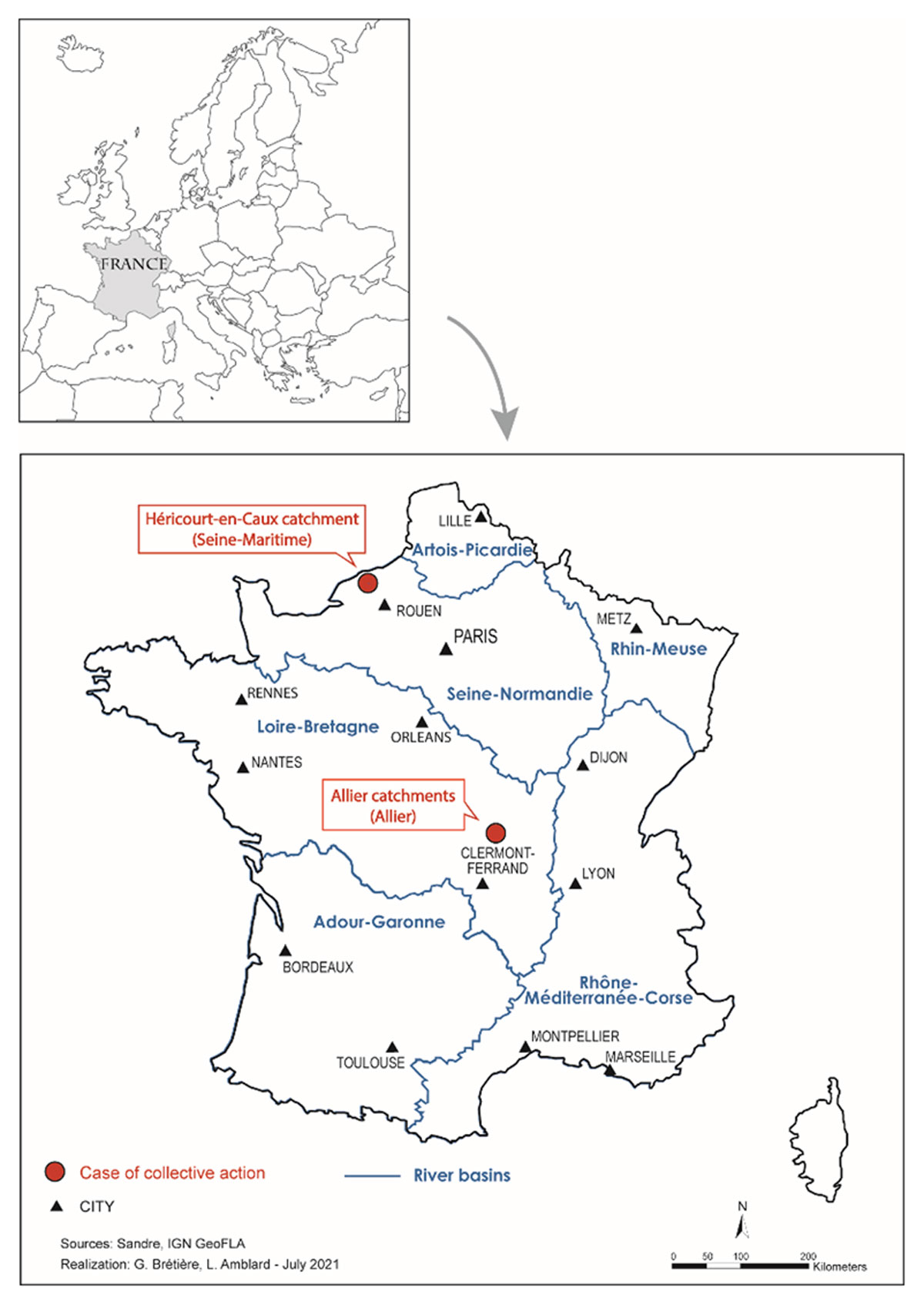
Map 1
Locations of the two cases of cooperative management of drinking water quality.
3.1.1. Characteristics of the drinking water catchments
In Allier, ten priority catchments are managed by six intermunicipal water utilities, represented by the Syndicat Mixte des Eaux de l’Allier (SMEA) (Table 1). The Héricourt-en-Caux water catchment is managed by the Syndicat Mixte d’Eau et d’Assainissement du Caux Central (SMEACC) water supplier. This catchment is considered strategic because it represents a large share of the SMEACC water supply (SMEACC, 2018 (a)). In the Allier case, the water resources are mainly degraded by nitrates. Only one of the ten catchments was initially identified as affected by pesticide pollution. However, since 2016, pesticide residues have been detected in all catchments (SCE, 2019). In Héricourt-en-Caux, an increase in pesticide rates above the drinking water standard led to the “Grenelle” classification of the water catchment in 2009 (SMEACC, 2018 (a)).
Table 1
Main characteristics of the two drinking water catchments.
| ALLIER | HÉRICOURT-EN-CAUX | |
|---|---|---|
| Water resource | ||
| Water management | Intermunicipal water utility (SMEA) | Intermunicipal water utility (SMEACC)* |
| Hydrogeological system | Alluvial aquifers (Allier and Loire rivers) | Karst aquifers |
| Population supplied by the resource | 39,900 | 20,000* |
| Share of the total drinking water supply | 51% | 61%* |
| Type of pollution | Nitrates/ Pesticides | Nitrates/ Pesticides* |
| Agriculture | ||
| Catchment area | 8,300 ha | 11,636 ha** |
| Agricultural area | 6,900 ha (83% of the catchment area) | 9,860 ha** (85% of the catchment area) |
| Number of farms | 120 | 260** |
| Types of farming systems | Mixed crop; mixed crop- livestock farming | Mixed crop-livestock farming** |
| Proportion of grassland (% of the agricultural area) | 24% | 27%** |
| Proportion of arable crops (% of the agricultural area) | Cereals: 63% Oleaginous: 9% Others: 4% | Cereals: 47%** Oleaginous: 11% Industrial crops: 15% |
[i] Sources: Allier: SMEA, 2013; Héricourt-en-Caux: * SMEACC, 2018 (a); ** CA de la Seine Maritime, 2012.
In both cases, the agricultural area represents approximately 85% of the water catchment area (Table 1). In Allier, 120 mixed crop and mixed crop-livestock farms (mostly for beef production) are located within the catchments. Cooperatives and agricultural trade companies represent the largest part of the agricultural market in the catchments. These organizations are also the main providers of technical advice to farmers. In Héricourt-en-Caux, most farms in the catchment are mixed crop-livestock farms (beef production and dairy farming). The milk produced in the area is collected by large companies (Danone, Lactalis). Cereals are collected by cooperatives and agricultural trade companies. The technical advice provided to farmers is mainly provided by the cooperatives of which they are members.
3.1.2. Collaborative water catchment protection
In Allier, the collaborative process targeting diffuse pollution in the catchment is led by the intermunicipal water utility (SMEA) and the Chamber of Agriculture, which is in charge of coordinating the definition and implementation of the agricultural action plan. In Héricourt-en-Caux, the intermunicipal water utility (SMEACC) leads the definition and implementation of both agricultural and nonagricultural actions. In both cases, a steering committee brings together diverse stakeholders, including drinking water suppliers, farm organizations, agrofood operators (cooperatives, agricultural trade companies), regional and local public agencies, local governments and environmental NGOs. In Héricourt-en-Caux, farmers are involved in the definition of actions targeting diffuse pollution through a farmers’ association represented in the steering committee. In Allier, farmers are represented in the steering committee by the Chamber of Agriculture coordinating the design and implementation of the agricultural action plan. The actions implemented since 2014 in both catchments include (i) the organization of information and training sessions; (ii) the provisioning of individual technical support; (iii) the realization of soil, manure and plant analyses as a basis for technical advice; and (iv) agri-environmental contracts (EU AESs and payment for ecosystem services (PES)-type contracts).
(i) Information and training activities
In Allier, meetings are organized once a year to inform farmers of the implementation of the actions and their impact on water quality (SCE, 2019). In Héricourt-en-Caux, information meetings are regularly organized and training actions include the organization of training sessions, field tours and demonstrations for farmers (SMEACC, 2019).
(ii) Individual technical support
The Allier Chamber of Agriculture provides free technical support to farmers. Extension agents discuss with farmers their fertilization and phytosanitary practices as a basis for recommendations to adjust those practices (SMEA, 2015). In Héricourt-en-Caux, farmers are also offered the opportunity to benefit from free technical support by the different agricultural organizations involved in catchment protection (SMEACC, 2019).
(iii) Analyses
In both cases, farmers are invited to have samples of soil and livestock manure analyzed to adapt their fertilization practices accordingly. In Allier, the Chamber of Agriculture performs the analyses at half price for farmers (SMEA, 2015; SCE, 2019). In Héricourt-en-Caux, farmers can benefit from such analyses at no cost. Soil analyses are conducted by the CapSeine cooperative and the water supplier. Livestock manure analyses are managed by the water supplier (SMEACC, 2018 (b)). In Allier, farmers also have access to rapeseed plant analysis as a tool for limiting nitrogen use (SMEA, 2015; SCE, 2019).
(iv) Agri-environmental contracts
In both cases, contracts are offered to farmers to change their practices in exchange for financial compensation. In Allier and Héricourt-en-Caux, EU AESs have been implemented since 2015 (SMEACC, 2018 (b); SCE, 2019). Additionally, contracts have been established between the water supplier and farmers for the implementation of filter strips to limit pollutant runoff in the Héricourt-en-Caux catchment. Under this PES-type contract, farmers receive annual payments from the water supplier (700 €/ha/year) (SMEACC, 2020, 2021).
In this context, farmers willing to participate in collaborative water pollution control may choose to participate in up to six actions in Allier (information meetings, technical support, livestock manure analyses, soil nitrogen residue analyses, rapeseed plant analyses and EU AES) and in up to seven actions in Héricourt-en-Caux (information meetings, training activities, technical support, livestock manure analyses, soil nitrogen residue analyses, EU AES and PES contracts). Data about farmers’ participation in actions in the two study areas are provided in Appendix A.
3.2. Data collection
In each study area, data collection followed a two-step protocol. First, exploratory semi-structured interviews were conducted with representatives of organizations involved in collaborative water catchment management (Section 3.2.1). Second, a survey of farmers who have land in the Allier and Héricourt-en-Caux water catchments was conducted (Section 3.2.2).
3.2.1. Interviews
The first objective of the exploratory interviews was to gather information on the collaborative process of defining and implementing actions that target agricultural diffuse pollution in the Allier and Héricourt-en-Caux “Grenelle” priority catchments. Furthermore, the interviews were used to refine the assumptions made regarding the variables that play a role in farmers’ decisions to participate in collaborative water management, based on the interviewees’ perception of the factors that favor or constrain farmers’ participation. The interviews served as a basis both for designing the farmer survey and adapting it to each study area and for interpreting the results of the statistical analysis of the quantitative data collected.
In Allier, six interviews were conducted in May and June 2016, and in Héricourt-en-Caux, eight interviews were conducted in May and June 2017 (Appendix B). In both cases, the interviewees selected were the main stakeholders involved in the governance of the water catchment protection processes, including drinking water suppliers, farm organizations, local offices of water agencies and local state agencies. The interviews were conducted using a questionnaire structured into four sections (role of the interviewee’s organization in water catchment protection; main characteristics of the water catchments; collaborative process and its outcomes; interviewee’s perception of the factors influencing farmers’ participation). Most interviews were conducted face to face. Due to the time constraints of some of the interviewees, the interviews with the water suppliers in Allier (SMEA and SIVOM Sologne Bourbonnaise) were conducted by email and phone, respectively, and the interview with the “Les Défis Ruraux” association in Héricourt-en-Caux was conducted by phone. The interviews lasted between one and three hours. They were recorded and transcribed in full.
The qualitative data collected through the semi-structured interviews were complemented with relevant documentation, such as environmental and agricultural diagnoses of water catchments, action plans, meeting minutes, newsletters and evaluation reports. Documents were either accessed via the stakeholders’ websites or provided by the interviewees themselves.
3.2.2. Farmer survey
As a second step, interviews were conducted with a sample of farmers having land in the Allier and Héricourt-en-Caux priority catchments. In Allier, 60 farmers were surveyed, of whom 36 participated in collaborative catchment management and 24 did not. In Héricourt-en-Caux, 60 farmers were surveyed, of whom 32 were participants in collaborative catchment management and 28 were nonparticipants.
The surveyed farmers were identified from lists of farmers who have land in the Allier and Héricourt-en-Caux drinking water catchments and are thus eligible for participation in the collaborative processes for water quality management. These lists were made available by local state agencies under specific agreements for access and use of personal data. The farmers included in the lists were randomly classified to constitute two samples of 60 farmers in each study area. The farmers were contacted by email, by phone or in person.
The objective of the survey was to collect quantitative data to characterize the link between farmers’ participation in collaborative water management and the factors identified in the literature review as likely to influence farmers’ decision to participate in AESs. The questionnaire was structured into four main sections (participation and level of involvement of the farmer; characteristics of the farm; farmer’s profile; farmer’s networks). The questionnaire was tested with two farmers in each study area. These test interviews were used to further adapt the questionnaire to the local agricultural context and ensure its clarity to the interviewees. Therefore, two versions of the questionnaire, adapted to the two study areas, were developed.
In Allier, the survey was conducted from July to September 2016. With the exception of two interviews conducted by phone and email, the interviews were conducted face to face. In Héricourt-en-Caux, all interviews were conducted face to face in September 2017.
Of the 120 surveyed farmers, 68 participate in the collaborative water management processes in Allier and Héricourt-en-Caux (Table 2). Most of them (80.6%) participate in at least one action based on analyses to adjust their fertilization practices. A majority of the farmers attend information meetings in both study areas. Less than one-third of the farmers are involved in agri-environmental contracts. Only four farmers have contracted EU AESs in each study area. A larger proportion of farmers are involved in the contracts offered by the drinking water supplier to limit pollutant runoff in the Héricourt-en-Caux catchment. While all the surveyed participating farmers in Allier (N = 36) have chosen to benefit from the technical support provided by the local Chamber of Agriculture, only three farmers among the interviewees in Héricourt-en-Caux have opted for this type of activity.
Table 2
Farmers’ participation in collaborative water quality management.
| ALL | ALLIER | HÉRICOURT-EN-CAUX | |
|---|---|---|---|
| Participation | 68 | 36 | 32 |
| 56.7% | 60.0% | 53.3% | |
| Participation/type of action | |||
| Information and/or training | 45 | 22 | 23 |
| 67.2% | 62.9% | 71.9% | |
| – Information | 44 | 22 | 22 |
| 65.7% | 62.9% | 68.7% | |
| – Training | 13 | - | 13 |
| 19.4% | - | 40.6% | |
| Technical support | 39 | 36 | 3 |
| 57.3% | 100% | 9.4% | |
| Analyses | 54 | 28 | 26 |
| 80.6% | 80% | 81.2% | |
| – Livestock manure analyses | 19 | 3 | 16 |
| 28.4% | 8.6% | 50% | |
| – Soil nitrogen residue analyses | 51 | 28 | 23 |
| 76.1% | 80% | 71.9% | |
| – Rapeseed plant analyses | 18 | 18 | - |
| 26.9% | 51.4% | - | |
| Contracts | 21 | 4 | 17 |
| 31.2% | 11.4% | 53.1% | |
| – EU AES | 8 | 4 | 4 |
| 11.9% | 11.4% | 12.5% | |
| – PES | 13 | - | 13 |
| 19.4% | - | 40.6% |
The level of farmers’ participation in collaborative water quality management, defined as the number of actions in which farmers participate, varies across the sample. Most of the farmers are involved in more than one action in both catchments (80% in Allier and 78% in Héricourt-en-Caux) (Table 3). In Allier, almost half of the farmers (45.7%) are engaged in four actions. In Héricourt-en-Caux, the share of farmers involved in one to four actions is similar.
Table 3
Farmers’ level of participation in collaborative water quality management.
| ALL | ALLIER | HÉRICOURT-EN-CAUX | |
|---|---|---|---|
| Participation | 68 | 36 | 32 |
| 56.7% | 60.0% | 53.3% | |
| Participation/number of actions | |||
| One action | 14 | 7 | 7 |
| 20.9% | 20% | 21.9% | |
| Two actions | 9 | 3 | 6 |
| 13.4% | 8.6% | 18.7% | |
| Three actions | 13 | 6 | 7 |
| 19.4% | 17.1% | 21.9% | |
| Four actions | 23 | 16 | 7 |
| 34.3% | 45.7% | 21.9% | |
| Five actions | 7 | 3 | 4 |
| 10.4% | 8.6% | 12.5% | |
| Six actions | 1 | 0 | 1 |
| 1.5% | 0% | 3.1% |
3.3. Data analysis
A statistical analysis of data collected in the two study areas was performed to better understand farmers’ participation in collaborative processes for water pollution control.
3.3.1. Econometric models
To assess the factors influencing farmers’ decision to participate in collaborative water management and their level of involvement, we used a probit model and an ordered probit model, respectively.
In the probit model, the dependent variable Farmers’ participation (y1) is a dichotomous variable that equals 0 if the farmer does not participate in collaborative water management and 1 if the farmer participates in collaborative water management, i.e., if the farmer chooses to engage in at least one action. The farmer’s decision to participate or not (y1) is assumed to reflect a latent, unobserved variable y1* that represents the benefits (net of costs and transaction costs) drawn from participation. We observe y1 if the underlying latent variable exceeds a given threshold.
The latent variable y* depends on a vector of observed explanatory variables X:
where B1 is a vector of the parameters to be estimated and μ1 is a random error term, assumed to be normally distributed.
To identify the factors influencing farmers’ level of participation, we categorized farmers into four groups reflecting increasing levels of engagement: no participation, “low” level of participation (participation in one action), “medium” level of participation (participation in 2 or 3 actions) and “high” level of participation (participation in four, five or six actions). In the ordered probit model, the dependent variable Farmers’ level of participation (y2) is an ordinal variable equal to 0 if the farmer does not participate in collaborative water management, 1 if the farmer chooses to engage in one action, 2 if the farmer chooses to engage in two or three actions and 3 if the farmer chooses to engage in four, five or six actions. The farmer’s choice of engagement in collaborative water management (y2) is assumed to reflect a latent, unobserved variable y2* that represents the benefits (net of costs and transaction costs) drawn from different levels of participation. We observe the different modalities of y2 if the underlying latent variable exceeds given thresholds (θ).
The latent variable y2* depends on a vector of observed explanatory variables X:
where B2 is a vector of the parameters to be estimated and μ2 is a random error term, assumed to be normally distributed.
The parameters in both models were obtained through maximum likelihood estimation using Stata statistical software.
3.3.2. Variables
The choice of the independent variables likely to influence farmers’ participation in collaborative water management (Table 4) was based on the literature review on the drivers of farmers’ participation in agri-environmental programs and the interviews conducted with the stakeholders involved in the governance of collaborative processes in the two study areas.
Table 4
Explanatory variables.
| VARIABLE | DEFINITION | EXPECTED IMPACT ON PARTICIPATION |
|---|---|---|
| Farm size | Utilized agricultural area (UAA) (ha) | + |
| Eligible area | Proportion of the farm UAA in the catchment (%) | + |
| Arable farming | = 1 if the farm specialized in arable crops | – |
| Equipment | Number of machinery items adapted to agroecological practices | + |
| Labor | Available family workforce (AWUs) | + |
| Gross operating surplus | = 1 if gross operating surplus ≥ 50,000 € | + |
| Off-farm income | = 1 if off-farm income | + |
| Age | Age of the farmer | –/+ |
| College education | = 1 if the farmer has a college education | + |
| Previous participation | = 1 if the farmer has previous experience participating in AESs | + |
| Environmental concern | = 1 if the farmer often or always takes the environment into account in farming practices | + |
| Coop | = 1 if the farmer is a member of a cooperative | –/+ |
| Agricultural network diversity | Number of different types of agricultural organizations of which the farmer is a member | + |
| Nonagricultural network diversity | Number of different types of nonagricultural organizations of which the farmer is a member | + |
| Héricourt-en-Caux | = 1 if the farm is in the Héricourt-en-Caux catchment | –/+ |
Variables characterizing the farming systems include Farm size, defined as the agricultural area utilized by the farm, which was expected to positively affect farmers’ participation. The Eligible area variable corresponds to the share of farmed land in the drinking water catchment. We assumed that it positively affects farmers’ participation due to fixed costs and transaction costs. Arable farming is equal to one for farms specializing in arable crops. Following the literature, we assumed that arable farms are less likely to participate in collaborative water management compared with farms specialized in livestock farming, as they may incur higher costs in adapting to environmental requirements. The Equipment variable corresponds to the number of machinery items owned by the farmer for nitrogen and pesticide management. We expected it to positively affect farmers’ participation by reducing the investment costs potentially associated with participation. Labor represents the family workforce available on the farm, measured in annual work units (AWUs). This variable was expected to limit the labor costs associated with changes in farming practices and administrative tasks and thus to have a positive effect on farmers’ participation. As an indicator of farm profitability, the Gross operating surplus variable is equal to one for farms having a gross operating surplus higher than 50,000 €. Finally, Off-farm income is farm income from wages and pensions. Both variables were expected to have a positive effect on farmers’ participation in collaborative water management by limiting the potential financial losses associated with participation.
Because of the various results of previous studies, we expected the Age variable to either positively or negatively affect farmers’ participation. The College education variable is equal to one if the farmer has a university diploma. We expected a positive impact of this variable on farmers’ participation, as a higher educational level is likely to facilitate information collection and treatment and thus decrease the level of transaction costs associated with participation. Previous participation is a dummy variable equal to one when the farmer has previous experience in participating in AESs. This variable was also expected to reduce transaction costs and thus to positively affect farmers’ participation in collaborative water management. Environmental concern is equal to one if the farmers declared that they often or always take the environment into account in their farming practices, as opposed to farmers who declared that they rarely take the environment into account. Because it raises the environmental nonmonetary incentives for participation, this variable was expected to have a positive effect on farmers’ involvement.
The social networks of farmers are described by three variables. Coop is equal to one if the farmer is a member of a cooperative. Based on the diverse results of previous studies, we expected this variable to either increase or decrease the probability of farmers’ participation in collaborative water management. Agricultural network diversity represents the number of different types of agricultural organizations to which the farmer belongs, and Nonagricultural network diversity corresponds to the number of different types of nonagricultural organizations to which the farmer belongs. We expected these two variables to positively affect farmers’ participation, as farmers’ involvement in diverse agricultural and nonagricultural networks may favor their access to information and thus decrease transaction costs.
Finally, the Héricourt-en-Caux variable equals one if the farm is in the Héricourt-en-Caux catchment. This variable aimed to control for the influence of potential differences in natural and economic conditions between the Allier and Héricourt-en-Caux catchments.
4. Results
In this section, we present the results of the statistical analysis of the drivers of farmers’ participation in collaborative water quality management. Appendix C displays the descriptive statistics of the variables used in the estimations.
4.1. Farm characteristics
According to the estimation results, participation in collaborative water management is positively affected by farm size and the proportion of the farm area in the drinking water catchment (Table 5). A one-ha increase in farm size increases the likelihood of participation by 0.1%. A one-unit increase in the proportion of eligible farm area increases the probability of participation by 0.5%. The level of participation is also significantly affected by the proportion of eligible farm area. A one-unit increase in this variable increases the probability of participating in two or three actions by 0.07% and the probability of participating in four to six actions by 0.4% (Table 6). The farm type has no significant effect either on farmers’ decision to engage in collaborative water management or on farmers’ level of engagement.
Table 5
Determinants of participation in collaborative water management (probit model).
| VARIABLE | COEFFICIENTS | STD. ERROR | AVERAGE MARGINAL EFFECTSB |
|---|---|---|---|
| Constant | –6.033*** | 1.147 | |
| Farm size | 0.003* | 0.002 | 0.001* |
| Eligible area | 0.024*** | 0.005 | 0.005*** |
| Arable farming | –0.044 | 0.402 | –0.010 |
| Equipment | 0.267** | 0.116 | 0.060** |
| Labor | 0.170 | 0.200 | 0.038 |
| Gross operating surplus | 0.866* | 0.444 | 0.202* |
| Off-farm income | 0.931** | 0.380 | 0.195** |
| Age | 0.028* | 0.016 | 0.006* |
| College education | –0.886** | 0.350 | –0.189*** |
| Previous participation | 0.273 | 0.368 | 0.062 |
| Environmental concern | 0.696* | 0.368 | 0.162* |
| Coop | 0.225 | 0.393 | 0.050 |
| Agricultural network diversity | 0.383** | 0.160 | 0.085** |
| Nonagricultural network diversity | 0.464** | 0.191 | 0.103** |
| Héricourt-en-Caux | –0.146 | 0.433 | –0.033 |
| Model summary | |||
| Number of observations | 117 | ||
| Pseudo R2 | 0.41 | ||
| % of correct predictionsa | 79.49 |
[i] a Model predictions based on the threshold c = 0.57. Collinearity tests showed no sign of collinearity among the variables (mean variance inflation factor (VIF) = 1.51; SQRT VIF below 1.5 for all variables). (*), (**), and (***) represent significance at the 0.1, 0.05 and 0.01 levels, respectively. b The estimated average marginal effects correspond to the changes in the probability of participating in collaborative water management when an independent variable changes by one unit.
Table 6
Determinants of the level of participation in collaborative water management (ordered probit model).
| VARIABLE | COEFFICIENTS | STD. ERROR | AVERAGE MARGINAL EFFECTS a | |||
|---|---|---|---|---|---|---|
| NONPARTICIPATION | ONE ACTION | TWO-THREE ACTIONS | FOUR-SIX ACTIONS | |||
| Farm size | 0.0002 | 0.0018 | –0.00006 | –3.24e-07 | 8.96e-06 | 0.00005 |
| Eligible area | 0.017*** | 0.004 | –0.004*** | –0.0002 | 0.0007** | 0.004*** |
| Arable farming | –0.128 | 0.295 | 0.033 | –7.52e-06 | –0.005 | –0.028 |
| Equipment | 0.249** | 0.086 | –0.065** | –0.0003 | 0.010* | 0.055** |
| Labor | 0.163 | 0.149 | –0.042 | –0.0002 | 0.006 | 0.036 |
| Gross operating surplus | 0.532 | 0.346 | –0.144 | –0.0008 | 0.027 | 0.117 |
| Off-farm income | 0.176 | 0.255 | –0.046 | –0.0006 | 0.006 | 0.040 |
| Age | 0.020 | 0.013 | –0.005 | 0.00003 | 0.0008 | 0.004 |
| College education | –0.710** | 0.282 | 0.181** | –0.003 | –0.029** | –0.148** |
| Previous participation | 0.264 | 0.282 | –0.070 | –0.001 | 0.011 | 0.060 |
| Environmental concern | 0.736** | 0.352 | –0.200** | 0.007 | 0.043 | 0.150** |
| Coop | 0.041 | 0.287 | –0.011 | –0.0003 | 0.002 | 0.009 |
| Agricultural network diversity | 0.349** | 0.138 | –0.091** | –0.0005 | 0.014** | 0.078** |
| Nonagricultural network diversity | 0.377** | 0.150 | –0.098** | –0.0005 | 0.015** | 0.084** |
| Héricourt-en-Caux | –0.407 | 0.352 | 0.106 | 0.0001 | –0.016 | –0.091 |
| /cut1 | 4.095 | |||||
| /cut2 | 4.576 | |||||
| /cut3 | 5.287 | |||||
| Model summary | ||||||
| Number of observations | 116 | |||||
| Pseudo R2 | 0.22 | |||||
| % of correct predictions | 59.48 | |||||
[i] (*), (**), and (***) represent significance at the 0.1, 0.05 and 0.01 levels, respectively. aThe estimated average marginal effects correspond to the changes in the probability of belonging to one category when an independent variable changes by one unit.
The probit and ordered probit estimations show that, as expected, the Equipment variable has a positive influence on farmers’ participation and on the level of their participation (Tables 5 and 6). Owning one additional machinery item for nitrogen or pesticide management increases the probability of farmers participating by 6%. It also increases the probability of participating in two of three actions by 1% and the probability of participating in four to six actions by 5.5%. The family labor available on the farm does not significantly affect either participation or the participation level. Farms with a higher gross operating surplus are more likely to engage in collaborative water management. Having a gross operating surplus higher than 50,000 € increases the likelihood of participation by 20.2%. Access to off-farm income also positively affects participation, increasing the probability of farmers becoming involved by 19.5%.
4.2. Farmers’ profiles
Both age and education have a significant effect on farmers’ choice to participate in collaborative water pollution control (Table 5). Farmers’ age appears to have a positive impact on participation but no effect on the number of actions in which they choose to participate. Being one year older increases the probability of participating by 0.6%. We also tested for a nonlinear effect of age by adding the squared form of the variable (Age2) to the first probit model (Appendix D). This alternative estimation shows no significant impact of either Age or Age2. In a third probit model, we replaced the continuous variable Age with the binary variable Young, which is equal to one if the farmer is younger than 40 years old. According to the estimation results, this variable negatively affects farmers’ participation. Being younger than 40 years old decreases the probability of participating by 17% (Appendix D). Contrary to expectations, a higher educational level negatively affects farmers’ participation and their level of engagement. Having a university diploma decreases the probability of participation by 18.9% (Table 5). It also decreases the probability of participation in two or three actions by 2.9% and the probability of participation in four to six actions by 14.8% (Table 6).
While having prior experience participating in AESs does not significantly affect participation or the level of participation, a high level of environmental concern has a positive impact on farmers’ involvement in collaborative water management. Often or always considering the environment in farming practices increases the probability of participation by 16.2% (Table 5). Furthermore, a high environmental concern increases the probability of participating in four to six actions by 15% (Table 6).
4.3. Farmers’ networks
According to the estimation results, being a cooperative member does not influence participation (Tables 5 and 6). Farmers participating in collaborative water management are significantly more likely to belong to a technical agricultural association, a cooperative for the joint use of farming equipment or a farming union (Table 7). They also more frequently have a management role within these organizations. The average number and diversity of agricultural organizations to which the farmers are affiliated are significantly greater among participating farmers. The proportion of farmers participating in collaborative water management who are members of a nonagricultural association (sports, hunting, fishing or cultural associations) is slightly higher than that of nonparticipating farmers (Table 8). Nearly 37% of the participants hold elected mandates in local governments compared to 8% of the nonparticipating farmers. The proportion of participating and nonparticipating farmers involved in a neighborhood group is roughly the same. The nonagricultural networks of participating farmers also appear significantly denser and more diversified.
Table 7
Farmers’ agricultural networks.
| ALL(N = 120) | NONPARTICIPANTS(N = 52) | PARTICIPANTS(N = 68) | |
|---|---|---|---|
| Agricultural association *** | 30% | 17.3% | 39.7% |
| Cooperative for machinery use *** | 66.7% | 51.9% | 77.9% |
| Farmer unions * | 31.7% | 23.1% | 38.2% |
| Management role ** | 13.3% | 5.8% | 19.1% |
| Number of agricultural networks *** | 2.2 | 1.75 | 2.6 |
| (1.6) | (1.7) | (1.5) | |
| Min: 0 Max: 6 | Min: 0 Max: 6 | Min: 0 Max: 6 | |
| Diversity of agricultural networks *** | 1.7 | 1.2 | 2.4 |
| (1.1) | (1) | (1.1) | |
| Min: 0 Max: 5 | Min: 0 Max: 4 | Min: 0 Max: 5 |
[i] Chi2 tests or Student’s t tests: * p value < 0.1; ** p value < 0.05; *** p value < 0.01.
Table 8
Farmers’ nonagricultural networks.
| ALL(N = 120) | NONPARTICIPANTS(N = 52) | PARTICIPANTS(N = 68) | |
|---|---|---|---|
| Association | 40.8% | 34.6% | 45.6% |
| Local government *** | 24.2% | 7.7% | 36.8% |
| Neighborhood group | 10.8% | 9.6% | 11.8% |
| Number of nonagricultural networks *** | 0.9 | 0.6 | 1.1 |
| (1) | (0.86) | (1) | |
| Min: 0 Max: 4 | Min: 0 Max: 3 | Min: 0 Max: 4 | |
| Diversity of nonagricultural networks *** | 0.8 | 0.5 | 1 |
| (0.8) | (0.7) | (0.8) | |
| Min: 0 Max: 3 | Min: 0 Max: 3 | Min: 0 Max: 3 |
[i] Chi2 tests or Student’s t tests: * p value < 0.1; ** p value < 0.05; *** p value < 0.01.
The two variables characterizing farmers’ networks in the empirical models have a significant impact on participation (Tables 5 and 6). The higher the agricultural and nonagricultural network diversity is, the greater the likelihood that farmers will participate and participate in a larger number of actions. Belonging to an additional type of agricultural organization increases the probability of participation by 8.5%. A higher diversity of agricultural networks increases the probability of participation in two or three actions by 1.4% and the probability of participation in four to six actions by 7.8%. Belonging to an additional type of nonagricultural organization increases the probability of participation by 10.3%. A higher diversity of nonagricultural networks increases the probability of participation in two or three actions by 1.5% and the probability of participation in four to six actions by 8.4%.
5. Discussion and conclusions
Only a few studies to date have focused on the determinants of farmers’ participation in collaborative watershed management (Lubell, 2004; Marshall, 2004, 2009). While a large body of literature exists on the drivers of farmers’ participation in individual agri-environmental schemes (AESs), less is known about famers’ participation in collaborative approaches (de Loë et al., 2015). The paper addresses this gap by identifying the factors influencing farmers’ decision to participate in actions targeting diffuse pollution in the context of collaborative water catchment management.
The results highlight that farm characteristics as well as farmers’ profiles and networks influence their decision to participate in collaborative water management. Most of the results are in line with the literature on farmers’ participation in AESs and, specifically, studies adopting a transaction cost approach (Falconer, 2000; Ducos et al., 2009; Mettepenningen et al., 2009; Espinosa-Goded et al., 2013; Coggan et al., 2015; McCann and Claassen, 2016).
The results show that larger farms with more equipment, higher incomes and access to off-farm income are more likely to engage in collaborative water management. The effect of equipment availability indicates that the costs linked to investment in the equipment needed to adopt farming practices in favor of water quality constrain farmers’ participation. The positive impact of farm incomes and access to off-farm income suggests that the economic benefits associated with participation (e.g., investment subsidies or monetary compensation) do not cover the costs or profit losses involved.
Adequate compensation for the costs associated with changes in farming practices could promote farmers’ involvement. In France and Europe, the main tool used to incentivize farmers’ participation in collaborative processes for drinking water catchment protection has been the EU AESs. However, their implementation was shown to be constrained by difficulties in adapting the types of measures and levels of compensation to local agricultural and environmental contexts, leading to a lower participation of farmers in the most environmentally ambitious measures (Cullen et al., 2018; Sattler et al., 2023). In other contexts, such as the US, the cost-effectiveness of voluntary conservation programs was also found to be limited due to a lack of targeting of the most vulnerable areas and a low flexibility for farmers in conservation management (Ribaudo, 2015; Stephenson et al., 2022).
An alternative tool to better incentivize farmers’ participation is a result-based approach linking payments to the provision of environmental outcomes (Berthet et al., 2021; Stephenson et al., 2022). The main advantage of this approach is the flexibility provided to farmers in the delivery of environmental outcomes (Sattler et al., 2023). A challenge lies in the monitoring of environmental results. Due to the complexity and uncertainty surrounding hydrogeological system dynamics, the observed short-term water quality trends may represent an imperfect measure of the environmental impact of changes in farming practices (Amblard, 2019). Intermediate outcome indicators such as soil nitrogen residues can serve as proxies for targeted environmental outcomes (Barataud et al., 2014; Stephenson et al., 2022). The development of new market outlets for improving the profitability of sustainable farming practices constitutes another tool to promote farmers’ participation in collaborative water management (Barataud et al., 2014; Sattler et al., 2023). The establishment of partnerships with agri-food operators within collaborative catchment protection processes has the potential to enhance the economic benefits for participating farmers. The effectiveness of such partnerships depends, however, on the development of a market demand for ecofriendly products (Ribaudo et al., 2010; Grolleau and McCann, 2012).
In contrast to most studies (Burton, 2014), we found that young farmers and farmers with a higher educational level are less likely to participate in collaborative water management. Several hypotheses can be proposed to explain this result. Younger farmers may lack the time, experience and/or financial resources to engage in actions targeting diffuse pollution. Interviews with the stakeholders involved in the governance of the collaborative processes suggest that the lower level of participation by younger farmers can be explained by a financial constraint due to the repayment of loans contracted to start their farming activity. Younger farmers are also the most educated farmers in the sample (Appendix E), which could explain the negative influence of education on farmers’ participation. While previous enrollment in AESs has no impact on participation in collaborative water management, farmers with a high level of environmental concern are more likely to participate. As part of a wider strategy combining regulatory and economic incentives, voluntary long-term approaches such as education and training can best address changes in farmers’ attitudes, which are critical for sustained environmental management (Mills et al., 2017; Dessart et al., 2019). In this regard, several studies highlight the major role played by the social context of information provision and the importance of farmers’ trust in information sources (Mills et al., 2017; Delaroche, 2020; Brown et al., 2021).
Our study also contributes to the understanding of the influence of agricultural and nonagricultural networks on farmers’ participation in collaborative water quality management. The literature identifies two main mechanisms through which social networks influence farmers’ participation in environmental programs: information access (e.g., Ducos et al., 2009) and social norms (e.g., Schomers et al., 2015). We found that the diversity of farmers’ agricultural and nonagricultural networks positively affects the likelihood of their participation in collaborative processes. Furthermore, farmers’ affiliation with organizations of different orientations (e.g., farmer unions with a productive orientation versus associations promoting the transition toward agroecological practices) is positively correlated with participation. These results suggest that the impact of farmers’ networks reflects the influence of information costs rather than that of social norms. Belonging to diverse organizations favors access to information, thereby decreasing the information costs borne by farmers. From a policy perspective, existing social networks seem to be effective channels for disseminating information about collaborative water catchment protection processes. Furthermore, strengthening communication with farmers less involved in agricultural and nonagricultural networks could reduce the transaction costs they face and improve the rate of participation in collaborative water management.
In line with previous studies (Ducos et al., 2009; McCann, 2009; Espinosa-Goded et al., 2013), the participation of smaller farms appears to be limited by fixed costs. The impact of the lower participation rate of smaller farms on the environmental effectiveness of the collaborative approach depends on their potential, compared to large farms, to contribute to water quality improvement. This potential may be higher, for example, if smaller farms are located in the catchment areas that are most vulnerable to diffuse pollution. In this case, providing specific support to small farms may bring enhanced environmental benefits.
This study contributes to understanding the drivers of and barriers to farmers’ participation in collaborative water quality management in the frame of the French “Grenelle” policy. Improving the generalizability of the results would require expanding the analysis to a larger number of collaborative cases. We identify two further lines of inquiry. First, farmers were assumed to face similar benefits and costs of cooperation regardless of the actions in which they chose to participate (information and training, technical support, analyses and/or agri-environmental contracts). However, the structure of benefits and costs, including transaction costs, varies across the different actions. A larger sample size would allow us to distinguish between the different actions in the analysis of farmers’ decision. Second, the environmental impact of cooperation depends on farmers’ compliance with the prescribed measures, beyond their involvement in collaborative processes (Yoder et al., 2022). Analyzing how the measures are monitored and enforced as well as characterizing the related costs would further shed light on the effectiveness and cost-effectiveness of the collaborative approach to diffuse pollution control.
Additional File
The additional file for this article can be found as follows:
Notes
Acknowledgements
This work was supported by the Office Français de la Biodiversité (OFB), formerly the Agence Française pour la Biodiversité (AFB), within the framework of the Irstea-AFB 2016–2018 research agreement. We are grateful to Delphine Loupsans (OFB) for her help and to Kevin Martin for his contribution to data collection as a research assistant at Irstea. We also thank all the farmers and other stakeholders who were interviewed for this research. Finally, the paper benefited greatly from the comments and suggestions of three anonymous reviewers.
Competing Interests
The authors have no competing interests to declare.