
Table 1
Barriers to women’s inclusion in value chains and their participation in cooperatives.
| BARRIER | DESCRIPTION | SOURCES |
|---|---|---|
| Lack of access to resources | Reduced access to: a) land, markets, income, credits, livestock, agricultural equipment, b) education, skills, information, c) infrastructure, services | 1, 2, 3, 4 |
| Time constraints | Responsible for domestic and care work, less or no time for paid labor, women have an overall higher workload | 1, 3, 4, 5 |
| Lack of decision-making power | Lower negotiation and decision-making power on all levels, e.g. household expenditures, labor activities, production decisions | 2, 4, 6 |
| Group participation | Lack of networks because of limited participation in economic or social groups or the community, especially in leadership roles | 1, 4 |
[i] Sources: 1) Bamber and Staritz 2016; 2) Coles and Mitchell 2011; 3) Stoian et al. 2012; 4) Anan 2018; 5) Brislane and Crawford 2014; 6) Stoian et al. 2018.
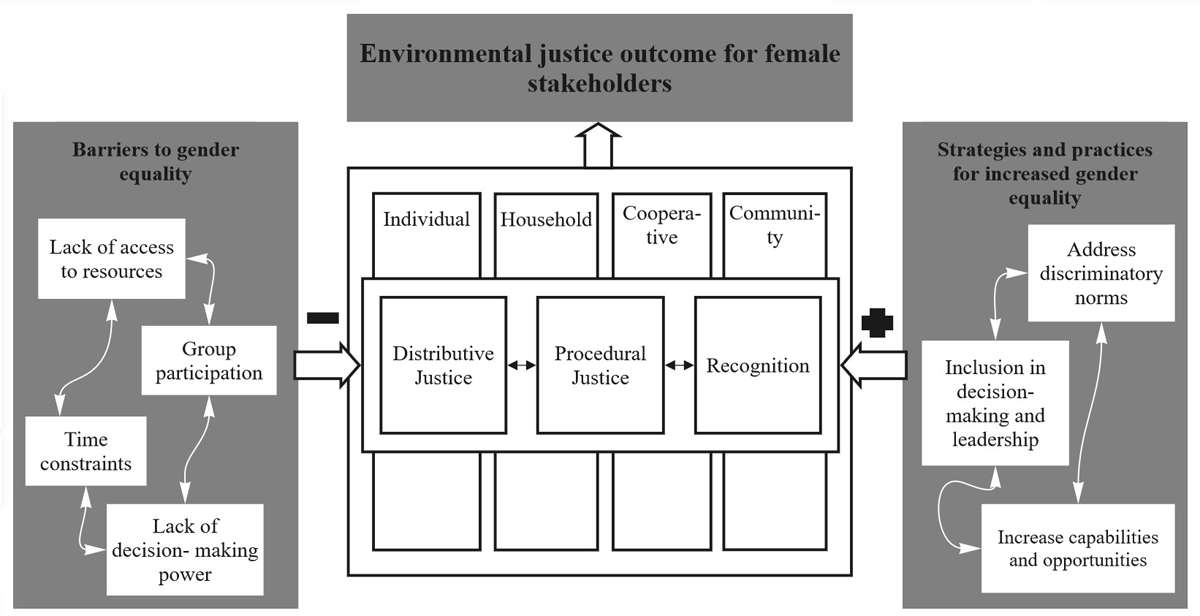
Figure 1
“Analytical framework. Source: Authors”
Table 2
Interview groups and number of people interviewed.
| INTERVIEW GROUP | DESCRIPTION | NUMBER |
|---|---|---|
| Manager | Person with a management or other leadership position within the cooperative, normally the general manager. | 7 |
| Female employee | Women working for the cooperative in any function, including in stockpiling. | 8 |
| Male employee | Men working for the cooperative in any function, including in stockpiling. | 5 |
| Female producer | Women who are either an official member of the cooperative or the partner of a male official member. | 12 |
| Male producer | Men who are either an official member of the cooperative or the partner of a female official member. | 9 |
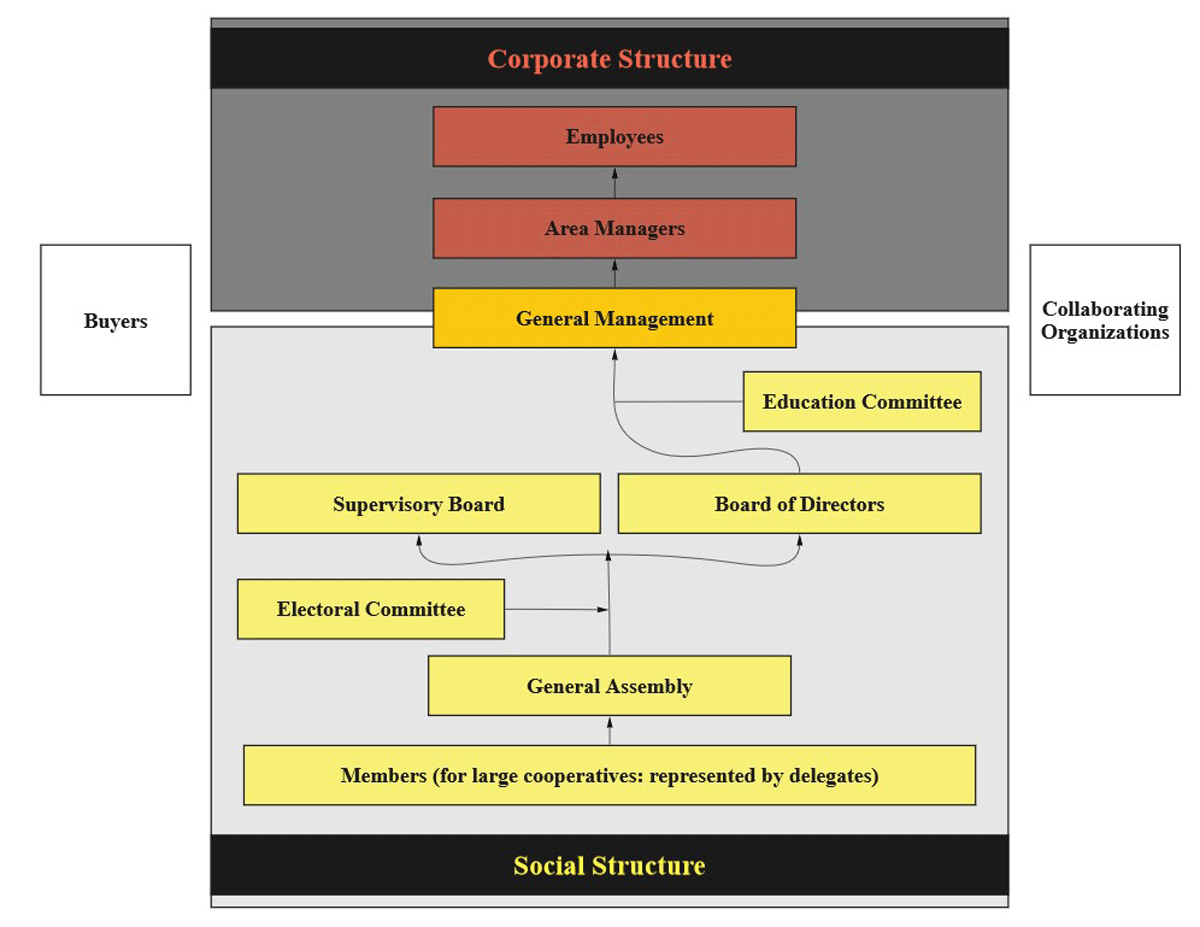
Figure 2
“Typical dual structure of cacao cooperatives in Peru with a social and a corporate part. Source: own work based on organigrams shared by the cooperatives under study.”
Table 3
Description of the selected cooperatives and producer association.
| COOPERATIVE 1 | COOPERATIVE 2 | COOPERATIVE 3 | COOPERATIVE 4 | COOPERATIVE 5 | ASSOCIATION 6 | |
|---|---|---|---|---|---|---|
| Founding year | 2015 | 1997 | 2013 (started in 1995 as association) | 2003 | 2016 (as cooperative) | 2009 |
| Products | Cacao | Cacao (main product) and timber To a lesser extent hot peppers, Tahiti lime and ginger | Coffee (75%), panela (since 2003),2 cacao since 2006, carbon credits from reforestation (since 2010) | Cacao Cacao derivatives: chocolates, liquor | Cacao Cacao derivatives: chocolates, Theobroma bicolor, cacao pulp derivatives | Chocolate, roasted majambo (Theobroma bicolor), chocolate from majambo, majambo and cacao liquor |
| Cacao production | 25 t3, min. farm size: 3ha | 4 000 t, min. farm size: 2ha | 1 000 t4, min. farm size: 0.5ha | 50 t, min. farm size: 0.5ha | 860 t, min. farm size: 1ha | N/A |
| N° of members | 40 | 1850 (average 2 000) | Overall: 6 500, cacao: 900 | 152 | 460 | N/A |
| N° of employees | 8 | 60 | 138 | Fix contracts: 7 Per hour basis: 3-5 | 21 | 15 |
| % female members | 37% (15 out of 40) | 20% (320 out of 1 850) | 20% | 20% (30 out of 152) | 12% | N/A (association with employees) |
| % female employees | 12.5% (1 out of 8) | 33% (15 out of 45) | 30% | 40% (fix contracts), 50% (overall) | 33% | 100% |
| Women in leadership positions | Social structure:
| Social structure:
| Social structure:
| Social structure:
| Social structure:
| All-women association |
| Services provided to members |
|
|
|
|
|
|
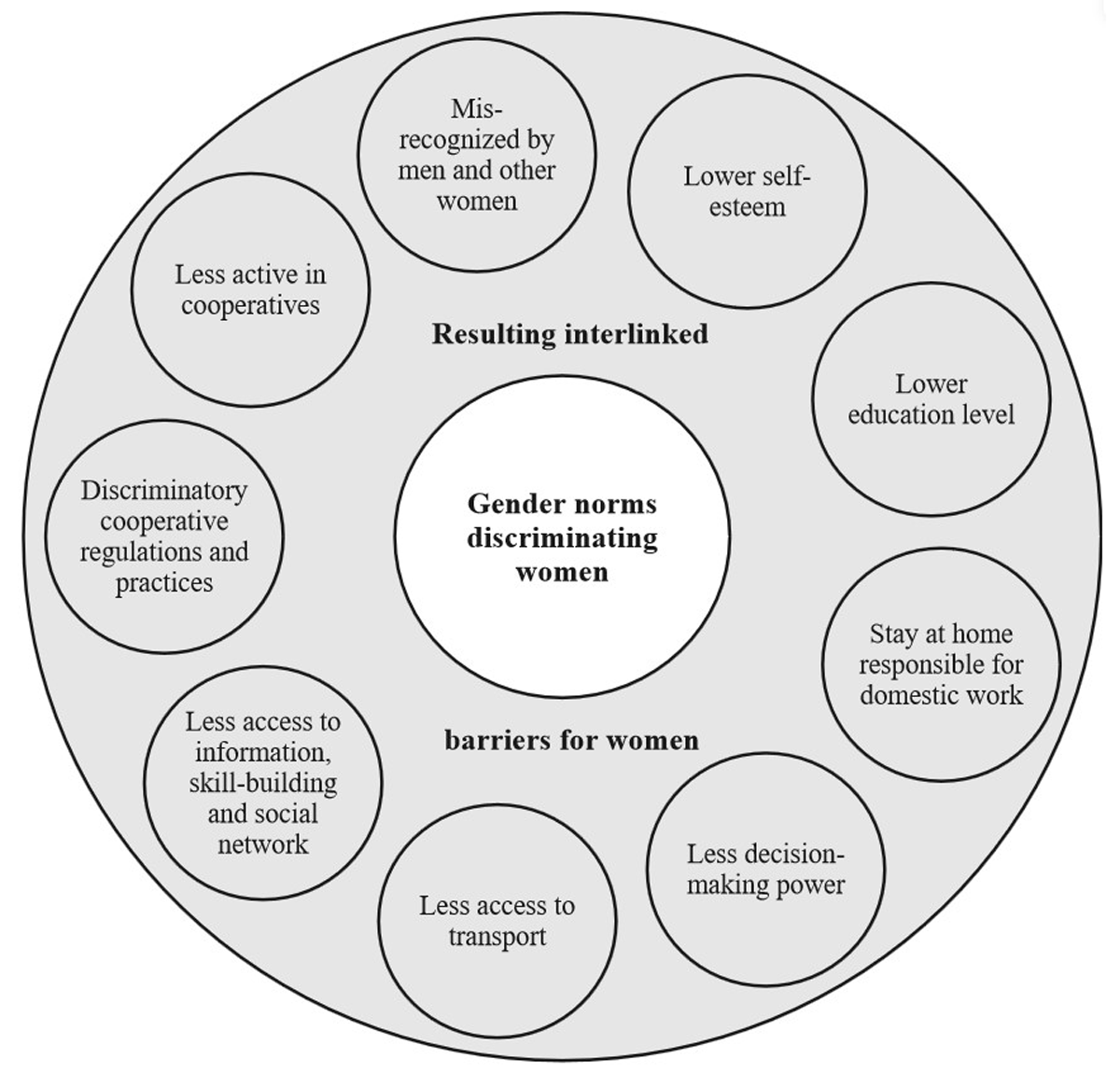
Figure 3
“Barriers to environmental justice for women in cacao growing regions. Source: Authors.”
Table 4
Strategies to improve environmental justice outcome for female stakeholders by cooperative/association.
| STRATEGY | EJ* | LEVELS** | COOP. 1 | COOP. 2 | COOP. 3 | COOP. 4 | COOP. 5 | ASSOC. 6 | |
|---|---|---|---|---|---|---|---|---|---|
| Training and awareness raising | |||||||||
| 1 | Workshops and other inputs about gender equality | D, P, R | 1, 2, 3 | ||||||
| 2 | Specific trainings/internships/projects specifically for women | D, P | 1, 2 | N/A | |||||
| 3 | Highlight the importance of gender equality and women’s participation during regular cooperative events | R | 1, 2, 3 | N/A | |||||
| 4 | Trainings that increase women’s understanding of general issues | D, P, R | 1, 2 | ||||||
| 5 | Special trainings for female employees of cooperatives | D | 1 | N/A | |||||
| 6 | Gender workshops/speeches for externals | D, P, R | 3 | ||||||
| Economic opportunities | |||||||||
| 7 | Create income opportunities for women in cacao value chain | D, P, R | 1, 2 (3) | ||||||
| 8 | Create income opportunities for women in other value chains/activities for self-consumption | D, P, R | (1) 2 | ||||||
| Communication | |||||||||
| 9 | Showcase women’s contribution in communications | R | 1 | ||||||
| 10 | Awareness raising during externally organized events | D, P, R | 3 | ||||||
| Participation | |||||||||
| 11 | Facilitate attendance and encourage the active participation of women in cooperative events | P, R | 1, 2 | N/A | |||||
| 12 | Send female representatives to external events | D, P, R | 1, 2 | ||||||
| Cooperative rules | |||||||||
| 13 | Transparent salary grid | D, P | 1 | N/A | |||||
| 14 | Institutionalized measures against sexual harassment within the cooperative | R, P | 1 | ||||||
| 15 | Gender equality as organizational culture (voice, treatment, invitation to events, leadership positions) | R (D, P) | 1 | N/A | |||||
| 16 | Health and death insurance | D | 2 | ||||||
| 17 | Establish quota for women in leadership positions | D, P, R | 1 | N/A | |||||
| 18 | Increase the rights for partners of official members | P | 2 | N/A | |||||
[i] Colors: White = strategy not implemented, Dark grey = strategy implemented, Bright grey = contradictory information.
*Environmental justice dimensions: D = Distributional justice, P = Procedural justice, R = Recognition.
**1 = Cooperative, 2 = Household/individual, 3 = Community.
Table 5
Indicators to assess environmental justice for women in community-based collective action.
| INDICATOR | DEFINITION | MEASUREMENT SCALE |
|---|---|---|
| Cooperative level: female cooperative members | ||
| Female cooperative members | Share of women among official cooperative members | Share |
| Women in leadership positions (social) | Share of women in leadership positions in social structure of cooperative | Share |
| Meeting and training attendance | Attendance of women in cooperative meetings and trainings | Frequency and quality of attendance, gender-disaggregated share of attendants |
| Quality of participation | Active participation and ability to influence collective choices | Degree |
| Cooperative level: female employees | ||
| Female employees | Share of women among cooperative employees | Share |
| Areas of work | Gender-disaggregated activities | Types of activities |
| Women in leadership positions (corporate) | Share of women in leadership positions in corporate structure of cooperative | Share |
| Salary | Gender-disaggregated salary schemes | Numerical |
| Household level | ||
| Allocation of tasks within household | Gender-disaggregated allocation of household tasks | Types of activities |
| Distribution of income and benefits from cooperative | Degree of (in)equality in income and in benefits from cooperative services | Degree |
| Decision-making power | Degree of (in)equality in decision-making power in household | Degree |
| Recognition within household | Recognition of persons, roles, and activities | Qualitative |
| Individual level | ||
| Self-esteem | Belief in one’s capabilities and worth | Qualitative |
| Mobility, exposure and recognition beyond community | Ability to travel, face exposure to different contexts and gain external recognition | Qualitative |
| Wider community level | ||
| Gendered roles | Degree of consistency of gendered roles in cooperative vis-à-vis wider community | Degree |
| Communal programs | Degree of cooperative programs open or for the wider community | Degree |
| Economic opportunities | Extent of jobs or other economic opportunities offered by a cooperative within its (rural) context | Numerical, types |